

Characterizing Bluesky Content Moderation Service: From Automation of Service to Landscape of Harms
Open accessThe DOI matches its DataCite record; 29 of the 29 references it cites were found in a registry or an index; none of the 34 sources its claims cite is checked for support yet.
Abstract
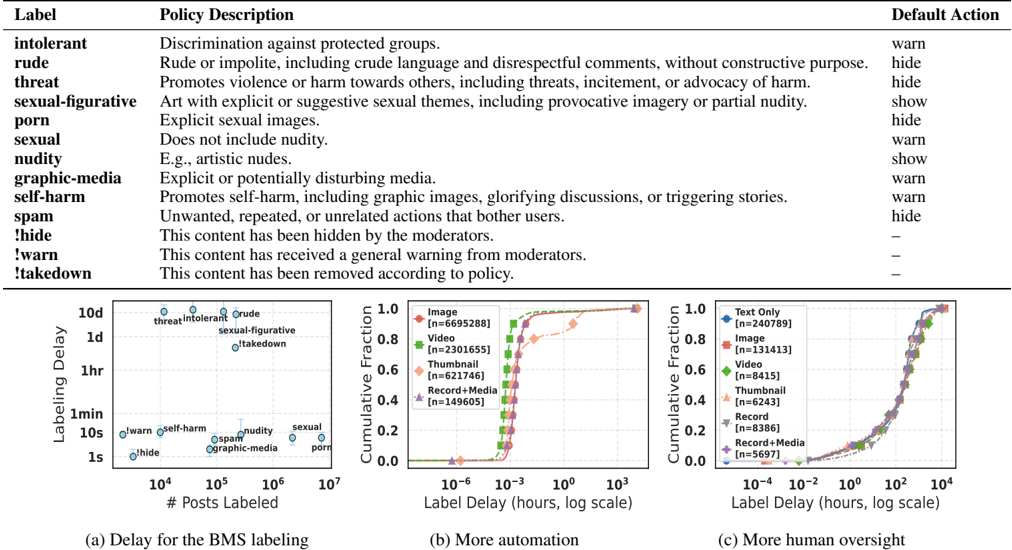
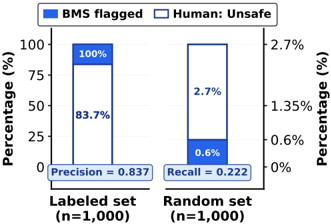
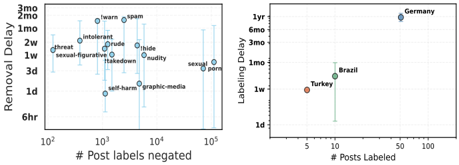
Empirical research on content moderation is fundamentally constrained by the opaque deployment of moderation systems on major social media platforms. To this end, the recent emergence of decentralized platforms with transparent, public moderation logs presents an unprecedented opportunity for independent audits. In this work, we leverage this architectural transparency to conduct the first large-scale audit of the default moderation system on Bluesky, the Bluesky Moderation Service (BMS). Analyzing its 10.6M moderation labels from 2025, we investigate three foundational aspects: (i) its mechanism (the degree of automation versus human oversight), (ii) its efficacy (accuracy in detecting harms), and (iii) its purpose (the landscape of harms it identifies). Our findings reveal a human-AI collaborative system where labels for sexual and graphic content are applied automatically in seconds, while nuanced and high stakes labels require more human oversight, taking hours or days. Through a manual annotation study, we find the BMS operates with high precision (0.837), but struggles with low recall (0.222), with our annotators identifying 4.5$\times$ more harmful content than the moderation system in a random sample. Finally, unsupervised clustering of the most frequently applied labeled posts uncovers detected harms ranging from hostility in discourse toward protected groups to the spread of sexually explicit and other graphic content. Our work offers a look into the operational realities of a deployed moderation system, providing a concrete data-driven foundation for designing more effective and transparent moderation systems.
Overview
CoChat Summary
TL;DR
The paper conducts the first large-scale audit of Bluesky’s default moderation service (BMS) using its public label stream, analyzing 10.6M post labels from 2025 to characterize automation, accuracy, and detected harms. It finds a human-AI system with high precision (0.837) but low recall (0.222), where automated labels act in seconds and human-oversight labels take hours to days.
Key findings
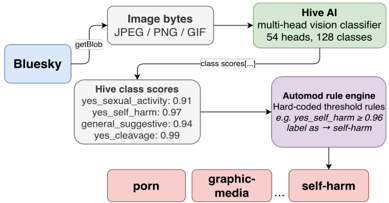
- RQ1: BMS is human-AI collaborative. Automated labels (e.g., porn, sexual, nudity, self-harm, graphic-media) are applied quickly—porn median 5.5 s (Table 3; abstract cites 7.1 s)—while human-oversight labels are slower—rude median 8.4 days, intolerant 13.0 days, threat 10.8 days.
- RQ2: On 1,000 labeled posts, annotators agreed with BMS in 83.7% (precision 0.837); automated-label precision 0.903, manual-label precision 0.755. On 1,000 random firehose posts, annotators flagged 27 unsafe, only 6 BMS-labeled, yielding recall 0.222; automated-label recall 0.600 (6/10), manual-label recall 0.
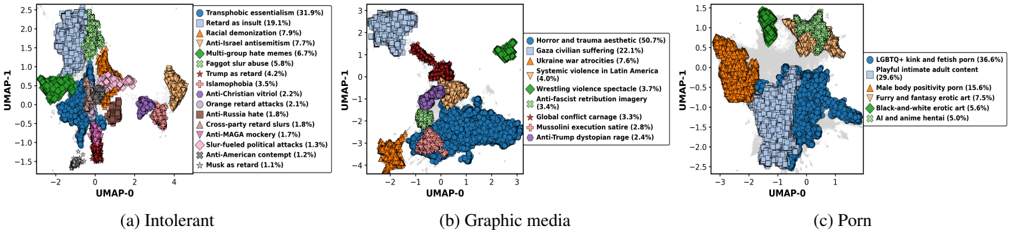
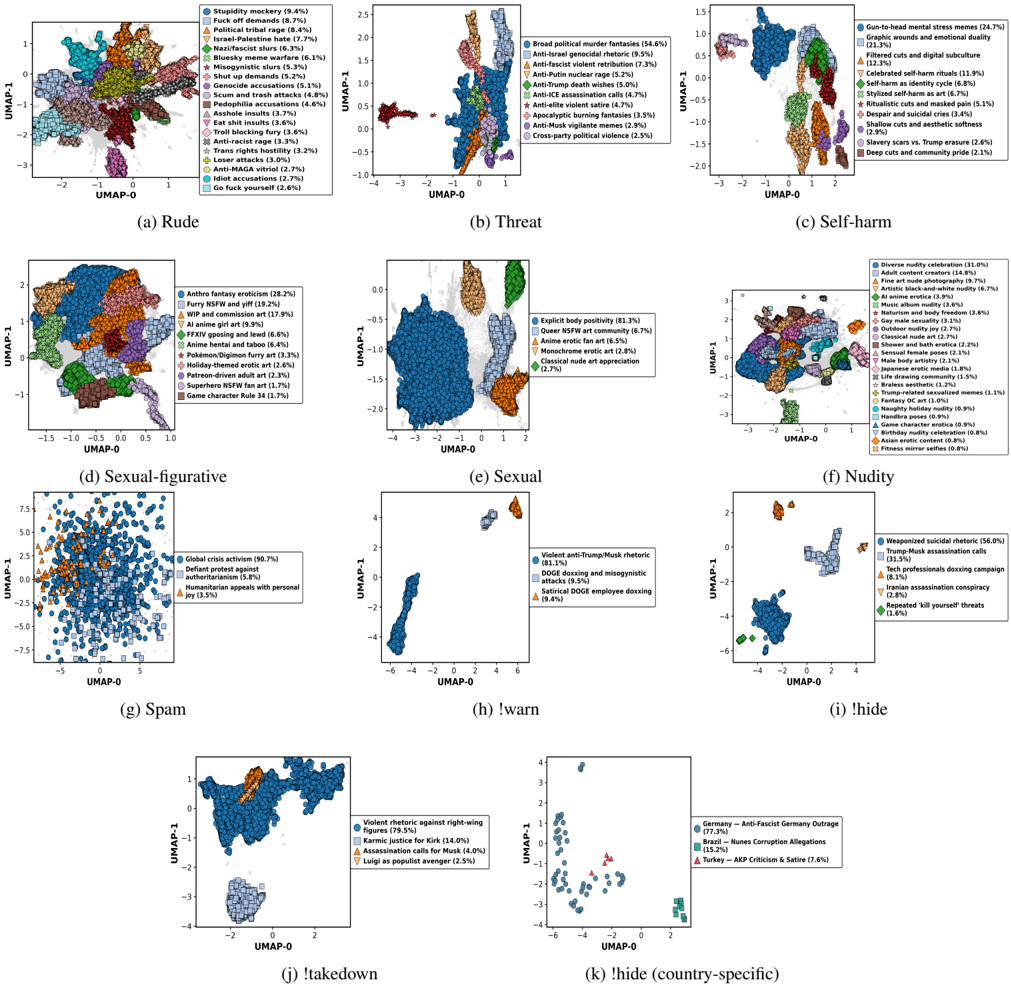
- RQ3: Unsupervised clustering of labeled posts reveals harms including hostility toward protected groups, sexually explicit/graphic content, and violent death wishes toward political leaders; the most taken-down posts contain violent death wishes to political leaders, and labels overlap across categories.
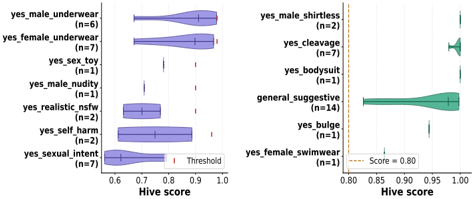
- RQ2 blindspots: Automod reproduced 311/336 (92.6%) labeled posts; among 336 semantically similar unlabeled posts, Automod flagged 47 (14.0%), and annotators judged 36 (10.7% of 336) unsafe, with failure modes H1 close-threshold misses (22, 61.1%) and H2 rule-set gaps (14, 38.9%).
Methods
- Data: collected BMS label stream for all of 2025 (18,343,953 labels total; 15,744,081 on posts; 2,418,534 accounts; 84,647 profiles; 96,691 other), retrieving post records for 10,681,824 post labels across 13 label values. Firehose collection March–Dec 2025 yielded 1.14B post records, 11.9M (~1%) BMS-labeled.
- RQ1 used labeling delay (createdAt to label cts) as proxy for automation vs human oversight, reporting medians/IQRs. RQ2 sampled 1,000 labeled posts stratified across nine harm categories for precision and 1,000 random firehose posts for recall; two coauthors annotated safe/unsafe with tiebreaker (Cohen’s κ=0.802). RQ3 used Qwen3-VL-Embedding-2B 2048-d multimodal embeddings, UMAP, HDBSCAN with Optuna/DBCV tuning, and Qwen3-VL-32B-Instruct map-reduce summarization; human validation of 31 clusters across 7 labels gave mean appropriateness 4.58 (SD 0.63), Krippendorff’s α=0.686.
- RQ2 blindspot experiment: 336 labeled single-image posts across five automated labels; nearest unlabeled firehose posts from 40M March–June 2025 sample via cosine similarity/faiss; passed through Automod/Hive API; 289 unflagged posts manually annotated (κ=0.63).
Limitations
- Stated: analysis is confined to BMS, not third-party labelers; labeling delay is a proxy; post-hoc media collection may miss posts taken down between moderation and collection, potentially skewing prevalence; focus is on label application, not downstream user behavior/content prevalence; spam records were largely not retrieved, limiting analysis; Hive API rate limit (100 requests/day) forced a smaller blindspot set; Automod code may not match current BMS rules.
- Stated/evident: annotation relied on coauthors and treated posts independently, lacking parent-thread context for replies; paper notes subjectivity and cultural thresholds, especially for rude/intolerant, and that many labeled intolerant/rude/threat posts are replies (79%, 97%, 85% respectively).
- Evident from text: recall estimate rests on a small random sample (27 unsafe posts, 6 BMS-labeled), and country-specific labelers lack specified labels/user choice, though the paper does not frame these as limitations.
Model-written summary. Check it against the paper before relying on it.
Integrity signals
Registry
Cites
Statistics
Figures
Verification
Claims the paper makes
0 Valid · 17 Not valid · 25 Not checked · 208 Own results and interpretations
A result the paper reports from its own data — it cites no other source for it, so there is none to check. The quote shows it is in the paper.
In the paper
“Our findings reveal a human-AI collaborative system where labels for sexual and graphic content are applied automatically in seconds, while nuanced and high stakes labels require more human oversight, taking hours or days.”
- Also stated in: § 1 Introduction · plain
“Whereas for more nuanced labels, it relies more on human oversight, incurring longer delays (e.g., median 8.4 days for rude label).”
§ Characterizing Bluesky Content Moderation Service: From Automation of Service to Landscape of Harms > Abstract
plainstates a cause- Asserted: passes — The authors put it forward as true.
- Checkable: passes — It can be checked against evidence.
- Load-bearing: passes — The paper’s conclusions depend on it.
- Based: passes — The paper gives a reason why it holds.
- Also stated in: § 1 Introduction · plain
A result the paper reports from its own data — it cites no other source for it, so there is none to check. The quote shows it is in the paper.
In the paper
“Our findings reveal a human-AI collaborative system where labels for sexual and graphic content are applied automatically in seconds, while nuanced and high stakes labels require more human oversight, taking hours or days.”
- Also stated in: § 1 Introduction · plain
“By using labeling delay as a proxy, our analyses show that the BMS labels sexual and graphic content quickly (e.g., median 7.1 seconds for porn label).”
§ Characterizing Bluesky Content Moderation Service: From Automation of Service to Landscape of Harms > Abstract
plain- Asserted: passes — The authors put it forward as true.
- Checkable: passes — It can be checked against evidence.
- Load-bearing: passes — The paper’s conclusions depend on it.
- Based: passes — The paper gives a reason why it holds.
- Also stated in: § 1 Introduction · plain
A result the paper reports from its own data — it cites no other source for it, so there is none to check. The quote shows it is in the paper.
In the paper
“Through a manual annotation study, we find the BMS operates with high precision (0.837), but struggles with low recall (0.222), with our annotators identifying 4.5× more harmful content than the moderation system in a random sample.”
- Also stated in: § 1 Introduction · plain
“While human annotators (coauthors) agree with 83.7% of all posts labeled by BMS in the set of 1000 labeled posts (precision 0.837), they flag 4.5× more posts to be harmful in the 1000 random posts (recall 0.222).”
§ Characterizing Bluesky Content Moderation Service: From Automation of Service to Landscape of Harms > Abstract
plain- Asserted: passes — The authors put it forward as true.
- Checkable: passes — It can be checked against evidence.
- Load-bearing: passes — The paper’s conclusions depend on it.
- Based: passes — The paper gives a reason why it holds.
- Also stated in: § 1 Introduction · plain
A result the paper reports from its own data — it cites no other source for it, so there is none to check. The quote shows it is in the paper.
In the paper
“Finally, unsupervised clustering of the most frequently applied labeled posts uncovers detected harms ranging from hostility in discourse toward protected groups to the spread of sexually explicit and other graphic content.”
- Also stated in: § 1 Introduction · plain
“By deploying unsupervised clustering on the labeled posts, we find several granular categories (within each label) of harmful content detected and moderated by BMS.”
§ Characterizing Bluesky Content Moderation Service: From Automation of Service to Landscape of Harms > Abstract
plain- Asserted: passes — The authors put it forward as true.
- Checkable: passes — It can be checked against evidence.
- Load-bearing: passes — The paper’s conclusions depend on it.
- Based: passes — The paper gives a reason why it holds.
- Also stated in: § 1 Introduction · plain
A result the paper reports from its own data — it cites no other source for it, so there is none to check. The quote shows it is in the paper.
In the paper
“Through a manual annotation study, we find the BMS operates with high precision (0.837), but struggles with low recall (0.222), with our annotators identifying 4.5× more harmful content than the moderation system in a random sample.”
- Also stated in: § 1 Introduction · plain
“While human annotators (coauthors) agree with 83.7% of all posts labeled by BMS in the set of 1000 labeled posts (precision 0.837), they flag 4.5× more posts to be harmful in the 1000 random posts (recall 0.222).”
§ Characterizing Bluesky Content Moderation Service: From Automation of Service to Landscape of Harms > Abstract
plain- Asserted: passes — The authors put it forward as true.
- Checkable: passes — It can be checked against evidence.
- Load-bearing: passes — The paper’s conclusions depend on it.
- Based: passes — The paper gives a reason why it holds.
- Also stated in: § 1 Introduction · plain
101 more claims
Create a free account to see all 250 claims and to verify the 22 references still open.
- Probably not a substantial claim. 75
- It may state two separate claims as one. 93
- The quote only partly states this claim. 5
Self-check
Percentages, sums and reported differences re-computed from the paper’s own numbers.
Each contradiction between two passages listed here was confirmed by an independent check.
Rated minor: it would not touch a result — a value no result rests on, a p-value that stays on the same side of the significance level, or a conflict that is clerical, resolved elsewhere in the paper, or outside its own findings.
In the paper
§ Characterizing Bluesky Content Moderation Service: From Automation of Service to Landscape of Harms > Abstract
“Analyzing its 10.6M moderation labels from 2025”
§ Characterizing Bluesky Content Moderation Service: From Automation of Service to Landscape of Harms > 3.3 Data Collection for Moderated Content
“Our subsequent analyses focus on this set of 10,681,824 post labels applied by the Bluesky Moderation Service (including country-specific services) covering 13 label values.”
Rated minor: it would not touch a result — a value no result rests on, a p-value that stays on the same side of the significance level, or a conflict that is clerical, resolved elsewhere in the paper, or outside its own findings.
In the paper
§ Characterizing Bluesky Content Moderation Service: From Automation of Service to Landscape of Harms > 3.3 Data Collection for Moderated Content
“English is the dominant language across all label categories, ranging from 49% (self-harm) to 97% (rude) of all posts.”
§ Characterizing Bluesky Content Moderation Service: From Automation of Service to Landscape of Harms > F Action Labeled Contents and Spam
“| !takedown | 214,079 | 1,409 | 8,931 | 1,946 | 420 | 1,691 | 199,682 | 195,252 (91%) | 18,827 (9%) no-lang (84%), en (14%), pt (0%) |”
Rated minor: it would not touch a result — a value no result rests on, a p-value that stays on the same side of the significance level, or a conflict that is clerical, resolved elsewhere in the paper, or outside its own findings.
In the paper
§ Characterizing Bluesky Content Moderation Service: From Automation of Service to Landscape of Harms > 1 Introduction
“e.g., median 7.1 seconds for porn label”
§ Characterizing Bluesky Content Moderation Service: From Automation of Service to Landscape of Harms > 4 RQ1: Automation and Human Oversight in the Bluesky Moderation Service
“the median labeling delay for porn was 5.5 s”
Citations
Cites
The Measurement of Observer Agreement for Categorical Data
Landis, J. R., & Koch, G. G. (1977) · Biometrics · doi:10.2307/2529310 · Cited by 81,148 · cited 1×
“686 , which falls within the substantial agreement range (Landis and Koch 1977).”
Larian Studios Dev Team (2024) · doi:10.1145/3292500.3330701 · Cited by 8,618
UMAP: Uniform Manifold Approximation and Projection for Dimension Reduction
McInnes, L., Healy, J., & Melville, J. (2018) · arXiv · doi:10.48550/arxiv.1802.03426 · Cited by 7,101 · cited 5×
“These embeddings are projected into a low-dimensional manifold using UMAP (McInnes, Healy, and Melville 2020) with cosine distance, then clustered using HDBSCAN (Campello, Moulavi, and Sander 2013).”
InfluentialDensity-Based Clustering Based on Hierarchical Density Estimates
Campello, R. J. G. B., Moulavi, D., & Sander, J. (2013) · Lecture Notes in Computer Science · doi:10.1007/978-3-642-37456-2_14 · Cited by 2,680 · cited 9×
“Based on these evaluations, n components = 5 was selected as a reasonable trade-off for dimensionality reduction, and this setting was used for subsequent HDBSCAN clustering.”
InfluentialGillespie, T. (2019) · doi:10.12987/9780300235029 · Cited by 806
Li, M., Zhang, Y., Long, D., Chen, K., Song, S., Bai, S., Yang, Z., Xie, P., Yang, A., Liu, D., et al. (2026) · arXiv · doi:10.48550/arxiv.2601.04720 · Cited by 393 · cited 3×
“We generate a 2048-dimensional embedding for each post using Qwen3-VL-Embedding-2B (Li et al. 2026), a vision-language model that jointly encodes text and media (images, video frames (R3-6)).”
InfluentialDensity-Based Clustering Validation
Moulavi, D., Jaskowiak, P. A., Campello, R. J. G. B., Zimek, A., & Sander, J. (2014) · Proceedings of the 2014 SIAM International Conference on Data Mining · doi:10.1137/1.9781611973440.96 · Cited by 275 · cited 2×
“…, min cluster size , min samples ) are jointly tuned per label via Bayesian optimization (Optuna TPE sampler (Akiba et al. 2019)), evaluated using the Density-Based Clustering Validation (DBCV) score (Moulavi et al. 2014), an intrinsic measure rewarding internally dense, well-separated clusters.”
Behind the Screen: Content Moderation in the Shadows of Social Media
Roberts, S. T. (2019) · Yale University Press eBooks · doi:10.12987/9780300245318 · Cited by 176
Challenges in the Decentralised Web: The Mastodon Case
Raman, A., Joglekar, S., Cristofaro, E. D., Sastry, N., & Tyson, G. (2019) · Proceedings of the Internet Measurement Conference · doi:10.1145/3355369.3355572 · Cited by 118 · cited 3×
“A new opportunity in this landscape arises from the emergence of decentralized platforms built on open protocols (Kleppmann et al. 2024; Raman et al. 2019; Bal-duf et al. 2024).”
Ma, R., & Kou, Y. (2022) · Proceedings of the ACM on Human-Computer Interaction · doi:10.1145/3555150 · Cited by 71
Research works printed but not linked: 2
- Akiba, T.; Sano, S.; Yanase, T.; Ohta, T.; and Koyama, M. 2019. Optuna: A Next-generation Hyperparameter Opti- mization Framework. In ACM SIGKDD.
- Cochran, W. 1977. Sampling Techniques. Wiley Series in Probability and Statistics. Wiley. ISBN 9780471162407.
Cited by
Majumdar, A., Paul, S., Singh, P., Abdelaziz, I., Jarollahi, S., Lee, S., Gummadi, K. P., Weber, I., & Dash, A. (2026) · arXiv · doi:10.48550/arxiv.2609.10410
“However, these automated systems often rely on brittle pattern-matching and rule-based models that fail to grasp the desired contextual nuances (Halevy et al., 2022; Bluesky, 2026; Singh et al., 2026).”
Self-citation
Metadata
- Authors
- Singh, P., Jarollahi, S., Majumdar, A., Pahari, V., Chakraborty, A., Gummadi, K. P., Weber, I., & Dash, A.
- Affiliations
- Max Planck Institute for Software Systems (DE)
- Saarland University (DE)
- Indian Institute of Technology Kharagpur (IN)
- Venue
- arXiv
- Publisher
- arXiv
- Published
- 2026
- ISSN
- 2331-8422 (ISSN-L)
- arXiv
- 2609.11373
- OpenAlex
- W7212230490
- Cited by
- 1
- References
- 29
- Citations by year
- 2026: 1
- Type
- posted content
- Language
- en
- Open access
- green
- arxiv.org
- Licence
- Locations
- arXiv (submittedVersion, cc-by-sa)
- Funders
- Alexander von Humboldt-Stiftung
- Bundesministerium für Forschung, Technologie und Raumfahrt
- Max-Planck-Gesellschaft
- Topics
- Physical Sciences › Computer Science › Artificial Intelligence › Hate Speech and Cyberbullying Detection
- Physical Sciences › Computer Science › Artificial Intelligence › Ethics and Social Impacts of AI
- Social Sciences › Sociology and Political Science › Misinformation and Its Impacts
- Keywords
- content moderation, Bluesky, human-AI collaboration, sexual content, graphic content
About these checks
Registry, retraction, Cites and statistics results are computed, not judged, with one exception: a printed reference that no index lists is read once by a model before it counts as a citation error. Claims are extracted by a model and kept only when their quote appears verbatim in the text; each cited source is then checked, with a model’s help, for whether it says what the claim relies on. Those verdicts can be wrong — read the claim’s quote and the cited source before relying on one.
A language model drew the claims from the paper on 2026-11-29, under version 3 of the claim definition (model deepseek-v4.1-flash, prompt extract-v3).
A second model labelled each claim on 2026-11-29 (model jev-1.13-20260917, definition revision gold-guideline-v0.2).
Statistics and arithmetic are recomputed, not judged.
Confidence bands are shown only for fields calibrated on our annotated test set. None is calibrated yet, so no band is shown.
What counts as a claim ›How we measure confidence ›How we check this ›
Are you an author, or do you see a problem with this page? Request a review
Data sources
Bibliographic data: Semantic Scholar, OpenAlex, Crossref.
Contains information from the Semantic Scholar Academic Graph Datasets, made available under the ODC Attribution License (ODC-BY 1.0).
Semantic Scholar’s data is described in: Kinney, R., et al. (2023). The Semantic Scholar Open Data Platform. arXiv:2301.10140.
