

Strategies to Improve Persistent Adherence in Colorectal Cancer Screening
Open accessThe DOI matches its Crossref record; 33 of the 33 references it cites were found in a registry or an index.
Abstract
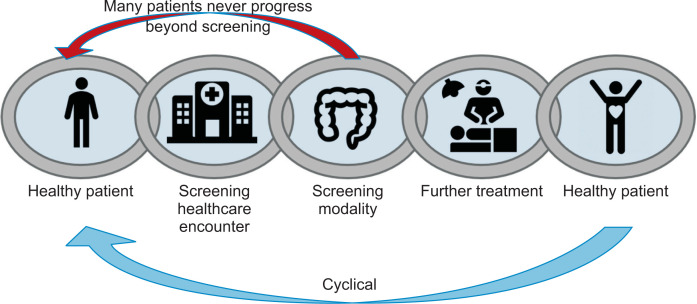
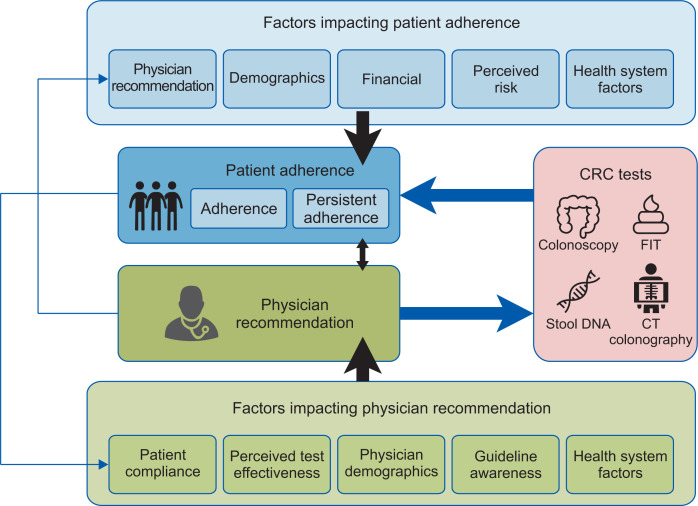
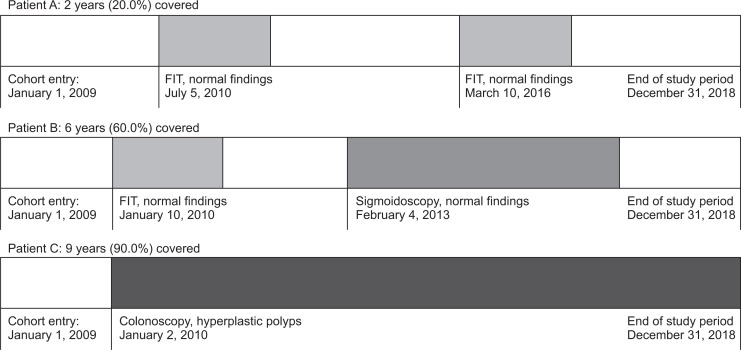
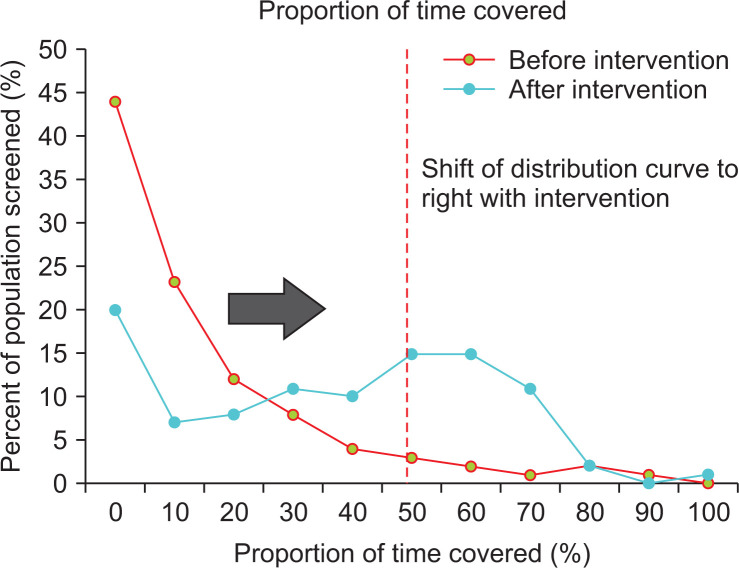
Colorectal cancer is a major cause of morbidity and mortality, and screening has been shown to reduce morbidity and mortality. This review highlights pertinent aspects of adherence to screening including the various options available and key concepts to consider in any systematic program. Persistent adherence, which is key to an efficacious screening program, is the compliance with repeated screening tests over a period of time. A "chain of survival" mindset emphasizes the stepwise, sequential and persistent approach to screening and is a helpful concept to drive the message of persistent adherence. A framework for the patient and physician interactions that support screening intervention is examined, and various factors that impact both patient and physician adoption and screening modality recommendations are reviewed. While systems-based approaches to screening have great utility in automation and monitoring in a surveillance program, some emerging data suggests that the human touch is still an essential driver for active participation in these programs. Finally, the proportion of time concept is discussed as a useful index for monitoring persistent adherence in both individuals and populations.
Overview
The claims and statistics of this paper haven’t been checked yet.
Free: it reads the open-access text and checks the first 5 claims that cite a source we can check. Create a free account to check every claim.
Integrity signals
Registry
Cites
Statistics
Figures
Verification
Claims the paper makes
The claims and statistics of this paper haven’t been checked yet.
Free: it reads the open-access text and checks the first 5 claims that cite a source we can check. Create a free account to check every claim.
Claims other papers make about this one
Each is checked against this paper’s own text: does it say what the citing paper says it does?
The cited source says what the claim attributes to it.
In the citing paper
“In the Asia-Pacific region, adherence to CRC screening also varies significantly and is 21.0% in South Korea and 62.9% in Thailand[53,54].”
From Risk factors, prevention and screening of colorectal cancer: A rising problem (2025) · cites this paper as [53]
Self-check
Percentages, sums and reported differences re-computed from the paper’s own numbers.
The self-check needs the paper’s full text.
Citations
Cites
Siegel, R. L., Miller, K. D., & Jemal, A. (2016) · CA: A Cancer Journal for Clinicians · doi:10.3322/caac.21332 · Cited by 16,003
International Agency for Research on Cancer (IARC)
(2018) · The Grants Register 2018 · doi:10.1007/978-1-349-94186-5_629 · Cited by 2,801
Detection and localization of surgically resectable cancers with a multi-analyte blood test
Cohen, J. D., Li, L., Wang, Y., Thoburn, C., Afsari, B., Danilova, L., Douville, C., Javed, A. A., Wong, F., Mattox, A., et al. (2018) · Science · doi:10.1126/science.aar3247 · Cited by 2,783
Screening for Colorectal Cancer: US Preventive Services Task Force Recommendation Statement
US Preventive Services Task Force, Bibbins-Domingo, K., Grossman, D. C., Curry, S. J., Davidson, K. W., Epling, J. W., García, F. A. R., Gillman, M. W., Harper, D. M., Kemper, A. R., et al. (2016) · JAMA · doi:10.1001/jama.2016.5989 · Cited by 2,509
Wolf, A. M. D., Fontham, E. T. H., Church, T. R., Flowers, C. R., Guerra, C. E., LaMonte, S. J., Etzioni, R., McKenna, M. T., Oeffinger, K. C., Shih, Y. T., et al. (2018) · CA: A Cancer Journal for Clinicians · doi:10.3322/caac.21457 · Cited by 1,944 · cited 1×
“Persistent adherence is the compliance to repeated screening tests over a period of time, and is generally harder to measure, given that various CRC screening modalities have different recommended intervals for repeat screening and surveillance.(11) It is persistent adherence, rather than once-off adherence to a CRC s…”
BackgroundAtkin, W. S., Edwards, R., Kralj-Hans, I., Wooldrage, K., Hart, A. R., Northover, J. M., Parkin, D. M., Wardle, J., Duffy, S. W., & Cuzick, J. (2010) · The Lancet · doi:10.1016/s0140-6736(10)60551-x · Cited by 1,623
Cummins, R. O., Ornato, J. P., Thies, W. H., & Pepe, P. E. (1991) · Circulation · doi:10.1161/01.cir.83.5.1832 · Cited by 1,521
Colorectal-Cancer Incidence and Mortality with Screening Flexible Sigmoidoscopy
Schoen, R. E., Pinsky, P. F., Weissfeld, J. L., Yokochi, L. A., Church, T., Laiyemo, A. O., Bresalier, R., Andriole, G. L., Buys, S. S., Crawford, E. D., et al. (2012) · New England Journal of Medicine · doi:10.1056/nejmoa1114635 · Cited by 1,021
Colorectal cancer population screening programs worldwide in 2016: An update
Navarro, M., Nicolas, A., Ferrandez, A., & Lanas, A. (2017) · World Journal of Gastroenterology · doi:10.3748/wjg.v23.i20.3632 · Cited by 611
Global trends in colorectal cancer mortality: projections to the year 2035
Araghi, M., Soerjomataram, I., Jenkins, M., Brierley, J., Morris, E., Bray, F., & Arnold, M. (2019) · International Journal of Cancer · doi:10.1002/ijc.32055 · Cited by 556 · cited 1×
“It is the third most common cancer diagnosed and the fourth cause of cancerrelated deaths worldwide.(1) According to the International Agency for Research on Cancer, there were 1,849,518 new cases and 880,792 cancer deaths in 2018.”
Background
Cited by
Engineering tumor-colonizing E. coli Nissle 1917 for detection and treatment of colorectal neoplasia
Gurbatri, C. R., Radford, G. A., Vrbanac, L., Im, J., Thomas, E. M., Coker, C., Taylor, S. R., Jang, Y., Sivan, A., Rhee, K., et al. (2024) · Nature Communications · doi:10.1038/s41467-024-44776-4 · Cited by 199
Why is early detection of colon cancer still not possible in 2023?
Tonini, V., & Zanni, M. (2024) · World Journal of Gastroenterology · doi:10.3748/wjg.v30.i3.211 · Cited by 69
“Adherence rates are no better in Asia-Pacific countries, ranging from 21.0% in South Korea to 62.9% in Thailand[66,67].”
InfluentialRisk factors, prevention and screening of colorectal cancer: A rising problem
Tsukanov, V. V., Vasyutin, A. V., & Tonkikh, J. L. (2025) · World Journal of Gastroenterology · doi:10.3748/wjg.v31.i5.98629 · Cited by 42
Different impacts of cancer types on cancer screening during COVID-19 pandemic in Taiwan
Shen, C.-T., Hsieh, H., Chang, Y., Tsai, H., & Chen, F. (2022) · Journal of the Formosan Medical Association · doi:10.1016/j.jfma.2022.02.006 · Cited by 19
“(2020) reported that there were several factors associated with adherence in the cancer screening including patient demographics and financial status, physicians’ attitudes, and even health care system interaction.(24) In Taiwan, financial issue was not the barrier because the Health Promotion Administration covered f…”
Astolfi, M., Rispoli, G., Zonta, G., Anania, G., & Malagu', C. (2023) · Cancers · doi:10.3390/cancers15061797 · Cited by 13
“On this basis, the research for specific CRC biomarkers and for an innovative method to detect them with low invasiveness is crucial to raise the patient adherence to oncological screening and monitoring programs [12].”
Background
Metadata
- Authors
- Kew, G. S., & Koh, C. J.
- Affiliations
- National University Hospital (SG)
- National University of Singapore (SG)
- Corresponding author
- Koh, Calvin Jianyi
- Venue
- Gut and Liver
- Published
- 2020-09-15
- Volume
- 14
- Issue
- 5
- Pages
- 546-552
- ISSN
- 1976-2283 (ISSN-L)
- 2005-1212
- PMC
- PMC7492491
- OpenAlex
- W2995219090
- Semantic Scholar
- 52987b0781b0f01a09ee3268702d42705deea0f8
- Cited by
- 21
- References
- 33
- Citations by year
- 2026: 4 · 2025: 3 · 2024: 10 · 2023: 2 · 2022: 2
- FWCI
- 0.05
- Type
- journal article
- Language
- en
- Open access
- diamond
- doi.org
- Licence
- cc-by-nc
- creativecommons.org/licenses/by-nc/4.0 (tdm)
- Locations
- Gut and Liver (publishedVersion, cc-by-nc)
- PubMed Central (publishedVersion, cc-by-nc)
- PubMed (publishedVersion)
- National University of Singapore (submittedVersion, cc-by-nc)
- DOAJ (DOAJ: Directory of Open Access Journals) (submittedVersion)
- Topics
- Health Sciences › Medicine › Oncology › Colorectal Cancer Screening and Detection
- Health Sciences › Medicine › Oncology › Global Cancer Incidence and Screening
- Health Sciences › Medicine › Oncology › Colorectal Cancer Surgical Treatments
- Keywords
- colorectal cancer screening, chain of survival, patient-physician interaction, screening program design
- MeSH terms
- Humans, Mass Screening, Patient Compliance, Colorectal Neoplasms, Early Detection of Cancer
About these checks
Registry, retraction, Cites and statistics results are computed, not judged, with one exception: a printed reference that no index lists is read once by a model before it counts as a citation error. Claims are extracted by a model and kept only when their quote appears verbatim in the text; each cited source is then checked, with a model’s help, for whether it says what the claim relies on. Those verdicts can be wrong — read the claim’s quote and the cited source before relying on one.
Statistics and arithmetic are recomputed, not judged.
Confidence bands are shown only for fields calibrated on our annotated test set. None is calibrated yet, so no band is shown.
What counts as a claim ›How we measure confidence ›How we check this ›
Are you an author, or do you see a problem with this page? Request a review
Data sources
Bibliographic data: Semantic Scholar, OpenAlex, Crossref.
Contains information from the Semantic Scholar Academic Graph Datasets, made available under the ODC Attribution License (ODC-BY 1.0).
Semantic Scholar’s data is described in: Kinney, R., et al. (2023). The Semantic Scholar Open Data Platform. arXiv:2301.10140.
