

The DOI matches its Crossref record; 1 of the 1 references it cites were found in a registry or an index.
Endoplasmic reticulum stress links psoriasis vulgaris with keratinocyte inflammation
Open accessAbstract
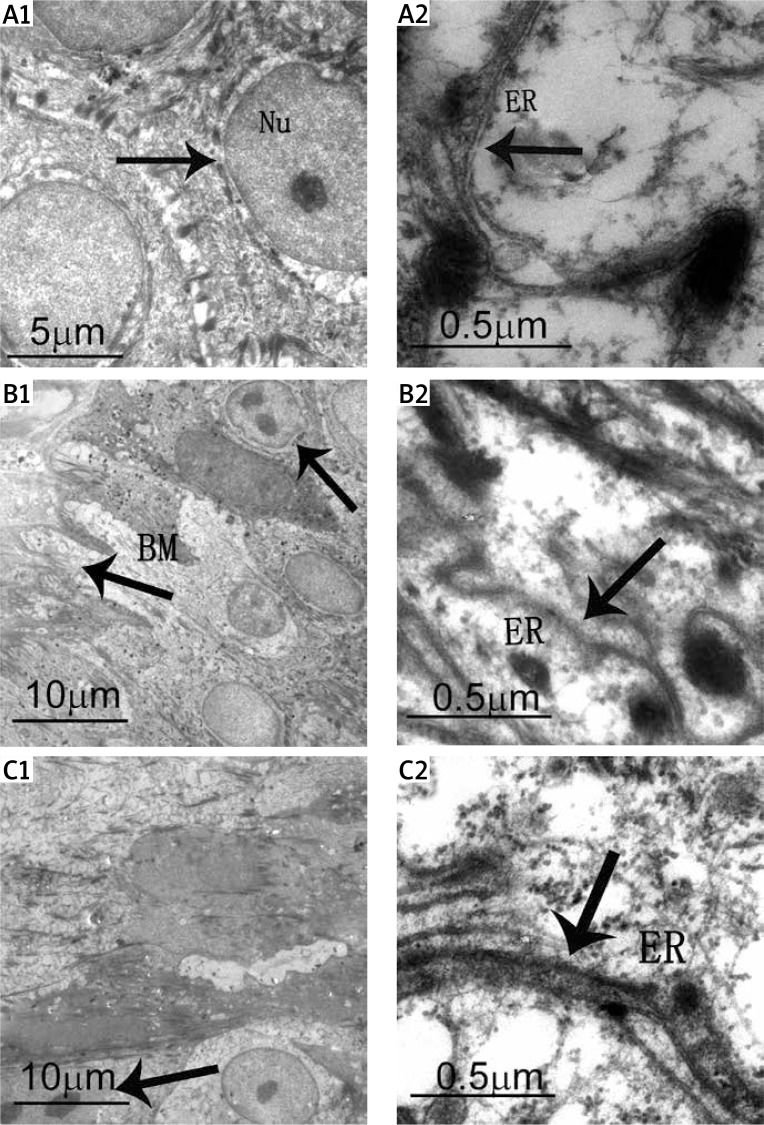
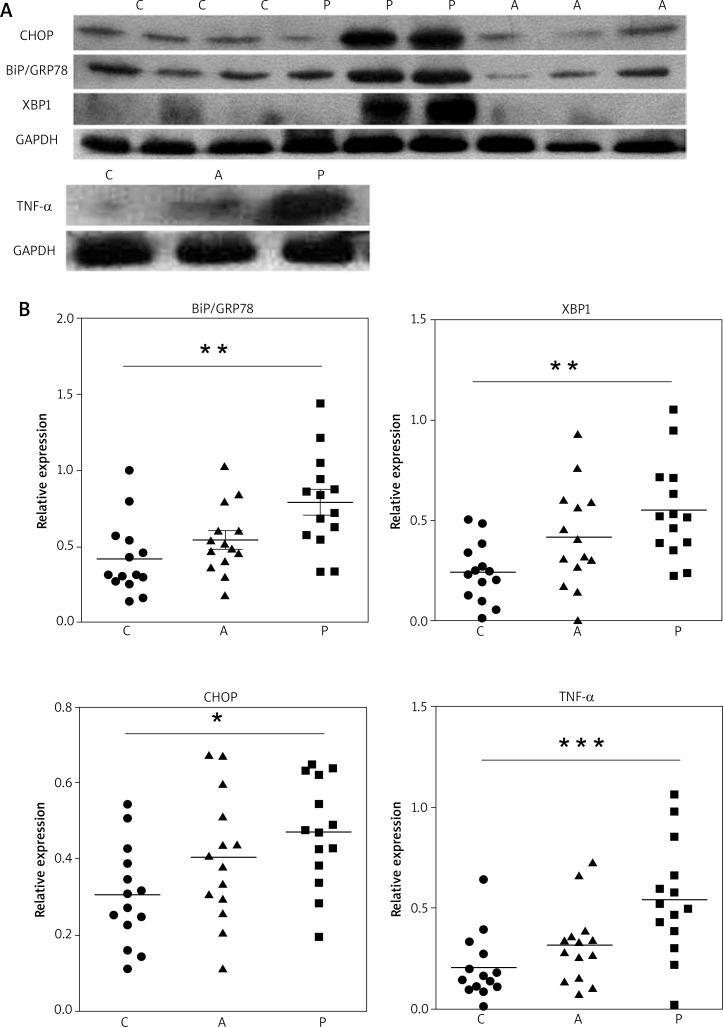
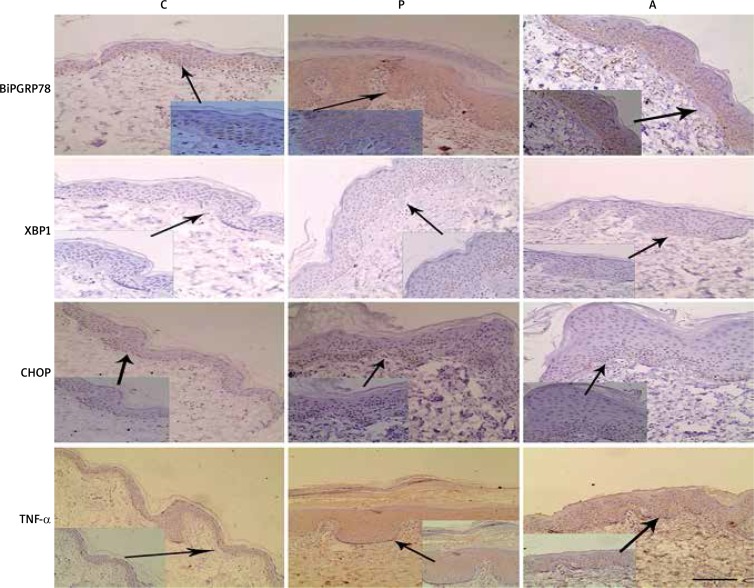
INTRODUCTION: Endoplasmic reticulum stress (ERS) has been implicated in the pathogenesis of various inflammatory diseases. However, the role of ERS in psoriasis is still unclear. AIM: To examine ERS in psoriasis keratinocytes and to assess the association of ERS with skin inflammation response. MATERIAL AND METHODS: We investigated ERS in keratinocytes of normal skin, lesional and perilesional psoriasis vulgaris (PV) skin tissues using transmission electron microscope (TEM) examination, Western blot and immunostaining analysis. RESULTS: By TEM examination, we found that endoplasmic reticulum (ER) in psoriatic keratinocytes was ultrastructurally abnormal, with changes in ER morphology and the ER expansion. Using Western blot and immunostaining analysis, we showed that the expression of ERS-associated proteins, such as BiP, CHOP and XBP1, was enhanced in PV epidermis compared to the healthy skin. Moreover, abundant TNF-α protein was correlated to the increased BiP, CHOP and XBP1 expression in PV epidermis. CONCLUSIONS: Our findings demonstrate that PV keratinocytes have an increased ERS, which may contribute to the pathogenesis of PV.
Overview
The claims and statistics of this paper haven’t been checked yet.
Run the check — free, no account needed. It reads the open-access text and checks the sources it cites.
Integrity signals
Registry
Cites
Statistics
Figures
Verification
Claims the paper makes
The claims and statistics of this paper haven’t been checked yet.
Run the check — free, no account needed. It reads the open-access text and checks the sources it cites.
Claims other papers make about this one
Each is checked against this paper’s own text: does it say what the citing paper says it does?
The cited source says what the claim attributes to it.
In the citing paper
“this finding is consistent with the alleviation of psoriasis vulgaris, also biologically characterized by UPR [455,456].”
From GANAB and N-Glycans Substrates Are Relevant in Human Physiology, Polycystic Pathology and Multiple Sclerosis: A Review (2022) · cites this paper as [456]
Self-check
Percentages, sums and reported differences re-computed from the paper’s own numbers.
The self-check needs the paper’s full text.
Citations
Cites
Li, Y., Schwabe, R. F., DeVries-Seimon, T., Yao, P. M., Gerbod-Giannone, M.-C., Tall, A. R., Davis, R. J., Flavell, R., Brenner, D. A., & Tabas, I. (2005) · Journal of Biological Chemistry · doi:10.1074/jbc.m501759200 · Cited by 421
Research works printed but not linked: 24
- [1]Parisi R Symmons DPM Griffiths CEM Ashcroft DM Global epidemiology of psoriasis: a systematic review of incidence and prevalence J Investig Dermatol 2013 133 377 85 23014338
- [2]Griffiths CE Barker JN Pathogenesis and clinical features of psoriasis Lancet 2007 370 263 71 17658397
- [3]Ayala-Fontanez N Soler DC McCormick TS Current knowledge on psoriasis and autoimmune diseases Psoriasis (Auckl) 2016 6 7 32 29387591 PMC5683130
- [4]Hawkes JE Chan TC Krueger JG Psoriasis pathogenesis and the development of novel targeted immune therapies J Allergy Clin Immunol 2017 140 645 53 28887948 PMC5600287
- [5]Nickoloff BJ Xin H Nestle FO Qin JZ The cytokine and chemokine network in psoriasis Clin Dermatol 2007 25 568 73 18021894
- [6]Lowes MA Suarez-Farinas M Krueger JG Immunology of psoriasis Ann Rev Immunol 2014 32 227 55 24655295 PMC4229247
- [7]Kumari S Bonnet MC Ulvmar MH Tumor necrosis factor receptor signaling in keratinocytes triggers interleukin-24-dependent psoriasis-like skin inflammation in mice Immunity 2013 39 899 911 24211183
- [8]Ron D Walter P Signal integration in the endoplasmic reticulum unfolded protein response Nature Rev Mol Cell Biol 2007 8 519 29 17565364
- [9]Todd DJ Lee AH Glimcher LH The endoplasmic reticulum stress response in immunity and autoimmunity Nat Rev Immunol 2008 8 663 74 18670423
- [10]Hotamisligil GS Endoplasmic reticulum stress and the inflammatory basis of metabolic disease Cell 2010 140 900 17 20303879 PMC2887297
- [11]Tabas I The role of endoplasmic reticulum stress in the progression of atherosclerosis Circ Res 2010 107 839 50 20884885 PMC2951143
- [12]Baban B Liu JY Mozaffari MS Endoplasmic reticulum stress response and inflammatory cytokines in type 2 diabetic nephropathy: role of indoleamine 2,3-dioxygenase and programmed death-1 Exp Mol Pathol 2013 94 343 51 23219834
- [13]Zhang K Kaufman RJ From endoplasmic-reticulum stress to the inflammatory response Nature 2008 454 455 62 18650916 PMC2727659
- [14]Samali A Fitzgerald U Deegan S Gupta S Methods for monitoring endoplasmic reticulum stress and the unfolded protein response Int J Cell Biol 2010 2010 830307 20169136 PMC2821749
- [15]Botti E Spallone G Caruso R Psoriasis, from pathogenesis to therapeutic strategies: IL-21 as a novel potential therapeutic target Curr Pharm Biotechnol 2012 13 1861 7 22250707
- [16]Mease PJ Inhibition of interleukin-17, interleukin-23 and the TH17 cell pathway in the treatment of psoriatic arthritis and psoriasis Curr Opin Rheumatol 2015 27 127 33 25599143
- [17]Nickoloff BJ Wrone-Smith T Injection of pre-psoriatic skin with CD4+ T cells induces psoriasis Am J Pathol 1999 155 145 58 10393847 PMC1866658
- [18]Shimoura N Nagai H Fujiwara S Exacerbation and prolongation of psoriasiform inflammation in diabetic obese mice: a synergistic role of CXCL5 and endoplasmic reticulum stress J Investig Dermatol 2018 138 854 63 29111234
- [19]Sugiura K Muro Y Futamura K The unfolded protein response is activated in differentiating epidermal keratinocytes J Investig Dermatol 2009 129 2126 35 19282840
- [21]Luo Y Li SJ Yang J HMGB1 induces an inflammatory response in endothelial cells via the RAGE-dependent endoplasmic reticulum stress pathway Biochem Biophys Res Commun 2013 438 732 8 23911608
- [22]Zhang K Shen X Wu J Endoplasmic reticulum stress activates cleavage of CREBH to induce a systemic inflammatory response Cell 2006 124 587 99 16469704
- [23]Deng J Lu PD Zhang Y Translational repression mediates activation of nuclear factor kappa B by phosphorylated translation initiation factor 2 Mol Cell Biol 2004 24 10161 8 15542827 PMC529034
- [24]Hu P Han Z Couvillon AD Autocrine tumor necrosis factor alpha links endoplasmic reticulum stress to the membrane death receptor pathway through IRE1alpha-mediated NF-kappaB activation and down-regulation of TRAF2 expression Mol Cell Biol 2006 26 3071 84 16581782 PMC1446932
- [25]Yamazaki H Hiramatsu N Hayakawa K Activation of the Akt-NF-kappaB pathway by subtilase cytotoxin through the ATF6 branch of the unfolded protein response J Immunol 2009 183 1480 7 19561103 PMC2762936
Cited by
Sorted by citations
De Masi, R., & Orlando, S. (2022) · International Journal of Molecular Sciences · doi:10.3390/ijms23137373 · Cited by 20
“In addition, this finding is consistent with the alleviation of psoriasis vulgaris, also biologically characterized by UPR [455,456].”
Result
Metadata
- Authors
- Zhao, M., Luo, J., Xiao, B., Tang, H., Song, F., Ding, X., & Yang, G.
- Affiliations
- Southern Medical University Shenzhen Hospital (CN)
- University of Cologne (DE)
- Corresponding author
- Ding, Xiaolei
- Venue
- Advances in Dermatology and Allergology
- Publisher
- Termedia Sp. z.o.o.
- Published
- 2020
- Volume
- 37
- Issue
- 1
- Pages
- 34-40
- ISSN
- 0860-6218 (ISSN-L)
- 1642-395X
- PMC
- PMC7247056
- OpenAlex
- W3013262169
- Cited by
- 18
- References
- 1
- Citations by year
- 2026: 6 · 2025: 3 · 2024: 3 · 2023: 3 · 2022: 2 · 2021: 1
- FWCI
- 0.53
- Type
- journal article
- Language
- en
- Open access
- gold
- doi.org
- Locations
- Advances in Dermatology and Allergology (publishedVersion)
- PubMed Central (publishedVersion, cc-by-nc-sa)
- PubMed (publishedVersion)
- Kölner Universitäts PublikationsServer (Universität zu Köln) (publishedVersion)
- DOAJ (DOAJ: Directory of Open Access Journals) (submittedVersion, cc-by-sa)
- Funders
- Chinese Academy of Sciences
- Topics
- Life Sciences › Immunology and Microbiology › Immunology › Psoriasis: Treatment and Pathogenesis
- Life Sciences › Biochemistry, Genetics and Molecular Biology › Cell Biology › Endoplasmic Reticulum Stress and Disease
- Health Sciences › Medicine › Dermatology › Dermatology and Skin Diseases
- Keywords
- endoplasmic reticulum stress, plaque psoriasis, keratinocytes, skin inflammation, BiP, CHOP, XBP1, TNF-α, endoplasmic reticulum ultrastructure, perilesional skin, psoriatic epidermis
About these checks
Registry, retraction, Cites and statistics results are computed, not judged, with one exception: a printed reference that no index lists is read once by a model before it counts as a citation error. Claims are extracted by a model and kept only when their quote appears verbatim in the text; each cited source is then checked, with a model’s help, for whether it says what the claim relies on. Those verdicts can be wrong — read the claim’s quote and the cited source before relying on one.
Statistics and arithmetic are recomputed, not judged.
Confidence bands are shown only for fields calibrated on our annotated test set. None is calibrated yet, so no band is shown.
What counts as a claim ›How we measure confidence ›How we check this ›
Are you an author, or do you see a problem with this page? Request a review
How to cite
Cite CoChat for the checks on this page, and the paper for its own findings.
- This page
- CoChat. (2026). Citation check: Endoplasmic reticulum stress links psoriasis vulgaris with keratinocyte inflammation. https://app.cochat.ai/papers/10.5114/ada.2020.93382
- The paper
- Zhao, M., Luo, J., Xiao, B., Tang, H., Song, F., Ding, X., & Yang, G. (2020). Endoplasmic reticulum stress links psoriasis vulgaris with keratinocyte inflammation. Advances in Dermatology and Allergology. https://doi.org/10.5114/ada.2020.93382
