

The DOI matches its Crossref record; 34 of the 34 references it cites were found in a registry or an index.
The efficacy of a discontinuous graded exercise test in measuring peak oxygen uptake in children aged 8 to 10 years
Abstract
As children's natural activity patterns are highly intermittent in nature, and characterised by rapid changes from rest to vigorous physical activity, discontinuous exercise tests may be considered ecologically valid for this population group.This study compared the peak physiological responses from a discontinuous and continuous graded exercise test (GXT_D, GXT_C, respectively) during treadmill exercise in children.Twentyone healthy children (9.6 ± 0.6 y) completed GXT_D and GXT_C in a randomised order, separated by 72-hours.Following each GXT, and after a 15-minute recovery, participants completed a verification test at 105% of the velocity attained at peak oxygen consumption (VO 2 peak).There were no differences in VO 2 peak (55.3 ± 8.2 cf.54.4 ± 7.6 mL•kg -1 •min -1 ) or maximal heart rate (202 ± 10 cf.204 ± 8 b•min -1 ) between GXT_C and GXT_D, respectively (P>.05).Peak running speed (10.7 ± 0.9 cf.12.1 ± 1.3 km•h -1 ) and respiratory exchange ratio (1.04 ± 0.05 cf.0.92 ± 0.05) were however different between tests (P<.001).Although similar peak physiological values were revealed between GXT_C and the corresponding verification test (P>.05),VO 2 peak (53.3 ± 7.3 mL•kg -1 •min -1 ) and heart rate (197 ± 13 b•min -1 ) were significantly lower in the GXT_D verification test (P<.05).In conclusion, a discontinuous GXT is an accurate measure of VO 2 peak in children aged 8 to 10 years and may be a valid alternative to a continuous GXT, despite its longer duration.
Overview
The claims and statistics of this paper haven’t been checked yet.
Run the check — free, no account needed. It reads the open-access text and checks the sources it cites.
Integrity signals
Registry
Cites
Statistics
Figures
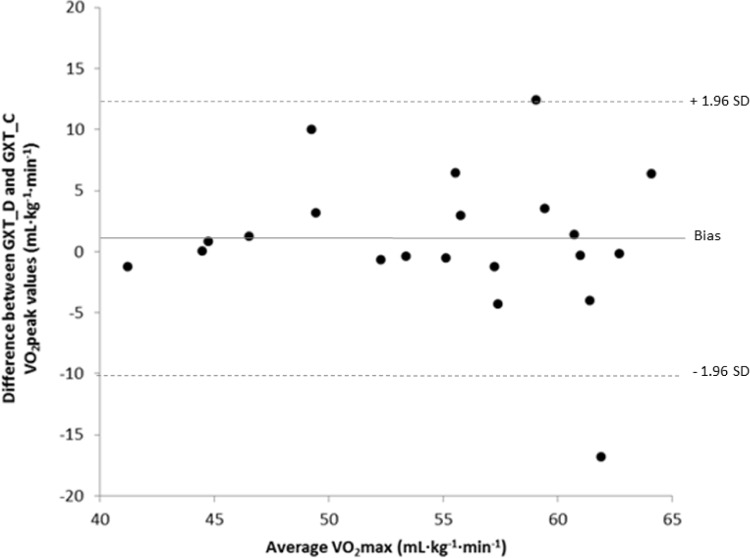
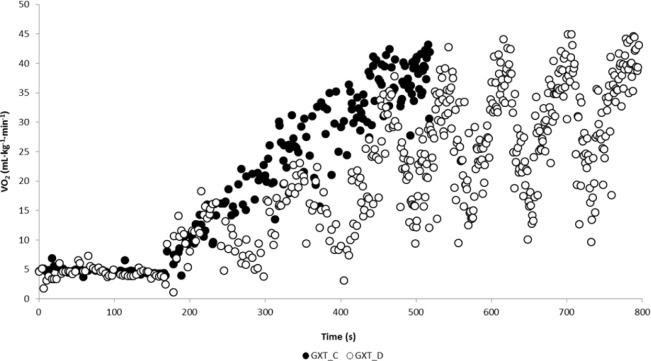
Verification
Claims the paper makes
The claims and statistics of this paper haven’t been checked yet.
Run the check — free, no account needed. It reads the open-access text and checks the sources it cites.
Claims other papers make about this one
Each is checked against this paper’s own text: does it say what the citing paper says it does?
The cited source says what the claim attributes to it.
In the citing paper
“Multiple studies have found there to be no differences in V O 2peak when comparing a discontinuous GXT protocol to a continuous protocol (12, 24, 26, 27).”
From Comparison of a Continuous and Discontinuous GXT on VO2 in Resistance-Trained and Endurance-Trained Males (2022) · cites this paper as [24]
In the citing paper
“These results confirm the myriad of research indicating that utilization of a discontinuous protocol to assess V O 2max does not provide any additional testing validity (12, 24, 26, 27).”
From Comparison of a Continuous and Discontinuous GXT on VO2 in Resistance-Trained and Endurance-Trained Males (2022) · cites this paper as [24]
Self-check
Percentages, sums and reported differences re-computed from the paper’s own numbers.
The self-check needs the paper’s full text.
Citations
Cites
STATISTICAL METHODS FOR ASSESSING AGREEMENT BETWEEN TWO METHODS OF CLINICAL MEASUREMENT
Martin Bland, J., & Altman, D. (1986) · The Lancet · doi:10.1016/s0140-6736(86)90837-8 · Cited by 47,965
Cohen, J. (1992) · Psychological Bulletin · doi:10.1037//0033-2909.112.1.155 · Cited by 8,771
Statistical methods for assessing agreement between two methods of clinical measurement
Bland, J. M., & Altman, D. G. (2010) · International Journal of Nursing Studies · doi:10.1016/j.ijnurstu.2009.10.001 · Cited by 5,220
Maximal Oxygen Intake as an Objective Measure of Cardio-Respiratory Performance
Taylor, H. L., Buskirk, E., & Henschel, A. (1955) · Journal of Applied Physiology · doi:10.1152/jappl.1955.8.1.73 · Cited by 1,342
Muscular Exercise, Lactic Acid, and the Supply and Utilization of Oxygen
Hill, A. V., & Lupton, H. (1923) · QJM · doi:10.1093/qjmed/os-16.62.135 · Cited by 997
The level and tempo of children???s physical activities: an observational study
BAILEY, R. C., OLSON, J., PEPPER, S. L., PORSZASZ, J., BARSTOW, T. J., & COOPER, D. M. (1995) · Medicine & Science in Sports & Exercise · doi:10.1249/00005768-199507000-00012 · Cited by 977
Midgley, A. W., McNaughton, L. R., Polman, R., & Marchant, D. (2007) · Sports Medicine · doi:10.2165/00007256-200737120-00002 · Cited by 460
The maximally attainable V̇o2during exercise in humans: the peak vs. maximum issue
Day, J. R., Rossiter, H. B., Coats, E. M., Skasick, A., & Whipp, B. J. (2003) · Journal of Applied Physiology · doi:10.1152/japplphysiol.00024.2003 · Cited by 447
: what do we know, and what do we still need to know?
Levine, B. D. (2008) · The Journal of Physiology · doi:10.1113/jphysiol.2007.147629 · Cited by 431
Validity of criteria for establishing maximal O2 uptake during ramp exercise tests
Poole, D. C., Wilkerson, D. P., & Jones, A. M. (2008) · European Journal of Applied Physiology · doi:10.1007/s00421-007-0596-3 · Cited by 417
Research works printed but not linked: 3
- [11]Eston RG Parfitt G Armstrong N Perceived exertion Paediatric Exercise Physiology. 2007 London Elsevier 275 298
- [19]Day JR Rossiter HB Coats EM Skasick A Whipp BJ The maximally attainable VO2 during exercise in humans: the peak versus maximum issue J Appl Physiol. 2003 95 1901 1907 12857763
- [25]Midgley AW McNaughton LR Polman R Marchant D Criteria for determination of maximal oxygen uptake Sports Med. 2007 37 1019 1028 18027991
Cited by
(2022) · International Journal of Exercise Science · doi:10.70252/nhay2400 · Cited by 3
Metadata
- Authors
- Lambrick, D., Jakeman, J., Grigg, R., Kaufmann, S., & Faulkner, J.
- Venue
- Biology of Sport
- Publisher
- Termedia Sp. z.o.o.
- Published
- 2017
- Volume
- 1
- Pages
- 57-61
- ISSN
- 0860-021X
- PMC
- PMC5377562
- Cited by
- 9
- References
- 34
About these checks
Registry, retraction, Cites and statistics results are computed, not judged, with one exception: a printed reference that no index lists is read once by a model before it counts as a citation error. Claims are extracted by a model and kept only when their quote appears verbatim in the text; each cited source is then checked, with a model’s help, for whether it says what the claim relies on. Those verdicts can be wrong — read the claim’s quote and the cited source before relying on one.
Statistics and arithmetic are recomputed, not judged.
Confidence bands are shown only for fields calibrated on our annotated test set. None is calibrated yet, so no band is shown.
What counts as a claim ›How we measure confidence ›How we check this ›
Are you an author, or do you see a problem with this page? Request a review
How to cite
Cite CoChat for the checks on this page, and the paper for its own findings.
- This page
- CoChat. (2026). Citation check: The efficacy of a discontinuous graded exercise test in measuring peak oxygen uptake in children aged 8 to 10 years. https://app.cochat.ai/papers/10.5114/biolsport.2017.63734
- The paper
- Lambrick, D., Jakeman, J., Grigg, R., Kaufmann, S., & Faulkner, J. (2017). The efficacy of a discontinuous graded exercise test in measuring peak oxygen uptake in children aged 8 to 10 years. Biology of Sport. https://doi.org/10.5114/biolsport.2017.63734
Data sources
Bibliographic data: Semantic Scholar, OpenAlex, Crossref.
Contains information from the Semantic Scholar Academic Graph Datasets, made available under the ODC Attribution License (ODC-BY 1.0).
Semantic Scholar’s data is described in: Kinney, R., et al. (2023). The Semantic Scholar Open Data Platform. arXiv:2301.10140.
