

The DOI matches its Crossref record; the references it cites are not checked yet.
Effectiveness of Cognitive Rehabilitation in Improving Symptoms and Restoring Cognitive Functions in Patients with Depression: An Updated Meta-Analysis of Randomized Controlled Trials
Open accessAbstract
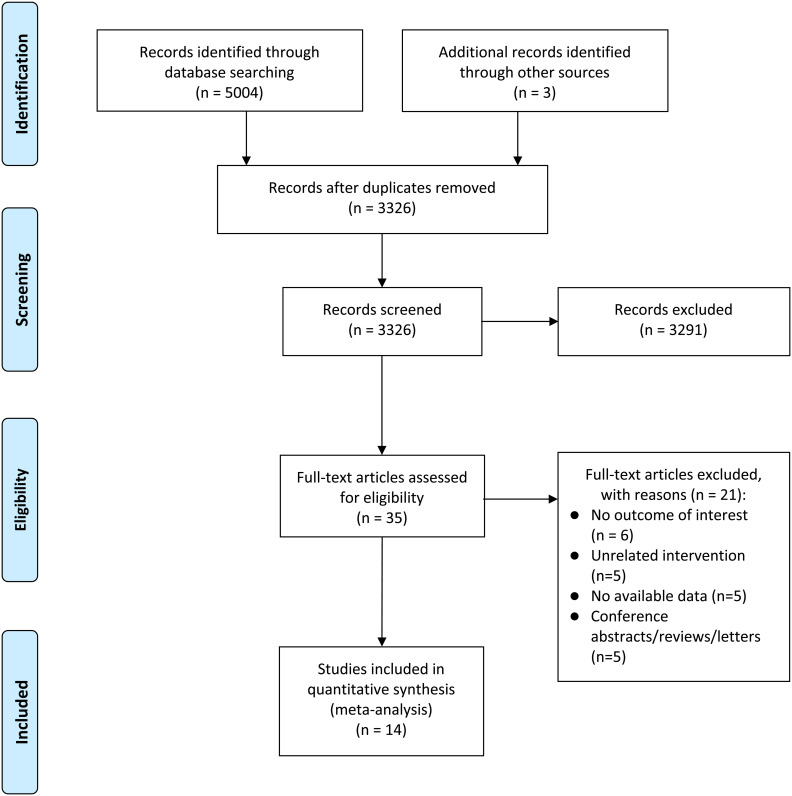
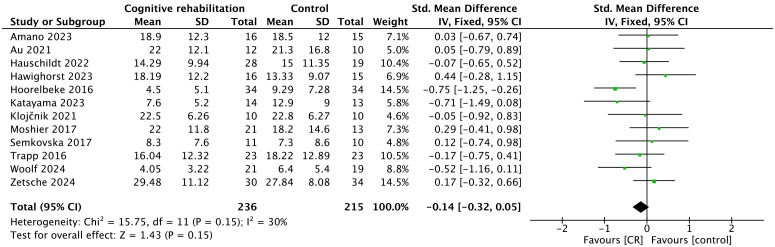
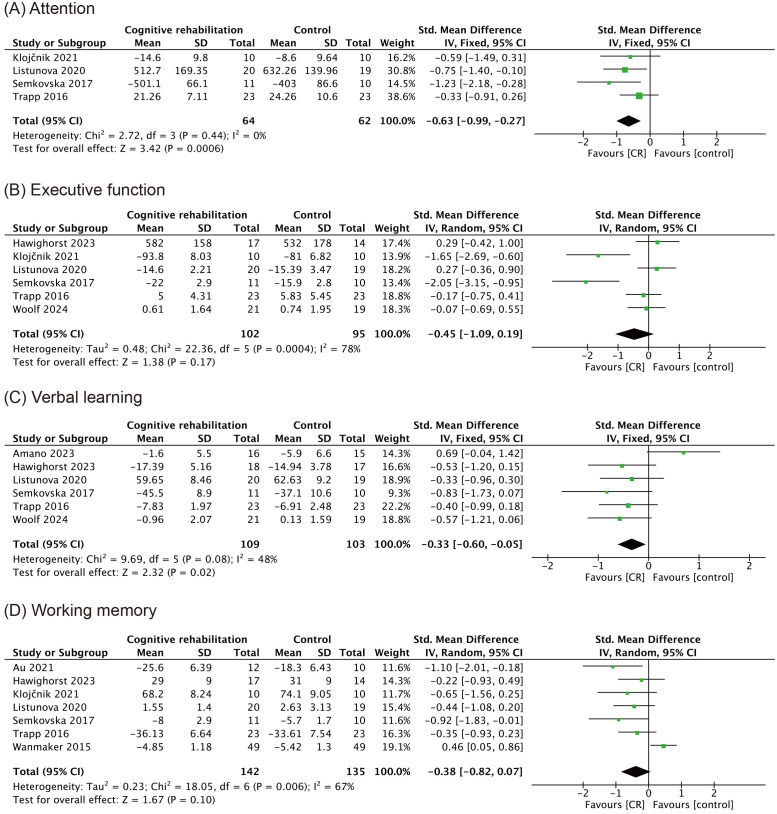
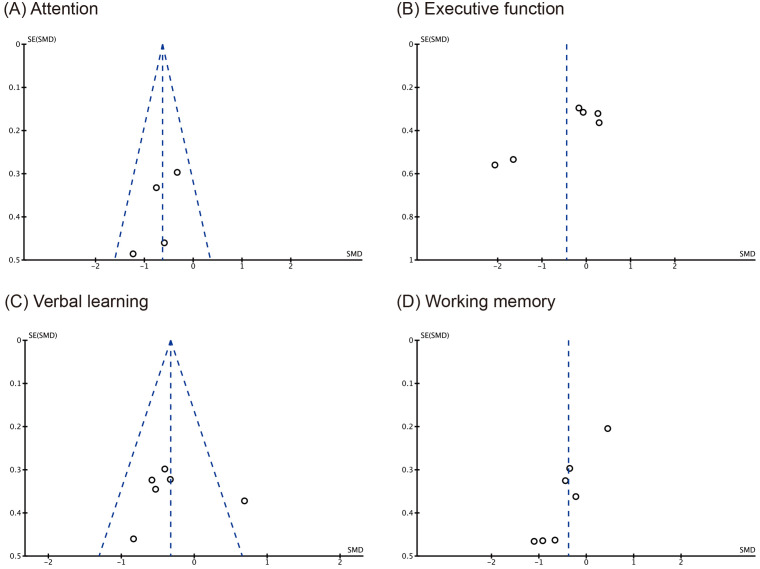
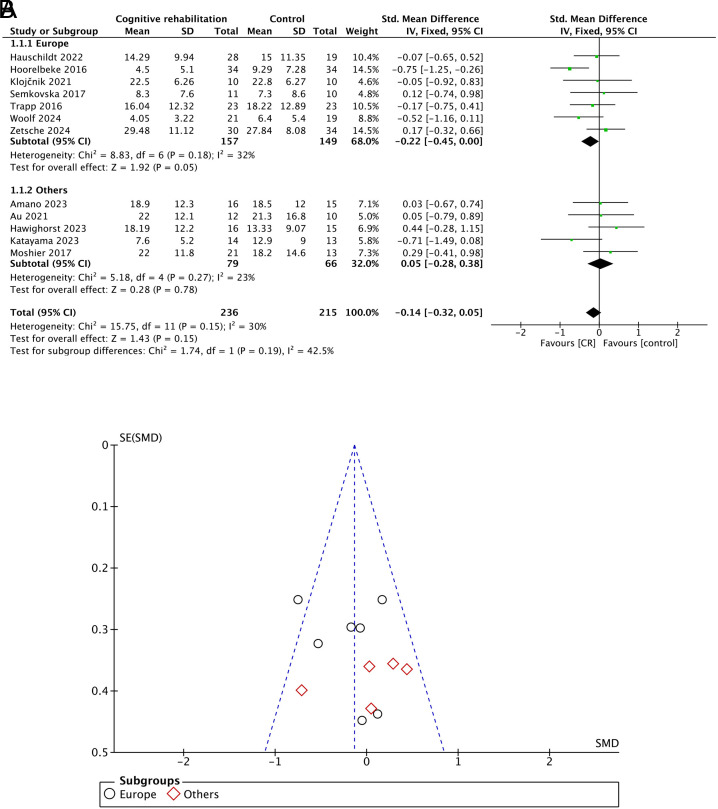
Objective: Patients with depression often experience cognitive impairments. Cognitive rehabilitation, as an adjunctive intervention, may help to improve symptoms and restore functions in these patients. This study explores the effectiveness of cognitive rehabilita-tion in improving symptoms and restoring cognitive functions in patients with depression. Methods: The following databases were systematically searched for relevant randomized controlled trials (RCTs): PubMed, Embase, and the Cochrane Central Register of Controlled Trials. Two reviewers independently screened the studies. The search was conducted from the inception of the databases to April 10, 2024. Standardized mean differences (SMDs) with 95% CIs, confidence interval were calculated using RevMan v. 5.3 software, and het-erogeneity was assessed using Cochran's Q test and the I2 statistic. Results: A total of 14 RCTs involving 700 patients were included in this meta-analysis. Compared with the control group, there was no significant difference in the severity of depression after cognitive rehabilitation intervention, with a pooled SMD of −0.14 (95% CI:0.32 to 0.05; P = .15; I2 = 30%). Among the 4 studies reporting attention-related data, cog-nitive rehabilitation significantly improved attention function in patients with depression compared with the control group, with an SMD of −0.63 (95% CI: −0.99 to −0.27; P < .001; I2 = 0%). In 6 studies, data showed significant improvement in verbal learning ability in patients with depression after cognitive rehabilitation intervention, with an SMD of −0.33 (95% CI: −0.60 to −0.05; P = .02; I2 = 48%). Executive function outcomes were reported in 6 studies, whereas working memory outcomes were reported in 7 studies, both before and after the intervention. No significant differences were observed between the groups, with SMDs of −0.45 (95% CI: −1.09 to 0.19; P = .17; I2 = 78%) in executive function and −0.38 (95% CI: −0.82 to 0.07; P = .10; I2 = 67%) in working memory post-intervention. Subgroup analysis suggested that cognitive rehabilitation training had a close to statistically signifi-cant improvement effect on depression severity in European regions, whereas no signifi-cant impact was observed in other regions. Conclusion: Cognitive rehabilitation shows certain value in improving attention and ver-bal learning in patients with depression as an adjunctive treatment, but its effectiveness in improving depressive symptoms, executive function, and working memory remains inconclusive. Future large-sample RCTs are needed to further explore this aspect.
Overview
The claims and statistics of this paper haven’t been checked yet.
Run the check — free, no account needed. It reads the open-access text and checks the sources it cites.
Integrity signals
Registry
Cites
Statistics
Figures
Verification
Claims the paper makes
The claims and statistics of this paper haven’t been checked yet.
Run the check — free, no account needed. It reads the open-access text and checks the sources it cites.
Claims other papers make about this one
Each is checked against this paper’s own text: does it say what the citing paper says it does?
The source backs part of the claim, not all of it — or backs it for a different population, condition or comparison.
In the citing paper
“In a meta-analysis of randomized controlled trials, cognitive behavioral therapy (CBT) for depression was confirmed to benefit attention and verbal learning but no other domains of cognition [84].”
From Personalized machine learning guided intervention for optimizing lifestyle behaviors in depression: a pilot study (2026) · cites this paper as [84]
Experimental — accuracy not yet measured
Self-check
Percentages, sums and reported differences re-computed from the paper’s own numbers.
The self-check needs the paper’s full text.
Citations
The citation lists haven’t been fetched yet
References 33 · Cited by 5
Metadata
- Authors
- Department of Mental Rehabilitation, R. H. O. H. P., Liu, L., Wang, K., Department of Clinical psychiatry, R. H. O. H. P., Xu, D., Department of Mental Rehabilitation, R. H. O. H. P., Wang, Y., Department of Clinical psychiatry, R. H. O. H. P., Xu, X., Department of Clinical psychiatry, R. H. O. H. P., Wang, Q., Department of Mental Rehabilitation, R. H. O. H. P., Wang, X., & Department of Clinical psychiatry, R. H. O. H. P.
- Corresponding author
- Wang, Yuhong
- Wang, Qian
- Wang, Xinfu
- Venue
- ALPHA PSYCHIATRY
- Publisher
- IMR Press
- Published
- 2024-11-16
- Volume
- 25
- Issue
- 6
- Pages
- 727-736
- ISSN
- 2757-8038 (ISSN-L)
- PMC
- PMC11736863
- OpenAlex
- W4405425059
- Cited by
- 5
- References
- 33
- Citations by year
- 2026: 2 · 2025: 3
- FWCI
- 0.37
- Type
- journal article
- Language
- en
- Open access
- hybrid
- doi.org
- Licence
- cc-by-nc
- Locations
- ALPHA PSYCHIATRY (publishedVersion, cc-by-nc)
- PubMed Central (publishedVersion, cc-by-nc)
- PubMed (publishedVersion)
- Topics
- Social Sciences › Psychology › Experimental and Cognitive Psychology › Anxiety, Depression, Psychometrics, Treatment, Cognitive Processes
- Health Sciences › Medicine › Pharmacology (medical) › Treatment of Major Depression
- Health Sciences › Medicine › Psychiatry and Mental health › Dementia and Cognitive Impairment Research
- Keywords
- cognitive rehabilitation, depression, cognitive impairment, attention, verbal learning, executive function, working memory, cognitive recovery, adjunctive therapy, depression severity, treatment effectiveness, adverse events, cost-effectiveness, quality of life, patient satisfaction, treatment acceptability, patient education
About these checks
Registry, retraction, Cites and statistics results are computed, not judged, with one exception: a printed reference that no index lists is read once by a model before it counts as a citation error. Claims are extracted by a model and kept only when their quote appears verbatim in the text; each cited source is then checked, with a model’s help, for whether it says what the claim relies on. Those verdicts can be wrong — read the claim’s quote and the cited source before relying on one.
Statistics and arithmetic are recomputed, not judged.
Confidence bands are shown only for fields calibrated on our annotated test set. None is calibrated yet, so no band is shown.
What counts as a claim ›How we measure confidence ›How we check this ›
Are you an author, or do you see a problem with this page? Request a review
How to cite
Cite CoChat for the checks on this page, and the paper for its own findings.
- This page
- CoChat. (2026). Citation check: Effectiveness of Cognitive Rehabilitation in Improving Symptoms and Restoring Cognitive Functions in Patients with Depression: An Updated Meta-Analysis of Randomized Controlled Trials. https://app.cochat.ai/papers/10.5152/alphapsychiatry.2024.241731
- The paper
- Department of Mental Rehabilitation, R. H. O. H. P., Liu, L., Wang, K., Department of Clinical psychiatry, R. H. O. H. P., Xu, D., Department of Mental Rehabilitation, R. H. O. H. P., Wang, Y., Department of Clinical psychiatry, R. H. O. H. P., Xu, X., Department of Clinical psychiatry, R. H. O. H. P., Wang, Q., Department of Mental Rehabilitation, R. H. O. H. P., Wang, X., & Department of Clinical psychiatry, R. H. O. H. P. (2024). Effectiveness of Cognitive Rehabilitation in Improving Symptoms and Restoring Cognitive Functions in Patients with Depression: An Updated Meta-Analysis of Randomized Controlled Trials. ALPHA PSYCHIATRY. https://doi.org/10.5152/alphapsychiatry.2024.241731
