

Future methane, hydroxyl, and their uncertainties: key climate and emission parameters for future predictions
Open accessPublished version of a preprint
The DOI matches its Crossref record; 94 of the 94 references it cites were found in a registry or an index.
Abstract
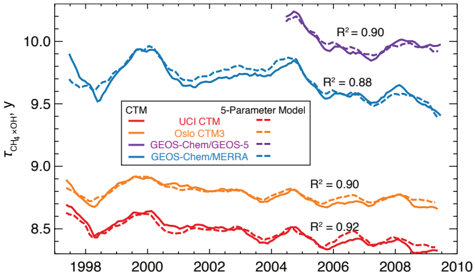
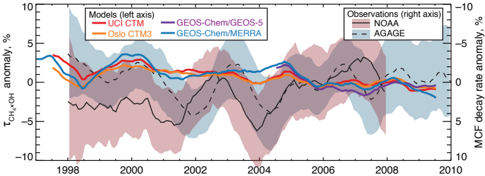
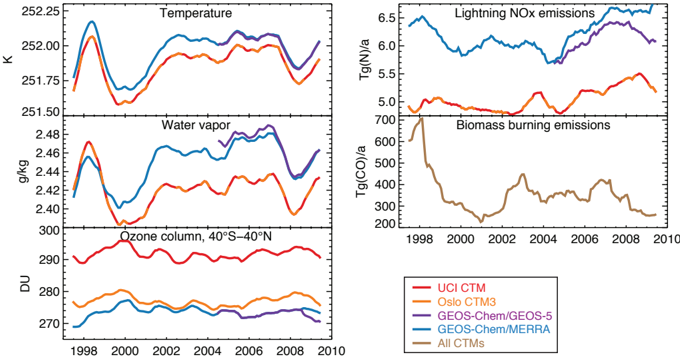
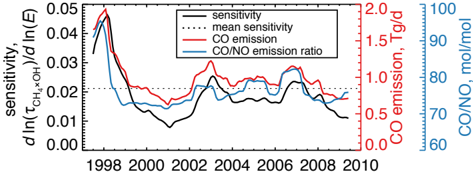
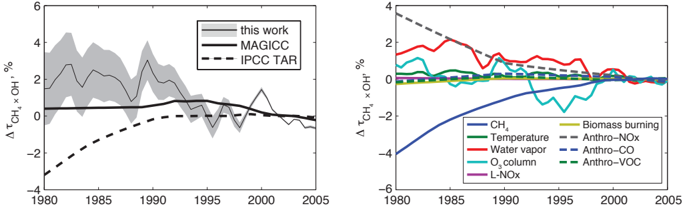
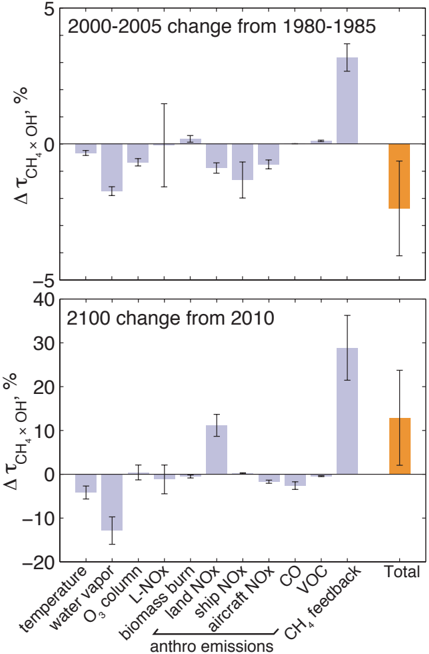
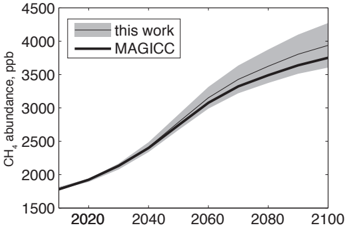
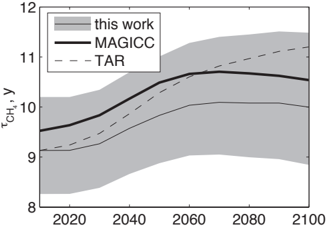
Accurate prediction of future methane abundances following a climate scenario requires understanding the lifetime changes driven by anthropogenic emissions, meteorological factors, and chemistry-climate feedbacks. Uncertainty in any of these influences or the underlying processes implies uncertainty in future abundance and radiative forcing. We simulate methane lifetime in three chemical transport models (CTMs) – UCI CTM, GEOS-Chem, and Oslo CTM3 – over the period 1997–2009 and compare the models' year-to-year variability against constraints from global methyl chloroform observations. Using sensitivity tests, we find that temperature, water vapor, stratospheric ozone column, biomass burning and lightning NOx are the dominant sources of interannual changes in methane lifetime in all three models. We also evaluate each model's response to forcings that have impacts on decadal time scales, such as methane feedback, and anthropogenic emissions. In general, these different CTMs show similar sensitivities to the driving variables. We construct a parametric model that reproduces most of the interannual variability of each CTM and use it to predict methane lifetime from 1980 through 2100 following a specified emissions and climate scenario (RCP 8.5). The parametric model propagates uncertainties through all steps and provides a foundation for predicting methane abundances in any climate scenario. Our sensitivity tests also enable a new estimate of the methane global warming potential (GWP), accounting for stratospheric ozone effects, including those mediated by water vapor. We estimate the 100-yr GWP to be 32, which is 25% larger than past assessments.
Overview
The claims and statistics of this paper haven’t been checked yet.
Free: it reads the open-access text and checks the first 5 claims that cite a source we can check. Create a free account to check every claim.
Integrity signals
Registry
Cites
Statistics
Figures
Verification
Claims the paper makes
The claims and statistics of this paper haven’t been checked yet.
Free: it reads the open-access text and checks the first 5 claims that cite a source we can check. Create a free account to check every claim.
Claims other papers make about this one
Each is checked against this paper’s own text: does it say what the citing paper says it does?
The cited source says what the claim attributes to it.
In the citing paper
“The TROPOS CH4 lifetimes agree relatively well with other studies (e.g., Holmes et al., 2013; Voulgarakis et al., 2013; Dals ø ren et al., 2016) not only in terms of absolute numbers but also the rate of changes; a detailed comparison is presented in Table D.3.”
From The contribution of global aviation to anthropogenic climate forcing for 2000 to 2018 (2021) · cites this paper as Holmes et al., 2013
Self-check
Percentages, sums and reported differences re-computed from the paper’s own numbers.
The self-check needs the paper’s full text.
Citations
Cites
Climate change 2007: the physical science basis
Solomon, S., Qin, D., Manning, M., Marquis, M. C., Averyt, K. B., Tignor, M., Miller, H. L., & Chen, Z. (2007) · Cited by 24,695
The representative concentration pathways: an overview
van Vuuren, D. P., Edmonds, J., Kainuma, M., Riahi, K., Thomson, A., Hibbard, K., Hurtt, G. C., Kram, T., Krey, V., Lamarque, J.-F., et al. (2011) · Climatic Change · doi:10.1007/s10584-011-0148-z · Cited by 7,741
Robust Responses of the Hydrological Cycle to Global Warming
Held, I. M., & Soden, B. J. (2006) · Journal of Climate · doi:10.1175/jcli3990.1 · Cited by 4,959 · cited 2×
“GHG-driven climate warming tends to reduce convection globally (Held and Soden, 2006), but could intensify convection in some regions (Del Genio et al., 2007), so the total effect on lightning is unclear.”
BackgroundMERRA: NASA’s Modern-Era Retrospective Analysis for Research and Applications
Rienecker, M. M., Suarez, M. J., Gelaro, R., Todling, R., Bacmeister, J., Liu, E., Bosilovich, M. G., Schubert, S. D., Takacs, L., Kim, G.-K., et al. (2011) · Journal of Climate · doi:10.1175/jcli-d-11-00015.1 · Cited by 4,852
Guenther, A., Karl, T., Harley, P., Wiedinmyer, C., Palmer, P. I., & Geron, C. (2006) · Atmospheric Chemistry and Physics · doi:10.5194/acp-6-3181-2006 · Cited by 4,603
Solomon, S. (2007) · Medical Entomology and Zoology · Cited by 4,149
The RCP greenhouse gas concentrations and their extensions from 1765 to 2300
Meinshausen, M., Smith, S. J., Calvin, K., Daniel, J. S., Kainuma, M. L. T., Lamarque, J.-F., Matsumoto, K., Montzka, S. A., Raper, S. C. B., Riahi, K., et al. (2011) · Climatic Change · doi:10.1007/s10584-011-0156-z · Cited by 3,584
IPCC (2007): Climate Change The Physical Science Basis
Solomon, S. (2007) · AGU Fall Meeting Abstracts · Cited by 3,476
(2010) · doi:10.5194/acp-10-11707-2010 · Cited by 2,859
Lamarque, J.-F., Bond, T. C., Eyring, V., Granier, C., Heil, A., Klimont, Z., Lee, D., Liousse, C., Mieville, A., Owen, B., et al. (2010) · Atmospheric Chemistry and Physics · doi:10.5194/acp-10-7017-2010 · Cited by 2,105
Research works printed but not linked: 5
- Prather, M., Ehhalt, D., Dentener, F., Derwent, R., Dlugokencky, E., Holland, E., Isaksen, I., Katima, J., Kirchhoff, V., Matson, P., Midgley, P., and Wang, M.: Atmospheric Chemistry and Green- house Gases, in Climate Change 2001: The Scientific Basis. Third Assessment Report of the Intergovernmental Panel on Cli- mate Change, edited by: Houghton, J., Ding, Y., Griggs, D., Noguer, M., van der Linden, P., Dai, X., Maskell, K., and John- son, C., Cambridge University Press, Cambridge, UK. 2001.
- Price, C. and Rind, D.: Modeling global lightning distributions in a general circulation model, Mon. Weather Rev., 122, 1930- 1939, 1994. · doi:10.1175/1520-0493(1994)122
- Ramaswamy, V., Boucher, O., Haigh, J., Hauglustaine, D., Hay- wood, J., Myhre, G., Nakajima, T., Shi, G. Y., and Solomon, S.: Radiative Forcing of Climate Change, in Cliamte Change 2001: The Scientific Basis. Third Assessment Report of the Intergov- ernmental Panel on Climate Change, edited by: Houghton, J. T., Ding, Y., Griggs, D., Noguer, M., van der Linden, P. J., Dai, X., Maskell, K., and Johnson, C., Cambridge University Press, Cam- bridge, UK. 2001.
- Shine, K. P., Fouquart, Y., Ramaswamy, V., Solomon, S., and Srini- vasan, J.: Radiative Forcing, in Climate Change 1994: Radia- tive Forcing of Climate Change and An Evaluation of the IPCC IS92 Emission Scenarios. Reports of Working Groups I and III C. D. Holmes et al.: Future methane, hydroxyl, and their uncertainties of the Intergovernmental Panel of Climate Change, edited by: Houghton, J., Meira Filho, L., Bruce, J., Lee, H., Callander, B., Haites, E., Harris, N., and Maskell, K., Cambridge University Press, Cambridge, 1995.
- Tiedtke, M.: A comprehensive mass flux scheme for cumulus pa- rameterization in large-scale models, Mon. Weather Rev., 117, 1779-1800, 1989. · doi:10.1175/1520-0493(1989)117
Cited by
Items 101–200 of 234
Naus, S., Montzka, S. A., Patra, P. K., & Krol, M. C. (2021) · Atmospheric Chemistry and Physics · doi:10.5194/acp-21-4809-2021 · Cited by 46
“Both networks maintain their own calibration scales for MCF, and previous comparisons have revealed site-dependent scale drifts and a possible phase difference between the two networks that exceed measurement repeatability (Holmes et al., 2013; Rigby et al., 2013).”
BackgroundKou, X., Ma, Q., Liu, Y., Khan, M. Z., Wu, B., Chen, W., Liu, X., Wang, C., & Li, Y. (2024) · Animals · doi:10.3390/ani14131965 · Cited by 55
“…end products of rumen fermentation in ruminants is methane, which is a polluting greenhouse gas and can characterize the energy loss of livestock [122–125]. polluting greenhouse gas and can characterize the energy loss of livestock [ Thus, enabling livestock to reduce methane production is…”
BackgroundLong‐Term Measurements of Methane Ebullition From Thaw Ponds
Burke, S. A., Wik, M., Lang, A. K., Contosta, A. R., Palace, M., Crill, P., & Varner, R. K. (2019) · Journal of Geophysical Research Biogeosciences · doi:10.1029/2018jg004786 · Cited by 52
IGCM4: a fast, parallel and flexible intermediate climate model
Joshi, M., Stringer, M. A., van der Wiel, K., O'Callaghan, A., & Fueglistaler, S. A. (2015) · Geoscientific model development · doi:10.5194/gmd-8-1157-2015 · Cited by 47
“…the SWV perturbation in ppmv for pre-industrial CH4 concentrations of 0.75 ppmv (bottom left), and potential future concentrations of CH4 of 2.5 ppmv (bottom right), as might be expected in the mid 21st century under the Representative Concentration Pathway (RCP) 8.5 scenario (Holmes et al., 2013).”
BackgroundInfluentialShadpour, S., Chud, T. C. S., Hailemariam, D., Plastow, G. S., de Oliveira, H. R., Stothard, P., Lassen, J., Miglior, F., Baes, C. F., Tulpan, D., et al. (2022) · Journal of Dairy Science · doi:10.3168/jds.2021-21176 · Cited by 54
Catalytic methane removal to mitigate its environmental effect
Wang, C., Xu, Y., & Tang, J. (2023) · Science China Chemistry · doi:10.1007/s11426-022-1487-8 · Cited by 42
Innovative Box-Wing Aircraft: Emissions and Climate Change
Tasca, A. L., Cipolla, V., Salem, K. A., & Puccini, M. (2021) · Sustainability · doi:10.3390/su13063282 · Cited by 45
Lan, K., & Yao, Y. (2021) · Environmental Science & Technology · doi:10.1021/acs.est.1c05923 · Cited by 47
Atmospheric removal of methane by enhancing the natural hydroxyl radical sink
Wang, Y., Ming, T., Li, W., Yuan, Q., de Richter, R. K., Davies, P. A., & Caillol, S. (2022) · Greenhouse Gases Science and Technology · doi:10.1002/ghg.2191 · Cited by 38
Huang, Y., Natraj, V., Zeng, Z., Kopparla, P., & Yung, Y. L. (2020) · Atmospheric measurement techniques · doi:10.5194/amt-13-6755-2020 · Cited by 38
Fahey, D. W., Doherty, S. J., Hibbard, K. A., Romanou, A., & Taylor, P. C. (2017) · doi:10.7930/j0513wcr · Cited by 57
Multifractal Detrended Cross-Correlation Analysis of Global Methane and Temperature
Tzanis, C. G., Koutsogiannis, I., Philippopoulos, K., & Kalamaras, N. (2020) · Remote Sensing · doi:10.3390/rs12030557 · Cited by 33
“On the other hand, the reaction with the hydroxyl radical (OH) is considered to be the basic sink of atmospheric CH4, a process that is subject to interannual fluctuations [20].”
BackgroundEnhanced atmospheric oxidation toward carbon neutrality reduces methane’s climate forcing
Liu, M., Song, Y., Matsui, H., Shang, F., Kang, L., Cai, X., Zhang, H., & Zhu, T. (2024) · Nature Communications · doi:10.1038/s41467-024-47436-9 · Cited by 48
“The model results are focused on the period of 2015 ‒ 2100 in a strong climate mitigation scenario towards sustainable development, Shared Socio-economic Pathway 1 ‒ 26 (SSP126) 36 .”
BackgroundNicewonger, M. R., Aydın, M., Prather, M. J., & SALTZMAN, E. S. (2018) · Proceedings of the National Academy of Sciences · doi:10.1073/pnas.1807172115 · Cited by 36
“We used a 3D chemical transport model [University of California, Irvine 3D Chemical Transport Model (UCI-CTM); see Methods] to estimate the sensitivity of ethane levels over Antarctica and Greenland to various ethane sources (23, 24).”
MethodMethane Combustion Over Ni/CexZr1–xO2 Catalysts: Impact of Ceria/Zirconia Ratio
Chen, J., Carlson, B. D., Toops, T. J., Li, Z., Lance, M. J., Karakalos, S., Choi, J., & Kyriakidou, E. A. (2020) · ChemCatChem · doi:10.1002/cctc.202000947 · Cited by 31
Gustin, M. S., Fine, R., Miller, M. B., Jaffe, D. A., & Burley, J. D. (2015) · The Science of The Total Environment · doi:10.1016/j.scitotenv.2015.03.046 · Cited by 30
“In addition, O3 is the fourth most important anthropogenic greenhouse gas after H2O, CO2 and CH4 with a radiative forcing capability of +0.35Wm−2 compared to +1.66Wm−2 for CO2 (National Research Council, 2010; Gauss et al., 2006; Forester et al., 2007 b).”
BackgroundQuiquet, A., Archibald, A. T., Friend, A. D., Chappellaz, J., Levine, J. G., Stone, E. J., Telford, P. J., & Pyle, J. A. (2015) · Quaternary Science Reviews · doi:10.1016/j.quascirev.2015.01.004 · Cited by 31
“The mutually compensating influences on the oxidising capacity reported by Levine et al. (2011b) have since been reproduced by Murray et al.”
BackgroundResultInfluentialAchakulwisut, P., Mickley, L. J., Murray, L. T., Tai, A. P. K., Kaplan, J. O., & Alexander, B. (2015) · Atmospheric chemistry and physics · doi:10.5194/acp-15-7977-2015 · Cited by 35
“Reconciling the magnitude of the inferred OH burden with modeled results remains an ongoing challenge (Holmes et al., 2013).”
BackgroundRegional and seasonal radiative forcing by perturbations to aerosol and ozone precursor emissions
Bellouin, N., Baker, L., Hodnebrog, Ø., Olivié, D., Cherian, R., MacIntosh, C. R., Samset, B. H., Esteve, A. R., Aamaas, B., Quaas, J., et al. (2016) · Atmospheric chemistry and physics · doi:10.5194/acp-16-13885-2016 · Cited by 33
“46 (Table 7), in close agreement with the multi-model mean derived by Holmes et al. (2013).”
ResultInfluentialDenninger, T. M., Dohme‐Meier, F., Eggerschwiler, L., Vanlierde, A., Grandl, F., Gredler, B., Kreuzer, M., Schwarm, A., & Münger, A. (2019) · Journal of Dairy Science · doi:10.3168/jds.2019-16804 · Cited by 39
An observation-based, reduced-form model for oxidation in the remote marine troposphere
Baublitz, C. B., Fiore, A. M., Ludwig, S., Nicely, J. M., Wolfe, G. M., Murray, L. T., Commane, R., Prather, M. J., Anderson, D. C., Correa, G. J. P., et al. (2023) · Proceedings of the National Academy of Sciences · doi:10.1073/pnas.2209735120 · Cited by 27
“Applying the mean increase in water vapor between 2,010 and 2,100 from RCP 8.5 (56), used by Holmes et al. (39), we infer from Proxy OH that the projected magnitude of change in [H 2 O] (42.3”
InfluentialHow a European network may help with estimating methane emissions on the French national scale
Pison, I., Berchet, A., Saunois, M., Bousquet, P., Broquet, G., Conil, S., Delmotte, M., Ganesan, A. L., Laurent, O., Martin, D., et al. (2018) · Atmospheric chemistry and physics · doi:10.5194/acp-18-3779-2018 · Cited by 30
Nicewonger, M. R., Aydın, M., Prather, M. J., & SALTZMAN, E. S. (2020) · Geophysical Research Letters · doi:10.1029/2019gl085101 · Cited by 30
“8° horizontal resolution and 57 vertical layers (Holmes et al., 2013; Prather & Hsu, 2010).”
BackgroundSearching for technosignatures in exoplanetary systems with current andfuture missions brPreprint
Haqq-Misra, J. D., Schwieterman, E. W., Socas‐Navarro, H., Kopparapu, R., Angerhausen, D., Beatty, T. G., Berdyugina, S. V., Felton, R. C., Sharma, S., la Torre, G. G. D., et al. (2022) · arXiv (Cornell University) · doi:10.3929/ethz-b-000557010 · Cited by 24
Dooley, J. F., Minschwaner, K. R., Dubey, M. K., Abbadi, S. H. E., Sherwin, E. D., Meyer, A. G., Follansbee, E., & Lee, J. E. (2024) · Atmospheric measurement techniques · doi:10.5194/amt-17-5091-2024 · Cited by 32
Nicewonger, M. R., Aydın, M., Prather, M. J., & SALTZMAN, E. S. (2020) · Journal of Geophysical Research Atmospheres · doi:10.1029/2020jd032932 · Cited by 26
“The UCI‐Chemistry Transport Model (UCI‐CTM) is a 3‐”
BackgroundMethodInfluentialDenisov, S. N., Eliseev, A. V., & Mokhov, I. I. (2019) · Doklady Earth Sciences · doi:10.1134/s1028334x19090010 · Cited by 23
Lifetimes and timescales of tropospheric ozone
Prather, M. J., & Xin, Z. (2024) · Elementa Science of the Anthropocene · doi:10.1525/elementa.2023.00112 · Cited by 35
On the chemistry of the global warming potential of hydrogen
Chen, C., Solomon, S., & Stone, K. A. (2024) · Frontiers in Energy Research · doi:10.3389/fenrg.2024.1463450 · Cited by 25
Lu, L., Cohen, J. B., Qin, K., Li, X., & He, Q. (2025) · Atmospheric chemistry and physics · doi:10.5194/acp-25-2291-2025 · Cited by 27
CMIP6 simulations with the compact Earth system model OSCAR v3.1
Quilcaille, Y., Gasser, T., Ciais, P., & Boucher, O. (2023) · Geoscientific model development · doi:10.5194/gmd-16-1129-2023 · Cited by 28
Scott, C. E., Monks, S. A., Spracklen, D. V., Arnold, S. R., Forster, P. M. D. F., Rap, A., Carslaw, K. S., Chipperfield, M. P., Reddington, C. L. S., & Wilson, C. (2017) · Faraday Discussions · doi:10.1039/c7fd00028f · Cited by 23
Elshorbany, Y., Duncan, B. N., Strode, S. A., Wang, J. S., & Kouatchou, J. (2016) · Geoscientific model development · doi:10.5194/gmd-9-799-2016 · Cited by 21
“These factors are known to influence variations in OH and thus CO and methane (e.g., Holmes et al., 2013).”
BackgroundResultHow well do integrated assessment models represent non-CO2 radiative forcing?
Harmsen, M. J. H. M., van Vuuren, D. P., van den Berg, M., Hof, A. F., Hope, C. W., Krey, V., Lamarque, J., Marcucci, A., Shindell, D. T., & Schaeffer, M. (2015) · Climatic Change · doi:10.1007/s10584-015-1485-0 · Cited by 24
Removing low-concentration methane via thermo-catalytic oxidation on CuOx/zeolite
Wang, Y., Wang, Y., Liu, Z., Li, Y., Lin, Y., Shao, S., Fan, X., Ming, T., Lü, X., Mu, L., et al. (2024) · Applied Surface Science · doi:10.1016/j.apsusc.2024.161691 · Cited by 19
Converging evidence for reduced global atmospheric oxidation in 2020
Chen, W., Zhang, Y., & Liang, R. (2025) · National Science Review · doi:10.1093/nsr/nwaf232 · Cited by 22
“S1) and lower interan-nual OH variability compared to observation proxies [26 ,28 ].”
Resetting tropospheric OH and CH 4 lifetime with ultraviolet H 2 O absorption
Prather, M. J., & Zhu, L. (2024) · Science · doi:10.1126/science.adn0415 · Cited by 24
Methane cycling in temperate forests
Wigley, K., Armstrong, C., Smaill, S. J., Reid, N. M., Kiely, L., & Wakelin, S. A. (2024) · Carbon Balance and Management · doi:10.1186/s13021-024-00283-z · Cited by 27
“OH radicals are produced via photolysis of O 3 and concentrations are temporally and spatially variable with local concentrations depending on highly variable factors such as temperature, cloud cover and surface albedo [157, 166].”
BackgroundZhao, T., Mao, J., Ayazpour, Z., Abad, G. G., Nowlan, C. R., & Zheng, Y. (2024) · Atmospheric chemistry and physics · doi:10.5194/acp-24-6105-2024 · Cited by 16
Caram, C., Szopa, S., Cozic, A., Bekki, S., Cuevas, C. A., & Saiz‐Lopez, A. (2023) · Geoscientific model development · doi:10.5194/gmd-16-4041-2023 · Cited by 19
Marcos, C. N., Carro, M. D., Gutiérrez‐Rivas, M., Atxaerandio, R., Goiri, I., García-Rodríguez, A., & González-Recio, Ó. (2024) · Journal of Dairy Science · doi:10.3168/jds.2023-24552 · Cited by 19
“Methane is a potent green-house gas with a global warming potential around 32 times higher than that of CO 2 (Holmes et al., 2013), and the main greenhouse gas contributor from the livestock sector (Gerber et al., 2013).”
BackgroundChua, G., Naïk, V., & Horowitz, L. W. (2023) · Atmospheric chemistry and physics · doi:10.5194/acp-23-4955-2023 · Cited by 24
“This could be related to variability in biomass burning, as pointed out by Holmes et al. (2013).”
BackgroundTechnosignatures: Frameworks for Their Assessment
Lingam, M., Haqq-Misra, J. D., Wright, J. T., Huston, M., Frank, A., & Kopparapu, R. (2023) · The Astrophysical Journal · doi:10.3847/1538-4357/acaca0 · Cited by 26
“On Earth, biogenic and abiotic production of NO x is ∼ 10.6 Tg of nitrogen per year ( Tg ( N ) yr – 1 ) , whereas anthropogenic sources supply ∼ 32 Tg ( N ) yr – 1 of NO x chie fl y on account of combustion ( Holmes et al. 2013 ) .”
BackgroundInfluentialThe Port Sector in Italy: Its Keystones for Energy-Efficient Growth
Nigro, M., Domenico, M. D., Murgia, T., & Stimilli, A. (2024) · Energies · doi:10.3390/en17071788 · Cited by 17
“Methane has a high global warming potential that is 86 times higher than CO 2 in a 20 year life span and 34 times higher in a 100 year life span [72].”
BackgroundLiu, Y., Yao, X., Zhou, L., Ming, T., Li, W., & de Richter, R. K. (2024) · Atmosphere · doi:10.3390/atmos15091046 · Cited by 14
van Caspel, W. E., Klimont, Z., Heyes, C., & Fagerli, H. (2024) · Atmospheric chemistry and physics · doi:10.5194/acp-24-11545-2024 · Cited by 16
Sensitivity of climate effects of hydrogen to leakage size, location, and chemical background
Skeie, R. B., Sandstad, M., Krishnan, S., Myhre, G., & Sand, M. (2025) · Atmospheric chemistry and physics · doi:10.5194/acp-25-4929-2025 · Cited by 15
“To conclude, the GWP100 values are independent of the magnitude of the emission perturbation within the range of 0.1–100 Tgyr − .”
InfluentialSouri, A. H., Duncan, B. N., Strode, S. A., Anderson, D. C., Manyin, M., Liu, J., Oman, L. D., Zhang, Z., & Weir, B. (2024) · Atmospheric chemistry and physics · doi:10.5194/acp-24-8677-2024 · Cited by 20
“Therefore, there is rather insufficient evidence to support the strong upward trends detected by OMI/MLS in the southern hemisphere, nor can it be claimed that MERRA2-GMI has reproduced reasonable trends in that region.”
BackgroundPrather, M. J., Guo, H., & Xin, Z. (2023) · Earth system science data · doi:10.5194/essd-15-3299-2023 · Cited by 13
“Sensitivity analyses are often calcu- lated with CCMs to assess the factors controlling the trends and variability in CH4 lifetime (Holmes et al., 2013).”
BackgroundInfluentialKey role of short-lived halogens on global atmospheric oxidation during historical periods
Bossolasco, A. G., Fernández, R. P., Li, Q., Mahajan, A. S., Villamayor, J., Barrera, J. A., Heard, D. E., Cuevas, C. A., Caram, C., Szopa, S., et al. (2025) · Environmental Science Atmospheres · doi:10.1039/d4ea00141a · Cited by 13
“11,12 Accurately estimating the levels of these oxidants remains a signi cant challenge due to their short lifetime and the many factors in uencing their production and loss; indeed, measuring these oxidants directly is di ffi cult at large scales.”
Liu, W., Zhang, D., Tian, J., Yu, F., Xie, Y., Cheng, S., Li, Q., Li, W., Peng, C. H., & Yan, Y. (2023) · The Science of The Total Environment · doi:10.1016/j.scitotenv.2023.164165 · Cited by 9
Feng, J., Liao, H., & Li, J. (2016) · Atmospheric chemistry and physics · doi:10.5194/acp-16-4927-2016 · Cited by 11
“The OH concentrations in GEOS-Chem were examined by previous studies (Holmes et al., 2013; Wu et al., 2007) by calculating the methane lifetime, which agreed closely with the lifetime of 11.”
InfluentialDenisov, S. N., Eliseev, A. V., & Mokhov, I. I. (2022) · Russian Meteorology and Hydrology · doi:10.3103/s1068373922100028 · Cited by 9
Leach, N. J., Nicholls, Z., Jenkins, S., Smith, C., Lynch, J., Cain, M. L., Wu, B., Tsutsui, J., & Allen, M. R. (2020) · Geoscientific Model Development · doi:10.5194/gmd-2019-379 · Cited by 11
Tropospheric Ozone Budget: Formation, Depletion and Climate Change
Tiwari, S., & Agrawal, M. (2018) · Springer eBooks · doi:10.1007/978-3-319-71873-6_2 · Cited by 10
What can we learn about tropospheric OH from satellite observations of methane?
Penn, E., Jacob, D. J., Chen, Z., East, J. D., Sulprizio, M. P., Bruhwiler, L., Maasakkers, J. D., Nesser, H. O., Qu, Z., Zhang, Y., et al. (2025) · Atmospheric chemistry and physics · doi:10.5194/acp-25-2947-2025 · Cited by 13
Greenhouse gas emissions from municipal wastewater treatment: Global insights and Vietnam's approach
Anh, L. T. L., & Luu, T. L. (2025) · Current Opinion in Environmental Science & Health · doi:10.1016/j.coesh.2025.100655 · Cited by 7
López-Comí, L., Morgenstern, O., Zeng, G., Masters, S. L., Querel, R., & Nedoluha, G. E. (2016) · Atmospheric chemistry and physics · doi:10.5194/acp-16-14599-2016 · Cited by 7
“(2011) and with other models (Dentener et al., 2003; Hess and Mahowald, 2009; John et al., 2012; Holmes et al., 2013), but disagree with other studies of CH3CCl3 observations that find a decrease in OH over that period (Prinn, 2001; Bousquet et al.”
ResultShen, W., Wang, M., Wang, J., Liu, Y., Dong, X., Shao, X., Yue, M., & Liu, Y. (2025) · Advances in Atmospheric Sciences · doi:10.1007/s00376-025-5041-1 · Cited by 5
Orkin, V. L., Kurylo, M. J., & Fleming, E. L. (2020) · Journal of Geophysical Research Atmospheres · doi:10.1029/2019jd032243 · Cited by 5
“Holmes et al. (2013) reported similar decay rates derived from results of the NOAA (0.1811 year−1) and AGAGE (0.1796 year−1) networks.”
ResultInfluentialQin, K., Shi, J., He, Q., Deng, W., Wang, S., Liu, J., & Cohen, J. B. (2022) · doi:10.1002/essoar.10512010.1 · Cited by 5
Ming, T., de Richter, R. K., Felzer, B. S., & Li, W. (2025) · Atmosphere · doi:10.3390/atmos16040406 · Cited by 5
A perspective on time: loss frequencies, time scales and lifetimes
Prather, M. J., & Holmes, C. D. (2013) · Environmental Chemistry · doi:10.1071/en13017 · Cited by 6
Intended and unintended consequences of atmospheric methane oxidation enhancement
Horowitz, H. M. (2026) · Atmospheric chemistry and physics · doi:10.5194/acp-26-9471-2026 · Cited by 4
“…standard and atmospheric oxidation enhancement experiments, respectively; f = 1.34 ± 0.06 is the GEOS-Chem methane feedback factor on its loss rate (Holmes et al., 2013); and [ CH 4 ] 0 = 1866 . parts per billion (ppb) is the global annual mean surface methane concentration in year 2019…”
InfluentialYusong, D., Jiawei, C., Huabin, L., Jinli, H., Guangcheng, L., Ronglin, S., Xian, W., Yan, W., & Ronggui, H. (2026) · Scientific Reports · doi:10.1038/s41598-026-43940-8 · Cited by 5
A Comprehensive Chemistry Evaluation and Diagnostics Package for E3SM – ChemDyg Version 1.1.0
Lee, H., Tang, Q., Prather, M. J., & Xie, J. (2025) · Environmental Modelling & Software · doi:10.1016/j.envsoft.2025.106498 · Cited by 3
Improving estimates of the atmospheric oxidative capacity and Amazon fire emissions
Naus, S. (2021) · doi:10.18174/536720 · Cited by 5
Yang, L., Gong, C., Mo, X., Zhang, J., Yang, B., & Yang, G. (2024) · Journal of Geophysical Research Oceans · doi:10.1029/2024jc021286 · Cited by 2
Ngo, K. Q., Le, M. T., Vu, T. A., Tran, T. T., Ratanasak, M., Gao, M., & Hasegawa, J. (2025) · Journal of the Taiwan Institute of Chemical Engineers · doi:10.1016/j.jtice.2025.106448 · Cited by 2
Shadpour, S., Fleming, A., Baes, C. F., Tulpan, D., Miglior, F., & Schenkel, F. S. (2025) · Journal of Dairy Science · doi:10.3168/jds.2025-27013 · Cited by 2
Assessing climate and air quality benefits of methane mitigation for U.S. landfills
Folorunsho, A. H., Dudhia, J., Jiang, L., Yokochi, A., & Li, Y. (2026) · Journal of Environmental Management · doi:10.1016/j.jenvman.2026.128707 · Cited by 2
LINKING CATTLE GRAZING BEHAVIOR TO METHANE AND CARBON DIOXIDE DYNAMICS
Blaise, Y., Lebeau, F., Andriamandroso, A., Beckers, Y., Heinesch, B., & Bindelle, J. (2016) · Open Repository and Bibliography (University of Liège) · Cited by 2
Unequal impacts of temperature deviations on poverty:International Evidence
Zhang, H., Zhang, A., Wu, K., Cai, Y., Qiu, Y. L., Wang, S., Wang, W., & Zhao, Y. (2025) · Structural Change and Economic Dynamics · doi:10.1016/j.strueco.2025.07.001 · Cited by 1
North–south inhomogeneous variations of methane emissions observed by TROPOMI over China
Yu, S., Liu, Z., Sun, T., Dou, X., & Cui, D. (2026) · Journal of Environmental Management · doi:10.1016/j.jenvman.2026.129542 · Cited by 1
Sahin, F., Şahin, G., Koç, A., & Akin, E. (2026) · Applied Sciences · doi:10.3390/app16104930 · Cited by 2
Tapin, E., Berchet, A., Martinez, A., Menoud, M., Thanwerdas, J., Lan, X., Malina, E., Gasbarra, D., & Saunois, M. (2026) · Earth system science data · doi:10.5194/essd-18-4793-2026 · Cited by 1
Historical and Contemporary Global Methane Cycling
Ussiri, D. A. N., & Lal, R. (2017) · Springer eBooks · doi:10.1007/978-3-319-53845-7_7 · Cited by 3
Methane distribution over Greece as derived from Sentinel-5P TROPOMI data
Kanakidou, M., Evangelou, I., Gialesakis, N., & Daskalakis, N. (2022) · Global NEST International Conference on Environmental Science & Technology · doi:10.30955/gnc2021.00758 · Cited by 1
Influence of Surface Methane on Tropospheric Ozone Concentrations and Cereal Yield in Asia
Tatsumi, K. (2023) · Agronomy · doi:10.3390/agronomy13102586 · Cited by 1
Zhang, J. (2017) · Illinois Digital Environment for Access to Learning and Scholarship (University of Illinois at Urbana-Champaign) · Cited by 2
Modeling of Properties and SI Engine Pollution of Associated Petroleum Gas in Iraq
Ali, E. (2020) · Journal of Petroleum Research and Studies · doi:10.52716/jprs.v10i2.340 · Cited by 1
Removal of methane and other non-CO2 GHGs
de Richter, R. K., Li, W., Rackley, S., & Ming, T. (2023) · Elsevier eBooks · doi:10.1016/b978-0-12-819663-2.00006-x · Cited by 1
Genetic control of methane emission, feed efficiency and metagenomics in dairy cattle
Difford, G. F. (2018) · doi:10.18174/458036 · Cited by 2
“Methane (CH4) is a potent greenhouse gas (GHG) with a climate change potential ~32 times greater than carbon dioxide (CO2)(Holmes et al., 2013) and an atmospheric half-life of 12 years, which is substantially shorter than CO2 (> 100 years)(IPCC, 2014).”
BackgroundBennett, K. A. (2020) · University of New Hampshire Scholars Repository (University of New Hampshire at Manchester) · Cited by 1
de Bruyn, N. (2021) · doi:10.22215/etd/2021-14581 · Cited by 1
Environmental Risk Minimization of Offshore Transport Systems in Ghana
Hotor, J. E. (2019) · NVA (Nasjonalt vitenarkiv)
Sources of variability in short-lived climate pollutants and their effect on climate
Rowlinson, M. (2019) · White Rose eTheses Online (University of Leeds, The University of Sheffield, University of York)
Lin, H. (2021) · Geoscientific model development · doi:10.5194/gmd-2021-130-ac1
Denisov, S. N., Eliseev, A. V., & Mokhov, I. I. (2021) · arXiv (Cornell University) · doi:10.48550/arxiv.2111.11793
Deconstruction of tropospheric chemical reactivity using aircraft measurements: the ATom dataPreprint
Guo, H., & Prather, M. J. (2021) · doi:10.1002/essoar.10509242.1
Caram, C., Szopa, S., Cozic, A., et al. (2022) · Geoscientific model development · doi:10.5194/gmd-2021-388-cc1
(2022) · Atmospheric chemistry and physics · doi:10.5194/acp-2021-975-rc2
Quilcaille, Y., Gasser, T., Ciais, P., et al. (2022) · Geoscientific model development · doi:10.5194/gmd-2021-412-rc1
Whaley, C. H. (2022) · Atmospheric chemistry and physics · doi:10.5194/acp-2021-975-ac2
Whaley, C. H. (2022) · Atmospheric chemistry and physics · doi:10.5194/acp-2021-975-ac1
Quilcaille, Y., Gasser, T., Ciais, P., et al. (2022) · Geoscientific model development · doi:10.5194/gmd-2021-412-rc2
Quilcaille, Y., Gasser, T., Ciais, P., et al. (2022) · Geoscientific model development · doi:10.5194/gmd-2021-412-ec1
(2021) · Geoscientific model development · doi:10.5194/gmd-2021-130-rc1
(2021) · Geoscientific model development · doi:10.5194/gmd-2021-130-rc2
Metadata
- Authors
- Holmes, C. D., Prather, M. J., Søvde, O. A., & Myhre, G.
- Affiliations
- University of California, Irvine (US)
- CICERO Center for International Climate Research (NO)
- Corresponding author
- Prather, M. J.
- Myhre, G.
- Venue
- Atmospheric chemistry and physics
- Publisher
- Copernicus GmbH
- Published
- 2013-01-11
- Volume
- 13
- Issue
- 1
- Pages
- 285-302
- ISSN
- 1680-7316 (ISSN-L)
- 1680-7324
- OpenAlex
- W2164917342
- Cited by
- 232
- References
- 93
- Citations by year
- 2026: 13 · 2025: 15 · 2024: 25 · 2023: 20 · 2022: 21 · 2021: 21 · 2020: 25 · 2019: 17 · 2018: 16 · 2017: 14 · 2016: 14 · 2015: 11 · 2014: 13 · 2013: 6
- FWCI
- 11.44
- Type
- journal article
- Language
- en
- Open access
- gold
- doi.org
- Licence
- Locations
- Atmospheric chemistry and physics (publishedVersion, cc-by)
- DOAJ (DOAJ: Directory of Open Access Journals) (submittedVersion)
- eScholarship (California Digital Library) (submittedVersion, cc-by)
- Funders
- U.S. Department of Energy (DESC0007021)
- National Aeronautics and Space Administration (NNX09AJ47G)
- Office of Science (DESC0007021)
- University of California, Irvine
- Topics
- Physical Sciences › Environmental Science › Global and Planetary Change › Atmospheric and Environmental Gas Dynamics
- Physical Sciences › Earth and Planetary Sciences › Atmospheric Science › Atmospheric Ozone and Climate
- Physical Sciences › Earth and Planetary Sciences › Atmospheric Science › Atmospheric chemistry and aerosols
- Keywords
- methane lifetime, methane abundance, hydroxyl radicals, climate change scenarios, RCP8.5, radiative forcing, error propagation, chemical transport model, interannual variability, stratospheric ozone, water vapor, lightning NOx, anthropogenic emissions
About these checks
Registry, retraction, Cites and statistics results are computed, not judged, with one exception: a printed reference that no index lists is read once by a model before it counts as a citation error. Claims are extracted by a model and kept only when their quote appears verbatim in the text; each cited source is then checked, with a model’s help, for whether it says what the claim relies on. Those verdicts can be wrong — read the claim’s quote and the cited source before relying on one.
Statistics and arithmetic are recomputed, not judged.
Confidence bands are shown only for fields calibrated on our annotated test set. None is calibrated yet, so no band is shown.
What counts as a claim ›How we measure confidence ›How we check this ›
Are you an author, or do you see a problem with this page? Request a review
Data sources
Bibliographic data: Semantic Scholar, OpenAlex, Crossref.
Contains information from the Semantic Scholar Academic Graph Datasets, made available under the ODC Attribution License (ODC-BY 1.0).
Semantic Scholar’s data is described in: Kinney, R., et al. (2023). The Semantic Scholar Open Data Platform. arXiv:2301.10140.
