

Future methane, hydroxyl, and their uncertainties: key climate and emission parameters for future predictions
Open accessPublished version of a preprint
The DOI matches its Crossref record; 94 of the 94 references it cites were found in a registry or an index.
Abstract
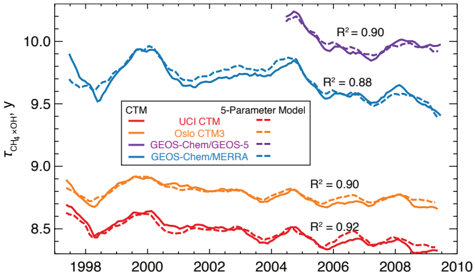
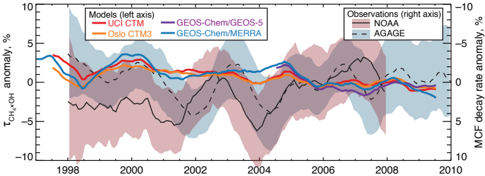
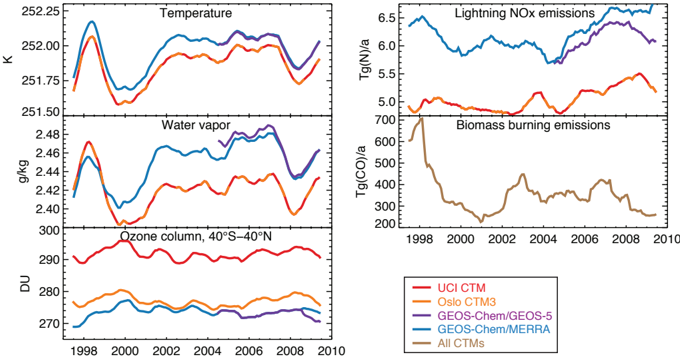
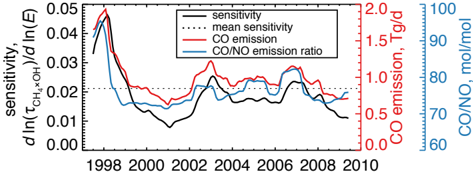
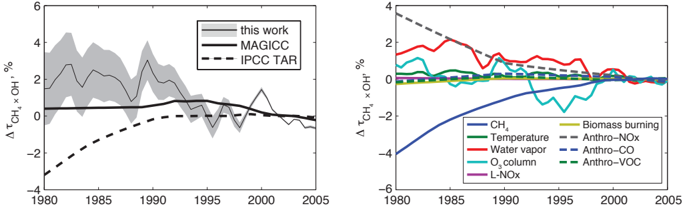
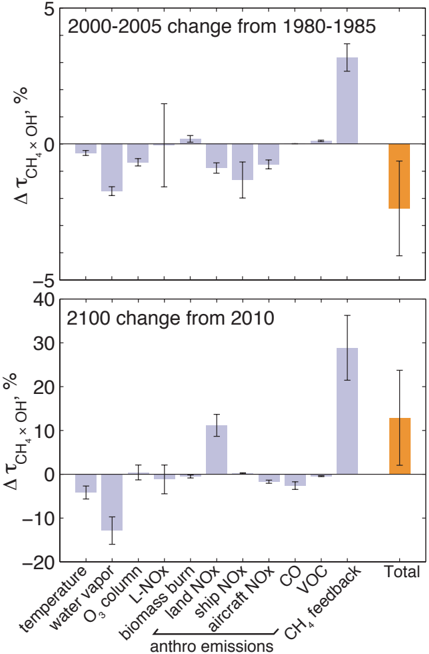
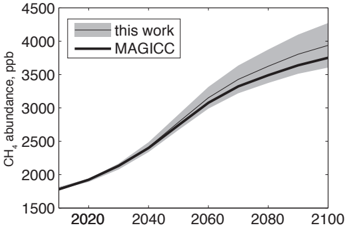
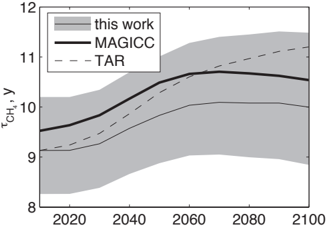
Accurate prediction of future methane abundances following a climate scenario requires understanding the lifetime changes driven by anthropogenic emissions, meteorological factors, and chemistry-climate feedbacks. Uncertainty in any of these influences or the underlying processes implies uncertainty in future abundance and radiative forcing. We simulate methane lifetime in three chemical transport models (CTMs) – UCI CTM, GEOS-Chem, and Oslo CTM3 – over the period 1997–2009 and compare the models' year-to-year variability against constraints from global methyl chloroform observations. Using sensitivity tests, we find that temperature, water vapor, stratospheric ozone column, biomass burning and lightning NOx are the dominant sources of interannual changes in methane lifetime in all three models. We also evaluate each model's response to forcings that have impacts on decadal time scales, such as methane feedback, and anthropogenic emissions. In general, these different CTMs show similar sensitivities to the driving variables. We construct a parametric model that reproduces most of the interannual variability of each CTM and use it to predict methane lifetime from 1980 through 2100 following a specified emissions and climate scenario (RCP 8.5). The parametric model propagates uncertainties through all steps and provides a foundation for predicting methane abundances in any climate scenario. Our sensitivity tests also enable a new estimate of the methane global warming potential (GWP), accounting for stratospheric ozone effects, including those mediated by water vapor. We estimate the 100-yr GWP to be 32, which is 25% larger than past assessments.
Overview
The claims and statistics of this paper haven’t been checked yet.
Free: it reads the open-access text and checks the first 5 claims that cite a source we can check. Create a free account to check every claim.
Integrity signals
Registry
Cites
Statistics
Figures
Verification
Claims the paper makes
The claims and statistics of this paper haven’t been checked yet.
Free: it reads the open-access text and checks the first 5 claims that cite a source we can check. Create a free account to check every claim.
Claims other papers make about this one
Each is checked against this paper’s own text: does it say what the citing paper says it does?
The cited source says what the claim attributes to it.
In the citing paper
“The TROPOS CH4 lifetimes agree relatively well with other studies (e.g., Holmes et al., 2013; Voulgarakis et al., 2013; Dals ø ren et al., 2016) not only in terms of absolute numbers but also the rate of changes; a detailed comparison is presented in Table D.3.”
From The contribution of global aviation to anthropogenic climate forcing for 2000 to 2018 (2021) · cites this paper as Holmes et al., 2013
Self-check
Percentages, sums and reported differences re-computed from the paper’s own numbers.
The self-check needs the paper’s full text.
Citations
Cites
Climate change 2007: the physical science basis
Solomon, S., Qin, D., Manning, M., Marquis, M. C., Averyt, K. B., Tignor, M., Miller, H. L., & Chen, Z. (2007) · Cited by 24,695
The representative concentration pathways: an overview
van Vuuren, D. P., Edmonds, J., Kainuma, M., Riahi, K., Thomson, A., Hibbard, K., Hurtt, G. C., Kram, T., Krey, V., Lamarque, J.-F., et al. (2011) · Climatic Change · doi:10.1007/s10584-011-0148-z · Cited by 7,741
Robust Responses of the Hydrological Cycle to Global Warming
Held, I. M., & Soden, B. J. (2006) · Journal of Climate · doi:10.1175/jcli3990.1 · Cited by 4,959 · cited 2×
“GHG-driven climate warming tends to reduce convection globally (Held and Soden, 2006), but could intensify convection in some regions (Del Genio et al., 2007), so the total effect on lightning is unclear.”
BackgroundMERRA: NASA’s Modern-Era Retrospective Analysis for Research and Applications
Rienecker, M. M., Suarez, M. J., Gelaro, R., Todling, R., Bacmeister, J., Liu, E., Bosilovich, M. G., Schubert, S. D., Takacs, L., Kim, G.-K., et al. (2011) · Journal of Climate · doi:10.1175/jcli-d-11-00015.1 · Cited by 4,852
Guenther, A., Karl, T., Harley, P., Wiedinmyer, C., Palmer, P. I., & Geron, C. (2006) · Atmospheric Chemistry and Physics · doi:10.5194/acp-6-3181-2006 · Cited by 4,603
Solomon, S. (2007) · Medical Entomology and Zoology · Cited by 4,149
The RCP greenhouse gas concentrations and their extensions from 1765 to 2300
Meinshausen, M., Smith, S. J., Calvin, K., Daniel, J. S., Kainuma, M. L. T., Lamarque, J.-F., Matsumoto, K., Montzka, S. A., Raper, S. C. B., Riahi, K., et al. (2011) · Climatic Change · doi:10.1007/s10584-011-0156-z · Cited by 3,584
IPCC (2007): Climate Change The Physical Science Basis
Solomon, S. (2007) · AGU Fall Meeting Abstracts · Cited by 3,476
(2010) · doi:10.5194/acp-10-11707-2010 · Cited by 2,859
Lamarque, J.-F., Bond, T. C., Eyring, V., Granier, C., Heil, A., Klimont, Z., Lee, D., Liousse, C., Mieville, A., Owen, B., et al. (2010) · Atmospheric Chemistry and Physics · doi:10.5194/acp-10-7017-2010 · Cited by 2,105
Research works printed but not linked: 5
- Prather, M., Ehhalt, D., Dentener, F., Derwent, R., Dlugokencky, E., Holland, E., Isaksen, I., Katima, J., Kirchhoff, V., Matson, P., Midgley, P., and Wang, M.: Atmospheric Chemistry and Green- house Gases, in Climate Change 2001: The Scientific Basis. Third Assessment Report of the Intergovernmental Panel on Cli- mate Change, edited by: Houghton, J., Ding, Y., Griggs, D., Noguer, M., van der Linden, P., Dai, X., Maskell, K., and John- son, C., Cambridge University Press, Cambridge, UK. 2001.
- Price, C. and Rind, D.: Modeling global lightning distributions in a general circulation model, Mon. Weather Rev., 122, 1930- 1939, 1994. · doi:10.1175/1520-0493(1994)122
- Ramaswamy, V., Boucher, O., Haigh, J., Hauglustaine, D., Hay- wood, J., Myhre, G., Nakajima, T., Shi, G. Y., and Solomon, S.: Radiative Forcing of Climate Change, in Cliamte Change 2001: The Scientific Basis. Third Assessment Report of the Intergov- ernmental Panel on Climate Change, edited by: Houghton, J. T., Ding, Y., Griggs, D., Noguer, M., van der Linden, P. J., Dai, X., Maskell, K., and Johnson, C., Cambridge University Press, Cam- bridge, UK. 2001.
- Shine, K. P., Fouquart, Y., Ramaswamy, V., Solomon, S., and Srini- vasan, J.: Radiative Forcing, in Climate Change 1994: Radia- tive Forcing of Climate Change and An Evaluation of the IPCC IS92 Emission Scenarios. Reports of Working Groups I and III C. D. Holmes et al.: Future methane, hydroxyl, and their uncertainties of the Intergovernmental Panel of Climate Change, edited by: Houghton, J., Meira Filho, L., Bruce, J., Lee, H., Callander, B., Haites, E., Harris, N., and Maskell, K., Cambridge University Press, Cambridge, 1995.
- Tiedtke, M.: A comprehensive mass flux scheme for cumulus pa- rameterization in large-scale models, Mon. Weather Rev., 117, 1779-1800, 1989. · doi:10.1175/1520-0493(1989)117
Cited by
The Global Methane Budget 2000–2017
Saunois, M., Stavert, A. R., Poulter, B., Bousquet, P., Canadell, J. G., Jackson, R. B., Raymond, P. A., Dlugokencky, E. J., Houweling, S., Patra, P. K., et al. (2019) · doi:10.5194/essd-2019-128 · Cited by 2,760
“OH concentrations and their changes can be sensitive to climate variability (Dlugokencky et al., 1996; Holmes et al., 2013; Turner et al., 2018), biomass burning (Voulgarakis et al.”
The Global Methane Budget 2000–2017
Saunois, M., Stavert, A. R., Poulter, B., Bousquet, P., Canadell, J. G., Jackson, R. B., Raymond, P. A., Dlugokencky, E. J., Houweling, S., Patra, P. K., et al. (2020) · Earth System Science Data · doi:10.5194/essd-12-1561-2020 · Cited by 2,711
The shared socio-economic pathway (SSP) greenhouse gas concentrations and their extensions to 2500
Meinshausen, M., Nicholls, Z. R. J., Lewis, J., Gidden, M. J., Vogel, E., Freund, M., Beyerle, U., Gessner, C., Nauels, A., Bauer, N., et al. (2020) · Geoscientific Model Development · doi:10.5194/gmd-13-3571-2020 · Cited by 1,815
The contribution of global aviation to anthropogenic climate forcing for 2000 to 2018
Lee, D. S., Fahey, D. W., Skowron, A., Allen, M. R., Burkhardt, U., Chen, Q., Doherty, S. J., Freeman, S., Forster, P. M., Fuglestvedt, J., et al. (2021) · Atmospheric Environment · doi:10.1016/j.atmosenv.2020.117834 · Cited by 1,957
(2019) · doi:10.5194/gmd-12-1443-2019 · Cited by 1,093
The global methane budget 2000–2012
Saunois, M., Bousquet, P., Poulter, B., Peregon, A., Ciais, P., Canadell, J. G., Dlugokencky, E. J., Etiope, G., Bastviken, D., Houweling, S., et al. (2016) · Earth System Science Data · doi:10.5194/essd-8-697-2016 · Cited by 1,060
Near-term Climate Change: Projections and Predictability
(2014) · Climate Change 2013 – The Physical Science Basis · doi:10.1017/cbo9781107415324.023 · Cited by 860
Nisbet, E. G., Manning, M. R., Dlugokencky, E. J., Fisher, R. E., Lowry, D., Michel, S. E., Myhre, C. L., Platt, S. M., Allen, G., Bousquet, P., et al. (2019) · Global Biogeochemical Cycles · doi:10.1029/2018gb006009 · Cited by 735
“As OH destruction is likely modulated by strong changes in meteorology (Holmes et al., 2013), such as may have taken place in the past decade in tropical mid-tropospheric moisture and cloud structure, it is possible that significant inter-annual variability in OH destruction may indeed occur, though detailed mechanism…”
BackgroundResultInfluentialSelf-citation(2023) · Climate Change 2021 – The Physical Science Basis · doi:10.1017/9781009157896.008 · Cited by 637
Air Quality and Climate Connections
Fiore, A. M., Naik, V., & Leibensperger, E. M. (2015) · Journal of the Air & Waste Management Association · doi:10.1080/10962247.2015.1040526 · Cited by 537
“…CH4 emissions prolong the lifetime of CH4; the estimated time scale for oxidation of a pulse of CH4 emitted today is ~12 years (Ehhalt et al., 2001; Holmes et al., 2013; Fiore et al., 2009), as compared to the estimated atmospheric lifetime (burden divided by emission rate) of 9.1 ± 0.09 years…”
BackgroundInfluentialChemistry and the Linkages between Air Quality and Climate Change
von Schneidemesser, E., Monks, P. S., Allan, J. D., Bruhwiler, L., Forster, P., Fowler, D., Lauer, A., Morgan, W. T., Paasonen, P., Righi, M., et al. (2015) · Chemical Reviews · doi:10.1021/acs.chemrev.5b00089 · Cited by 522
Global Methane Budget 2000–2020
Saunois, M., Martinez, A., Poulter, B., Zhang, Z., Raymond, P. A., Regnier, P., Canadell, J. G., Jackson, R. B., Patra, P. K., Bousquet, P., et al. (2025) · Earth System Science Data · doi:10.5194/essd-17-1873-2025 · Cited by 427
Interpreting contemporary trends in atmospheric methane
Turner, A. J., Frankenberg, C., & Kort, E. A. (2019) · Proceedings of the National Academy of Sciences · doi:10.1073/pnas.1814297116 · Cited by 426
Methane Mitigation: Methods to Reduce Emissions, on the Path to the Paris Agreement
Nisbet, E. G., Fisher, R. E., Lowry, D., France, J. L., Allen, G., Bakkaloglu, S., Broderick, T. J., Cain, M., Coleman, M., Fernandez, J., et al. (2020) · Reviews of Geophysics · doi:10.1029/2019rg000675 · Cited by 405
Analysis of present-day and future OH and methane lifetime in the ACCMIP simulations
Voulgarakis, A., Naik, V., Lamarque, J.-F., Shindell, D. T., Young, P. J., Prather, M. J., Wild, O., Field, R. D., Bergmann, D., Cameron-Smith, P., et al. (2013) · Atmospheric chemistry and physics · doi:10.5194/acp-13-2563-2013 · Cited by 324
Host genetics and the rumen microbiome jointly associate with methane emissions in dairy cows
Difford, G. F., Plichta, D. R., Løvendahl, P., Lassen, J., Noel, S. J., Højberg, O., Wright, A.-D. G., Zhu, Z., Kristensen, L., Nielsen, H. B., et al. (2018) · PLOS Genetics · doi:10.1371/journal.pgen.1007580 · Cited by 382
“The FTIR and NDIR device inlets were installed in the AMS feed bins and methane (CH4) and carbon dioxide (CO2) gas concentrations (ppm) sampled continuously every 5 s and 1 s, respectively[66,67].”
BackgroundInfluentialAmbiguity in the causes for decadal trends in atmospheric methane and hydroxyl
Turner, A. J., Frankenberg, C., Wennberg, P. O., & Jacob, D. J. (2017) · Proceedings of the National Academy of Sciences · doi:10.1073/pnas.1616020114 · Cited by 379
“For example, changes in J ( O(1)D ) due to stratospheric ozone could provide a large enough change in OH (37) but the changes in stratospheric ozone are only weakly correlated with the OH anomalies derived here (SI Appendix, section 5).”
BackgroundNaik, V., Voulgarakis, A., Fiore, A. M., Horowitz, L. W., Lamarque, J.-F., Lin, M., Prather, M. J., Young, P. J., Bergmann, D., Cameron-Smith, P. J., et al. (2013) · Atmospheric Chemistry and Physics · doi:10.5194/acp-13-5277-2013 · Cited by 371
FAIR v1.3: a simple emissions-based impulse response and carbon cycle model
Smith, C. J., Forster, P. M., Allen, M., Leach, N., Millar, R. J., Passerello, G. A., & Regayre, L. A. (2018) · Geoscientific Model Development · doi:10.5194/gmd-11-2273-2018 · Cited by 317
“34; Holmes et al. (2013), also used in AR5) and is used for perturbation calculations against a constant background concentration.”
InfluentialBergamaschi, P., Houweling, S., Segers, A., Krol, M., Frankenberg, C., Scheepmaker, R. A., Dlugokencky, E., Wofsy, S. C., Kort, E. A., Sweeney, C., et al. (2013) · Journal of Geophysical Research: Atmospheres · doi:10.1002/jgrd.50480 · Cited by 316
“[Holmes et al., 2013; Montzka et al., 2011], while estimates based on MCF observations are somewhat higher (up to ~5”
BackgroundPrevotella: A Key Player in Ruminal Metabolism
Betancur-Murillo, C. L., Aguilar-Marín, S. B., & Jovel, J. (2022) · Microorganisms · doi:10.3390/microorganisms11010001 · Cited by 277
Maasakkers, J. D., Jacob, D. J., Sulprizio, M. P., Scarpelli, T. R., Nesser, H., Sheng, J.-X., Zhang, Y., Hersher, M., Bloom, A. A., Bowman, K. W., et al. (2019) · Atmospheric Chemistry and Physics · doi:10.5194/acp-19-7859-2019 · Cited by 280
“Atmospheric methane has a lifetime of 9.1±0.9 years (Prather et al., 2012), with a dominant sink from oxidation by the hydroxyl radical (OH) that is also subject to interannual variability and trends (Holmes et al., 2013).”
InfluentialA multi-model assessment of the Global Warming Potential of hydrogen
Sand, M., Skeie, R. B., Sandstad, M., Krishnan, S., Myhre, G., Bryant, H., Derwent, R., Hauglustaine, D., Paulot, F., Prather, M., et al. (2023) · Communications Earth & Environment · doi:10.1038/s43247-023-00857-8 · Cited by 250
Young people's burden: requirement of negative CO 2 emissions
Hansen, J., Sato, M., Kharecha, P., von Schuckmann, K., Beerling, D. J., Cao, J., Marcott, S., Masson-Delmotte, V., Prather, M. J., Rohling, E. J., et al. (2017) · Earth System Dynamics · doi:10.5194/esd-8-577-2017 · Cited by 266
Contrasting the direct radiative effect and direct radiative forcing of aerosols
Heald, C. L., Ridley, D. A., Kroll, J. H., Barrett, S. R. H., Cady-Pereira, K. E., Alvarado, M. J., & Holmes, C. D. (2014) · Atmospheric Chemistry and Physics · doi:10.5194/acp-14-5513-2014 · Cited by 227
Lightning NO x and Impacts on Air Quality
Murray, L. T. (2016) · Current Pollution Reports · doi:10.1007/s40726-016-0031-7 · Cited by 210
“Global mean OH is particularly sensitive to lightning NOx because of the location and altitude of its production and because lightning lacks co-emission of reduced carbon species that would counteract the NOx influence [Labrador, 2004; Holmes et al, 2013; Murray et al, 2013, 2014].”
BackgroundInfluentialPath-dependent reductions in CO2 emission budgets caused by permafrost carbon release
Gasser, T., Kechiar, M., Ciais, P., Burke, E. J., Kleinen, T., Zhu, D., Huang, Y., Ekici, A., & Obersteiner, M. (2018) · Nature Geoscience · doi:10.1038/s41561-018-0227-0 · Cited by 184
Improved Mechanistic Model of the Atmospheric Redox Chemistry of Mercury
Shah, V., Jacob, D. J., Thackray, C. P., Wang, X., Sunderland, E. M., Dibble, T. S., Saiz-Lopez, A., Černušák, I., Kellö, V., Castro, P. J., et al. (2021) · Environmental Science & Technology · doi:10.1021/acs.est.1c03160 · Cited by 182
Leach, N. J., Jenkins, S., Nicholls, Z., Smith, C. J., Lynch, J., Cain, M., Walsh, T., Wu, B., Tsutsui, J., & Allen, M. R. (2021) · Geoscientific Model Development · doi:10.5194/gmd-14-3007-2021 · Cited by 175
Remote sensing of methane leakage from natural gas and petroleum systems revisited
Schneising, O., Buchwitz, M., Reuter, M., Vanselow, S., Bovensmann, H., & Burrows, J. P. (2020) · Atmospheric Chemistry and Physics · doi:10.5194/acp-20-9169-2020 · Cited by 178
Lu, X., Jacob, D. J., Zhang, Y., Maasakkers, J. D., Sulprizio, M. P., Shen, L., Qu, Z., Scarpelli, T. R., Nesser, H., Yantosca, R. M., et al. (2021) · Atmospheric Chemistry and Physics · doi:10.5194/acp-21-4637-2021 · Cited by 172
Trends in global tropospheric hydroxyl radical and methane lifetime since 1850 from AerChemMIP
Stevenson, D. S., Zhao, A., Naik, V., O'Connor, F. M., Tilmes, S., Zeng, G., Murray, L. T., Collins, W. J., Griffiths, P. T., Shim, S., et al. (2020) · Atmospheric Chemistry and Physics · doi:10.5194/acp-20-12905-2020 · Cited by 159
Observational evidence for interhemispheric hydroxyl-radical parity
Patra, P. K., Krol, M. C., Montzka, S. A., Arnold, T., Atlas, E. L., Lintner, B. R., Stephens, B. B., Xiang, B., Elkins, J. W., Fraser, P. J., et al. (2014) · Nature · doi:10.1038/nature13721 · Cited by 163
CarbonTracker-CH 4 : an assimilation system for estimating emissions of atmospheric methane
Bruhwiler, L., Dlugokencky, E., Masarie, K., Ishizawa, M., Andrews, A., Miller, J., Sweeney, C., Tans, P., & Worthy, D. (2014) · Atmospheric Chemistry and Physics · doi:10.5194/acp-14-8269-2014 · Cited by 162
“1 yr (Holmes et al., 2013) with CO2 the eventual product of its oxidation.”
BackgroundInfluentialHouweling, S., Krol, M., Bergamaschi, P., Frankenberg, C., Dlugokencky, E. J., Morino, I., Notholt, J., Sherlock, V., Wunch, D., Beck, V., et al. (2014) · Atmospheric Chemistry and Physics · doi:10.5194/acp-14-3991-2014 · Cited by 158
Schneising, O., Buchwitz, M., Reuter, M., Bovensmann, H., Burrows, J. P., Borsdorff, T., Deutscher, N. M., Feist, D. G., GRIFFITH, D. W. T., Hase, F., et al. (2019) · Atmospheric measurement techniques · doi:10.5194/amt-12-6771-2019 · Cited by 186
Wolfe, G. M., Nicely, J. M., Clair, J. M. S., Hanisco, T. F., Liao, J., Oman, L. D., Brune, W. H., Miller, D. O., Thames, A. B., Abad, G. G., et al. (2019) · Proceedings of the National Academy of Sciences · doi:10.1073/pnas.1821661116 · Cited by 164
“Models also struggle to capture interannual variability (2, 3) and hemispheric gradients (4) in OH.”
BackgroundVariability and quasi-decadal changes in the methane budget over the period 2000–2012
Saunois, M., Bousquet, P., Poulter, B., Peregon, A., Ciais, P., Canadell, J. G., Dlugokencky, E. J., Etiope, G., Bastviken, D., Houweling, S., et al. (2017) · Atmospheric Chemistry and Physics · doi:10.5194/acp-17-11135-2017 · Cited by 146
Global inverse modeling of CH 4 sources and sinks: an overview of methods
Houweling, S., Bergamaschi, P., Chevallier, F., Heimann, M., Kaminski, T., Krol, M., Michalak, A. M., & Patra, P. (2017) · Atmospheric Chemistry and Physics · doi:10.5194/acp-17-235-2017 · Cited by 140
“, 2011), and the associated uncertainties (Holmes et al., 2013; Voulgarakis et al., 2013; Naik et al., 2013), these methods are not satisfactory.”
The NASA Atmospheric Tomography (ATom) Mission: Imaging the Chemistry of the Global Atmosphere
Thompson, C. R., Wofsy, S. C., Prather, M. J., Newman, P. A., Hanisco, T. F., Ryerson, T. B., Fahey, D. W., Apel, E. C., Brock, C. A., Brune, W. H., et al. (2021) · Bulletin of the American Meteorological Society · doi:10.1175/bams-d-20-0315.1 · Cited by 165
“These oceanic regions are important for global air quality and climate, accounting on average for an estimated 75% of global CH4 removal, 59% of chemical production of tropospheric O3, and 68% of chemical destruction of tropospheric O3; these chemical reactivities are particularly sensitive to changes in the intensity…”
BackgroundHolmes, C. D., Bertram, T. H., Confer, K., Graham, K. A., Ronan, A. C., Wirks, C., & Shah, V. P. (2019) · Geophysical Research Letters · doi:10.1029/2019gl081990 · Cited by 155
Zhao, Y., Saunois, M., Bousquet, P., Lin, X., Berchet, A., Hegglin, M. I., Canadell, J. G., Jackson, R. B., Hauglustaine, D. A., Szopa, S., et al. (2019) · Atmospheric Chemistry and Physics · doi:10.5194/acp-19-13701-2019 · Cited by 134
“4 %, consistent with the ACCMIP project (Naik et al., 2013) and with other atmospheric chemistry model studies (Dentener et al., 2003; John et al., 2012; Holmes et al., 2013; Dalsøren et al., 2016).”
BackgroundMethodEllis, R. A., Jacob, D. J., Sulprizio, M. P., Zhang, L., Holmes, C. D., Schichtel, B. A., Blett, T. F., Porter, E. M., Pardo, L. H., & Lynch, J. (2013) · Atmospheric chemistry and physics · doi:10.5194/acp-13-9083-2013 · Cited by 144
Methane and Global Environmental Change
Reay, D., Smith, P., Christensen, T. R., James, R. H., & Clark, H. (2018) · Annual Review of Environment and Resources · doi:10.1146/annurev-environ-102017-030154 · Cited by 157
“Increases in UV radiation (due to stratospheric ozone depletion), humidity and temperature (due to climate change), and ozone and NOx concentrations (due to both climate change and anthropogenic emissions) can all increase OH abundance (13).”
BackgroundMurray, L. T., Mickley, L. J., Kaplan, J. O., Sofen, E. D., Pfeiffer, M., & Alexander, B. (2014) · Atmospheric Chemistry and Physics · doi:10.5194/acp-14-3589-2014 · Cited by 127
Interannual variability in tropical tropospheric ozone and OH: The role of lightning
Murray, L. T., Logan, J. A., & Jacob, D. J. (2013) · Journal of Geophysical Research: Atmospheres · doi:10.1002/jgrd.50857 · Cited by 120
“We find that stratospheric ozone22 plays little role in driving IAV in OH during 1998-2006, in contrast to pre-23 vious studies that examined different periods.24 D R A F T April 27, 2013, 9:50am D R A F T”
ResultLin, H., Jacob, D. J., Lundgren, E. W., Sulprizio, M. P., Keller, C. A., Fritz, T. M., Eastham, S. D., Emmons, L. K., Campbell, P., Baker, B., et al. (2021) · Geoscientific model development · doi:10.5194/gmd-14-5487-2021 · Cited by 150
Bourgeois, I., Peischl, J., Thompson, C. R., Aikin, K. C., Campos, T. L., Clark, H. L., Commane, R., Daube, B. C., Diskin, G. S., Elkins, J. W., et al. (2020) · Atmospheric chemistry and physics · doi:10.5194/acp-20-10611-2020 · Cited by 132
Methyl Chloroform Continues to Constrain the Hydroxyl (OH) Variability in the Troposphere
Patra, P. K., Krol, M. C., Prinn, R. G., Takigawa, M., Mühle, J., Montzka, S. A., Lal, S., Yamashita, Y., Naus, S., Chandra, N., et al. (2021) · Journal of Geophysical Research: Atmospheres · doi:10.1029/2020jd033862 · Cited by 98
“” This corroborates earlier findings suggesting inconsistent phasing in CH3CCl3-derived OH variability from year-to-year using data from different measurement networks and also when compared to full CTMs (Holmes et al., 2013; McNorton et al., 2016).”
BackgroundMethodInfluentialChemical Feedback From Decreasing Carbon Monoxide Emissions
Gaubert, B., Worden, H. M., Arellano, A. F. J., Emmons, L. K., Tilmes, S., Barré, J., Martinez Alonso, S., Vitt, F., Anderson, J. L., Alkemade, F., et al. (2017) · Geophysical Research Letters · doi:10.1002/2017gl074987 · Cited by 106
“…we consider that quantifying and explaining the OH trends is beyond the scope of this study since other relevant parameters such as air temperature, water vapor, ozone column, biomass burning emissions, and lightning NOx emissions have not been analyzed in detail (e.g., Holmes et al., 2013).”
BackgroundMethane Feedback on Atmospheric Chemistry: Methods, Models, and Mechanisms
Holmes, C. D. (2018) · Journal of Advances in Modeling Earth Systems · doi:10.1002/2017ms001196 · Cited by 124
Nicely, J. M., Canty, T. P., Manyin, M., Oman, L. D., Salawitch, R. J., Steenrod, S. D., Strahan, S. E., & Strode, S. A. (2018) · Journal of Geophysical Research: Atmospheres · doi:10.1029/2018jd028388 · Cited by 101
The compact Earth system model OSCAR v2.2: description and first results
Gasser, T., Ciais, P., Boucher, O., Quilcaille, Y., Tortora, M., Bopp, L., & Hauglustaine, D. (2017) · Geoscientific Model Development · doi:10.5194/gmd-10-271-2017 · Cited by 101
“(41) The functional form of Fprec can be either linear (Ehhalt et al., 2001) or logarithmic (Holmes et al., 2013).”
BackgroundInfluentialBanerjee, A., Archibald, A. T., Maycock, A. C., Telford, P., Abraham, N. L., Yang, X., Braesicke, P., & Pyle, J. A. (2014) · Atmospheric Chemistry and Physics · doi:10.5194/acp-14-9871-2014 · Cited by 99
“Any changes in HOx can affect the lifetime of methane, whose loss depends primarily on OH (Holmes et al., 2013; Murray et al., 2014).”
BackgroundMonitoring global tropospheric OH concentrations using satellite observations of atmospheric methane
Zhang, Y., Jacob, D. J., Maasakkers, J. D., Sulprizio, M. P., Sheng, J.-X., Gautam, R., & Worden, J. (2018) · Atmospheric Chemistry and Physics · doi:10.5194/acp-18-15959-2018 · Cited by 99
Space‐Based Observations for Understanding Changes in the Arctic‐Boreal Zone
Duncan, B. N., Ott, L. E., Abshire, J. B., Brucker, L., Carroll, M., Carton, J. A., Comiso, J. C., Dinnat, E. P., Forbes, B. C., Gonsamo, A., et al. (2020) · Reviews of Geophysics · doi:10.1029/2019rg000652 · Cited by 113
“Detecting CH4 and CO2 over the ABZ is particularly difficult for passive sensors, which rely on reflected sunlight, because of low sun elevation angles in spring and fall and no sun in winter, and because of atmospheric scatter from clouds and aerosols.”
BackgroundInfluentialAtmospheric methane evolution the last 40 years
Dalsøren, S. B., Myhre, C. L., Myhre, G., Gomez-Pelaez, A. J., Søvde, O. A., Isaksen, I. S. A., Weiss, R. F., & Harth, C. M. (2016) · Atmospheric chemistry and physics · doi:10.5194/acp-16-3099-2016 · Cited by 96
“Previous studies have shown a strong influence of ENSO events on CH4 (Holmes et al., 2013; Warwick et al., 2002; Johnson et al., 2002).”
BackgroundResultSelf-citationRole of OH variability in the stalling of the global atmospheric CH 4 growth rate from 1999 to 2006
McNorton, J., Chipperfield, M. P., Gloor, M., Wilson, C., Feng, W., Hayman, G. D., Rigby, M., Krummel, P. B., O'Doherty, S., Prinn, R. G., et al. (2016) · Atmospheric Chemistry and Physics · doi:10.5194/acp-16-7943-2016 · Cited by 94
Large uncertainties in global hydroxyl projections tied to fate of reactive nitrogen and carbon
Murray, L. T., Fiore, A. M., Shindell, D. T., Naïk, V., & Horowitz, L. W. (2021) · Proceedings of the National Academy of Sciences · doi:10.1073/pnas.2115204118 · Cited by 93
Methane emissions from Alaska in 2012 from CARVE airborne observations
Chang, R. Y.-W., Miller, C. E., Dinardo, S. J., Karion, A., Sweeney, C., Daube, B. C., Henderson, J. M., Mountain, M. E., Eluszkiewicz, J., Miller, J. B., et al. (2014) · Proceedings of the National Academy of Sciences · doi:10.1073/pnas.1412953111 · Cited by 91
Modulation of hydroxyl variability by ENSO in the absence of external forcing
Turner, A. J., Fung, I., Naik, V., Horowitz, L. W., & Cohen, R. C. (2018) · Proceedings of the National Academy of Sciences · doi:10.1073/pnas.1807532115 · Cited by 90
Skeie, R. B., Hodnebrog, Ø., & Myhre, G. (2023) · Communications Earth & Environment · doi:10.1038/s43247-023-00969-1 · Cited by 117
Perspectives on removal of atmospheric methane
Ming, T., Li, W., Yuan, Q., Davies, P. A., de Richter, R. K., Peng, C., Deng, Q., Yuan, Y., Caillol, S., & Zhou, N. (2022) · Advances in Applied Energy · doi:10.1016/j.adapen.2022.100085 · Cited by 95
“Moreover, because CH 4 depletes the atmospheric reservoir of hydroxyl radicals responsible for removing CH 4 itself, large additions of CH 4 to the atmosphere extends the lifetime and GWP of the CH 4 already in the atmosphere [41, 42].”
BackgroundDelhaye, D., Ouf, F. X., Ferry, D., Ortega, I. K., Penanhoat, O., Peillon, S., Salm, F., Vancassel, X., Focşa, C., Irimiea, C., et al. (2016) · Journal of Aerosol Science · doi:10.1016/j.jaerosci.2016.11.018 · Cited by 96
Hall, S. R., Ullmann, K., Prather, M. J., Flynn, C. M., Murray, L. T., Fiore, A. M., Correa, G. J. P., Strode, S. A., Steenrod, S. D., Lamarque, J., et al. (2018) · Atmospheric chemistry and physics · doi:10.5194/acp-18-16809-2018 · Cited by 95
Yin, Y., Chevallier, F., Ciais, P., Bousquet, P., Saunois, M., Zheng, B., Worden, J. R., Bloom, A. A., Parker, R. J., Jacob, D. J., et al. (2021) · Atmospheric chemistry and physics · doi:10.5194/acp-21-12631-2021 · Cited by 98
Black Carbon Emissions from Associated Natural Gas Flaring
Weyant, C. L., Shepson, P. B., Subramanian, R., Cambaliza, M. O., Heimburger, A. M. F., McCabe, D. C., Baum, E., Stirm, B. H., & Bond, T. C. (2016) · Environmental Science & Technology · doi:10.1021/acs.est.5b04712 · Cited by 84
Madronich, S., Shao, M., Wilson, S. R., Solomon, K. R., Longstreth, J. D., & Tang, X. Y. (2014) · Photochemical & Photobiological Sciences · doi:10.1039/c4pp90037e · Cited by 79
Isotopic evidence of multiple controls on atmospheric oxidants over climate transitions
Geng, L., Murray, L. T., Mickley, L. J., Lin, P., Fu, Q., Schauer, A. J., & Alexander, B. (2017) · Nature · doi:10.1038/nature22340 · Cited by 83
Assessment of pre-industrial to present-day anthropogenic climate forcing in UKESM1
O’Connor, F. M., Abraham, N. L., Dalvi, M., Folberth, G., Griffiths, P. T., Hardacre, C. J., Johnson, B. T. T., Kahana, R., Keeble, J., Kim, B., et al. (2021) · Atmospheric chemistry and physics · doi:10.5194/acp-21-1211-2021 · Cited by 94
The impact of future emission policies on tropospheric ozone using a parameterised approach
Turnock, S. T., Wild, O., Dentener, F. J., Davila, Y., Emmons, L. K., Flemming, J., Folberth, G., Henze, D. K., Jonson, J. E., Keating, T. J., et al. (2018) · Atmospheric chemistry and physics · doi:10.5194/acp-18-8953-2018 · Cited by 91
Schnell, J. L., Prather, M. J., Josse, B., Naïk, V., Horowitz, L. W., Cameron-Smith, P. J., Bergmann, D. J., Zeng, G., Plummer, D. A., Sudo, K., et al. (2015) · Atmospheric chemistry and physics · doi:10.5194/acp-15-10581-2015 · Cited by 78
Rowlinson, M. J., Rap, A., Arnold, S. R., Pope, R. J., Chipperfield, M. P., McNorton, J., Forster, P., Gordon, H., Pringle, K. J., Feng, W., et al. (2019) · Atmospheric Chemistry and Physics · doi:10.5194/acp-19-8669-2019 · Cited by 68
On the Causes and Consequences of Recent Trends in Atmospheric Methane
Schaefer, H. (2019) · Current Climate Change Reports · doi:10.1007/s40641-019-00140-z · Cited by 87
Erickson, D. J., Sulzberger, B., Zepp, R. G., & Austin, A. T. (2014) · Photochemical & Photobiological Sciences · doi:10.1039/c4pp90036g · Cited by 69
On the role of trend and variability in the hydroxyl radical (OH) in the global methane budget
Zhao, Y., Saunois, M., Bousquet, P., Lin, X., Berchet, A., Hegglin, M. I., Canadell, J. G., Jackson, R. B., Deushi, M., Jöckel, P., et al. (2020) · Atmospheric Chemistry and Physics · doi:10.5194/acp-20-13011-2020 · Cited by 69
“…of OH to changes in biomass burning, ozone, water vapor, and lightning NO x emissions during El Niño years have been recognized by previous studies (Holmes et al., 2013; Murray et al., 2014; Turner et al., 2018; Rowlinson et al., 2019; Nguyen et al., 2020) Here, the consistent temporal…”
MethodStrode, S. A., Duncan, B. N., Yegorova, E., Kouatchou, J., Ziemke, J. R., & Douglass, A. R. (2015) · Atmospheric chemistry and physics · doi:10.5194/acp-15-11789-2015 · Cited by 75
Overexplaining or underexplaining methane’s role in climate change
Prather, M. J., & Holmes, C. D. (2017) · Proceedings of the National Academy of Sciences · doi:10.1073/pnas.1704884114 · Cited by 64
Emission metrics for quantifying regional climate impacts of aviation
Lund, M. T., Aamaas, B., Berntsen, T., Bock, L., Burkhardt, U., Fuglestvedt, J. S., & Shine, K. P. (2017) · Earth System Dynamics · doi:10.5194/esd-8-547-2017 · Cited by 63
Key drivers of ozone change and its radiative forcing over the 21st century
Iglesias‐Suarez, F., Kinnison, D. E., Rap, A., Maycock, A. C., Wild, O., & Young, P. J. (2018) · Atmospheric chemistry and physics · doi:10.5194/acp-18-6121-2018 · Cited by 74
Algorithmic climate change functions for the use in eco-efficient flight planning
van Manen, J., & Grewe, V. (2018) · Transportation Research Part D Transport and Environment · doi:10.1016/j.trd.2018.12.016 · Cited by 73
Stratospheric ozone changes under solar geoengineering: implications for UV exposure and air quality
Nowack, P. J., Abraham, N. L., Braesicke, P., & Pyle, J. A. (2016) · Atmospheric Chemistry and Physics · doi:10.5194/acp-16-4191-2016 · Cited by 61
“We note that the increase in ozone found here could also lead to a change in the lifetime of the greenhouse gas methane in a geoengineered climate (Holmes et al., 2013; Morgenstern et al., 2013) and thus in the amount of solar geoengineering needed to offset the anthropogenic greenhouse gas forcing.”
BackgroundGlobal atmospheric chemistry – which air matters
Prather, M. J., Zhu, X., Flynn, C. M., Strode, S. A., Rodriguez, J. M., Steenrod, S. D., Liu, J., Lamarque, J.-F., Fiore, A. M., Horowitz, L. W., et al. (2017) · Atmospheric Chemistry and Physics · doi:10.5194/acp-17-9081-2017 · Cited by 60
Schmitz, R. A., Pol, A., Mohammadi, S. S., Hogendoorn, C., van Gelder, A. H., Jetten, M. S. M., Daumann, L. J., & den Camp, H. J. M. O. (2020) · The ISME Journal · doi:10.1038/s41396-020-0609-3 · Cited by 62
Cedeno, F. R. P., Olubiyo, O. J., & Ferreira, S. (2025) · Journal of Biological Engineering · doi:10.1186/s13036-025-00509-9 · Cited by 80
“Methane, although short-lived compared to CO 2 , has a high global warming potential, with estimates suggesting it is 28 to 36 times more effective at trapping heat than CO 2 , over a 100-year period [15].”
Climate versus emission drivers of methane lifetime against loss by tropospheric OH from 1860–2100
John, J. G., Fiore, A. M., Naik, V., Horowitz, L. W., & Dunne, J. P. (2012) · Atmospheric Chemistry and Physics · doi:10.5194/acp-12-12021-2012 · Cited by 57
Horowitz, H. M., Holmes, C. D., Wright, A., Sherwen, T., Wang, X., Evans, M. J., Huang, J., Jaeglé, L., Chen, Q., Zhai, S., et al. (2020) · Geophysical Research Letters · doi:10.1029/2019gl085838 · Cited by 78
“We calculate the change in steady state methane concentrations based on the change in simulated methane lifetime and feedback of methane on its own loss rate following Holmes et al. (2013) and Holmes (2018).”
BackgroundMethodThe climate impact of ship NO x emissions: an improved estimate accounting for plume chemistry
Holmes, C. D., Prather, M. J., & Vinken, G. C. M. (2014) · Atmospheric chemistry and physics · doi:10.5194/acp-14-6801-2014 · Cited by 70
Zhao, Y., Saunois, M., Bousquet, P., Lin, X., Berchet, A., Hegglin, M. I., Canadell, J. G., Jackson, R. B., Dlugokencky, E. J., Langenfelds, R. L., et al. (2020) · Atmospheric Chemistry and Physics · doi:10.5194/acp-20-9525-2020 · Cited by 57
Barker, P., Allen, G., Gallagher, M. W., Pitt, J., Fisher, R., Bannan, T. J., Nisbet, E. G., Bauguitte, S. J.-B., Pasternak, D., Cliff, S., et al. (2020) · Atmospheric chemistry and physics · doi:10.5194/acp-20-15443-2020 · Cited by 62
Alexander, B., & Mickley, L. J. (2015) · Current Pollution Reports · doi:10.1007/s40726-015-0006-0 · Cited by 61
“5 lengthens the methane lifetime, resulting in a positive feedback for this key greenhouse gas [13, 135].”
BackgroundA machine learning examination of hydroxyl radical differences among model simulations for CCMI-1
Nicely, J. M., Duncan, B. N., Hanisco, T. F., Wolfe, G. M., Salawitch, R. J., Deushi, M., Haslerud, A. S., Jöckel, P., Josse, B., Kinnison, D. E., et al. (2020) · Atmospheric Chemistry and Physics · doi:10.5194/acp-20-1341-2020 · Cited by 52
Nitrogen Dioxide Pollution as a Signature of Extraterrestrial Technology
Kopparapu, R., Arney, G., Haqq-Misra, J., Lustig‐Yaeger, J., & Villanueva, G. (2021) · The Astrophysical Journal · doi:10.3847/1538-4357/abd7f7 · Cited by 63
Frömming, C., Grewe, V., Brinkop, S., Jöckel, P., Haslerud, A. S., Rosanka, S., van Manen, J., & Matthes, S. (2021) · Atmospheric chemistry and physics · doi:10.5194/acp-21-9151-2021 · Cited by 72
The impact of historical land use change from 1850 to 2000 on secondary particulate matter and ozone
Heald, C. L., & Geddes, J. A. (2016) · Atmospheric chemistry and physics · doi:10.5194/acp-16-14997-2016 · Cited by 58
Sofen, E. D., Alexander, B., Steig, E. J., Thiemens, M. H., Kunasek, S. A., Amos, H. M., Schauer, A. J., Hastings, M. G., Bautista, J., Jackson, T. L., et al. (2014) · Atmospheric chemistry and physics · doi:10.5194/acp-14-5749-2014 · Cited by 53
Qin, K., Lu, L., Liu, J., He, Q., Shi, J., Deng, W., Wang, S., & Cohen, J. B. (2023) · Remote Sensing of Environment · doi:10.1016/j.rse.2023.113720 · Cited by 64
Effects of Chemical Feedbacks on Decadal Methane Emissions Estimates
Nguyen, N. H., Turner, A. J., Yin, Y., Prather, M. J., & Frankenberg, C. (2020) · Geophysical Research Letters · doi:10.1029/2019gl085706 · Cited by 47
“Variations in stratospheric ozone and NOx can result in OH recycling and production variability, and these OH sources have been thought to have increased in recent decades (e.g., Holmes et al., 2013; Naik et al., 2013; Nicely et al., 2018).”
BackgroundInfluentialPolar amplification of Pliocene climate by elevated trace gas radiative forcing
Hopcroft, P. O., Ramstein, G., Pugh, T. A. M., Hunter, S. J., Murguía‐Flores, F., Quiquet, A., Sun, Y., Tan, N., & Valdes, P. J. (2020) · Proceedings of the National Academy of Sciences · doi:10.1073/pnas.2002320117 · Cited by 48
“Hence we employ 447 a parametric model (37) which is calibrated with three coupled 448 climate-chemistry transport models.”
BackgroundMethodInfluentialWhaley, C. H., Mahmood, R., von Salzen, K., Winter, B., Eckhardt, S., Arnold, S. R., Beagley, S. R., Becagli, S., Chien, R., Christensen, J. H., et al. (2022) · Atmospheric chemistry and physics · doi:10.5194/acp-22-5775-2022 · Cited by 66
Metadata
- Authors
- Holmes, C. D., Prather, M. J., Søvde, O. A., & Myhre, G.
- Affiliations
- University of California, Irvine (US)
- CICERO Center for International Climate Research (NO)
- Corresponding author
- Prather, M. J.
- Myhre, G.
- Venue
- Atmospheric chemistry and physics
- Publisher
- Copernicus GmbH
- Published
- 2013-01-11
- Volume
- 13
- Issue
- 1
- Pages
- 285-302
- ISSN
- 1680-7316 (ISSN-L)
- 1680-7324
- OpenAlex
- W2164917342
- Cited by
- 232
- References
- 93
- Citations by year
- 2026: 13 · 2025: 15 · 2024: 25 · 2023: 20 · 2022: 21 · 2021: 21 · 2020: 25 · 2019: 17 · 2018: 16 · 2017: 14 · 2016: 14 · 2015: 11 · 2014: 13 · 2013: 6
- FWCI
- 11.44
- Type
- journal article
- Language
- en
- Open access
- gold
- doi.org
- Licence
- Locations
- Atmospheric chemistry and physics (publishedVersion, cc-by)
- DOAJ (DOAJ: Directory of Open Access Journals) (submittedVersion)
- eScholarship (California Digital Library) (submittedVersion, cc-by)
- Funders
- U.S. Department of Energy (DESC0007021)
- National Aeronautics and Space Administration (NNX09AJ47G)
- Office of Science (DESC0007021)
- University of California, Irvine
- Topics
- Physical Sciences › Environmental Science › Global and Planetary Change › Atmospheric and Environmental Gas Dynamics
- Physical Sciences › Earth and Planetary Sciences › Atmospheric Science › Atmospheric Ozone and Climate
- Physical Sciences › Earth and Planetary Sciences › Atmospheric Science › Atmospheric chemistry and aerosols
- Keywords
- methane lifetime, methane abundance, hydroxyl radicals, climate change scenarios, RCP8.5, radiative forcing, error propagation, chemical transport model, interannual variability, stratospheric ozone, water vapor, lightning NOx, anthropogenic emissions
About these checks
Registry, retraction, Cites and statistics results are computed, not judged, with one exception: a printed reference that no index lists is read once by a model before it counts as a citation error. Claims are extracted by a model and kept only when their quote appears verbatim in the text; each cited source is then checked, with a model’s help, for whether it says what the claim relies on. Those verdicts can be wrong — read the claim’s quote and the cited source before relying on one.
Statistics and arithmetic are recomputed, not judged.
Confidence bands are shown only for fields calibrated on our annotated test set. None is calibrated yet, so no band is shown.
What counts as a claim ›How we measure confidence ›How we check this ›
Are you an author, or do you see a problem with this page? Request a review
Data sources
Bibliographic data: Semantic Scholar, OpenAlex, Crossref.
Contains information from the Semantic Scholar Academic Graph Datasets, made available under the ODC Attribution License (ODC-BY 1.0).
Semantic Scholar’s data is described in: Kinney, R., et al. (2023). The Semantic Scholar Open Data Platform. arXiv:2301.10140.
