

On the effects of organic matter and sulphur-containing compounds on the CCN activation of combustion particles
Open accessPublished version of a preprint
The DOI matches its Crossref record; 40 of the 40 references it cites were found in a registry or an index.
Abstract
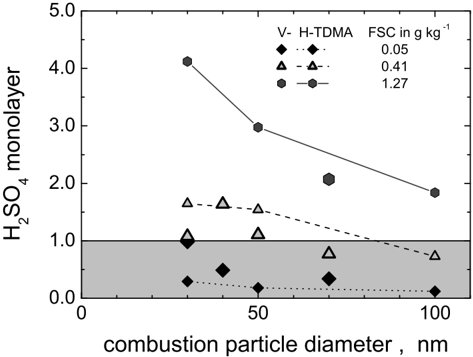
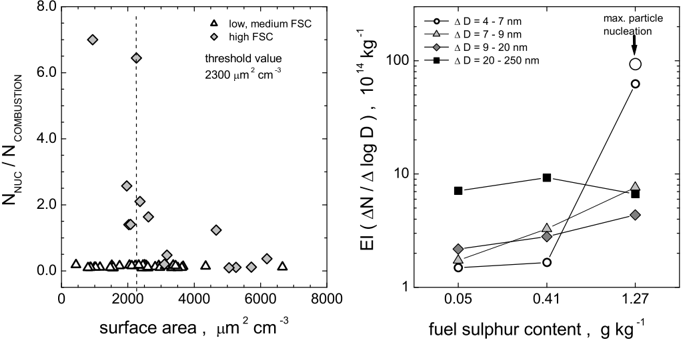
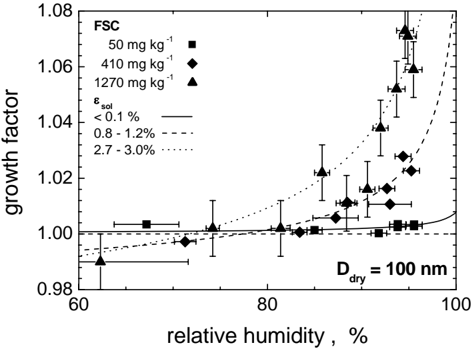
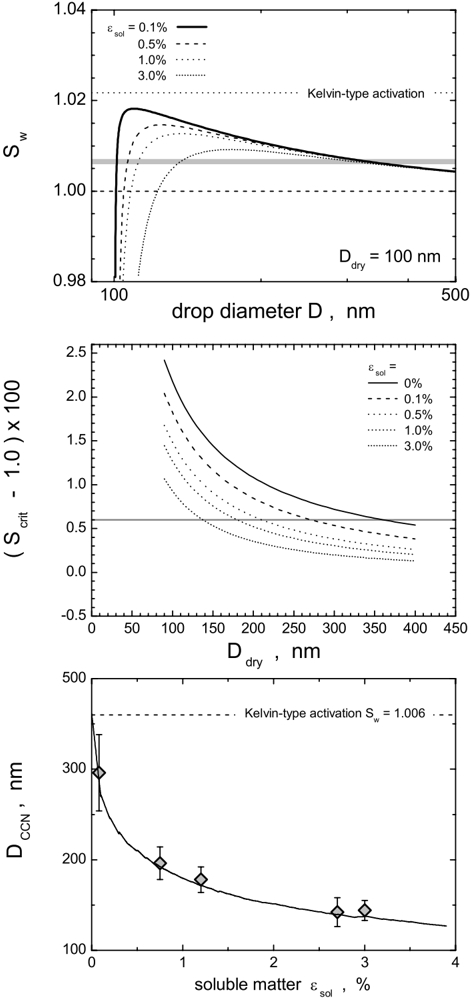
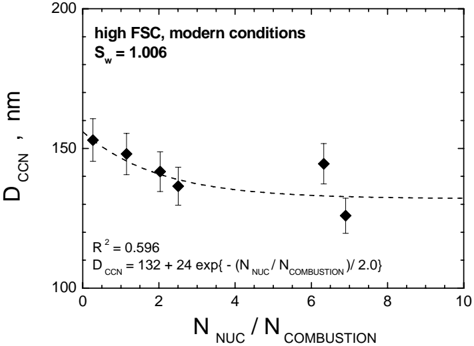
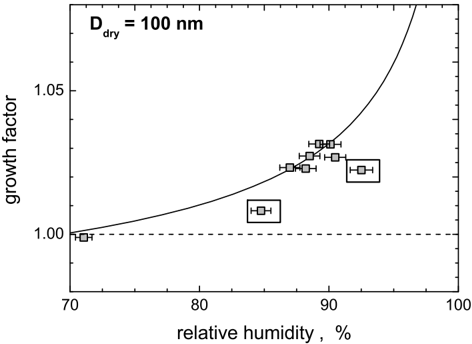
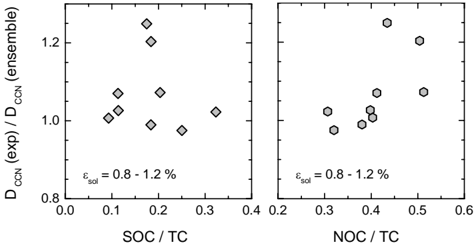
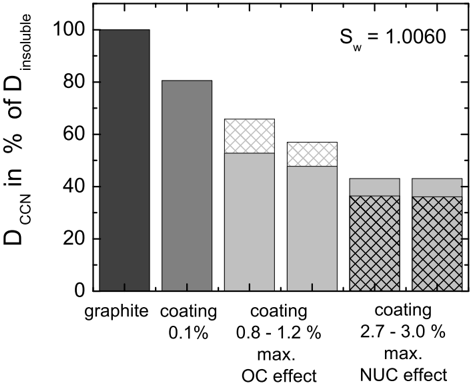
The European PartEmis project (Measurement and prediction of emissions of aerosols and gaseous precursors from gas turbine engines) was focussed on the characterisation and quantification of exhaust emissions from a gas turbine engine. The combustion aerosol characterisation included on-line measurements of mass and number concentration, size distribution, mixing state, thermal stability of internally mixed particles, hygroscopicity, cloud condensation nuclei (CCN) activation potential, and off-line analysis of chemical composition. Based on this extensive data set, the role of sulphuric acid coating and of the organic fraction of the combustion particles for the CCN activation was investigated. Modelling of CCN activation was conducted using microphysical and chemical properties obtained from the measurements as input data. Coating the combustion particles with water-soluble sulphuric acid, increases the potential CCN activation, or lowers the activation diameter, respectively. The adaptation of a Köhler model to the experimental data yielded coatings from 0.1 to 3 vol-% of water-soluble matter, which corresponds to an increase in the fraction of CCN-activated combustion particles from ≤10−4 to ≌10−2 at a water vapour saturation ratio Sw=1.006. Additional particle coating by coagulation of combustion particles and aqueous sulphuric acid particles formed by nucleation further reduces the CCN activation diameter. In contrast, particles containing a large fraction of non-volatile organic compounds grow significantly less at high relative humidity than particles with a lower content of non-volatile OC. The resulting reduction in the potential CCN activation with an increasing fraction of non-volatile OC becomes visible as a trend in the experimental data. While a coating of water-soluble sulphuric acid increases the potential CCN activation, or lowers the activation diameter, respectively, the non-volatile organic compounds, mainly found at lower combustion temperatures, can partially compensate this sulphuric acid-related enhancement of CCN activation of carbonaceous combustion aerosol particles.
Overview
The claims and statistics of this paper haven’t been checked yet.
Free: it reads the open-access text and checks the first 5 claims that cite a source we can check. Create a free account to check every claim.
Integrity signals
Registry
Cites
Statistics
Figures
Verification
Claims the paper makes
The claims and statistics of this paper haven’t been checked yet.
Free: it reads the open-access text and checks the first 5 claims that cite a source we can check. Create a free account to check every claim.
Self-check
Percentages, sums and reported differences re-computed from the paper’s own numbers.
The self-check needs the paper’s full text.
Citations
Cites
Microphysics of Clouds and Precipitation
Pruppacher, H. R., & Klett, J. D. (1978) · Springer eBooks · doi:10.1007/978-94-009-9905-3 · Cited by 3,975
Global indirect aerosol effects: a review
Lohmann, U., & Feichter, J. (2005) · Atmospheric Chemistry and Physics · doi:10.5194/acp-5-715-2005 · Cited by 2,606
Global indirect aerosol effects: a reviewPreprint
Lohmann, U., & Feichter, J. (2004) · doi:10.5194/acpd-4-7561-2004 · Cited by 1,861
Microphysics of Clouds and Precipitation
Pruppacher, H. R., & Klett, J. D. (2010) · Atmospheric and Oceanographic Sciences Library · doi:10.1007/978-0-306-48100-0 · Cited by 1,501
Cloud albedo enhancement by surface-active organic solutes in growing droplets
Facchini, M. C., Mircea, M., Fuzzi, S., & Charlson, R. J. (1999) · Nature · doi:10.1038/45758 · Cited by 754 · cited 2×
“The effects of surface active and partially soluble organic compounds on the activation of aerosols to CCN are widely discussed (Saxena et al., 1995; Novakov and Corrigan, 1996; Facchini et al., 1999; Charlson et al., 2001; Broekhuizen et al., 2004), showing that these compounds tend to increase the CCN activation pot…”
BackgroundThe effect of physical and chemical aerosol properties on warm cloud droplet activation
McFiggans, G., Artaxo, P., Baltensperger, U., Coe, H., Facchini, M. C., Feingold, G., Fuzzi, S., Gysel, M., Laaksonen, A., Lohmann, U., et al. (2006) · Atmospheric Chemistry and Physics · doi:10.5194/acp-6-2593-2006 · Cited by 710
Self-citationPetzold, A., & Schönlinner, M. (2004) · Journal of Aerosol Science · doi:10.1016/j.jaerosci.2003.09.005 · Cited by 623 · cited 5×
“Black carbon (BC) was determined using Multi-Angle Absorption Photometry (Petzold and Schönlinner, 2004).”
BackgroundMethodInfluentialSelf-citationOrganics alter hygroscopic behavior of atmospheric particles
(1995) · Journal of Geophysical Research: Atmospheres · doi:10.1029/95jd01835 · Cited by 589 · cited 1×
“The effects of surface active and partially soluble organic compounds on the activation of aerosols to CCN are widely discussed (Saxena et al., 1995; Novakov and Corrigan, 1996; Facchini et al., 1999; Charlson et al., 2001; Broekhuizen et al., 2004), showing that these compounds tend to increase…”
BackgroundHygroscopic properties of carbon and diesel soot particles
Weingartner, E., Burtscher, H., & Baltensperger, U. (1997) · Atmospheric Environment · doi:10.1016/s1352-2310(97)00023-x · Cited by 470 · cited 1×
“Weingartner et al. (1997) investigated the hygroscopic growth behaviour of carbon and diesel soot particles, but without investigating the CCN activation.”
BackgroundSelf-citationResults of the “carbon conference” international aerosol carbon round robin test stage I
Schmid, H. (2001) · Atmospheric Environment · doi:10.1016/s1352-2310(00)00493-3 · Cited by 417 · cited 3×
“In an international aerosol carbon round robin test, multi-step combustion was found to report EC values very close to the average of all deployed methods (Schmid et al., 2001).”
MethodResultInfluential
Cited by
Bounding the role of black carbon in the climate system: A scientific assessment
Bond, T. C., Doherty, S. J., Fahey, D. W., Forster, P. M., Berntsen, T., DeAngelo, B. J., Flanner, M. G., Ghan, S., Kärcher, B., Koch, D., et al. (2013) · Journal of Geophysical Research: Atmospheres · doi:10.1002/jgrd.50171 · Cited by 6,385
“Other filter-based absorption instruments include the Integrating Plate [Lin et al., 1973] and the Multi-Angle Absorption Photometer (MAAP) [Petzold et al., 2005b].”
BackgroundMethodThe contribution of global aviation to anthropogenic climate forcing for 2000 to 2018
Lee, D. S., Fahey, D. W., Skowron, A., Allen, M. R., Burkhardt, U., Chen, Q., Doherty, S. J., Freeman, S., Forster, P. M., Fuglestvedt, J., et al. (2021) · Atmospheric Environment · doi:10.1016/j.atmosenv.2020.117834 · Cited by 1,957
Aerosol–cloud–precipitation interactions. Part 1. The nature and sources of cloud-active aerosols
Andreae, M. O., & Rosenfeld, D. (2008) · Earth-Science Reviews · doi:10.1016/j.earscirev.2008.03.001 · Cited by 1,660
Transport impacts on atmosphere and climate: Aviation
Lee, D. S., Pitari, G., Grewe, V., Gierens, K., Penner, J. E., Petzold, A., Prather, M. J., Schumann, U., Bais, A., & Berntsen, T. (2010) · Atmospheric Environment · doi:10.1016/j.atmosenv.2009.06.005 · Cited by 765
“The split of organic and elemental carbon (EC) can be measured by thermal analysis methods (Petzold and Schröder, 1998; Petzold et al., 2003, 2005a).”
InfluentialSelf-citationThe effect of physical and chemical aerosol properties on warm cloud droplet activation
McFiggans, G., Artaxo, P., Baltensperger, U., Coe, H., Facchini, M. C., Feingold, G., Fuzzi, S., Gysel, M., Laaksonen, A., Lohmann, U., et al. (2006) · Atmospheric Chemistry and Physics · doi:10.5194/acp-6-2593-2006 · Cited by 710
“(Note, that Petzold et al.(2005) recently reported the strong dependence of GFD and CCN activation of gas turbine combustor particles on combustion conditions and resultant content of volatile and involatile organic compounds and sulphuric acid).”
Self-citationChemistry and the Linkages between Air Quality and Climate Change
von Schneidemesser, E., Monks, P. S., Allan, J. D., Bruhwiler, L., Forster, P., Fowler, D., Lauer, A., Morgan, W. T., Paasonen, P., Righi, M., et al. (2015) · Chemical Reviews · doi:10.1021/acs.chemrev.5b00089 · Cited by 522
Masiol, M., & Harrison, R. M. (2014) · Atmospheric Environment · doi:10.1016/j.atmosenv.2014.05.070 · Cited by 515
An overview of current issues in the uptake of atmospheric trace gases by aerosols and clouds
Kolb, C. E., Cox, R. A., Abbatt, J. P. D., Ammann, M., Davis, E. J., Donaldson, D. J., Garrett, B. C., George, C., Griffiths, P. T., Hanson, D. R., et al. (2010) · Atmospheric Chemistry and Physics · doi:10.5194/acp-10-10561-2010 · Cited by 405
Formation and radiative forcing of contrail cirrus
Kärcher, B. (2018) · Nature Communications · doi:10.1038/s41467-018-04068-0 · Cited by 377
Soot inception: Carbonaceous nanoparticle formation in flames
Martin, J. W., Salamanca, M., & Kraft, M. (2022) · Progress in Energy and Combustion Science · doi:10.1016/j.pecs.2021.100956 · Cited by 270
Petzold, A., Hasselbach, J., Lauer, P., Baumann, R., Franke, K., Gurk, C., Schlager, H., & Weingartner, E. (2008) · Atmospheric Chemistry and Physics · doi:10.5194/acp-8-2387-2008 · Cited by 218
Self-citationAmbient black carbon particle hygroscopic properties controlled by mixing state and composition
Liu, D., Allan, J., Whitehead, J., Young, D., Flynn, M., Coe, H., McFiggans, G., Fleming, Z. L., & Bandy, B. (2013) · Atmospheric Chemistry and Physics · doi:10.5194/acp-13-2015-2013 · Cited by 197
Formation of highly hygroscopic soot aerosols upon internal mixing with sulfuric acid vapor
Khalizov, A. F., Zhang, R., Zhang, D., Xue, H., Pagels, J., & McMurry, P. H. (2009) · Journal of Geophysical Research: Atmospheres · doi:10.1029/2008jd010595 · Cited by 189
“02 at 90% RH) [Pitchford et al., 1991; Hagen et al., 1992; Weingartner et al., 1997; Petzold et al., 2005] that increased somewhat upon enrichment of the fuel”
BackgroundInfluentialMapping the Operation of the Miniature Combustion Aerosol Standard (Mini-CAST) Soot Generator
Moore, R. H., Ziemba, L. D., Dutcher, D. D., Beyersdorf, A. J., Chan, K., Crumeyrolle, S. N., Raymond, T. M., Thornhill, K. L., Winstead, E. L., & Anderson, B. E. (2014) · Aerosol Science and Technology · doi:10.1080/02786826.2014.890694 · Cited by 156
The microphysical pathway to contrail formation
Kärcher, B., Burkhardt, U., Bier, A., Bock, L., & Ford, I. J. (2015) · Journal of Geophysical Research: Atmospheres · doi:10.1002/2015jd023491 · Cited by 114
Lim, S., Lee, M., Lee, G., Kim, S., Yoon, S., & Kang, K. (2012) · Atmospheric chemistry and physics · doi:10.5194/acp-12-2007-2012 · Cited by 136
Liu, D., Flynn, M. J., Beer, M. G., Targino, A. C., Crawford, I., Bower, K. N., Choularton, T. W., Jurányi, Z., Steinbacher, M., Hueglin, C., et al. (2010) · Atmospheric chemistry and physics · doi:10.5194/acp-10-7389-2010 · Cited by 136
Self-citationEffect of wood combustion conditions on the morphology of freshly emitted fine particles
Torvela, T., Tissari, J., Sippula, O., Kaivosoja, T., Leskinen, J. T. T., Virén, A., Lähde, A., & Jokiniemi, J. K. (2014) · Atmospheric Environment · doi:10.1016/j.atmosenv.2014.01.028 · Cited by 138
Black Carbon Particles Do Not Matter for Immersion Mode Ice Nucleation
Kanji, Z. A., Welti, A., Corbin, J. C., & Mensah, A. A. (2020) · Geophysical Research Letters · doi:10.1029/2019gl086764 · Cited by 121
“BC containing particles in the atmosphere are predominantly in the Aitken and accumulation mode, mostly ≤200 nm but can be up to 300 nm (Bond et al., 2013; Petzold et al., 1998; Petzold et al., 2005).”
BackgroundInfluence of particle size and chemistry on the cloud nucleating properties of aerosols
Quinn, P. K., Bates, T. S., Coffman, D. J., & Covert, D. S. (2008) · Atmospheric chemistry and physics · doi:10.5194/acp-8-1029-2008 · Cited by 121
“Furthermore, this assumption is supported by Petzold et al. (2005) who, based on measurements of combustion particles generated in a gas turbine engine, concluded that carbonaceous particles are very poor CCN.”
BackgroundWater interaction with hydrophobic and hydrophilic soot particles
Popovicheva, O., Persiantseva, N. M., Shonija, N. K., DeMott, P. J., Koehler, K. A., Petters, M. D., Kreidenweis, S. M., Tishkova, V., Demirdjian, B., & Suzanne, J. (2008) · Physical Chemistry Chemical Physics · doi:10.1039/b718944n · Cited by 110
Gas Turbine Engine Emissions—Part II: Chemical Properties of Particulate Matter
Timko, M. T., Onasch, T. B., Northway, M. J., Jayne, J. T., Canagaratna, M. R., Herndon, S. C., Wood, E. C., Miake-Lye, R. C., & Knighton, W. B. (2010) · Journal of Engineering for Gas Turbines and Power · doi:10.1115/1.4000132 · Cited by 109
Semeniuk, T. A., Wise, M. E., Martin, S. T., Russell, L. M., & Buseck, P. R. (2006) · Journal of Atmospheric Chemistry · doi:10.1007/s10874-006-9055-5 · Cited by 107
“In contrast, non-volatile organic coatings inhibit hygroscopic growth of combustion particles (Petzold et al. 2005).”
BackgroundGlobal aviation contrail climate effects from 2019 to 2021
Teoh, R., Engberg, Z., Schumann, U., Voigt, C., Shapiro, M., Rohs, S., & Stettler, M. E. J. (2024) · Atmospheric Chemistry and Physics · doi:10.5194/acp-24-6071-2024 · Cited by 103
Chemical Properties of Aircraft Engine Particulate Exhaust Emissions
Onasch, T. B., Jayne, J. T., Herndon, S., Worsnop, D. R., Miake-Lye, R. C., Mortimer, I. P., & Anderson, B. E. (2009) · Journal of Propulsion and Power · doi:10.2514/1.36371 · Cited by 93
“[52] during the European PartEmis project predicted a coverage of sulfuric acid on 100 nm soot particles to be 0:8 monolayer coverage for a similar FSC (383 vs 410 ppmm sulfur in the fuel for APEX and PartEmis, respectively).”
BackgroundRomshoo, B., Muller, T. G., Pfeifer, S., Saturno, J., Nowak, A. K., Ciupek, K., Quincey, P. G., & Wiedensohler, A. (2021) · Atmospheric chemistry and physics · doi:10.5194/acp-21-12989-2021 · Cited by 83
“Depending upon the atmospheric conditions after emission, irregularly shaped primary spherules provide active sites for the deposition of water vapour, which causes changes in the hygroscopicity of the particles (Petzold et al., 2005; Peng et al., 2017).”
BackgroundCritical condensed mass for activation of black carbon as cloud condensation nuclei in Tokyo
Kuwata, M., Kondo, Y., & Takegawa, N. (2009) · Journal of Geophysical Research Atmospheres · doi:10.1029/2009jd012086 · Cited by 88
“This view is based on laboratory experiments of the CCN activity of BC particles [e.g., Lammel and Novakov, 1995; Petzold et al., 2005; Dusek et al. ,2 006].”
MethodQuantification of water uptake by soot particles
Popovicheva, O. B., Persiantseva, N. M., Tishkova, V., Shonija, N. K., & Zubareva, N. A. (2008) · Environmental Research Letters · doi:10.1088/1748-9326/3/2/025009 · Cited by 77
Gibson, E. R., Gierlus, K. M., Hudson, P. K., & Grassian, V. H. (2007) · Aerosol Science and Technology · doi:10.1080/02786820701557222 · Cited by 70
“…effect has the largest amount of uncertainty when estimating the impact of aerosols on climate and as such has become a focus of a number of field and laboratory studies (Abbatt et al. 2005; Dinar et al. 2006; Huff Hartz et al. 2006; Mircea et al. 2005; Petzold et al. 2005; Ramaswamy et al. 2001).”
BackgroundDemirdjian, B., Ferry, D., Suzanne, J., Popovicheva, O., Persiantseva, N. M., & Shonija, N. K. (2006) · Journal of Atmospheric Chemistry · doi:10.1007/s10874-006-9043-9 · Cited by 69
The importance of contrail ice formation for mitigating the climate impact of aviation
Kärcher, B. (2016) · Journal of Geophysical Research: Atmospheres · doi:10.1002/2015jd024696 · Cited by 53
Gunsch, M. J., Kirpes, R. M., Kolesar, K. R., Barrett, T. E., China, S., Sheesley, R. J., Laskin, A., Wiedensohler, A., Tuch, T., & Pratt, K. A. (2017) · Atmospheric Chemistry and Physics · doi:10.5194/acp-17-10879-2017 · Cited by 60
Peters, K., Quaas, J., & Graßl, H. (2011) · Journal of Geophysical Research: Atmospheres · doi:10.1029/2011jd016531 · Cited by 47
“For this effect, an increase in available CCN eventually leads to more and smaller cloud droplets if the liquid water content of the respective cloud remains constant.”
BackgroundInfluentialLi, K., Ye, X., Pang, H., Lu, X., Chen, H., Wang, X., Yang, X., Chen, J., & Chen, Y. (2018) · Atmospheric chemistry and physics · doi:10.5194/acp-18-15201-2018 · Cited by 51
Measurements of particle emissions of an A350-941 burning 100 % sustainable aviation fuels in cruise
Dischl, R., Sauer, D. N., Voigt, C., Harlaß, T., Sakellariou, F., Märkl, R., Schumann, U., Scheibe, M., Kaufmann, S., Roiger, A., et al. (2024) · Atmospheric chemistry and physics · doi:10.5194/acp-24-11255-2024 · Cited by 60
Impact of alternative jet fuels on aircraft-induced aerosols
Rojo, C., Vancassel, X., Mirabel, P., Ponche, J.-L., & Garnier, F. (2015) · Fuel · doi:10.1016/j.fuel.2014.12.021 · Cited by 46
Self-citationKuik, F., Lauer, A., Beukes, J. P., van Zyl, P. G., Josipovic, M., Vakkari, V., Laakso, L., & Feig, G. T. (2015) · Atmospheric chemistry and physics · doi:10.5194/acp-15-8809-2015 · Cited by 50
Ice residual properties in mixed‐phase clouds at the high‐alpine Jungfraujoch site
Kupiszewski, P., Zanatta, M., Mertes, S., Vochezer, P., Lloyd, G., Schneider, J., Schenk, L., Schnaiter, M., Baltensperger, U., Weingartner, E., et al. (2016) · Journal of Geophysical Research Atmospheres · doi:10.1002/2016jd024894 · Cited by 49
Self-citationBox model trajectory studies of contrail formation using a particle-based cloud microphysics scheme
Bier, A., Unterstraßer, S., & Vancassel, X. (2022) · Atmospheric chemistry and physics · doi:10.5194/acp-22-823-2022 · Cited by 51
Self-citationBier, A., Unterstraßer, S., Zink, J., Hillenbrand, D., Jurkat, T., & Lottermoser, A. (2024) · Atmospheric chemistry and physics · doi:10.5194/acp-24-2319-2024 · Cited by 51
“In this work, we investigate the sensitivity to these parameters and their relevance for H 2 contrail properties.”
BackgroundRighi, M., Hendricks, J., & Brinkop, S. (2023) · Earth System Dynamics · doi:10.5194/esd-14-835-2023 · Cited by 43
“This is an aspect that could be considered in the next generation of scenarios to better support modelling studies and assessments such as the one presented in this work.”
MethodQuantification of the Hygroscopic Effect of Soot Aging in the Atmosphere: Laboratory Simulations
Popovicheva, O. B., Persiantseva, N. M., Kireeva, Е., Khokhlova, T. D., & Shonija, N. K. (2010) · The Journal of Physical Chemistry A · doi:10.1021/jp109238x · Cited by 41
Gogoi, M. M., Babu, S. S., Jayachandran, V. N., Moorthy, K. K., Satheesh, S. K., Naja, M., & Kotamarthi, V. R. (2015) · Journal of Geophysical Research Atmospheres · doi:10.1002/2014jd022966 · Cited by 40
“As reported in laboratory studies, cloud activation of particles containing BC is due to the condensation of hygroscopic compounds [Lammel and Novakov, 1995; Petzold et al., 2005].”
BackgroundSchroder, J. C., Hanna, S., Modini, R. L., Corrigan, A. L., Kreidenwies, S. M., Macdonald, A. M., Noone, K. J., Russell, L. M., Leaitch, W. R., & Bertram, A. K. (2015) · Atmospheric chemistry and physics · doi:10.5194/acp-15-1367-2015 · Cited by 40
Gil, J., Kim, J., Lee, M., Lee, G., Ahn, J., Lee, D. S., Jung, J., Cho, S., Whitehill, A., Szykman, J., et al. (2021) · Atmospheric Environment · doi:10.1016/j.atmosenv.2020.118182 · Cited by 31
“In urban areas, the count median diameter (CMD) of a fresh BC particle is typically between 50 and 80 nm; when the air mass is affected by a plume from the aircraft engine exhaust or wildfire, the CMD falls in the range of 30–120 nm (Petzold et al., 2005;Reddington et al., 2013).”
BackgroundGaillot, T., Beauchet, S., Lorne, D., & Krim, L. (2023) · Atmospheric Environment · doi:10.1016/j.atmosenv.2023.119983 · Cited by 31
Romshoo, B., Pöhlker, M. L., Wiedensohler, A., Pfeifer, S., Saturno, J., Nowak, A. K., Ciupek, K., Quincey, P. G., Vasilatou, K., Ess, M. N., et al. (2022) · Atmospheric measurement techniques · doi:10.5194/amt-15-6965-2022 · Cited by 29
“In the first method by Rissler et al. 2012, the aggregate mass is divided by the mass of a single primary to obtain N&&. The second technique described by Sorensen. (2011) uses the mobility mass scaling exponent in conjunction with the concept that black carbon aggregates fall 250 into the slip regime. The third metho…”
MethodJayachandran, V. N., Nair, V. S., & Babu, S. S. (2018) · Atmospheric Research · doi:10.1016/j.atmosres.2018.07.018 · Cited by 28
Wildfire Smoke Influence on Cloud Water Chemical Composition at Whiteface Mountain, New York
Lee, J. Y., Peterson, P. K., Vear, L. R., Cook, R. D., Sullivan, A. P., Smith, E. N., Hawkins, L. N., Olson, N. E., Hems, R. F., Snyder, P. K., et al. (2022) · Journal of Geophysical Research Atmospheres · doi:10.1029/2022jd037177 · Cited by 22
Gil, J., Kim, J., Lee, M., Lee, G., Lee, D., Jung, J., An, J., Hong, J., Cho, S., Lee, J., et al. (2019) · Atmospheric Chemistry and Physics Discussions · doi:10.5194/acp-2019-1012 · Cited by 22
Freney, E. J., Sellegri, K., Asmi, E., Rose, C., Chauvigné, A., Baray, J., Colomb, A., Hervo, M., Montoux, N., Bouvier, L., et al. (2016) · Aerosol and Air Quality Research · doi:10.4209/aaqr.2015.03.0164 · Cited by 22
“The absorption coefficient ( σ ap) was measured by a Multi-angled absorption photometer (MAAP 5012) (Petzold et al. , 2005).”
Water Interaction with Laboratory-Simulated Fossil Fuel Combustion Particles
Popovicheva, O., Kireeva, Е., Shonija, N. K., & Khokhlova, T. D. (2009) · The Journal of Physical Chemistry A · doi:10.1021/jp905522s · Cited by 21
Contrail Formation: Analysis of Sublimation Mechanisms
Kärcher, B., Kleine, J., Sauer, D., & Voigt, C. (2018) · Geophysical Research Letters · doi:10.1029/2018gl079391 · Cited by 19
“In the absence of data, emitted soot particles are distributed lognormally with a geometric mean radius of 15 nm and standard deviation 1.6 (Moore et al., 2017) and are associated with a soluble volume fraction of 1% (Petzold et al., 2005).”
BackgroundInfluentialSources and Nature of Atmospheric Aerosols
Andreae, M. O., Hegg, D. A., & Baltensperger, U. (2008) · Springer eBooks · doi:10.1007/978-1-4020-8690-8_3 · Cited by 22
Self-citationLee, S., Ghim, Y. S., Kim, S., & Yoon, S. (2010) · Atmospheric Environment · doi:10.1016/j.atmosenv.2010.08.044 · Cited by 17
Santos, L., Salo, K., & Thomson, E. S. (2022) · Environmental Science Processes & Impacts · doi:10.1039/d2em00054g · Cited by 18
Presser, C. (2012) · Journal of Quantitative Spectroscopy and Radiative Transfer · doi:10.1016/j.jqsrt.2012.01.009 · Cited by 16
“[6]).”
Quante, G., Voß, S., Bullerdiek, N., Voigt, C., & Kaltschmitt, M. (2024) · Atmospheric Environment X · doi:10.1016/j.aeaoa.2024.100259 · Cited by 17
Wong, H., Jun, M., Peck, J., Waitz, I. A., & Miake‐Lye, R. C. (2014) · Aerosol Science and Technology · doi:10.1080/02786826.2014.953243 · Cited by 15
“…performed in the near field (<1000 m downstream) suggested that they are the most dominant components at low thrust settings due to incomplete combustion (Petzold et al. 2005; Knighton et al. 2007; Yelvington et al. 2007; Onasch et al. 2009; Timko et al. 2010a,b, 2013, 2014; Presto et al. 2011).”
BackgroundCostabile, F., Angelini, F., Barnaba, F., & Gobbi, G. P. (2014) · Atmospheric Environment · doi:10.1016/j.atmosenv.2014.11.064 · Cited by 13
Fuel sulfur content can modulate contrail ice crystal numbers
Dischl, R., Märkl, R., Sauer, D. N., Voigt, C., Harlaß, T., Scheibe, M., Hahn, V., Kaufmann, S., Marsing, A., Dörnbrack, A., et al. (2025) · Communications Earth & Environment · doi:10.1038/s43247-025-02951-5 · Cited by 14
Santos, L., Salo, K., Kong, X., Noda, J., Kristensen, T. B., Ohigashi, T., & Thomson, E. S. (2023) · Environmental Science Atmospheres · doi:10.1039/d2ea00081d · Cited by 11
Mahnke, C., Gomes, A. R., Bundke, U., van den Berg, M. A., Ziereis, H., Sharma, M., Righi, M., Hendricks, J., Zahn, A., Wahner, A., et al. (2024) · Environmental Science & Technology · doi:10.1021/acs.est.3c09728 · Cited by 9
Self-citationDehkhoda, N., Sim, J., Joo, S., Shin, S., & Noh, Y. (2022) · Remote Sensing · doi:10.3390/rs14061510 · Cited by 8
Wu, J., Faccinetto, A., Batut, S., Cazaunau, M., Pangui, E., Nuns, N., Hanoune, B., Doussin, J., Desgroux, P., & Petitprez, D. (2023) · The Science of The Total Environment · doi:10.1016/j.scitotenv.2023.167745 · Cited by 9
Aiken, A. C., McMeeking, G. R., Levin, E. J. T., Dubey, M. K., DeMott, P. J., & Kreidenweis, S. M. (2016) · Aerosol Science and Technology · doi:10.1080/02786826.2016.1173647 · Cited by 8
“Indirect effects include cloud interactions, e.g., the ability to function as cloud condensation nuclei (CCN; Petzold et al. 2005; Dusek et al. 2006; Koehler et al. 2009; Petters et al. 2009) and ice nucleating particles (INP; Cozic et al. 2008; Twohy et al. 2010).”
BackgroundGrimonprez, S., Wu, J., Faccinetto, A., Gosselin, S., Riber, É., Cuenot, B., Cazaunau, M., Pangui, E., Formenti, P., Doussin, J., et al. (2020) · Proceedings of the Combustion Institute · doi:10.1016/j.proci.2020.06.306 · Cited by 8
Contrail and cirrus cloud avoidance technology
Noppel, F. (2007) · OpenGrey (Institut de l'Information Scientifique et Technique) · Cited by 8
Wiegand, M., Koops, L. G., Mailach, R., & Balderas‐Xicohténcatl, R. (2026) · Atmospheric Environment X · doi:10.1016/j.aeaoa.2026.100502 · Cited by 7
Targeted use of paraffinic kerosene: Potentials and implications
Quante, G., Voigt, C., & Kaltschmitt, M. (2024) · Atmospheric Environment X · doi:10.1016/j.aeaoa.2024.100279 · Cited by 6
Weber, P., Bischof, O. F., Fischer, B., van den Berg, M. A., Hering, S. V., Spielman, S., Lewis, G., Petzold, A., & Bundke, U. (2023) · Atmospheric measurement techniques · doi:10.5194/amt-16-3505-2023 · Cited by 4
“As an insoluble hydrophobic substance, fresh combustion soot is not activated for droplet formation inside a CPC as efficiently as hydrophilic substances (Petzold et al., 2005).”
BackgroundSelf-citationHanna, S., Xu, J., Schroder, J. C., Wang, Q., McMeeking, G. R., Hayden, K. L., Leaitch, W. R., Macdonald, A. M., von Salzen, K., Martin, R. V., et al. (2018) · Atmospheric Environment · doi:10.1016/j.atmosenv.2018.02.041 · Cited by 4
Maruhashi, J., Righi, M., Sharma, M., Hendricks, J., Jöckel, P., Grewe, V., & Dedoussi, I. C. (2026) · Geoscientific model development · doi:10.5194/gmd-19-2747-2026 · Cited by 3
Thermochemical Characterization of Materials using a Novel Laser-Heating Technique
Presser, C., Nazarian, A., & Conny, J. M. (2014) · AIAA Aerospace Sciences Meeting · doi:10.2514/6.2014-1071 · Cited by 3
Nibert, P., Wu, Y., Joly, M., Amato, P., Cristofanelli, P., Calzolari, F., Piro, J., Putero, D., Montaguti, S., Renzi, L., et al. (2026) · Atmospheric chemistry and physics · doi:10.5194/acp-26-6489-2026 · Cited by 2
Muth, L. J., Hoshyaripour, G. A., Vogel, B., Vogel, H., & Hoose, C. (2026) · Atmospheric chemistry and physics · doi:10.5194/acp-26-8505-2026 · Cited by 2
Gurentsov, E. V., Eremin, A. V., & Schulz, C. (2008) · Kinetics and Catalysis · doi:10.1134/s002315840802002x · Cited by 2
Formation of highly hygroscopic soot aerosols by atmospheric processing with sulfuric acid vapor
Khalizov, A. K., Zhang, R., Zhang, D. D., Xue, H., Pagels, J., McMurry, P. H., & Chen, J. (2007) · Lund University Publications (Lund University)
Particle Emissions from Aviation
Petzold, A. (2006)
Self-citationBier, A. (2021) · Atmospheric chemistry and physics · doi:10.5194/acp-2021-361-ac2
Bier, A. (2021) · Atmospheric chemistry and physics · doi:10.5194/acp-2021-361-ac1
Bier, A. (2021) · Atmospheric chemistry and physics · doi:10.5194/acp-2021-361-ac3
Bier, A., Unterstraßer, S., & Vancassel, X. (2021) · Atmospheric chemistry and physics · doi:10.5194/acp-2021-361-rc2
Romshoo, B. (2021) · Atmospheric chemistry and physics · doi:10.5194/acp-2020-1290-ac1
Bier, A., Unterstraßer, S., & Vancassel, X. (2021) · Atmospheric chemistry and physics · doi:10.5194/acp-2021-361-cc1
Comment on egusphere-2023-1859
Teoh, R., Engberg, Z., Schumann, U., et al. (2023) · doi:10.5194/egusphere-2023-1859-cc4
Comment on egusphere-2023-1321
Unterstraßer, S. (2023) · doi:10.5194/egusphere-2023-1321-ac1
Stettler, M. E. J. (2024) · doi:10.5194/egusphere-2023-1859-ac1
Afkari, P., Chouak, M., Cantin, S., & Garnier, F. (2026) · Journal of Aerosol Science · doi:10.1016/j.jaerosci.2026.106786 · Cited by 1
Marhaba, I. (2017) · theses.fr (ABES) · doi:10.70675/99779d91z02b7z4e3az9aa9z8521fb563543 · Cited by 1
Cloud‐Top Relative Humidity Modulates Aerosol Effects Across Marine Cloud Regimes
Liu, F., Mao, F., Pan, Z., Rosenfeld, D., Gong, W. Y., & Zang, L. (2026) · Journal of Geophysical Research Atmospheres · doi:10.1029/2025jd045791
Metadata
- Authors
- Petzold, A., Gysel, M., Vancassel, X., Hitzenberger, R., Puxbaum, H., Vrochticky, S., Weingartner, E., Baltensperger, U., & Mirabel, P.
- Affiliations
- Deutsches Zentrum für Luft- und Raumfahrt e. V. (DLR) (DE)
- University of Oxford (GB)
- University of Vienna (AT)
- TU Wien (AT)
- Paul Scherrer Institute (CH)
- Université de Strasbourg (FR)
- Venue
- Atmospheric chemistry and physics
- Publisher
- Copernicus GmbH
- Published
- 2005-12-01
- Volume
- 5
- Issue
- 12
- Pages
- 3187-3203
- ISSN
- 1680-7316 (ISSN-L)
- 1680-7324
- OpenAlex
- W2156887544
- Cited by
- 100
- References
- 37
- Citations by year
- 2026: 6 · 2025: 2 · 2024: 7 · 2023: 9 · 2022: 8 · 2021: 11 · 2020: 3 · 2019: 2 · 2018: 5 · 2017: 2 · 2016: 4 · 2015: 5 · 2014: 7 · 2013: 2 · 2012: 2
- FWCI
- 2.98
- Type
- journal article
- Language
- en
- Open access
- gold
- doi.org
- Licence
- Locations
- Atmospheric chemistry and physics (publishedVersion, cc-by)
- elib (German Aerospace Center) (acceptedVersion)
- DORA PSI (Paul Scherrer Institute) (submittedVersion, cc-by-nc-sa)
- HAL (submittedVersion, other-oa)
- DOAJ (DOAJ: Directory of Open Access Journals) (submittedVersion, cc-by-sa)
- Institutional Repository (IHS Vienna) (cc-by)
- Funders
- Strong
- European Commission
- Universität Wien
- Office Fédéral de l'Education et de la Science
- Topics
- Physical Sciences › Earth and Planetary Sciences › Atmospheric Science › Atmospheric chemistry and aerosols
- Physical Sciences › Environmental Science › Global and Planetary Change › Atmospheric aerosols and clouds
- Physical Sciences › Chemical Engineering › Fluid Flow and Transfer Processes › Advanced Combustion Engine Technologies
- Keywords
- cloud condensation nuclei activation, combustion aerosols, non-volatile organic compounds, particle mixing state, hygroscopicity, Kohler model, particle coagulation, aerosol microphysics
About these checks
Registry, retraction, Cites and statistics results are computed, not judged, with one exception: a printed reference that no index lists is read once by a model before it counts as a citation error. Claims are extracted by a model and kept only when their quote appears verbatim in the text; each cited source is then checked, with a model’s help, for whether it says what the claim relies on. Those verdicts can be wrong — read the claim’s quote and the cited source before relying on one.
Statistics and arithmetic are recomputed, not judged.
Confidence bands are shown only for fields calibrated on our annotated test set. None is calibrated yet, so no band is shown.
What counts as a claim ›How we measure confidence ›How we check this ›
Are you an author, or do you see a problem with this page? Request a review
Data sources
Bibliographic data: Semantic Scholar, OpenAlex, Crossref.
Contains information from the Semantic Scholar Academic Graph Datasets, made available under the ODC Attribution License (ODC-BY 1.0).
Semantic Scholar’s data is described in: Kinney, R., et al. (2023). The Semantic Scholar Open Data Platform. arXiv:2301.10140.
