

The impact of traffic emissions on atmospheric ozone and OH: results from QUANTIFY
Open accessPublished version of a preprint
The DOI matches its Crossref record; 80 of the 81 references it cites were found in a registry or an index.
Abstract
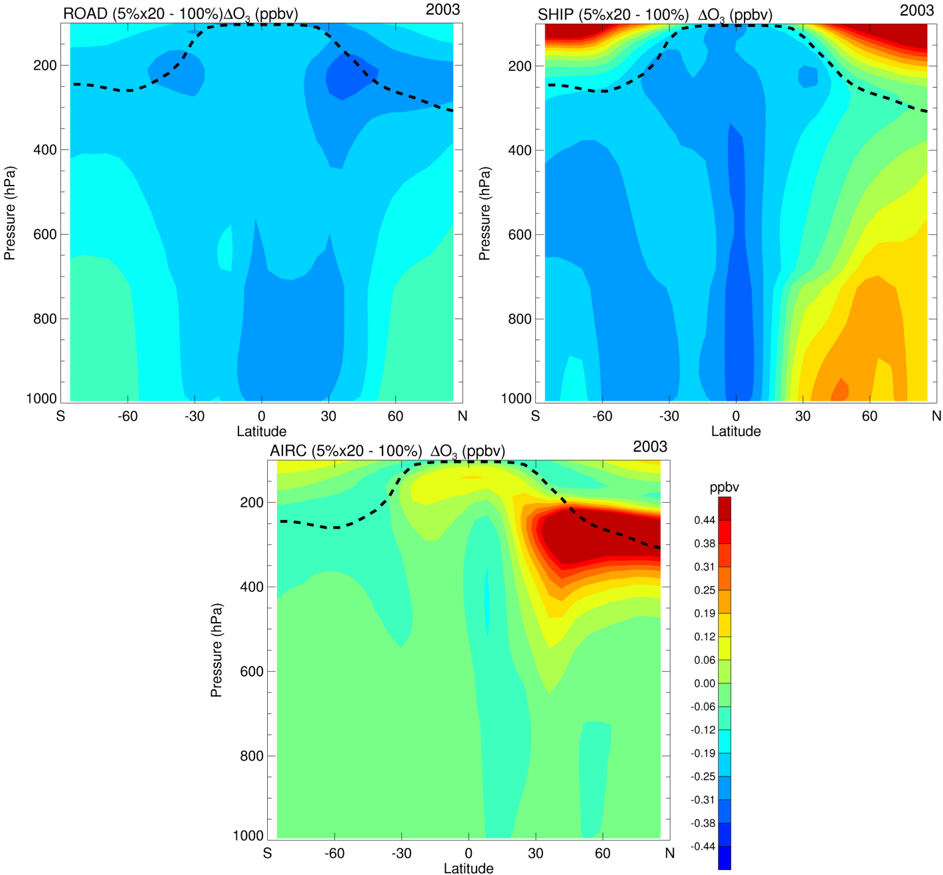
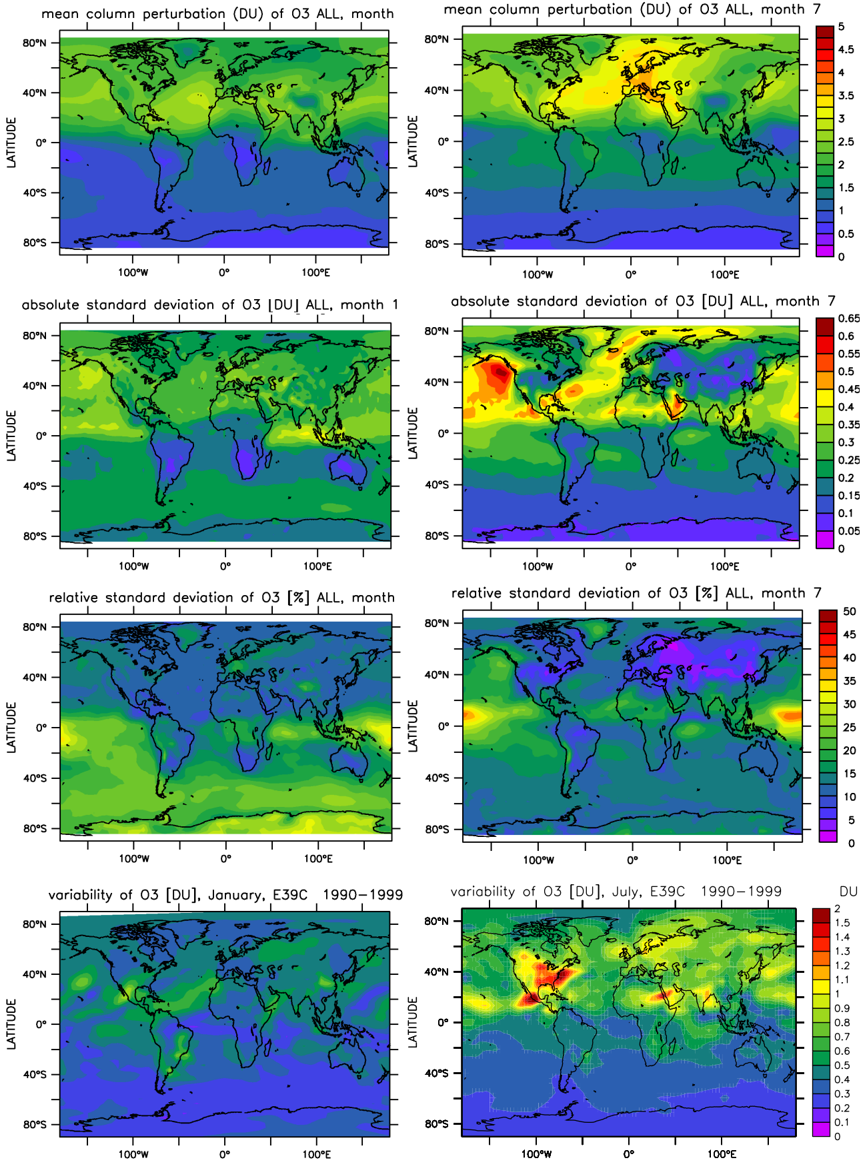
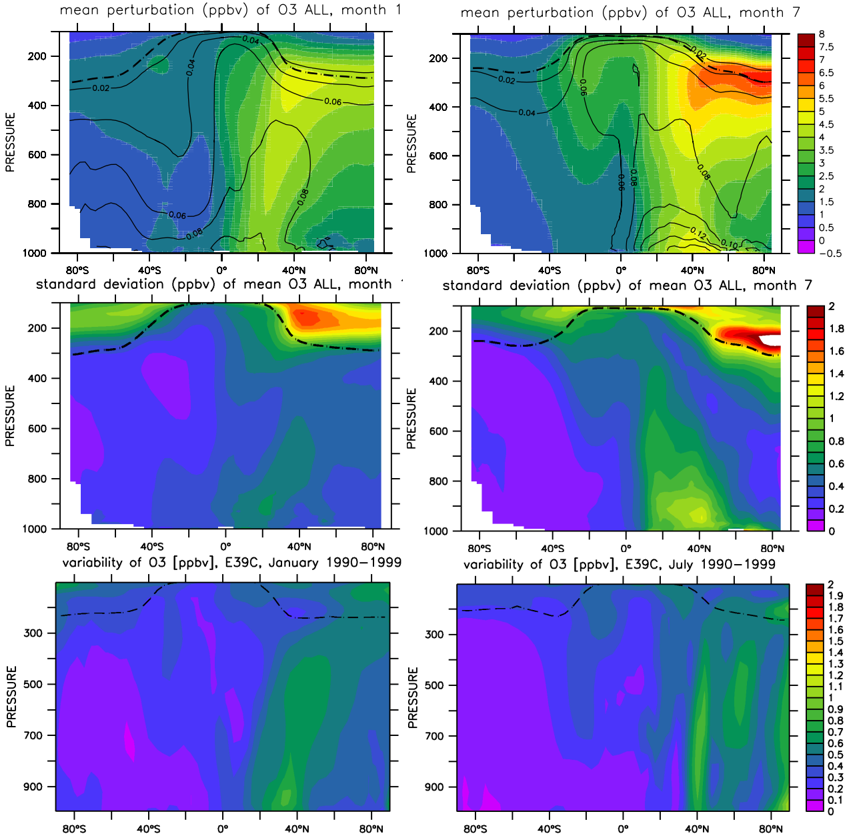
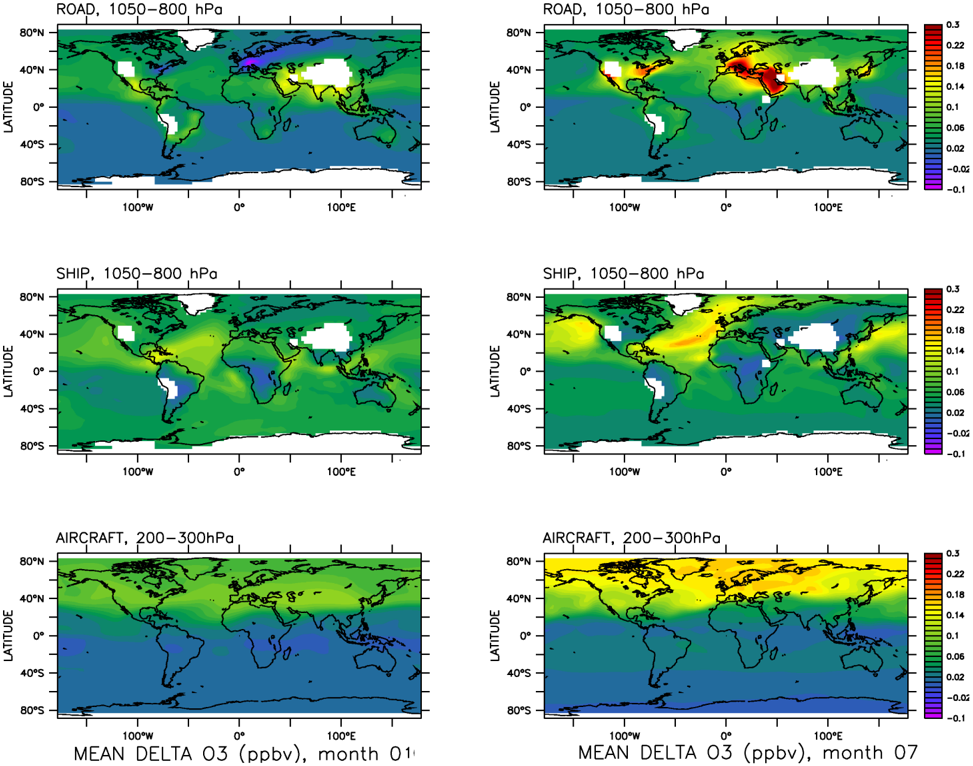
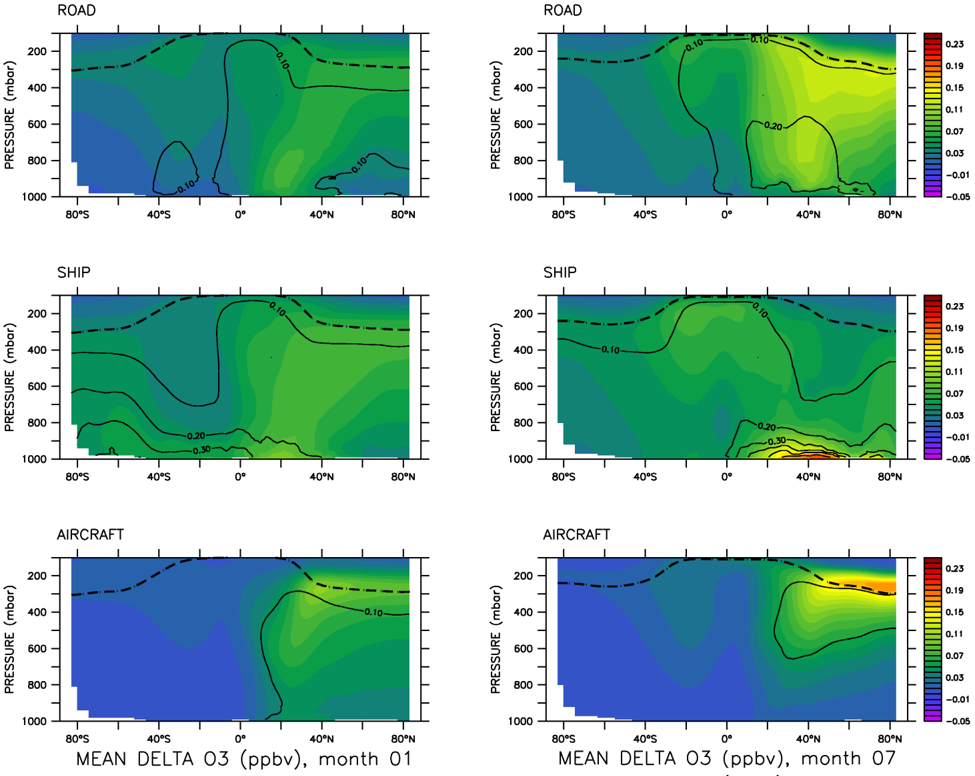
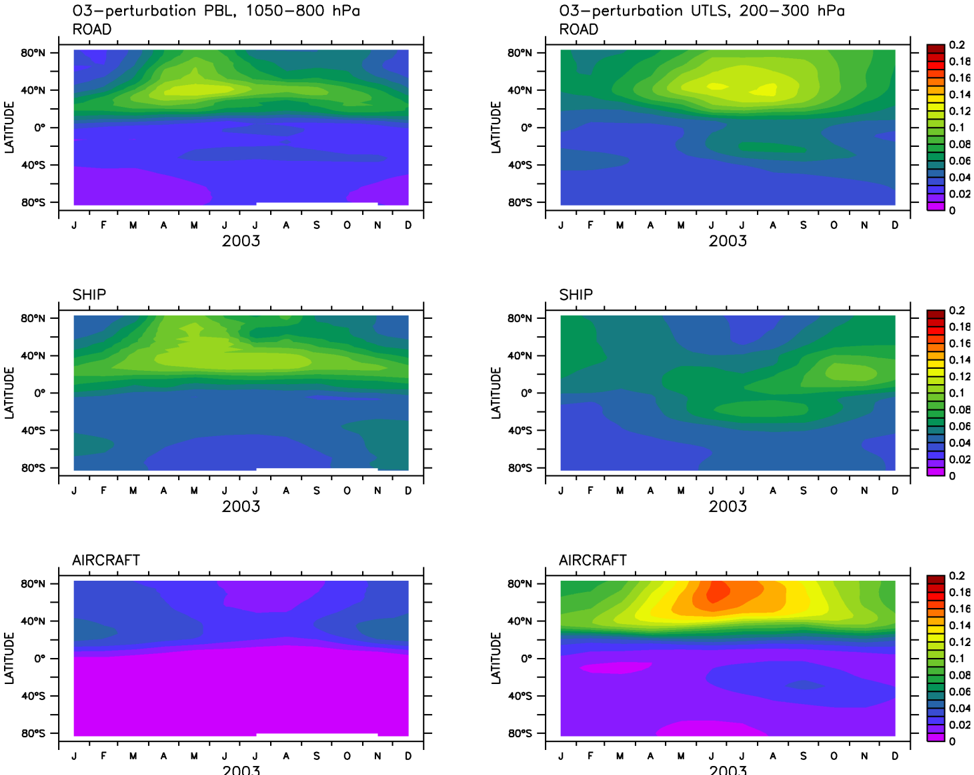
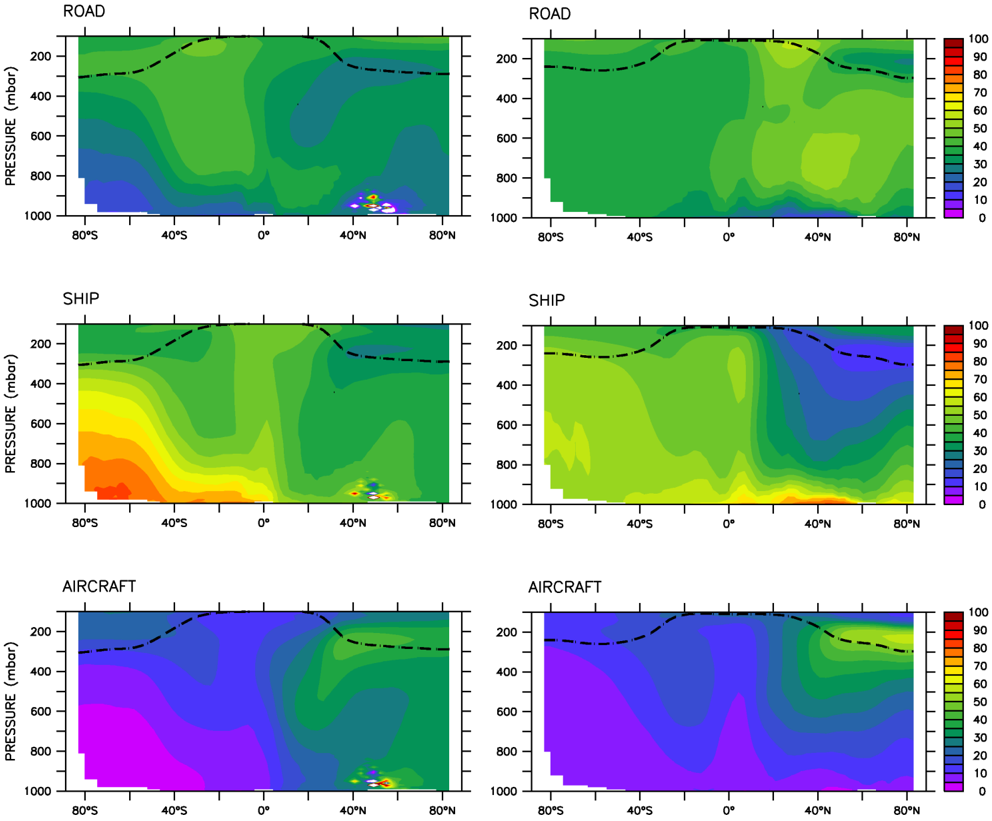
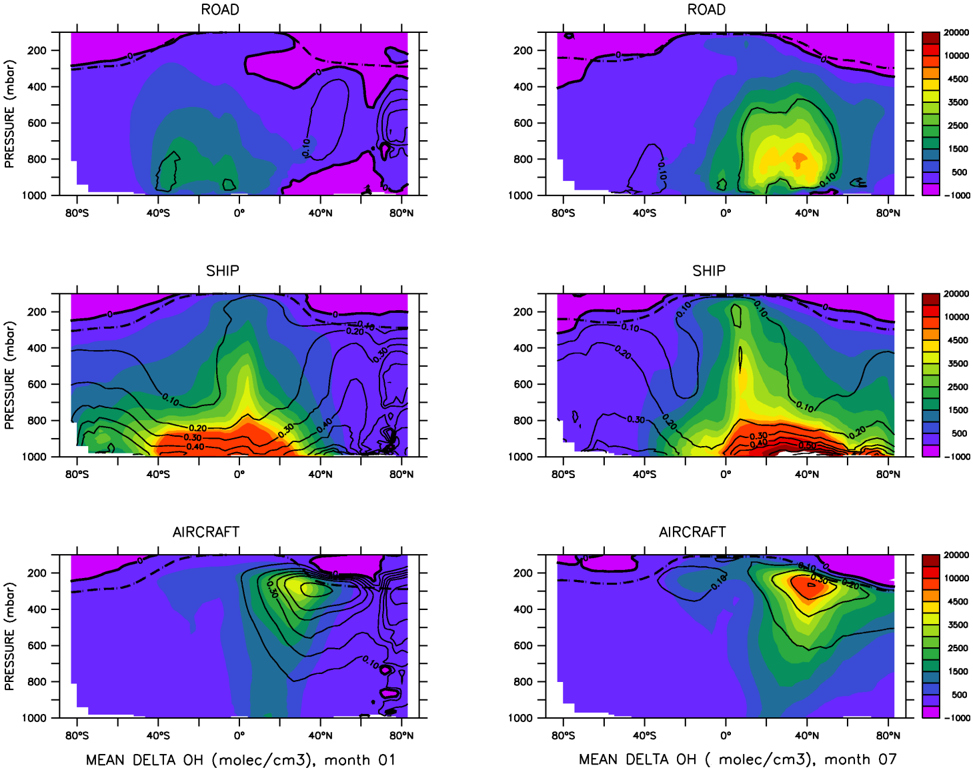
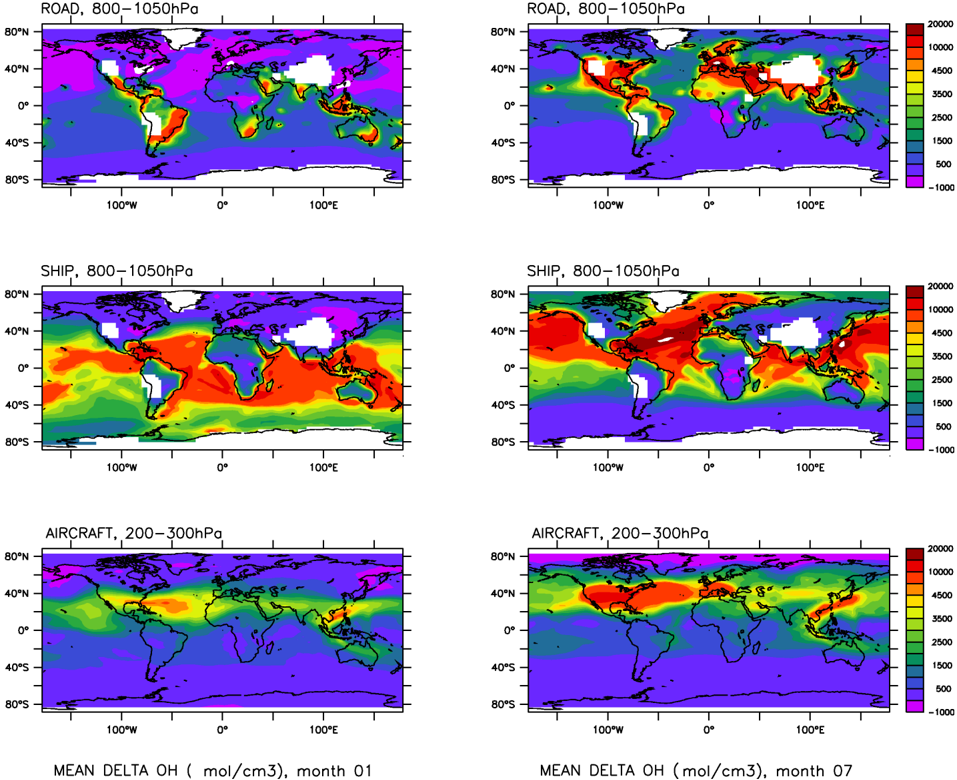
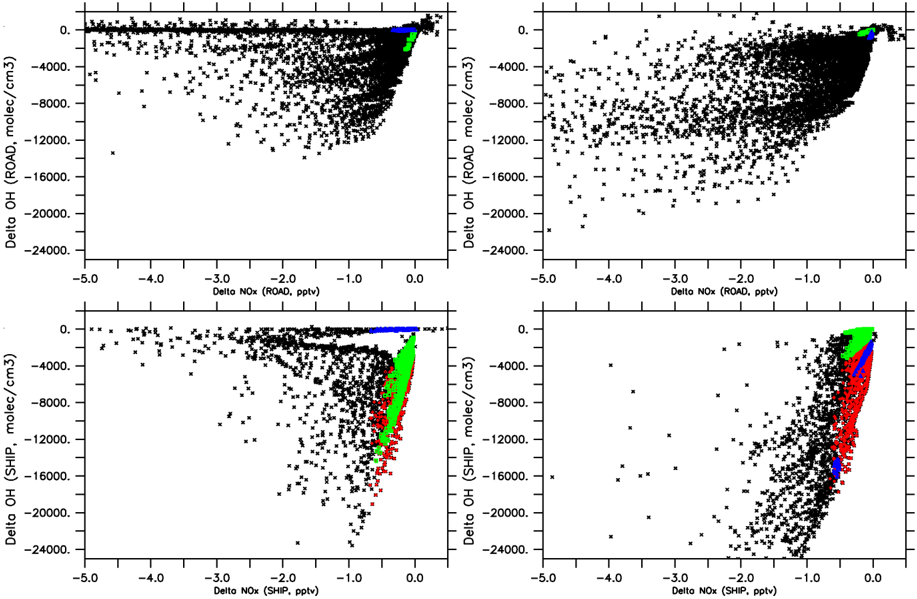
To estimate the impact of emissions by road, aircraft and ship traffic on ozone and OH in the present-day atmosphere six different atmospheric chemistry models have been used. Based on newly developed global emission inventories for road, ship and aircraft emission data sets each model performed sensitivity simulations reducing the emissions of each transport sector by 5%. The model results indicate that on global annual average lower tropospheric ozone responds most sensitive to ship emissions (50.6%±10.9% of the total traffic induced perturbation), followed by road (36.7%±9.3%) and aircraft exhausts (12.7%±2.9%), respectively. In the northern upper troposphere between 200–300 hPa at 30–60° N the maximum impact from road and ship are 93% and 73% of the maximum effect of aircraft, respectively. The latter is 0.185 ppbv for ozone (for the 5% case) or 3.69 ppbv when scaling to 100%. On the global average the impact of road even dominates in the UTLS-region. The sensitivity of ozone formation per NOx molecule emitted is highest for aircraft exhausts. The local maximum effect of the summed traffic emissions on the ozone column predicted by the models is 0.2 DU and occurs over the northern subtropical Atlantic extending to central Europe. Below 800 hPa both ozone and OH respond most sensitively to ship emissions in the marine lower troposphere over the Atlantic. Based on the 5% perturbation the effect on ozone can exceed 0.6% close to the marine surface (global zonal mean) which is 80% of the total traffic induced ozone perturbation. In the southern hemisphere ship emissions contribute relatively strongly to the total ozone perturbation by 60%–80% throughout the year. Methane lifetime changes against OH are affected strongest by ship emissions up to 0.21 (± 0.05)%, followed by road (0.08 (±0.01)%) and air traffic (0.05 (± 0.02)%). Based on the full scale ozone and methane perturbations positive radiative forcings were calculated for road emissions (7.3±6.2 mWm−2) and for aviation (2.9±2.3 mWm−2). Ship induced methane lifetime changes dominate over the ozone forcing and therefore lead to a net negative forcing (−25.5±13.2 mWm−2).
Overview
The claims and statistics of this paper haven’t been checked yet.
Free: it reads the open-access text and checks the first 5 claims that cite a source we can check. Create a free account to check every claim.
Integrity signals
Registry
Cites
Statistics
Figures
Verification
Claims the paper makes
The claims and statistics of this paper haven’t been checked yet.
Free: it reads the open-access text and checks the first 5 claims that cite a source we can check. Create a free account to check every claim.
Claims other papers make about this one
Each is checked against this paper’s own text: does it say what the citing paper says it does?
The source backs part of the claim, not all of it — or backs it for a different population, condition or comparison.
In the citing paper
“These TROPOS O3 magnitudes are at the upper limit of model ranges, as present-day aircraft O3 perturbations found in the literature vary from 3 to 11 Tg (O3) (e.g., Hoor et al., 2009; Holmes et al., 2011; Khodayari et al., 2014a).”
From The contribution of global aviation to anthropogenic climate forcing for 2000 to 2018 (2021) · cites this paper as Hoor et al., 2009
Experimental — accuracy not yet measuredThe cited source says what the claim attributes to it.
In the citing paper
“The short-term O3 RF varies from 6.2 to 45.1 mW m 2 (Tg (N) yr 1 ) 1 , where these values come from the NASA ModelE2 (Olsen et al., 2013) and p-TOMCAT (Hoor et al., 2009) models, respectively.”
From The contribution of global aviation to anthropogenic climate forcing for 2000 to 2018 (2021) · cites this paper as Hoor et al., 2009
Self-check
Percentages, sums and reported differences re-computed from the paper’s own numbers.
The self-check needs the paper’s full text.
Citations
Cites
Emission of trace gases and aerosols from biomass burning
Andreae, M. O., & Merlet, P. (2001) · Global Biogeochemical Cycles · doi:10.1029/2000gb001382 · Cited by 3,902 · cited 1×
“For biomass burning monthly means for the year 2000 were used based on GFED estimates with multi-year (1997– 2002) averaged activity data using Andreae and Merlet (2001) and Andreae (2004, personal communication) for NOx emission factors (BB-AVG-AM).”
A Comprehensive Mass Flux Scheme for Cumulus Parameterization in Large-Scale Models
Tiedtke, M. (1989) · Monthly Weather Review · doi:10.1175/1520-0493(1989)117<1779:acmfsf>2.0.co;2 · Cited by 3,648
Müller, G., Pannhorst, W., & Schiffner, U. (1995) · Schott Series on Glass and Glass Ceramics · doi:10.1007/978-3-662-03083-7_2 · Cited by 1,982
An Asian emission inventory of anthropogenic emission sources for the period 1980–2020
Ohara, T., Akimoto, H., Kurokawa, J., Horii, N., Yamaji, K., Yan, X., & Hayasaka, T. (2007) · Atmospheric Chemistry and Physics · doi:10.5194/acp-7-4419-2007 · Cited by 1,410 · cited 2×
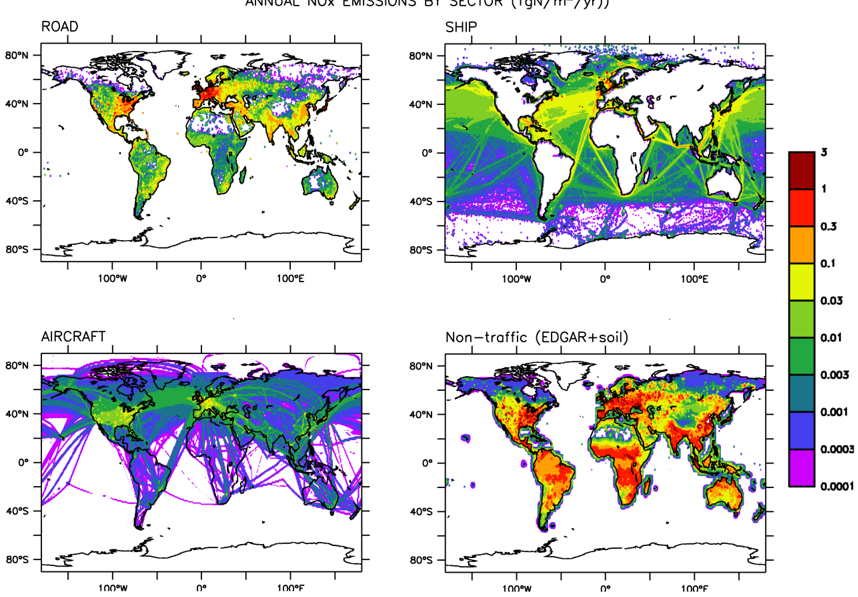
“Globally, road NOx emissions are dominated by the eastern US and western Europe as well as India and eastern China, the latter with an increase rate of 6%/year ( Ohara et al., 2007) only between 2000 and 2003.”
Multimodel ensemble simulations of present‐day and near‐future tropospheric ozone
Stevenson, D. S., Dentener, F. J., Schultz, M. G., Ellingsen, K., van Noije, T. P. C., Wild, O., Zeng, G., Amann, M., Atherton, C. S., Bell, N., et al. (2006) · Journal of Geophysical Research: Atmospheres · doi:10.1029/2005jd006338 · Cited by 1,198
Self-citationLocal Versus Nonlocal Boundary-Layer Diffusion in a Global Climate Model
Holtslag, A. A. M., & Boville, B. A. (1993) · Journal of Climate · doi:10.1175/1520-0442(1993)006<1825:lvnbld>2.0.co;2 · Cited by 1,109
A simple lightning parameterization for calculating global lightning distributions
Price, C., & Rind, D. (1992) · Journal of Geophysical Research: Atmospheres · doi:10.1029/92jd00719 · Cited by 850 · cited 3×
“The lightning source was determined interactively in LMDz-INCA with a modified Price and Rind(1992) parameterization, and its total was prescribed at≈ 2.”
InfluentialNumerical advection by conservation of second‐order moments
Prather, M. J. (1986) · Journal of Geophysical Research: Atmospheres · doi:10.1029/jd091id06p06671 · Cited by 804 · cited 2×
“The lightning source was determined interactively in LMDz-INCA with a modified Price and Rind (1992) parameterization, and its total was prescribed at ≈ 2.”
Self-citationCondensation and Cloud Parameterization Studies with a Mesoscale Numerical Weather Prediction Model
Sundqvist, H., Berge, E., & Kristjánsson, J. E. (1989) · Monthly Weather Review · doi:10.1175/1520-0493(1989)117<1641:cacpsw>2.0.co;2 · Cited by 800
The global lightning-induced nitrogen oxides source
Schumann, U., & Huntrieser, H. (2007) · Atmospheric Chemistry and Physics · doi:10.5194/acp-7-3823-2007 · Cited by 708 · cited 2×
“Lightning NOx was specified at 5 TgN/year, representing the current best estimate (Schumann and Huntrieser, 2007).”
Research works printed but not linked: 3
- Kahn Ribeiro, S., Kobayashi, S., Beuthe, M., Gasca, J., Greene, D., Lee, D., Muromachi, Y., Newton, P., Plotkin, S., Sperling, D., Wit, R., and Zhou, P.: Transport and its infrastructure, in: Cli- mate Change 2007: Mitigation. Contribution of Working Group III to the Fourth Assessment Report of the Intergovernmental Panel on Climate Change, IPCC, edited by Metz, B., Davidson, O., Bosch, P., Dave, R., and Meyer, L., Cambridge University Press, Cambridge, United Kingdom and New York, NY, USA, 2007.
- Lemke, P., Ren, J., Alley, R., Allison, I., Carrasco, J., Flato, G., Fujii, Y., Kaser, G., Mote, P., Thomas, R., and T., Z.: Obser- vations: Changes in Snow, Ice and Frozen Ground, in: Cli- mate Change 2007: The Physical Science Basis. Contribution of Working Group I to the Fourth Assessment Report of the Intergovernmental Panel on Climate Change, IPCC, edited by: Solomon, S., Qin, D., Manning, M., Chen, Z., Marquis, M., Av- eryt, K., Tignor, M., and Miller, H., Cambridge University Press, Cambridge, United Kingdom and New York, NY, USA, 2007.
- Schumann, U. (Ed.): Air pollution research report 68, Pollu- tion from aircraft emissions in the North Atlantic flight corri- dor (POLINAT 2), European Commission, L-2985 Luxembourg, ISBN 92-828-6197-X, 1998.
Cited by
Items 101–189 of 189
Ozone production efficiency of a ship-plume: ITCT 2K2 case study
Kim, H. S., Kim, Y. H., Han, K. M., Kim, J., & Song, C. H. (2015) · Chemosphere · doi:10.1016/j.chemosphere.2015.05.022 · Cited by 12
Seasonally adaptive data-driven ozone prediction in megacity environments
Seo, J. H., Cho, J., Hong, E., Cho, S., Gil, J., Joo, T., & Weon, S. (2026) · Environmental Research · doi:10.1016/j.envres.2026.123741 · Cited by 10
The ACCENT-protocol: a framework for benchmarking and model evaluation
Grewe, V., MOUSSIOPOULOS, N., Builtjes, P. J. H., Borrego, C. S., Isaksen, I. S. A., & Volz‐Thomas, A. (2012) · Geoscientific model development · doi:10.5194/gmd-5-611-2012 · Cited by 10
Self-citationCohen, Y., Hauglustaine, D. A., Bellouin, N., Lund, M. T., Matthes, S., Skowron, A., Thor, R., Bundke, U., Petzold, A., Rohs, S., et al. (2025) · Atmospheric chemistry and physics · doi:10.5194/acp-25-5793-2025 · Cited by 11
Self-citationJain, A. K., Seshadri, S., Anand, J., Chandra, N., Patra, P. K., Canadell, J. G., Chhabra, A., Ciais, P., Gilani, H., Gumma, M. K., et al. (2025) · Global Biogeochemical Cycles · doi:10.1029/2024gb008261 · Cited by 9
“Much like the CO emission, the contribution of SA CH 4 (0.14 ± 0.07 Tg CO 2 eq yr 1 ), NMHC (2.33 ± 0.23 Tg CO 2 eq yr 1 ), and N 2 O (0.01 ± 0.01 Tg CO 2 eq yr 1 ) (Figure 1) emissions to the global fire emissions is relatively smaller (less than 1% of total emission) (Table 2).”
InfluentialZhang, Z., Jiang, H., Liu, J., Zhang, X., Huang, C., Lu, X., Jin, J., & Zhou, G. (2014) · International Journal of Remote Sensing · doi:10.1080/01431161.2014.885151 · Cited by 9
SAUSEN, R., Gierens, K., Eyring, V., Hendricks, J., & Righi, M. (2012) · Research topics in aerospace · doi:10.1007/978-3-642-30183-4_43 · Cited by 9
Self-citationOzone source attribution in polluted European areas during summer 2017 as simulated with MECO(n)
Kilian, M., Grewe, V., Jöckel, P., Kerkweg, A., Mertens, M., Zahn, A., & Ziereis, H. (2024) · Atmospheric chemistry and physics · doi:10.5194/acp-24-13503-2024 · Cited by 8
Self-citationLinke, F., Dahlmann, K., Gerlinger, B., Wöhler, S., Otten, T., Plohr, M., Presto, F., Hartmann, J., & Weiß, M. (2020) · AIAA AVIATION Forum · doi:10.2514/6.2020-2650 · Cited by 8
Impacts of climate change on waterborne transport
Hawkes, P., Pauli, G., Moser, H., Arntsen, Ø. A., Gaufrès, P., Mai, S. F., & White, K. D. (2010) · Proceedings of the Institution of Civil Engineers - Civil Engineering · doi:10.1680/cien.2010.163.5.55 · Cited by 7
Indications of Distinctive Efficacies for Transport Related Ozone Perturbations
Ponater, M., Dietmüller, S., Stuber, N., Shine, K. P., Highwood, E. J., & Rädel, G. (2009) · elib (German Aerospace Center) · Cited by 7
Self-citationSource attribution of near-surface ozone pollution in Jiangsu Province of China over 2013–2019
He, S., Yang, Y., Wang, H., Wang, P., & Liao, H. (2025) · Atmospheric Environment · doi:10.1016/j.atmosenv.2025.121205 · Cited by 6
Distinctive efficacies of the components contributing to total aviation climate impact
Ponater, M. (2010) · elib (German Aerospace Center) · Cited by 6
Assessment of NO2 satellite observations for en-route aircraft emissions detection
Pujadas, M., Núñez, L., & Lubrani, P. (2011) · Remote Sensing of Environment · doi:10.1016/j.rse.2011.07.013 · Cited by 6
Ship-plume sulfur chemistry: ITCT 2K2 case study
Kim, H. S., Kim, Y. H., & Song, C. H. (2013) · The Science of The Total Environment · doi:10.1016/j.scitotenv.2013.01.099 · Cited by 6
Williams, J. E., Hodnebrog, Ø., van Velthoven, P. F. J., Berntsen, T. K., Dessens, O., Gauss, M., Grewe, V., Isaksen, I. S. A., Olivié, D., Prather, M. J., et al. (2014) · Atmospheric Environment · doi:10.1016/j.atmosenv.2014.02.041 · Cited by 5
Self-citationWaterborne transport, ports and navigation: climate change drivers, impacts and mitigation
Hawkes, P. J., Pauli, G., Moser, H., Arntsen, Ø. A., Gaufrès, P., Mai, S. F., & White, K. D. (2010) · EPrints - HR Wallingford (HR Wallingford) · Cited by 5
Impact of traffic emissions on ozone formation in Hong Kong
Zhan, C., Dai, J., Wang, F., & Guo, H. (2025) · Atmospheric Environment · doi:10.1016/j.atmosenv.2025.121507 · Cited by 4
Traffic Air Quality Health Index in a Selected Street, Alexandria
Abdellatef, E., Zaki, G., & Issa, A. I. (2018) · Journal of High Institute of Public Health · doi:10.21608/jhiph.2018.19903 · Cited by 4
Rieger, V., & Grewe, V. (2022) · Geoscientific model development · doi:10.5194/gmd-15-5883-2022 · Cited by 4
Self-citationWei, M., Sun, B., Wang, H., & Xu, Z. (2017) · Environmental Science and Pollution Research · doi:10.1007/s11356-017-0631-9 · Cited by 4
“Many studies tried to reveal the relationship based on real-world characteristics, real-time conditions, and on-road vehicular exhaust emission status under heterogeneous traffic conditions (Jaikumar et al. 2017; Schmid et al. 2001; Hoor et al. 2008; Srimuruganandam and Nagendra 2010).”
BackgroundEnvironmental and economic assessment of alternative transportation fuels
Withers, M. R. (2014) · DSpace@MIT (Massachusetts Institute of Technology) · Cited by 4
Villarroya-Ballarín, A., & Puig-i-Baguer, J. (2012) · Depósito Académico Digital Universidad de Navarra (University of Navarra) · Cited by 4
Quantitative evaluation of ozone and selected climate parameters in the chemistry-climate model EMAC
Klinger, C. (2011) · elib (German Aerospace Center) · Cited by 4
Atmospheric Histories of Ethane and Carbon Monoxide from Polar Firn Air and Ice Cores
Verhulst, K. R. (2014) · eScholarship (California Digital Library) · Cited by 4
A new method to assess the climate effect of mitigation strategies for road traffic
Rieger, V. (2018) · elib (German Aerospace Center) · doi:10.4233/uuid:cc96a7c7-1ec7-449a-84b0-2f9a342a5be5 · Cited by 4
Gallardo, V. (2023) · theses.fr (ABES) · doi:10.70675/1ca2089czbc89z4f6czb96czebf62b6b4804 · Cited by 4
Maruhashi, J., Righi, M., Sharma, M., Hendricks, J., Jöckel, P., Grewe, V., & Dedoussi, I. C. (2026) · Geoscientific model development · doi:10.5194/gmd-19-2747-2026 · Cited by 3
Self-citationQUANTIFY model evaluation of global chemistry models: Carbon monoxide
Poberaj, C., Staehelin, J., Bintania, R., van Velthoven, P. F. J., Dessens, O., Gauss, M., Isaksen, I. S. A., Grewe, V., Jöckel, P., Hoor, P. M., et al. (2010) · UCL Discovery (University College London) · Cited by 3
Self-citationEstimating the environmental benefits of aviation fuel and emissions reductions
Dorbian, C. S. (2010) · DSpace@MIT (Massachusetts Institute of Technology) · Cited by 3
Past, present, and future climate impacts of aviation
Grobler, C. (2024) · DSpace@MIT (Massachusetts Institute of Technology) · Cited by 3
Butler, T. M., & Wild, O. (2022) · Springer eBooks · doi:10.1007/978-981-15-2527-8_12-1 · Cited by 2
Oh, L. J., Eastham, S. D., & Barrett, S. R. H. (2026) · npj Climate and Atmospheric Science · doi:10.1038/s41612-026-01324-9 · Cited by 2
Cohen, Y., Hauglustaine, D. A., Staniaszek, Z., Lund, M. T., Dedoussi, I. C., Matthes, S., Quadros, F. D. A., Righi, M., Skowron, A., & Thor, R. (2026) · Atmospheric chemistry and physics · doi:10.5194/acp-26-5983-2026 · Cited by 2
Self-citationZhang, J. (2017) · Illinois Digital Environment for Access to Learning and Scholarship (University of Illinois at Urbana-Champaign) · Cited by 2
Mansour, A. I., & Al-Jameel, H. A. (2023) · IOP Conference Series Earth and Environmental Science · doi:10.1088/1755-1315/1129/1/012046 · Cited by 2
Analysis of Nitric Oxide and Nitrogen Dioxide Variability at a Central Mediterranean WMO/GAW Station
D’Amico, F., Feudo, T. L., Ammoscato, I., Benedetto, G. D., Sinopoli, S., Malacaria, L., Busetto, M., Putero, D., & Calidonna, C. R. (2025) · Nitrogen · doi:10.3390/nitrogen6030084 · Cited by 2
Williams, J. E., & van Velthoven, P. F. J. (2011) · International Journal of Geophysics · doi:10.1155/2011/324359 · Cited by 2
“These intercomparison studies have shown that TM4 exhibits chemical changes for 2003 that are close to an ensemble model mean using a range of state-of-the-art CTMs using the current presentday setup [17].”
BackgroundButler, T. M., & Wild, O. (2023) · Springer eBooks · doi:10.1007/978-981-15-2760-9_12 · Cited by 2
Fan, A. (2010) · DSpace@MIT (Massachusetts Institute of Technology) · Cited by 2
Monitoring and Modeling of Outdoor Air Pollution
Reis, S. (2016) · Oxford University Press eBooks · doi:10.1093/acrefore/9780199389414.013.72 · Cited by 2
Dispersion Models to Forecast Traffic-related Emissions in Urban Areas
Scannapieco, D., Naddeo, V., & Belgiorno, V. (2011) · DOAJ (DOAJ: Directory of Open Access Journals) · Cited by 1
Hilaire, J., León, R. R. D., & Lee, D. S. (2009) · Cited by 1
Graßl, H. (2012) · Springer eBooks · doi:10.1007/978-1-0716-0596-7_555 · Cited by 1
Chemistry of the Atmosphere and Impacts from Global Aviation
Köhler, M. O. (2010) · Wiley eBooks · doi:10.1002/9780470686652.eae347 · Cited by 1
Weather influence on aviation NOx climate impacts via ozone and methane
Rosanka, S. (2017) · Research Repository (Delft University of Technology) · Cited by 1
Graßl, H. (2012) · Springer eBooks · doi:10.1007/978-1-4419-0851-3_555 · Cited by 1
Messungen von salpetriger Säure und Eispartikeln im Nachlauf von Flugzeugen
Jeßberger, P. (2013) · Gutenberg Open Science · doi:10.25358/openscience-1752 · Cited by 1
Climate–Chemistry Interactions in the Urban Atmosphere
Isaksen, I. S. A., Søvde, O. A., Zerefos, C., & Eleftheratos, K. (2014) · Springer eBooks · doi:10.1007/978-94-007-5784-4_16
Self-citationEfficacies of individual components contributing to aviation climate impact
Ponater, M. (2011) · elib (German Aerospace Center)
Risk assessment of contrail formation using AIRS, MOZAIC and AERO2k databases
Lamquin, N., Cros, S., & Smit, H. G. J. (2009) · Cited by 1
SPIDER model simulations of aircraft plume dilution
Dotzek, N., Matthes, S., & SAUSEN, R. (2009)
Self-citationAviation effects on air quality and climate in present day and mid-century
Phoenix, D. B. (2015) · Illinois Digital Environment for Access to Learning and Scholarship (University of Illinois at Urbana-Champaign)
Studies towards assessing the effects of aviation on climate
Khodayari, A. (2013) · Illinois Digital Environment for Access to Learning and Scholarship (University of Illinois at Urbana-Champaign)
Study on impacts of aviation emissions and related dynamics and chemistry
Lee, H. (2012) · Illinois Digital Environment for Access to Learning and Scholarship (University of Illinois at Urbana-Champaign)
Schnell, J. L. (2016) · eScholarship (California Digital Library)
Lund, M. T., Aamaas, B., Berntsen, T. K., & Fuglestvedt, J. S. (2016) · BIBSYS Brage (BIBSYS (Norway))
Temporal and Spatial Variations of Tropospheric Ozone over the Arctic
Zhao, Y. C. (2019) · TSpace (University of Toronto)
Wang, T. (2021) · Atmospheric chemistry and physics · doi:10.5194/acp-2020-1185-ac3
Rieger, V. (2022) · Geoscientific model development · doi:10.5194/gmd-2021-127-ac2
Rieger, V. (2022) · Geoscientific model development · doi:10.5194/gmd-2021-127-ac3
Righi, M., Eyring, V., Gottschaldt, K.-D., Klinger, C., Frank, F., Jöckel, P., & Cionni, I. (2014) · doi:10.5194/gmdd-7-6549-2014-supplement
Self-citation(2011) · Elsevier eBooks · doi:10.1016/b978-0-12-386917-3.16001-4
(2021) · Atmospheric chemistry and physics · doi:10.5194/acp-2020-1185-rc1
(2021) · Geoscientific model development · doi:10.5194/gmd-2021-127-rc1
(2021) · Atmospheric chemistry and physics · doi:10.5194/acp-2020-1185-rc2
(2021) · Geoscientific model development · doi:10.5194/gmd-2021-127-rc2
Tao, W. (2021) · Atmospheric chemistry and physics · doi:10.5194/acp-2020-1185-ac1
Wang, T. (2021) · Atmospheric chemistry and physics · doi:10.5194/acp-2020-1185-ac2
Terrenoire, E., Hauglustaine, D. A., Cohen, Y., et al. (2022) · Atmospheric chemistry and physics · doi:10.5194/acp-2022-222-rc1
(2022) · Atmospheric chemistry and physics · doi:10.5194/acp-2022-222-rc2
Hauglustaine, D. A. (2022) · Atmospheric chemistry and physics · doi:10.5194/acp-2022-222-ac2
Self-citationHauglustaine, D. A. (2022) · Atmospheric chemistry and physics · doi:10.5194/acp-2022-222-ac1
Self-citation(2022) · Geoscientific model development · doi:10.5194/gmd-2022-250-rc2
Thor, R. (2023) · Geoscientific model development · doi:10.5194/gmd-2022-250-ac1
Mertens, M., Brinkop, S., Graf, P., et al. (2024) · doi:10.5194/egusphere-2024-324-rc3
Klenner, J., Lund, M. T., Muri, H., & Strømman, A. H. (2024) · Atmospheric Environment X · doi:10.1016/j.aeaoa.2024.100301
Modelli previsionali di dispersione delle emissioni da traffico in ambito urbano
Scannapieco, D., Naddeo, V., & Belgiorno, V. (2011) · TeMA · doi:10.6092/1970-9870/492
Proceedings of the 2nd International Conference on Transport, \nAtmosphere and Climate (TAC-2)
(2010) · elib (German Aerospace Center)
Yhteiskäyttöpalvelun vaikutukset liikenteeseen – tapaus Liiteri
Polojärvi, J. (2019) · Tampere University Institutional Repository (Tampere University)
Large present-day and future climate forcing due to non-CO2 emissions from global transport
Hendricks, J., Righi, M., Brinkop, S., Dahlmann, K., Mertens, M., Beer, C. G., Grewe, V., Kaiser, C., & Ponater, M. (2026) · npj Climate and Atmospheric Science · doi:10.1038/s41612-026-01383-y
Self-citationClimate change impacts on aviation emissions and aircraft engine performance at takeoffPreprint
Gallardo, V., Sánchez-Gómez, E., Riber, É., Gowree, E. R., & Jiménez‐Guerrero, P. (2026) · SSRN Electronic Journal · doi:10.2139/ssrn.6904228
Nalam, A., Mertens, M., Grewe, V., van Caspel, W. E., Jonson, J. E., & Butler, T. M. (2026) · Atmospheric Environment · doi:10.1016/j.atmosenv.2026.122328
Self-citationAtmospheric CH4 plateau sustained by NOx emission rise and southward shift
Zhu, Y., Shen, L., Liu, G., Bates, K. H., Cai, Y., & Peng, S. (2026) · Nature · doi:10.1038/s41586-026-10983-w
“9f) alongside low background NO x concentrations substantially enhances OH production efficiency 28 .”
Dyakov, Y. A., Rodionov, A. I., Rodionov, I. D., Петровна, Р. И., Stepanov, I. G., Shestakov, D. V., & Голубков, М. Г. (2026) · Russian Journal of Physical Chemistry B · doi:10.1134/s1990793126700806
Metadata
- Authors
- Hoor, P., Borken-Kleefeld, J., Caro, D., Dessens, O., Endresen, O., Gauss, M., Grewe, V., Hauglustaine, D., Isaksen, I. S. A., Jöckel, P., Lelieveld, J., Myhre, G., Meijer, E., Olivie, D., Prather, M., Schnadt Poberaj, C., Shine, K. P., Staehelin, J., Tang, Q., van Aardenne, J., van Velthoven, P., & Sausen, R.
- Affiliations
- Max Planck Institute for Chemistry (DE)
- Laboratoire des Sciences du Climat et de l'Environnement (FR)
- University of Cambridge (GB)
- University of Oslo (NO)
- Deutsches Zentrum für Luft- und Raumfahrt e. V. (DLR) (DE)
- Royal Netherlands Meteorological Institute (NL)
- University of California, Irvine (US)
- University of Reading (GB)
- ETH Zurich (CH)
- ORCID
- Venue
- Atmospheric chemistry and physics
- Publisher
- Copernicus GmbH
- Published
- 2009-05-14
- Volume
- 9
- Issue
- 9
- Pages
- 3113-3136
- ISSN
- 1680-7316 (ISSN-L)
- 1680-7324
- OpenAlex
- W2160324942
- Cited by
- 160
- References
- 79
- Citations by year
- 2026: 8 · 2025: 7 · 2024: 5 · 2023: 4 · 2022: 11 · 2021: 9 · 2020: 6 · 2019: 2 · 2018: 5 · 2017: 6 · 2016: 3 · 2015: 5 · 2014: 16 · 2013: 10 · 2012: 18
- FWCI
- 12.97
- Type
- journal article
- Language
- en
- Open access
- gold
- doi.org
- Licence
- Locations
- Atmospheric chemistry and physics (publishedVersion, cc-by)
- Repository for Publications and Research Data (ETH Zurich) (publishedVersion, cc-by)
- elib (German Aerospace Center) (acceptedVersion)
- HAL (submittedVersion, cc-by)
- DOAJ (DOAJ: Directory of Open Access Journals) (submittedVersion, cc-by-sa)
- Max Planck Institute for Plasma Physics (submittedVersion)
- UCL Discovery (University College London) (submittedVersion)
- eScholarship (California Digital Library) (submittedVersion, cc-by)
- MPG.PuRe (Max Planck Society) (submittedVersion)
- ETH Zürich Research Collection (cc-by)
- Funders
- European Commission
- Max-Planck-Gesellschaft
- Topics
- Physical Sciences › Earth and Planetary Sciences › Atmospheric Science › Atmospheric chemistry and aerosols
- Physical Sciences › Earth and Planetary Sciences › Atmospheric Science › Atmospheric Ozone and Climate
- Physical Sciences › Environmental Science › Global and Planetary Change › Atmospheric and Environmental Gas Dynamics
- Keywords
- vehicle emissions, atmospheric ozone, hydroxyl radicals, ship emissions, aviation emissions, road traffic emissions, emission sensitivity, upper troposphere and lower stratosphere, methane lifetime, radiative forcing, emission inventory, marine boundary layer, Southern Hemisphere, atmospheric chemistry modeling
About these checks
Registry, retraction, Cites and statistics results are computed, not judged, with one exception: a printed reference that no index lists is read once by a model before it counts as a citation error. Claims are extracted by a model and kept only when their quote appears verbatim in the text; each cited source is then checked, with a model’s help, for whether it says what the claim relies on. Those verdicts can be wrong — read the claim’s quote and the cited source before relying on one.
Statistics and arithmetic are recomputed, not judged.
Confidence bands are shown only for fields calibrated on our annotated test set. None is calibrated yet, so no band is shown.
What counts as a claim ›How we measure confidence ›How we check this ›
Are you an author, or do you see a problem with this page? Request a review
Data sources
Bibliographic data: Semantic Scholar, OpenAlex, Crossref.
Contains information from the Semantic Scholar Academic Graph Datasets, made available under the ODC Attribution License (ODC-BY 1.0).
Semantic Scholar’s data is described in: Kinney, R., et al. (2023). The Semantic Scholar Open Data Platform. arXiv:2301.10140.
