

Multi-point galactic cosmic ray measurements between 1 and 4.5 AU over a full solar cycle
Open accessPublished version of a preprint
The DOI matches its Crossref record; 40 of the 43 references it cites were found in a registry or an index.
Abstract
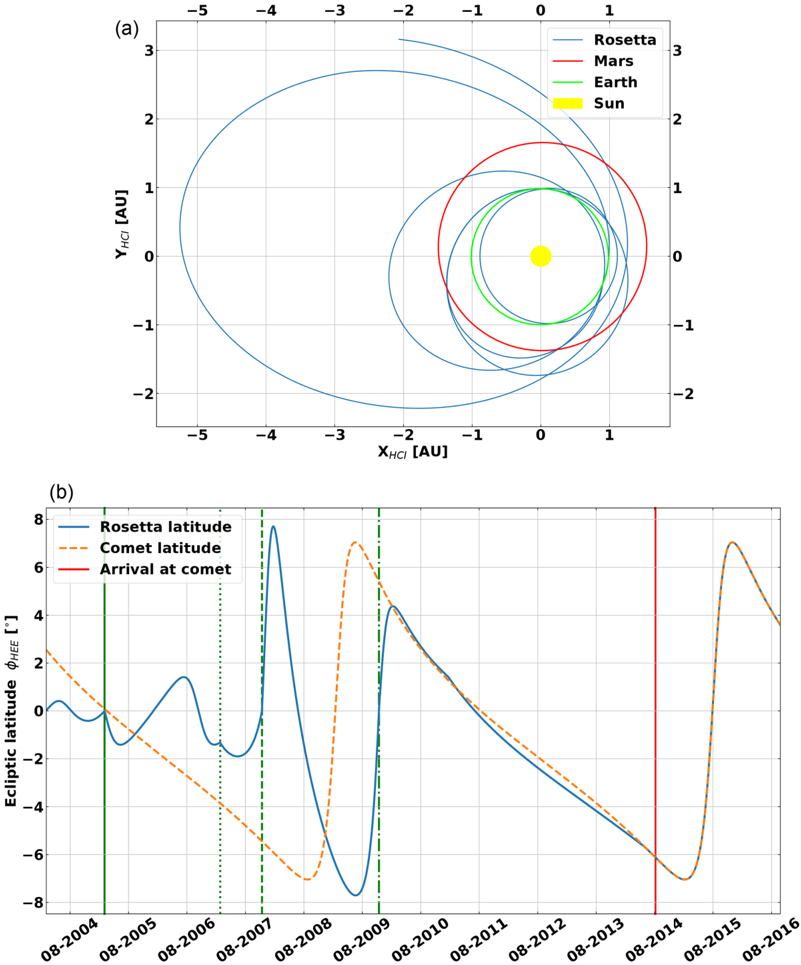
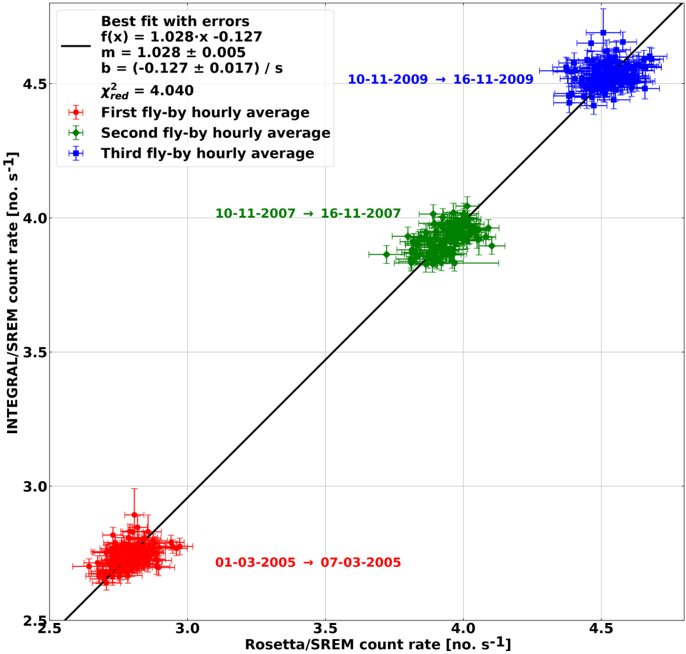
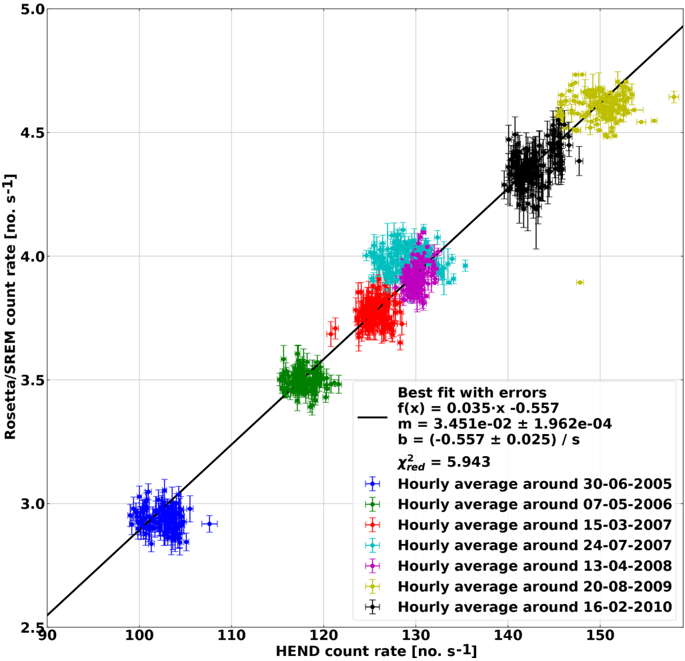
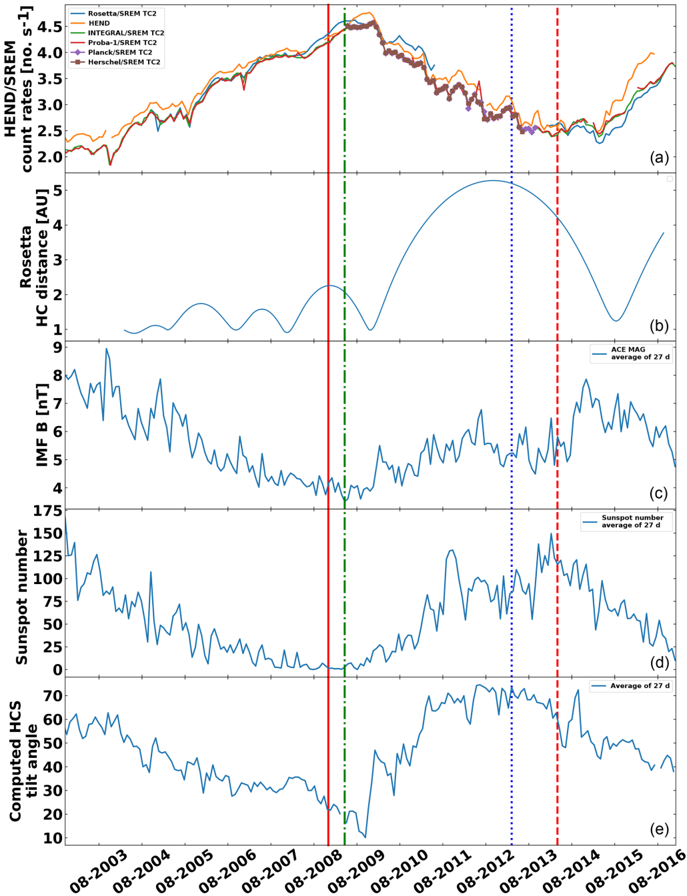
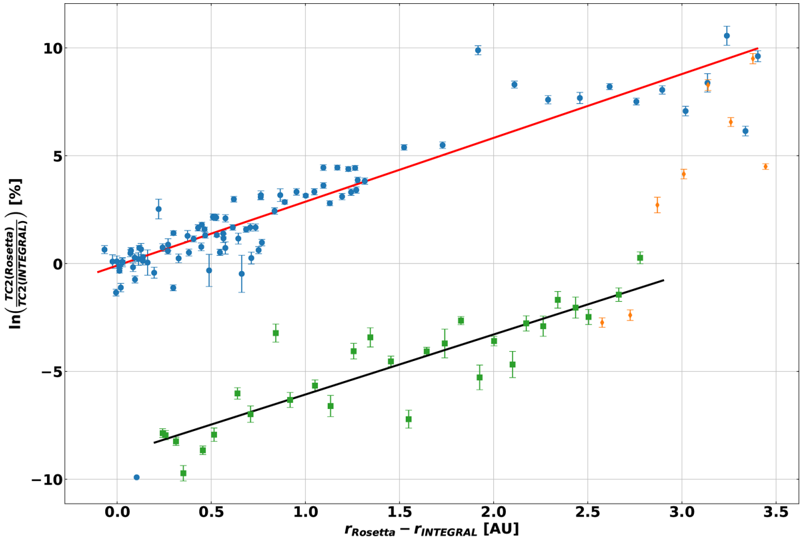
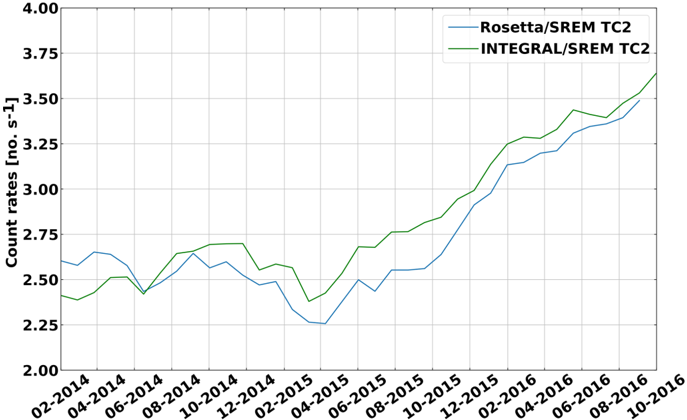
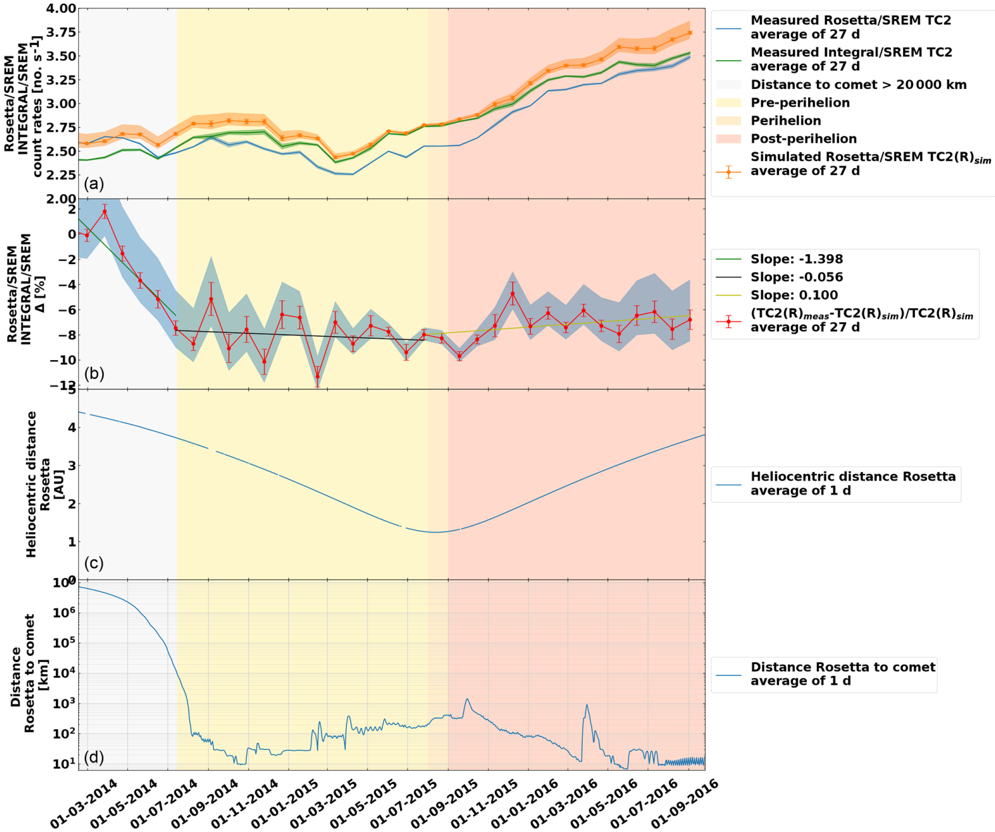
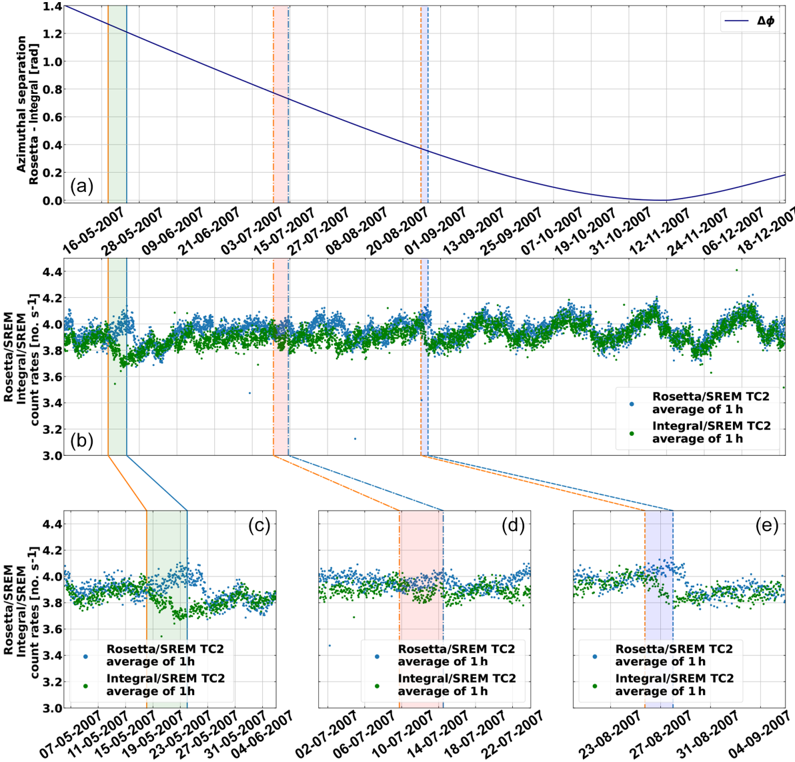
The radiation data collected by the Standard Radiation Environment Monitor (SREM) aboard ESA missions INTEGRAL (INTErnational Gamma-Ray Astrophysics Laboratory), Rosetta, Herschel, Planck and Proba-1, and by the high-energy neutron detector (HEND) instrument aboard Mars Odyssey, are analysed with an emphasis on characterising galactic cosmic rays (GCRs) in the inner heliosphere. A cross calibration between all sensors was performed for this study, which can also be used in subsequent works. We investigate the stability of the SREM detectors over long-term periods. The radiation data are compared qualitatively and quantitatively with the corresponding solar activity. Based on INTEGRAL and Rosetta SREM data, a GCR helioradial gradient of 2.96 % AU −1 is found between 1 and 4.5 AU. In addition, the data during the last phase of the Rosetta mission around comet 67P/Churyumov–Gerasimenko were studied in more detail. An unexpected yet unexplained 8 % reduction of the Galactic Comic Ray flux measured by Rosetta SREM in the vicinity of the comet is noted.
Overview
The claims and statistics of this paper haven’t been checked yet.
Free: it reads the open-access text and checks the first 5 claims that cite a source we can check. Create a free account to check every claim.
Integrity signals
Registry
Cites
Statistics
Figures
Verification
Claims the paper makes
The claims and statistics of this paper haven’t been checked yet.
Free: it reads the open-access text and checks the first 5 claims that cite a source we can check. Create a free account to check every claim.
Claims other papers make about this one
Each is checked against this paper’s own text: does it say what the citing paper says it does?
The cited source says what the claim attributes to it.
In the citing paper
“Honig et al. (2019) found the GCR fluxes increase by about 2.96% per au between 1 and 4.5 au.”
From Radiation environment for future human exploration on the surface of Mars: the current understanding based on MSL/RAD dose measurements (2021) · cites this paper as Honig et al. 2019
Self-check
Percentages, sums and reported differences re-computed from the paper’s own numbers.
The self-check needs the paper’s full text.
Citations
Cites
Solar Wind Electron Proton Alpha Monitor (SWEPAM) for the Advanced Composition Explorer
McComas, D. J., Bame, S. J., Barker, P., Feldman, W. C., Phillips, J. L., Riley, P., & Griffee, J. W. (1998) · The Advanced Composition Explorer Mission · doi:10.1007/978-94-011-4762-0_20 · Cited by 821
The Ace Magnetic Fields Experiment
Smith, C. W., L’Heureux, J., Ness, N. F., Acuña, M. H., Burlaga, L. F., & Scheifele, J. (1998) · The Advanced Composition Explorer Mission · doi:10.1007/978-94-011-4762-0_21 · Cited by 732
Cosmic Rays, Clouds, and Climate
Carslaw, K. S., Harrison, R. G., & Kirkby, J. (2002) · Science · doi:10.1126/science.1076964 · Cited by 567
67P/Churyumov-Gerasimenko, a Jupiter family comet with a high D/H ratio
Altwegg, K., Balsiger, H., Bar-Nun, A., Berthelier, J. J., Bieler, A., Bochsler, P., Briois, C., Calmonte, U., Combi, M., De Keyser, J., et al. (2015) · Science · doi:10.1126/science.1261952 · Cited by 533
Solar Modulation of Cosmic Rays
Potgieter, M. (2013) · Living Reviews in Solar Physics · doi:10.12942/lrsp-2013-3 · Cited by 501 · cited 3×
“We associate the GCR count rate changes over the years with the solar cycle (e.g. Heber and Potgieter, 2008; Potgieter, 2013), which is discussed in more depth below.”
BackgroundMethodDust measurements in the coma of comet 67P/Churyumov-Gerasimenko inbound to the Sun
Rotundi, A., Sierks, H., Della Corte, V., Fulle, M., Gutierrez, P. J., Lara, L., Barbieri, C., Lamy, P. L., Rodrigo, R., Koschny, D., et al. (2015) · Science · doi:10.1126/science.aaa3905 · Cited by 365 · cited 1×
“…it was not until August that the in situ instruments aboard Rosetta began to discern a coma signal, when the spacecraft got to within 100 km of the nucleus (Altwegg et al., 2015; Rotundi et al., 2015); thus, the transition in behaviour occurs before the spacecraft is immersed in the cometary coma.”
BackgroundThe Mars Odyssey Gamma-Ray Spectrometer Instrument Suite
Boynton, W. V., Feldman, W. C., Mitrofanov, I. G., Evans, L. G., Reedy, R. C., Squyres, S. W., Starr, R., Trombka, J. I., d'Uston, C., Arnold, J. R., et al. (2004) · Space Science Reviews · doi:10.1023/b:spac.0000021007.76126.15 · Cited by 332
Solar modulation of cosmic raysPreprint
Potgieter, M. S. (2013) · Cited by 283
Cosmic ray modulation and the solar magnetic field
Cane, H. V., Wibberenz, G., Richardson, I. G., & von Rosenvinge, T. T. (1999) · Geophysical Research Letters · doi:10.1029/1999gl900032 · Cited by 195 · cited 2×
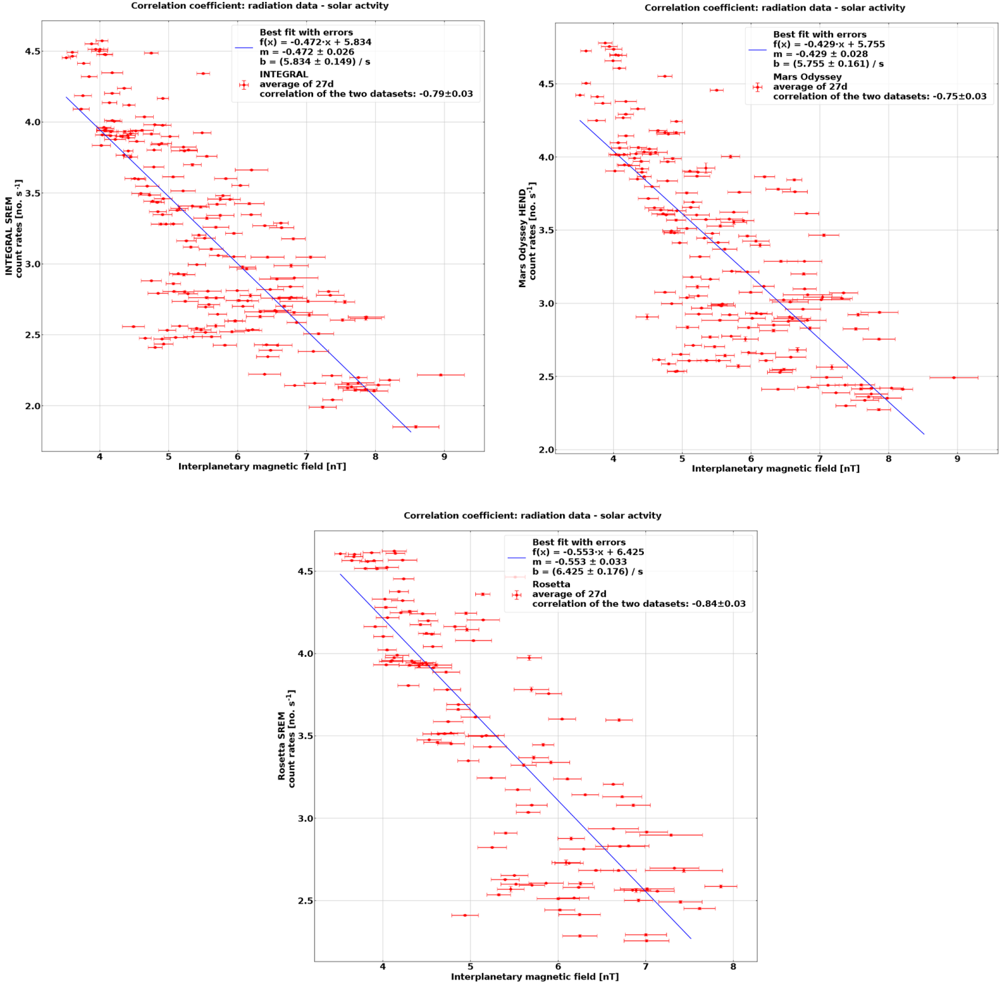
“The correlation coefficients, listed in Table A1, show the expected anticorrelation (e.g Cane et al., 1999; Belov, 2000; Utomo, 2017).”
BackgroundRECORD-SETTING COSMIC-RAY INTENSITIES IN 2009 AND 2010
Mewaldt, R. A., Davis, A. J., Lave, K. A., Leske, R. A., Stone, E. C., Wiedenbeck, M. E., Binns, W. R., Christian, E. R., Cummings, A. C., de Nolfo, G. A., et al. (2010) · The Astrophysical Journal · doi:10.1088/2041-8205/723/1/l1 · Cited by 178
Research works printed but not linked: 1
- 13. Heber, B. and Potgieter, M. S.: Galactic and anomalous cosmic rays through the Solar cycle: New insights from Ulysses, in: The He- liosphere through the Solar activity cycle, Books in astronomy and space sciences, edited by: Balogh, A., Lanzerotti, L. J., and Suess, S. T., Springer-Praxis, 2008.
Cited by
Guo, J., Zeitlin, C., Wimmer-Schweingruber, R. F., Hassler, D. M., Ehresmann, B., Rafkin, S., Freiherr von Forstner, J. L., Khaksarighiri, S., Liu, W., & Wang, Y. (2021) · The Astronomy and Astrophysics Review · doi:10.1007/s00159-021-00136-5 · Cited by 73
“Using multiple spacecraft observations, Honig et al. (2019) found the GCR fluxes increase by about 2.96% per au between 1 and 4.5 au.”
MethodInfluentialSelf-citationINTEGRAL reloaded: Spacecraft, instruments and ground system
Kuulkers, E., Ferrigno, C., Kretschmar, P., Alfonso-Garzón, J., Baab, M., Bazzano, A., Bélanger, G., Benson, I., Bird, A. J., Bozzo, E., et al. (2021) · New Astronomy Reviews · doi:10.1016/j.newar.2021.101629 · Cited by 43
“, Rosetta) provide comparisons of the cosmic-ray rates as a function of the place within the Solar system (Honig et al. 2019).”
BackgroundGuo, J., Zhang, J., Dobynde, M. I., Wang, Y., & Wimmer-Schweingruber, R. F. (2022) · Journal of Geophysical Research Planets · doi:10.1029/2021je007157 · Cited by 36
“5 AU is only in the order of 1%–2% according to multiple spacecraft observations (Honig et al., 2019; Roussos et al., 2020).”
BackgroundSelf-citationRoussos, E., Dialynas, K., Krupp, N., Kollmann, P., Paranicas, C., Roelof, E. C., Yuan, C., Mitchell, D. G., & Krimigis, S. M. (2020) · The Astrophysical Journal · doi:10.3847/1538-4357/abc346 · Cited by 24
Wang, Y., Guo, J., Li, G., Roussos, E., & Zhao, J. (2022) · The Astrophysical Journal · doi:10.3847/1538-4357/ac5896 · Cited by 25
“The gradient of the GCR flux is only about 2%–4% per au (at distances <10 au) according to observations from multiple spacecraft (Honig et al. 2019; Roussos et al. 2020).”
BackgroundSelf-citationParticle radiation environment in the heliosphere: Status, limitations, and recommendations
Guo, J., Wang, B., Whitman, K., Plainaki, C., Zhao, L., Bain, H. M., Cohen, C. M. S., Dalla, S., Dumbović, M., Janvier, M., et al. (2024) · Advances in Space Research · doi:10.1016/j.asr.2024.03.070 · Cited by 40
“It is also important to accumulate data of CR variations at multiple locations in the heliosphere (varying in heliospheric distance and latitude) which will improve the understanding of solar modulation (De Simone et al., 2011; Vos and Potgieter, 2016; Honig et al., 2019; Modzelewska et al., 2019; Knutsen et al., 2021…”
BackgroundSelf-citationThe BepiColombo Environment Radiation Monitor, BERM
Pinto, M., Sánchez‐Cano, B., Moissl, R., Benkhoff, J., Cardoso, C., Gonçalves, P., Assis, P., Vainio, R., Oleynik, P., Lehtolainen, A., et al. (2022) · Space Science Reviews · doi:10.1007/s11214-022-00922-2 · Cited by 24
“…in late 2025, BERM will provide accurate observations of GCR at the closest distances to the Sun, as well as their evolution with both the solar cycle and heliocentric distance, complementing previous studies made at farther distances (Honig et al. 2019; Roussos et al. 2020; Knutsen et al. 2021).”
BackgroundMethodSelf-citationJanvier, M., Démoulin, P., Guo, J., Dasso, S., Regnault, F., Topsi-Moutesidou, S., Gutierrez, C., & Perri, B. (2021) · The Astrophysical Journal · doi:10.3847/1538-4357/ac2b9b · Cited by 23
“…et al. (2016), measuring the gradients with MESSENGER and the Cosmic Ray Telescope for Environmental Radiation (CRaTER) on the Lunar Reconnaissance Orbiter, but also a 2%–4% per au increase found in other studies beyond 1 au (e.g., Heber et al. 2002; Honig et al. 2019; Roussos et al. 2020).”
MethodSelf-citationLiu, W. M., Guo, J., Wang, Y., & Slaba, T. C. (2024) · The Astrophysical Journal Supplement Series · doi:10.3847/1538-4365/ad18ad · Cited by 26
Self-citationDirectionality of the Martian Surface Radiation and Derivation of the Upward Albedo Radiation
Guo, J., Khaksarighiri, S., Wimmer‐Schweingruber, R. F., Hassler, D. M., Ehresmann, B., Zeitlin, C., Löffler, S., Matthiä, D., Berger, T., Reitz, G., et al. (2021) · Geophysical Research Letters · doi:10.1029/2021gl093912 · Cited by 14
“5 AU (within 10 AU) according to multi-spacecraft observations (Honig et al., 2019; Roussos et al., 2020).”
Self-citationGalactic cosmic ray modulation at Mars and beyond measured with EDACs on Mars Express and Rosetta
Knutsen, E. W., Witasse, O. G., Sánchez‐Cano, B., Lester, M., Wimmer-Schweingruber, R. F., Denis, M., Godfrey, J., & Johnstone, A. (2021) · Astronomy and Astrophysics · doi:10.1051/0004-6361/202140767 · Cited by 16
Self-citationObservations of neutron radiation environment during Odyssey cruise to Mars
Litvak, M. L., Mitrofanov, I. G., Sanin, A. B., Bakhtin, B. N., Golovin, D. V., & Zeitlin, C. J. (2021) · Life Sciences in Space Research · doi:10.1016/j.lssr.2021.03.003 · Cited by 12
Sánchez‐Cano, B., Witasse, O. G., Knutsen, E. W., Meggi, D., Viet, S., Lester, M., Wimmer-Schweingruber, R. F., Pinto, M., Moissl, R., Benkhoff, J., et al. (2023) · Space Weather · doi:10.1029/2023sw003540 · Cited by 11
Self-citationThe JUICE Radiation Environment Monitor, RADEM
Hajdas, W., Gonçalves, P., Pinto, M., Socha, P., Marcinkowski, R., Xiao, H., dos Santos, F. P., Arruda, L., Galli, A., Marques, A., et al. (2025) · Space Science Reviews · doi:10.1007/s11214-025-01163-9 · Cited by 12
“Gradient calculations can be performed with standalone RADEM measurements or by combining RADEM with reference simultaneous GRC measurements at 1 AU (Roussos et al. 2020; Honig et al. 2019) or at the inner-most solar system by BepiColombo and Solar Orbiter (for a first example, see Fig.”
Self-citationBepiColombo cruise science: overview of the mission contribution to heliophysics
Sánchez‐Cano, B., Hadid, L., Aizawa, S., Murakami, G., Bamba, Y., Chiba, S., Hara, T., Heyner, D., Ho, G. C., Iwai, K., et al. (2025) · Earth Planets and Space · doi:10.1186/s40623-025-02256-z · Cited by 12
“A more detailed study in this topic is currently being performed, and it will complement similar observations at further distances performed by missions such as Rosetta in the outer heliosphere (Honig et al. 2019).”
Self-citationVenus's induced magnetosphere during active solar wind conditions at BepiColombo's Venus 1 flyby
Volwerk, M., Sánchez‐Cano, B., Heyner, D., Aizawa, S., André, N., Varsani, A., Mieth, J. Z. D., Orsini, S., Baumjohann, W., Fischer, D., et al. (2021) · Annales Geophysicae · doi:10.5194/angeo-39-811-2021 · Cited by 11
“BERM is a particle detector able to provide radiation information, in a way similar to the Standard Radiation Environment Monitor (SREM) instrument aboard several ESA missions such as Rosetta (Honig et al., 2019).”
BackgroundMethodSelf-citationCutoff Rigidities, Galactic Cosmic Ray Flux, and Heavy Ion Detections at Jupiter
Enghoff, M. B., Enghoff, M. B., Svensmark, J., Becker, H. N., Jørgensen, J. L., Kotsiaros, S., Herceg, M., Alexander, J. W., Florence, M. M., & Connerney, J. E. P. (2024) · Journal of Geophysical Research Planets · doi:10.1029/2023je008085 · Cited by 6
“Roussos et al. (2020) extended this range down to 1 AU and found a gradient varying between 2% and 4%, depending on solar activity, while Honig et al. (2019) found a gradient of 2.96% per AU between 1 and 4.5 AU.”
BackgroundMethodInfluentialSpace Environmental Effects on Multifunctional Radiation Shielding Materials
Sen, S., O'Dell, J. S., Yan, Y., Heilbronn, L., Ning, H., Finckenor, M., Carrico, M., & Pillay, S. B. (2024) · Earth and Space Science · doi:10.1029/2024ea003681 · Cited by 6
“Aside from AO, UV, and thermal extremes, the space environment also consists of a continuous flux of galactic cosmic rays (GCRs) (Boezio et al., 2020; Wilson, 2000) and transient but intense fluxes of solar energetic particles (SEPs) (Honig et al., 2019; Smart & Shea, 1990; Wilson, 2000).”
Futaana, Y., Shimoyama, M., Wieser, M., Karlsson, S., Andersson, H., Nilsson, H., Wang, X., Fedorov, A., André, N., Holmström, M., et al. (2022) · The Astrophysical Journal · doi:10.3847/1538-4357/ac9a49 · Cited by 9
Liu, W. M., Guo, J., Zhang, J., & Semkova, J. (2023) · The Astrophysical Journal · doi:10.3847/1538-4357/acce3c · Cited by 11
“This factor is slightly larger, likely because the modeled GCR flux at 1.5 au should be a few percent larger than that at 1 au due to a small radial gradient of the GCR intensity in interplanetary space (Honig et al. 2019; Roussos et al. 2020).”
BackgroundInfluentialSelf-citationAttrill, G. D. R., Nicholas, A. C., Routledge, G., Miah, J. A., Kataria, D. O., Mitchell, C. N., Watson, R. J., Williams, J., Agathanggelou, A., Brown, C. M., et al. (2020) · Journal of Space Weather and Space Climate · doi:10.1051/swsc/2020066 · Cited by 5
“Although the primary function of CIRCE data will be exploited for scientific benefit, it can also be utilised for engineering purposes (see Honig et al., 2019, for other examples of this type of dual functionality).”
BackgroundIn-flight calibration of RADEM, the JUICE mission radiation monitor
Pinto, M., Santos, F., Gomes, A., Gonçalves, T. M., Arruda, L., Gonçalves, P., Rodríguez‐García, L., Vainio, R., Witasse, O. G., & Altobelli, N. (2026) · Astronomy and Astrophysics · doi:10.1051/0004-6361/202558601 · Cited by 3
Self-citationRadiation Effects in the Inner Heliosphere With BepiColombo
Pinto, M., Poivey, C. F., Donadoni, M., Polo, C. B., Witasse, O. G., Clérigo, I., Heiskanen, P., Falcolini, M., & Pesce, A. (2025) · IEEE Transactions on Nuclear Science · doi:10.1109/tns.2025.3556814 · Cited by 3
“While little information about the GCR radial gradient in the inner solar system exists, at distances larger than 1 A.U., it has been shown that it is negligible in relation to solar modulation ( ∼ 3%/A.U.) [14].”
Self-citationGalactic cosmic rays at 0.7 A.U. with Venus Express housekeeping data
Rimbot, T., Witasse, O. G., Pinto, M., Knutsen, E. W., Sánchez‐Cano, B., Wood, S., Tremolizzo, E., & Exner, W. (2024) · Planetary and Space Science · doi:10.1016/j.pss.2024.105867 · Cited by 2
Self-citationThe Impact of Space Radiation on Brains of Future Martian and Lunar Explorers
Li, Y., Guo, J., Khaksarighiri, S., Dobynde, M. I., Zhang, J., Liu, B., & Wimmer-Schweingruber, R. F. (2023) · Space Weather · doi:10.1029/2023sw003470 · Cited by 6
“The radial gradient of GCR flux is only in the order of 1%–2% between 1 and 1.5 AU according to multiple spacecraft observations (Honig et al., 2019; Roussos et al., 2020), and therefore we assume that the GCR flux is the same at the vicinity of the Moon and Mars as predicted by the BON14 model for…”
MethodInfluentialSelf-citationGomes, A., Pinto, M., Cardoso, C., Vanio, R., Esko, E., Kilpua, E. K. J., Lehtolainen, A., Oleynik, P., Sánchez‐Cano, B., Dresing, N., et al. (2026) · Earth Planets and Space · doi:10.1186/s40623-026-02432-9 · Cited by 3
Self-citationFuture opportunities in solar system plasma science through ESA’s exploration programme
Holmström, M., Lester, M., & Sánchez‐Cano, B. (2024) · npj Microgravity · doi:10.1038/s41526-024-00373-9 · Cited by 1
Self-citationObservations of a Solar Energetic Particle Event From Inside and Outside the Coma of Comet 67P
Wellbrock, A., Jones, G. H., Dresing, N., Coates, A. J., Wedlund, C. S., Nilsson, H., Sánchez‐Cano, B., Palmerio, E., Turc, L., Myllys, M., et al. (2022) · Journal of Geophysical Research Space Physics · doi:10.1029/2022ja030398 · Cited by 3
“Honig et al. (2019) analyzed data from the European Space Agency's (ESA's) Standard Radiation Environment Monitors (SREM) carried on several ESA spacecraft such as Rosetta and INTEGRAL in order to characterize galactic cosmic rays (GCRs) in the inner heliosphere.”
Self-citationVolwerk, M. (2021) · Annales Geophysicae · doi:10.5194/angeo-2021-24-ac2
Volwerk, M. (2021) · Annales Geophysicae · doi:10.5194/angeo-2021-24-ac3
Volwerk, M. (2021) · Annales Geophysicae · doi:10.5194/angeo-2021-24-ac1
(2021) · Annales Geophysicae · doi:10.5194/angeo-2021-24-rc1
(2021) · Annales Geophysicae · doi:10.5194/angeo-2021-24-rc2
(2021) · Annales Geophysicae · doi:10.5194/angeo-2021-24-cc1
Mitrofanov, I. G., Sanin, A. B., Malakhov, A., Litvak, M. L., & Golovin, D. V. (2022) · Nuclear Instruments and Methods in Physics Research Section A Accelerators Spectrometers Detectors and Associated Equipment · doi:10.1016/j.nima.2022.166997
Erik Kuulkers, A., Laurent, P., Kretschmar, P., Bazzano, A., Brandt, S. K., Bel, M. C., Cangemi, F., Coleiro, A., Ehle, M., Ferrigno, C., et al. (2022) · Springer eBooks · doi:10.1007/978-981-16-4544-0_56-1
Erik Kuulkers, A., Laurent, P., Kretschmar, P., Bazzano, A., Brandt, S. K., Bel, M. C., Cangemi, F., Coleiro, A., Ehle, M., Ferrigno, C., et al. (2024) · Springer eBooks · doi:10.1007/978-981-19-6960-7_56
Metadata
- Authors
- Honig, T., Witasse, O. G., Evans, H., Nieminen, P., Kuulkers, E., Taylor, M. G. G. T., Heber, B., Guo, J., & Sánchez-Cano, B.
- Affiliations
- Johannes Gutenberg University Mainz (DE)
- European Space Agency (FR)
- Christian-Albrechts-Universität zu Kiel (DE)
- University of Science and Technology of China (CN)
- Corresponding author
- Honig, Thomas
- Witasse, Olivier G.
- Evans, Hugh
- Nieminen, Petteri
- Heber, Bernd
- Guo, Jingnan
- Venue
- Annales Geophysicae
- Publisher
- Copernicus GmbH
- Published
- 2019-09-25
- Volume
- 37
- Issue
- 5
- Pages
- 903-918
- ISSN
- 0992-7689 (ISSN-L)
- 1432-0576
- OpenAlex
- W2944143073
- Semantic Scholar
- a374cac65b1971037d0eee8cdd1236ce2b75f062
- Cited by
- 38
- References
- 43
- Citations by year
- 2026: 2 · 2025: 3 · 2024: 7 · 2023: 3 · 2022: 7 · 2021: 13 · 2020: 2 · 2019: 1
- FWCI
- 3.07
- Type
- journal article
- Language
- en
- Open access
- gold
- doi.org
- Licence
- Locations
- Annales Geophysicae (publishedVersion, cc-by)
- DOAJ (DOAJ: Directory of Open Access Journals) (submittedVersion)
- Figshare (submittedVersion, cc-by)
- Funders
- National Aeronautics and Space Administration
- Stanford Bio-X
- Science and Technology Facilities Council (ST/S000429/1, ST/N000749/1)
- Topics
- Physical Sciences › Physics and Astronomy › Astronomy and Astrophysics › Solar and Space Plasma Dynamics
- Physical Sciences › Physics and Astronomy › Nuclear and High Energy Physics › Astrophysics and Cosmic Phenomena
- Physical Sciences › Earth and Planetary Sciences › Space and Planetary Science › Ionosphere and magnetosphere dynamics
- Keywords
- galactic cosmic rays, inner heliosphere, solar cycle, Srem, Mars Odyssey, integrals, Rosetta, Herschel, Planck, detector stability, comet 67P/Churyumov-Gerasimenko, solar activity
About these checks
Registry, retraction, Cites and statistics results are computed, not judged, with one exception: a printed reference that no index lists is read once by a model before it counts as a citation error. Claims are extracted by a model and kept only when their quote appears verbatim in the text; each cited source is then checked, with a model’s help, for whether it says what the claim relies on. Those verdicts can be wrong — read the claim’s quote and the cited source before relying on one.
Statistics and arithmetic are recomputed, not judged.
Confidence bands are shown only for fields calibrated on our annotated test set. None is calibrated yet, so no band is shown.
What counts as a claim ›How we measure confidence ›How we check this ›
Are you an author, or do you see a problem with this page? Request a review
Data sources
Bibliographic data: Semantic Scholar, OpenAlex, Crossref.
Contains information from the Semantic Scholar Academic Graph Datasets, made available under the ODC Attribution License (ODC-BY 1.0).
Semantic Scholar’s data is described in: Kinney, R., et al. (2023). The Semantic Scholar Open Data Platform. arXiv:2301.10140.
