

Multi-point galactic cosmic ray measurements between 1 and 4.5 AU over a full solar cycle
Open accessPublished version of a preprint
The DOI matches its Crossref record; 40 of the 43 references it cites were found in a registry or an index.
Abstract
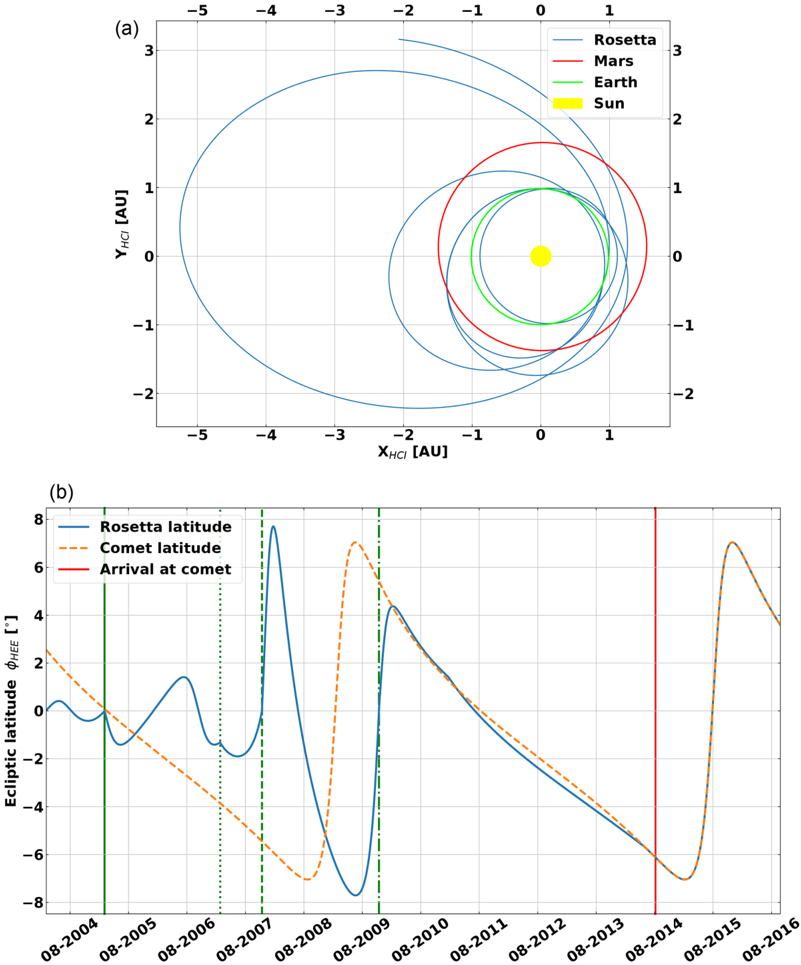
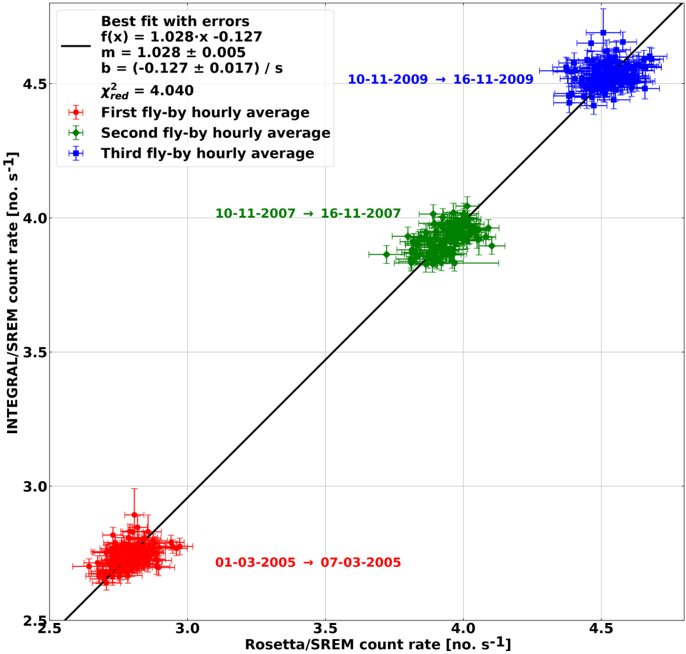
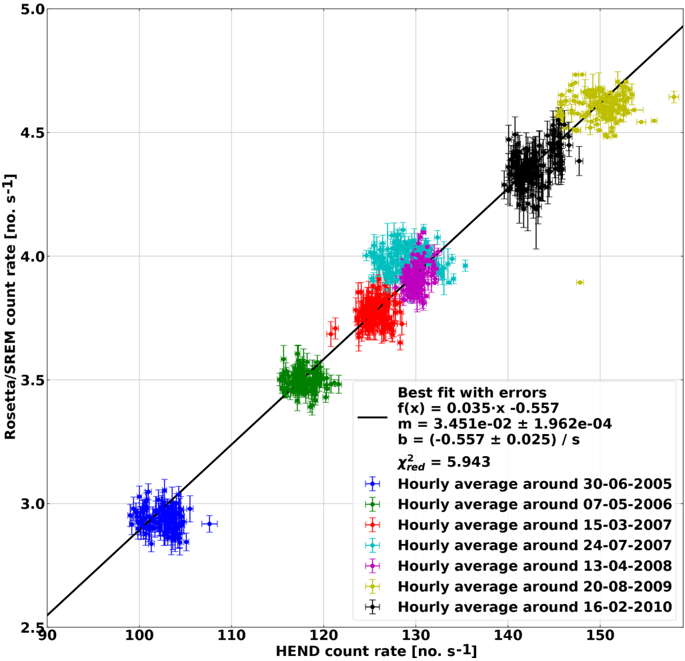
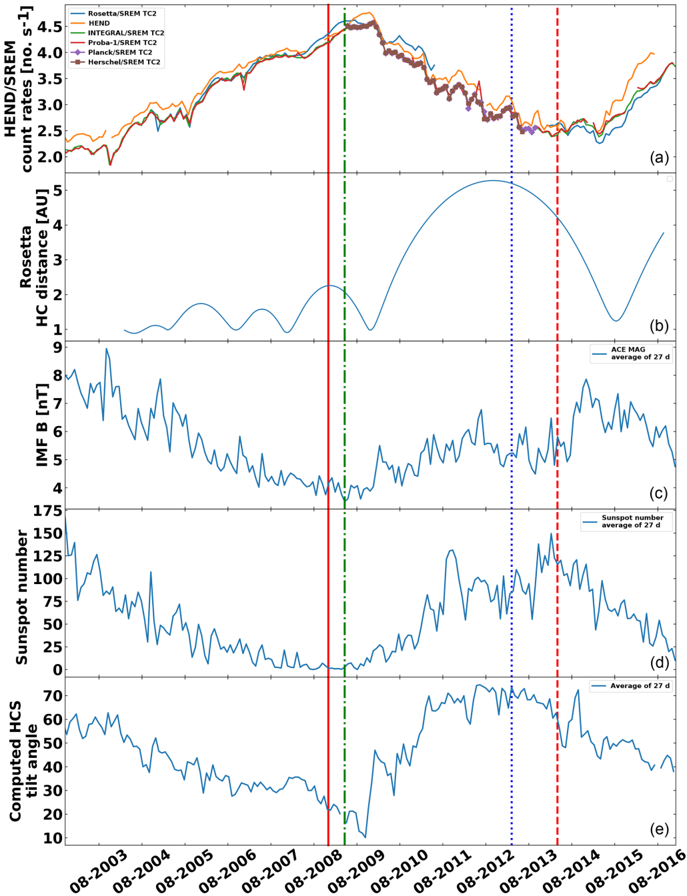
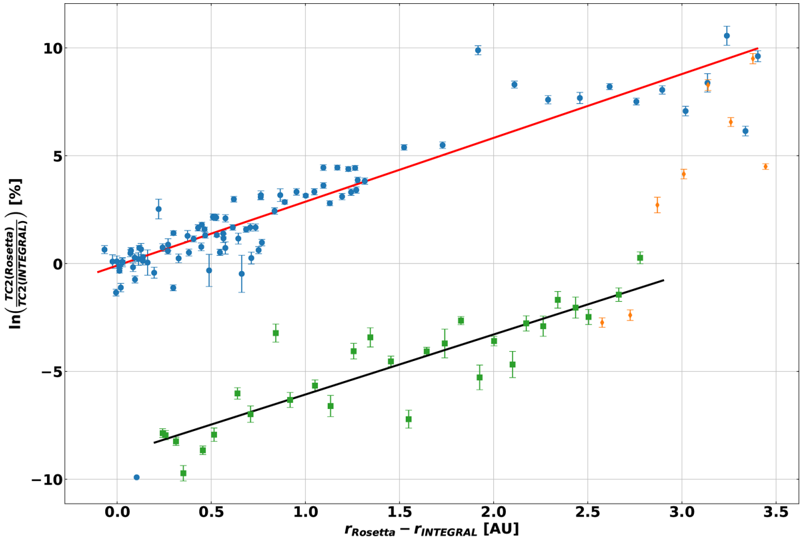
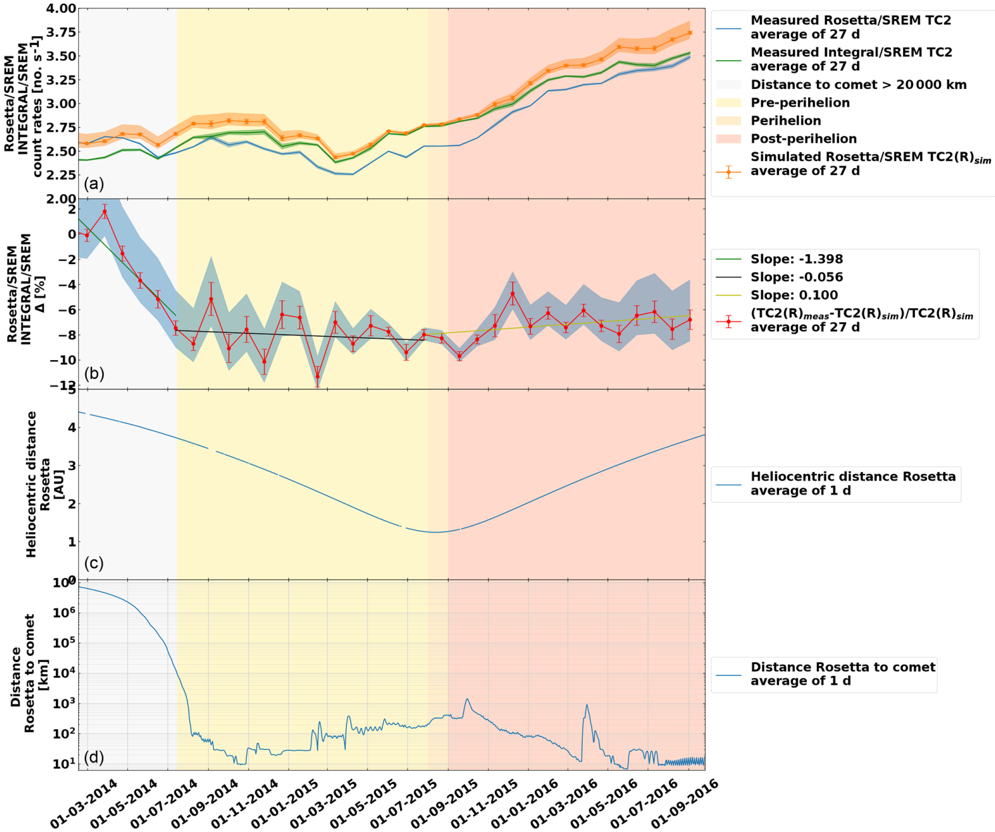
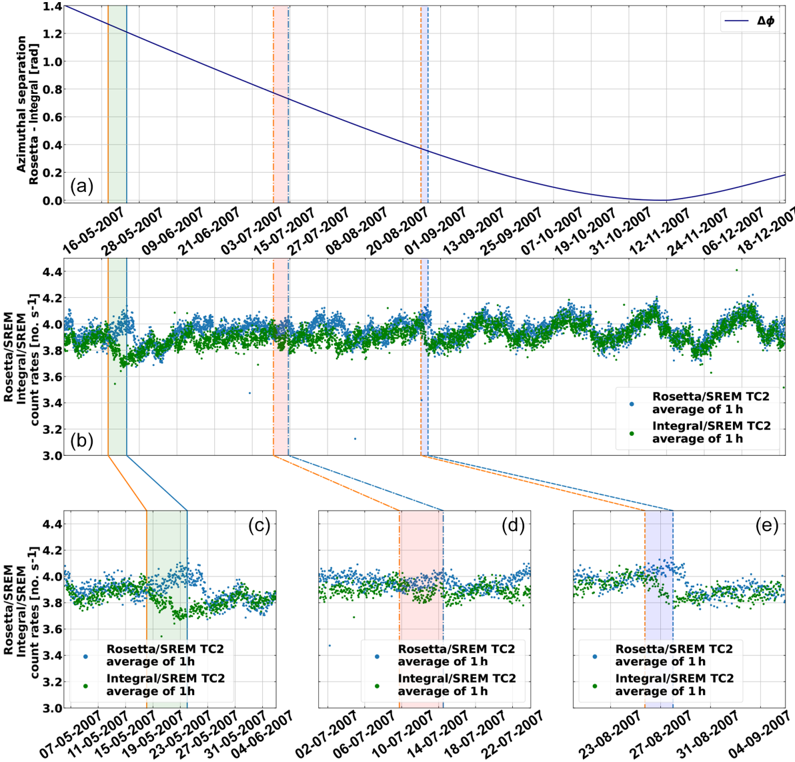
The radiation data collected by the Standard Radiation Environment Monitor (SREM) aboard ESA missions INTEGRAL (INTErnational Gamma-Ray Astrophysics Laboratory), Rosetta, Herschel, Planck and Proba-1, and by the high-energy neutron detector (HEND) instrument aboard Mars Odyssey, are analysed with an emphasis on characterising galactic cosmic rays (GCRs) in the inner heliosphere. A cross calibration between all sensors was performed for this study, which can also be used in subsequent works. We investigate the stability of the SREM detectors over long-term periods. The radiation data are compared qualitatively and quantitatively with the corresponding solar activity. Based on INTEGRAL and Rosetta SREM data, a GCR helioradial gradient of 2.96 % AU −1 is found between 1 and 4.5 AU. In addition, the data during the last phase of the Rosetta mission around comet 67P/Churyumov–Gerasimenko were studied in more detail. An unexpected yet unexplained 8 % reduction of the Galactic Comic Ray flux measured by Rosetta SREM in the vicinity of the comet is noted.
Overview
The claims and statistics of this paper haven’t been checked yet.
Free: it reads the open-access text and checks the first 5 claims that cite a source we can check. Create a free account to check every claim.
Integrity signals
Registry
Cites
Statistics
Figures
Verification
Claims the paper makes
The claims and statistics of this paper haven’t been checked yet.
Free: it reads the open-access text and checks the first 5 claims that cite a source we can check. Create a free account to check every claim.
Claims other papers make about this one
Each is checked against this paper’s own text: does it say what the citing paper says it does?
The cited source says what the claim attributes to it.
In the citing paper
“Honig et al. (2019) found the GCR fluxes increase by about 2.96% per au between 1 and 4.5 au.”
From Radiation environment for future human exploration on the surface of Mars: the current understanding based on MSL/RAD dose measurements (2021) · cites this paper as Honig et al. 2019
Self-check
Percentages, sums and reported differences re-computed from the paper’s own numbers.
The self-check needs the paper’s full text.
Citations
Cites
Solar Wind Electron Proton Alpha Monitor (SWEPAM) for the Advanced Composition Explorer
McComas, D. J., Bame, S. J., Barker, P., Feldman, W. C., Phillips, J. L., Riley, P., & Griffee, J. W. (1998) · The Advanced Composition Explorer Mission · doi:10.1007/978-94-011-4762-0_20 · Cited by 821
The Ace Magnetic Fields Experiment
Smith, C. W., L’Heureux, J., Ness, N. F., Acuña, M. H., Burlaga, L. F., & Scheifele, J. (1998) · The Advanced Composition Explorer Mission · doi:10.1007/978-94-011-4762-0_21 · Cited by 732
Cosmic Rays, Clouds, and Climate
Carslaw, K. S., Harrison, R. G., & Kirkby, J. (2002) · Science · doi:10.1126/science.1076964 · Cited by 567
67P/Churyumov-Gerasimenko, a Jupiter family comet with a high D/H ratio
Altwegg, K., Balsiger, H., Bar-Nun, A., Berthelier, J. J., Bieler, A., Bochsler, P., Briois, C., Calmonte, U., Combi, M., De Keyser, J., et al. (2015) · Science · doi:10.1126/science.1261952 · Cited by 533
Solar Modulation of Cosmic Rays
Potgieter, M. (2013) · Living Reviews in Solar Physics · doi:10.12942/lrsp-2013-3 · Cited by 501 · cited 3×
“We associate the GCR count rate changes over the years with the solar cycle (e.g. Heber and Potgieter, 2008; Potgieter, 2013), which is discussed in more depth below.”
BackgroundMethodDust measurements in the coma of comet 67P/Churyumov-Gerasimenko inbound to the Sun
Rotundi, A., Sierks, H., Della Corte, V., Fulle, M., Gutierrez, P. J., Lara, L., Barbieri, C., Lamy, P. L., Rodrigo, R., Koschny, D., et al. (2015) · Science · doi:10.1126/science.aaa3905 · Cited by 365 · cited 1×
“…it was not until August that the in situ instruments aboard Rosetta began to discern a coma signal, when the spacecraft got to within 100 km of the nucleus (Altwegg et al., 2015; Rotundi et al., 2015); thus, the transition in behaviour occurs before the spacecraft is immersed in the cometary coma.”
BackgroundThe Mars Odyssey Gamma-Ray Spectrometer Instrument Suite
Boynton, W. V., Feldman, W. C., Mitrofanov, I. G., Evans, L. G., Reedy, R. C., Squyres, S. W., Starr, R., Trombka, J. I., d'Uston, C., Arnold, J. R., et al. (2004) · Space Science Reviews · doi:10.1023/b:spac.0000021007.76126.15 · Cited by 332
Solar modulation of cosmic raysPreprint
Potgieter, M. S. (2013) · Cited by 283
Cosmic ray modulation and the solar magnetic field
Cane, H. V., Wibberenz, G., Richardson, I. G., & von Rosenvinge, T. T. (1999) · Geophysical Research Letters · doi:10.1029/1999gl900032 · Cited by 195 · cited 2×
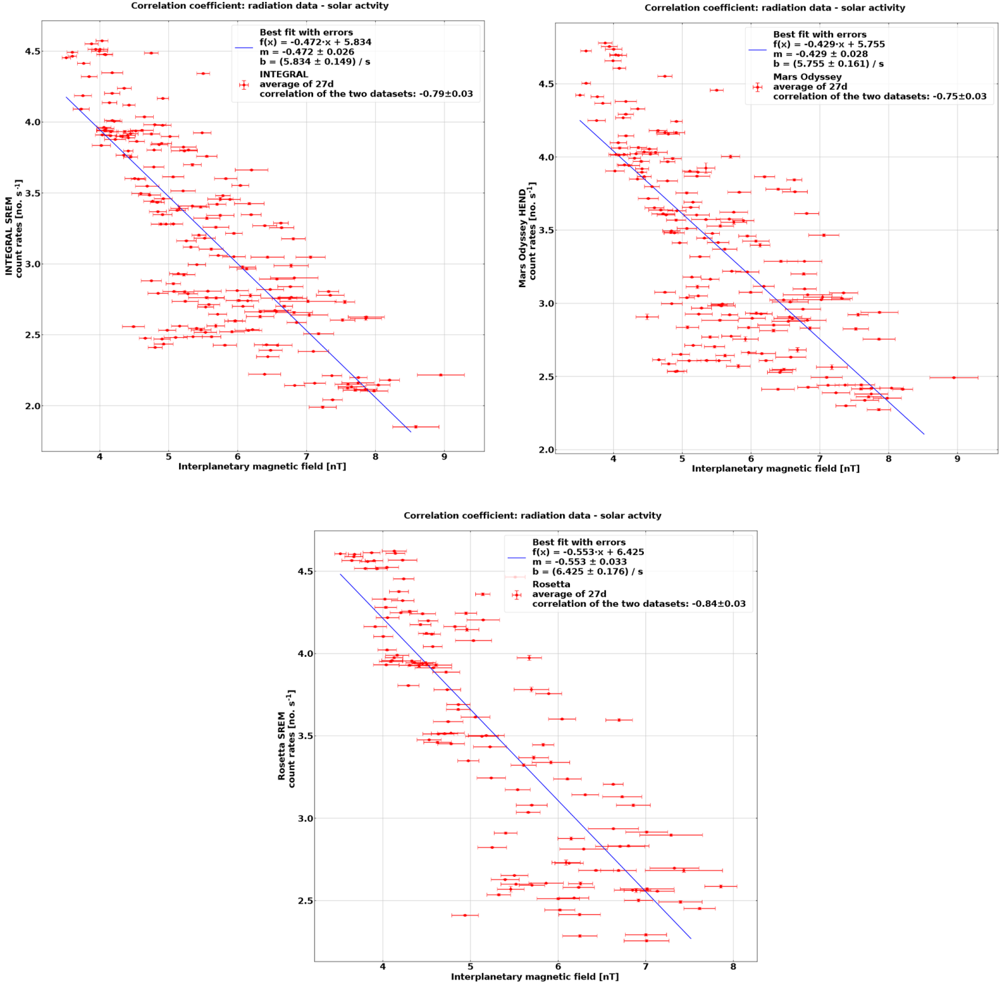
“The correlation coefficients, listed in Table A1, show the expected anticorrelation (e.g Cane et al., 1999; Belov, 2000; Utomo, 2017).”
BackgroundRECORD-SETTING COSMIC-RAY INTENSITIES IN 2009 AND 2010
Mewaldt, R. A., Davis, A. J., Lave, K. A., Leske, R. A., Stone, E. C., Wiedenbeck, M. E., Binns, W. R., Christian, E. R., Cummings, A. C., de Nolfo, G. A., et al. (2010) · The Astrophysical Journal · doi:10.1088/2041-8205/723/1/l1 · Cited by 178
Cosmic-Ray Modulation Equations
Moraal, H. (2011) · Space Science Reviews · doi:10.1007/s11214-011-9819-3 · Cited by 164 · cited 1×
“The variation in galactic cosmic ray intensity depends on different physical processes: inward diffusion in the interplanetary magnetic field (IMF), adiabatic cooling, outward convection and deceleration in the solar wind plasma, drift along the heliospheric current sheet, and interaction with magnetic structures in s…”
BackgroundWitasse, O., Sánchez‐Cano, B., Mays, M. L., Kajdič, P., Opgenoorth, H., Elliott, H. A., Richardson, I. G., Zouganelis, I., Zender, J., Wimmer‐Schweingruber, R. F., et al. (2017) · Journal of Geophysical Research: Space Physics · doi:10.1002/2017ja023884 · Cited by 126
Self-citationLarge Scale Modulation: View From the Earth
Belov, A. V. (2000) · Space Science Reviews · doi:10.1023/a:1026584109817 · Cited by 119
Hansen, K. C., Altwegg, K., Berthelier, J. J., Bieler, A., Biver, N., Bockelée-Morvan, D., Calmonte, U., Capaccioni, F., Combi, M. R., Keyser, J. D., et al. (2016) · Monthly Notices of the Royal Astronomical Society · doi:10.1093/mnras/stw2413 · Cited by 108
The Advanced Composition Explorer
Stone, E. C., Frandsen, A. M. A., Mewaldt, R. A., Christian, E. R., Margolies, D. L., Ormes, J. F., & Snow, F. (1998) · Springer eBooks · doi:10.1007/978-94-011-4762-0_1 · Cited by 106
The Large-Scale Structure of the Heliospheric Current Sheet during the Ulysses Epoch
Hoeksema, J. T. (1995) · Springer eBooks · doi:10.1007/978-94-011-0167-7_25 · Cited by 104
Potgieter, M. S., Burger, R. A., & Ferreira, S. E. S. (2001) · Springer eBooks · doi:10.1007/978-94-017-3230-7_49 · Cited by 68
67P/Churyumov-Gerasimenko: Activity between March and June 2014 as observed from Rosetta/OSIRIS
Tubiana, C., Snodgrass, C., Bertini, I., Mottola, S., Vincent, J., Lara, L. M., Fornasier, S., Knollenberg, J., Thomas, N., Fulle, M., et al. (2014) · Astronomy and Astrophysics · doi:10.1051/0004-6361/201424735 · Cited by 68
Results from the ESA SREM monitors and comparison with existing radiation belt models
Evans, H. D. R., Bühler, P., Hajdas, W., Daly, E. J., Nieminen, P. J., & Mohammadzadeh, A. (2008) · Advances in Space Research · doi:10.1016/j.asr.2008.03.022 · Cited by 55 · cited 1×
“The SREM (e.g. Evans et al., 2008) is a particle detector developed to provide radiation information on a broad range of ESA space missions.”
BackgroundSelf-citationStudy of the Cosmic-Ray Modulation During the Passage of ICMEs and CIRs
Badruddin, B., & Kumar, A. (2016) · Solar Physics · doi:10.1007/s11207-015-0843-4 · Cited by 47 · cited 1×
“GCR short temporal variations can be driven by coronal mass ejections (CMEs) and corotating interaction regions (CIRs; e.g. Moraal, 2013; Badruddin and Kumar, 2016; SanchezCano et al., 2017; Witasse et al., 2017) and can influence the timing of signals at various locations in the heliosphere.”
BackgroundThe ESA Standard Radiation Environment Monitor program first results from PROBA-I and INTEGRAL
Mohammadzadeh, A., Evans, H. D. R., Nieminen, P. J., Daly, E. J., Vuilleumier, P., Buhler, P., Eggel, C., Hajdas, W., Schlumpf, N., Zehnder, A., et al. (2003) · IEEE Transactions on Nuclear Science · doi:10.1109/tns.2003.821796 · Cited by 46 · cited 1×
“In the first of the two detector heads, the detectors D1 and D2 are arranged in a telescope configuration, with the main entrance covered by 2 mm of aluminium that provides a lower energy threshold of about 20 MeV for protons and about 1.5 MeV for electrons (Mohammadzadeh et al., 2003).”
BackgroundSelf-citationGlobal Gradients for Cosmic-Ray Protons in the Heliosphere During the Solar Minimum of Cycle 23/24
Vos, E. E., & Potgieter, M. S. (2016) · Solar Physics · doi:10.1007/s11207-016-0945-7 · Cited by 46 · cited 3×
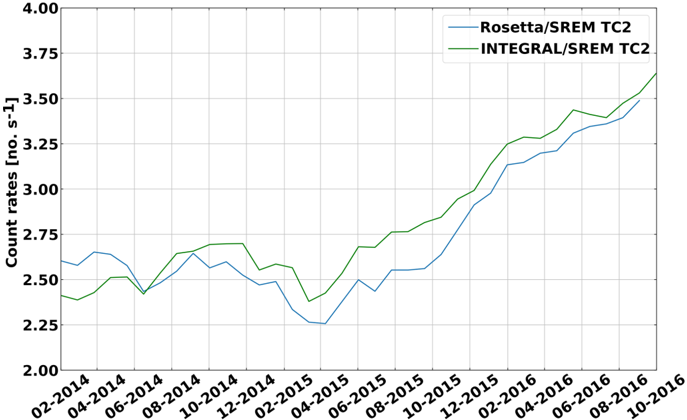
“After that period (green points and black fit), the count rate variation and the ratio are in very good agreement with the expectation of a positive radial gradient of about 2.9 % AU−1 (e.g. Vos and Potgieter, 2016; Gieseler and Heber, 2016).”
ResultInfluentialCosmic rays, aerosols, clouds, and climate: Recent findings from the CLOUD experiment
Pierce, J. R. (2017) · Journal of Geophysical Research Atmospheres · doi:10.1002/2017jd027475 · Cited by 45 · cited 1×
“The study of the effects of GCRs on the Earth’s atmosphere and climate is also a fascinating field of research (e.g Carslaw et al., 2002; Pierce, 2017; Frigo et al., 2018).”
BackgroundGieseler, J., & Heber, B. (2016) · Astronomy & Astrophysics · doi:10.1051/0004-6361/201527972 · Cited by 42 · cited 3×
“After that period (green points and black fit), the count rate variation and the ratio are in very good agreement with the expectation of a positive radial gradient of about 2.9 % AU−1 (e.g. Vos and Potgieter, 2016; Gieseler and Heber, 2016).”
BackgroundResultSelf-citationMars plasma system response to solar wind disturbances during solar minimum
Sánchez‐Cano, B., Hall, B. E. S., Lester, M., Mays, M. L., Witasse, O. G., Ambrosi, R. M., Andrews, D. J., Cartacci, M., Cicchetti, A., Holmström, M., et al. (2017) · Journal of Geophysical Research Space Physics · doi:10.1002/2016ja023587 · Cited by 42
Self-citationMars Odyssey measurements of galactic cosmic rays and solar particles in Mars orbit, 2002-2008
Zeitlin, C., Boynton, W., Mitrofanov, I., Hassler, D., Atwell, W., Cleghorn, T. F., Cucinotta, F. A., Dayeh, M., Desai, M., Guetersloh, S. B., et al. (2010) · Space Weather · doi:10.1029/2009sw000563 · Cited by 41 · cited 2×
“This instrument can be used also as a proxy for GCRs, as demonstrated in Zeitlin et al. (2010), since HEND measures secondary particles produced by the interactions of primary energetic GCR with the spacecraft, providing indirectly a measure of the cosmic rays (Zeitlin et al., 2010).”
MethodInfluentialModulation over a 22-year cosmic ray cycle: On the tilt angles of the heliospheric current sheet
Ferreira, S. E. S., & Potgieter, M. S. (2003) · Advances in Space Research · doi:10.1016/s0273-1177(03)00360-0 · Cited by 36 · cited 2×
“…the corresponding radial gradients. current sheet (HCS) tilt is the maximum latitudinal extent of the HCS, computed using a potential field model applied to photospheric magnetic field observations (Hoeksema, 1995; Ferreira and Potgieter, 2003), showing the known solar cycle modulation of GCRs.”
MethodSnodgrass, C., Jehin, E., Manfroid, J., Opitom, C., Fitzsimmons, A., Tozzi, G. P., Faggi, S., Yang, B., Knight, M. M., Conn, B. C., et al. (2016) · Astronomy and Astrophysics · doi:10.1051/0004-6361/201527834 · Cited by 33
Lawrence, D. J., Peplowski, P. N., Feldman, W. C., Schwadron, N. A., & Spence, H. E. (2016) · Journal of Geophysical Research Space Physics · doi:10.1002/2016ja022962 · Cited by 26
Large Scale Modulation: View from the Earth
Belov, A. V. (2000) · Space sciences series of ISSI · doi:10.1007/978-94-017-1187-6_5 · Cited by 21 · cited 1×
“The correlation coefficients, listed in Table A1, show the expected anticorrelation (e.g Cane et al., 1999; Belov, 2000; Utomo, 2017).”
BackgroundPeculiarities of cosmic ray modulation in the solar minimum 23/24
Alania, M. V., Modzelewska, R., & Wawrzynczak, A. (2014) · Journal of Geophysical Research Space Physics · doi:10.1002/2013ja019500 · Cited by 19
Mishra, V. K., & Mishra, A. P. (2016) · Indian Journal of Physics · doi:10.1007/s12648-016-0895-9 · Cited by 19 · cited 1×
“…anticorrelation between radiation monitor count rates and the IMF magnitude and sunspot number is evident (e.g. Cane et al., 1999; Potgieter, 2013; Mishra and Mishra, 2016, and reference therein) where the peak count rates at all spacecraft are coincident with the beginning of solar cycle 24 in…”
BackgroundEnergetic Particle Showers Over Mars from Comet C/2013 A1 Siding Spring
Sánchez‐Cano, B., Witasse, O. G., Lester, M., Rahmati, A., Ambrosi, R. M., Lillis, R. J., Leblanc, F., Blelly, P., Costa, M., Cowley, S. W. H., et al. (2018) · Journal of Geophysical Research Space Physics · doi:10.1029/2018ja025454 · Cited by 15
Self-citationKozai, M., Munakata, K., Kato, C., Kuwabara, T., Bieber, J. W., Evenson, P. A., Rockenbach, M., Lago, A. D., Schuch, N. J., Tokumaru, M., et al. (2014) · Earth Planets and Space · doi:10.1186/s40623-014-0151-5 · Cited by 14 · cited 1×
“…convection and deceleration in the solar wind plasma, drift along the heliospheric current sheet, and interaction with magnetic structures in shocks and in interplanetary coronal mass ejections (e.g. Potgieter, 2013; Moraal, 2013; Alania et al., 2014; Kozai et al., 2014; Giseler and Heber, 2016).”
BackgroundFrigo, É., Antonelli, F., da Silva, D. S. S., Lima, P. C. M., Pacca, I. I. G., & Bageston, J. V. (2018) · Annales Geophysicae · doi:10.5194/angeo-36-555-2018 · Cited by 14 · cited 1×
“The study of the effects of GCRs on the Earth’s atmosphere and climate is also a fascinating field of research (e.g Carslaw et al., 2002; Pierce, 2017; Frigo et al., 2018).”
BackgroundCorrelation analysis of solar constant, solar activity and cosmic ray
Utomo, Y. S. (2017) · Journal of Physics Conference Series · doi:10.1088/1742-6596/817/1/012045 · Cited by 12 · cited 1×
“The correlation coefficients, listed in Table A1, show the expected anticorrelation (e.g Cane et al., 1999; Belov, 2000; Utomo, 2017).”
BackgroundWebber, W. R., & Lockwood, J. A. (1991) · Journal of Geophysical Research Atmospheres · doi:10.1029/91ja01602 · Cited by 10 · cited 1×
“The cosmic ray radial gradient is computed following the equation (Webber and Lockwood, 1991) Gr= ln(N2/N1)/(r2− r1), (1) where N is the count rate and r is the heliocentric radial distance at locations 1 and 2, where r2 > r1.”
MethodRussell, C. T. (2004) · Springer eBooks · doi:10.1007/978-0-306-48600-5 · Cited by 8
Heber, B., Kóta, J., & Steiger, R. V. (2013) · Space Science Reviews · doi:10.1007/s11214-013-9998-1 · Cited by 2
Self-citationWyrwoll, V., Lüdeke, S., Evans, H. D. R., & Poppe, B. (2017) · European Conference on Radiation and Its Effects on Components and Systems · doi:10.1109/radecs.2017.8696188 · Cited by 1 · cited 1×
“However, previous studies point to the fact that the heavy ion channel is most sensitive to protons (Lüdeke and Wyrwol, 2017).”
BackgroundSelf-citation
Research works printed but not linked: 1
- 13. Heber, B. and Potgieter, M. S.: Galactic and anomalous cosmic rays through the Solar cycle: New insights from Ulysses, in: The He- liosphere through the Solar activity cycle, Books in astronomy and space sciences, edited by: Balogh, A., Lanzerotti, L. J., and Suess, S. T., Springer-Praxis, 2008.
Cited by
Guo, J., Zeitlin, C., Wimmer-Schweingruber, R. F., Hassler, D. M., Ehresmann, B., Rafkin, S., Freiherr von Forstner, J. L., Khaksarighiri, S., Liu, W., & Wang, Y. (2021) · The Astronomy and Astrophysics Review · doi:10.1007/s00159-021-00136-5 · Cited by 73
“Using multiple spacecraft observations, Honig et al. (2019) found the GCR fluxes increase by about 2.96% per au between 1 and 4.5 au.”
MethodInfluentialSelf-citationINTEGRAL reloaded: Spacecraft, instruments and ground system
Kuulkers, E., Ferrigno, C., Kretschmar, P., Alfonso-Garzón, J., Baab, M., Bazzano, A., Bélanger, G., Benson, I., Bird, A. J., Bozzo, E., et al. (2021) · New Astronomy Reviews · doi:10.1016/j.newar.2021.101629 · Cited by 43
“, Rosetta) provide comparisons of the cosmic-ray rates as a function of the place within the Solar system (Honig et al. 2019).”
BackgroundGuo, J., Zhang, J., Dobynde, M. I., Wang, Y., & Wimmer-Schweingruber, R. F. (2022) · Journal of Geophysical Research Planets · doi:10.1029/2021je007157 · Cited by 36
“5 AU is only in the order of 1%–2% according to multiple spacecraft observations (Honig et al., 2019; Roussos et al., 2020).”
BackgroundSelf-citationRoussos, E., Dialynas, K., Krupp, N., Kollmann, P., Paranicas, C., Roelof, E. C., Yuan, C., Mitchell, D. G., & Krimigis, S. M. (2020) · The Astrophysical Journal · doi:10.3847/1538-4357/abc346 · Cited by 24
Wang, Y., Guo, J., Li, G., Roussos, E., & Zhao, J. (2022) · The Astrophysical Journal · doi:10.3847/1538-4357/ac5896 · Cited by 25
“The gradient of the GCR flux is only about 2%–4% per au (at distances <10 au) according to observations from multiple spacecraft (Honig et al. 2019; Roussos et al. 2020).”
BackgroundSelf-citation
Metadata
- Authors
- Honig, T., Witasse, O. G., Evans, H., Nieminen, P., Kuulkers, E., Taylor, M. G. G. T., Heber, B., Guo, J., & Sánchez-Cano, B.
- Affiliations
- Johannes Gutenberg University Mainz (DE)
- European Space Agency (FR)
- Christian-Albrechts-Universität zu Kiel (DE)
- University of Science and Technology of China (CN)
- Corresponding author
- Honig, Thomas
- Witasse, Olivier G.
- Evans, Hugh
- Nieminen, Petteri
- Heber, Bernd
- Guo, Jingnan
- Venue
- Annales Geophysicae
- Publisher
- Copernicus GmbH
- Published
- 2019-09-25
- Volume
- 37
- Issue
- 5
- Pages
- 903-918
- ISSN
- 0992-7689 (ISSN-L)
- 1432-0576
- OpenAlex
- W2944143073
- Semantic Scholar
- a374cac65b1971037d0eee8cdd1236ce2b75f062
- Cited by
- 38
- References
- 43
- Citations by year
- 2026: 2 · 2025: 3 · 2024: 7 · 2023: 3 · 2022: 7 · 2021: 13 · 2020: 2 · 2019: 1
- FWCI
- 3.07
- Type
- journal article
- Language
- en
- Open access
- gold
- doi.org
- Licence
- Locations
- Annales Geophysicae (publishedVersion, cc-by)
- DOAJ (DOAJ: Directory of Open Access Journals) (submittedVersion)
- Figshare (submittedVersion, cc-by)
- Funders
- National Aeronautics and Space Administration
- Stanford Bio-X
- Science and Technology Facilities Council (ST/S000429/1, ST/N000749/1)
- Topics
- Physical Sciences › Physics and Astronomy › Astronomy and Astrophysics › Solar and Space Plasma Dynamics
- Physical Sciences › Physics and Astronomy › Nuclear and High Energy Physics › Astrophysics and Cosmic Phenomena
- Physical Sciences › Earth and Planetary Sciences › Space and Planetary Science › Ionosphere and magnetosphere dynamics
- Keywords
- galactic cosmic rays, inner heliosphere, solar cycle, Srem, Mars Odyssey, integrals, Rosetta, Herschel, Planck, detector stability, comet 67P/Churyumov-Gerasimenko, solar activity
About these checks
Registry, retraction, Cites and statistics results are computed, not judged, with one exception: a printed reference that no index lists is read once by a model before it counts as a citation error. Claims are extracted by a model and kept only when their quote appears verbatim in the text; each cited source is then checked, with a model’s help, for whether it says what the claim relies on. Those verdicts can be wrong — read the claim’s quote and the cited source before relying on one.
Statistics and arithmetic are recomputed, not judged.
Confidence bands are shown only for fields calibrated on our annotated test set. None is calibrated yet, so no band is shown.
What counts as a claim ›How we measure confidence ›How we check this ›
Are you an author, or do you see a problem with this page? Request a review
Data sources
Bibliographic data: Semantic Scholar, OpenAlex, Crossref.
Contains information from the Semantic Scholar Academic Graph Datasets, made available under the ODC Attribution License (ODC-BY 1.0).
Semantic Scholar’s data is described in: Kinney, R., et al. (2023). The Semantic Scholar Open Data Platform. arXiv:2301.10140.
