

Carbonate “clumped” isotope signatures in aragonitic scleractinian and calcitic gorgonian deep-sea corals
Open accessPublished version of a preprint
The DOI matches its Crossref record; 86 of the 88 references it cites were found in a registry or an index.
Abstract
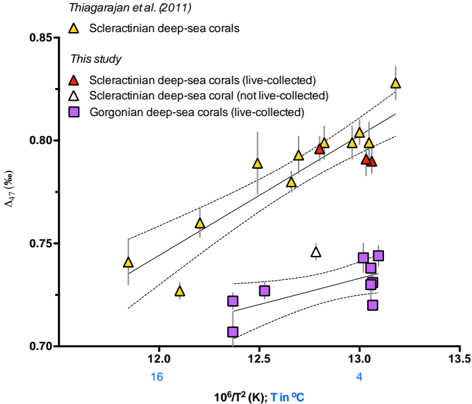
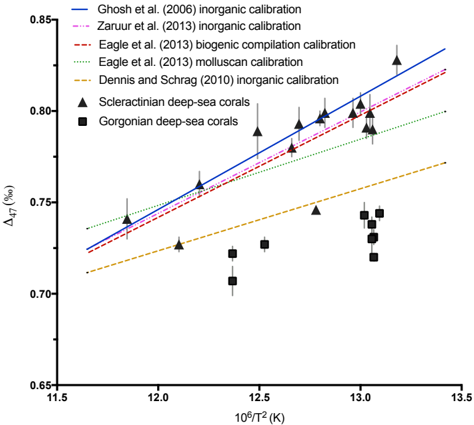
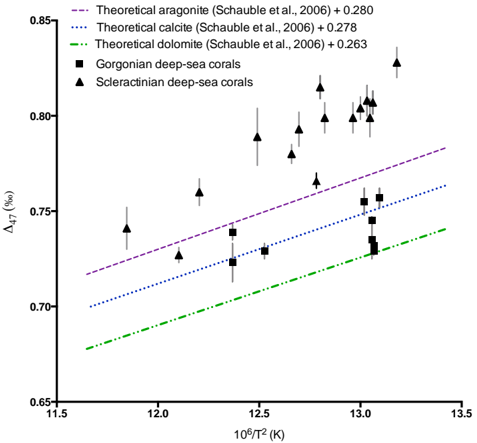
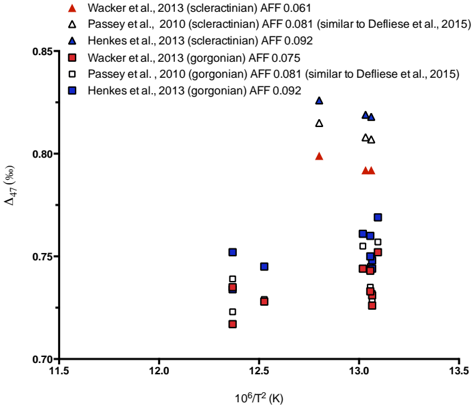
Deep-sea corals are a potentially valuable archive of the temperature and ocean chemistry of intermediate and deep waters. Living in near-constant temperature, salinity, and pH and having amongst the slowest calcification rates observed in carbonate-precipitating biological organisms, deep-sea corals can provide valuable constraints on processes driving mineral equilibrium and disequilibrium isotope signatures. Here we report new data to further develop “clumped” isotopes as a paleothermometer in deep-sea corals as well as to investigate mineral-specific, taxon-specific, and growth-rate-related effects. Carbonate clumped isotope thermometry is based on measurements of the abundance of the doubly substituted isotopologue 13C18O16O2 in carbonate minerals, analyzed in CO2 gas liberated on phosphoric acid digestion of carbonates and reported as Δ47 values. We analyzed Δ47 in live-collected aragonitic scleractinian (Enallopsammia sp.) and high-Mg calcitic gorgonian (Isididae and Coralliidae) deep-sea corals and compared results to published data for other aragonitic scleractinian taxa. Measured Δ47 values were compared to in situ temperatures, and the relationship between Δ47 and temperature was determined for each group to investigate taxon-specific effects. We find that aragonitic scleractinian deep-sea corals exhibit higher values than high-Mg calcitic gorgonian corals and the two groups of coral produce statistically different relationships between Δ47–temperature calibrations. These data are significant in the interpretation of all carbonate clumped isotope calibration data as they show that distinct Δ47–temperature calibrations can be observed in different materials recovered from the same environment and analyzed using the same instrumentation, phosphoric acid composition, digestion temperature and technique, CO2 gas purification apparatus, and data handling. There are three possible explanations for the origin of these different calibrations. The offset between the corals of different mineralogy is in the same direction as published theoretical predictions for the offset between calcite and aragonite although the magnitude of the offset is different. One possibility is that the deep-sea coral results reflect high-Mg and aragonite crystals attaining nominal mineral equilibrium clumped isotope signatures due to conditions of extremely slow growth. In that case, a possible explanation for the attainment of disequilibrium bulk isotope signatures and equilibrium clumped isotope signatures by deep-sea corals is that extraordinarily slow growth rates can promote the occurrence of isotopic reordering in the interfacial region of growing crystals. We also cannot rule out a component of a biological “vital effect” influencing clumped isotope signatures in one or both orders of coral. Based on published experimental data and theoretical calculations, these biological vital effects could arise from kinetic isotope effects due to the source of carbon used for calcification, temperature- and pH-dependent rates of CO2 hydration and/or hydroxylation, calcifying fluid pH, the activity of carbonic anhydrase, the residence time of dissolved inorganic carbon in the calcifying fluid, and calcification rate. A third possible explanation is the occurrence of variable acid digestion fractionation factors. Although a recent study has suggested that dolomite, calcite, and aragonite may have similar clumped isotope acid digestion fractionation factors, the influence of acid digestion kinetics on Δ47 is a subject that warrants further investigation.
Overview
The claims and statistics of this paper haven’t been checked yet.
Free: it reads the open-access text and checks the first 5 claims that cite a source we can check. Create a free account to check every claim.
Integrity signals
Registry
Cites
Statistics
Figures
Verification
Claims the paper makes
The claims and statistics of this paper haven’t been checked yet.
Free: it reads the open-access text and checks the first 5 claims that cite a source we can check. Create a free account to check every claim.
Claims other papers make about this one
Each is checked against this paper’s own text: does it say what the citing paper says it does?
The source backs part of the claim, not all of it — or backs it for a different population, condition or comparison.
In the citing paper
“We found the impact of Mg 2+ substitution into calcite was to lower Δ 63 (Table 6; Fig. 8), which is broadly consistent with these observations.”
From Theoretical constraints on the effects of added cations on clumped, oxygen, and carbon isotope signatures of dissolved inorganic carbon species and minerals (2020) · cites this paper as Kimball et al. (2016)
Experimental — accuracy not yet measuredThe cited source says what the claim attributes to it.
In the citing paper
“Kimball et al. (2016) showed that high-Mg calcite from live-collected gorgonian deep-sea corals has lower Δ 47 values than many synthetic calcites as well as aragonitic deep-sea coral.”
From Theoretical constraints on the effects of added cations on clumped, oxygen, and carbon isotope signatures of dissolved inorganic carbon species and minerals (2020) · cites this paper as Kimball et al. (2016)
Self-check
Percentages, sums and reported differences re-computed from the paper’s own numbers.
The self-check needs the paper’s full text.
Citations
Cites
On the Isotopic Chemistry of Carbonates and a Paleotemperature Scale
McCrea, J. M. (1950) · The Journal of Chemical Physics · doi:10.1063/1.1747785 · Cited by 3,742 · cited 1×
“For oxygen isotope processes, they draw on work characterizing the oxygen isotopic fractionation between DIC species (i.e., CO2, H2CO3,, HCO−3 , CO 2− 3 ) (McCrea, 1950; Usdowski et al., 1991; Zeebe and Wolf-Gladrow, 2001; Beck et al., 2005; Zeebe, 2007; Rollion-Bard et al., 2011).”
MethodEquilibrium and nonequilibrium oxygen isotope effects in synthetic carbonates
Kim, S.-T., & O'Neil, J. R. (1997) · Geochimica et Cosmochimica Acta · doi:10.1016/s0016-7037(97)00169-5 · Cited by 2,887
Oxygen Isotope Fractionation in Divalent Metal Carbonates
O'Neil, J. R., Clayton, R. N., & Mayeda, T. K. (1969) · The Journal of Chemical Physics · doi:10.1063/1.1671982 · Cited by 2,549
The thermodynamic properties of isotopic substances
Urey, H. C. (1947) · Journal of the Chemical Society (Resumed) · doi:10.1039/jr9470000562 · Cited by 2,544
Revised Carbonate-water isotopic temperature scale
EPSTEIN, S., BUCHSBAUM, R., LOWENSTAM, H. A., & UREY, H. C. (1953) · Geological Society of America Bulletin · doi:10.1130/0016-7606(1953)64[1315:rcits]2.0.co;2 · Cited by 2,271 · cited 5×
“Despite not observing this offset between calcite and aragonite 147 in synthetic or biogenic carbonates, it has been predicted in theoretical studies.”
BackgroundInfluentialCalculation of Equilibrium Constants for Isotopic Exchange Reactions
Bigeleisen, J., & Mayer, M. G. (1947) · The Journal of Chemical Physics · doi:10.1063/1.1746492 · Cited by 1,893
Oxygen and carbon isotope fractionation in biogenic aragonite: Temperature effects
Grossman, E. L., & Ku, T.-L. (1986) · Chemical Geology: Isotope Geoscience section · doi:10.1016/0168-9622(86)90057-6 · Cited by 1,176
13C and 18O isotopic disequilibrium in biological carbonates: I. Patterns
McConnaughey, T. (1989) · Geochimica et Cosmochimica Acta · doi:10.1016/0016-7037(89)90282-2 · Cited by 1,033 · cited 4×
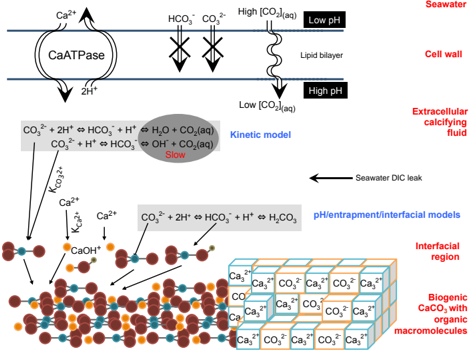
“The first of these models, proposed by McConnaughey (1989a), calls on a kinetic fractionation during the hydration and hydroxylation steps of DIC speciation in which precipitation outpaces the ability of the system to reach isotopic equilibrium (“Kinetic model” in Fig.”
BackgroundMethodInfluentialEffect of seawater carbonate concentration on foraminiferal carbon and oxygen isotopes
Spero, H. J., Bijma, J., Lea, D. W., & Bemis, B. E. (1997) · Nature · doi:10.1038/37333 · Cited by 975 · cited 1×
“…isotopes has been observed in numerous calcifying organisms and inorganic precipitation experiments and linked to calcification processes (e.g., McConnaughey, 1989a; Spero et al., 1997; Zeebe, 1999; Adkins et al., 2003: Watson, 2004; DePaolo, 2011; Gabitov et al., 2012; Watkins et al., 2014).”
Background13C–18O bonds in carbonate minerals: a new kind of paleothermometer
Ghosh, P., Adkins, J., Affek, H., Balta, B., Guo, W., Schauble, E. A., Schrag, D., & Eiler, J. M. (2006) · Geochimica et Cosmochimica Acta · doi:10.1016/j.gca.2005.11.014 · Cited by 914 · cited 21×
“…13, 6487–6505, 2016 www.biogeosciences.net/13/6487/2016/ Aragonitic specimens have included deep-sea (Thiagarajan et al., 2011) and shallow (Ghosh et al., 2006; Saenger et al., 2012) scleractinian corals, mollusks (Eagle et al., 2013; Henkes et al., 2013), and land snails (Zaarur et al.,…”
BackgroundMethodResultInfluential
Research works printed but not linked: 3
- Allemand, D., Cuif, J.-P., Watabe, N., Oishi, M., and Kawaguchi, T.: The organic matrix of skeletal structures of the Mediterranean Red Coral, Corallium rubrum, in: Biomineralisation '93, edited by: Allemand, D., Cuif, J.-P., 7th Int Symp Biomineralisation, Bulletin de l'Institut oceanographique, Monaco, Numero special 14, 129-140, 1994.
- Smith, J. E., Schwarcz, H. P., Risk, M. J., McConnaughey, T. A., and Keller, N.: Paleotemperatures from deep-sea corals: Overcoming "vital effects": Palaios, 15, 25-32, 2000. · doi:10.1669/0883-1351(2000)015
- Zeebe, R. E. and Wolf-Gladrow, D.: CO 2 in Seawater: Equilibrium, Kinetics, Isotopes, Elsevier Oceanography Series, 65, Amster- dam, 346 pp., 2001.
Cited by
Dual clumped isotope thermometry resolves kinetic biases in carbonate formation temperatures
Bajnai, D., Guo, W., Spötl, C., Coplen, T. B., Methner, K., Löffler, N., Krsnik, E., Gischler, E., Hansen, M., Henkel, D., et al. (2020) · Nature Communications · doi:10.1038/s41467-020-17501-0 · Cited by 147
Assessing kinetic fractionation in brachiopod calcite using clumped isotopes
Bajnai, D., Fiebig, J., Tomašových, A., Milner Garcia, S., Rollion-Bard, C., Raddatz, J., Löffler, N., Primo-Ramos, C., & Brand, U. (2018) · Scientific Reports · doi:10.1038/s41598-017-17353-7 · Cited by 78
Davies, A. J., & John, C. M. (2019) · Geochimica et Cosmochimica Acta · doi:10.1016/j.gca.2018.07.038 · Cited by 63
Temperature Dependence of Clumped Isotopes (∆ 47 ) in Aragonite
de Winter, N. J., Witbaard, R., Kocken, I. J., Müller, I. A., Guo, J., Goudsmit, B., & Ziegler, M. (2022) · Geophysical Research Letters · doi:10.1029/2022gl099479 · Cited by 52
Guo, Y., Deng, W., & Wei, G. (2019) · Geochimica et Cosmochimica Acta · doi:10.1016/j.gca.2019.01.012 · Cited by 52
Temperature dependence of clumped isotopes (∆47) in aragonite
Winter, N. J. D., Witbaard, R., Kocken, I. J., Müller, I. A., Guo, J., Goudsmit, B., & Ziegler, M. (2022) · doi:10.1002/essoar.10511492.2 · Cited by 51
Dual clumped isotope thermometry of coral carbonate
Davies, A., Guo, W., Bernecker, M., Tagliavento, M., Raddatz, J., Gischler, E., Flögel, S., & Fiebig, J. (2022) · Geochimica et Cosmochimica Acta · doi:10.1016/j.gca.2022.10.015 · Cited by 43
Upadhyay, D., Lucarelli, J., Arnold, A., Flores, R., Bricker, H., Ulrich, R. N., Jesmok, G., Santi, L., Defliese, W., Eagle, R. A., et al. (2021) · Rapid Communications in Mass Spectrometry · doi:10.1002/rcm.9143 · Cited by 33
Self-citationHill, P. S., Schauble, E. A., & Tripati, A. (2020) · Geochimica et Cosmochimica Acta · doi:10.1016/j.gca.2019.10.016 · Cited by 29
Chaabane, S., Correa, M. L., Ziveri, P., Trotter, J., Kallel, N., Douville, É., McCulloch, M. T., Taviani, M., Linares, C., & Montagna, P. (2019) · Chemical Geology · doi:10.1016/j.chemgeo.2019.06.008 · Cited by 30
“Proxy-based paleoclimate reconstructions can help overcome these data limitations; in particular, the geochemical composition of shallow- and deep-water aragonite and calcite corals has been widely used to reconstruct seawater conditions, such as sea surface temperature (SST), salinity, and pH (Beck et al., 1992; Mits…”
BackgroundCame, R. E., Azmy, K., Tripati, A., & Olanipekun, B.-J. (2017) · Geochimica et Cosmochimica Acta · doi:10.1016/j.gca.2016.10.028 · Cited by 29
“As described in Section 1, many of the previously published D47 to temperature relationships lie in one of two main clusters: one cluster that resembles the equation initially derived by the group at Caltech (Ghosh et al., 2006a, 2007; Tripati et al., 2010, 2015; Thiagarajan et al., 2011; Grauel et al., 2013; Zaarur e…”
BackgroundResultInfluentialDietzel, M., Purgstaller, B., Kluge, T., Leis, A., & Mavromatis, V. (2020) · Geochimica et Cosmochimica Acta · doi:10.1016/j.gca.2020.02.032 · Cited by 29
Equilibrated Gas and Carbonate Standard‐Derived Dual (Δ 47 and Δ 48 ) Clumped Isotope Values
Lucarelli, J. K., Carroll, H. M., Ulrich, R. N., Elliott, B. M., Coplen, T. B., Eagle, R. A., & Tripati, A. (2023) · Geochemistry, Geophysics, Geosystems · doi:10.1029/2022gc010458 · Cited by 27
“…effects observed in abiotic and biogenic carbonate minerals, including speleothems (Affek et al., 2008; Daëron et al., 2011) and coral (Bajnai et al., 2020; Kimball et al., 2016; Saenger et al., 2012; Thiagarajan et al., 2011), may affect the accuracy of Δ 47 -based temperature reconstructions.”
Self-citationSaenger, C., Gabitov, R. I., Farmer, J. R., Watkins, J. M., & Stone, R. P. (2017) · Chemical Geology · doi:10.1016/j.chemgeo.2017.02.014 · Cited by 27
Zhang, N., Yamada, K., Kano, A., Matsumoto, R., & Yoshida, N. (2018) · Chemical Geology · doi:10.1016/j.chemgeo.2018.05.001 · Cited by 28
Proteinaceous corals as proxy archives of paleo-environmental change
Williams, B. (2020) · Earth-Science Reviews · doi:10.1016/j.earscirev.2020.103326 · Cited by 21
Davies, A., Davis, S., & John, C. M. (2021) · Chemical Geology · doi:10.1016/j.chemgeo.2021.120317 · Cited by 20
Guo, Y., Deng, W., Wei, G., Lo, L., & Wang, N. (2019) · Chemical Geology · doi:10.1016/j.chemgeo.2019.04.030 · Cited by 19
Clumped isotopic compositions of cultured and natural land-snail shells and their implications
Dong, J., Eiler, J. M., An, Z., Li, X., Liu, W., & Hu, J. (2021) · Palaeogeography Palaeoclimatology Palaeoecology · doi:10.1016/j.palaeo.2021.110530 · Cited by 17
Wierzbowski, H. (2021) · Geosciences · doi:10.3390/geosciences11100419 · Cited by 16
“Despite the common equilibrium precipitation of clumped isotopes in biogenic calcites and aragonites, kinetic effects, which induce Δ47 offsets, are observed or suggested in cold water benthic and planktic foraminifera [355,357], rapidly growing hermatypic corals [375,376], deep-water corals [359,377], and temperate-…”
BackgroundRaddatz, J., & Rüggeberg, A. (2019) · The Depositional Record · doi:10.1002/dep2.98 · Cited by 15
“More and more studies reveal that Δ47 values are in disequilibrium (Bajnai et al., 2018), as for example for CWCs (Thiagarajan et al., 2011; Kimball et al., 2016; Spooner et al., 2016).”
BackgroundLucarelli, J., Purgstaller, B., Ulrich, R. N., Parvez, Z., Leis, A., Goetschl, K. E., Eagle, R. A., Dietzel, M., & Tripati, A. (2023) · Geochimica et Cosmochimica Acta · doi:10.1016/j.gca.2023.07.027 · Cited by 14
Self-citationParvez, Z. A., Lucarelli, J. K., Matamoros, I. W., Rubi, J., Miguel, K., Elliott, B., Flores, R., Ulrich, R. N., Eagle, R. A., Watkins, J. M., et al. (2023) · Geochimica et Cosmochimica Acta · doi:10.1016/j.gca.2023.06.022 · Cited by 9
Self-citationParvez, Z., El-Shenawy, M. I., Lucarelli, J., Kim, S., Johnson, K. R., Wright, K. T., Gebregiorgis, D., Montañez, I. P., Wortham, B. E., Asrat, A., et al. (2023) · Geochimica et Cosmochimica Acta · doi:10.1016/j.gca.2023.11.017 · Cited by 9
Self-citationDefliese, W. F., & Tripati, A. (2020) · Rapid Communications in Mass Spectrometry · doi:10.1002/rcm.8666 · Cited by 12
Exploring the Temperature Dependence of Clumped Isotopes in Modern Porites Corals
Guo, Y., Deng, W., Wei, G., Chen, X., Liu, X., Wang, X., Lo, L., Cai, G., & Zeng, T. (2020) · Journal of Geophysical Research Biogeosciences · doi:10.1029/2019jg005402 · Cited by 10
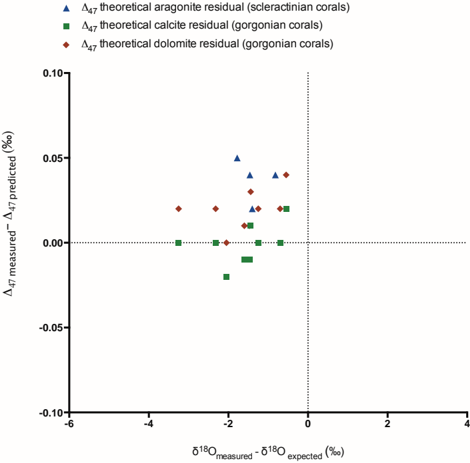
“of δ(13)C, δ(18)O, and Δ47 have previously been defined as the offsets of measured values relative to their respective equilibrium values (Kimball et al., 2016; Saenger et al., 2012; Spooner et al., 2016; Thiagarajan et al., 2011).”
BackgroundPrasanna, K., Ghosh, P., Eagle, R. A., Tripati, A., Kapur, V. V., Feeney, R. F., Fosu, B. R., & Mishra, D. (2021) · Geochemistry Geophysics Geosystems · doi:10.1029/2020gc009601 · Cited by 12
Self-citationSclerochronology in the Southern Ocean
Gonzalez, A. R. (2021) · Polar Biology · doi:10.1007/s00300-021-02899-0 · Cited by 6
Quizon, A. A., Petersen, S., de Winter, N. J., & Vellekoop, J. (2025) · Geochimica et Cosmochimica Acta · doi:10.1016/j.gca.2025.10.023 · Cited by 5
He, M., Yu, X., Deng, W., Chen, X., Peng, X., Ta, K., Xu, H., Cui, Z., Yang, Q. X., Yang, Y., et al. (2024) · Journal of Geophysical Research Biogeosciences · doi:10.1029/2024jg008032 · Cited by 9
“Organically bound S and O, such as acidic polysaccharide chondroitin sulfate and reduced S associated proteins could play a role in regulating the initial nucleation and growth of CaCO 3 crystals (Kimball et al., 2016; Meldrum, 2003; Yuyama & Watanabe, 2008).”
Comparative clumped isotope temperature relationships in freshwater carbonates
Arnold, A., Mering, J., Chari, L., Román‐Palacios, C., Li, H., Petrys, H., Mitsunaga, B., Elliott, B., Wilson, J., Lucarelli, J., et al. (2025) · The Depositional Record · doi:10.1002/dep2.312 · Cited by 4
“…carbonates, which have been more extensively studied, there is a body of literature supporting material specificity or kinetic effects in some archives (e.g. coral, echinoderms; cf. Ghosh et al., 2006a, 2006b; Saenger et al., 2012; Kimball et al., 2016; Spooner et al., 2016; Davies & John, 2019).”
Self-citationRecent Efforts to Improve the Accuracy and Precision of Carbonate Clumped‐Isotope Analysis
Oikawa, K., Abe, O., & Iryu, Y. (2024) · Island Arc · doi:10.1111/iar.12537 · Cited by 4
“Subsequently, Δ 47 values have been found to be influenced by speleothems (Affek et al. 2008; Daëron et al. 2011), brachio-pods (Bajnai et al. 2018), and corals (Thiagarajan, Adkins, and Eiler 2011; Saenger et al. 2012; Kimball, Eagle, and Dunbar 2016; Spooner et al. 2016).”
Carbonate clumped isotope (Δ47) thermometry andits application in paleoelevation reconstruction
Xiong, Z., Ding, L., & Xie, J. (2019) · Chinese Science Bulletin (Chinese Version) · doi:10.1360/n972019-00032 · Cited by 4
Pesnin, M., Thaler, C., Daëron, M., Nomade, S., & Rollion‐Bard, C. (2024) · Chemical Geology · doi:10.1016/j.chemgeo.2024.122148 · Cited by 3
Kapcsolt izotópok (clumped isotopes) a földtudományi kutatásokban
Kele, S., & Bajnai, D. (2017) · Földtani Közlöny · doi:10.23928/foldt.kozl.2017.147.2.177 · Cited by 3
Lucarelli, J., Carroll, H. M., Elliott, B. M., Eagle, R. A., & Tripati, A. (2021) · EarthArXiv (California Digital Library) · doi:10.31223/x5t318 · Cited by 3
Self-citationLucarelli, J., Purgstaller, B., Parven, Z., Watkins, J. M., Eagle, R. A., Dietzel, M., & Tripati, A. (2022) · EarthArXiv (California Digital Library) · doi:10.31223/x5ns7w · Cited by 2
Self-citation
Metadata
- Authors
- Kimball, J., Eagle, R., & Dunbar, R.
- Affiliations
- University of California, Los Angeles (US)
- Ifremer (FR)
- Stanford University (US)
- Corresponding author
- Eagle, Robert
- Venue
- Biogeosciences
- Publisher
- Copernicus GmbH
- Published
- 2016-12-12
- Volume
- 13
- Issue
- 23
- Pages
- 6487-6505
- ISSN
- 1726-4170 (ISSN-L)
- 1726-4189
- OpenAlex
- W2291181171
- Cited by
- 36
- References
- 88
- Citations by year
- 2025: 1 · 2024: 4 · 2023: 2 · 2022: 5 · 2021: 7 · 2020: 3 · 2019: 8 · 2018: 3 · 2017: 2 · 2016: 1
- FWCI
- 2.85
- Type
- journal article
- Language
- en
- Open access
- gold
- doi.org
- Licence
- Locations
- Biogeosciences (publishedVersion, cc-by)
- HAL (submittedVersion, cc-by-nd)
- HAL (submittedVersion, cc-by)
- Institutional Archive of Ifremer (French Research Institute for Exploitation of the Sea) (submittedVersion, other-oa)
- DOAJ (DOAJ: Directory of Open Access Journals) (submittedVersion, cc-by-sa)
- OSTI OAI (U.S. Department of Energy Office of Scientific and Technical Information) (submittedVersion)
- Funders
- Division of Ocean Sciences (OCE-1437166, Graduate Fellowship)
- Basic Energy Sciences (DE-FG02-13ER16402)
- Agence Nationale de la Recherche ("Laboratoire d'Excellence" LabexMER (ANR-10-LABX-19))
- Topics
- Physical Sciences › Earth and Planetary Sciences › Atmospheric Science › Geology and Paleoclimatology Research
- Physical Sciences › Environmental Science › Ecology › Coral and Marine Ecosystems Studies
- Physical Sciences › Earth and Planetary Sciences › Paleontology › Paleontology and Stratigraphy of Fossils
- Keywords
- clumped isotopes, carbonate clumped isotope thermometry, deep-sea corals, scleractinian corals, gorgonian corals, aragonite, calcite, Isididae, Coralliidae, paleothermometry, growth rate effects, mineral equilibria
About these checks
Registry, retraction, Cites and statistics results are computed, not judged, with one exception: a printed reference that no index lists is read once by a model before it counts as a citation error. Claims are extracted by a model and kept only when their quote appears verbatim in the text; each cited source is then checked, with a model’s help, for whether it says what the claim relies on. Those verdicts can be wrong — read the claim’s quote and the cited source before relying on one.
Statistics and arithmetic are recomputed, not judged.
Confidence bands are shown only for fields calibrated on our annotated test set. None is calibrated yet, so no band is shown.
What counts as a claim ›How we measure confidence ›How we check this ›
Are you an author, or do you see a problem with this page? Request a review
Data sources
Bibliographic data: Semantic Scholar, OpenAlex, Crossref.
Contains information from the Semantic Scholar Academic Graph Datasets, made available under the ODC Attribution License (ODC-BY 1.0).
Semantic Scholar’s data is described in: Kinney, R., et al. (2023). The Semantic Scholar Open Data Platform. arXiv:2301.10140.
