

The DOI matches its Crossref record; 1 of the 1 references it cites were found in a registry or an index.
Orbitally tuned timescale and astronomical forcing in the middle Eocene to early Oligocene
Published version of a preprint
Abstract
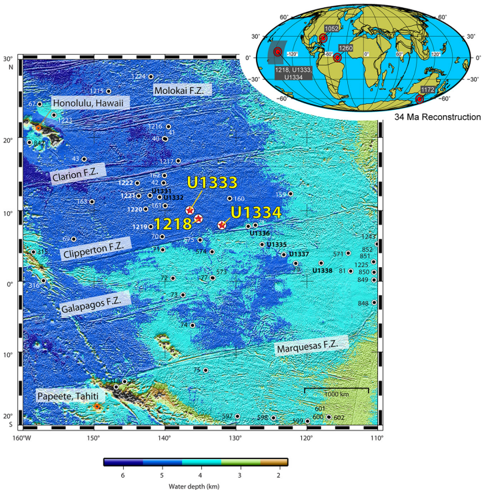
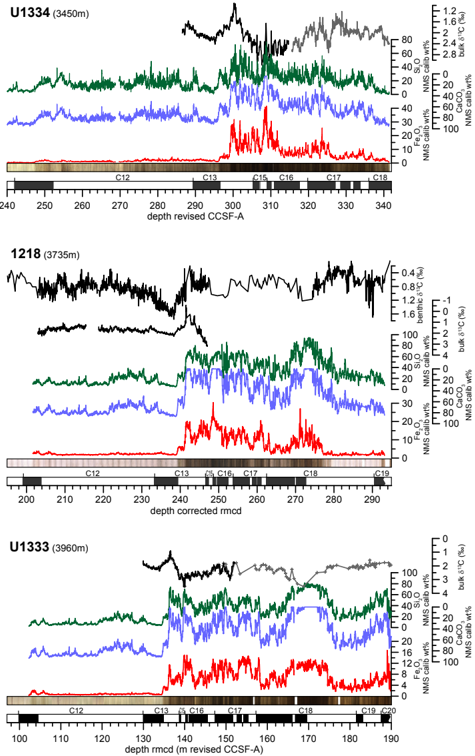
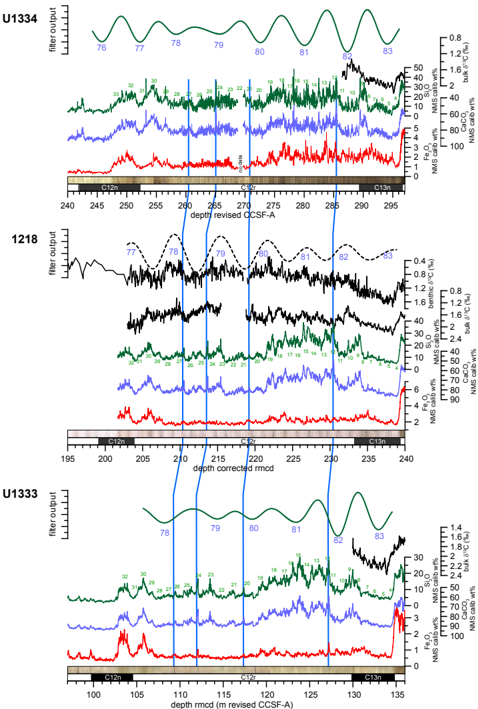
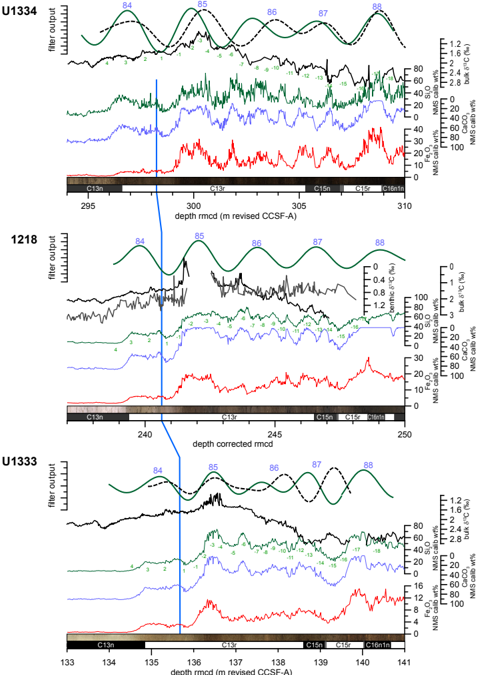
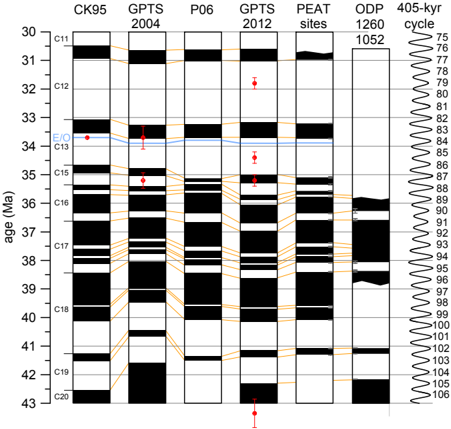
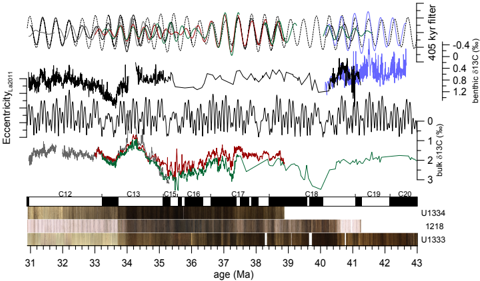
Abstract. Deciphering the driving mechanisms of Earth system processes, including the climate dynamics expressed as paleoceanographic events, requires a complete, continuous, and high-resolution stratigraphy that is very accurately dated. In this study, a robust astronomically calibrated age model was constructed for the middle Eocene to early Oligocene interval (31–43 Ma) in order to permit more detailed study of the exceptional climatic events that occurred during this time, including the middle Eocene climate optimum and the Eocene–Oligocene transition. A goal of this effort is to accurately date the middle Eocene to early Oligocene composite section cored during the Pacific Equatorial Age Transect (PEAT, IODP Exp. 320/321). The stratigraphic framework for the new timescale is based on the identification of the stable long eccentricity cycle in published and new high-resolution records encompassing bulk and benthic stable isotope, calibrated XRF core scanning, and magnetostratigraphic data from ODP Sites 171B-1052, 189-1172, 199-1218, and 207-1260 as well as IODP Sites 320-U1333, and 320-U1334 spanning magnetic polarity Chrons C12n to C20n. Subsequently orbital tuning of the records to the La2011 orbital solution was conducted. The resulting new timescale revises and refines the existing orbitally tuned age model and the geomagnetic polarity timescale from 31 to 43 Ma. The newly defined absolute age for the Eocene–Oligocene boundary validates the astronomical tuned age of 33.89 Ma identified at the Massignano, Italy, global stratotype section and point. The compilation of geochemical records of climate-controlled variability in sedimentation through the middle-to-late Eocene and early Oligocene demonstrates strong power in the eccentricity band that is readily tuned to the latest astronomical solution. Obliquity driven cyclicity is only apparent during 2.4 myr eccentricity cycle minima around 35.5, 38.3, and 40.1 Ma.
Overview
The claims and statistics of this paper haven’t been checked yet.
Run the check — free, no account needed. It reads the open-access text and checks the sources it cites.
Integrity signals
Registry
Cites
Statistics
Figures
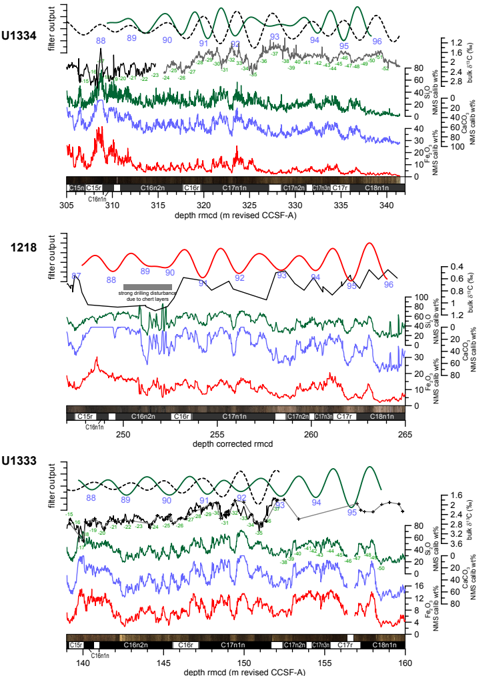
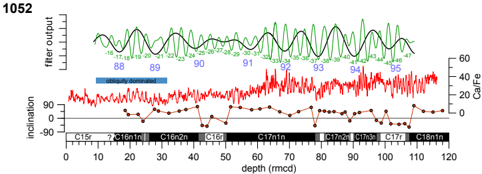
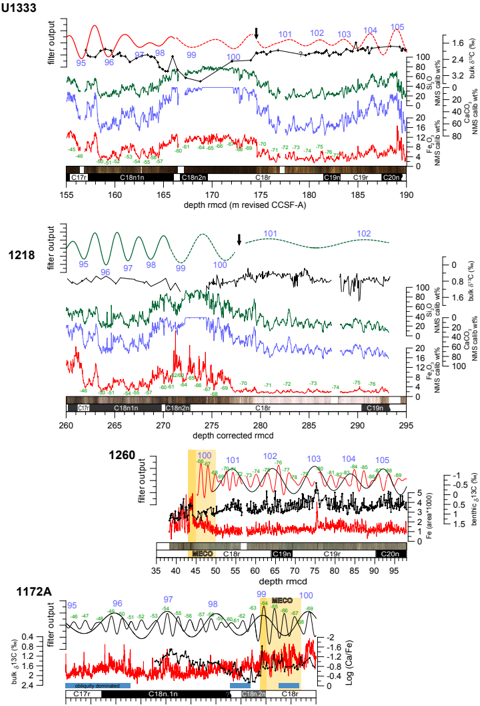
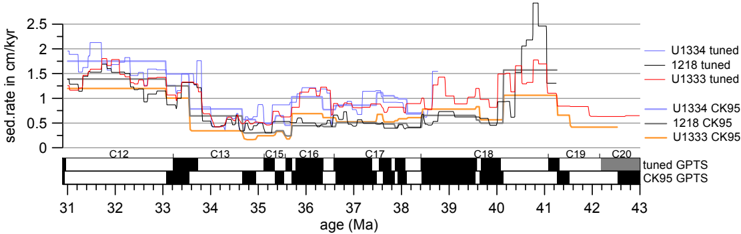
Verification
Claims the paper makes
The claims and statistics of this paper haven’t been checked yet.
Run the check — free, no account needed. It reads the open-access text and checks the sources it cites.
Claims other papers make about this one
Each is checked against this paper’s own text: does it say what the citing paper says it does?
In the citing paper
“Due to the high signal-to-noise ratio of nondestructive XRF core scanning data, they are perfect to perform testing of composite records, integrating data from multiple holes and sites by high-resolution correlation and cyclostratigraphic or astronomical age model development (37–41).”
From Earth orbital rhythms links timing of Deccan trap volcanism phases and global climate change (2025) · cites this paper as [37]
Self-check
Percentages, sums and reported differences re-computed from the paper’s own numbers.
The self-check needs the paper’s full text.
Citations
Cites
Atmospheric carbon dioxide concentrations over the past 60 million years
Pearson, P. N., & Palmer, M. R. (2000) · Nature · doi:10.1038/35021000 · Cited by 1,771
Research works printed but not linked: 98
- Bijl, P. K., Houben, A. J. P., Schouten, S., Bohaty, S. M., Sluijs, A., Reichart, G.-J., Sinninghe Damste, J. S., and Brinkhuis, H.: Transient Middle Eocene Atmospheric CO2 and Temperature Variations, Science, 330, 819–821, https://doi.org/10.1126/science.1193654, 2010. · DOI
- Bijl, P. K., Bendle, J. A. P., Bohaty, S. M., Pross, J., Schouten, S., Tauxe, L., Stickley, C. E., McKay, R. M., Röhl, U., Olney, M., Sluijs, A., Escutia, C., Brinkhuis, H., and Scientists, E.: Eocene cooling linked to early flow across the Tasmanian Gateway, P. Natl. Acad. Sci. USA, 110, 9645–9650, https://doi.org/10.1073/pnas.1220872110, 2013. · DOI
- Bohaty, S. and Zachos, J. C.: Significant Southern Ocean warming event in the late middle Eocene, Geology, 31, 1017–1020, 2003. · DOI
- Bohaty, S. M., Zachos, J. C., Florindo, F., and Delaney, M. L.: Coupled greenhouse warming and deep-sea acidification in the middle Eocene, Paleoceanography, 24, PA2207, https://doi.org/10.1029/2008pa001676, 2009. · DOI
- Bohaty, S. M., Zachos, J. C., and Delaney, M. L.: Foraminiferal Mg/Ca evidence for Southern Ocean cooling across the Eocene–Oligocene transition, Earth Planet. Sc. Lett., 317–318, 251–261, https://doi.org/10.1016/j.epsl.2011.11.037, 2012. · DOI
- Brown, R. E., Koeberl, C., Montanari, A., and Bice, D. M.: Evidence for a change in Milankovitch forcing caused by extraterrestrial events at Massignano, Italy, Eocene-Oligocene boundary GSSP, in: The Late Eocene Earth – Hothouse, Icehouse and Impacts, edited by: Koeberl, C., and Montanari, A., Geol. S. Am. S., 452, 119–137, https://doi.org/10.1130/2009.2452(08), 2009. · DOI
- Burgess, C. E., Pearson, P. N., Lear, C. H., Morgans, H. E. G., Handley, L., Pancost, R. D., and Schouten, S.: Middle Eocene climate cyclicity in the southern Pacific: Implications for global ice volume, Geology, 36, 651–654, 2008. · DOI
- Cande, S. C. and Kent, D. V.: Revised calibration of the geomagnetic polarity timescale for the Late Cretaceous and Cenozoic, J. Geophys. Res., 100, 6093–6095, 1995. · DOI
- Coxall, H. K. and Wilson, P. A.: Early Oligocene glaciation and productivity in the eastern equatorial Pacific: Insights into global carbon cycling, Paleoceanography, 26, PA2221, https://doi.org/10.1029/2010pa002021, 2011. · DOI
- Coxall, H. K., Wilson, P. A., Pälike, H., Lear, C. H., and Backman, J.: Rapid stepwise onset of Antarctic glaciation and deeper calcite compensation in the Pacific Ocean, Nature, 433, 53–57, https://doi.org/10.1038/nature03135, 2005. · DOI
- DeConto, R. M. and Pollard, D.: Rapid Cenozoic glaciation of Antarctica induced by declining atmospheric CO2, Nature, 421, 245–249, https://doi.org/10.1038/nature01290, 2003. · DOI
- DeConto, R. M., Pollard, D., Wilson, P. A., Pälike, H., Lear, C. H., and Pagani, M.: Thresholds for Cenozoic bipolar glaciation, Nature, 455, 652–656, https://doi.org/10.1038/nature07337, 2008. · DOI
- Dunn, D. A.: Change from "Atlantic-type" to "Pacific-type" carbonate stratigraphy in the middle Pliocene Equatorial Pacific Ocean, Mar. Geol., 50, 41–59, https://doi.org/10.1016/0025-3227(82)90060-3, 1982. · DOI
- Dupont-Nivet, G., Krijgsman, W., Langereis, C. G., Abels, H. A., Dai, S., and Fang, X.: Tibetan plateau aridification linked to global cooling at the Eocene-Oligocene transition, Nature, 445, 635–638, 2007. · DOI
- Edgar, K. M., Wilson, P. A., Sexton, P. F., and Suganuma, Y.: No extreme bipolar glaciation during the main Eocene calcite compensation shift, Nature, 448, 908–911, https://doi.org/10.1038/nature06053, 2007. · DOI
- Edgar, K. M., Wilson, P. A., Sexton, P. F., Gibbs, S. J., Roberts, A. P., and Norris, R. D.: New biostratigraphic, magnetostratigraphic and isotopic insights into the Middle Eocene Climatic Optimum in low latitudes, Palaeogeogr. Palaeocl., 297, 670–682, https://doi.org/10.1016/j.palaeo.2010.09.016, 2010. · DOI
- Ehrmann, W. U. and Mackensen, A.: Sedimentological evidence for the formation of an East Antarctic ice sheet in Eocene/Oligocene time, Palaeogeogr. Palaeocl., 93, 85–112, https://doi.org/10.1016/0031-0182(92)90185-8, 1992. · DOI
- Eldrett, J. S., Harding, I. C., Wilson, P. A., Butler, E., and Roberts, A. P.: Continental ice in Greenland during the Eocene and Oligocene, Nature, 446, 176–179, 2007. · DOI
- Fuller, M. and Touchard, Y.: On the Magnetostratigraphy of the East Tasman Plateau, Timing of the Opening of the Tasmanian Gateway and Paleoenvironmental Changes, in: The Cenozoic Southern Ocean: Tectonics, Sedimentation and Climate Change between Australia and Antarctica, edited by: Exon, N. F., Kennett, J. P., and Malone, M. J., Am. Geophys. Union, Geophys. Monogr., 63–78, 2004. · DOI
- Gale, A. S., Huggett, J. M., Pälike, H., Laurie, E., Hailwood, E. A., and Hardenbol, J.: Correlation of Eocene-Oligocene marine and continental records: orbital cyclicity, magnetostratigraphy and sequence stratigraphy of the Solent Group, Isle of Wight, UK, J. Geol. Soc. London, 163, 401–415, https://doi.org/10.1144/0016-764903-175, 2006. · DOI
- Grazzini, C. V. and Oberhaensli, H.: Isotopic Events at the Eocene/Oligocene Transition. A Review, Developments in Palaeontology and Stratigraphy, 311–329, https://doi.org/10.1016/S0920-5446(08)70136-5, 1986. · DOI
- Guidry, E. P., Richter, C., Acton, G. D., Channell, J. E. T., Evans, H. F., Ohneiser, C., Yamamoto, Y., and Yamazaki, T.: Oligocene-Miocene magnetostratigraphy of deep-sea sediments from the Equatorial Pacific (IODP Site U1333), Geological Society, London, Special Publications, 373, 13–27, https://doi.org/10.1144/SP373.7, 2013. · DOI
- Hay, W. W., DeConto, R., Wold, C. N., Wilson, K. M., Voigt, S., Schulz, M., Wold-Rossby, A., Dullo, W.-C., Ronov, A. B., Balukhovsky, A. N., and Soeding, E.: Alternative Global Cretaceous Paleogeography, in: The Evolution of Cretaceous Ocean/Climate Systems, edited by: Barrera, E. and Johnson, C., Geological Society of America Special Paper, 1–47, 1999. · DOI
- Hilgen, F. J. and Kuiper, K. F.: A critical evaluation of the numerical age of the Eocene-Oligocene boundary, in: The Late Eocene Earth – Hothouse, Icehouse, and Impacts: Geological Society of America Special Paper, edited by: Koeberl, C. and Montanari, A., Geol. S. Am. S., 452, 139–148, https://doi.org/10.1130/2009.2452(09), 2009. · DOI
- Hinnov, L. A. and Hilgen, F. J.: Cyclostratigraphy and Astrochronology, in: The Geological Timescale 2012, edited by: Gradstein, F. M., Ogg, J. G., Schmitz, M. D., and Ogg, G. M., Elsevier, 63–83, https://doi.org/10.1016/B978-0-444-59425-9.00004-4, 2012. · DOI
- Jovane, L., Florindo, F., Sprovieri, M., and Pälike, H.: Astronomic calibration of the late Eocene/early Oligocene Massignano section (central Italy), Geochem. Geophy. Geosy., 7, Q07012, https://doi.org/10.1029/2005GC001195, 2006. · DOI
- Katz, M. E., Cramer, B. S., Toggweiler, J. R., Esmay, G., Liu, C., Miller, K. G., Rosenthal, Y., Wade, B. S., and Wright, J. D.: Impact of Antarctic Circumpolar Current Development on Late Paleogene Ocean Structure, Science, 332, 1076–1079, https://doi.org/10.1126/science.1202122, 2011. · DOI
- Kirschvink, J. L.: The least-squares line and plane and the analysis of palaeomagnetic data, Geophys. J. Roy. Astr. S., 62, 699–718, 1980. · DOI
- Koeberl, C. and Montanari, A.: The Late Eocene Earth – Hothouse, Icehouse and Impacts, Geol. S. Am. S., 322 pp., 2009. · DOI
- Kuiper, K. F., Deino, A., Hilgen, F. J., Krijgsman, W., Renne, P. R., and Wijbrans, J. R.: Synchronizing Rock Clocks of Earth History, Science, 320, 500–504, https://doi.org/10.1126/science.1154339, 2008. · DOI · Paper page
- Kuroda, J. and Westerhold, T.:: Data report: volcanic glass shards from the Eocene–Oligocene transition interval at Site U1333, in: Proceedings of the Integrated Ocean Drilling Program, 320/321, edited by: Pälike, H., Lyle, M., Nishi, H., Raffi, I., Gamage, K., Klaus, A., and the Expedition 320/321 Scientists, https://doi.org/10.2204/iodp.proc.320321.211.2013, 2013. · DOI
- Lanci, L., Pares, J. M., Channell, J. E. T., and Kent, D. V.: Miocene magnetostratigraphy from Equatorial Pacific sediments (ODP Site 1218, Leg 199), Earth Planet. Sc. Lett., 226, 207–224, https://doi.org/10.1016/j.epsl.2004.07.025, 2004. · DOI
- Lanci, L., Parés, J. M., Channell, J. E. T., and Kent, D. V.: Oligocene magnetostratigraphy from Equatorial Pacific sediments (ODP Sites 1218 and 1219, Leg 199), Earth Planet. Sc. Lett., 237, 617–634, https://doi.org/10.1016/j.epsl.2005.07.004, 2005. · DOI
- Laskar, J., Robutel, P., Joutel, F., Gastineau, M., Correia, A., and Levrard, B.: A long-term numerical solution for the insolation quantities of the Earth, Astron. Astrophys., 428, 261–285, https://doi.org/10.1051/0004-6361:20041335, 2004. · DOI · Paper page
- Laskar, J., Fienga, A., Gastineau, M., and Manche, H.: La2010: a new orbital solution for the long-term motion of the Earth, Astron. Astrophys., 532, A89, https://doi.org/10.1051/0004-6361/201116836, 2011a. · DOI
- Laskar, J., Gastineau, M., Delisle, J. B., Farrés, A., and Fienga, A.: Strong chaos induced by close encounters with Ceres and Vesta, Astron. Astrophys., 532, L4, https://doi.org/10.1051/0004-6361/201117504, 2011b. · DOI · Paper page
- Lear, C. H., Rosenthal, Y., Coxall, H. K., and Wilson, P. A.: Late Eocene to early Miocene ice sheet dynamics and the global carbon cycle, Paleoceanography, 19, PA4015, https://doi.org/10.1029/2004PA001039, 2004. · DOI
- Lear, C. H., Bailey, T. R., Pearson, P. N., Coxall, H. K., and Rosenthal, Y.: Cooling and ice growth across the Eocene-Oligocene transition, Geology, 36, 251–254, 2008. · DOI
- Leon-Rodriguez, L. and Dickens, G. R.: Data report: stable isotope composition of Eocene bulk carbonate at Sites U1331, U1332, and U1333, in: Proceedings of the Integrated Ocean Drilling Program, 320/321, edited by: Pälike, H., Lyle, M., Nishi, H., Raffi, I., Gamage, K., Klaus, A., and and the Expedition 320/321 Scientists, https://doi.org/10.2204/iodp.proc.320321.208.2013, 2013. · DOI
- Liu, Z., Pagani, M., Zinniker, D., DeConto, R., Huber, M., Brinkhuis, H., Shah, S. R., Leckie, R. M., and Pearson, A.: Global Cooling During the Eocene-Oligocene Climate Transition, Science, 323, 1187–1190, https://doi.org/10.1126/science.1166368, 2009. · DOI
- Lourens, L. J., Hilgen, F. J., Laskar, J., Shackleton, N. J., and Wilson, D.: The Neogene Period, in: A Geological Timescale 2004, edited by: Gradstein, F., Ogg, J., and Smith, A., 409–440, Cambridge University Press, Cambridge, UK, https://doi.org/10.1017/CBO9780511536045.022, 2004. · DOI
- Lourens, L. J., Sluijs, A., Kroon, D., Zachos, J.`C., Thomas, E., Röhl, U., Bowles, J., and Raffi, I.: Astronomical pacing of late Palaeocene to early Eocene global warming events, Nature, 435, 1083–1087, https://doi.org/10.1038/nature03814, 2005. · DOI
- Lowrie, W. and Lanci, L.: Magnetostratigraphy of Eocene-Oligocene boundary sections in Italy: No evidence for short subchrons within chrons 12R and 13R, Earth Planet. Sc. Lett., 126, 247–258, https://doi.org/10.1016/0012-821X(94)90110-4, 1994. · DOI
- Luterbacher, H. P., Ali, J. R., Brinkhuis, H., Gradstein, F. M., Hooker, J. J., Monechi, S., Ogg, J. G., Powell, J., Röhl, U., Sanfilippo, A., Schmitz, B.: The Paleogene Period, in: A Geological Timescale 2004, edited by: Gradstein, F., Ogg, J., and Smith, A., Cambridge University Press, 20, 384–408, https://doi.org/10.1017/CBO9780511536045.021, 2004. · DOI
- Lyle, M., Wilson, P. A., Janecek, T. R., et al.: Initial Reports volume citation, in: Proceedings of the Ocean Drilling Program Initial Reports, Leg 199: College Station, TX (Ocean Drilling Program), USA, 2002. · DOI
- Lyle, M., Olivarez Lyle, A., Backman, J., and Tripati, A.: Biogenic sedimentation in the Eocene equatorial Pacific – the stuttering greenhouse and Eocene carbonate compensation depth, in: Proc. ODP, Sci. Results, 199: College Station, TX (Ocean Drilling Program), edited by: Wilson, P. A., Lyle, M., and Firth, J. V., 1–35, https://doi.org/10.2973/odp.proc.sr.199.219.2005, 2005. · DOI
- Lyle, M., Olivarez Lyle, A., Gorgas, T., Holbourn, A., Westerhold, T., Hathorne, E., Kimoto, K., and Yamamoto, S.: Data report: raw and normalized elemental data along the Site U1338 splice from X-ray fluorescence scanning, in: Proc. IODP, 320/321: Tokyo (Integrated Ocean Drilling Program Management International, Inc.), edited by: Pälike, H., Lyle, M., Nishi, H., Raffi, I., Gamage, K., Klaus, A., and and the Expedition 320/321 Scientists, https://doi.org/10.2204/iodp.proc.320321.203.2012, 2012. · DOI
- Miller, K. G., Wright, J. D., and Fairbanks, R. G.: Unlocking the icehouse: Oligocene-miocene oxygen isotope, eustacy, and margin erosion, J. Geophys. Res., 96, 6829–6848, 1991. · DOI
- Moore, T. C. and Kamikuri, S.: Data report: radiolarian stratigraphy across the Eocene/Oligocene boundary in the equatorial Pacific, Sites 1218, U1333, and U1334, in: Proc. IODP, 320/321: Tokyo (Integrated Ocean Drilling Program Management International, Inc.), edited by: Pälike, H., Lyle, M., Nishi, H., Raffi, I., Gamage, K., Klaus, A., and and the Expedition 320/321 Scientists, https://doi.org/10.2204/iodp.proc.320321.204.2012, 2012. · DOI
- Moore Jr., T. C.: Erosion and reworking of Pacific sediments near the Eocene-Oligocene boundary, Paleoceanography, 28, 263–273, https://doi.org/10.1002/palo.20027, 2013. · DOI
- Moore Jr., T. C., Pisias, N. G., and Dunn, D. A.: Carbonate time series of the Quaternary and Late Miocene sediments in the Pacific Ocean: A spectral comparison, Mar. Geol.y, 46, 217–233, 1982. · DOI
- Ogg, J. G.: Geomagnetic Polarity time scale, in: The Geological Timescale 2012, edited by: Gradstein, F., Ogg, J., Schmitz, M. D., and Ogg, G. M., Elsevier, 85–114, 2012. · DOI · Paper page
- Ogg, J. G. and Bardot, L.,: Aptian through Eocene magnetostratigraphic correlation of the Blake Nose Transect (Leg 171B), Florida continental margin, in: Proceedings of the Ocean Drilling Program, edited by: Kroon, D., Norris, R. D., and Klaus, A., Scientific Results Volume 171B, 1–58, https://doi.org/10.2973/odp.proc.sr.171b.104.2001, 2001. · DOI
- Ogg, J. G. and Smith, A. G.: The geomagnetic polarity time scale, in: A Geological Timescale 2004, edited by: Gradstein, F., Ogg, J., and Smith, A., Cambridge University Press, Cambridge University Press, Cambridge, UK, 63–86, 2004. · DOI
- Pälike, H., Shackleton, N. J., and Röhl, U.: Astronomical forcing in Late Eocene marine sediments, Earth Planet. Sc. Lett., 193, 589–602, 2001. · DOI
- Pälike, H., Moore, T., Backman, J., Raffi, I., Lanci, L., Parés, J. M., and Janecek, T.: Integrated stratigraphic correlation and improved composite depth scales for ODP Sites 1218 and 1219, in: Proceedings of the Ocean Drilling Program, edited by: Wilson, P. A., Lyle, M., and Firth, J. V., Scientific Results Volume 199, 1–41, https://doi.org/10.2973/odp.proc.sr.199.213.2005, 2005. · DOI
- Pälike, H., Norris, R. D., Herrle, J. O., Wilson, P. A., Coxall, H. K., Lear, C. H., Shackleton, N. J., Tripati, A. K., and Wade, B. S.: The Heartbeat of the Oligocene Climate System, Science, 314, 1894–1898, https://doi.org/10.1126/science.1133822, 2006. · DOI
- Pälikelike, H., Nishi, H., Lyle, M., Raffi, I., Gamage, K., Klaus, A., and the Expedition 320/321 Scientists: Proc. IODP, 320/321: Tokyo (Integrated Ocean Drilling Program Management International, Inc.), https://doi.org/10.2204/iodp.proc.320321, 2010. · DOI
- Pälike, H., Lyle, M. W., Nishi, H., Raffi, I., Ridgwell, A., Gamage, K., Klaus, A., Acton, G., Anderson, L., Backman, J., Baldauf, J., Beltran, C., Bohaty, S. M., Bown, P., Busch, W., Channell, J. E. T., Chun, C. O. J., Delaney, M., Dewangan, P., Dunkley Jones, T., Edgar, K. M., Evans, H., Fitch, P., Foster, G. L., Gussone, N., Hasegawa, H., Hathorne, E. C., Hayashi, H., Herrle, J. O., Holbourn, A., Hovan, S., Hyeong, K., Iijima, K., Ito, T., Kamikuri, S.-I., Kimoto, K., Kuroda, J., Leon-Rodriguez, L., Malinverno, A., Moore Jr, T. C., Murphy, B. H., Murphy, D. P., Nakamura, H., Ogane, K., Ohneiser, C., Richter, C., Robinson, R., Rohling, E. J., Romero, O., Sawada, K., Scher, H., Schneider, L., Sluijs, A., Takata, H., Tian, J., Tsujimoto, A., Wade, B. S., Westerhold, T., Wilkens, R., Williams, T., Wilson, P. A., Yamamoto, Y., Yamamoto, S., Yamazaki, T., and Zeebe, R. E.: A Cenozoic record of the equatorial Pacific carbonate compensation depth, Nature, 488, 609–614, https://doi.org/10.1038/nature11360, 2012. · DOI
- Pearson, P. N., van Dongen, B. E., Nicholas, C. J., Pancost, R. D., Schouten, S., Singano, J. M., and Wade, B. S.: Stable warm tropical climate through the Eocene Epoch, Geology, 35, 211–214, https://doi.org/10.1130/g23175a.1, 2007. · DOI
- Pearson, P. N., McMillan, I., Wade, B., Jones, T., Coxall, H., Bown, P., Lear, C.: Extinction and environmental change across the Eocene-Oligocene boundary in Tanzania, Geology, 36, 179–182, https://doi.org/10.1130/G24308A.1, 2008. · DOI
- Peters, S. E., Carlson, A. E., Kelly, D. C., and Gingerich, P. D.: Large-scale glaciation and deglaciation of Antarctica during the Late Eocene, Geology, 38, 723–726, https://doi.org/10.1130/g31068.1, 2010. · DOI
- Pollard, D. and DeConto, R. M.: Hysteresis in Cenozoic Antarctic ice-sheet variations, Global Planet. Change, 45, 9–21, https://doi.org/10.1016/j.gloplacha.2004.09.011, 2005. · DOI
- Premoli Silva, I. and Jenkins, G. D.: Decision on the Eocene-Oligocene boundary stratotype, Episodes, 16, 379–382, 1993. · DOI
- Prentice, M. L. and Matthews, R. K.: Cenozoic ice-volume history: Development of a composite oxygen isotope record, Geology, 16, 963–966, https://doi.org/10.1130/0091-7613(1988)0162.3.co;2, 1988. · DOI · Paper page
- Prothero, D. R. and Emry, R. J.: The Terrestrial Eocene-Oligocene Transition in North America, Cambridge University Press, Cambridge, 1996. · DOI
- Prothero, D. R., Ivany, L. C., and Nesbitt, E. A.: From greenhouse to icehouse: The marine Eocene-Oligocene transition, Columbia University Press, New York, 2003.
- Röhl, U. and Abrams, L. J.: High-Resolution, Downhole and Non-Destructive Core Measurements from Sites 999 and 1001 in the Caribbean Sea: Application to the Late Paleocene Thermal Maximum, in: Proceedings of the Ocean Drilling Program, edited by: Leckie, R. M., Sigurdsson, H., Acton, G. D., and Draper, G., Scientific Results, College Station, TX (Ocean Drilling Program), 165, 191–203, https://doi.org/10.2973/odp.proc.sr.165.009.2000, 2000. · DOI
- Röhl, U., Wefer, G., Brinkhuis, H., Stickley, C. E., Fuller, M., Schellenberg, S. A., and Williams, G. L.: Sea level and astronomically induced environmental changes in middle and late sediments from the East Tasman Plateau, in: The Cenozoic Southern Ocean: Tectonics, Sedimentation and Climate Change between Australia and Antarctica, edited by: Exon, N. F., Kennett, J. P., and Malone, M. J., American Geophysical Union (AGU), Geoph. Monog. Series, 151, 113–126, 2004. · DOI
- Röhl, U., Westerhold, T., Bralower, T. J., and Zachos, J. C.: On the duration of the Paleocene-Eocene thermal maximum (PETM), Geochem. Geophy. Geosy., 8, Q12002, https://doi.org/10.1029/2007GC001784, 2007. · DOI
- Shackleton, N. J. and Kennett, J. P.: Paleotemperature History Of The Cenozoic and The Initiation of Antarctic Glaciation: Oxygen and Carbon Isotope analyses in DSDP Sites 277, 279, and 281, in: Deep Sea Drilling Project (DSDP), Volume XXIX, edited by: Kennett, J. P., Houtz, R. E., and et al., DSDP Initial Reports, Part III, 17, 743–755, https://doi.org/10.2973/dsdp.proc.29.117.1975, 1975. · DOI
- Shipboard Scientific Party: Site 1052, in: Proceedings of the Ocean Drilling Program: College Station, TX (Ocean Drilling Program), edited by: Norris, R. D., Kroon, D., Klaus, A., and et al., Initial Reports, 171B, 241–319, https://doi.org/10.2973/odp.proc.ir.171b.106.1998, 1998. · DOI
- Shipboard Scientific Party: Site 1171, in: Proceedings of the Ocean Drilling Program: College Station, TX (Ocean Drilling Program), edited by: Exon, N. F., Kennett, J. P., Malone, M. J., and et al., Initial Reports, 189, 1–176, https://doi.org/10.2973/odp.proc.ir.189.106.2001, 2001. · DOI
- Shipboard Scientific Party: Site 1260, in: Proceedings of the Ocean Drilling Program: College Station, TX (Ocean Drilling Program), edited by: Erbacher, J., Mosher, D. C., Malone, M. J., and et al., Initial Reports, 207, 1–113, https://doi.org/10.2973/odp.proc.ir.207.107.2004, 2004. · DOI
- Smith, M. E., Chamberlain, K. R., Singer, B. S., and Carroll, A. R.: Eocene clocks agree: Coeval 40Ar/39Ar, U-Pb, and astronomical ages from the Green River Formation, Geology, 38, 527–530, https://doi.org/10.1130/g30630.1, 2010. · DOI
- Stickley, C. E., St John, K., Koc, N., Jordan, R. W., Passchier, S., Pearce, R. B., and Kearns, L. E.: Evidence for middle Eocene Arctic sea ice from diatoms and ice-rafted debris, Nature, 460, 376–379, https://doi.org/10.1038/nature08163, 2009. · DOI
- St. John, K.: Cenozoic ice-rafting history of the central Arctic Ocean: Terrigenous sands on the Lomonosov Ridge, Paleoceanography, 23, PA1S05, https://doi.org/10.1029/2007PA001483, 2008. · DOI
- Suganuma, Y. and Ogg, J. G.: Campanian through Eocene magnetostratigraphy of Sites 1257–1261, ODP Leg 207, Demerara Rise (western equatorial Atlantic), in: Proceedings of the Ocean Drilling Program, Scientific Results Volume 207, Chapter 3: Sedimentology and stratigraphy, edited by: Mosher, D. C., Erbacher, J., and Malone, M. J., ODP, Sci. Results, 207: Initial Reports, 1–48, https://doi.org/10.2973/odp.proc.sr.207.102.2006, 2006. · DOI
- Tripati, A., Backman, J., Elderfield, H., and Ferretti, P.: Eocene bipolar glaciation associated with global carbon cycle changes, Nature, 436, 341–346, https://doi.org/10.1038/nature03874, 2005. · DOI
- Tripati, A. K., Eagle, R. A., Morton, A., Dowdeswell, J. A., Atkinson, K. L., Bahe, Y., Dawber, C. F., Khadun, E., Shaw, R. M. H., Shorttle, O., and Thanabalasundaram, L.: Evidence for glaciation in the Northern Hemisphere back to 44 Ma from ice-rafted debris in the Greenland Sea, Earth Planet. Sc. Lett., 265, 112–122, 2008. · DOI
- Van Andel, T. H.: Mesozoic/cenozoic calcite compensation depth and the global distribution of calcareous sediments, Earth Planet. Sc. Lett., 26, 187–194, https://doi.org/10.1016/0012-821x(75)90086-2, 1975. · DOI
- Vandenberghe, N., Hilgen, F. J., and Speijer, R. P.: The Paleogene Period, in: The Geological Timescale 2012, edited by: Gradstein, F. M., Ogg, J. G., Schmitz, M. D., and Ogg, G. M., Elsevier, 855–922, https://doi.org/10.1016/B978-0-444-59425-9.00028-7, 2012. · DOI
- Vonhof, H. B., Smit, J., Brinkhuis, H., Montanari, A., and Nederbragt, A. J.: Global cooling accelerated by early late Eocene impacts?, Geology, 28, 687–690, https://doi.org/10.1130/0091-7613(2000)282.0.co;2, 2000. · DOI
- Wade, B. S. and Pälike, H.: Oligocene climate dynamics, Paleoceanography, 19, PA4019, https://doi.org/10.1029/2004PA001042, 2004. · DOI
- Walsh, S. L., Prothero, D. R., and Lundquist, D. J.: Stratigraphy and paleomagnetism of the middle Eocene Friars Formation and Poway Group, southwestern San Diego County, California in: The Terrestrial Eocene-Oligocene Transition in North America, edited by: Prothero, D. R. and Emry, R. J., Cambridge University Press, Cambridge, 120–151, https://doi.org/10.1017/CBO9780511665431.007, 1996. · DOI
- Westerhold, T. and Röhl, U.: High resolution cyclostratigraphy of the early Eocene – new insights into the origin of the Cenozoic cooling trend, Clim. Past, 5, 309–327, https://doi.org/10.5194/cp-5-309-2009, 2009. · DOI
- Westerhold, T. and Röhl, U.: Orbital pacing of Eocene climate during the Middle Eocene climate optimum and the chron C19r event: Missing link found in the tropical western Atlantic, Geochem. Geophy. Geosy., 14, 4811–4825, https://doi.org/10.1002/ggge.20293, 2013. · DOI
- Westerhold, T., Röhl, U., Laskar, J., Bowles, J., Raffi, I., Lourens, L. J., and Zachos, J. C.: On the duration of magnetochrons C24r and C25n and the timing of early Eocene global warming events: Implications from the Ocean Drilling Program Leg 208 Walvis Ridge depth transect, Paleoceanography, 22, PA2201, https://doi.org/10.1029/2006PA001322, 2007. · DOI · Paper page
- Westerhold, T., Röhl, U., Donner, B., McCarren, H. K., and Zachos, J. C.: A complete high-resolution Paleocene benthic stable isotope record for the central Pacific (ODP Site 1209), Paleoceanography, 26, PA2216, https://doi.org/10.1029/2010pa002092, 2011. · DOI · Paper page
- Westerhold, T., Röhl, U., Wilkens, R., Pälike, H., Lyle, M., Jones, T. D., Bown, P., Moore, T., Kamikuri, S., Acton, G., Ohneiser, C., Yamamoto, Y., Richter, C., Fitch, P., Scher, H., Liebrand, D., and the Expedition 320/321 Scientists: Revised composite depth scales and integration of IODP Sites U1331–U1334 and ODP Sites 1218–1220, in: Proceedings of the Integrated Ocean Drilling Program, 320/321, edited by: Pälike, H., Lyle, M., Nishi, H., Raffi, I., Gamage, K., Klaus, A., and the Expedition 320/321 Scientists, https://doi.org/10.2204/iodp.proc.320321.201.2012, 2012a. · DOI
- Westerhold, T., Röhl, U., and Laskar, J.: Time scale controversy: Accurate orbital calibration of the early Paleogene, Geochem. Geophy. Geosy., 13, Q06015, https://doi.org/10.1029/2012gc004096, 2012b. · DOI
- Westerhold, T., Röhl, U., Pälike, H., Wilkens, R., Wilson, P. A., and Acton, G.: Orbitally tuned time scale and astronomical forcing in the middle Eocene to early Oligocene determined on ODP and IODP sediment cores, Unpublished dataset #821903, Supplement to: Westerhold, T., Röhl, U., Pälike, H., Wilkens, R., Wilson, P. A., and Acton, G.: Orbitally tuned time scale and astronomical forcing in the middle Eocene to early Oligocene, Clim. Past Discuss., 9, 6635–6682, https://doi.org/10.5194/cpd-9-6635-2013, 2013, available online in the WDC-MARE PANGAEA database: http://doi.pangaea.de/10.1594/PANGAEA.821903, last access: 12 May 2014, 2013. · DOI
- Wilkens, R., Dickens, G. R., Tian, J., Backman, J., and the Expedition 320/321 Scientists: Data report: revised composite depth scales for Sites U1336, U1337, and U1338, in: Proceedings of the Integrated Ocean Drilling Program, 320/321, edited by: Pälike, H., Lyle, M., Nishi, H., Raffi, I., Gamage, K., Klaus, A., and the Expedition 320/321 Scientists, https://doi.org/10.2204/iodp.proc.320321.201.2012, 2013. · DOI
- Xiao, G. Q., Abels, H. A., Yao, Z. Q., Dupont-Nivet, G., and Hilgen, F. J.: Asian aridification linked to the first step of the Eocene-Oligocene climate Transition (EOT) in obliquity-dominated terrestrial records (Xining Basin, China), Clim. Past, 6, 501–513, https://doi.org/10.5194/cp-6-501-2010, 2010. · DOI
- Zachos, J., Pagani, M., Sloan, L., Thomas, E., and Billups, K.: Trends, Rhythms, and Aberrations in Global Climate 65 Ma to Present, Science, 292, 686–693, https://doi.org/10.1126/science.1059412, 2001. · DOI · Paper page
- Zachos, J. C., Stott, L. D., and Lohmann, K. C.: Evolution of early Cenozoic marine temperatures, Paleoceanography, 9, 353–387, https://doi.org/10.1029/93PA03266, 1994. · DOI
- Zachos, J. C., Quinn, T. M., and Salamy, K. A.: High-resolution (104 years) deep-sea foraminiferal stable isotope records of the Eocene-Oligocene climate transition, Paleoceanography, 11, 251–266, https://doi.org/10.1029/96PA00571, 1996. · DOI
- Zachos, J. C., McCarren, H., Murphy, B., Röhl, U., and Westerhold, T.: Tempo and scale of late Paleocene and early Eocene carbon isotope cycles: Implications for the origin of hyperthermals, Earth Planet. Sc. Lett., 299, 242–249, https://doi.org/10.1016/j.epsl.2010.09.004, 2010. · DOI
Cited by
Earth orbital rhythms links timing of Deccan trap volcanism phases and global climate change
Westerhold, T., Dallanave, E., Penman, D., Schoene, B., Röhl, U., Gussone, N., & Kuroda, J. (2025) · Science Advances · doi:10.1126/sciadv.adr8584 · Cited by 17
Self-citation
Metadata
- Authors
- Westerhold, T., Röhl, U., Pälike, H., Wilkens, R., Wilson, P. A., & Acton, G.
- Venue
- Climate of the Past
- Publisher
- Copernicus GmbH
- Published
- 2014-05-16
- Volume
- 10
- Issue
- 3
- Pages
- 955-973
- ISSN
- 1814-9332
- Cited by
- 72
- References
- 1
- Language
- en
About these checks
Registry, retraction, Cites and statistics results are computed, not judged, with one exception: a printed reference that no index lists is read once by a model before it counts as a citation error. Claims are extracted by a model and kept only when their quote appears verbatim in the text; each cited source is then checked, with a model’s help, for whether it says what the claim relies on. Those verdicts can be wrong — read the claim’s quote and the cited source before relying on one.
Statistics and arithmetic are recomputed, not judged.
Confidence bands are shown only for fields calibrated on our annotated test set. None is calibrated yet, so no band is shown.
What counts as a claim ›How we measure confidence ›How we check this ›
Are you an author, or do you see a problem with this page? Request a review
