

MAREDAT: towards a world atlas of MARine Ecosystem DATa
Open accessPublished version of a preprint
The DOI matches its Crossref record; 43 of the 43 references it cites were found in a registry or an index.
Abstract
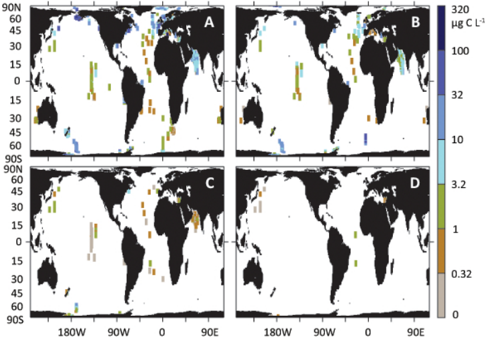
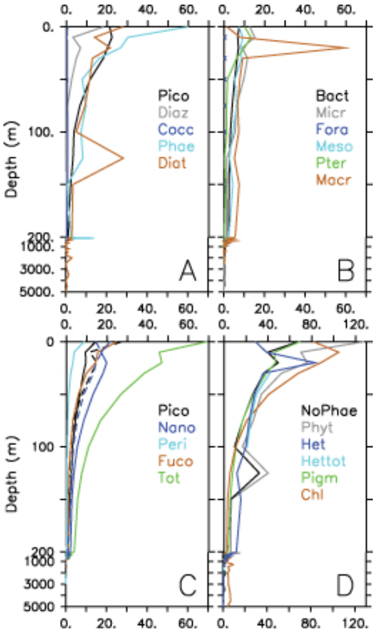
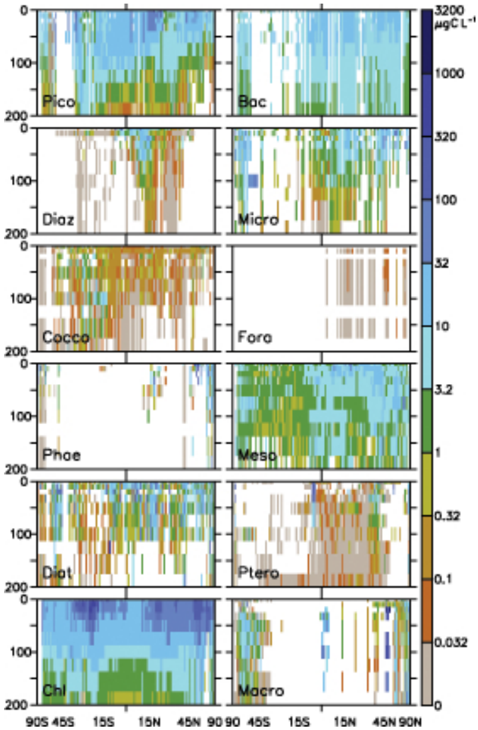
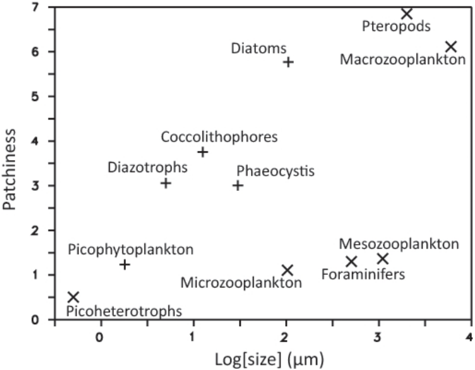
We present a summary of biomass data for 11 plankton functional types (PFTs) plus phytoplankton pigment data, compiled as part of the MARine Ecosystem biomass DATa (MAREDAT) initiative. The goal of the MAREDAT initiative is to provide, in due course, global gridded data products with coverage of all planktic components of the global ocean ecosystem. This special issue is the first step towards achieving this. The PFTs presented here include picophytoplankton, diazotrophs, coccolithophores, Phaeocystis, diatoms, picoheterotrophs, microzooplankton, foraminifers, mesozooplankton, pteropods and macrozooplankton. All variables have been gridded onto a World Ocean Atlas (WOA) grid (1° × 1° × 33 vertical levels × monthly climatologies). The results show that abundance is much better constrained than their carbon content/elemental composition, and coastal seas and other high productivity regions have much better coverage than the much larger volumes where biomass is relatively low. The data show that (1) the global total heterotrophic biomass (2.0–4.6 Pg C) is at least as high as the total autotrophic biomass (0.5–2.4 Pg C excluding nanophytoplankton and autotrophic dinoflagellates); (2) the biomass of zooplankton calcifiers (0.03–0.67 Pg C) is substantially higher than that of coccolithophores (0.001–0.03 Pg C); (3) patchiness of biomass distribution increases with organism size; and (4) although zooplankton biomass measurements below 200 m are rare, the limited measurements available suggest that Bacteria and Archaea are not the only important heterotrophs in the deep sea. More data will be needed to characterise ocean ecosystem functioning and associated biogeochemistry in the Southern Hemisphere and below 200 m. Future efforts to understand marine ecosystem composition and functioning will be helped both by further archiving of historical data and future sampling at new locations. Microzooplankton database: doi:10.1594/PANGAEA.779970 All MAREDAT databases: http://www.pangaea.de/search?&q=maredat
Overview
The claims and statistics of this paper haven’t been checked yet.
Free: it reads the open-access text and checks the first 5 claims that cite a source we can check. Create a free account to check every claim.
Integrity signals
Registry
Cites
Statistics
Figures
Verification
Claims the paper makes
The claims and statistics of this paper haven’t been checked yet.
Free: it reads the open-access text and checks the first 5 claims that cite a source we can check. Create a free account to check every claim.
Claims other papers make about this one
Each is checked against this paper’s own text: does it say what the citing paper says it does?
The source backs part of the claim, not all of it — or backs it for a different population, condition or comparison.
In the citing paper
“Previous reports have observed inverted biomass pyramids in local marine environments (36, 37). An additional study noted an inverted consumer/producer ratio for the global plankton biomass (16).”
From The biomass distribution on Earth (2018) · cites this paper as [16]
Experimental — accuracy not yet measured
Self-check
Percentages, sums and reported differences re-computed from the paper’s own numbers.
The self-check needs the paper’s full text.
Citations
Cites
The Theory of Island Biogeography
MacArthur, R. H., & Wilson, E. O. (2001) · Princeton University Press eBooks · doi:10.1515/9781400881376 · Cited by 12,632
Fundamentals of Ecology (1953)
Odum, E. P. (2017) · The Future of Nature · doi:10.12987/9780300188479-022 · Cited by 5,006
Mackey, M., Mackey, D., Higgins, H., & Wright, S. (1996) · Marine Ecology Progress Series · doi:10.3354/meps144265 · Cited by 1,465 · cited 3×
“For this reason, statistical methods employing multiple pigment to chlorophyll ratios are required to adequately resolve the algal community composition (e.g. Mackey et al., 1996; Van den Meersche et al., 2008).”
Uitz, J., Claustre, H., Morel, A., & Hooker, S. B. (2006) · Journal of Geophysical Research: Oceans · doi:10.1029/2005jc003207 · Cited by 959
Ecosystem dynamics based on plankton functional types for global ocean biogeochemistry models
Quéré, C. L., Harrison, S. P., Colin Prentice, I., Buitenhuis, E. T., Aumont, O., Bopp, L., Claustre, H., Cotrim Da Cunha, L., Geider, R., Giraud, X., et al. (2005) · Global Change Biology · doi:10.1111/j.1365-2486.2005.1004.x · Cited by 849
Geider, R., MacIntyre, H., & Kana, T. (1997) · Marine Ecology Progress Series · doi:10.3354/meps148187 · Cited by 784 · cited 1×
“3 model (Buitenhuis et al., 2013), which uses photosynthetic parameters synthesised by Geider et al. (1997).”
An ecosystem model of the global ocean including Fe, Si, P colimitations
Aumont, O., Maier‐Reimer, E., Blain, S., & Monfray, P. (2003) · Global Biogeochemical Cycles · doi:10.1029/2001gb001745 · Cited by 457
Database of diazotrophs in global ocean: abundance, biomass and nitrogen fixation rates
Luo, Y.-W., Doney, S. C., Anderson, L. A., Benavides, M., Berman-Frank, I., Bode, A., Bonnet, S., Boström, K. H., Böttjer, D., Capone, D. G., et al. (2012) · Earth System Science Data · doi:10.5194/essd-4-47-2012 · Cited by 408
Biomass distribution in marine planktonic communities
Gasol, J. M., del Giorgio, P. A., & Duarte, C. M. (1997) · Limnology and Oceanography · doi:10.4319/lo.1997.42.6.1353 · Cited by 391 · cited 4×
“Within the uncertainty in the data this is in agreement with Gasol et al. (1997), who estimated that the open ocean biomass of phytoplankton, total zooplankton and picoheterotrophs is roughly the same.”
InfluentialRemote sensing of phytoplankton groups in case 1 waters from global SeaWiFS imagery
Alvain, S., Moulin, C., Dandonneau, Y., & Bréon, F. M. (2005) · Deep Sea Research Part I: Oceanographic Research Papers · doi:10.1016/j.dsr.2005.06.015 · Cited by 384
Research works printed but not linked: 1
- Odum, E. P.: Fundamentals of Ecology, W. B. Saunders, Philadel- phia, 574 pp., 1971.
Cited by
Items 101–199 of 199
Explicit Planktic Calcifiers in the University of Victoria Earth System Climate Model, Version 2.9
Kvale, K., Meißner, K. J., Keller, D. P., Eby, M., & Schmittner, A. (2015) · ATMOSPHERE-OCEAN · doi:10.1080/07055900.2015.1049112 · Cited by 34
“Phytopankton calcifiers in CAL can be compared with the recent Marine Ecosystem Data (MAREDAT; Buitenhuis et al., 2013a; O’Brien et al., 2013) sample data synthesis.”
BackgroundResultInfluentialPohl, A., Harper, D. A. T., Donnadieu, Y., Hir, G. L., Nardin, É., & Servais, T. (2017) · Lethaia · doi:10.1111/let.12247 · Cited by 31
Cascading effects augment the direct impact of CO2 on phytoplankton growth in a biogeochemical model
Seifert, M., Nissen, C., Rost, B., & Hauck, J. (2022) · Elementa Science of the Anthropocene · doi:10.1525/elementa.2021.00104 · Cited by 33
Carbon-centric dynamics of Earth’s marine phytoplankton
Stoer, A. C., & Fennel, K. (2024) · Proceedings of the National Academy of Sciences · doi:10.1073/pnas.2405354121 · Cited by 28
“…based on either satellite - observed ocean color or cell abundance from measurements taken from water samples. estimates from Buitenhuis et al. ( 38 ) put global C phy between 500 and 2,400 Tg. Relying on previous estimates, a global census for all oceanic life on Earth ( 41 ) provides a best…”
PhytoBase: A global synthesis of open-ocean phytoplankton occurrences
Righetti, D., Vogt, M., Zimmermann, N. E., Guiry, M. D., & Gruber, N. (2020) · Earth system science data · doi:10.5194/essd-12-907-2020 · Cited by 27
Intercomparison of Ocean Color Algorithms for Picophytoplankton Carbon in the Ocean
Martínez-Vicente, V., Evers-King, H., Roy, S., Kostadinov, T. S., Tarran, G. A., Graff, J. R., Brewin, R. J. W., Dall’Olmo, G., Jackson, T., Hickman, A. E., et al. (2017) · Frontiers in Marine Science · doi:10.3389/fmars.2017.00378 · Cited by 28
“…same computation of picoplankton as the one used in this work, which meant ignoring the nanoeukaryotes, cryptophytes and coccolithophorids contributions to the picoplankton carbon and use the same carbon to cell conversion factors as in this study (i.e., those of MAREDAT; Buitenhuis et al., 2013).”
InfluentialThe FORCIS database: A global census of planktonic Foraminifera from ocean waters
Chaabane, S., de Garidel‐Thoron, T., Giraud, X., Schiebel, R., Beaugrand, G., Brummer, G.-J. A., Casajus, N., Greco, M., Grigoratou, M., Howa, H., et al. (2023) · Scientific Data · doi:10.1038/s41597-023-02264-2 · Cited by 25
Dugenne, M., Corrales‐Ugalde, M., Luo, J. Y., Kiko, R., O’Brien, T., Irisson, J., Lombard, F., Stemmann, L., Stock, C. A. A., Anderson, C. R., et al. (2024) · Earth system science data · doi:10.5194/essd-16-2971-2024 · Cited by 34
Kwon, E. Y., Dunne, J. P. P., & Lee, K. (2024) · Science Advances · doi:10.1126/sciadv.adl0779 · Cited by 27
“…ranging from those containing less soluble calcite (constituting coccolithophores and foraminifera) to those having more soluble aragonite or high-Mg calcite (constituting pteropods and fish bones), is another source of uncertainty with respect to the global ocean CaCO 3 cycle ( 9 , 10 ).”
Exploration of marine phytoplankton: from their historical appreciation to the omics era
Karlusich, J. J. P., Ibarbalz, F. M., & Bowler, C. (2020) · Journal of Plankton Research · doi:10.1093/plankt/fbaa049 · Cited by 40
Global gradients in species richness of marine plankton functional groups
Benedetti, F., Gruber, N., & Vogt, M. (2023) · Journal of Plankton Research · doi:10.1093/plankt/fbad044 · Cited by 27
Tenório, M. M. B., Dupouy, C., Rodier, M., & Neveux, J. (2018) · Aquatic Microbial Ecology · doi:10.3354/ame01873 · Cited by 25
Plankton Planet: A frugal, cooperative measure of aquatic life at the planetary scale
de Vargas, C., Bescot, N. L., Pollina, T., Henry, N., Romac, S., Colin, S., Haëntjens, N., Carmichael, M., Berger, C., Guen, D. L., et al. (2022) · Frontiers in Marine Science · doi:10.3389/fmars.2022.936972 · Cited by 36
Typical Features of Genomes in the Mamiellophyceae
Grimsley, N. H., Yau, S., Piganeau, G., & Moreau, H. (2015) · Springer eBooks · doi:10.1007/978-4-431-55130-0_6 · Cited by 21
Vogt, M., Hashioka, T., Payne, M., Buitenhuis, E. T., Quéré, C. L., Alvain, S., Aita, M. N., Bopp, L., Doney, S. C., Hirata, T., et al. (2013) · doi:10.5194/bgd-10-17193-2013 · Cited by 21
Microbial Ecology to Ocean Carbon Cycling: From Genomes to Numerical Models
Levine, N. M., Alexander, H., Bertrand, E. M., Coles, V. J., Dutkiewicz, S., Leles, S. G., & Zakem, E. J. (2025) · Annual Review of Earth and Planetary Sciences · doi:10.1146/annurev-earth-040523-020630 · Cited by 21
Phytoplankton functional types: a trait perspectivePreprint
Irwin, A. J., & Finkel, Z. V. (2017) · bioRxiv (Cold Spring Harbor Laboratory) · doi:10.1101/148312 · Cited by 29
Constraining CaCO3 Export and Dissolution With an Ocean Alkalinity Inverse Model
Liang, H., Lunstrum, A. M., Dong, S., Berelson, W. M., & John, S. G. (2023) · Global Biogeochemical Cycles · doi:10.1029/2022gb007535 · Cited by 25
Clerc, C., Bopp, L., Benedetti, F., Vogt, M., & Aumont, O. (2023) · Biogeosciences · doi:10.5194/bg-20-869-2023 · Cited by 21
Planktic Foraminiferal Resilience to Environmental Change Associated With the PETM
Barrett, R., Adebowale, M., Birch, H. S., Wilson, J. D., & Schmidt, D. N. (2023) · Paleoceanography and Paleoclimatology · doi:10.1029/2022pa004534 · Cited by 18
“Planktic foraminifers play a key role in the inorganic carbon cycle (Buitenhuis et al., 2013; Schiebel, 2002) yet it is not well understood how their carbonate production responds to environmental change.”
BackgroundGrigoratou, M., Monteiro, F., Wilson, J. D., Ridgwell, A. J., & Schmidt, D. N. (2021) · Global Change Biology · doi:10.1111/gcb.15964 · Cited by 19
“Planktonic foraminifera are one of the least abundant zooplankton groups in the ocean, contributing less than 5% to the total microprotozooplankton abundance (Beers & Stewart, 1971) and 0.04% of the total plankton biomass in the upper 200 m (Buitenhuis et al., 2013).”
BackgroundInfluentialOn modeling the Southern Ocean Phytoplankton Functional TypesPreprint
Loza, S., Dutkiewicz, S., Lösch, M., Oelker, J., Soppa, M. A., Trimborn, S., Xi, H., & Bracher, A. U. (2019) · doi:10.5194/bg-2019-289 · Cited by 18
“…evaluation of these PFTs was presented by Le Quéré et al. (2016) by comparing the dominance of the PFTs to satellite-based dominance retrievals, and to a global dataset of in situ-based integrated PFT biomass within upper60 200 m of Alvain et al. (2008) and (Buitenhuis et al., 2013), respectively.”
BackgroundGlobal database of actual nitrogen loss rates in coastal and marine sediments
Chang, Y., Tan, E., Gao, D., Liu, C., Zhang, Z., Huang, Z., Liu, J., Han, Y., Xu, Z., Chen, B., et al. (2025) · Earth system science data · doi:10.5194/essd-17-3521-2025 · Cited by 16
“More details about Chauvenet’s criterion can be found in Glover et al. (2011) and Buitenhuis et al. (2013).”
Correcting estimations of copepod volume from two‐dimensional images
Dubois, C., Irisson, J., & Debreuve, É. (2022) · Limnology and Oceanography Methods · doi:10.1002/lom3.10492 · Cited by 16
Meilland, J., Fabri‐Ruiz, S., Koubbi, P., Monaco, C. L., Cotté, C., Hosie, G. W., Sanchez, S., & Howa, H. (2016) · Deep Sea Research Part I Oceanographic Research Papers · doi:10.1016/j.dsr.2015.12.014 · Cited by 19
Linacre, L., Sánchez-Robles, C., Mirabal-Gómez, U., Lara-Lara, J. R., & Bazán-Guzmán, C. (2021) · PLoS ONE · doi:10.1371/journal.pone.0247071 · Cited by 15
“From a broader perspective, the range of carbon biomass values for dinoflagellates and diatoms assessed in our study is roughly in agreement with estimates for both global and open-ocean ecosystems reported in the literature [22, 46, 64–66].”
InfluentialGonzález‐Olalla, J. M., Medina‐Sánchez, J. M., Cabrerizo, M. J., Villar‐Argáiz, M., Sánchez‐Castillo, P., & Carrillo, P. (2017) · Journal of Geophysical Research Biogeosciences · doi:10.1002/2017jg003834 · Cited by 15
Impacts of the Early Eocene Climatic Optimum (EECO, ∼53‐49 Ma) on Planktic Foraminiferal Resilience
Filippi, G., Barrett, R., Schmidt, D. N., D’Onofrio, R., Westerhold, T., Brombin, V., & Luciani, V. (2024) · Paleoceanography and Paleoclimatology · doi:10.1029/2023pa004820 · Cited by 14
“…the sea floor (Knecht et al., 2023; Neukermans et al., 2023; Schiebel, 2002), though there are significant differences between ocean basins and latitudes, with the highest values recorded in tropical, northern Pacific, Southern Ocean and upwelling regions (Buitenhuis et al., 2013; Schiebel, 2002).”
Kvale, K., Keller, D. P., Koeve, W., Meißner, K. J., Somes, C. J., Yao, W., & Oschlies, A. (2021) · Geoscientific model development · doi:10.5194/gmd-14-7255-2021 · Cited by 17
Grigoratou, M., Monteiro, F., Ridgwell, A. J., & Schmidt, D. N. (2021) · Marine Micropaleontology · doi:10.1016/j.marmicro.2021.102004 · Cited by 14
Kang, L., Lu, H.-M., Sung, P.-T., Chan, Y., Lin, Y., Gong, G., & Chiang, K. (2016) · Journal of Oceanography · doi:10.1007/s10872-016-0385-x · Cited by 15
“This carbon biomass contribution is generally lower than that of other phytoplankton functional groups (Buitenhuis et al. 2013).”
BackgroundGardner, J. J., Hodge, B. S., & Boyle, N. R. (2019) · Scientific Reports · doi:10.1038/s41598-019-53188-0 · Cited by 14
Schiebel, R., & Hemleben, C. (2017) · Springer eBooks · doi:10.1007/978-3-662-50297-6_1 · Cited by 12
Meilland, J., Howa, H., Monaco, C. L., & Schiebel, R. (2016) · Marine Micropaleontology · doi:10.1016/j.marmicro.2016.02.004 · Cited by 11
Brotas, V., Ferreira, A., Veloso, V., Tracana, A., Guerreiro, C., Tarran, G. A., Woodward, E. M. S., Ribeiro, L., Netting, J., Clewley, D., et al. (2023) · Frontiers in Marine Science · doi:10.3389/fmars.2023.1229692 · Cited by 10
Stawiarski, B., Buitenhuis, E. T., & Fallens, M. (2017) · Limnology and Oceanography · doi:10.1002/lno.10745 · Cited by 14
Ying, R., Monteiro, F., Wilson, J. D., & Schmidt, D. N. (2023) · Geoscientific model development · doi:10.5194/gmd-16-813-2023 · Cited by 13
“Significant developments of global foraminifera models have been driven by the increasing number and extent of flux and community structure observations (Siccha and Kucera, 2017; Buitenhuis et al., 2013; Sunagawa et al., 2020).”
Vogt, M. (2015) · Science · doi:10.1126/science.aad6946 · Cited by 11
Pigani, E., Mele, B. H., Campese, L., Ser‐Giacomi, E., d’Alcalà, M. R., Iudicone, D., & Suweis, S. S. (2024) · Science Advances · doi:10.1126/sciadv.adh0477 · Cited by 13
“Their particular emphasis on diatoms was due to their primary role in plankton communities regarding diversity and biomass ( 31 ), important contributions to carbon and silica biogeochemical cycles ( 32 ), and homogeneous ecological position within the community despite varied life strategies ( 33…”
Global patterns in primary production of marine phytoplankton taxonomic groups
Sun, D., Jia, Y., Yang, S., Lang, S., Ye, Z., Li, Z., & Wang, S. (2025) · Global and Planetary Change · doi:10.1016/j.gloplacha.2025.105057 · Cited by 12
The Global Distribution of Grazing Dynamics Estimated From Inverse Modeling
Rohr, T. W., Richardson, A. J., Lenton, A. A., Chamberlain, M. A., & Shadwick, E. H. (2024) · Geophysical Research Letters · doi:10.1029/2023gl107732 · Cited by 10
“Compared to observations, model values (including WOMBAT) are well aligned with in‐situ, float‐based estimates (0.25 d 1 ; Johnson and Bif (2021); Buitenhuis et al. (2013)) but lower than ship‐board incubations (0.52 d 1 ; Schmoker et al. (2013)) and remote sensing (i.e., CbPM) estimates (0.65 d 1…”
MethodInfluentialImpact of Spatial Variability in Zooplankton Grazing Rates on Carbon Export Flux
Meyjes, S. A., Petrik, C. M., Rohr, T. W., Cael, B. B., & Mashayek, A. (2024) · Global Biogeochemical Cycles · doi:10.1029/2023gb008085 · Cited by 11
“Local‐ k mean global biomass for microphytoplankton is within the range of estimates by Buitenhuis et al. (2013) (Table 3).”
BackgroundInfluentialImpacts of Vertical Migrants on Biogeochemistry in an Earth System Model
Getzlaff, J., & Kriest, I. (2024) · Global Biogeochemical Cycles · doi:10.1029/2023gb007842 · Cited by 9
“The total zooplankton biomass of 0.5–0.53 Gt C in our simulation (Figure 3, Table C1) is at the upper end of estimates observed by Buitenhuis et al. (2013), but within the very large uncertainty range given by Drago et al. (2022).”
InfluentialGenome-resolved biogeography of Phaeocystales, cosmopolitan bloom-forming algae
Füssy, Z., Lampe, R. H., Arrigo, K. R., Barry, K., Brisbin, M. M., Brussaard, C. P. D., Decelle, J., de Vargas, C., DiTullio, G. R., Elbourne, L. D. H., et al. (2025) · Nature Communications · doi:10.1038/s41467-025-63565-1 · Cited by 12
Shelled pteropod abundance and distribution across the Mediterranean Sea during spring
Johnson, R., Manno, C., & Ziveri, P. (2022) · Progress In Oceanography · doi:10.1016/j.pocean.2022.102930 · Cited by 7
Nuryadi, H., Nguyen, T. T. M., Ito, M., Okada, N., Wakaoji, S., Maruyama, T., Nakano, Y., Fujimura, H., Takeyama, H., & Suda, S. (2018) · Journal of Applied Phycology · doi:10.1007/s10811-018-1544-9 · Cited by 8
Deep Learning for Enhanced Ocean Color Remote Sensing: A Foundation Model Approach
Yang, Y., Wang, H., & Li, X. (2025) · IEEE Transactions on Geoscience and Remote Sensing · doi:10.1109/tgrs.2025.3600411 · Cited by 9
“These datasets are derived from publicly available data from SeaBASS [41], [42], NASA bio-optical marine algorithm dataset (NOMAD) [43], [44], marine ecosystem data (MAREDAT) [45], global ocean data analysis project, version 2 (GLODAPv2) [46], and others.”
Species Distribution Models for Mesopelagic Mesozooplankton Community
Egorova, Y., Reygondeau, G., Cheung, W. W. L., & Pakhomov, E. A. (2024) · Journal of Biogeography · doi:10.1111/jbi.15011 · Cited by 8
Phytoplankton global mapping from space with a support vector machine algorithm
de Boissieu, F., Menkès, C. E., Dupouy, C., Rodier, M., Bonnet, S., Mangeas, M., & Frouin, R. (2014) · Proceedings of SPIE, the International Society for Optical Engineering/Proceedings of SPIE · doi:10.1117/12.2083730 · Cited by 6
Stawiarski, B. (2014) · UEA Digital Repository (University of East Anglia) · Cited by 10
Plankton Planet : ‘seatizen’ oceanography to assess open ocean life at the planetary scalePreprint
de Vargas, C., Pollina, T., Romac, S., Bescot, N. L., Henry, N., Berger, C., Colin, S., Haëntjens, N., Carmichael, M., Guen, D. L., et al. (2020) · bioRxiv (Cold Spring Harbor Laboratory) · doi:10.1101/2020.08.31.263442 · Cited by 6
Collins, J. R., Cape, M., Boenish, R., Benitez‐Nelson, C. R., Doney, S. C., Fujita, R. M., Gaines, S. D., Gruby, R. L., Jin, D., Kim, H., et al. (2025) · Global Biogeochemical Cycles · doi:10.1029/2024gb008393 · Cited by 9
Kriest, I., Getzlaff, J., Landolfi, A., Sauerland, V., Schartau, M., & Oschlies, A. (2023) · Biogeosciences · doi:10.5194/bg-20-2645-2023 · Cited by 8
Strack, A., Jonkers, L., Rillo, M. C., Baumann, K., Hillebrand, H., & Kučera, M. (2024) · Global Ecology and Biogeography · doi:10.1111/geb.13841 · Cited by 7
Climate variability effects on autotrophic picophytoplankton in the southern Gulf of California
Martínez–López, A., Hakspiel–Segura, C., Verdugo–Díaz, G., & Pérez‐Morales, A. (2024) · Hydrobiologia · doi:10.1007/s10750-024-05588-1 · Cited by 5
“The extent of APP’s global spatial distribution received little attention until the last decade (Buitenhuis et al., 2013), and the conceptual understanding of their ecology and temporal fluctuations of their distributions is a formative process.”
Oceanographic Data Repositories: An Analysis of the International Situation
da Silva, F. C. C., Abadal, E., & Barreiro, E. W. (2017) · Publications · doi:10.3390/publications5020008 · Cited by 5
“A good example is the world atlas of marine ecosystem data MAREDAT [10,11].”
BackgroundBGC-val: a model- and grid-independent Python toolkit to evaluate marine biogeochemical models
de Mora, L., Yool, A., Palmiéri, J., Sellar, A., Kuhlbrodt, T., Popova, E. E., Jones, C., & Allen, J. I. (2018) · Geoscientific model development · doi:10.5194/gmd-11-4215-2018 · Cited by 4
“, 2013b) global database for marine pigment (Peloquin et al., 2013), picophytoplankton (Buitenhuis et al.”
BackgroundLa biomasse des foraminifères planctoniques actuels et son impact sur la pompe biologique de carbone
Movellan, A. (2013) · HAL · Cited by 6
Dalmonech, D., Foley, A., Anav, A., Friedlingstein, P., Friend, A. D., Kidston, M., Willeit, M., & Zaehle, S. (2014) · doi:10.5194/bgd-11-2083-2014 · Cited by 7
“The new MAREDAT (MARine Ecosystem DATa) database (Buitenhuis et al., 2013) provides one of the first comprehensive biomass datasets to validate plankton in the ocean.”
Garcia, H., Boyer, T., Levitus, S., Reagan, J., Mishonov, A. V., Jiang, L., Wang, Z., Paver, C. R., Nyadjro, E. S., Cross, S., et al. (2026) · Scientific Data · doi:10.1038/s41597-026-06957-2 · Cited by 5
Chromatic acclimation shapes phytoplankton biogeography
Mattei, F., Hickman, A. E., Uitz, J., Dufour, L., Vellucci, V., Garczarek, L., Partensky, F., & Dutkiewicz, S. (2025) · Science Advances · doi:10.1126/sciadv.adr9609 · Cited by 10
Meiler, S., Britten, G. L., Dutkiewicz, S., Moisander, P. H., & Follows, M. J. (2023) · Limnology and Oceanography · doi:10.1002/lno.12363 · Cited by 4
“…The synthesis of published biogeography compilations of several phytoplankton functional types, relying mostly on microscopy, faces similar issues (Buitenhuis et al. 2013, and references therein) and uncertainty is also present in conversions between flow cytometry pico- and pico-nano-sized cell…”
Backgrounddi Matteo, L., Benedetti, F., Ayata, S., & Aumont, O. (2025) · Biogeosciences · doi:10.5194/bg-22-7233-2025 · Cited by 5
“In the reference FOREFF configuration, total carbon export is 5.01 GtCyr − at 150 m and 1.69 GtCyr − at 1000 m.”
InfluentialProjected impacts of global warming scenarios on marine ecosystems: Insights from the CMIP6 model
Song, Z. (2024) · Theoretical and Natural Science · doi:10.54254/2753-8818/37/20240153 · Cited by 4
Drivers of microbial carbon biomass variability in two oceanic regions of the Gulf of Mexico
Linacre, L., Durazo, R., Camacho-Ibar, V. F., Mirabal-Gómez, U., Velásquez-Aristizábal, J. A., Sánchez-Robles, C., Lara-Lara, J. R., & Bazán-Guzmán, C. (2024) · Progress In Oceanography · doi:10.1016/j.pocean.2024.103348 · Cited by 3
Gomes, D. G. E. (2025) · Proceedings of the Royal Society B Biological Sciences · doi:10.1098/rspb.2024.1515 · Cited by 5
Dynamics of Microbial Abundance in Unvegetated and Seagrass Habitats: A Case Study
Olivia, M., Chen, P. W.-Y., Annabel, C. N., Chou, W., Chen, J., Mukhanov, V., Chao, C.-F., & Tsai, A. (2025) · Journal of Marine Science and Engineering · doi:10.3390/jmse13061048 · Cited by 2
Long-term changes in depth distribution and phenology of four North Atlantic plankton species
Castant, J., Vantrepotte, V., Thibault, H., & Beaugrand, G. (2025) · Marine Ecology Progress Series · doi:10.3354/meps14945 · Cited by 2
Schiebel, R., & Hemleben, C. (2017) · Springer eBooks · doi:10.1007/978-3-662-50297-6_7 · Cited by 4
HOW CARBON IMMOBILIZATION FROM RESTORED MARINE FORESTS MAY HELP CLIMATE CHANGE MITIGATION PLANS?
Rossi, S. (2022) · Arquivos de Ciências do Mar · doi:10.32360/acmar.v55iespecial.78542 · Cited by 2
“Phytoplankton may be considered a Carbon sink only for hours or weeks (Buitenhuis et al., 2013).”
BackgroundMesopelagic Mesozooplankton and Micronekton Database
Egorova, Y., Pakhomov, E. A., McIvor, I., Le, A., & Spesivy, T. (2025) · Scientific Data · doi:10.1038/s41597-025-05638-w · Cited by 2
A diverse community constitutes global coccolithophore calcium carbonate stocksPreprint
de Vries, J., Monteiro, F., Poulton, A. J., Wiseman, N. A., & Wolf, L. J. (2025) · bioRxiv (Cold Spring Harbor Laboratory) · doi:10.1101/2025.09.11.675535 · Cited by 2
Global estimate of mesopelagic mesozooplankton biomass
Egorova, Y., Reygondeau, G., Cheung, W. W. L., & Pakhomov, E. A. (2025) · Scientific Reports · doi:10.1038/s41598-025-96105-4 · Cited by 2
“Buitenhuis et al. 14 provided similar estimates, while Hatton et al. 15 reported 41 Gt (wet weight) or roughly 0.49 PgC.”
InfluentialDrago, L., Cailliau, C., Pouline, P., Beker, B., Jalabert, L., Romagnan, J., & Ayata, S. (2025) · Earth system science data · doi:10.5194/essd-17-6583-2025 · Cited by 2
“…will contribute to a better understanding of plankton dynamics in protected Atlantic waters, while serving as examples of how traditional and modern approaches could be effectively combined and shared to support observational studies, monitoring surveys, and modeling efforts (Holland et al., 2025).”
Modelling role of jellyfish in plankton marine/coastal ecosystems
Wright, R. M. (2024) · Elsevier eBooks · doi:10.1016/b978-0-323-90798-9.00030-5 · Cited by 1
Benedetti, F. (2016) · theses.fr (ABES) · doi:10.70675/4d57ff8azd810z4f0fzb5c3z1335347024d4 · Cited by 5
Explicit planktic calcifiers in the University of Victoria Earth System Climate ModelPreprint
Kvale, K., Meißner, K. J., Keller, D. P., Eby, M., & Schmittner, A. (2014) · doi:10.5194/gmdd-7-1709-2014
“Phytopankton calcifiers in CAL can be compared with the recent Marine Ecosystem Data (MAREDAT; Buitenhuis et al., 2013a; O’Brien et al., 2013) sample data synthesis.”
BackgroundResultInfluentialSchiebel, R., & Hemleben, C. (2017) · Springer eBooks · doi:10.1007/978-3-662-50297-6_10
Faculty Opinions recommendation of The biomass distribution on Earth.
Thattai, M. (2018) · Faculty Opinions – Post-Publication Peer Review of the Biomedical Literature · doi:10.3410/f.733266475.793546463
Chien, C.-T. (2022) · Geoscientific model development · doi:10.5194/gmd-2021-361-ac2
Ying, R. (2022) · Geoscientific model development · doi:10.5194/gmd-2022-177-ac1
Ying, R., Monteiro, F., Wilson, J. D., et al. (2022) · Geoscientific model development · doi:10.5194/gmd-2022-177-cec1
Ying, R., Monteiro, F., Wilson, J. D., et al. (2022) · Geoscientific model development · doi:10.5194/gmd-2022-177-rc1
Ying, R., Monteiro, F., Wilson, J. D., et al. (2022) · Geoscientific model development · doi:10.5194/gmd-2022-177-rc2
Clerc, C. (2023) · doi:10.5194/egusphere-2022-1282-ac2
Tang, W., Ward, B. B., Beman, M., et al. (2023) · Earth system science data · doi:10.5194/essd-2023-194-rc2
Tang, W., Ward, B. B., Beman, M. J., et al. (2023) · Earth system science data · doi:10.5194/essd-2023-194-rc3
Reply to referee comments on essd-2023-194
Tang, W. (2023) · Earth system science data · doi:10.5194/essd-2023-194-ac1
Bouncing photons, underwater robots, and the ocean’s green film
Barone, B. (2024) · Proceedings of the National Academy of Sciences · doi:10.1073/pnas.2420619121
Oetjens, A., Chase, Z., Strutton, P. G., & Rohr, T. W. (2025) · Communications Earth & Environment · doi:10.1038/s43247-025-03090-7 · Cited by 4
“While SouthernOceanzooplanktonbiomassobservationsaresparse,thecompiled MAREDAT 52 – 55 data set (Supplementary Fig.”
The contributions of various calcifying plankton to the South Atlantic calcium carbonate stock
Kruijt, A., van Dijk, R., Sulpis, O., Beaufort, L., Lassus, G., Brummer, G.-J. A., van der Burg, A. D., Cala, B. A., Ourradi, Y., Peijnenburg, K. T. C. A., et al. (2026) · Biogeosciences · doi:10.5194/bg-23-531-2026 · Cited by 5
“Recently, several databases have been developed, containing abundance data for foraminifera (FORCIS, Chaabane et al., 2023), pteropods (MAREDAT, Buitenhuis et al. 2013, Bednaršek et al., 2012; AtlantECO, Vogt et al. 2020 (pteropods being one of several plankton functional types documented in both…”
Lv, T., Benedetti, F., Eriksson, D., Vogt, M., & Thomas, M. K. (2026) · bioRxiv (Cold Spring Harbor Laboratory) · doi:10.64898/2026.02.18.706362 · Cited by 4
“…integrates data from several key sources: the Global Biodiversity Information Facility (GBIF; https://www.gbif.org), the Ocean Biogeographic Information System (OBIS; https://www.obis.org), Villar et al. (2015), and the MARine Ecosystem biomass DATa (MAREDAT) initiative (Buitenhuis et al., 2013).”
Sauzède, R. (2015) · theses.fr (ABES) · doi:10.70675/0e80611fz97f2z47f3zbfcbz28152367a185 · Cited by 1
“, Buitenhuis et al., 2012; Leblanc et al., 2012]. These data sets, nevertheless, remain rather sparse and the possibility to regularly improve and update them is weak simply because there are less taxonomic experts than before. Alternative procedures thus need to be developed. Uitz et al. [2006] have shown that phytop…”
MethodLasbleiz, M. (2014) · theses.fr (ABES) · doi:10.70675/eb077e93z8cedz4735z8c4fz3afbd5162570 · Cited by 3
Computational modeling of biotic interactions structure and function in marine plankton ecosystems
Gaudin, M. (2024) · theses.fr (ABES) · doi:10.70675/62554a42z2b8cz4abez8fb5zc3b7684202b9
Morimoto, T., Hamamoto, Y., Shono, T., Ueda, M., Kuwata, A., Taniuchi, Y., Kuroda, H., Tadokoro, K., Tsujimura, Y., Miyaoka, T., et al. (2026) · ISME Communications · doi:10.1093/ismeco/ycag178
Oceanic carbon cycle – The biological carbon pump
Wilson, J. D., & Planchat, A. (2026) · Elsevier eBooks · doi:10.1016/b978-0-443-15748-6.00106-4
Metadata
- Authors
- Buitenhuis, E. T., Vogt, M., Moriarty, R., Bednaršek, N., Doney, S. C., Leblanc, K., Le Quéré, C., Luo, Y.-W., O'Brien, C., O'Brien, T., Peloquin, J., Schiebel, R., & Swan, C.
- Affiliations
- University of East Anglia (GB)
- ETH Zurich (CH)
- University of Manchester (GB)
- National Oceanic and Atmospheric Administration (US)
- Woods Hole Oceanographic Institution (US)
- Centre National de la Recherche Scientifique (FR)
- ORCID
- Venue
- Earth system science data
- Publisher
- Copernicus GmbH
- Published
- 2013-07-12
- Volume
- 5
- Issue
- 2
- Pages
- 227-239
- ISSN
- 1866-3508 (ISSN-L)
- 1866-3516
- OpenAlex
- W2117824279
- Cited by
- 199
- References
- 43
- Citations by year
- 2026: 5 · 2025: 16 · 2024: 18 · 2023: 24 · 2022: 20 · 2021: 14 · 2020: 13 · 2019: 13 · 2018: 11 · 2017: 16 · 2016: 11 · 2015: 13 · 2014: 10 · 2013: 9
- FWCI
- 10.14
- Type
- journal article
- Language
- en
- Open access
- gold
- doi.org
- Licence
- Locations
- Earth system science data (publishedVersion, cc-by)
- Repository for Publications and Research Data (ETH Zurich) (publishedVersion, cc-by)
- HAL (submittedVersion)
- HAL (submittedVersion, cc-by)
- DOAJ (DOAJ: Directory of Open Access Journals) (submittedVersion, cc-by-sa)
- UEA Digital Repository (University of East Anglia) (submittedVersion, cc-by)
- Repository for Publications and Research Data (ETH Zurich) (submittedVersion, cc-by)
- Zenodo (CERN European Organization for Nuclear Research) (submittedVersion, other-oa)
- ETH Zürich Research Collection (cc-by)
- Funders
- National Science Foundation (0424599)
- European Commission (238366, 282672)
- Eidgenössische Technische Hochschule Zürich
- Topics
- Physical Sciences › Earth and Planetary Sciences › Oceanography › Marine Plankton and Biogeochemistry
- Physical Sciences › Earth and Planetary Sciences › Oceanography › Oceanographic and Atmospheric Processes
- Physical Sciences › Environmental Science › Environmental Chemistry › Aquatic Ecosystems and Phytoplankton Dynamics
- Keywords
- plankton functional types, phytoplankton pigments, zooplankton biomass, heterotrophic biomass, autotrophic biomass, picophytoplankton, nitrogen-fixing bacteria, coccolithophores, Phaeocystis, diatoms, microzooplankton, foraminifera, mesozooplankton, pteropods, macrozooplankton, World Ocean Atlas
About these checks
Registry, retraction, Cites and statistics results are computed, not judged, with one exception: a printed reference that no index lists is read once by a model before it counts as a citation error. Claims are extracted by a model and kept only when their quote appears verbatim in the text; each cited source is then checked, with a model’s help, for whether it says what the claim relies on. Those verdicts can be wrong — read the claim’s quote and the cited source before relying on one.
Statistics and arithmetic are recomputed, not judged.
Confidence bands are shown only for fields calibrated on our annotated test set. None is calibrated yet, so no band is shown.
What counts as a claim ›How we measure confidence ›How we check this ›
Are you an author, or do you see a problem with this page? Request a review
Data sources
Bibliographic data: Semantic Scholar, OpenAlex, Crossref.
Contains information from the Semantic Scholar Academic Graph Datasets, made available under the ODC Attribution License (ODC-BY 1.0).
Semantic Scholar’s data is described in: Kinney, R., et al. (2023). The Semantic Scholar Open Data Platform. arXiv:2301.10140.
