

Parsimonious statistical learning models for low flow estimation
Open accessPreprint — published as 10.5194/hess-26-129-2022
The DOI matches its Crossref record; 75 of the 75 references it cites were found in a registry or an index.
Abstract
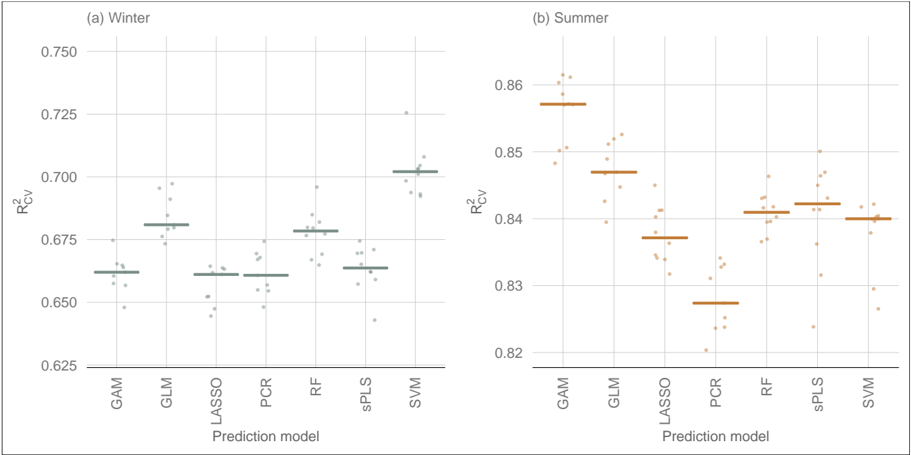
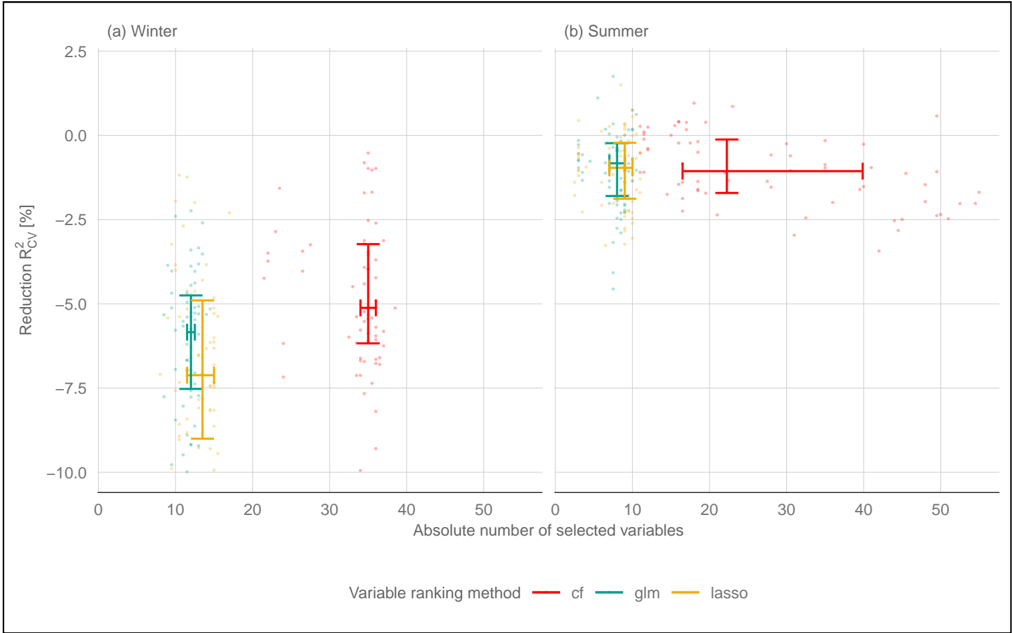
Statistical learning methods offer a promising approach for low flow regionalization. We examine seven statistical learning models (lasso, linear and non-linear model based boosting, sparse partial least squares, principal component regression, random forest, and support vector machine regression) for the prediction of winter and summer low flow based on a hydrological diverse dataset of 260 catchments in Austria. In order to produce sparse models we adapt the recursive feature elimination for variable preselection and propose to use three different variable ranking methods (conditional forest, lasso and linear model based boosting) for each of the prediction models. Results are evaluated for the low flow characteristic Q95 (Pr(Q>Q95) = 0.95) standardized by catchment area using a repeated nested cross validation scheme. We found a generally high prediction accuracy for winter (R2CV of 0.66 to 0.7) and summer (R2CV of 0.83 to 0.86). The models perform similar or slightly better than a Top-kriging model that constitutes the current benchmark for the study area. The best performing models are support vector machine regression (winter) and non-linear model based boosting (summer), but linear models exhibit similar prediction accuracy. The use of variable preselection can significantly reduce the complexity of all models with only a small loss of performance. The so obtained learning models are more parsimonious, thus easier to interpret and more robust when predicting at ungauged sites. A direct comparison of linear and non-linear models reveals that non-linear relationships can be sufficiently captured by linear learning models, so there is no need to use more complex models or to add non-liner effects. When performing low flow regionalization in a seasonal climate, the temporal stratification into summer and winter low flows was shown to increase the predictive performance of all learning models, offering an alternative to catchment grouping that is recommended otherwise.
Overview
The claims and statistics of this paper haven’t been checked yet.
Free: it reads the open-access text and checks the first 5 claims that cite a source we can check. Create a free account to check every claim.
Integrity signals
Registry
Cites
Statistics
Figures
Verification
Claims the paper makes
The claims and statistics of this paper haven’t been checked yet.
Free: it reads the open-access text and checks the first 5 claims that cite a source we can check. Create a free account to check every claim.
Self-check
Percentages, sums and reported differences re-computed from the paper’s own numbers.
The self-check needs the paper’s full text.
Citations
Cites
Breiman, L. (2001) · Machine Learning · doi:10.1023/a:1010933404324 · Cited by 133,538 · cited 1×
“RF is a bagging (bootstrap aggregating) method originally developed by Breiman (2001).”
MethodRegression shrinkage and selection via the lasso
Tibshirani, R. (1996) · Journal of the Royal Statistical Society Series B: Statistical Methodology · doi:10.1111/j.2517-6161.1996.tb02080.x · Cited by 51,482 · cited 1×
“Lasso was originally introduced by Tibshirani (1996), where the regression coefficients β lasso can be defined as follows: β lasso = argminβ{1/2 N∑ i=1 (yi −β0− p∑ j=1 xijβj ) + λ p∑ j=1 |βj |}, (1) with β0 as the intercept and βj as the regression coefficients.”
The Elements of Statistical Learning
Hastie, T., Tibshirani, R., & Friedman, J. (2009) · Springer Series in Statistics · doi:10.1007/978-0-387-84858-7 · Cited by 25,970
Regularization Paths for Generalized Linear Models via Coordinate Descent
Friedman, J., Hastie, T., & Tibshirani, R. (2010) · Journal of Statistical Software · doi:10.18637/jss.v033.i01 · Cited by 19,927 · cited 3×
“The Lasso approach can handle high correlated data, coefficients can be shrunk to zero, and correlated variables do not enter the final model (Friedman et al., 2010).”
BackgroundMethodThe Nature of Statistical Learning Theory
Vapnik, V. N. (2000) · Springer eBooks · doi:10.1007/978-1-4757-3264-1 · Cited by 10,696 · cited 1×
“(7) V can be any loss function, but in the initial idea of Vapnik (2000), it is defined by a threshold r .”
BackgroundGene selection for cancer classification using support vector machines
Guyon, I., Weston, J., Barnhill, S., & Vapnik, V. (2002) · Machine Learning · doi:10.1023/a:1012487302797 · Cited by 9,954
Geurts, P., Ernst, D., & Wehenkel, L. (2006) · Machine Learning · doi:10.1007/s10994-006-6226-1 · Cited by 9,300 · cited 1×
“We used the estimated response variance as a splitting criterion because rank-based approaches or the use of extremely randomized trees (Geurts et al., 2006) did not improve prediction accuracy.”
MethodWrappers for feature subset selection
Kohavi, R., & John, G. H. (1997) · Artificial Intelligence · doi:10.1016/s0004-3702(97)00043-x · Cited by 8,947 · cited 2×
“, Lasso, boosting models, or treebased methods; (ii) filter-based methods (Guyon and Elisseeff, 2003), which include correlation-based variable selection or univariate regression filters; finally, (iii) wrapper-based methods (Kohavi and John, 1997) such as recursive feature elimination (RFE) (Guyon et al.”
MethodAn introduction to variable and feature selection
GuyonIsabelle, & ElisseeffAndré (2003) · Journal of Machine Learning Research · doi:10.5555/944919.944968 · Cited by 7,715
Unbiased Recursive Partitioning: A Conditional Inference Framework
Hothorn, T., Hornik, K., & Zeileis, A. (2006) · Journal of Computational and Graphical Statistics · doi:10.1198/106186006x133933 · Cited by 4,021 · cited 2×
“– The third method (cfrank) uses conditional forests (Hothorn et al., 2006; Strobl et al., 2007, 2009) for variable ranking, where the standardized coefficients are a sum of the main and interaction effects for each variable.”
Method
Research works printed but not linked: 2
- https://doi.org/10.5194/hess-2021-481 Preprint. Discussion started: 22 September 2021 c Author(s) 2021. CC BY 4.0 License. · doi:10.5194/hess-2021-481preprint.discussionstarted:22september2021cauthor
- Wold, H.: Estimation of principal components and related models by iterative least squares, Multivariate analysis, pp. 391-420, 1966. https://doi.org/10.5194/hess-2021-481 Preprint. Discussion started: 22 September 2021 c Author(s) 2021. CC BY 4.0 License. · doi:10.5194/hess-2021-481preprint.discussionstarted:22september2021cauthor
Cited by
Papacharalampous, G., & Tyralis, H. (2022) · Water · doi:10.3390/w14101657 · Cited by 19
“…signature regionalization (see, e.g., the modelling works by Beck et al. 2015; Westerberg et al. 2016; Addor et al. 2018; Tyralis et al. 2021b; Laimighofer et al. 2022, as well as the reviews and taxonomies of streamflow signatures by McMillan et al. 2017; McMillan 2020) and catchment model…”
Laimighofer, J., Melcher, M., & Laaha, G. (2022) · Hydrology and Earth System Sciences · doi:10.5194/hess-26-4553-2022 · Cited by 12
“…from (cid:58)(cid:58)(cid:58)(cid:58)(cid:58) model (cid:58)(cid:58)(cid:58)(cid:58)(cid:58)(cid:58) fitting The applied method is fully described in Laimighofer et al. (2022) and to increase clarity we added a visual explanation of the full cross validation procedure (Fig.”
Self-citationLaaha, G. (2023) · Hydrology and Earth System Sciences · doi:10.5194/hess-27-689-2023 · Cited by 8
Self-citationDelSanto, A., Bhuiyan, M. A. E., Andreadis, K. M., & Palmer, R. N. (2023) · Water · doi:10.3390/w15152813 · Cited by 12
A novel ensemble feature selection method for pixel-level segmentation of HER2 overexpression
Aguilera, A., Raquel Pezoa, R., & Rodríguez-Delherbe, A. (2022) · Complex & Intelligent Systems · doi:10.1007/s40747-022-00774-x · Cited by 10
“A parsimonious model implies learning models less complex, thus easier to interpret, to understand and more robust when predicting new samples [61].”
Background
Metadata
- Authors
- Laimighofer, J., Melcher, M., & Laaha, G.
- Affiliations
- BOKU University (AT)
- FH JOANNEUM University of Applied Sciences (AT)
- Corresponding author
- Laimighofer, Johannes
- Laaha, Gregor
- Venue
- Hydrology and earth system sciences
- Publisher
- Copernicus GmbH
- Published
- 2021-09-22
- Volume
- 26
- Issue
- 1
- Pages
- 129-148
- ISSN
- 1027-5606 (ISSN-L)
- OpenAlex
- W4225623739
- Cited by
- 30
- References
- 65
- Citations by year
- 2026: 1 · 2025: 6 · 2024: 5 · 2023: 6 · 2022: 12
- FWCI
- 2.12
- Type
- journal article
- Language
- en
- Open access
- gold
- doi.org
- Licence
- Locations
- Hydrology and earth system sciences (publishedVersion, cc-by)
- FH JOANNEUM ePUB (submittedVersion, cc-by)
- DOAJ (DOAJ: Directory of Open Access Journals) (submittedVersion, cc-by-sa)
- Funders
- Österreichischen Akademie der Wissenschaften (25819)
- Topics
- Physical Sciences › Environmental Science › Water Science and Technology › Hydrology and Watershed Management Studies
- Physical Sciences › Environmental Science › Environmental Engineering › Hydrological Forecasting Using AI
- Physical Sciences › Environmental Science › Global and Planetary Change › Hydrology and Drought Analysis
- Keywords
- statistical learning models, recursive feature elimination, feature selection, feature ranking, support vector regression, sparse partial least squares, principal component regression, random forest, ungauged basins, seasonal stratification
About these checks
Registry, retraction, Cites and statistics results are computed, not judged, with one exception: a printed reference that no index lists is read once by a model before it counts as a citation error. Claims are extracted by a model and kept only when their quote appears verbatim in the text; each cited source is then checked, with a model’s help, for whether it says what the claim relies on. Those verdicts can be wrong — read the claim’s quote and the cited source before relying on one.
Statistics and arithmetic are recomputed, not judged.
Confidence bands are shown only for fields calibrated on our annotated test set. None is calibrated yet, so no band is shown.
What counts as a claim ›How we measure confidence ›How we check this ›
Are you an author, or do you see a problem with this page? Request a review
How to cite
Cite CoChat for the checks on this page, and the paper for its own findings.
- This page
- CoChat. (2026). Citation check: Parsimonious statistical learning models for low flow estimation. https://app.cochat.ai/papers/10.5194/hess-2021-481
- The paper
- Laimighofer, J., Melcher, M., & Laaha, G. (2021). Parsimonious statistical learning models for low flow estimation. Hydrology and earth system sciences. https://doi.org/10.5194/hess-2021-481
Data sources
Bibliographic data: Semantic Scholar, OpenAlex, Crossref.
Contains information from the Semantic Scholar Academic Graph Datasets, made available under the ODC Attribution License (ODC-BY 1.0).
Semantic Scholar’s data is described in: Kinney, R., et al. (2023). The Semantic Scholar Open Data Platform. arXiv:2301.10140.
