

Hydrodynamics of pedestrians' instability in floodwaters
Open accessPublished version of a preprint
The DOI matches its Crossref record; 45 of the 47 references it cites were found in a registry or an index, and 2 are not checked yet; none of the 54 sources its claims cite is checked for support yet.
Abstract
People's safety is the first objective to be fulfilled by flood risk mitigation measures, and according to existing reports on the causes of casualties, most of the fatalities are due to inappropriate behaviour such as walking or driving in floodwaters. Currently available experimental data on people instability in floodwaters suffer from a large dispersion primarily depending on the large variability of the physical characteristics of the subjects. This paper introduces a dimensionless mobility parameter θP for people partly immersed in flood flows, which accounts for both flood and subject characteristics. The parameter θP is capable of identifying a unique threshold of instability depending on a Froude number, thus reducing the scatter of existing experimental data. Moreover, a three-dimensional (3-D) numerical model describing the detailed geometry of a human body and reproducing a selection of critical pairs of water depth and velocity is presented. The numerical results in terms of hydrodynamic forces and force coefficients are analysed and discussed. Both the mobility parameter θP and the numerical results hint at the crucial role of the Froude number and relative submergence as the most relevant dimensionless numbers to interpret the loss of stability. Finally, the mobility parameter θP is compared with an analogous dimensionless parameter for vehicles' instability in floodwaters, providing a new contribution to support flood risk management and educating people.
Checked 2026-11-22 · 2 references not checked yet
Overview
CoChat Summary
TL;DR
This paper introduces a dimensionless mobility parameter θ_P for pedestrian instability in floodwaters that combines flood and subject characteristics and identifies a unique critical threshold depending on Froude number. It also presents a simplified 3-D numerical model of a human body in flood flow to analyze hydrodynamic forces and force coefficients.
Key findings
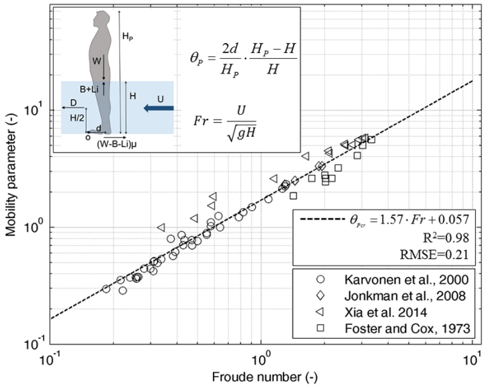
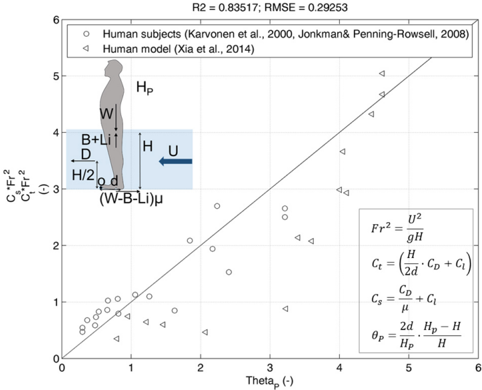
- The mobility parameter θ_P for selected flume experiments defines a unique critical threshold θ_Pcr = 1.57 Fr + 0.057 (R² = 0.98, RMSE = 0.21), reducing scatter of dimensional depth–velocity data; θ_Pcr ranges from 0.3 at low Froude numbers to 6 for super-critical flows.
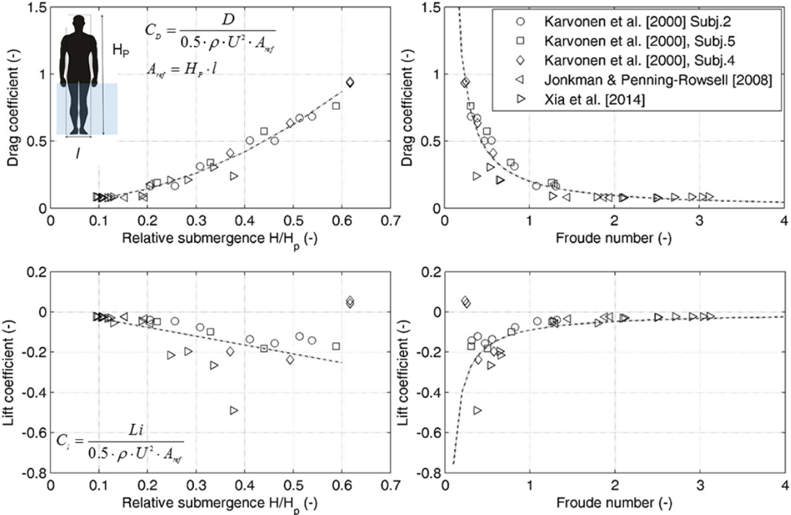
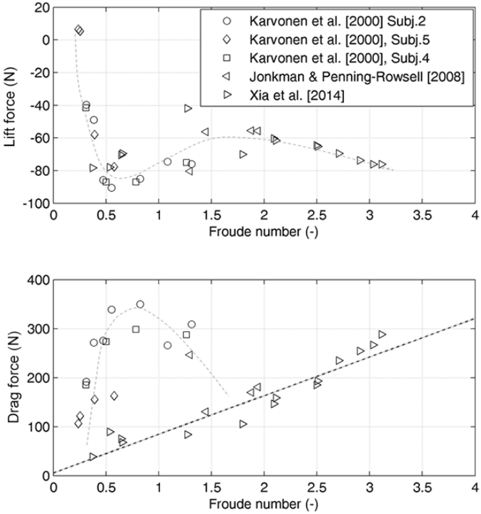
- Numerical simulations (33 steady flows, Fr 0.2–3.5) show drag coefficient decreases exponentially with Froude number from approximately 1 at low Fr to 0.1 at high Fr; lift coefficients range from -0.49 to 0.06; drag force for human subjects ranges from 100 N to 350 N and peaks near Fr ≈ 1.
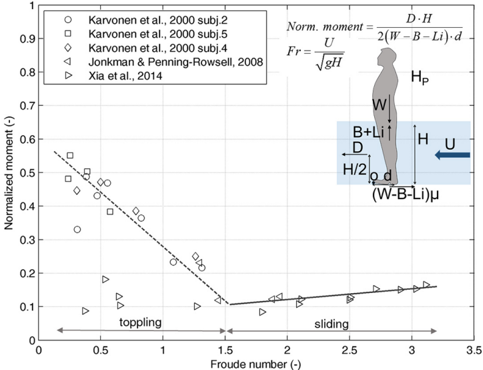
- Normalized moment indicates toppling instability for Fr < 1.5 and sliding for Fr ≥ 1.5, with a possible mix near Fr = 1.5.
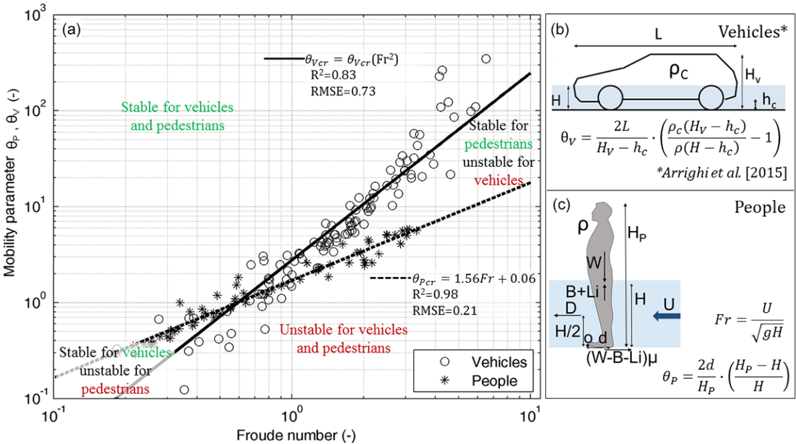
- Comparison with the vehicle mobility parameter shows critical curves intersect at Fr ≈ 0.6; for Fr 0.1–0.6 moving by car is safer than on foot, while for Fr > 0.6 moving on foot is safer than by car.
Methods
- Dimensional analysis of sliding and toppling force/moment balances derives θ_P; tested against selected flume datasets (Foster and Cox, 1973; Karvonen et al., 2000; Jonkman and Penning-Rowsell, 2008; Xia et al., 2014), excluding Abt et al. (1989) and Takahashi et al. (1992) for stated reasons.
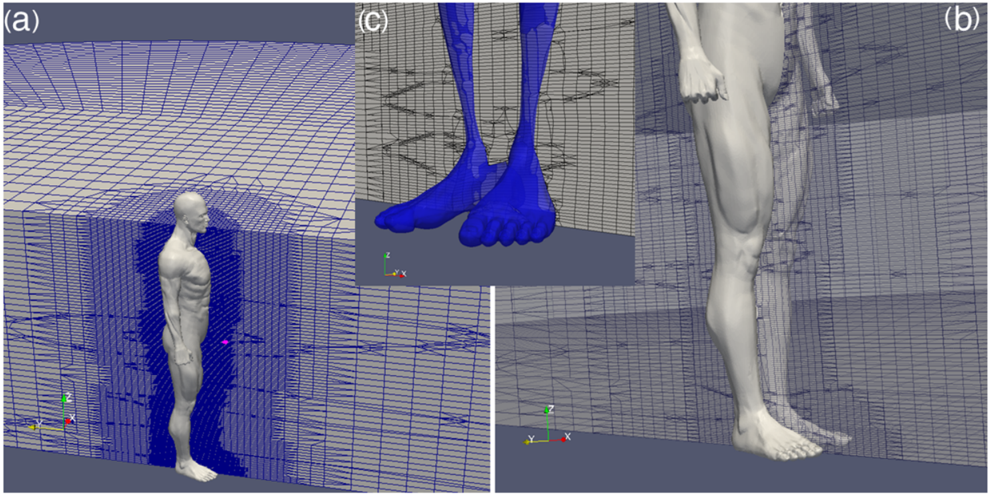
- 3-D CFD simulations using OpenFOAM waveFoam (RANS, VOF, laminar turbulence settings) with a rigid triangulated human geometry; mesh approximately 4.5×10⁵ cells, 0.015 m near body; 33 simulations covering Fr 0.2–3.5, comparing drag/lift forces and coefficients to experiments.
- Local sensitivity analysis of θ_P to foot length d, height H_P, and body density ρ_P; goodness-of-fit sensitivity to d and friction coefficient μ with ±10% and ±30% variations.
Limitations
- Stated: human body modeled as rigid with feet-bottom adherence; no turbulence model due to lack of calibration/validation data; only frontal flow orientation and no walking condition; friction and foot length were not measured in experiments; effects of posture, clothing, relative motion, psychological characteristics, local turbulence, and water density require further study.
- Stated: direct comparison between human subjects and human-scale model was not possible for highly super-critical flows because only recent studies tested human subjects there.
- Evident from text: the numerical model is simplified and the human-scale model behaves passively, so force estimates may not fully represent real human response; selected experimental datasets and assumed constant friction coefficient (μ = 0.3) constrain generality.
Model-written summary. Check it against the paper before relying on it.
Integrity signals
Registry
Cites
Statistics
Figures
Verification
Claims the paper makes
0 Valid · 3 Not valid · 36 Not checked · 91 Own results and interpretations
A result the paper reports from its own data — it cites no other source for it, so there is none to check. The quote shows it is in the paper.
In the paper
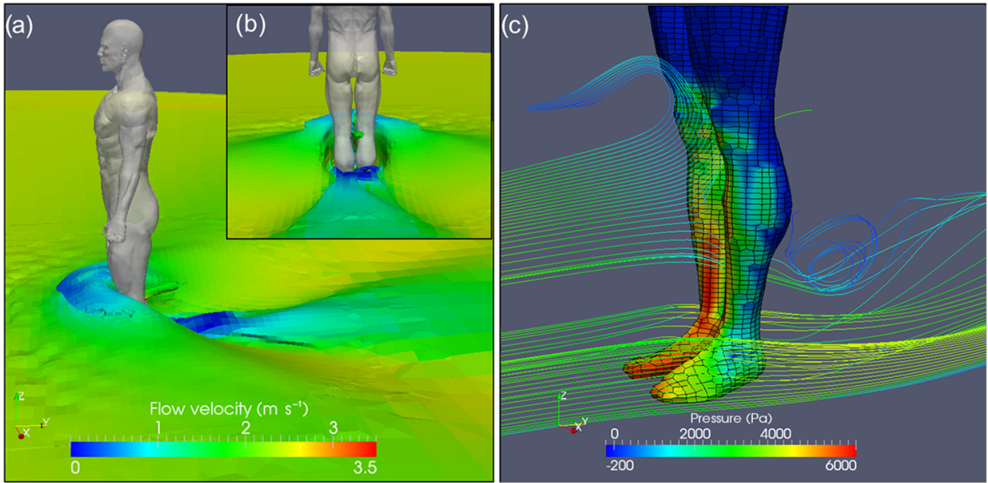
“Drag coefficient ranges from 0.1 for high Froude numbers, up to approximately 1 for low Froude numbers.”
§ Hydrodynamics of pedestrians' instability in floodwaters > 4.1 Forces and force coefficients
plainstates an association- Asserted: passes — The authors put it forward as true.
- Checkable: passes — It can be checked against evidence.
- Load-bearing: passes — The paper’s conclusions depend on it.
- Based: passes — The paper gives a reason why it holds.
In the paper
“Particularly, the selection of points calculated from the data by Xia et al. (2014) are above the threshold curve, i.e. they lie in the stable side of the diagram.”
§ Hydrodynamics of pedestrians' instability in floodwaters > 2.3 Dimensionless instability threshold from Foster
What the sources say
- Not checked yetcites Xia et al. (2014) matched to “New criterion for the stability of a human body in floodwaters” (2014) source
plain- Asserted: passes — The authors put it forward as true.
- Checkable: passes — It can be checked against evidence.
- Load-bearing: passes — The paper’s conclusions depend on it.
- Based: passes — The paper gives a reason why it holds.
In the paper
“Some of the data by Foster and Cox (1973) instead are under the curve, and thus in the unstable portion of the diagram.”
§ Hydrodynamics of pedestrians' instability in floodwaters > 2.3 Dimensionless instability threshold from Foster
What the sources say
- Not matchedcites Foster and Cox (1973)
An author–year citation the paper’s reference list doesn’t settle. We don’t search these by name.
plain- Asserted: passes — The authors put it forward as true.
- Checkable: passes — It can be checked against evidence.
- Load-bearing: unclear — It is unclear whether the paper’s conclusions depend on it.
- Based: passes — The paper gives a reason why it holds.
- Not matched
A result the paper reports from its own data — it cites no other source for it, so there is none to check. The quote shows it is in the paper.
In the paper
“For super-critical flows, a significant splashing area is detected in correspondence with the impact zone (Fig. 3, panels a, c).”
§ Hydrodynamics of pedestrians' instability in floodwaters > 4.1 Forces and force coefficients
plainstates an associationSingle case- Asserted: passes — The authors put it forward as true.
- Checkable: passes — It can be checked against evidence.
- Load-bearing: unclear — It is unclear whether the paper’s conclusions depend on it.
- Based: passes — The paper gives a reason why it holds.
A result the paper states — it cites no source for it, so there is none to check. The quote shows it is in the paper.
In the paper
“The critical mobility parameter θ P cr ranges from 0.3 for low Froude numbers (i.e.sub-critical conditions) up to 6 for super-critical flows”
§ Hydrodynamics of pedestrians' instability in floodwaters > 2.3 Dimensionless instability threshold from Foster
plainstates an association- Asserted: passes — The authors put it forward as true.
- Checkable: passes — It can be checked against evidence.
- Load-bearing: passes — The paper’s conclusions depend on it.
- Based: passes — The paper gives a reason why it holds.
70 more claims
Create a free account to see all 130 claims and to verify the 35 references still open.
- Probably not a substantial claim. 20
- It may state two separate claims as one. 41
Self-check
Percentages, sums and reported differences re-computed from the paper’s own numbers.
Each contradiction between two passages listed here was confirmed by an independent check.
Rated major: it would touch a result — a value a result rests on, reported and recomputed p-values on opposite sides of the significance level, two passages that conflict with no sign which is right, or a cited work retracted before this paper was published.
In the paper
§ Hydrodynamics of pedestrians' instability in floodwaters > 4.3 Comparison with experimental data
“The determination coefficient is 0.76 and the RMSE is 0.63.”
§ Hydrodynamics of pedestrians' instability in floodwaters > 6 Conclusions
“| RMSE | 0.28 | 0.67 | 0.29 0.67 | 0.31 0.69 | 0.31 0.97 | 0.32 1.26 |”
Rated minor: it would not touch a result — a value no result rests on, a p-value that stays on the same side of the significance level, or a conflict that is clerical, resolved elsewhere in the paper, or outside its own findings.
In the paper
§ Hydrodynamics of pedestrians' instability in floodwaters > 4.3 Comparison with experimental data
“In fact, the determination coefficient R 2 does not decrease under 0.7.”
§ Hydrodynamics of pedestrians' instability in floodwaters > 6 Conclusions
“| R 2 | 0.82 | 0.76 | 0.82 0.73 | 0.81 0.70 | 0.81 0.64 | 0.77 0.62 |”
Rated minor: it would not touch a result — a value no result rests on, a p-value that stays on the same side of the significance level, or a conflict that is clerical, resolved elsewhere in the paper, or outside its own findings.
In the paper
§ Hydrodynamics of pedestrians' instability in floodwaters > 4.1 Forces and force coefficients
“Figure 5 depicts the lift and drag forces versus the Froude number for all the simulated subjects (top and bottom panels respectively).”
§ Hydrodynamics of pedestrians' instability in floodwaters > 6 Conclusions
“Figure5.Estimated lift (top panel) and drag (bottom panel) forces versus the relative submergence”
Rated minor: it would not touch a result — a value no result rests on, a p-value that stays on the same side of the significance level, or a conflict that is clerical, resolved elsewhere in the paper, or outside its own findings.
In the paper
§ Hydrodynamics of pedestrians' instability in floodwaters > 4.1 Forces and force coefficients
“Figure 4 shows the drag coefficient and lift coefficients versus the Froude number on the right-hand side of the figure in the top and bottom panels respectively.”
§ Hydrodynamics of pedestrians' instability in floodwaters > 6 Conclusions
“Figure 4.Estimated drag and lift coefficients versus Froude number (top left and bottom left panels respectively) and versus the relative submergence (top right and bottom right panels respectively)”
Rated minor: it would not touch a result — a value no result rests on, a p-value that stays on the same side of the significance level, or a conflict that is clerical, resolved elsewhere in the paper, or outside its own findings.
In the paper
§ Hydrodynamics of pedestrians' instability in floodwaters > 4.1 Forces and force coefficients
“Except for subject 4, which is represented with a diamond symbol, the lift coefficients are negative.”
§ Hydrodynamics of pedestrians' instability in floodwaters > 4.1 Forces and force coefficients
“subject 5 (Karvonen et al., 2000) experiences a positive vertical force since a portion of the lower body trunk is immersed in water.”
Citations
Cites
Introduction to fluid mechanics
(2013) · Engineering Science · doi:10.4324/9780203114964-25 · Cited by 1,957
A wave generation toolbox for the open‐source CFD library: OpenFoam®
Jacobsen, N. G., Fuhrman, D. R., & Fredsøe, J. (2011) · International Journal for Numerical Methods in Fluids · doi:10.1002/fld.2726 · Cited by 1,360
Socio-hydrology: conceptualising human-flood interactions
Di Baldassarre, G., Viglione, A., Carr, G., Kuil, L., Salinas, J. L., & Blöschl, G. (2013) · Hydrology and Earth System Sciences · doi:10.5194/hess-17-3295-2013 · Cited by 635
An Analysis of the Causes and Circumstances of Flood Disaster Deaths
Jonkman, S. N., & Kelman, I. (2005) · Disasters · doi:10.1111/j.0361-3666.2005.00275.x · Cited by 599
Debates—Perspectives on socio‐hydrology: Capturing feedbacks between physical and social processes
Di Baldassarre, G., Viglione, A., Carr, G., Kuil, L., Yan, K., Brandimarte, L., & Blöschl, G. (2015) · Water Resources Research · doi:10.1002/2014wr016416 · Cited by 486
Vulnerability to flooding: health and social dimensions
Tapsell, S. M., Penning-Rowsell, E. C., Tunstall, S. M., & Wilson, T. L. (2002) · Philosophical Transactions of the Royal Society of London. Series A: Mathematical, Physical and Engineering Sciences · doi:10.1098/rsta.2002.1013 · Cited by 425
Siegrist, M., & Gutscher, H. (2008) · Risk Analysis · doi:10.1111/j.1539-6924.2008.01049.x · Cited by 413
Chakraborty, J., Tobin, G. A., & Montz, B. E. (2005) · Natural Hazards Review · doi:10.1061/(asce)1527-6988(2005)6:1(23 · Cited by 355
Vickery, B. J. (1966) · Journal of Fluid Mechanics · doi:10.1017/s002211206600020x · Cited by 343
Flood Risk Management: Hazards, Vulnerability and Mitigation Measures
(2006) · NATO Science Series · doi:10.1007/978-1-4020-4598-1 · Cited by 311
Research works printed but not linked: 4
- Beckers, J. V. L., De Bruijn, K. M., and Riedstra, D.: Life safety cri- teria for flood protection standards, 5th International Conference on Flood Management, p. 2600, Tokyo, 27-29 September 2012.
- Munich Re: Great natural catastrophes worldwide 1950-2011, Number of events with trend, available at: https://www.munichre. com/en/media-relations/publications/press-releases/2012 (last access: 10 February 2015), 2012.
- Munich Re: Loss events worldwide 1980-2014, 10 costliest events ordered by overall losses, available at: https://www.munichre. com/en/media-relations/publications/press-releases/index.html, last access: 10 February 2015a. Munich Re: Loss events worldwide 2014 (January), avail- able at: https://www.munichre.com/site/wrap/get/documents_ E-581009931/mram/assetpool.munichreamerica.wrap/PDF/ 2014/2014_globalmap.pdf, last access: 10 February 2015b.
- Yee, M.: Human stability in floodways, Undergraduate honours Thesis, University of New South Wales, Australia, 2003.
Cited by
Flood Risk in Urban Areas: Modelling, Management and Adaptation to Climate Change. A Review
Cea, L., & Costabile, P. (2022) · Hydrology · doi:10.3390/hydrology9030050 · Cited by 317
Disparities of population exposed to flood hazards in the United States
Qiang, Y. (2019) · Journal of Environmental Management · doi:10.1016/j.jenvman.2018.11.039 · Cited by 151
Preparedness against mobility disruption by floods
Arrighi, C., Pregnolato, M., Dawson, R. J., & Castelli, F. (2019) · Science of The Total Environment · doi:10.1016/j.scitotenv.2018.11.191 · Cited by 169
“Furthermore, the information on flow velocity, which is crucial to assess risk to people (Arrighi et al., 2017; Arrighi et al., 2015; Jonkman and Kelman, 2005; Milanesi et al., 2015), is not available.”
BackgroundSelf-citationCostabile, P., Costanzo, C., Lorenzo, G. D., & Macchione, F. (2019) · Journal of Hydrology · doi:10.1016/j.jhydrol.2019.124231 · Cited by 133
An operational procedure for rapid flood risk assessment in Europe
Dottori, F., Kalas, M., Salamon, P., Bianchi, A., Alfieri, L., & Feyen, L. (2017) · Natural Hazards and Earth System Sciences · doi:10.5194/nhess-17-1111-2017 · Cited by 84
Dias, C., Rahman, N. B. A., & Zaiter, A. (2021) · International Journal of Disaster Risk Reduction · doi:10.1016/j.ijdrr.2021.102192 · Cited by 98
Comprehensive flood vulnerability analysis in urban communities: Iowa case study
Alabbad, Y., & Demir, İ. (2022) · International Journal of Disaster Risk Reduction · doi:10.1016/j.ijdrr.2022.102955 · Cited by 96
Costabile, P., Costanzo, C., Kalogiros, J. A., & Bellos, V. (2023) · Water Resources Research · doi:10.1029/2023wr034599 · Cited by 84
Silvestro, F., Rossi, L., Campo, L., Parodi, A., Fiori, E., Rudari, R., & Ferraris, L. (2019) · Journal of Hydrology · doi:10.1016/j.jhydrol.2019.02.055 · Cited by 85
Costabile, P., & Costanzo, C. (2021) · Journal of Hydrology · doi:10.1016/j.jhydrol.2021.126306 · Cited by 74
Lazzarin, T., Viero, D. P., Molinari, D., Ballio, F., & Defina, A. (2022) · Journal of Hydrology · doi:10.1016/j.jhydrol.2022.127485 · Cited by 75
Zhi, G., Liao, Z., Tian, W., & Wu, J. (2020) · Journal of Environmental Management · doi:10.1016/j.jenvman.2020.110521 · Cited by 70
Lu, Y., Zhai, G., & Zhou, S. (2024) · Ecological Indicators · doi:10.1016/j.ecolind.2024.112322 · Cited by 59
High-resolution 2D shallow water modelling of dam failure floods for emergency action plans
Ferrari, A., Vacondio, R., & Mignosa, P. (2023) · Journal of Hydrology · doi:10.1016/j.jhydrol.2023.129192 · Cited by 55
Flooding Urban Landscapes: Analysis Using Combined Hydrodynamic and Hydrologic Modeling Approaches
Jha, M. K., & Afreen, S. (2020) · Water · doi:10.3390/w12071986 · Cited by 53
Shirvani, M., & Kesserwani, G. (2021) · Natural hazards and earth system sciences · doi:10.5194/nhess-21-3175-2021 · Cited by 53
Comparison of flood hazard assessment criteria for pedestrians with a refined mechanics-based method
Musolino, G., Ahmadian, R., & Falconer, R. A. (2020) · Journal of Hydrology X · doi:10.1016/j.hydroa.2020.100067 · Cited by 47
Enhancing pedestrian evacuation routes during flood events
Musolino, G., Ahmadian, R., & Xia, J. (2022) · Natural Hazards · doi:10.1007/s11069-022-05251-9 · Cited by 47
Musolino, G., Ahmadian, R., Xia, J., & Falconer, R. A. (2020) · Journal of Flood Risk Management · doi:10.1111/jfr3.12627 · Cited by 45
Cao, D., Yuan, J., Chen, H., Zhao, K., & Liu, P. L. ‐. (2021) · Coastal Engineering · doi:10.1016/j.coastaleng.2021.103891 · Cited by 44
Can the 2D shallow water equations model flow intrusion into buildings during urban floods?
Dewals, B., Kitsikoudis, V., Mejía‐Morales, M. A., Archambeau, P., Mignot, E., Proust, S., Erpicum, S., Pirotton, M., & Paquier, A. (2023) · Journal of Hydrology · doi:10.1016/j.jhydrol.2023.129231 · Cited by 43
Impact of the porosity of an urban block on the flood risk assessment: A laboratory experiment
Mejía‐Morales, M. A., Mignot, E., Paquier, A., Sigaud, D., & Proust, S. (2021) · Journal of Hydrology · doi:10.1016/j.jhydrol.2021.126715 · Cited by 42
A spatial framework to explore needs and opportunities for interoperable urban flood management
Dawson, D., Vercruysse, K., & Wright, N. (2020) · Philosophical Transactions of the Royal Society A Mathematical Physical and Engineering Sciences · doi:10.1098/rsta.2019.0205 · Cited by 41
Human stability during floods: Experimental tests on a physical model simulating human body
Postacchini, M., Bernardini, G., D’Orazio, M., & Quagliarini, E. (2021) · Safety Science · doi:10.1016/j.ssci.2020.105153 · Cited by 41
Empirical flash flood vulnerability functions for residential buildings
Arrighi, C., Mazzanti, B., Pistone, F., & Castelli, F. (2020) · SN Applied Sciences · doi:10.1007/s42452-020-2696-1 · Cited by 40
Self-citationFundamental diagrams for straight movement of pedestrians in water
Li, X., Yu, H., Song, W., Zhang, J., Zhan, Z., Ren, X., & Xu, H. (2022) · Safety Science · doi:10.1016/j.ssci.2022.106018 · Cited by 38
Lazzarin, T., Viero, D. P., Molinari, D., Ballio, F., & Defina, A. (2022) · Journal of Hydrology · doi:10.1016/j.jhydrol.2022.128687 · Cited by 34
Zhu, Z., Zhang, Y., Gou, L., Peng, D., & Pang, B. (2023) · Urban Climate · doi:10.1016/j.uclim.2023.101420 · Cited by 32
Stability of Individuals during Urban Inundations: What Should We Learn from Field Observations?
Chanson, H., & Brown, R. (2018) · Geosciences · doi:10.3390/geosciences8090341 · Cited by 32
Comprehensive flood risk assessment in highly developed urban areas
Dong, B., Xia, J., & Wang, X. (2024) · Journal of Hydrology · doi:10.1016/j.jhydrol.2024.132391 · Cited by 31
Characterization of Overtopping Waves on Sea Dikes with Gentle and Shallow Foreshores
Suzuki, T., Altomare, C., YASUDA, T., & Verwaest, T. (2020) · Journal of Marine Science and Engineering · doi:10.3390/jmse8100752 · Cited by 30
Risk assessment of metro tunnel evacuation in devastating urban flooding events
Li, Q., Xia, J., Zhou, M., Deng, S., & Dong, B. (2023) · Tunnelling and Underground Space Technology · doi:10.1016/j.tust.2023.105540 · Cited by 30
Overtopping Metrics and Coastal Safety: A Case of Study from the Catalan Coast
Altomare, C., Gironella, X., Suzuki, T., Viccione, G., & Saponieri, A. (2020) · Journal of Marine Science and Engineering · doi:10.3390/jmse8080556 · Cited by 29
Mohanty, M. P., & Karmakar, S. (2021) · Journal of Environmental Management · doi:10.1016/j.jenvman.2021.112456 · Cited by 29
Shin, E. T., Kim, H., Rhee, D. S., Eom, T., & Song, C. G. (2021) · Natural Hazards · doi:10.1007/s11069-021-04888-2 · Cited by 29
Modeling and simulation of crowd dynamics at evacuation bottlenecks during flood disasters
Shi, D., Li, J., Wang, Q., Chen, J., Lovreglio, R., Lo, J. T. Y., & Ma, J. (2025) · Transportation Research Part E Logistics and Transportation Review · doi:10.1016/j.tre.2025.104064 · Cited by 28
Costabile, P., Lombardo, M., Chiaravalloti, F., Caloiero, T., & Costanzo, C. (2025) · Urban Climate · doi:10.1016/j.uclim.2025.102724 · Cited by 26
Cozzolino, L., Cimorelli, L., Morte, R. D., Pugliano, G., Piscopo, V., & Pianese, D. (2019) · Advances in Water Resources · doi:10.1016/j.advwatres.2019.103422 · Cited by 25
Lazzarin, T., Chen, A., & Viero, D. P. (2023) · The Science of The Total Environment · doi:10.1016/j.scitotenv.2023.168718 · Cited by 24
Wave overtopping layer thickness on the crest of rubble mound seawalls
Koosheh, A., Etemad‐Shahidi, A., Cartwright, N., Tomlinson, R. B., & van Gent, M. R. A. (2023) · Coastal Engineering · doi:10.1016/j.coastaleng.2023.104441 · Cited by 23
Galuppini, G., Quintilliani, C., Arosio, M., Barbero, G., Ghilardi, P., Manenti, S., Petaccia, G., Todeschini, S., Ciaponi, C., Martina, M. L. V., et al. (2020) · Urban Water Journal · doi:10.1080/1573062x.2020.1734950 · Cited by 23
Li, X., Erpicum, S., Mignot, E., Archambeau, P., Rivière, N., Pirotton, M., & Dewals, B. (2020) · Water Resources Research · doi:10.1029/2019wr026774 · Cited by 21
Li, X., Yu, H., Xu, H., Ren, X., Song, W., & Zhang, J. (2023) · International Journal of Disaster Risk Reduction · doi:10.1016/j.ijdrr.2023.103822 · Cited by 20
Data-driven flood hazard zonation of Italy
Marchesini, I., Salvati, P., Rossi, M., Donnini, M., Sterlacchini, S., & Guzzetti, F. (2021) · Journal of Environmental Management · doi:10.1016/j.jenvman.2021.112986 · Cited by 20
Inline force on human body due to non-impulsive wave overtopping at a vertical seawall
Cao, D., Chen, H., & Yuan, J. (2020) · Ocean Engineering · doi:10.1016/j.oceaneng.2020.108300 · Cited by 19
Stability of Solids in Stepped Flume Nappe Flows: Subsidies for Human Stability in Flows
Ribeiro, H. D. B., Simões, A. L. A., da Luz, L. D., Mangieri, L. S. G., & Schulz, H. E. (2021) · Journal of Applied Fluid Mechanics · doi:10.47176/jafm.14.03.31815 · Cited by 19
Investigation of pedestrian speed in formation evacuating in two specific water depths
Li, X., Yu, H., Song, W., & Zhang, J. (2023) · Safety Science · doi:10.1016/j.ssci.2023.106333 · Cited by 19
Re, M., Kazimierski, L. D., & Badano, N. D. (2019) · Journal of Flood Risk Management · doi:10.1111/jfr3.12524 · Cited by 19
Interlinking Bristol Based Models to Build Resilience to Climate Change
Stevens, J., Henderson, R., Webber, J. L., Evans, B., Chen, A., Djordjević, S., Sánchez-Muñoz, D., & Domínguez‐García, J. L. (2020) · Sustainability · doi:10.3390/su12083233 · Cited by 19
Urban Flood Drifters (UFDs): Onset of movement
Valero, D., Bayón, A., & Franca, M. J. (2024) · The Science of The Total Environment · doi:10.1016/j.scitotenv.2024.171568 · Cited by 18
A coupled model for macroscopic behavior of crowd in flood induced evacuation
Maity, S., & Sundar, S. (2022) · Physica A Statistical Mechanics and its Applications · doi:10.1016/j.physa.2022.128161 · Cited by 18
Jhong, B.-C., Tachikawa, Y., Tanaka, T., Udmale, P. D., & Tung, C. (2020) · Water · doi:10.3390/w12092508 · Cited by 18
Shao, Z. S., Li, Y., Gong, H., & Chai, H. (2023) · Frontiers of Environmental Science & Engineering · doi:10.1007/s11783-024-1782-9 · Cited by 17
Multi-Risk Assessment in the Veneto Region: An Approach to Rank Seismic and Flood Risk
Tocchi, G., Ottonelli, D., Rebora, N., & Polese, M. (2023) · Sustainability · doi:10.3390/su151612458 · Cited by 17
Tan, W., Cao, D., & Yuan, J. (2022) · Ocean Engineering · doi:10.1016/j.oceaneng.2022.112153 · Cited by 16
Cao, D., Lin, Z., Yuan, J., Tan, W., & Chen, H. (2024) · Engineering Applications of Computational Fluid Mechanics · doi:10.1080/19942060.2024.2319768 · Cited by 16
Supporting participative pre‐flood risk reduction in a UNESCO biosphere
O’Grady, M. J., Evans, B., Eigbogba, S., Muldoon, C., Campbell, A. G., Brewer, P., & O’Hare, G. M. P. (2019) · Journal of Flood Risk Management · doi:10.1111/jfr3.12520 · Cited by 16
Suzuki, T., García-Feal, O., Domínguez, J. M., & Altomare, C. (2022) · Computational Particle Mechanics · doi:10.1007/s40571-022-00468-8 · Cited by 16
Gou, L., Zhu, Z., Liu, S., Peng, D., & Zhang, D. (2024) · Physics of Fluids · doi:10.1063/5.0191951 · Cited by 14
Monteiro, L. R., dos Santos, C. I., Kobiyama, M., Corseuil, C. W., & Chaffe, P. L. B. (2021) · Revista Brasileira de Recursos Hídricos · doi:10.1590/2318-0331.262120200161 · Cited by 13
Establishing closure criteria for coastal roadways under flooding conditions
Maghsoodifar, F., Radfar, S., Moftakhari, H. R., & Moradkhani, H. (2025) · International Journal of Disaster Risk Reduction · doi:10.1016/j.ijdrr.2025.105805 · Cited by 12
Crowd safety assessment for flood evacuation in subway platform tunnels
Cao, S., Ma, L., Zeng, Y., Wang, Y., Wang, P., & Li, X. (2025) · Tunnelling and Underground Space Technology · doi:10.1016/j.tust.2025.106848 · Cited by 11
Leal, M., Reis, E., & Santos, P. P. (2022) · Journal of Geographical Sciences · doi:10.1007/s11442-022-1971-z · Cited by 11
The 2017 Flash Flood of Livorno (Italy): Lessons Learnt from an Exceptional Hydrologic Event
Arrighi, C., & Castelli, F. (2020) · Advances in Science, Technology & Innovation/Advances in science, technology & innovation · doi:10.1007/978-3-030-34397-2_23 · Cited by 10
Self-citationKannangara, C., Kuligowski, E. D., Siriwardana, C., Zhang, G., Adikariwattage, V., & Jayawardane, P. (2025) · Safety Science · doi:10.1016/j.ssci.2025.107065 · Cited by 9
Zhao, X., Hou, Y., Lu, F., Shi, Z., & Huang, Z. (2024) · Physics of Fluids · doi:10.1063/5.0233624 · Cited by 9
Experimental study of the flow patterns in a street during drainage or overflow to or from drains
Chibane, T., Paquier, A., & Benmamar, S. (2021) · Urban Water Journal · doi:10.1080/1573062x.2021.1913612 · Cited by 9
Probabilistic assessment of human instability in urban areas exposed to flood events
Bernardini, G., Lagona, F., Mingione, M., & Postacchini, M. (2025) · Scientific Reports · doi:10.1038/s41598-025-25267-y · Cited by 8
A multi-factor flood resilience index for guiding disaster mitigation in densely populated region
Ho, H., Chang, Y.-T., & Chang, Y.-S. (2025) · International Journal of Disaster Risk Reduction · doi:10.1016/j.ijdrr.2025.105387 · Cited by 8
Numerical simulation of waves overtopping over impermeable sloped seadikes
Sharifian, M., Moghim, M. N., & Chamani, M. R. (2022) · Ocean Engineering · doi:10.1016/j.oceaneng.2022.113100 · Cited by 8
Admissible post-wave overtopping flow for persons on a horizontal surface
der Meer, J. W. V., Steendam, G. J., Bruce, T., & Breteler, M. K. (2022) · Journal of Coastal and Hydraulic Structures · doi:10.48438/jchs.2022.0015 · Cited by 8
Wang, Y., Liu, P., Chu, S., Lin, J., Liu, H., & Ma, T. (2025) · Scientific Reports · doi:10.1038/s41598-025-19649-5 · Cited by 7
Wei, J., Lv, Y., Yang, X., Cao, S., & Li, Y. (2025) · Tunnelling and Underground Space Technology · doi:10.1016/j.tust.2025.107260 · Cited by 7
Shin, J., Rhee, D. S., & Park, I. (2024) · Applied Sciences · doi:10.3390/app14178096 · Cited by 7
Huang, Z., Hou, Y., Lu, F., & Zhao, X. (2025) · Ocean Engineering · doi:10.1016/j.oceaneng.2025.120664 · Cited by 6
Dynamic evacuation route planning for urban residents in flood disasters
Cao, S., Zhou, Y., Tong, Y., Ye, R., Yang, X., Zeng, Y., & Wang, P. (2025) · Simulation Modelling Practice and Theory · doi:10.1016/j.simpat.2025.103250 · Cited by 6
Uribe, C. H. A., Russo, B., Alvarez, J. D. T., & Martínez, E. (2025) · Progress in Disaster Science · doi:10.1016/j.pdisas.2025.100448 · Cited by 5
Reimagining How Flood Warnings Can Inform Decision‐Making and Community Actions
Tran, V. N., Huan, X., Antar, A. D., Banović, N., Bednar, J. H., Bergt, S., Chen, C. Y., Domínguez, F., Fatichi, S., Gonzalez, R., et al. (2026) · Earth s Future · doi:10.1029/2026ef008857 · Cited by 5
Zhou, Y., Xia, C., Shi, Z., Lu, G., Liu, L., & Liu, M. (2024) · Buildings · doi:10.3390/buildings14103140 · Cited by 5
Hou, Y., Zhao, X., Tao, G., Huang, Z., Xu, N., & Leng, Z. (2024) · Water · doi:10.3390/w16162357 · Cited by 5
An Entropic Approach to Estimating the Instability Criterion of People in Floodwaters
Zhu, Z., Zhang, Y., Gou, L., & Pang, B. (2021) · Entropy · doi:10.3390/e23010074 · Cited by 5
Xue, W., Wu, Z., Xu, H., Wang, H., Liang, Q., Ma, C., Zhou, Y., & Xu, S. (2025) · Journal of Hydrology · doi:10.1016/j.jhydrol.2025.133903 · Cited by 4
Complex dynamics of single-file pedestrian flow under varying flood water depths
Li, X., Chen, J., Yu, H., Guo, C., Zhang, J., Bode, N. W. F., & Song, W. (2025) · Chaos Solitons & Fractals · doi:10.1016/j.chaos.2025.117805 · Cited by 4
Human decision-making in crowds in a virtual flood scenario
Arshaghi, B. E., Lawson, G., Briganti, R., & Siebers, P. (2026) · Natural hazards and earth system sciences · doi:10.5194/nhess-26-981-2026 · Cited by 4
Li, X., Guo, C., Chen, J., Qin, Y., Zhang, J. J., Bode, N. W. F., & Song, W. (2026) · Journal of Hydrology · doi:10.1016/j.jhydrol.2026.135395 · Cited by 4
Rrokaj, S., Bubeck, P., Thieken, A. H., & Molinari, D. (2026) · Natural Hazards · doi:10.1007/s11069-026-08045-5 · Cited by 4
Guo, X., Wang, W., Fang, X., Gong, Y., Li, J., Wang, M., & Li, X. (2024) · Water · doi:10.3390/w16091218 · Cited by 4
Vieira, L. M. D. S., Fontes, A. S., & Simões, A. L. A. (2019) · Revista Brasileira de Recursos Hídricos · doi:10.1590/2318-0331.241920180185 · Cited by 4
Leal, M., Hudson, P., Mobini, S., Sörensen, J., Madeira, P. M., Tesselaar, M., & Zêzere, J. L. (2022) · Journal of Environmental Management · doi:10.1016/j.jenvman.2022.116079 · Cited by 4
Zhang, L., & Zhang, J. (2025) · Journal of Hydraulic Research · doi:10.1080/00221686.2024.2447110 · Cited by 3
Pan, W., Pan, S., Kaneto, J., YOSHIDA, K., & Nishiyama, S. (2025) · Geographies · doi:10.3390/geographies5040074 · Cited by 3
Albano, R., Ermini, R. G. A., Moramarco, T., & Sole, A. (2026) · Modeling Earth Systems and Environment · doi:10.1007/s40808-026-02779-8 · Cited by 3
Fagundes, M. R., Fan, F. M., Michel, G. P., Kobiyama, M., Vanelli, F. M., Monteiro, L. R., Campagnolo, K., Loss, J. F., & Abatti, B. H. (2024) · Revista Brasileira de Recursos Hídricos · doi:10.1590/2318-0331.292420240094 · Cited by 3
SENSITIVITY OF TRANSPORT MODEL TO HYDRAULIC MODEL FOR FLOOD RISK ASSESSMENT OF ROAD INFRASTRUCTURES
Arrighi, C., Pregnolato, M., Dawson, R., & Castelli, F. (2019) · Proceedings of the IAHR World Congress · doi:10.3850/38wc092019-1786 · Cited by 3
Self-citationMejía‐Morales, M. A. (2022) · theses.fr (ABES) · doi:10.70675/f0140674z0d2bz4379z9bd9z106ee895b7bc · Cited by 3
Park, I., Lee, D., Shin, J., & Rhee, D. S. (2025) · Water · doi:10.3390/w17223322 · Cited by 2
Wang, Y., Cai, Z., Chu, S., Liu, P., Liu, H., Lin, J., & Tang, L. (2026) · Frontiers in Water · doi:10.3389/frwa.2026.1777013 · Cited by 2
Di, D., Hu, H., Zhang, Z., Jia, H., Li, M., & Xu, J. (2026) · Journal of Hydrology · doi:10.1016/j.jhydrol.2026.135478 · Cited by 2
Livestock vulnerability to flooding
Lazzarin, T., & Defina, A. (2024) · Journal of Hydrology · doi:10.1016/j.jhydrol.2024.132613 · Cited by 2
Numerical simulation of human hydrodynamic characteristics in uniform current impacts
Dong, G., Liu, Z., Zheng, Z., & Ma, X. (2025) · Ocean Engineering · doi:10.1016/j.oceaneng.2025.121514 · Cited by 2
Metadata
- Authors
- Arrighi, C., Oumeraci, H., & Castelli, F.
- Affiliations
- University of Florence (IT)
- Technische Universität Braunschweig (DE)
- Venue
- Hydrology and Earth System Sciences
- Publisher
- Copernicus GmbH
- Published
- 2017-01-26
- Volume
- 21
- Issue
- 1
- Pages
- 515-531
- ISSN
- 1027-5606 (ISSN-L)
- 1607-7938
- OpenAlex
- W2441567408
- Cited by
- 147
- References
- 46
- Citations by year
- 2026: 34 · 2025: 22 · 2024: 16 · 2023: 12 · 2022: 14 · 2021: 20 · 2020: 17 · 2019: 6 · 2018: 5 · 2017: 1
- FWCI
- 3.24
- Type
- journal article
- Language
- en
- Open access
- gold
- doi.org
- Licence
- Locations
- Hydrology and earth system sciences (publishedVersion, cc-by)
- Florence Research (University of Florence) (submittedVersion, other-oa)
- DOAJ (DOAJ: Directory of Open Access Journals) (submittedVersion, cc-by-sa)
- Funders
- Università degli Studi di Firenze
- Topics
- Physical Sciences › Environmental Science › Global and Planetary Change › Flood Risk Assessment and Management
- Physical Sciences › Engineering › Civil and Structural Engineering › Hydraulic flow and structures
- Physical Sciences › Engineering › Civil and Structural Engineering › Earthquake and Tsunami Effects
- Keywords
- floodwater, Froude number, relative submergence, force coefficients, 3D human body model, flood risk mitigation, flood casualties
About these checks
Registry, retraction, Cites and statistics results are computed, not judged, with one exception: a printed reference that no index lists is read once by a model before it counts as a citation error. Claims are extracted by a model and kept only when their quote appears verbatim in the text; each cited source is then checked, with a model’s help, for whether it says what the claim relies on. Those verdicts can be wrong — read the claim’s quote and the cited source before relying on one.
A language model drew the claims from the paper on 2026-11-18, under version 3 of the claim definition (model deepseek-v4.1-flash, prompt extract-v3).
A second model labelled each claim on 2026-11-18 (model jev-1.13-20260917, definition revision gold-guideline-v0.2).
Statistics and arithmetic are recomputed, not judged.
Confidence bands are shown only for fields calibrated on our annotated test set. None is calibrated yet, so no band is shown.
What counts as a claim ›How we measure confidence ›How we check this ›
Are you an author, or do you see a problem with this page? Request a review
Data sources
Bibliographic data: Semantic Scholar, OpenAlex, Crossref.
Contains information from the Semantic Scholar Academic Graph Datasets, made available under the ODC Attribution License (ODC-BY 1.0).
Semantic Scholar’s data is described in: Kinney, R., et al. (2023). The Semantic Scholar Open Data Platform. arXiv:2301.10140.
