

Hydrodynamics of pedestrians' instability in floodwaters
Open accessPublished version of a preprint
The DOI matches its Crossref record; 45 of the 47 references it cites were found in a registry or an index, and 2 are not checked yet; none of the 54 sources its claims cite is checked for support yet.
Abstract
People's safety is the first objective to be fulfilled by flood risk mitigation measures, and according to existing reports on the causes of casualties, most of the fatalities are due to inappropriate behaviour such as walking or driving in floodwaters. Currently available experimental data on people instability in floodwaters suffer from a large dispersion primarily depending on the large variability of the physical characteristics of the subjects. This paper introduces a dimensionless mobility parameter θP for people partly immersed in flood flows, which accounts for both flood and subject characteristics. The parameter θP is capable of identifying a unique threshold of instability depending on a Froude number, thus reducing the scatter of existing experimental data. Moreover, a three-dimensional (3-D) numerical model describing the detailed geometry of a human body and reproducing a selection of critical pairs of water depth and velocity is presented. The numerical results in terms of hydrodynamic forces and force coefficients are analysed and discussed. Both the mobility parameter θP and the numerical results hint at the crucial role of the Froude number and relative submergence as the most relevant dimensionless numbers to interpret the loss of stability. Finally, the mobility parameter θP is compared with an analogous dimensionless parameter for vehicles' instability in floodwaters, providing a new contribution to support flood risk management and educating people.
Checked 2026-11-22 · 2 references not checked yet
Overview
CoChat Summary
TL;DR
This paper introduces a dimensionless mobility parameter θ_P for pedestrian instability in floodwaters that combines flood and subject characteristics and identifies a unique critical threshold depending on Froude number. It also presents a simplified 3-D numerical model of a human body in flood flow to analyze hydrodynamic forces and force coefficients.
Key findings
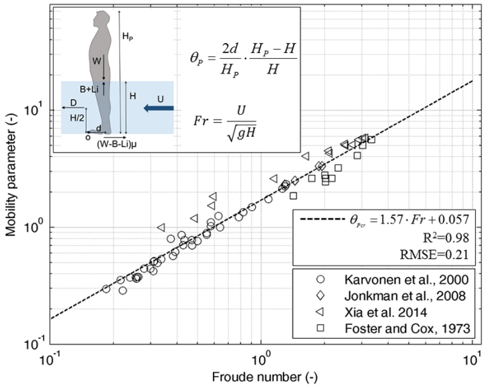
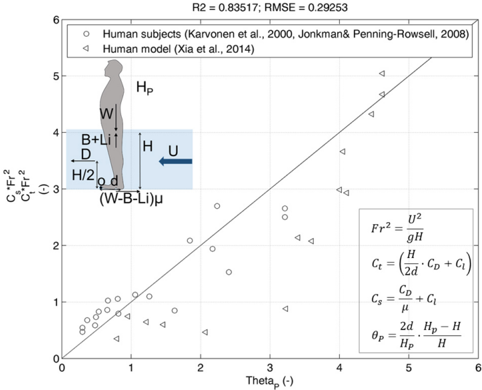
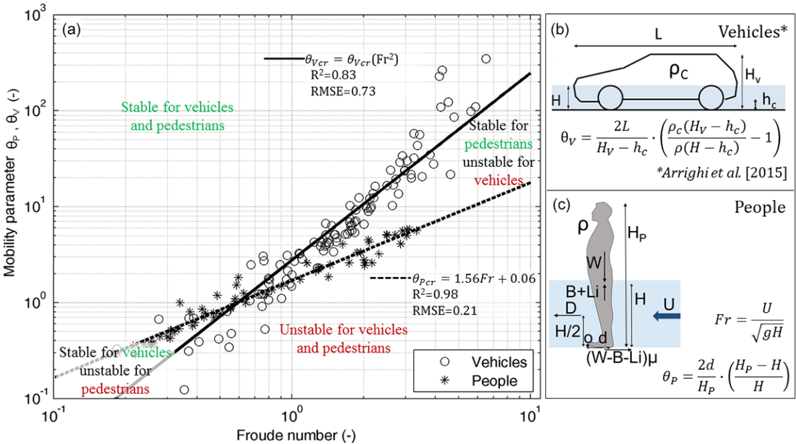
- The mobility parameter θ_P for selected flume experiments defines a unique critical threshold θ_Pcr = 1.57 Fr + 0.057 (R² = 0.98, RMSE = 0.21), reducing scatter of dimensional depth–velocity data; θ_Pcr ranges from 0.3 at low Froude numbers to 6 for super-critical flows.
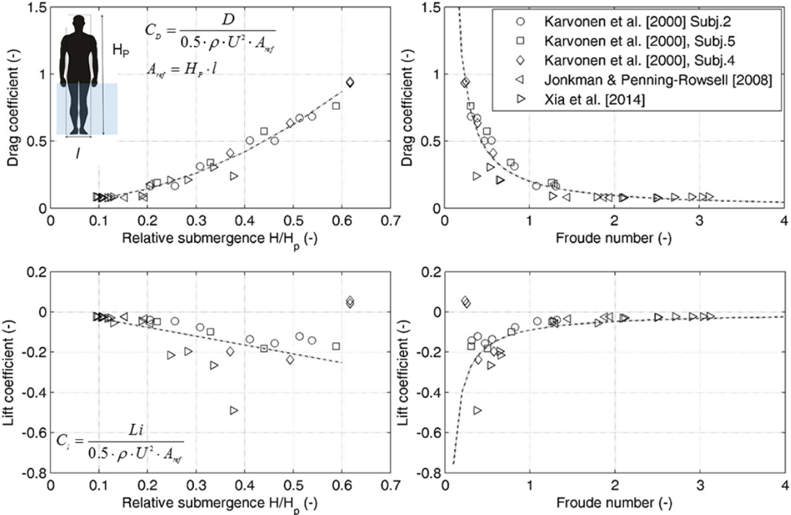
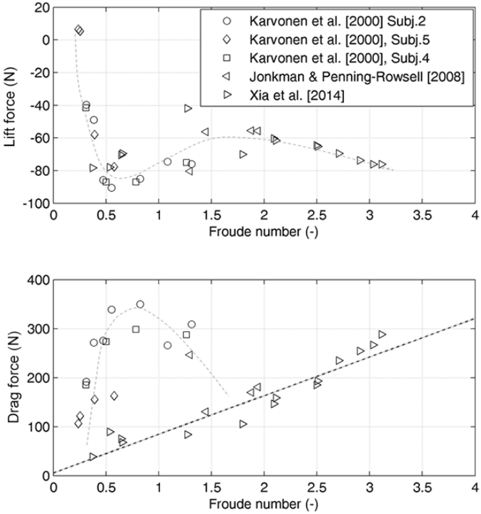
- Numerical simulations (33 steady flows, Fr 0.2–3.5) show drag coefficient decreases exponentially with Froude number from approximately 1 at low Fr to 0.1 at high Fr; lift coefficients range from -0.49 to 0.06; drag force for human subjects ranges from 100 N to 350 N and peaks near Fr ≈ 1.
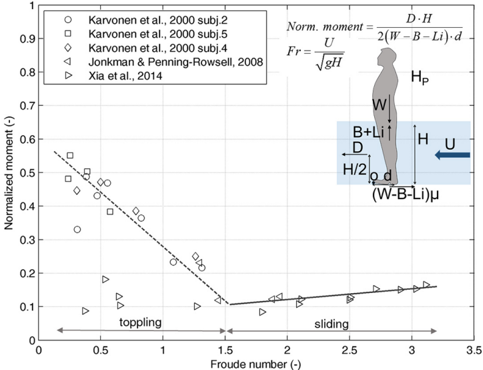
- Normalized moment indicates toppling instability for Fr < 1.5 and sliding for Fr ≥ 1.5, with a possible mix near Fr = 1.5.
- Comparison with the vehicle mobility parameter shows critical curves intersect at Fr ≈ 0.6; for Fr 0.1–0.6 moving by car is safer than on foot, while for Fr > 0.6 moving on foot is safer than by car.
Methods
- Dimensional analysis of sliding and toppling force/moment balances derives θ_P; tested against selected flume datasets (Foster and Cox, 1973; Karvonen et al., 2000; Jonkman and Penning-Rowsell, 2008; Xia et al., 2014), excluding Abt et al. (1989) and Takahashi et al. (1992) for stated reasons.
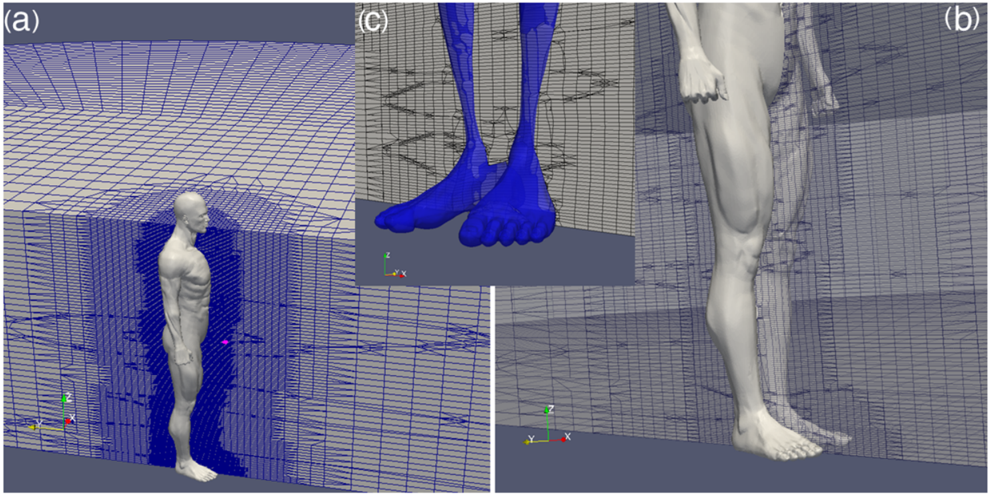
- 3-D CFD simulations using OpenFOAM waveFoam (RANS, VOF, laminar turbulence settings) with a rigid triangulated human geometry; mesh approximately 4.5×10⁵ cells, 0.015 m near body; 33 simulations covering Fr 0.2–3.5, comparing drag/lift forces and coefficients to experiments.
- Local sensitivity analysis of θ_P to foot length d, height H_P, and body density ρ_P; goodness-of-fit sensitivity to d and friction coefficient μ with ±10% and ±30% variations.
Limitations
- Stated: human body modeled as rigid with feet-bottom adherence; no turbulence model due to lack of calibration/validation data; only frontal flow orientation and no walking condition; friction and foot length were not measured in experiments; effects of posture, clothing, relative motion, psychological characteristics, local turbulence, and water density require further study.
- Stated: direct comparison between human subjects and human-scale model was not possible for highly super-critical flows because only recent studies tested human subjects there.
- Evident from text: the numerical model is simplified and the human-scale model behaves passively, so force estimates may not fully represent real human response; selected experimental datasets and assumed constant friction coefficient (μ = 0.3) constrain generality.
Model-written summary. Check it against the paper before relying on it.
Integrity signals
Registry
Cites
Statistics
Figures
Verification
Claims the paper makes
0 Valid · 3 Not valid · 36 Not checked · 91 Own results and interpretations
A result the paper reports from its own data — it cites no other source for it, so there is none to check. The quote shows it is in the paper.
In the paper
“Drag coefficient ranges from 0.1 for high Froude numbers, up to approximately 1 for low Froude numbers.”
§ Hydrodynamics of pedestrians' instability in floodwaters > 4.1 Forces and force coefficients
plainstates an association- Asserted: passes — The authors put it forward as true.
- Checkable: passes — It can be checked against evidence.
- Load-bearing: passes — The paper’s conclusions depend on it.
- Based: passes — The paper gives a reason why it holds.
In the paper
“Particularly, the selection of points calculated from the data by Xia et al. (2014) are above the threshold curve, i.e. they lie in the stable side of the diagram.”
§ Hydrodynamics of pedestrians' instability in floodwaters > 2.3 Dimensionless instability threshold from Foster
What the sources say
- Not checked yetcites Xia et al. (2014) matched to “New criterion for the stability of a human body in floodwaters” (2014) source
plain- Asserted: passes — The authors put it forward as true.
- Checkable: passes — It can be checked against evidence.
- Load-bearing: passes — The paper’s conclusions depend on it.
- Based: passes — The paper gives a reason why it holds.
In the paper
“Some of the data by Foster and Cox (1973) instead are under the curve, and thus in the unstable portion of the diagram.”
§ Hydrodynamics of pedestrians' instability in floodwaters > 2.3 Dimensionless instability threshold from Foster
What the sources say
- Not matchedcites Foster and Cox (1973)
An author–year citation the paper’s reference list doesn’t settle. We don’t search these by name.
plain- Asserted: passes — The authors put it forward as true.
- Checkable: passes — It can be checked against evidence.
- Load-bearing: unclear — It is unclear whether the paper’s conclusions depend on it.
- Based: passes — The paper gives a reason why it holds.
- Not matched
A result the paper reports from its own data — it cites no other source for it, so there is none to check. The quote shows it is in the paper.
In the paper
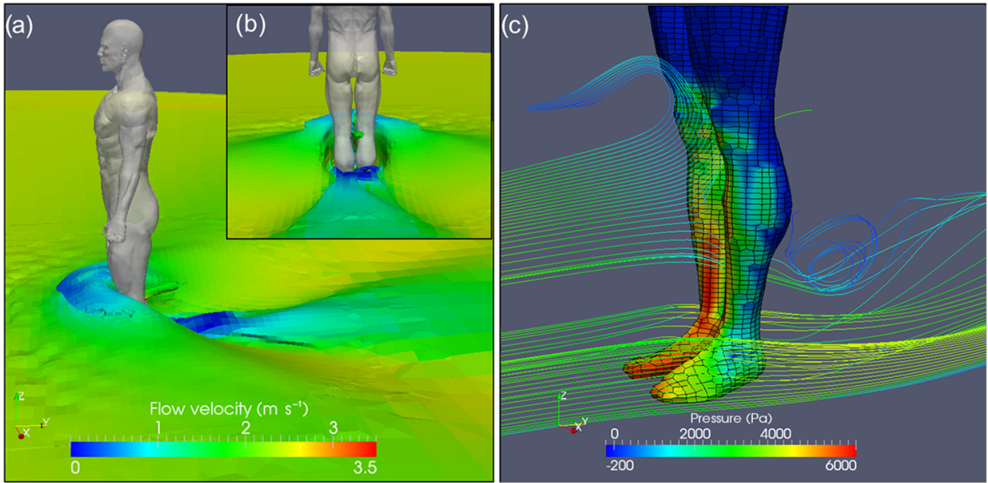
“For super-critical flows, a significant splashing area is detected in correspondence with the impact zone (Fig. 3, panels a, c).”
§ Hydrodynamics of pedestrians' instability in floodwaters > 4.1 Forces and force coefficients
plainstates an associationSingle case- Asserted: passes — The authors put it forward as true.
- Checkable: passes — It can be checked against evidence.
- Load-bearing: unclear — It is unclear whether the paper’s conclusions depend on it.
- Based: passes — The paper gives a reason why it holds.
A result the paper states — it cites no source for it, so there is none to check. The quote shows it is in the paper.
In the paper
“The critical mobility parameter θ P cr ranges from 0.3 for low Froude numbers (i.e.sub-critical conditions) up to 6 for super-critical flows”
§ Hydrodynamics of pedestrians' instability in floodwaters > 2.3 Dimensionless instability threshold from Foster
plainstates an association- Asserted: passes — The authors put it forward as true.
- Checkable: passes — It can be checked against evidence.
- Load-bearing: passes — The paper’s conclusions depend on it.
- Based: passes — The paper gives a reason why it holds.
70 more claims
Create a free account to see all 130 claims and to verify the 35 references still open.
- Probably not a substantial claim. 20
- It may state two separate claims as one. 41
Self-check
Percentages, sums and reported differences re-computed from the paper’s own numbers.
Each contradiction between two passages listed here was confirmed by an independent check.
Rated major: it would touch a result — a value a result rests on, reported and recomputed p-values on opposite sides of the significance level, two passages that conflict with no sign which is right, or a cited work retracted before this paper was published.
In the paper
§ Hydrodynamics of pedestrians' instability in floodwaters > 4.3 Comparison with experimental data
“The determination coefficient is 0.76 and the RMSE is 0.63.”
§ Hydrodynamics of pedestrians' instability in floodwaters > 6 Conclusions
“| RMSE | 0.28 | 0.67 | 0.29 0.67 | 0.31 0.69 | 0.31 0.97 | 0.32 1.26 |”
Rated minor: it would not touch a result — a value no result rests on, a p-value that stays on the same side of the significance level, or a conflict that is clerical, resolved elsewhere in the paper, or outside its own findings.
In the paper
§ Hydrodynamics of pedestrians' instability in floodwaters > 4.3 Comparison with experimental data
“In fact, the determination coefficient R 2 does not decrease under 0.7.”
§ Hydrodynamics of pedestrians' instability in floodwaters > 6 Conclusions
“| R 2 | 0.82 | 0.76 | 0.82 0.73 | 0.81 0.70 | 0.81 0.64 | 0.77 0.62 |”
Rated minor: it would not touch a result — a value no result rests on, a p-value that stays on the same side of the significance level, or a conflict that is clerical, resolved elsewhere in the paper, or outside its own findings.
In the paper
§ Hydrodynamics of pedestrians' instability in floodwaters > 4.1 Forces and force coefficients
“Figure 5 depicts the lift and drag forces versus the Froude number for all the simulated subjects (top and bottom panels respectively).”
§ Hydrodynamics of pedestrians' instability in floodwaters > 6 Conclusions
“Figure5.Estimated lift (top panel) and drag (bottom panel) forces versus the relative submergence”
Rated minor: it would not touch a result — a value no result rests on, a p-value that stays on the same side of the significance level, or a conflict that is clerical, resolved elsewhere in the paper, or outside its own findings.
In the paper
§ Hydrodynamics of pedestrians' instability in floodwaters > 4.1 Forces and force coefficients
“Figure 4 shows the drag coefficient and lift coefficients versus the Froude number on the right-hand side of the figure in the top and bottom panels respectively.”
§ Hydrodynamics of pedestrians' instability in floodwaters > 6 Conclusions
“Figure 4.Estimated drag and lift coefficients versus Froude number (top left and bottom left panels respectively) and versus the relative submergence (top right and bottom right panels respectively)”
Rated minor: it would not touch a result — a value no result rests on, a p-value that stays on the same side of the significance level, or a conflict that is clerical, resolved elsewhere in the paper, or outside its own findings.
In the paper
§ Hydrodynamics of pedestrians' instability in floodwaters > 4.1 Forces and force coefficients
“Except for subject 4, which is represented with a diamond symbol, the lift coefficients are negative.”
§ Hydrodynamics of pedestrians' instability in floodwaters > 4.1 Forces and force coefficients
“subject 5 (Karvonen et al., 2000) experiences a positive vertical force since a portion of the lower body trunk is immersed in water.”
Citations
Cites
Introduction to fluid mechanics
(2013) · Engineering Science · doi:10.4324/9780203114964-25 · Cited by 1,957
A wave generation toolbox for the open‐source CFD library: OpenFoam®
Jacobsen, N. G., Fuhrman, D. R., & Fredsøe, J. (2011) · International Journal for Numerical Methods in Fluids · doi:10.1002/fld.2726 · Cited by 1,360
Socio-hydrology: conceptualising human-flood interactions
Di Baldassarre, G., Viglione, A., Carr, G., Kuil, L., Salinas, J. L., & Blöschl, G. (2013) · Hydrology and Earth System Sciences · doi:10.5194/hess-17-3295-2013 · Cited by 635
An Analysis of the Causes and Circumstances of Flood Disaster Deaths
Jonkman, S. N., & Kelman, I. (2005) · Disasters · doi:10.1111/j.0361-3666.2005.00275.x · Cited by 599
Debates—Perspectives on socio‐hydrology: Capturing feedbacks between physical and social processes
Di Baldassarre, G., Viglione, A., Carr, G., Kuil, L., Yan, K., Brandimarte, L., & Blöschl, G. (2015) · Water Resources Research · doi:10.1002/2014wr016416 · Cited by 486
Vulnerability to flooding: health and social dimensions
Tapsell, S. M., Penning-Rowsell, E. C., Tunstall, S. M., & Wilson, T. L. (2002) · Philosophical Transactions of the Royal Society of London. Series A: Mathematical, Physical and Engineering Sciences · doi:10.1098/rsta.2002.1013 · Cited by 425
Siegrist, M., & Gutscher, H. (2008) · Risk Analysis · doi:10.1111/j.1539-6924.2008.01049.x · Cited by 413
Chakraborty, J., Tobin, G. A., & Montz, B. E. (2005) · Natural Hazards Review · doi:10.1061/(asce)1527-6988(2005)6:1(23 · Cited by 355
Vickery, B. J. (1966) · Journal of Fluid Mechanics · doi:10.1017/s002211206600020x · Cited by 343
Flood Risk Management: Hazards, Vulnerability and Mitigation Measures
(2006) · NATO Science Series · doi:10.1007/978-1-4020-4598-1 · Cited by 311
Research works printed but not linked: 4
- Beckers, J. V. L., De Bruijn, K. M., and Riedstra, D.: Life safety cri- teria for flood protection standards, 5th International Conference on Flood Management, p. 2600, Tokyo, 27-29 September 2012.
- Munich Re: Great natural catastrophes worldwide 1950-2011, Number of events with trend, available at: https://www.munichre. com/en/media-relations/publications/press-releases/2012 (last access: 10 February 2015), 2012.
- Munich Re: Loss events worldwide 1980-2014, 10 costliest events ordered by overall losses, available at: https://www.munichre. com/en/media-relations/publications/press-releases/index.html, last access: 10 February 2015a. Munich Re: Loss events worldwide 2014 (January), avail- able at: https://www.munichre.com/site/wrap/get/documents_ E-581009931/mram/assetpool.munichreamerica.wrap/PDF/ 2014/2014_globalmap.pdf, last access: 10 February 2015b.
- Yee, M.: Human stability in floodways, Undergraduate honours Thesis, University of New South Wales, Australia, 2003.
Cited by
Items 101–147 of 147
Buchinger, M., Scheuer, S., & Habersack, H. M. (2024) · Österreichische Wasser- und Abfallwirtschaft · doi:10.1007/s00506-024-01027-6 · Cited by 2
An efficient numerical approach to model wave overtopping of rubble mound breakwaters
Moretto, M. (2020) · Research Repository (Delft University of Technology) · Cited by 2
Impacts of water depth on pedestrian speed, gait, and stability: results from an experimental study
Li, X., Song, W., Zhang, J., & Bode, N. W. F. (2026) · Acta Polytechnica CTU Proceedings · doi:10.14311/app.2026.57.0226 · Cited by 1
“These studies consider a wide range of human characteristics [19] and postures [15], as well as hydrodynamic conditions [20].”
Tian, Z., Liang, Z., Chen, H., Xiao, X., & Wen, H. (2026) · Ocean Engineering · doi:10.1016/j.oceaneng.2026.124536 · Cited by 1
Yu, S., Li, X., Kitsikoudis, V., Dellinger, G., Chen, L., Lai, C., Guiot, L., Erpicum, S., & Dewals, B. (2026) · Journal of Hydrology · doi:10.1016/j.jhydrol.2026.135445 · Cited by 1
Chen, J., Li, X., Song, W., & Zhang, J. (2026) · Physica A Statistical Mechanics and its Applications · doi:10.1016/j.physa.2026.131636 · Cited by 1
Guo, C., Li, X., Wang, J., Zhang, J., & Song, W. (2026) · Transportation Research Part D Transport and Environment · doi:10.1016/j.trd.2026.105521 · Cited by 1
Influence of model geometric distortion in laboratory scale modelling of urban flooding
Li, X., Erpicum, S., Archambeau, P., Pirotton, M., Dewals, B., Mignot, E., Rivière, N., & Poupardin, A. (2020) · CRC Press eBooks · doi:10.1201/b22619-274 · Cited by 1
Carrizales, J., Rodas, M. C., & Castillo, L. F. (2021) · IOP Conference Series Earth and Environmental Science · doi:10.1088/1755-1315/958/1/012024 · Cited by 1
Report on Seventh International Conference on Flood Management
Imamura, Y., Ikeuchi, H., OKAMOTO, T., Tanaka, K., Koike, T., IKEUCHI, K., Ishiwatari, M., Miyamoto, M., Hitokoto, M., Yamazaki, D., et al. (2018) · JOURNAL OF JAPAN SOCIETY OF HYDROLOGY AND WATER RESOURCES · doi:10.3178/jjshwr.31.25
Kesserwani, G. (2021) · Natural hazards and earth system sciences · doi:10.5194/nhess-2021-79-ac2
(2021) · Natural hazards and earth system sciences · doi:10.5194/nhess-2021-79-rc2
(2021) · Natural hazards and earth system sciences · doi:10.5194/nhess-2021-79-rc3
(2021) · Natural hazards and earth system sciences · doi:10.5194/nhess-2021-79-rc1
Kesserwani, G. (2021) · Natural hazards and earth system sciences · doi:10.5194/nhess-2021-79-ac1
Kesserwani, G. (2021) · Natural hazards and earth system sciences · doi:10.5194/nhess-2021-79-ac3
An Advanced Human-Environment-Flood Framework for Studying and Modelling Human Behaviour in FloodsPreprint
Arshaghi, B. E., Lawson, G., Briganti, R., & Siebers, P. (2024) · SSRN Electronic Journal · doi:10.2139/ssrn.4713266
Estimation of Operator Instability Probability During Flood Event
Prasad, M. H., & Vinod, G. (2024) · Lecture notes in mechanical engineering · doi:10.1007/978-981-97-3087-2_27
Xu, N., Shao, Z. S., Wang, F., & Gong, H. (2024) · Water · doi:10.3390/w16223314
Pereira, D. D. S., Araújo, D. K. D. L., & Vasconcelos, G. L. M. B. (2025) · Anais do Terceiro Sustentare e Sexto Wipis · doi:10.29327/sustentare-wipis-2024.1017817
An integrated flood impact assessment framework for mitigation and decision support systems
Alabbad, Y. (2023) · Iowa Research Online (The University of Iowa) · doi:10.25820/etd.006917
Sánchez Tapiero, D. I., Alexis Bonilla Granados, C., & Derley Ramón Valencia, J. (2025) · Dialnet (Universidad de la Rioja)
Wei, Y., Wang, M., Ni, M., Cui, Y., Sun, T., Wang, C., & Pan, S. (2025) · Natural Hazards · doi:10.1007/s11069-025-07760-9
A comparative assessment of human entrapment and instability risks in flash floods
Cheng, X., Cheng, L., Wu, S., Zhang, J., Li, Y., Lei, X., Wu, K., & Liu, P. (2026) · Journal of Environmental Management · doi:10.1016/j.jenvman.2026.128761
The Impacts and Benefits of Local Mesh Refinements at Buildings in Hydrodynamic ModelingPreprint
Vos, L. F. D., Mahajan, K., Caviedes-Voullième, D., & Rüther, N. (2026) · SSRN Electronic Journal · doi:10.2139/ssrn.6218998
Minh, H. D., Corzo, G., Barreto, W., & Zevenbergen, C. (2026) · Hydrology research · doi:10.2166/nh.2026.046
2D hydrodynamic modelling for urban flood hazard assessment: the case of Niamey, Niger
Tangam, I. S., Yonaba, R., Ibrahim, B., Mounirou, L. A., Fowé, T., Kiema, A., Adamou, M. M., & Karambiri, H. (2026) · Geomatics Natural Hazards and Risk · doi:10.1080/19475705.2026.2675778
Najjar‐Ghabel, S., Piadeh, F., Behzadian, K., & Ardakanian, A. (2026) · Environmental Modelling & Software · doi:10.1016/j.envsoft.2026.107221
Zhang, H., Yi, F., Wang, Y., Yang, C., & Jia, H. (2026) · Natural Hazards · doi:10.1007/s11069-026-08253-z
Sulaiman, H. A., Mohd, C. K. N. C. K., Bade, A., & Zolkifly, I. A. (2026) · SSRN Electronic Journal · doi:10.2139/ssrn.7274806
Sulaiman, H. A., Mohd, C. K. N. C. K., Bade, A., & Zolkifly, I. A. (2026) · The Visual Computer · doi:10.1007/s00371-026-04708-3
Agent-Based Dynamic Assessment of Pedestrian Flood Risk Considering Age and Education
Jiang, X., Deng, Y., & Zhou, Y. (2026) · Sustainability · doi:10.3390/su18178766
Sabar, H., Zerhoudi, I., Baida, M. E., Chourak, M., Chaaraoui, A., Amrani, S., & Oujidi, M. (2026) · Ecological Engineering & Environmental Technology · doi:10.12912/27197050/235670
Fagundes, M. R., Poeppl, R. E., Fan, F. M., Abatti, B. H., Michel, G. P., & Kobiyama, M. (2026) · Journal of Hydrology · doi:10.1016/j.jhydrol.2026.136383
A Response-Time-Based Framework for Flood Safety Assessment in Subway Stations
Eum, T.-S., Shin, E. T., Park, I., Lee, I., Park, J., & Song, C. G. (2026) · Water · doi:10.3390/w18192362
Seck, M., Thiam, M., baldé, M., & Fall, A. N. (2026) · City and Environment Interactions · doi:10.1016/j.cacint.2026.100481
Altomare, C., Chen, X., Raby, A. C., Gironella, X., & Suzuki, T. (2025) · PEARL (University of Plymouth)
Luca, D. L. D., Lucantonio, M., Biondi, D., Cruscomagno, F., Napolitano, F., Ridolfi, E., Getuli, V., Bruttini, A., & Cinquepalmi, F. (2026) · International Journal of Disaster Risk Reduction · doi:10.1016/j.ijdrr.2026.106495
Santana, E. J. C., Vidal, R. P., & Lambán, M. C. (2026) · Zaguan (Universidad de Zaragoza)
Effects of water depth and exit width on bottleneck evacuation dynamics under flood conditions
Li, X., Guo, C., Zhang, J., & Song, W. (2026) · Journal of Hydrology · doi:10.1016/j.jhydrol.2026.136637
Sudibyo, R., Kurniadi, A., & Tawakal, M. I. (2026) · Jurnal Pertahanan dan Bela Negara · doi:10.33172/jpbh.v16i1.20167
Orkun, K. R. S., Napoli, B. D., Marco, L., Hayal, N. G., Ottonelli, D., d’Aragona, M. G., Faravelli, M., Polese, M., & Cattari, S. (2026) · International Journal of Disaster Risk Reduction · doi:10.1016/j.ijdrr.2026.106539
Time-Aware Urban Flood Routing with Sticky Edge Closure on Forecast Depth: A Hanoi Case StudyPreprint
Tran, M. A., Nguyen, V., Nguyen, V., & Hòa, B. M. (2026) · arXiv (Cornell University) · doi:10.48550/arxiv.2611.02479
Liu, Z., Ma, X., An, H., Tang, M., & Dong, G. (2026) · Ocean Engineering · doi:10.1016/j.oceaneng.2026.129345
Kim, J., Jun, H., & Kwon, S. H. (2026) · Journal of Hydrology Regional Studies · doi:10.1016/j.ejrh.2026.104189
Qin, R., Zhou, X., Khakzad, N., Lan, M., Zhu, J., & Yu, T. (2026) · Reliability Engineering & System Safety · doi:10.1016/j.ress.2026.113860
Metadata
- Authors
- Arrighi, C., Oumeraci, H., & Castelli, F.
- Affiliations
- University of Florence (IT)
- Technische Universität Braunschweig (DE)
- Venue
- Hydrology and Earth System Sciences
- Publisher
- Copernicus GmbH
- Published
- 2017-01-26
- Volume
- 21
- Issue
- 1
- Pages
- 515-531
- ISSN
- 1027-5606 (ISSN-L)
- 1607-7938
- OpenAlex
- W2441567408
- Cited by
- 147
- References
- 46
- Citations by year
- 2026: 34 · 2025: 22 · 2024: 16 · 2023: 12 · 2022: 14 · 2021: 20 · 2020: 17 · 2019: 6 · 2018: 5 · 2017: 1
- FWCI
- 3.24
- Type
- journal article
- Language
- en
- Open access
- gold
- doi.org
- Licence
- Locations
- Hydrology and earth system sciences (publishedVersion, cc-by)
- Florence Research (University of Florence) (submittedVersion, other-oa)
- DOAJ (DOAJ: Directory of Open Access Journals) (submittedVersion, cc-by-sa)
- Funders
- Università degli Studi di Firenze
- Topics
- Physical Sciences › Environmental Science › Global and Planetary Change › Flood Risk Assessment and Management
- Physical Sciences › Engineering › Civil and Structural Engineering › Hydraulic flow and structures
- Physical Sciences › Engineering › Civil and Structural Engineering › Earthquake and Tsunami Effects
- Keywords
- floodwater, Froude number, relative submergence, force coefficients, 3D human body model, flood risk mitigation, flood casualties
About these checks
Registry, retraction, Cites and statistics results are computed, not judged, with one exception: a printed reference that no index lists is read once by a model before it counts as a citation error. Claims are extracted by a model and kept only when their quote appears verbatim in the text; each cited source is then checked, with a model’s help, for whether it says what the claim relies on. Those verdicts can be wrong — read the claim’s quote and the cited source before relying on one.
A language model drew the claims from the paper on 2026-11-18, under version 3 of the claim definition (model deepseek-v4.1-flash, prompt extract-v3).
A second model labelled each claim on 2026-11-18 (model jev-1.13-20260917, definition revision gold-guideline-v0.2).
Statistics and arithmetic are recomputed, not judged.
Confidence bands are shown only for fields calibrated on our annotated test set. None is calibrated yet, so no band is shown.
What counts as a claim ›How we measure confidence ›How we check this ›
Are you an author, or do you see a problem with this page? Request a review
Data sources
Bibliographic data: Semantic Scholar, OpenAlex, Crossref.
Contains information from the Semantic Scholar Academic Graph Datasets, made available under the ODC Attribution License (ODC-BY 1.0).
Semantic Scholar’s data is described in: Kinney, R., et al. (2023). The Semantic Scholar Open Data Platform. arXiv:2301.10140.
