

VCF: A Real-World Video Conference Deepfake Benchmark for Face-Swap Detection and Robustness Evaluation
Open accessThe DOI matches its Crossref record; 16 of the 16 references it cites were found in a registry or an index; 2 of the 6 sources its claims cite were checked for support.
Abstract
The rapid advancement of deepfake generation techniques poses significant security and privacy risks, particularly in video conferencing scenarios where variable resolutions, compression artifacts, and environmental factors complicate detection. Existing benchmarks often fail to address these context-specific challenges, limiting their applicability to real-world communication platforms. To bridge this gap, we introduce VCF (Video Conference DeepFakes) dataset, the first, to the best of our knowledge, specialized benchmark designed for evaluating deepfake detection in video conferencing contexts. VCF leverages the VCD dataset as target videos and the LaPa dataset as a set of source faces, algorithmically ranking sources by similarity in gender, ethnicity, age, and facial hair to select optimal matches for enhanced deepfake visual plausibility. The dataset incorporates multi-resolution videos, H.264 compression artifacts from different compression rates, and diverse backgrounds to simulate conditions specific to video conferences. Comprehensive evaluations of 14 detection methods reveal significant performance degradation under video quality variations. Our results emphasize the critical need for robust detection frameworks resilient to resolution shifts, compression artifacts, and diverse generation pipelines. VCF provides a standardized, scenario-specific benchmark to drive advancements in securing digital communication platforms against evolving deepfake threats.
Overview
CoChat Summary
## TL;DR
VCF is a new benchmark for deepfake detection in video conferencing settings, built to test robustness to resolution changes, H.264 compression, and background variations. On this benchmark, 14 detectors trained on FF++ generally drop in performance, with the best reported full-VCF AUC at 0.667 for X-CLIP.
## Key findings
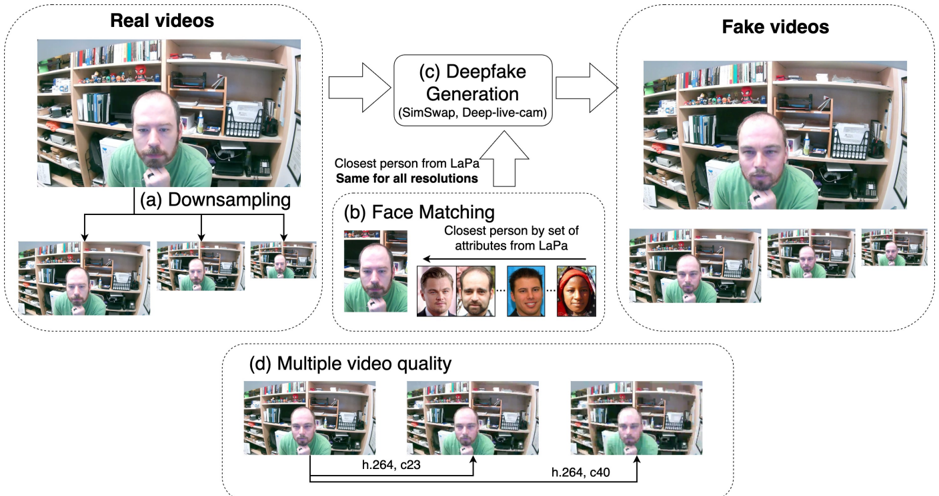
- The final VCF repository contains 1,920 authentic clips and 7,680 deepfake variants; the authors describe this as 9,600 total videos with 160 subjects, 4 resolutions (1080p, 540p, 360p, 270p), and 3 compression levels (raw, c23/23, c40/40).
- Evaluating 14 detectors cross-domain (trained on FF++ (c23)) shows that performance on VCF is lower than on Celeb-DF; the paper states that scores “drop relative to Celeb-DF” on the new benchmark.
- X-CLIP is the top reported method on the full VCF dataset with AUC 0.667; on Celeb-DF it gets 0.862.
- Quality degradation hurts detection: the paper reports X-CLIP drops from 0.804 on 1080p, raw to 0.560 on 270p, c40, and notes that for almost all experiments the video ROC-AUC does not exceed 0.7.
## Methods
- The paper introduces VCF, a synthetic benchmark built from VCD as target videos and LaPa as source faces, using face matching by gender, ethnicity, age, and facial hair to select source-target pairs.
- Deepfakes were generated with SimSwap and Deep-Live-Cam, with multiple settings: SimSwap at 224×224 and 512×512, and Deep-Live-Cam in standard and enhanced modes.
- Videos were downsampled from 1080p to 540p, 360p, and 270p, then compressed with H.264 at QP 23 and 40; evaluation used video-level AUC and the code/training pipeline from DeepfakeBench.
## Limitations
- The paper explicitly says that most methods struggle as generation quality increases or when additional synthetic “enhance” operations are applied, and that the benchmark exposes poor generalization across pipelines.
- It also states that for almost all experiments the ROC-AUC does not exceed 0.7, which the authors call unacceptable for real-world scenarios.
- Evident from the text: the benchmark is built from open-source datasets and selected generation methods only, so its coverage of real-world manipulation diversity is limited to the specific sources and pipelines described.
Model-written summary. Check it against the paper before relying on it.
Integrity signals
Registry
Cites
Statistics
Figures
Verification
Claims the paper makes
2 Valid · 1 Not valid · 2 Not checked · 25 Own results and interpretations
A result the paper states — it cites no source for it, so there is none to check. The quote shows it is in the paper.
In the paper
“algorithmically ranking sources by similarity in gender, ethnicity, age, and facial hair to select optimal matches for enhanced deepfake visual plausibility.”
plainstates a cause- Asserted: passes — The authors put it forward as true.
- Checkable: passes — It can be checked against evidence.
- Load-bearing: passes — The paper’s conclusions depend on it.
- Based: passes — The paper gives a reason why it holds.
A result the paper reports from its own data — it cites no other source for it, so there is none to check. The quote shows it is in the paper.
In the paper
“Comprehensive evaluations of 14 detection methods reveal significant performance degradation under video quality variations.”
plainstates a cause- Asserted: passes — The authors put it forward as true.
- Checkable: passes — It can be checked against evidence.
- Load-bearing: passes — The paper’s conclusions depend on it.
- Based: passes — The paper gives a reason why it holds.
A result the paper reports from its own data — it cites no other source for it, so there is none to check. The quote shows it is in the paper.
In the paper
“Method robustness varies by generation type.”
plainstates an association- Asserted: passes — The authors put it forward as true.
- Checkable: passes — It can be checked against evidence.
- Load-bearing: passes — The paper’s conclusions depend on it.
- Based: passes — The paper gives a reason why it holds.
A result the paper reports from its own data — it cites no other source for it, so there is none to check. The quote shows it is in the paper.
In the paper
“For almost all experiments, the video ROC-AUC metric does not exceed 0.7, which is an unacceptable quality of work for real-world scenarios.”
plain- Asserted: passes — The authors put it forward as true.
- Checkable: passes — It can be checked against evidence.
- Load-bearing: passes — The paper’s conclusions depend on it.
- Based: passes — The paper gives a reason why it holds.
A result the paper reports from its own data — it cites no other source for it, so there is none to check. The quote shows it is in the paper.
In the paper
“X-CLIP quality metrics drops from 0.804 to 0.560 when when video quality decreases ('1080p, raw' compared to '270p, c40').”
- Also stated in: § 5. Comparison to existing deepfake datasets · plain
“X-CLIP's AUC drops from 0.804 on '1080p, raw' videos to 0.5602 on '270p, c40' which can be seen in table 1”
plainstates a cause- Asserted: passes — The authors put it forward as true.
- Checkable: passes — It can be checked against evidence.
- Load-bearing: passes — The paper’s conclusions depend on it.
- Based: passes — The paper gives a reason why it holds.
- Also stated in: § 5. Comparison to existing deepfake datasets · plain
9 more claims
Create a free account to see all 30 claims and every source verdict.
- Probably not a substantial claim. 6
- It may state two separate claims as one. 12
- The quote only partly states this claim. 1
Citations
Cites
EfficientNet: Rethinking Model Scaling for Convolutional Neural Networks
Tan, M., & Le, Q. V. (2019) · arXiv · doi:10.48550/arxiv.1905.11946 · Cited by 17,072
FaceForensics++: Learning to Detect Manipulated Facial Images
Rossler, A., Cozzolino, D., Verdoliva, L., Riess, C., Thies, J., & Niessner, M. (2019) · 2019 IEEE/CVF International Conference on Computer Vision (ICCV) · doi:10.1109/iccv.2019.00009 · Cited by 3,314 · cited 2×
“All detectors are trained on FF++ (c23) (Rossler et al., 2019) and tested in cross-domain manner on Celeb-DF (Li et al., 2020b) and different parts of ours VCF dataset.”
Celeb-DF: A Large-Scale Challenging Dataset for DeepFake Forensics
Li, Y., Yang, X., Sun, P., Qi, H., & Lyu, S. (2020) · 2020 IEEE/CVF Conference on Computer Vision and Pattern Recognition (CVPR) · doi:10.1109/cvpr42600.2020.00327 · Cited by 1,846 · cited 6×
“Among the tested approaches, X-CLIP achieves the highest score (0.862) on Celeb-DF, followed by methods such as SRM (0.840), UCF (0.838), and Capsule (0.834).”
InfluentialThinking in Frequency: Face Forgery Detection by Mining Frequency-Aware Clues
Qian, Y., Yin, G., Sheng, L., Chen, Z., & Shao, J. (2020) · Lecture Notes in Computer Science · doi:10.1007/978-3-030-58610-2_6 · Cited by 1,058 · cited 1×
“F3Net (Qian et al., 2020) employs frequency-aware decomposition and local frequency statistics to deeply mine the forgery patterns, while FFD (Dang et al., 2020) using the attention mechanism to improve the classification and localization of altered areas.”
On the Detection of Digital Face Manipulation
Dang, H., Liu, F., Stehouwer, J., Liu, X., & Jain, A. K. (2020) · 2020 IEEE/CVF Conference on Computer Vision and Pattern Recognition (CVPR) · doi:10.1109/cvpr42600.2020.00582 · Cited by 764
Generalizing Face Forgery Detection with High-frequency Features
Luo, Y., Zhang, Y., Yan, J., & Liu, W. (2021) · 2021 IEEE/CVF Conference on Computer Vision and Pattern Recognition (CVPR) · doi:10.1109/cvpr46437.2021.01605 · Cited by 609 · cited 2×
“SRM (Luo et al., 2021), originally designed for stegana-lysis, has been repurposed to detect noise patterns indicative of deepfakes.”
InfluentialSpatial-Phase Shallow Learning: Rethinking Face Forgery Detection in Frequency Domain
Liu, H., Li, X., Zhou, W., Chen, Y., He, Y., Xue, H., Zhang, W., & Yu, N. (2021) · 2021 IEEE/CVF Conference on Computer Vision and Pattern Recognition (CVPR) · doi:10.1109/cvpr46437.2021.00083 · Cited by 600 · cited 1×
“The SPSL framework (Liu et al., 2021) combines spatial and phase spectrum features via shallow learning to suppress high-level features and focus on the local region.”
DeepFakes: a New Threat to Face Recognition? Assessment and Detection
Korshunov, P., & Marcel, S. (2018) · arXiv · doi:10.48550/arxiv.1812.08685 · Cited by 497
SimSwap: An Efficient Framework For High Fidelity Face Swapping
Chen, R., Chen, X., Ni, B., & Ge, Y. (2020) · Proceedings of the 28th ACM International Conference on Multimedia · doi:10.1145/3394171.3413630 · Cited by 418 · cited 2×
“SimSwap (Chen et al., 2020b) is a framework designed to transfer the identity of an arbitrary source face into an arbitrary target face while preserving the attributes of the target face.”
X-CLIP: End-to-End Multi-grained Contrastive Learning for Video-Text Retrieval
Ma, Y., Xu, G., Sun, X., Yan, M., Zhang, J., & Ji, R. (2022) · Proceedings of the 30th ACM International Conference on Multimedia · doi:10.1145/3503161.3547910 · Cited by 321
Cited by
Prospective frozen-policy confirmation of deepfake review-queue authorization on the VCF benchmark
Li, B., Wang, C., 王光碧, et al. (2026) · Zenodo (CERN European Organization for Nuclear Research) · doi:10.5281/zenodo.21858258
Metadata
- Authors
- Krasilnikov, M., Nikitin, M., & Konushin, A.
- Affiliations
- Lomonosov Moscow State University (RU)
- Venue
- The International Archives of the Photogrammetry, Remote Sensing and Spatial Information Sciences
- Publisher
- Copernicus GmbH
- Published
- 2025-09-04
- Volume
- XLVIII-2/W9-2025
- Pages
- 169-174
- ISSN
- 1682-1750 (ISSN-L)
- 2194-9034
- OpenAlex
- W4413977067
- Semantic Scholar
- 2ec661c7b4ff6ef8f68c3708f18aa38e98641283
- Cited by
- 2
- References
- 13
- Citations by year
- 2026: 2
- FWCI
- 0.69
- Type
- journal article
- Language
- en
- Open access
- diamond
- doi.org
- Licence
- Locations
- The international archives of the photogrammetry, remote sensing and spatial information sciences/International archives of the photogrammetry, remote sensing and spatial information sciences (publishedVersion, cc-by)
- DOAJ (DOAJ: Directory of Open Access Journals) (submittedVersion, cc-by-sa)
- Topics
- Physical Sciences › Computer Science › Computer Vision and Pattern Recognition › Digital Media Forensic Detection
- Physical Sciences › Computer Science › Computer Vision and Pattern Recognition › Face recognition and analysis
- Physical Sciences › Computer Science › Computer Vision and Pattern Recognition › Generative Adversarial Networks and Image Synthesis
- Keywords
- deepfake detection, videoconferencing, face swapping, compression artifacts, multi-resolution video, detection robustness, video quality degradation, digital communication security
About these checks
Registry, retraction, Cites and statistics results are computed, not judged, with one exception: a printed reference that no index lists is read once by a model before it counts as a citation error. Claims are extracted by a model and kept only when their quote appears verbatim in the text; each cited source is then checked, with a model’s help, for whether it says what the claim relies on. Those verdicts can be wrong — read the claim’s quote and the cited source before relying on one.
A language model drew the claims from the paper on 2026-09-30, under version 3 of the claim definition (model deepseek-v4.1-flash, prompt extract-v3).
A second model labelled each claim on 2026-09-30 (model jev-1.13-20260917, definition revision gold-guideline-v0.2).
Statistics and arithmetic are recomputed, not judged.
Confidence bands are shown only for fields calibrated on our annotated test set. None is calibrated yet, so no band is shown.
What counts as a claim ›How we measure confidence ›How we check this ›
Are you an author, or do you see a problem with this page? Request a review
How to cite
Cite CoChat for the checks on this page, and the paper for its own findings.
- This page
- CoChat. (2026). Citation check: VCF: A Real-World Video Conference Deepfake Benchmark for Face-Swap Detection and Robustness Evaluation. https://app.cochat.ai/papers/10.5194/isprs-archives-xlviii-2-w9-2025-169-2025
- The paper
- Krasilnikov, M., Nikitin, M., & Konushin, A. (2025). VCF: A Real-World Video Conference Deepfake Benchmark for Face-Swap Detection and Robustness Evaluation. The International Archives of the Photogrammetry, Remote Sensing and Spatial Information Sciences. https://doi.org/10.5194/isprs-archives-xlviii-2-w9-2025-169-2025
Data sources
Bibliographic data: Semantic Scholar, OpenAlex, Crossref.
Contains information from the Semantic Scholar Academic Graph Datasets, made available under the ODC Attribution License (ODC-BY 1.0).
Semantic Scholar’s data is described in: Kinney, R., et al. (2023). The Semantic Scholar Open Data Platform. arXiv:2301.10140.
