

The DOI matches its Crossref record; 2 of the 2 references it cites were found in a registry or an index.
Replanting the Flower in Different Soil? A Critical Analysis of Education Borrowing in Hong Kong
Open accessAbstract
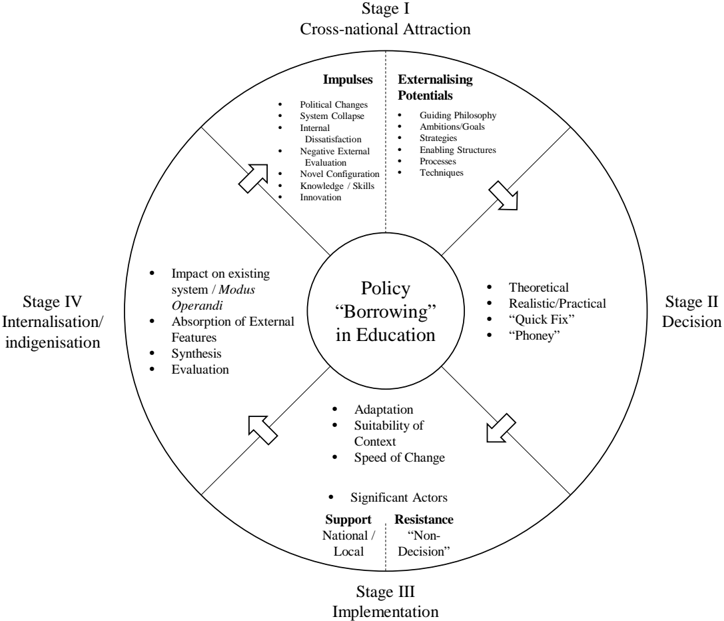
This paper critically analyses the impact the New Senior Secondary (NSS) has had on Hong Kong through Phillips and Ochs’ four-stage model of policy borrowing in education. It argues that the Hong Kong government overlooked the fundamental contextual differences between the two curricula, and that this incompatibility has led to various challenges in integrating the NSS into the existing education system. This paper also contributes to the methodological literature on comparative education and theorisation of education borrowing by illustrating the importance of context. The monopolistic and generalisation assumptions in the positivist paradigm have misled many governments to reify statistics and uncritically transfer incompatible policies to their home countries; the case of the NSS in Hong Kong is an example of this. Although the interpretivist paradigm helps comparativists better understand local context, it is also important to be aware of the limitations of the analytical model used here. Phillips and Ochs’ model was developed based on observations of education borrowing between England and Germany, and it might not truly represent the situation in non-English speaking Asian countries. Also, the model was not specifically built for a capitalist economy, and, therefore, comparativists also need to be aware of the economic structure of the country they are studying, as this can greatly affect the aim of public education. Further study should incorporate literatures and models from Asian countries in order to make the analysis more relevant.
Overview
The claims and statistics of this paper haven’t been checked yet.
Run the check — free, no account needed. It reads the open-access text and checks the sources it cites.
Integrity signals
Registry
Cites
Statistics
Figures
Verification
Claims the paper makes
The claims and statistics of this paper haven’t been checked yet.
Run the check — free, no account needed. It reads the open-access text and checks the sources it cites.
Claims other papers make about this one
Each is checked against this paper’s own text: does it say what the citing paper says it does?
In the citing paper
“Empirical research on China's reform initiative (Chow, 2014;Hu, 2002;Liu, 2010;Tan, 2013Tan, , 2015a) ) show that transnational educational borrowing in China is problematic due to cultural and epistemological incommensurability.”
From ‘Complex teaching realities’ and ‘deep rooted cultural traditions’: Barriers to the implementation and internalisation of formative assessment in China (2016) · cites this paper as Chow, 2014
Self-check
Percentages, sums and reported differences re-computed from the paper’s own numbers.
The self-check needs the paper’s full text.
Citations
Cites
Learning from Abroad: The Role of Policy Transfer in Contemporary Policy‐Making
Dolowitz, D. P., & Marsh, D. (2000) · Governance · doi:10.1111/0952-1895.00121 · Cited by 3,314
Rose, R. (1991) · Journal of Public Policy · doi:10.1017/s0143814x00004918 · Cited by 1,356
Research works printed but not linked: 39
- Ball, S. (1998). Big policies/small world: An introduction to international perspectives in education policy. Comparative Education, 34(2), 119-130. http://dx.doi.org/10.1080/03050069828225 · DOI
- Bereday, G. (1964). Sir Michael Sadler's" Study of Foreign Systems of Education". Comparative education review, 7(3), 307-314. http://dx.doi.org/10.1086/445012 · DOI
- Black, N. (2001). Evidence based policy: proceed with care. BMJ: British Medical Journal, 323(7307), 275. http://dx.doi.org/10.1136/bmj.323.7307.275 · DOI
- Bray, M., & Yamato, Y. (2003). Comparative education in a microcosm: Methodological insights from the international schools sector in Hong Kong. In Comparative Education 49(1-2), (pp. 51-73): Springer. http://dx.doi.org/10.1007/978-94-007-1094-8 · DOI
- Cambridge, J., & Thompson, J. (2004). Internationalism and globalization as contexts for cation. Compare, 34(2), 161-175. international edu http://dx.doi.org/10.1080/0305792042000213994 · DOI
- Cheng, Y. (2009). Hong Kong educational reforms in the last decade: Reform syndrome and new developments. International Journal of Educational Management, 23(1), 65-86. http://dx.doi.org/10.1108/09513540910926439 · DOI
- Choi, C. C. (1999). Public examinations in Hong Kong. Assessment in Education: Principles, Policy & Practice, 6(3), 405-417.
- Chrysostomou, S. (2004). Interdisciplinary approaches in the new curriculum in Greece: A focus on music education. Arts Education Policy Review, 105(5), 23-30. http://dx.doi.org/10.3200/AEPR.105.5.23-30 · DOI
- Costello, T. W. (1970). Psychological aspects: the soft side of policy formation. Policy Sciences, 1(1), 161-168. http://dx.doi.org/10.1007/BF00145202 · DOI
- Crossley, M. (2001). Cross-cultural issues, small states and research: capacity building in Belize. International Journal of Educational Development, 21(3), 217-229. http://dx.doi.org/10.1016/S0738-0593(00)00030-4 · DOI
- Crossley, M. (2008). International transfer and comparative education. Comparative Education, 44(1), 1-2. http://dx.doi.org/10.1080/03050060701809359 · DOI
- Crossley, M., & Broadfoot, P. (1992). Comparative and international research in education: scope, problems and potential. British Educational Research Journal, 18(2), 99-112. http://dx.doi.org/10.1080/0141192920180201 · DOI
- Crossley, M., & Jarvis, P. (2001). Context matters. Comparative Education, 37(4), 405-408. http://dx.doi.org/10.1080/03050060120091210 · DOI
- Dolowitz, D. (1998). Learning from America: Policy transfer and the development of the British workfare state. Oregon: Sussex Academic Press.
- Dolowitz, D., & Marsh, D. (1996). Who learns what from whom: a review of the policy transfer literature. Political studies, 44(2), 343-357. http://dx.doi.org/10.1111/j.1467-9248.1996.tb00334.x · DOI
- Dolowitz, D., & Medearis, D. (2009). Considerations of the obstacles and opportunities to formalizing cross-national policy transfer to the United States: a case study of the transfer of urban environmental and planning policies from Germany. Environment and planning. C, Government & policy, 27(4), 684. http://dx.doi.org/10.1068/c0865j · DOI
- Evans, M., & Davies, J. (1999). Understanding policy transfer: A Multi-level, multi- disciplinary perspective. Public administration, 77(2), 361-385. http://dx.doi.org/10.1111/1467-9299.00158 · DOI
- Forlin, C. (2007). Inclusive educational practices: A way forward for Hong Kong. Chinese Education & Society, 40(4), 63-75. http://dx.doi.org/10.2753/CED1061-1932400405 · DOI
- Hung, S. (2013). Civic Education Policy of the Hong Kong's Special Administration Region: a Historical and Comparative Analysis with Theories of the State. Asian Education and Development Studies, 2(2), 6-6. http://dx.doi.org/10.1108/20463161311321448 · DOI
- James, O., & Lodge, M. (2003). The limitations of 'policy transfer'and 'lesson drawing'for public policy research. Political studies review, 1(2), 179-193. http://dx.doi.org/10.1111/1478-9299.t01-1-00003 · DOI
- Lee, R., Strohmeier, B., Bunker, K., & Van Orden, D. (2008). Naturally occurring asbestos-A recurring public policy challenge. Journal of Hazardous Materials, 153(1), 1-21. http://dx.doi.org/10.1016/j.jhazmat.2007.11.079 · DOI
- Levin, B. (1998). An epidemic of education policy:(what) can we learn from each other? Comparative Education, 34(2), 131-141. http://dx.doi.org/10.1080/03050069828234 · DOI
- Lin, A., & Martin, P. (Eds.). (2005). From a Critical Deconstruction Paradigm to a Critical Construction Paradigm: An introduction to Decolonisation, Globalisation and Language-in-Education Policy and Practice. Canada: Multilingual Matters Ltd.
- Nedergaard, P. (2006). Which countries learn from which? A comparative analysis of the direction of mutual learning processes within the open method of coordination committees of the European Union and among the Nordic countries. Cooperation and Conflict, 41(4), 422-442. http://dx.doi.org/10.1177/0010836706069870 · DOI
- Ochs, K., & Phillips, D. (2002). Comparative studies and'cross-national attraction'in education: a typology for the analysis of English interest in educational policy and provision in Germany. Educational studies, 28(4), 325-339. http://dx.doi.org/10.1080/0305569022000042372 · DOI
- Olaniyan, D., & Okemakinde, T. (2008). Human capital theory: Implications for educational development. Pakistan Journal of Social Sciences, 5(5), 479-483.
- Phillips, D., & Ochs, K. (2003). Processes of policy borrowing in education: Some explanatory and analytical devices. Comparative Education, 39(4), 451-461. http://dx.doi.org/10.1080/0305006032000162020 · DOI
- Phillips, D., & Ochs, K. (2004). Researching policy borrowing: some methodological challenges in comparative education. British Educational Research Journal, 30(6), 773-784. http://dx.doi.org/10.1080/0141192042000279495 · DOI
- Powell, W., & Di Maggio, P. (Eds.). (1991). Introduction. Chicago: University of Chicago Press Chicago.
- Psacharopoulos, G. (1987). To vocationalize or not to vocationalize? That is the curriculum question. International Review of Education, 33(2), 187-211. http://dx.doi.org/10.1007/BF00598482 · DOI
- Rose, R. (1993). Lesson-drawing in public policy: A guide to learning across time and space: Cambridge Univ Press.
- Sabatier, P., & Mazmanian, D. (1980). The Implementation of Public Policy: A Framework of Analysis. Policy Studies Journal, 8(4), 538-560. http://dx.doi.org/10.1111/j.1541-0072.1980.tb01266.x · DOI
- Slee, R., & Weiner, G. (2001). Education reform and reconstruction as a challenge to research genres: Reconsidering school effectiveness research and inclusive schooling. School Effectiveness and School Improvement, 12(1), 83-98. http://dx.doi.org/10.1076/sesi.12.1.83.3463 · DOI
- Steiner-Khamsi, G. (2006). The economics of policy borrowing and lending: A study of late adopters. Oxford Review of Education, 32(5), 665-678. http://dx.doi.org/10.1080/03054980600976353 · DOI
- Stenhouse, L. (1979). Case Study in Comparative Education: Particularity and Generalisation. Comparative Education, 15(1), 5-10. http://dx.doi.org/10.1080/0305006790150102 · DOI
- Tikly, L. (2001). Globalisation and education in the postcolonial world: Towards a conceptual framework. Comparative Education, 37(2), 151-171. http://dx.doi.org/10.1080/03050060124481 · DOI
- Wallner, J. (2008). Legitimacy and public policy: Seeing beyond effectiveness, efficiency, and performance. Policy Studies Journal, 36(3), 421-443.
- Wolman, H. (Ed.). (1993). Cross-National Comparisons of urban Economic Programs: Is Policy Transfer Possible? New York: St. Martin's Press.
- Yang, R. (2007). Comparing education policies. In M. Bray, B. Adamson & M. Mason (Eds.), Comparative Education Research: Approaches and Methodology (pp. 241-262). Hong Kong: The Comparative Education Research Centre, University of Hong Kong and Springer.
Cited by
Sorted by citations
Poole, A. (2016) · Cogent Education · doi:10.1080/2331186x.2016.1156242 · Cited by 46
“Empirical research on China’s reform initiative (Chow, 2014; Hu, 2002; Liu, 2010; Tan, 2013, 2015a) show that transnational educational borrowing in China is problematic due to cultural and epistemological incommensurability.”
Background
Metadata
- Authors
- Chow, A.
- Affiliations
- University of Bristol (GB)
- Corresponding author
- Chow, Anthony
- Venue
- International Journal of Education
- Publisher
- Macrothink Institute, Inc.
- Published
- 2014-06-16
- Volume
- 6
- Issue
- 2
- Pages
- 114
- ISSN
- 1948-5476 (ISSN-L)
- OpenAlex
- W2101246919
- Cited by
- 14
- References
- 2
- Citations by year
- 2026: 1 · 2023: 2 · 2022: 1 · 2020: 1 · 2019: 2 · 2018: 1 · 2017: 1 · 2016: 5
- FWCI
- 13.02
- Type
- journal article
- Language
- en
- Open access
- hybrid
- doi.org
- Licence
- cc-by
- Locations
- International Journal of Education (publishedVersion, cc-by)
- Hong Kong Education Bibliographic Database (submittedVersion)
- Topics
- Social Sciences › Political Science and International Relations › Global Educational Policies and Reforms
- Social Sciences › Political Science and International Relations › Policy Transfer and Learning
- Social Sciences › Sociology and Political Science › Educational Theory and Curriculum Studies
- Keywords
- policy borrowing, Hong Kong education policy, curriculum integration, interpretivism
About these checks
Registry, retraction, Cites and statistics results are computed, not judged, with one exception: a printed reference that no index lists is read once by a model before it counts as a citation error. Claims are extracted by a model and kept only when their quote appears verbatim in the text; each cited source is then checked, with a model’s help, for whether it says what the claim relies on. Those verdicts can be wrong — read the claim’s quote and the cited source before relying on one.
Statistics and arithmetic are recomputed, not judged.
Confidence bands are shown only for fields calibrated on our annotated test set. None is calibrated yet, so no band is shown.
What counts as a claim ›How we measure confidence ›How we check this ›
Are you an author, or do you see a problem with this page? Request a review
