

The Effects of Drinking Coffee While Recovering from Colon and Rectal Resection Surgery
Open accessThe DOI matches its Crossref record; 13 of the 13 references it cites were found in a registry or an index.
Abstract
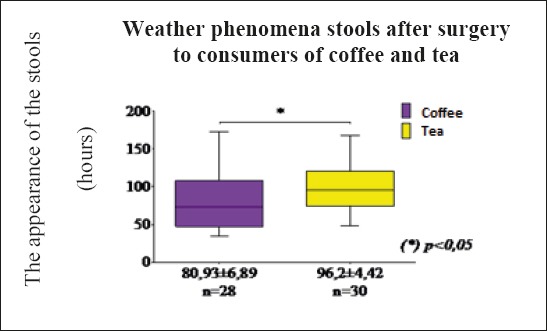
AIM: Resection surgery on the colon and rectum are changing both anatomical and physiological relations within the abdominal cavity. Delayed functions of the gastrointestinal tract, flatulence, failure of peristalsis, prolonged spasms and pain, limited postoperative recovery of these patients increase the overall cost of treatment. Early consumption of coffee instead of tea should lead to faster restoration of normal function of the colon without unwanted negative repercussions. METHOD: This study is designed as a prospective-retrospective clinical study and was carried out at the Surgery Center Tuzla, during the year 2013/ 2014. Sixty patients were randomized in relation to the type of resection surgery, etiology of disease-malignant benign, and in relation to whether they were coffee users or not. Patients were divided into two groups. The first group of thirty patients was given 100 ml of instant coffee divided into three portions right after removing the nasogastric tube, first postoperative day, while the second group of thirty patients got 100 ml of tea. Monitored parameter was: time of first stool and the second group of monitored parameters was: whether there was returning of nasogastric tube or not, increased use of laxatives, whether there was anastomotic leak, radiologic and clinical dehiscence, audit procedures, or lethal outcomes in the treatment of patients. RESULTS: A total of 61 patients were randomized into two groups of 30 int he group of tea and coffee 29 in the group, two patients were excluded from the study because they did not consume coffee before surgery. Time of getting stool in the postoperative period after elective resection surgery on the colon and rectum is significantly shorter after drinking coffee for about 15h (p <0.01). Also, the length of hospital stay was significantly shorter after drinking coffee (p <0.01). Time of hospitalization in subjects/respondents coffee consumers on average lasted 8.6 days with consumers of tea for 16 days. The incidence of postoperative complications was significantly lower after consumption of coffee (p <0.05). CONCLUSION: Postoperative consumption of coffee is a safe and effective way to accelerate the establishment of the bowel function after colorectal resection surgery.
Overview
The claims and statistics of this paper haven’t been checked yet.
Free: it reads the open-access text and checks the first 5 claims that cite a source we can check. Create a free account to check every claim.
Integrity signals
Registry
Cites
Statistics
Figures
Verification
Claims the paper makes
The claims and statistics of this paper haven’t been checked yet.
Free: it reads the open-access text and checks the first 5 claims that cite a source we can check. Create a free account to check every claim.
Claims other papers make about this one
Each is checked against this paper’s own text: does it say what the citing paper says it does?
The source backs part of the claim, not all of it — or backs it for a different population, condition or comparison.
In the citing paper
“In these regards, C-reactive protein (CRP) levels, used as a marker of postoperative complications, were found to be significantly lower in patients given coffee after removal of the nasogastric tube on the first postoperative day compared with the group of patients that were not given coffee.”
From Effects of Coffee and Its Components on the Gastrointestinal Tract and the Brain–Gut Axis (2020) · cites this paper as [155]
Experimental — accuracy not yet measuredThe source backs part of the claim, not all of it — or backs it for a different population, condition or comparison.
In the citing paper
“Decaffeinated coffee was proved to reduce time to initiation of bowel movement [155], suggesting that caffeine is not necessary for coffee effect, and it was suggested that maybe CGAs and melanoidins could have a role [15].”
From Effects of Coffee and Its Components on the Gastrointestinal Tract and the Brain–Gut Axis (2020) · cites this paper as [155]
Experimental — accuracy not yet measuredThe cited source says what the claim attributes to it.
In the citing paper
“Similar data were found in several single studies [118,119,120,121,122,123].”
From Effects of Coffee on the Gastro-Intestinal Tract: A Narrative Review and Literature Update (2022) · cites this paper as [122]
In the citing paper
“One study reported an effect similar for decaffeinated or regular coffee [122], indicating that the effect is rather linked other compounds such as chlorogenic acids and melanoidins [2].”
From Effects of Coffee on the Gastro-Intestinal Tract: A Narrative Review and Literature Update (2022) · cites this paper as [122]
Self-check
Percentages, sums and reported differences re-computed from the paper’s own numbers.
The self-check needs the paper’s full text.
Citations
Cites
Management of patients in fast track surgery
Wilmore, D. W., & Kehlet, H. (2001) · BMJ · doi:10.1136/bmj.322.7284.473 · Cited by 796
C‐Reactive Protein Is an Early Predictor of Septic Complications After Elective Colorectal Surgery
Ortega‐Deballon, P., Radais, F., Facy, O., d’Athis, P., Masson, D., Charles, P. E., Cheynel, N., Favre, J., & Rat, P. (2010) · World Journal of Surgery · doi:10.1007/s00268-009-0367-x · Cited by 232
Review of the Pathophysiology and Management of Postoperative Ileus
Mattei, P., & Rombeau, J. L. (2006) · World Journal of Surgery · doi:10.1007/s00268-005-0613-9 · Cited by 231
C-reactive protein as early predictor for infectious postoperative complications in rectal surgery
Welsch, T., Müller, S. A., Ulrich, A., Kischlat, A., Hinz, U., Kienle, P., Büchler, M. W., Schmidt, J., & Schmied, B. M. (2007) · International Journal of Colorectal Disease · doi:10.1007/s00384-007-0354-3 · Cited by 209
Coffee and Gastrointestinal Function: Facts and Fiction: A Review
J. Boekema, M. S. (1999) · Scandinavian Journal of Gastroenterology · doi:10.1080/003655299750025525 · Cited by 164 · cited 1×
“Since coffee does not contain any calories, and its impact cannot be explained by volume, acidity and osmolarity, it is only probably the idea of pharmacological effect that we see or get (15).”
BackgroundGum Chewing Reduces Ileus After Elective Open Sigmoid Colectomy
Schuster, R. (2006) · Archives of Surgery · doi:10.1001/archsurg.141.2.174 · Cited by 161
Ludwig, K. (2008) · Archives of Surgery · doi:10.1001/archsurg.143.11.1098 · Cited by 149
Is Coffee a Colonie Stimulant?
Rao, S. S. C., Welcher, K., Zimmerman, B., & Stumbo, P. (1998) · European Journal of Gastroenterology & Hepatology · doi:10.1097/00042737-199802000-00003 · Cited by 133
Postoperative ileus: strategies for reduction
Saclarides, T. (2008) · Therapeutics and Clinical Risk Management · doi:10.2147/tcrm.s2390 · Cited by 109
Li, S., Liu, Y., Peng, Q., Xie, L., Wang, J., & Qin, X. (2013) · Journal of Gastroenterology and Hepatology · doi:10.1111/jgh.12206 · Cited by 107
Müller, S. A., Rahbari, N. N., Schneider, F., Warschkow, R., Simon, T., von Frankenberg, M., Bork, U., Weitz, J., Schmied, B. M., & Büchler, M. W. (2012) · British Journal of Surgery · doi:10.1002/bjs.8885 · Cited by 100
Alvimopan for postoperative ileus
Bream‐Rouwenhorst, H. R., & Cantrell, M. A. (2009) · American Journal of Health-System Pharmacy · doi:10.2146/ajhp080445 · Cited by 34
Postoperative complications of colon surgery.
Ruíz-Tóvar, J., Morales-Castiñeirasc, V., & Lobo-Martínez, E. (2010) · PubMed · Cited by 9
Research works printed but not linked: 1
- [8]Ruiz-Tovar Jaime Morales-Castiñeiras Vicente Lobo-Martínez Eduardo Complicaciones posoperatorias de la cirugía colónica Cirugía y Cirujanos 2010 78 3 283 291 20642915
Cited by
Irani, J., Hedrick, T. L., Miller, T. E., Lee, L., Steinhagen, E. F., Shogan, B. D., Goldberg, J. E., Feingold, D. L., Lightner, A. L., & Paquette, I. M. (2022) · Surgical Endoscopy · doi:10.1007/s00464-022-09758-x · Cited by 190
Irani, J., Hedrick, T. L., Miller, T. E., Lee, L., Steinhagen, E. F., Shogan, B. D., Goldberg, J. E., Feingold, D. L., Lightner, A. L., & Paquette, I. M. (2022) · Diseases of the Colon & Rectum · doi:10.1097/dcr.0000000000002650 · Cited by 163
Effects of Coffee on the Gastro-Intestinal Tract: A Narrative Review and Literature Update
Nehlig, A. (2022) · Nutrients · doi:10.3390/nu14020399 · Cited by 158
Effects of Coffee and Its Components on the Gastrointestinal Tract and the Brain–Gut Axis
Iriondo-DeHond, A., Uranga, J. A., del Castillo, M. D., & Abalo, R. (2020) · Nutrients · doi:10.3390/nu13010088 · Cited by 126
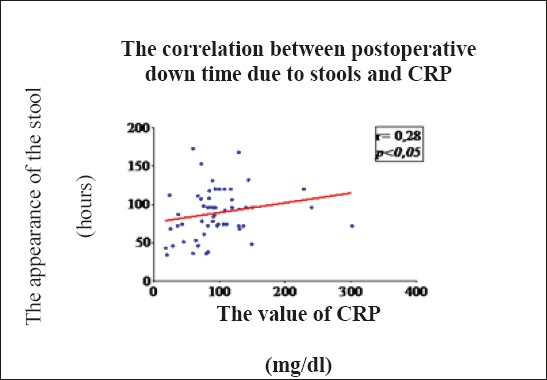
“Furthermore, in that study, lower CRP levels were associated with reduced time to initiation of bowel movements, as well as reduced rates of postsurgical complications and hospitalization time, particularly in patients with a right colon tumor [155].”
BackgroundEffect of Caffeine Intake on Postoperative Ileus: A Systematic Review and Meta-Analysis
Gkegkes, I. D., Minis, E. E., & Iavazzo, C. (2020) · Digestive Surgery · doi:10.1159/000496431 · Cited by 57
Metadata
- Authors
- Piric, M., Pasic, F., Rifatbegovic, Z., & Konjic, F.
- Affiliations
- University Clinical Center Tuzla (BA)
- Corresponding author
- Piric, Mirela
- ORCID
- Piric, Mirela
- Venue
- Medical Archives
- Publisher
- ScopeMed
- Published
- 2015
- Volume
- 69
- Issue
- 6
- Pages
- 357
- ISSN
- 0350-199X (ISSN-L)
- PMC
- PMC4720464
- OpenAlex
- W2257734265
- Cited by
- 34
- References
- 13
- Citations by year
- 2026: 4 · 2025: 1 · 2024: 5 · 2023: 5 · 2022: 8 · 2021: 4 · 2020: 1 · 2019: 4 · 2018: 1 · 2017: 1
- FWCI
- 0.67
- Type
- journal article
- Language
- en
- Open access
- green
- www.ncbi.nlm.nih.gov
- Licence
- cc-by-nc
- Locations
- Medical Archives (publishedVersion)
- PubMed Central (publishedVersion, cc-by-nc)
- PubMed (publishedVersion)
- Topics
- Health Sciences › Medicine › Surgery › Enhanced Recovery After Surgery
- Health Sciences › Medicine › Pharmacology (medical) › Coffee research and impacts
- Health Sciences › Medicine › Gastroenterology › Gastrointestinal motility and disorders
- Keywords
- coffee consumption, tea, colorectal resection, postoperative recovery, bowel function, first flatus, length of hospital stay, postoperative complications, anastomotic leakage, nasogastric tube removal, laxative use
- MeSH terms
- Adult, Aged, Aged, 80 and over, Coffee, Colon, Female, Humans, Male, Middle Aged, Postoperative Period, Rectum, Recovery of Function
About these checks
Registry, retraction, Cites and statistics results are computed, not judged, with one exception: a printed reference that no index lists is read once by a model before it counts as a citation error. Claims are extracted by a model and kept only when their quote appears verbatim in the text; each cited source is then checked, with a model’s help, for whether it says what the claim relies on. Those verdicts can be wrong — read the claim’s quote and the cited source before relying on one.
Statistics and arithmetic are recomputed, not judged.
Confidence bands are shown only for fields calibrated on our annotated test set. None is calibrated yet, so no band is shown.
What counts as a claim ›How we measure confidence ›How we check this ›
Are you an author, or do you see a problem with this page? Request a review
Data sources
Bibliographic data: Semantic Scholar, OpenAlex, Crossref.
Contains information from the Semantic Scholar Academic Graph Datasets, made available under the ODC Attribution License (ODC-BY 1.0).
Semantic Scholar’s data is described in: Kinney, R., et al. (2023). The Semantic Scholar Open Data Platform. arXiv:2301.10140.
