

Postprandial Hyperlipidemia and Remnant Lipoproteins
Open accessThe DOI matches its Crossref record; 133 of the 133 references it cites were found in a registry or an index.
Abstract
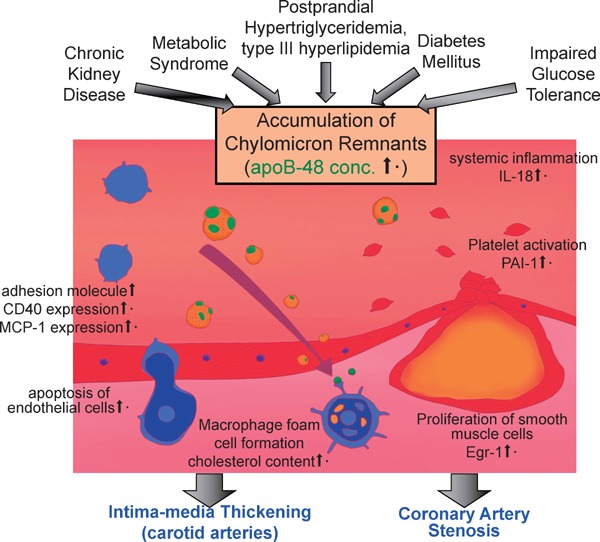
Fasting hypertriglyceridemia is positively associated with the morbidity of coronary heart disease (CHD), and postprandial (non-fasting) hypertriglyceridemia is also correlated with the risk status for CHD, which is related to the increase in chylomicron (CM) remnant lipoproteins produced from the intestine. CM remnant particles, as well as oxidized low density lipoprotein (LDL) or very low density lipoprotein (VLDL) remnants, are highly atherogenic and act by enhancing systemic inflammation, platelet activation, coagulation, thrombus formation, and macrophage foam cell formation. The cholesterol levels of remnant lipoproteins significantly correlate with small, dense LDL; impaired glucose tolerance (IGT) and CHD prevalence. We have developed an assay of apolipoprotein (apo)B-48 levels to evaluate the accumulation of CM remnants. Fasting apoB-48 levels correlate with the morbidity of postprandial hypertriglyceridemia, obesity, type III hyperlipoproteinemia, the metabolic syndrome, hypothyroidism, chronic kidney disease, and IGT. Fasting apoB-48 levels also correlate with carotid intima-media thickening and CHD prevalence, and a high apoB-48 level is a significant predictor of CHD risk, independent of the fasting TG level. Diet interventions, such as dietary fibers, polyphenols, medium-chain fatty acids, diacylglycerol, and long-chain n-3 polyunsaturated fatty acids (PUFA), ameliorate postprandial hypertriglyceridemia, moreover, drugs for dyslipidemia (n-3 PUFA, statins, fibrates or ezetimibe) and diabetes concerning incretins (dipeptidyl-peptidase IV inhibitor or glucagon like peptide-1 analogue) may improve postprandial hypertriglyceridemia. Since the accumulation of CM remnants correlates to impaired lipid and glucose metabolism and atherosclerotic cardiovascular events, further studies are required to investigate the characteristics, physiological activities, and functions of CM remnants for the development of new interventions to reduce atherogenicity.
Overview
The claims and statistics of this paper haven’t been checked yet.
Free: it reads the open-access text and checks the first 5 claims that cite a source we can check. Create a free account to check every claim.
Integrity signals
Registry
Cites
Statistics
Figures
Verification
Claims the paper makes
The claims and statistics of this paper haven’t been checked yet.
Free: it reads the open-access text and checks the first 5 claims that cite a source we can check. Create a free account to check every claim.
Claims other papers make about this one
Each is checked against this paper’s own text: does it say what the citing paper says it does?
The cited source says what the claim attributes to it.
In the citing paper
“However, fasting and postprandial hypertriglyceridemia as well as reduced high-density lipoprotein cholesterol (HDL-C) remain as residual risk factors of atherosclerotic cardiovascular diseases (ASCVD).”
From Pemafibrate, a new selective PPARα modulator: drug concept and its clinical applications for dyslipidemia and metabolic diseases (2020) · cites this paper as [68]
Self-check
Percentages, sums and reported differences re-computed from the paper’s own numbers.
The self-check needs the paper’s full text.
Citations
Cites
Empagliflozin, Cardiovascular Outcomes, and Mortality in Type 2 Diabetes
Zinman, B., Wanner, C., Lachin, J. M., Fitchett, D., Bluhmki, E., Hantel, S., Mattheus, M., Devins, T., Johansen, O. E., Woerle, H. J., et al. (2015) · New England Journal of Medicine · doi:10.1056/nejmoa1504720 · Cited by 12,315
Liraglutide and Cardiovascular Outcomes in Type 2 Diabetes
Marso, S. P., Daniels, G. H., Brown-Frandsen, K., Kristensen, P., Mann, J. F. E., Nauck, M. A., Nissen, S. E., Pocock, S., Poulter, N. R., Ravn, L. S., et al. (2016) · New England Journal of Medicine · doi:10.1056/nejmoa1603827 · Cited by 7,629
Ezetimibe Added to Statin Therapy after Acute Coronary Syndromes
Cannon, C. P., Blazing, M. A., Giugliano, R. P., McCagg, A., White, J. A., Theroux, P., Darius, H., Lewis, B. S., Ophuis, T. O., Jukema, J. W., et al. (2015) · New England Journal of Medicine · doi:10.1056/nejmoa1410489 · Cited by 4,487
Saxagliptin and cardiovascular outcomes in patients with type 2 diabetes mellitus
Scirica, B. M., Bhatt, D. L., Braunwald, E., Steg, P. G., Davidson, J., Hirshberg, B., Ohman, P., Frederich, R., Wiviott, S. D., Hoffman, E. B., et al. (2013) · New England Journal of Medicine · doi:10.1056/nejmoa1307684 · Cited by 3,470
Effects of Combination Lipid Therapy in Type 2 Diabetes Mellitus
(2010) · New England Journal of Medicine · doi:10.1056/nejmoa1001282 · Cited by 2,837
Effect of Sitagliptin on Cardiovascular Outcomes in Type 2 Diabetes
Green, J. B., Bethel, M. A., Armstrong, P. W., Buse, J. B., Engel, S. S., Garg, J., Josse, R., Kaufman, K. D., Koglin, J., Korn, S., et al. (2015) · New England Journal of Medicine · doi:10.1056/nejmoa1501352 · Cited by 2,577
Yokoyama, M., Origasa, H., Matsuzaki, M., Matsuzawa, Y., Saito, Y., Ishikawa, Y., Oikawa, S., Sasaki, J., Hishida, H., Itakura, H., et al. (2007) · The Lancet · doi:10.1016/s0140-6736(07)60527-3 · Cited by 2,516
Alogliptin after acute coronary syndrome in patients with type 2 diabetes
White, W. B., Cannon, C. P., Heller, S. R., Nissen, S. E., Bergenstal, R. M., Bakris, G. L., Perez, A. T., Fleck, P. R., Mehta, C. R., Kupfer, S., et al. (2013) · New England Journal of Medicine · doi:10.1056/nejmoa1305889 · Cited by 2,502
Nordestgaard, B. G., Benn, M., Schnohr, P., & Tybjærg-Hansen, A. (2007) · JAMA · doi:10.1001/jama.298.3.299 · Cited by 2,058
Cited by
Sandesara, P. B., Virani, S. S., Fazio, S., & Shapiro, M. D. (2019) · Endocrine Reviews · doi:10.1210/er.2018-00184 · Cited by 608
“chylomicron remnants) can b e done via ultracentrifugation or, indirectly, by measuring apoB48 (55,65,66).”
MethodYanai, H., & Yoshida, H. (2019) · International Journal of Molecular Sciences · doi:10.3390/ijms20051190 · Cited by 468
“Remnant lipoproteins directly and indirectly correlate to the enhancement of atherogenicity [98].”
BackgroundThe Canadian laboratory initiative on pediatric reference intervals: A CALIPER white paper
Adeli, K., Higgins, V., Trajcevski, K., & White-Al Habeeb, N. (2017) · Critical Reviews in Clinical Laboratory Sciences · doi:10.1080/10408363.2017.1379945 · Cited by 303
Yamashita, S., Masuda, D., & Matsuzawa, Y. (2020) · Current Atherosclerosis Reports · doi:10.1007/s11883-020-0823-5 · Cited by 191
Self-citationArai, H., Yamashita, S., Yokote, K., Araki, E., Suganami, H., Ishibashi, S., & on behalf of the K-877 Study Group (2018) · Journal of Atherosclerosis and Thrombosis · doi:10.5551/jat.44412 · Cited by 136
Self-citationVarbo, A., & Nordestgaard, B. G. (2017) · Current Opinion in Lipidology · doi:10.1097/mol.0000000000000429 · Cited by 135
Cao, Y.-X., Zhang, H.-W., Jin, J.-L., Liu, H.-H., Zhang, Y., Gao, Y., Guo, Y.-L., Wu, N.-Q., Hua, Q., Li, Y.-F., et al. (2020) · Cardiovascular Diabetology · doi:10.1186/s12933-020-01076-7 · Cited by 98
Cholesterol Remnants, Triglyceride-Rich Lipoproteins and Cardiovascular Risk
Baratta, F., Cocomello, N., Coronati, M., Ferro, D., Pastori, D., Angelico, F., & Ben, M. D. (2023) · International Journal of Molecular Sciences · doi:10.3390/ijms24054268 · Cited by 95
APOC-III: a Gatekeeper in Controlling Triglyceride Metabolism
Giammanco, A., Spina, R., Cefalu, A. B., & Averna, M. R. (2023) · Current Atherosclerosis Reports · doi:10.1007/s11883-023-01080-8 · Cited by 94
Modification of lipoprotein metabolism and function driving atherogenesis in diabetes
Luciani, L., Pedrelli, M., & Parini, P. (2024) · Atherosclerosis · doi:10.1016/j.atherosclerosis.2024.117545 · Cited by 72
Secondary dyslipidemia: its treatments and association with atherosclerosis
Yanai, H., & Yoshida, H. (2020) · Global Health & Medicine · doi:10.35772/ghm.2020.01078 · Cited by 90
Generoso, G., Janovsky, C. C. P. S., & Bittencourt, M. S. (2019) · Current Opinion in Endocrinology, Diabetes & Obesity · doi:10.1097/med.0000000000000468 · Cited by 69
Yamashita, S., Masuda, D., & Matsuzawa, Y. (2019) · Journal of Atherosclerosis and Thrombosis · doi:10.5551/jat.48918 · Cited by 66
Self-citationNew Perspectives on Atherogenic Dyslipidaemia and Cardiovascular Disease
Lorenzatti, A. J., & Toth, P. P. (2020) · European Cardiology Review · doi:10.15420/ecr.2019.06 · Cited by 72
Mechanisms of Atherosclerosis Induced by Postprandial Lipemia
Zhao, Y., Liu, L., Yang, S., Liu, G., Pan, L., Gu, C., Wang, Y., Li, D. X., Zhao, R., & Wu, M. (2021) · Frontiers in Cardiovascular Medicine · doi:10.3389/fcvm.2021.636947 · Cited by 78
Thomas, M. C., Coughlan, M. T., & Cooper, M. E. (2023) · Cell Metabolism · doi:10.1016/j.cmet.2023.01.004 · Cited by 56
Adetunji, C. O., Michael, O. S., Rathee, S., Singh, K. R., Ajayi, O. O., Adetunji, J. B., Ojha, A., Singh, J., & Singh, R. P. (2021) · Materials Today Advances · doi:10.1016/j.mtadv.2021.100198 · Cited by 66
He, N., & Ye, H. (2020) · Advances in experimental medicine and biology · doi:10.1007/978-981-15-1792-1_5 · Cited by 72
A comprehensive metabolic profiling of the metabolically healthy obesity phenotype
Telle‐Hansen, V. H., Christensen, J. J., Formo, G. A., Holven, K. B., & Ulven, S. M. (2020) · Lipids in Health and Disease · doi:10.1186/s12944-020-01273-z · Cited by 57
“Increased levels of ApoB is positively associated with dyslipidemia and metabolic syndrome (MetS) [21] and is an important risk factor for atherosclerosis and CVD [22].”
Yamashita, S., Arai, H., Yokote, K., Araki, E., Suganami, H., & Ishibashi, S. (2018) · Journal of Clinical Lipidology · doi:10.1016/j.jacl.2018.06.010 · Cited by 51
Self-citationUpdate on the laboratory investigation of dyslipidemias
Ramasamy, I. (2018) · Clinica Chimica Acta · doi:10.1016/j.cca.2018.01.015 · Cited by 50
Magalhaes, M. S., Smith, P., Portman, J. R., Jackson-Jones, L. H., Bain, C. C., Ramachandran, P., Michailidou, Z., Stimson, R. H., Dweck, M. R., Denby, L., et al. (2021) · Nature Communications · doi:10.1038/s41467-021-24684-7 · Cited by 47
Wang, K., Wang, R., Yang, J., Liu, X., Shen, H., Sun, Y., Zhou, Y., Fang, Z. A., & Ge, H. (2022) · Frontiers in Cardiovascular Medicine · doi:10.3389/fcvm.2022.913869 · Cited by 57
“Chylomicron remnants can be quantitatively evaluated by serum apolipoprotein B-48 concentration (8).”
BackgroundApolipoprotein E and Atherosclerosis
Marais, A. D. (2021) · Current Atherosclerosis Reports · doi:10.1007/s11883-021-00933-4 · Cited by 57
JCS 2023 Guideline on the Primary Prevention of Coronary Artery Disease
Fujiyoshi, A., Kohsaka, S., Hata, J., Hara, M., Kai, H., Masuda, D., Miyamatsu, N., Nishio, Y., Ogura, M., Sata, M., et al. (2024) · Circulation Journal · doi:10.1253/circj.cj-23-0285 · Cited by 61
Self-citationSekimoto, T., Koba, S., Mori, H., Sakai, R., Arai, T., Yokota, Y., Sato, S., Tanaka, H., Masaki, R., Oishi, Y., et al. (2021) · Journal of Atherosclerosis and Thrombosis · doi:10.5551/jat.60152 · Cited by 48
Sairyo, M., Kobayashi, T., Masuda, D., Kanno, K., Zhu, Y., Okada, T., Koseki, M., Ohama, T., Nishida, M., Sakata, Y., et al. (2018) · Journal of Atherosclerosis and Thrombosis · doi:10.5551/jat.39693 · Cited by 47
Self-citationSawada, T., Uzu, K., Hashimoto, N., Onishi, T., Takaya, T., Shimane, A., Taniguchi, Y., Yasaka, Y., Ohara, T., & Kawai, H. (2019) · Journal of Atherosclerosis and Thrombosis · doi:10.5551/jat.50807 · Cited by 44
The chylomicron saga: time to focus on postprandial metabolism
Gugliucci, A. (2024) · Frontiers in Endocrinology · doi:10.3389/fendo.2023.1322869 · Cited by 55
“A substantial connection between non-fasting TG and total mortality has been shown, as well as a signi fi cant association between non-fasting TG and cholesterol and myocardial infarction risk (6, 18, 33, 102).”
BackgroundMethodInfluentialOtahal, A., Kuten-Pella, O., Kramer, K., Neubauer, M., Lacza, Z., Nehrer, S., & Luna, A. D. (2021) · Scientific Reports · doi:10.1038/s41598-021-84234-5 · Cited by 43
Yamashita, S., Rizzo, M., Su, T., & Masuda, D. (2023) · Metabolites · doi:10.3390/metabo13050626 · Cited by 44
“Chylomicron remnants and VLDL remnants (IDL) are called “remnant lipoproteins” and are proatherogenic [50,51].”
BackgroundSelf-citationSakai, K., Koba, S., Nakamura, Y., Yokota, Y., Tsunoda, F., Shoji, M., Itoh, Y., Hamazaki, Y., & Kobayashi, Y. (2018) · Geriatrics and gerontology international/Geriatrics & gerontology international · doi:10.1111/ggi.13287 · Cited by 41
Pepa, G. D., Vetrani, C., Vitale, M., Bozzetto, L., Costabile, G., Cipriano, P., Mangione, A., Patti, L., Riccardi, G., Rivellese, A. A., et al. (2019) · European Journal of Clinical Nutrition · doi:10.1038/s41430-019-0459-0 · Cited by 36
Masood, S., Masood, O., Mujtaba, S. F., & Banerjee, M. (2024) · Springer eBooks · doi:10.1007/978-981-97-4723-8_4 · Cited by 33
Feingold, K. R. (2015) · Europe PMC (PubMed Central) · Cited by 36
Masuda, D., Kobayashi, T., Sairyou, M., Hanada, H., Ohama, T., Koseki, M., Nishida, M., Maeda, N., Kihara, S., Minami, T., et al. (2017) · Journal of Atherosclerosis and Thrombosis · doi:10.5551/jat.41343 · Cited by 28
Self-citationCho, K. Y., Miyoshi, H., Nakamura, A., Greenberg, A. S., & Atsumi, T. (2022) · Journal of Atherosclerosis and Thrombosis · doi:10.5551/jat.63153 · Cited by 28
Nakamura, A., Sato, K., Kanazawa, M., Kondo, M., Endo, H., Takahashi, T., & Nozaki, E. (2018) · Heart and Vessels · doi:10.1007/s00380-018-1319-x · Cited by 27
Microsomal Triglyceride Transfer Protein: From Lipid Metabolism to Metabolic Diseases
Iqbal, J., Jahangir, Z., & Qarni, A. A. A. (2020) · Advances in experimental medicine and biology · doi:10.1007/978-981-15-6082-8_4 · Cited by 26
Multi-organ Coordination of Lipoprotein Secretion by Hormones, Nutrients and Neural Networks
Stahel, P., Xiao, C., Nahmias, A., Tian, L., & Lewis, G. F. (2021) · Endocrine Reviews · doi:10.1210/endrev/bnab008 · Cited by 26
Antipsychotic-Induced Alterations in Lipid Turnover
Pereira, S., Au, E., Agarwal, S. M., Wright, D. C., & Hahn, M. (2023) · Endocrinology · doi:10.1210/endocr/bqad025 · Cited by 25
Ohtaki, S., Ashida, K., Matsuo, Y., Moritaka, K., Iwata, S., Nagayama, A., Kawaguchi, A., Koga, H., Yoshinobu, S., Hasuzawa, N., et al. (2022) · Clinical Case Reports · doi:10.1002/ccr3.5671 · Cited by 25
Atherosclerosis and Physical Activity
Al-Mamari, A. (2009) · Oman Medical Journal · doi:10.5001/omj.2009.34 · Cited by 27
Farukhi, Z. M., Demler, O., Caulfield, M. P., Kulkarni, K. R., Wohlgemuth, J. G., Cobble, M. E., Luttmann‐Gibson, H., Li, C., Nelson, J. R., Cook, N. R., et al. (2020) · Journal of clinical lipidology · doi:10.1016/j.jacl.2020.02.005 · Cited by 23
“Due to their rapid metabolism in plasma and measurement via a very specific antibody assay, chylomicrons (CM) and chylomicron remnants (CMR) are not routinely assessed in clinical practice [6].”
BackgroundMethodSecondary hyperlipidemias: etiology and pathogenesis
Ershova, A. I., Раши, Д. О. А., Иванова, А. А., Aksenova, Y. O., & Meshkov, A. N. (2019) · Russian Journal of Cardiology · doi:10.15829/1560-4071-2019-5-74-81 · Cited by 22
Chen, Y., Li, G., Guo, X., Ouyang, N., Li, Z., Ye, N., Yu, S., Yang, H., & Sun, Y. (2021) · Journal of Clinical Medicine · doi:10.3390/jcm10153388 · Cited by 22
Hypertriglyceridemia and Atherosclerotic Carotid Artery Stenosis
Miura, Y., & Suzuki, H. (2022) · International Journal of Molecular Sciences · doi:10.3390/ijms232416224 · Cited by 22
“However, when TRL remnants are retained in the circulating blood due to the overproduction and/or impaired clearance of TRL remnants, they accumulate in the subendothelial space, causing the formation of atherosclerotic plaques [26,27].”
BackgroundHirowatari, Y., & Yoshida, H. (2019) · Journal of Atherosclerosis and Thrombosis · doi:10.5551/jat.rv17037 · Cited by 22
Masuda, D., Miyata, Y., Matsui, S., & Yamashita, S. (2019) · Atherosclerosis · doi:10.1016/j.atherosclerosis.2019.11.014 · Cited by 19
Self-citationNakamura, A., Kagaya, Y., Saito, H., Kanazawa, M., Sato, K., Miura, M., Kondo, M., & Endo, H. (2022) · Journal of Atherosclerosis and Thrombosis · doi:10.5551/jat.63659 · Cited by 20
Li, Y., Shi, G., Liang, W. P., Shang, H., Li, H., Han, Y., Zhao, W., Bai, L., & Qin, C. (2023) · Cells · doi:10.3390/cells12151936 · Cited by 23
“VLDL can further metabolize to LDLs by hepatic tissues [49].”
BackgroundRemnant cholesterol and long-term incidence of death in coronary artery disease patients
Drexel, H., Mader, A., Larcher, B., Festa, A., Vonbank, A., Fraunberger, P., Leiherer, A., & Saely, C. H. (2025) · Atherosclerosis · doi:10.1016/j.atherosclerosis.2024.119048 · Cited by 17
Tian, J., Chen, H., Liu, P., Wang, C., & Chen, Y. (2019) · Scientific Reports · doi:10.1038/s41598-019-40385-0 · Cited by 19
Postprandial hyperlipidemia as a risk factor in patients with type 2 diabetes
Tomlinson, B., Chan, P., & Lam, C. W. K. (2020) · Expert Review of Endocrinology & Metabolism · doi:10.1080/17446651.2020.1750949 · Cited by 22
“Elevated apoB48 levels are a significant predictor of CHD risk, independent of the fasting triglyceride levels [24].”
BackgroundInfluentialTakao, T., Suka, M., Yanagisawa, H., & Kasuga, M. (2020) · Journal of Diabetes Investigation · doi:10.1111/jdi.13403 · Cited by 20
Costanzo, A. D., Perla, F. M., D’Erasmo, L., Arca, M., Chiesa, C., & Pacifico, L. (2021) · The Journal of Pediatrics · doi:10.1016/j.jpeds.2021.01.019 · Cited by 17
Apheresis as emerging treatment option in severe early onset preeclampsia
Contini, C., Pütz, G., Pecks, U., & Winkler, K. (2019) · Atherosclerosis Supplements · doi:10.1016/j.atherosclerosissup.2019.08.028 · Cited by 16
Shademan, B., Nourazarian, A., Laghousi, D., Karamad, V., & Nikanfar, M. (2021) · Journal of Clinical Laboratory Analysis · doi:10.1002/jcla.23996 · Cited by 14
The relationship of remnant cholesterol and abdominal obesity in children: A cross-sectional study
Tong, J., Li, X., Liang, X., Tang, F., Ren, Y., Hao, G., Peng, X., Luo, S., Ye, F., Huang, D., et al. (2022) · Frontiers in Cardiovascular Medicine · doi:10.3389/fcvm.2022.929560 · Cited by 16
“Moreover, it was a useful predictor of postprandial hyperlipidemia (38, 39).”
BackgroundProteomic studies on apoB‐containing lipoprotein in cardiovascular research: A comprehensive review
Gianazza, E., Zoanni, B., Mallia, A., Brioschi, M., Colombo, G. I., & Banfi, C. (2021) · Mass Spectrometry Reviews · doi:10.1002/mas.21747 · Cited by 16
Okada, T., Ohama, T., Okazaki, M., Kanno, K., Matsuda, H., Sairyo, M., Zhu, Y., Saga, A., Kobayashi, T., Masuda, D., et al. (2018) · PLoS ONE · doi:10.1371/journal.pone.0190875 · Cited by 13
Self-citationPostprandial plasma lipidome responses to a high-fat meal among healthy women
Yoshinaga, M. Y., Quintanilha, B. J., Chaves‐Filho, A. B., Miyamoto, S., Sampaio, G. R., & Rogero, M. M. (2021) · The Journal of Nutritional Biochemistry · doi:10.1016/j.jnutbio.2021.108809 · Cited by 15
Varin, E. M., Hanson, A. A., Beaudry, J. L., Nguyen, M.-A., Cao, X., Baggio, L. L., Mulvihill, E. E., & Drucker, D. J. (2020) · JCI Insight · doi:10.1172/jci.insight.140418 · Cited by 15
A significant presence in atherosclerotic cardiovascular disease: Remnant cholesterol: A review
Wang, L., Zhang, Q., Wu, Z., & Huang, X. (2024) · Medicine · doi:10.1097/md.0000000000038754 · Cited by 17
“[37,38] Once RC enters the intima and preferentially attaches to LDL-C through adhesion, [19,29,39,40] reactive oxygen species production is increased by RC, with the result that vascular endothelial dysfunction is induced.”
BackgroundMethodObeid, R., Awwad, H. M., Knell, A., Hübner, U., & Geisel, J. (2018) · Nutrients · doi:10.3390/nu10091209 · Cited by 13
Gugliucci, A. (2024) · Journal of Clinical Medicine · doi:10.3390/jcm13175229 · Cited by 11
“Somewhat neglected, though, is the fact that a large proportion of those TRL are chylomicrons (CM) that do not contain apoB100, but apoB48 [6,9,21,22].”
BackgroundPost-prandial Remnant Lipoprotein Metabolism in Sitosterolemia
Tada, H., Nomura, A., Nohara, A., Inazu, A., Mabuchi, H., Yamagishi, M., & Kawashiri, M. (2018) · Journal of Atherosclerosis and Thrombosis · doi:10.5551/jat.44768 · Cited by 10
Ye, H., Wang, G., Wang, X., Wang, X., Ni, W., Chen, L., Zhu, Y., Zhao, L., Xiong, Z., Wang, Y., et al. (2023) · Journal of Ethnopharmacology · doi:10.1016/j.jep.2023.116444 · Cited by 9
Katsa, M. E., Ketselidi, K., Kalliostra, M., Ioannidis, A., Gil, A. P. R., Diamantakos, P., Melliou, E., Magiatis, P., & Nomikos, T. (2024) · International Journal of Molecular Sciences · doi:10.3390/ijms25020908 · Cited by 11
“Although the majority of postprandial studies have focused on the implications of postprandial dysmetabolism on inflammation, oxidative stress and endothelial dysfunction, it seems that postprandial dysmetabolism can also induce transient alterations of the hemostatic system [4,5].”
BackgroundThe Effects of Long-Term Dietary Therapy on Patients with Hypertriglyceridemia
Yamanaka, M., Sakuma, M., Matsushita, A., Tanaka, S., Yamamoto, Y., Asai, T., & Arai, H. (2018) · Journal of Atherosclerosis and Thrombosis · doi:10.5551/jat.42440 · Cited by 9
Kurihara, O., Okajima, F., Takano, M., Kato, K., Munakata, R., Murakami, D., Miyauchi, Y., Emoto, N., Sugihara, H., Seino, Y., et al. (2018) · Arteriosclerosis Thrombosis and Vascular Biology · doi:10.1161/atvbaha.118.311245 · Cited by 10
Irie, S., Anno, T., Kawasaki, F., Shigemoto, R., Nakanishi, S., Kaku, K., & Kaneto, H. (2019) · BMC Endocrine Disorders · doi:10.1186/s12902-019-0425-9 · Cited by 8
Arai, K., Koba, S., Yokota, Y., Tsunoda, F., Tsujita, H., Kondo, S., Tsukamoto, S., Shoji, M., & Shinke, T. (2020) · Journal of Atherosclerosis and Thrombosis · doi:10.5551/jat.55780 · Cited by 10
Zhu, L., Wen, X.-Y., Xiang, Q., Guo, L., Xu, J. R., Zhao, S., & Liu, L. (2021) · Frontiers in Cardiovascular Medicine · doi:10.3389/fcvm.2021.674446 · Cited by 10
“Compared with fasting hypertriglyceridemia, elevated fasting low-density lipoprotein cholesterol (LDL-C) levels aremore closely associated with CHD, although evidence also shows that non-fasting hypertriglyceridemia is an independent risk factor for CHD (2).”
BackgroundCholesterol-lowering drugs: Focus on Ezetimibe: Cholesterol-lowering drugs: Focus on ezetimibe
Bays, H. E. (2022) · European Atherosclerosis Journal · doi:10.56095/eaj.v1i1.8 · Cited by 9
Proteomic Analysis of Human Chylomicron Remnants Isolated by Apolipoprotein B-48 Immunoprecipitation
Masuda, D., Okada, T., Sairyou, M., Takafuji, K., Ohama, T., Koseki, M., Nishida, M., Sakata, Y., & Yamashita, S. (2024) · Journal of Atherosclerosis and Thrombosis · doi:10.5551/jat.64920 · Cited by 7
Self-citationShao, L., Bai, Y., Wang, Q., Chen, Z., Xie, Y., & Bian, X. (2019) · Bioorganic & Medicinal Chemistry Letters · doi:10.1016/j.bmcl.2019.126723 · Cited by 8
Tyramine exerts hypolipidemic and anti-obesity effects in vivo
Morais, T. M. F., de Melo, T. S., Dantas, M. B., Ferreira, J. M., de Sousa, D. F., Magalhães, E. P., de Menezes, R. R. P. P. B., Pessoa, O. D. L., Feitosa, M. L., de Sousa, F. C. F., et al. (2022) · Brazilian Journal of Pharmaceutical Sciences · doi:10.1590/s2175-97902022e201191 · Cited by 8
Xu, L., Chen, X., Lu, J., Xu, Y., Yang, H., Zhou, X., Zhou, J., Xu, J., & Shen, H. (2021) · Diabetology & Metabolic Syndrome · doi:10.1186/s13098-021-00667-y · Cited by 8
Case Report: Various Abnormalities in Lipid and Glucose Metabolism Induced by Capecitabine
Anno, T., Yamatsuji, T., Tomoda, K., Nakanishi, S., & Kaneto, H. (2021) · Frontiers in Oncology · doi:10.3389/fonc.2021.664475 · Cited by 6
“org 4 patients with metabolic syndrome (17).”
Vine, D. F., Proctor, E., Weaver, O. R., Ghosh, M., Maximova, K., & Proctor, S. D. (2021) · Journal of the Endocrine Society · doi:10.1210/jendso/bvab114 · Cited by 11
“These studies examined older participants (>50-90yrs) taking statins and those with pre-existing health outcomes such as diabetes, coronary heart disease and stroke (70,71).”
BackgroundSimultaneous evaluation of fatty acid and triglycerides after percutaneous coronary intervention
Matsumoto, I., Moriya, S., Kurozumi, M., Namba, T., & Takagi, Y. (2022) · Journal of Cardiology · doi:10.1016/j.jjcc.2022.02.011 · Cited by 6
Sato, D., Morino, K., Ogaku, S., Tsuji, A., Nishimura, K., Sekine, O., Ugi, S., & Maegawa, H. (2019) · Journal of Diabetes Investigation · doi:10.1111/jdi.13016 · Cited by 11
Takeda, Y., Sakuma, I., Hiramitsu, S., Okada, M., Ueda, S., & Sakurai, M. (2022) · BMJ Open · doi:10.1136/bmjopen-2022-061360 · Cited by 5
The role of chitosan-based nanoparticles to reduce obesity: a glimpse
Rakshit, S., Pal, K., Mondal, K. C., & Halder, S. K. (2022) · Elsevier eBooks · doi:10.1016/b978-0-323-90750-7.00009-0 · Cited by 7
Kanda, D., Miyata, M., Ikeda, Y., Tokushige, A., Sonoda, T., Arikawa, R., Anzaki, K., Kosedo, I., Yoshino, S., Takumi, T., et al. (2021) · Journal of Atherosclerosis and Thrombosis · doi:10.5551/jat.62908 · Cited by 5
Baragetti, A. (2022) · Metabolism and Target Organ Damage · doi:10.20517/mtod.2022.09 · Cited by 6
Larouche, M., Brisson, D., Morissette, M.-C., & Gaudet, D. (2023) · Orphanet Journal of Rare Diseases · doi:10.1186/s13023-023-02743-0 · Cited by 4
Zhang, J. J., Tang, Z., Jiang, J., Huang, S., Zeng, H., Gu, J., Wang, C., & Zhang, H. (2023) · Reviews in Cardiovascular Medicine · doi:10.31083/j.rcm2411314 · Cited by 4
Rodrigues, A. M. D. S., Martins, L. B., Fagundes, G. B. P., Tibães, J. R. B., Amaral, M. H. A., Vieira, É. L. M., Oliveira, M. C., Correia, M. I. T. D., & Ferreira, A. V. M. (2024) · Nutrition · doi:10.1016/j.nut.2024.112602 · Cited by 4
Effects of Undaria pinnatifida (Wakame) on Postprandial Serum Lipid Responses in Humans
Yoshinaga, K., & Mitamura, R. (2019) · Nippon Eiyo Shokuryo Gakkaishi · doi:10.4327/jsnfs.72.267 · Cited by 5
Staňková, B., Macášek, J., Zeman, M., Vecka, M., TVRZICKÁ, E., Jáchymová, M., Slaby, A., & Žák, A. (2019) · Folia Biologica · doi:10.14712/fb2019065040159 · Cited by 4
Gómez-Sámano, M. Á., Ramos, D. C., Grajales-Gómez, M., Escamilla-Márquez, M. A., López-Estrada, A., Guillén-Pineda, L. E., López-Carrasco, G., & Gomez-Perez, F. J. (2017) · BMJ Open Diabetes Research & Care · doi:10.1136/bmjdrc-2016-000344 · Cited by 6
Kanda, D., Takumi, T., Arikawa, R., Anzaki, K., Sonoda, T., Ohmure, K., Fukumoto, D., Tokushige, A., & Ohishi, M. (2023) · Internal and Emergency Medicine · doi:10.1007/s11739-023-03385-7 · Cited by 3
Mohammedsaeed, W. M., Ahmed, A., Alharbi, N., Aljohani, A., Alruwaithi, R., Alharbi, R., & Alahmadi, S. (2023) · Cureus · doi:10.7759/cureus.44219 · Cited by 4
“Consistent with our research, the majority of prior studies have indicated a negative correlation between circulating ADPQ and serum triglyceride levels [54,55].”
BackgroundResultInfluentialThe Significance of Lipoproteins in the Development of Obesity
Blagov, A. V., Rufanov, K. A., Irina, K., Sukhorukov, V. N., Goncharov, A., Pleshko, E. M., & Orekhov, A. N. (2024) · Frontiers in Bioscience-Scholar · doi:10.31083/j.fbs1601008 · Cited by 4
Sandoval, V., Vergara-Nieto, Á., Bentes, A., Silva, S. V. E., Núñez, C. S., & Martínez-Huenchullán, S. (2025) · Biology · doi:10.3390/biology14050463 · Cited by 4
“High plasma triglyceride levels, a condition known as hypertriglyceridemia, also contribute to the development of cardiovascular diseases (CVDs) through various mechanisms [7,8].”
de Oliveira, A. C., Gomes, A. P. O., Rodrigues, L. C., Cunha, R. D. S., Serra, T. M., Schincaglia, R. M., Silva, M. A. C., Horst, M. A., Rostagno, M. A., Magalhães, K. G., et al. (2022) · Applied Sciences · doi:10.3390/app12041973 · Cited by 3
Kolovou, G. D., Giannakopoulou, V., Kalogeropoulos, P. G., Anagnostopoulou, K. K., Goumas, G. S., Kazianis, G., Limberi, S. J., Perrea, D. N., Mihas, C. C., Kolovou, V., et al. (2019) · Contemporary Clinical Trials · doi:10.1016/j.cct.2019.05.011 · Cited by 3
Lan, X., Wu, Q., Yang, D., Lin, J., Xu, S., Wu, J., Wang, Z., & Wang, S. (2019) · Starch - Stärke · doi:10.1002/star.201900138 · Cited by 4
Metadata
- Authors
- Masuda, D., & Yamashita, S.
- Affiliations
- The University of Osaka (JP)
- Rinku General Medical Center (JP)
- Corresponding author
- Masuda, Daisaku
- Venue
- Journal of Atherosclerosis and Thrombosis
- Publisher
- Japan Atherosclerosis Society
- Published
- 2017
- Volume
- 24
- Issue
- 2
- Pages
- 95-109
- ISSN
- 1340-3478 (ISSN-L)
- 1880-3873
- PMC
- PMC5305681
- OpenAlex
- W2554722168
- Cited by
- 145
- References
- 133
- Citations by year
- 2026: 9 · 2025: 6 · 2024: 13 · 2023: 17 · 2022: 19 · 2021: 21 · 2020: 18 · 2019: 18 · 2018: 14 · 2017: 8
- FWCI
- 2.32
- Type
- journal article
- Language
- en
- Open access
- diamond
- doi.org
- Licence
- cc-by-nc-sa
- Locations
- Journal of Atherosclerosis and Thrombosis (publishedVersion, cc-by-nc-sa)
- PubMed Central (publishedVersion, cc-by-nc-sa)
- PubMed (publishedVersion)
- Funders
- Boehringer Ingelheim Japan
- Ono Pharmaceutical
- MSD K.K.
- Japan Society for the Promotion of Science (17H02100, 15K01713)
- Topics
- Health Sciences › Medicine › Cardiology and Cardiovascular Medicine › Lipid metabolism and disorders
- Health Sciences › Medicine › Cardiology and Cardiovascular Medicine › Lipoproteins and Cardiovascular Health
- Health Sciences › Medicine › Endocrinology, Diabetes and Metabolism › Diabetes, Cardiovascular Risks, and Lipoproteins
- Keywords
- postprandial hypertriglyceridemia, chylomicron remnants, remnant lipoproteins, apolipoprotein B-48, coronary heart disease risk, atherosclerosis, small dense LDL, impaired glucose tolerance, type III hyperlipoproteinemia, metabolic syndrome, carotid intima-media thickening, dietary fiber, polyphenols, medium-chain fatty acids, diacylglycerol, omega-3 fatty acids, statins, fibrates, ezetimibe, incretins, dyslipidemia
- MeSH terms
- Animals, Cholesterol, Humans, Hyperlipidemias, Lipoproteins, Triglycerides, Postprandial Period
About these checks
Registry, retraction, Cites and statistics results are computed, not judged, with one exception: a printed reference that no index lists is read once by a model before it counts as a citation error. Claims are extracted by a model and kept only when their quote appears verbatim in the text; each cited source is then checked, with a model’s help, for whether it says what the claim relies on. Those verdicts can be wrong — read the claim’s quote and the cited source before relying on one.
Statistics and arithmetic are recomputed, not judged.
Confidence bands are shown only for fields calibrated on our annotated test set. None is calibrated yet, so no band is shown.
What counts as a claim ›How we measure confidence ›How we check this ›
Are you an author, or do you see a problem with this page? Request a review
Data sources
Bibliographic data: Semantic Scholar, OpenAlex, Crossref.
Contains information from the Semantic Scholar Academic Graph Datasets, made available under the ODC Attribution License (ODC-BY 1.0).
Semantic Scholar’s data is described in: Kinney, R., et al. (2023). The Semantic Scholar Open Data Platform. arXiv:2301.10140.
