

ORGANIC CERTIFICATION: CHALLENGES AND BENEFITS FOR PRODUCERS
Open accessThe DOI matches its Crossref record; 30 of the 30 references it cites were found in a registry or an index.
Abstract
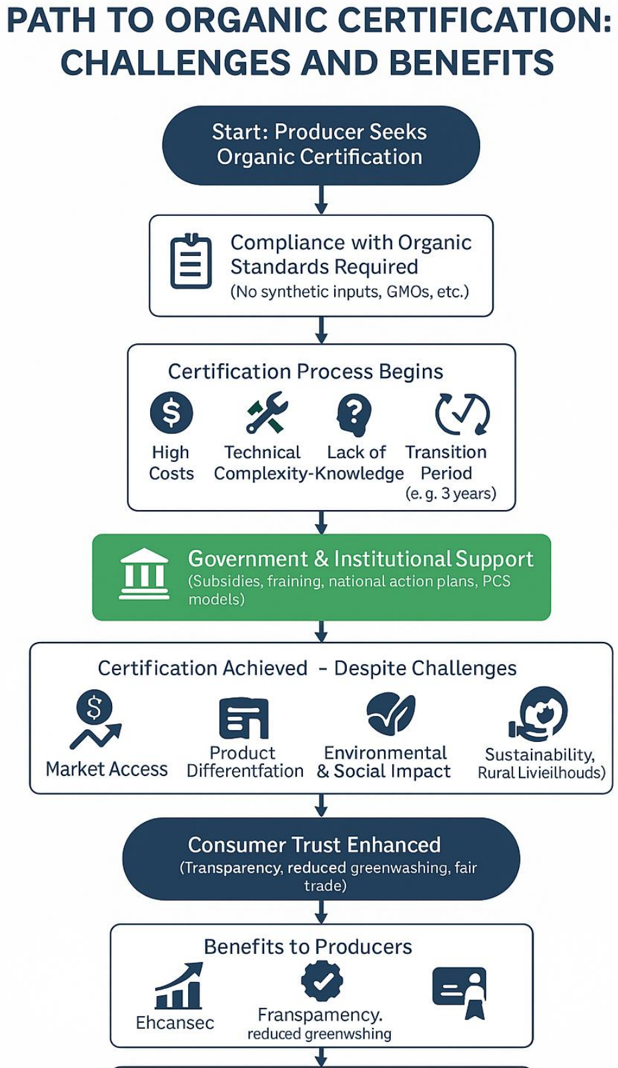
The pursuit of organic certification has become increasingly significant for agricultural producers seeking to meet growing consumer demand for sustainable and health-conscious food products. This certification verifies compliance with rigorous standards that prohibit synthetic inputs and genetically modified organisms, fostering transparency and trust in the organic market. However, producers face various challenges in the certification process, including high costs, complex regulatory requirements, transition periods with reduced yields, and limited technical support—especially for small-scale and developing country farmers. Despite these obstacles, organic certification offers substantial benefits, such as access to premium markets, product differentiation, and opportunities to promote social equity and environmental sustainability. Government policies and participatory certification models play crucial roles in mitigating barriers and supporting broader adoption. Addressing the economic, technical, and institutional challenges is essential to ensure inclusive growth of the organic sector worldwide.
Overview
The claims and statistics of this paper haven’t been checked yet.
Free: it reads the open-access text and checks the first 5 claims that cite a source we can check. Create a free account to check every claim.
Integrity signals
Registry
Cites
Statistics
Figures
Verification
Claims the paper makes
The claims and statistics of this paper haven’t been checked yet.
Free: it reads the open-access text and checks the first 5 claims that cite a source we can check. Create a free account to check every claim.
Claims other papers make about this one
Each is checked against this paper’s own text: does it say what the citing paper says it does?
The cited source says what the claim attributes to it.
In the citing paper
“One of the key value-based product differentiation strategies employed is organic certification [23,26,48,49], reflecting growing demand for higher-quality, safer, healthier, and more ethical products [47,50].”
From Who Reaches the Consumer? A Network Analysis of Market Reach Factors of Slovakia's Short Food Supply Chains (2026) · cites this paper as [48]
Self-check
Percentages, sums and reported differences re-computed from the paper’s own numbers.
The self-check needs the paper’s full text.
Citations
Cites
The publisher hasn’t deposited this paper’s reference list.
Research works printed but not linked: 2
- [6]6. DeLind, L. B. (2000). Transforming organic agriculture into industrial organic products: Reconsidering national organic standards. *Human Organization, 59*(2), 198-208. https://doi.org/10.17730/humo.59.2.7h436423270m7n52 · doi:10.17730/humo.59.2.7h436423270m7n52
- [21]21. Home, R., Bouagnimbeck, H., Ugas, R., Arbenz, M., & Stolze, M. (2017). Participatory guarantee systems: Organic certification to empower farmers and strengthen communities. *Agroecology and Sustainable Food Systems, 41*(5), 526-545. https://doi.org/10.1080/21683565.2017.1300325 · doi:10.1080/21683565.2017.1300325
Cited by
Varecha, L., Jarábková, J., & Hrivnák, M. (2026) · Agriculture · doi:10.3390/agriculture16060649
Salim, A. A., Kowalska, A., & Smalej, O. (2026) · Journal for Perspectives of Economic Political and Social Integration · doi:10.18290/pepsi-2026-0008
Metadata
- Authors
- Baldin, A. M.
- Corresponding author
- Baldin, Antonio Mauricio
- Venue
- Revista Sistemática
- Publisher
- Seven Events
- Published
- 2022-02-10
- Volume
- 6
- Issue
- 2
- ISSN
- 2675-5211 (ISSN-L)
- OpenAlex
- W4412926792
- Cited by
- 2
- References
- 0
- Citations by year
- 2026: 2
- FWCI
- 0.00
- Type
- journal article
- Language
- en
- Open access
- hybrid
- doi.org
- Licence
- Locations
- Revista Sistemática (publishedVersion, cc-by-nc)
- Topics
- Life Sciences › Agricultural and Biological Sciences › Plant Science › Organic Food and Agriculture
- Social Sciences › Business, Management and Accounting › Strategy and Management › Global trade, sustainability, and social impact
- Life Sciences › Agricultural and Biological Sciences › General Agricultural and Biological Sciences › Plant and soil sciences
- Keywords
- organic certification, organic farming, farmers, certification costs, transition period, smallholder farmers, developing countries, premium market, product differentiation, consumer demand for organic food, participatory certification, public policy, sustainable agriculture, social equity, environmental sustainability
About these checks
Registry, retraction, Cites and statistics results are computed, not judged, with one exception: a printed reference that no index lists is read once by a model before it counts as a citation error. Claims are extracted by a model and kept only when their quote appears verbatim in the text; each cited source is then checked, with a model’s help, for whether it says what the claim relies on. Those verdicts can be wrong — read the claim’s quote and the cited source before relying on one.
Statistics and arithmetic are recomputed, not judged.
Confidence bands are shown only for fields calibrated on our annotated test set. None is calibrated yet, so no band is shown.
What counts as a claim ›How we measure confidence ›How we check this ›
Are you an author, or do you see a problem with this page? Request a review
How to cite
Cite CoChat for the checks on this page, and the paper for its own findings.
- This page
- CoChat. (2026). Citation check: ORGANIC CERTIFICATION: CHALLENGES AND BENEFITS FOR PRODUCERS. https://app.cochat.ai/papers/10.56238/rcsv6n2-005
- The paper
- Baldin, A. M. (2022). ORGANIC CERTIFICATION: CHALLENGES AND BENEFITS FOR PRODUCERS. Revista Sistemática. https://doi.org/10.56238/rcsv6n2-005
Data sources
Bibliographic data: Semantic Scholar, OpenAlex, Crossref.
Contains information from the Semantic Scholar Academic Graph Datasets, made available under the ODC Attribution License (ODC-BY 1.0).
Semantic Scholar’s data is described in: Kinney, R., et al. (2023). The Semantic Scholar Open Data Platform. arXiv:2301.10140.
