

Prevalence and Risk of Heart Failure Among Older Adults Experiencing Homelessness: A Systematic Review and Meta-Analysis
Open accessThe DOI matches its Crossref record; 49 of the 49 references it cites were found in a registry or an index; none of the 57 sources its claims cite is checked for support yet.
Abstract
Background Understanding the prevalence and risk of heart failure (HF) among older adults is crucial for informing the design and implementation of interventions and guiding equitable healthcare delivery. Methods A systematic search was conducted in MEDLINE, Embase, Cochrane Database of Systematic Reviews, CINAHL, and Web of Science from inception to April 2025. We included studies of adults aged 50 years or older experiencing homelessness. Outcomes included HF prevalence, risk of HF, and HF mortality. Screening, extraction, and risk-of-bias assessments were completed in duplicate. Random effects meta-analysis using generalized linear mixed models was used to estimate the prevalence of HF. The risk and mortality of HF were analyzed using random effects models, with housed older adults serving as the comparator. Results Thirty-four studies with 573,697 individuals experiencing homelessness were included in this study (weighted mean age: 59.0 years, weighted female percentage: 19.9%). The prevalence of HF was 12.0% (95% confidence interval (CI) 7.3–19.0; I2 = 99.9%). The odds of HF compared to housed adults (weighted mean age: 70.8 years) was 0.93 (95% CI 0.71–1.23; I2 = 99.7%). The unadjusted odds of mortality from HF was 0.40 (95% CI 0.22–0.74; I2 = 100%). Conclusions This meta-analysis suggests that older adults experiencing homelessness have a prevalence of HF similar to or higher than population-based studies of housed adults of a similar age. Housing status was not associated with the odds of HF and was associated with a decreased odds of mortality, although substantial heterogeneity across studies limits evidence certainty.
Overview
CoChat Summary
TL;DR
This systematic review and meta-analysis of 34 studies and 573,697 older adults experiencing homelessness estimated a heart failure prevalence of 12.0%, with no association between homelessness and odds of heart failure and lower odds of heart failure mortality compared with housed adults. Evidence certainty was very low and heterogeneity was substantial.
Key findings
- Among 34 studies with 573,697 individuals experiencing homelessness (weighted mean age 59.0 years; weighted female percentage 19.9%), pooled heart failure prevalence was 12.0% (95% CI 7.3–19.0; I2 = 99.9%).
- The odds of heart failure compared with housed adults (weighted mean age 70.8 years) were 0.93 (95% CI 0.71–1.23; I2 = 99.7%).
- The unadjusted odds of mortality from heart failure were 0.40 (95% CI 0.22–0.74; I2 = 100%).
- No studies measured heart failure incidence; GRADE certainty was very low for prevalence and uncertain for risk of heart failure and risk of mortality.
Methods
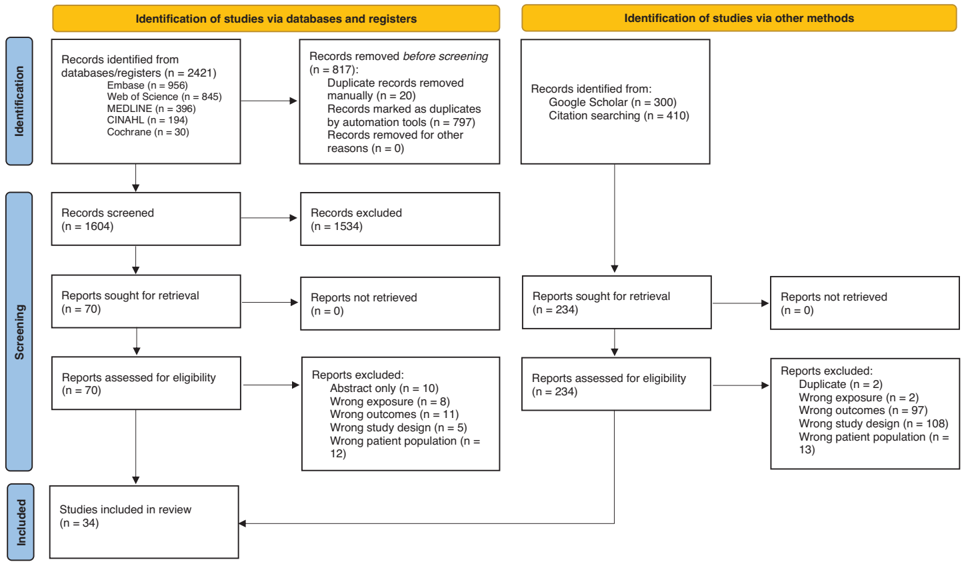
- Systematic search of MEDLINE, Embase, Cochrane Database of Systematic Reviews, CINAHL, and Web of Science from inception to April 3, 2025, plus Google Scholar and backward citation searching; included randomized controlled trials and observational studies of adults aged 50 years or older who experienced homelessness, with outcomes of heart failure prevalence, incidence, risk, or mortality.
- Included 34 studies (24 cohort, 10 cross-sectional; 28/34 from the United States), with 573,697 individuals experiencing homelessness and 46,390,207 housed comparators; screening, extraction, and risk-of-bias assessments were completed in duplicate.
- Random-effects meta-analysis used generalized linear mixed models with logit transformation for prevalence, and random-effects models with generic inverse variance and Hartung–Knapp adjustment for odds of heart failure and heart failure mortality; sensitivity analyses, meta-regression for study-level age, publication bias assessment, and GRADE were also performed.
Limitations
- Stated: the review did not examine healthcare utilization or guideline-directed medical therapy; could not subgroup heart failure-specific versus all-cause mortality; could not explain heterogeneity; could not analyze sex differences; included studies did not account for confounders such as duration and severity of homelessness; and ICD codes for housing status may misclassify homelessness.
- Stated: included studies did not differentiate heart failure mortality from all-cause mortality, so these rates could not be pooled separately.
- Evident from the text: heterogeneity was very high (I2 = 99.9% for prevalence, 99.7% for odds of heart failure, 100% for mortality), GRADE certainty was very low or uncertain, small-study bias suggested a high prevalence of heart failure, few studies were from outside North America, and no studies measured heart failure incidence.
Model-written summary. Check it against the paper before relying on it.
Integrity signals
Registry
Cites
Statistics
Figures
Verification
Claims the paper makes
0 Valid · 0 Not valid · 21 Not checked · 64 Own results and interpretations
A result the paper reports from its own data — it cites no other source for it, so there is none to check. The quote shows it is in the paper.
In the paper
“Housing status was not associated with the odds of HF and was associated with a decreased odds of mortality, although substantial heterogeneity across studies limits evidence certainty.”
§ Prevalence and Risk of Heart Failure Among Older Adults Experiencing Homelessness: A Systematic Review and Meta-Analysis > Abstract > Conclusions
plain- Asserted: passes — The authors put it forward as true.
- Checkable: passes — It can be checked against evidence.
- Load-bearing: passes — The paper’s conclusions depend on it.
- Based: passes — The paper gives a reason why it holds.
None of the sources cited for this claim have been checked yet.
In the paper
“Meta-analysis of mortality (n = 6 studies) showed an OR of 0.40 (95% CI 0.22–0.74, I2 = 100%) (Figure 4).(6,39,46,50–52)”
§ Prevalence and Risk of Heart Failure Among Older Adults Experiencing Homelessness: A Systematic Review and Meta-Analysis > RESULTS > Odds of HF, Incidence of HF, and HF Mortality
What the sources say
- Not checked yetcites [6] Plumb JD Homelessness: care, prevention, and public policy Ann Intern Med 1997 126 12 973 5 10.7326/0003-4819-126-12-199706150-00007 9182475 source
- Not checked yetcites [39] Miyawaki A Khullar D Tsugawa Y Processes of care and outcomes for homeless patients hospitalised for cardiovascular conditions at safety-net versus non-safety-net hospitals: cross-sectional study BMJ Open 2021 11 4 e046959 10.1136/bmjopen-2020-046959 36107751 PMC8039275
- Not checked yetcites [46] Averbuch T Mohamed MO Islam S Defilippis EM Breathett K Alkhouli MA The association between socioeconomic status, sex, race/ethnicity and in-hospital mortality among patients hospitalized for heart failure J Card Fail 2022 28 5 697 709 10.1016/j.cardfail.2021.09.012 34628014
- Not checked yetcites [50] Godolphin PJ White IR Tierney JF Fisher DJ Estimating interactions and subgroup-specific treatment effects in meta-analysis without aggregation bias: a within-trial framework Res Synth Methods 2022 14 1 68 78 10.1002/jrsm.1590 35833636 PMC10087172
- Not checked yetcites [51] Kevil CG Goeders NE Woolard MD Bhuiyan MS Dominic P Kolluru GK Methamphetamine use and cardiovascular disease Arterioscler Thromb Vasc Biol 2019 39 9 1739 46 10.1161/ATVBAHA.119.312461 31433698 PMC6709697 source
- Not checked yetcites [52] Bates BA Akhabue E Nahass MM Mukherjee A Hiltner E Rock J Validity of International Classification of Diseases (ICD)-10 diagnosis codes for identification of acute heart failure hospitalization and heart failure with reduced versus preserved ejection fraction in a national Medicare sample Circ Cardiovasc Qual Outcomes 2023 16 2 e009078 10.1161/CIRCOUTCOMES.122.009078 36688301 source
plainstates an association- Asserted: passes — The authors put it forward as true.
- Checkable: passes — It can be checked against evidence.
- Load-bearing: unclear — It is unclear whether the paper’s conclusions depend on it.
- Based: passes — The paper gives a reason why it holds.
A result the paper reports from its own data — it cites no other source for it, so there is none to check. The quote shows it is in the paper.
In the paper
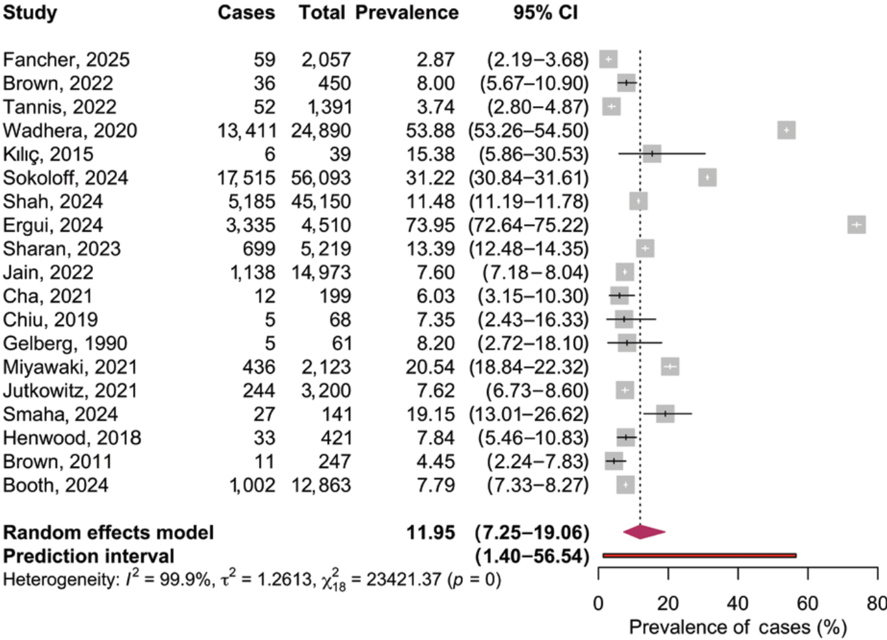
“The prevalence of HF was 12.0% (95% confidence interval (CI) 7.3–19.0; I2 = 99.9%).”
§ Prevalence and Risk of Heart Failure Among Older Adults Experiencing Homelessness: A Systematic Review and Meta-Analysis > Abstract > Results
plainn = 573,697- Asserted: passes — The authors put it forward as true.
- Checkable: passes — It can be checked against evidence.
- Load-bearing: passes — The paper’s conclusions depend on it.
- Based: passes — The paper gives a reason why it holds.
A result the paper reports from its own data — it cites no other source for it, so there is none to check. The quote shows it is in the paper.
In the paper
“Meta-regression for the age difference to the risk difference of HF was non-significant (b = −0.007, 95% CI −0.018 to 0.003).”
§ Prevalence and Risk of Heart Failure Among Older Adults Experiencing Homelessness: A Systematic Review and Meta-Analysis > RESULTS > Odds of HF, Incidence of HF, and HF Mortality
plain- Asserted: passes — The authors put it forward as true.
- Checkable: passes — It can be checked against evidence.
- Load-bearing: unclear — It is unclear whether the paper’s conclusions depend on it.
- Based: passes — The paper gives a reason why it holds.
A result the paper reports from its own data — it cites no other source for it, so there is none to check. The quote shows it is in the paper.
In the paper
“The funnel plot, Egger’s test (p = .023), and Doi (LFK (Luis Furuya-Kanamori) index = 1.01) test suggest the presence of small study bias toward a high prevalence of HF.”
§ Prevalence and Risk of Heart Failure Among Older Adults Experiencing Homelessness: A Systematic Review and Meta-Analysis > RESULTS > Prevalence of HF
hedgedstates an association- Asserted: passes — The authors put it forward as true.
- Checkable: passes — It can be checked against evidence.
- Load-bearing: unclear — It is unclear whether the paper’s conclusions depend on it.
- Based: passes — The paper gives a reason why it holds.
36 more claims
Create a free account to see all 85 claims and to verify the 56 references still open.
- It may state two separate claims as one. 21
- Probably not a substantial claim. 34
Self-check
Percentages, sums and reported differences re-computed from the paper’s own numbers.
Each contradiction between two passages listed here was confirmed by an independent check.
Rated minor: it would not touch a result — a value no result rests on, a p-value that stays on the same side of the significance level, or a conflict that is clerical, resolved elsewhere in the paper, or outside its own findings.
In the paper
§ Prevalence and Risk of Heart Failure Among Older Adults Experiencing Homelessness: A Systematic Review and Meta-Analysis > RESULTS > Participant Characteristics
“anxiety disorders (45.8%”
§ Prevalence and Risk of Heart Failure Among Older Adults Experiencing Homelessness: A Systematic Review and Meta-Analysis > RESULTS > Participant Characteristics
“33.2–39.5%”
Rated minor: it would not touch a result — a value no result rests on, a p-value that stays on the same side of the significance level, or a conflict that is clerical, resolved elsewhere in the paper, or outside its own findings.
In the paper
“Sixty-eight full-text studies were reviewed, with 21 studies meeting inclusion criteria. Backwards citation searching and the Google Scholar search identified an additional 12 studies, primarily comprising the HOPE-HOME cohort (n = 6/32 studies, 17.7%). This yielded a total of 34 studies.”
§ Prevalence and Risk of Heart Failure Among Older Adults Experiencing Homelessness: A Systematic Review and Meta-Analysis > RESULTS > Study Selection
Reported 34 · recomputed 33
Rated minor: it would not touch a result — a value no result rests on, a p-value that stays on the same side of the significance level, or a conflict that is clerical, resolved elsewhere in the paper, or outside its own findings.
In the paper
“the HOPE-HOME cohort (n = 6/32 studies, 17.7%)”
§ Prevalence and Risk of Heart Failure Among Older Adults Experiencing Homelessness: A Systematic Review and Meta-Analysis > RESULTS > Study Selection
Reported 17.7 · recomputed 18.75
Rated minor: it would not touch a result — a value no result rests on, a p-value that stays on the same side of the significance level, or a conflict that is clerical, resolved elsewhere in the paper, or outside its own findings.
In the paper
§ Prevalence and Risk of Heart Failure Among Older Adults Experiencing Homelessness: A Systematic Review and Meta-Analysis > Abstract > Results
“The prevalence of HF was 12.0% (95% confidence interval (CI) 7.3–19.0; I2 = 99.9%).”
§ Prevalence and Risk of Heart Failure Among Older Adults Experiencing Homelessness: A Systematic Review and Meta-Analysis > RESULTS > Prevalence of HF
“the prevalence of HF among older adults experiencing homelessness was 12.0% (95% confidence interval (CI) 7.3–19.1%, I2 = 99.9%)”
Citations
Cites
The PRISMA 2020 statement: An updated guideline for reporting systematic reviews
Page, M. J., McKenzie, J. E., Bossuyt, P. M., Boutron, I., Hoffmann, T. C., Mulrow, C. D., Shamseer, L., Tetzlaff, J. M., Akl, E. A., Brennan, S. E., et al. (2021) · BMJ · doi:10.1136/bmj.n71 · Cited by 108,283
Redfield, M. M., Jacobsen, S. J., Burnett, J. C., Mahoney, D. W., Bailey, K. R., & Rodeheffer, R. J. (2003) · JAMA · doi:10.1001/jama.289.2.194 · Cited by 3,004
The role of google scholar in evidence reviews and its applicability to grey literature searching
Haddaway, N. R., Collins, A. M., Coughlin, D., & Kirk, S. (2015) · PLOS ONE · doi:10.1371/journal.pone.0138237 · Cited by 2,387
Schandelmaier, S., Briel, M., Varadhan, R., Schmid, C. H., Devasenapathy, N., Hayward, R. A., Gagnier, J., Borenstein, M., van der Heijden, G. J. M. G., Dahabreh, I. J., et al. (2020) · Canadian Medical Association Journal · doi:10.1503/cmaj.200077 · Cited by 749
Heart Failure Epidemiology and Outcomes Statistics: A Report of the Heart Failure Society of America
Bozkurt, B., Ahmad, T., Alexander, K. M., Baker, W. L., Bosak, K., Breathett, K., Fonarow, G. C., Heidenreich, P., Ho, J. E., Hsich, E., et al. (2023) · Journal of Cardiac Failure · doi:10.1016/j.cardfail.2023.07.006 · Cited by 695
Bozkurt, B., Ahmad, T., Alexander, K., Baker, W. L., Bosak, K., Breathett, K., Carter, S., Drazner, M. H., Dunlay, S. M., Fonarow, G. C., et al. (2025) · Journal of Cardiac Failure · doi:10.1016/j.cardfail.2024.07.001 · Cited by 427
Prevalence, incidence and survival of heart failure: a systematic review
Emmons-Bell, S., Johnson, C., & Roth, G. (2022) · Heart · doi:10.1136/heartjnl-2021-320131 · Cited by 369
Ho, J. E., Enserro, D., Brouwers, F. P., Kizer, J. R., Shah, S. J., Psaty, B. M., Bartz, T. M., Santhanakrishnan, R., Lee, D. S., Chan, C., et al. (2016) · Circulation: Heart Failure · doi:10.1161/circheartfailure.115.003116 · Cited by 362
Methamphetamine Use and Cardiovascular Disease: In Search of Answers
Kevil, C. G., Goeders, N. E., Woolard, M. D., Bhuiyan, M. S., Dominic, P., Kolluru, G. K., Arnold, C. L., Traylor, J. G., & Orr, A. W. (2019) · Arteriosclerosis, Thrombosis, and Vascular Biology · doi:10.1161/atvbaha.119.312461 · Cited by 294
Geriatric syndromes in older homeless adults
Brown, R. T., Kiely, D. K., Bharel, M., & Mitchell, S. L. (2012) · Journal of General Internal Medicine · doi:10.1007/s11606-011-1848-9 · Cited by 256
McCormick, N., Lacaille, D., Bhole, V., & Avina-Zubieta, J. A. (2014) · PLoS ONE · doi:10.1371/journal.pone.0104519 · Cited by 234
Bates, B. A., Akhabue, E., Nahass, M. M., Mukherjee, A., Hiltner, E., Rock, J., Wilton, B., Mittal, G., Visaria, A., Rua, M., et al. (2023) · Circulation: Cardiovascular Quality and Outcomes · doi:10.1161/circoutcomes.122.009078 · Cited by 118
Differences in Health Status Between Older and Younger Homeless Adults
Gelberg, L., Linn, L. S., & Mayer‐Oakes, S. A. (1990) · Journal of the American Geriatrics Society · doi:10.1111/j.1532-5415.1990.tb01503.x · Cited by 116
Disparities in Care and Mortality Among Homeless Adults Hospitalized for Cardiovascular Conditions
Wadhera, R. K., Khatana, S. A. M., Choi, E. H., Jiang, G. Y., Shen, C., Yeh, R. W., & Maddox, K. E. J. (2019) · JAMA Internal Medicine · doi:10.1001/jamainternmed.2019.6010 · Cited by 105
Al-Shakarchi, N. J., Evans, H. E. R., Luchenski, S. A., Story, A., & Banerjee, A. (2020) · Heart · doi:10.1136/heartjnl-2020-316706 · Cited by 82
Factors Associated With Mortality Among Homeless Older Adults in California: The HOPE HOME Study.
Brown, R. T., Evans, J. L., Valle, K. A., Guzman, D., Chen, Y.-H., & Kushel, M. (2022) · JAMA Internal Medicine · doi:10.1001/jamainternmed.2022.3697 · Cited by 73
Coe, A. B., Moczygemba, L. R., Gatewood, S. B. S., Osborn, R. D., Matzke, G. R., & Goode, J.-V. R. (2015) · Research in Social and Administrative Pharmacy · doi:10.1016/j.sapharm.2012.11.004 · Cited by 65
Homelessness: Care, Prevention, and Public Policy
Plumb, J. D. (1997) · Annals of Internal Medicine · doi:10.7326/0003-4819-126-12-199706150-00007 · Cited by 63
Emergency Department Use in a Cohort of Older Homeless Adults: Results From the HOPE HOME Study
Raven, M. C., Tieu, L., Lee, C. T., Ponath, C., Guzman, D., & Kushel, M. (2017) · Academic Emergency Medicine · doi:10.1111/acem.13070 · Cited by 63
Richard, L., Hwang, S. W., Forchuk, C., Nisenbaum, R., Clemens, K., Wiens, K., Booth, R., Azimaee, M., & Shariff, S. Z. (2019) · BMJ Open · doi:10.1136/bmjopen-2019-030221 · Cited by 61
Factors associated with substance use in older homeless adults: Results from the HOPE HOME Study
Spinelli, M. A., Ponath, C., Tieu, L., Hurstak, E. E., Guzman, D., & Kushel, M. (2016) · Substance Abuse · doi:10.1080/08897077.2016.1264534 · Cited by 54
Averbuch, T., Mohamed, M. O., Islam, S., DeFilippis, E. M., Breathett, K. K., Alkhouli, M. A., Michos, E. D., Martin, G. P., Kontopantelis, E., Mamas, M. A., et al. (2021) · Journal of Cardiac Failure · doi:10.1016/j.cardfail.2021.09.012 · Cited by 53
Tong, M. S., Tieu, L., Lee, C. T., Ponath, C., Guzman, D., & Kushel, M. (2018) · Journal of Public Health · doi:10.1093/pubmed/fdy063 · Cited by 51
Examining the health status of homeless adults entering permanent supportive housing
Henwood, B. F., Lahey, J., Rhoades, H., Winetrobe, H., & Wenzel, S. L. (2017) · Journal of Public Health · doi:10.1093/pubmed/fdx069 · Cited by 51
LFK index does not reliably detect small‐study effects in meta‐analysis: A simulation study
Schwarzer, G., Rücker, G., & Semaca, C. (2024) · Research Synthesis Methods · doi:10.1002/jrsm.1714 · Cited by 47
Godolphin, P. J., White, I. R., Tierney, J. F., & Fisher, D. J. (2022) · Research Synthesis Methods · doi:10.1002/jrsm.1590 · Cited by 42
Morbidity and Mortality Among Adults Experiencing Homelessness Hospitalized With COVID-19
Cha, S., Henry, A., Montgomery, M. P., Laws, R. L., Pham, H., Wortham, J. M., Garg, S., Kim, L., Mosites, E. M., COVID-NET Surveillance Team, et al. (2021) · The Journal of Infectious Diseases · doi:10.1093/infdis/jiab261 · Cited by 36
Sharan, R., Wiens, K., Ronksley, P. E., Hwang, S. W., Booth, G. L., Austin, P. C., Spackman, E., Bai, L., & Campbell, D. J. T. (2023) · Diabetes Care · doi:10.2337/dc23-0211 · Cited by 30
Margolin, E., Huynh, T., Brann, A. M., & Greenberg, B. (2024) · JACC Advances · doi:10.1016/j.jacadv.2023.100818 · Cited by 28
Beyond the funnel plot: The advantages of Doi plots and prediction intervals in meta-analyses
Shamim, M. A., Dwivedi, P., & Padhi, B. K. (2023) · Asian Journal of Psychiatry · doi:10.1016/j.ajp.2023.103550 · Cited by 28
Determinants of Implementation of a Clinical Practice Guideline for Homeless Health
Magwood, O., Hanemaayer, A., Saad, A., Salvalaggio, G., Bloch, G. C., Moledina, A., Pinto, N. M., Ziha, L., Geurguis, M., Aliferis, A., et al. (2020) · International Journal of Environmental Research and Public Health · doi:10.3390/ijerph17217938 · Cited by 28
Shakoor, A., van Maarschalkerwaart, W., Schaap, J., de Boer, R. A., Mieghem, N. M. V., Boersma, E. H., van Heerebeek, L., Brugts, J. J., & van der Boon, R. M. A. (2024) · ESC Heart Failure · doi:10.1002/ehf2.14986 · Cited by 21
Booth, R. G., Dasgupta, M., Forchuk, C., & Shariff, S. Z. (2024) · The Lancet Public Health · doi:10.1016/s2468-2667(24)00022-7 · Cited by 21
Abbs, E., Brown, R., Guzman, D., Kaplan, L., & Kushel, M. (2020) · Journal of General Internal Medicine · doi:10.1007/s11606-020-05637-0 · Cited by 21
El-Zein, R. S., Mohammed, M., Nguyen, D. D., Hill, C. L., Thomas, L. E., Nassif, M. E., DeVore, A. D., Albert, N. M., Butler, J., Patterson, J. H., et al. (2024) · Circulation Cardiovascular Quality and Outcomes · doi:10.1161/circoutcomes.123.010211 · Cited by 17
Differences in disease prevalence among homeless and non-homeless veterans at an urban VA hospital
Tannis, C., & Rajupet, S. R. (2021) · Chronic Illness · doi:10.1177/17423953211023959 · Cited by 14
Inpatient Care and Outcomes Among People With Cancer Experiencing Homelessness
Shah, K. J., Santos, P. M. G., Boe, L. A., Barnes, J. M., Tao, A., Tsai, C. J., & Chino, F. L. (2024) · JAMA Oncology · doi:10.1001/jamaoncol.2024.3645 · Cited by 11
Sleep Quality among Homeless-Experienced Older Adults: Exploratory Results from the HOPE HOME Study
Garcia, C. M., Schrier, E., Carey, C. A., Valle, K. A., Evans, J. L., & Kushel, M. (2023) · Journal of General Internal Medicine · doi:10.1007/s11606-023-08429-4 · Cited by 11
Miyawaki, A., Khullar, D., & Tsugawa, Y. (2021) · BMJ Open · doi:10.1136/bmjopen-2020-046959 · Cited by 10
Jutkowitz, E., DeVone, F., Halladay, C. W., Hooshyar, D., Tsai, J., & Rudolph, J. L. (2021) · PubMed · Cited by 10
Homeless Patients in the Emergency Department
Kılıç, T. Y., Yeşilaras, M., Atilla, O., Toker, I., & Temizyurek, Z. (2015) · Eurasian Journal of Emergency Medicine · doi:10.5152/jaem.2015.70188 · Cited by 8
Prevalence and Risk of Dementia Among Adults Who Have Experienced Homelessness, a Meta‐Analysis
Hoang, P., Huang, Y. Q., Jay, M., Berg, V., van Ballegooie, C., Reppas‐Rindlisbacher, C. E., Lane, N. E., Alston, J., & Rochon, P. A. (2025) · Journal of the American Geriatrics Society · doi:10.1111/jgs.70072 · Cited by 6
Self-citationSmaha, J., Falat, J., Gažová, A., Kužma, M., Kyselovič, J., Palkovič, M., Kuruc, R., Babál, P., Payer, J., & Jackuliak, P. (2024) · International Journal of Public Health · doi:10.3389/ijph.2024.1607642 · Cited by 6
Examining Heart Failure Outcomes Amid Housing Insecurity
WEBB, M., Brownell, N. K., Gabrielian, S. E., Fonarow, G. C., & Ziaeian, B. (2024) · Journal of Cardiac Failure · doi:10.1016/j.cardfail.2024.06.005 · Cited by 5
Association of Homelessness and Unstable Housing With Cardiovascular Care Utilization Among Veterans
Sokoloff, L. J., Wu, J., Eberly, L. A., Nathan, A. S., Julien, H. M., Kobayashi, T., Damrauer, S. M., Groeneveld, P. W., Tsai, J., & Khatana, S. A. M. (2024) · Circulation Cardiovascular Quality and Outcomes · doi:10.1161/circoutcomes.124.010993 · Cited by 2
Ergui, I., Salama, J., Hooda, U., Ebner, B., Dangl, M. D., Vincent, L. T., Sancassani, R. B., & Colombo, R. A. (2024) · Clinical Cardiology · doi:10.1002/clc.24235 · Cited by 1
Explaining heterogeneity in meta-analysis: a comparison of methods
Thompson, S. G., & Sharp, S. J. (1999) · Statistics in Medicine · doi:10.1002/(sici)1097-0258(19991030)18:20
(2020) · doi:10.1093/eurheartj/ehaa795
(2024) · doi:10.1108/ijhrh-09-2023-0077
Research works printed but not linked: 5
- [35]Jain A Dhaduk K Taj Shiza S Shawl S Raina J Itare V Abstract 61: Major adverse cardiovascular and cerebrovascular events among homeless cancer survivors: a decade-apart nationwide hospitalizations analysis Circ Cardiovasc Qual Outcomes 2022 15 Suppl_1 A61 10.1161/circoutcomes.15.suppl_1.61 · doi:10.1161/circoutcomes.15.suppl_1.61
- [37]Chiu CA Werge DA Arab N Palafox M Minejima E 1486: Evaluation of the impact of homelessness on presentation and outcomes of gram-negative sepsis Open Forum Infect Dis 2019 6 Suppl 2 S541 10.1093/ofid/ofz360.1350 · doi:10.1093/ofid/ofz360.1350
- [45]Weze K Echols M Hospitalization trends for patients experiencing homelessness and heart failure pre- and post-affordable care act implementation J Card Fail 2023 29 4 558 9 10.1016/j.cardfail.2022.10.032 · doi:10.1016/j.cardfail.2022.10.032
- [47]Minhas A Salah H Shahid I Warraich HJ Fudim M Nasir K Abstract 9992: Homelessness and heart failure Circulation 2021 144 Suppl_1 A9992 10.1161/circ.144.suppl_1.9992 · doi:10.1161/circ.144.suppl_1.9992
- [53]Tran K Butcher R Heart function clinics for patients with heart failure Can J Health Technol 2021 1 9 36409795
Cited by
Still being checked.
Metadata
- Authors
- Hoang, P. M., Ding, J., Almsari, L., Seedu, J., Asgarali, R., Huang, Y. Q., De Castro, C., Rochon, P., Harris, M., & Kokorelias, K. M.
- Affiliations
- University Health Network (CA)
- University of Toronto (CA)
- University of British Columbia (CA)
- Wilfrid Laurier University (CA)
- Corresponding author
- Hoang, Peter M.
- Venue
- Canadian Geriatrics Journal
- Publisher
- Canadian Geriatrics Society
- Published
- 2026-09-02
- Volume
- 29
- Issue
- 3
- Pages
- 200-208
- ISSN
- 1925-8348 (ISSN-L)
- PMC
- PMC13528768
- OpenAlex
- W7204933013
- Semantic Scholar
- 259095b8b721a25453200336ec0a0b9b0a9a2803
- Cited by
- 0
- References
- 49
- FWCI
- 0.00
- Type
- journal article
- Language
- en
- Open access
- diamond
- doi.org
- Licence
- Locations
- Canadian Geriatrics Journal (publishedVersion, cc-by-nc-nd)
- PubMed Central (publishedVersion, cc-by-nc-nd)
- PubMed (publishedVersion)
- DOAJ (DOAJ: Directory of Open Access Journals) (submittedVersion)
- Funders
- Alzheimer Society
- University of Toronto
- Topics
- Social Sciences › Sociology and Political Science › Homelessness and Social Issues
- Health Sciences › Medicine › Cardiology and Cardiovascular Medicine › Heart Failure Treatment and Management
- Health Sciences › Medicine › Cardiology and Cardiovascular Medicine › Cardiovascular Function and Risk Factors
- Keywords
- heart failure, homelessness, older adults, heart failure prevalence, heart failure mortality, housing status, risk factors, health equity
About these checks
Registry, retraction, Cites and statistics results are computed, not judged, with one exception: a printed reference that no index lists is read once by a model before it counts as a citation error. Claims are extracted by a model and kept only when their quote appears verbatim in the text; each cited source is then checked, with a model’s help, for whether it says what the claim relies on. Those verdicts can be wrong — read the claim’s quote and the cited source before relying on one.
A language model drew the claims from the paper on 2026-11-25, under version 3 of the claim definition (model deepseek-v4.1-flash, prompt extract-v3).
A second model labelled each claim on 2026-11-25 (model jev-1.13-20260917, definition revision gold-guideline-v0.2).
Statistics and arithmetic are recomputed, not judged.
Confidence bands are shown only for fields calibrated on our annotated test set. None is calibrated yet, so no band is shown.
What counts as a claim ›How we measure confidence ›How we check this ›
Are you an author, or do you see a problem with this page? Request a review
Data sources
Bibliographic data: Semantic Scholar, OpenAlex, Crossref.
Contains information from the Semantic Scholar Academic Graph Datasets, made available under the ODC Attribution License (ODC-BY 1.0).
Semantic Scholar’s data is described in: Kinney, R., et al. (2023). The Semantic Scholar Open Data Platform. arXiv:2301.10140.
