

Arginine and Linear Growth in Children and Adolescents: Scientific Evidence or Marketing Claim?
Open accessThe DOI matches its Crossref record; 13 of the 13 references it cites were found in a registry or an index; none of the 49 sources its claims cite is checked for support yet.
Abstract
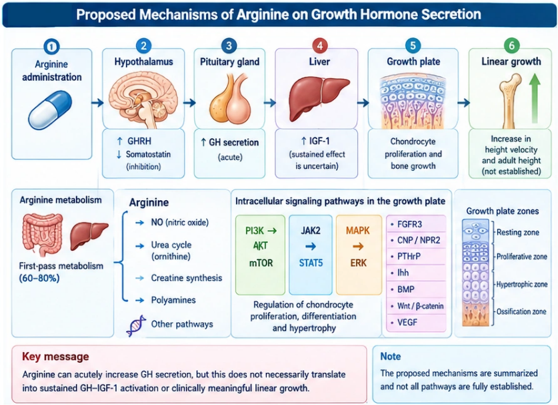
Context: Arginine is a conditionally essential amino acid involved in nitrogen metabolism, protein synthesis, nitric oxide production, and several metabolic pathways. It has also been used intravenously as a pharmacological stimulus in growth hormone (GH) stimulation testing. These physiological effects have led to widespread claims that oral arginine supplementation can increase linear growth in children and adolescents. However, an acute hormonal response should not be equated with a clinically meaningful increase in height. Evidence Acquisition: This narrative review examines the biological fate of arginine after administration and its relationship to GH secretion and growth plate physiology; it also examines evidence concerning insulin-like growth factor-1 (IGF-1) and clinical studies evaluating oral arginine supplementation and linear growth. Major pediatric and endocrine textbooks, international clinical guidelines, and recent systematic reviews and meta-analyses were considered, with particular attention to evidence directly evaluating growth outcomes rather than surrogate hormonal responses. Results: Arginine can acutely increase GH secretion, partly by attenuating somatostatin-mediated inhibition. However, this response is transient and differs substantially from sustained activation of the GH–IGF-1 axis and persistent stimulation of the growth plate. A 2023 systematic review and meta-analysis found no significant overall effect of arginine supplementation on IGF-1 concentrations. A 2026 systematic review and meta-analysis of oral arginine in prepubertal children with idiopathic short stature reported a small increase in height velocity in pooled analyses that included 6- or 12-month interventions, corresponding to a re-expressed mean difference of approximately 0.59 cm/year (95% CI: 0.19 – 1.00). However, the evidence was considered low quality, and the effect was not statistically significant when the analysis was restricted to 12-month interventions. Conclusions: Current evidence does not establish oral arginine as a standard treatment for increasing height in children and adolescents. The distinction between an acute GH response, a biological effect on the GH–IGF-1 axis, increased growth velocity, and an increase in adult height is essential when evaluating claims concerning arginine supplementation. In children with short stature, assessment of growth pattern, growth velocity, familial target height, pubertal status, nutritional status, and possible underlying disease should precede consideration of supplements. Further adequately powered randomized controlled trials with standardized growth outcomes and sufficiently long follow-up are needed.
Overview
CoChat Summary
TL;DR
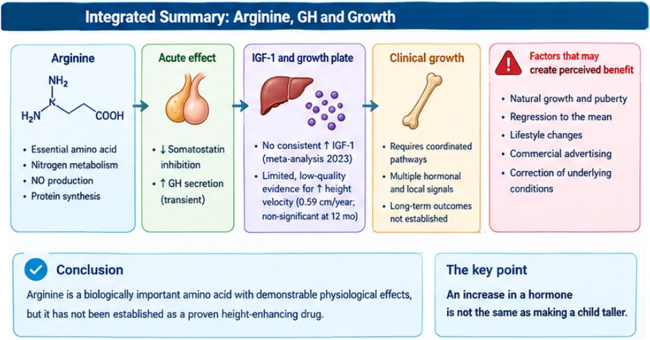
This narrative review argues that arginine's ability to acutely stimulate growth hormone secretion does not establish it as an effective height-promoting intervention in children and adolescents. Current evidence, including a 2026 meta-analysis showing a small and low-quality height-velocity signal, is insufficient to recommend oral arginine as standard treatment for short stature.
Key findings
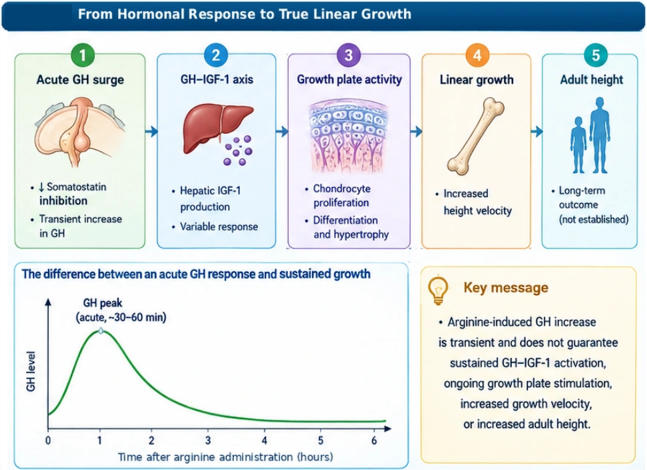
- Arginine can acutely increase GH secretion, partly by attenuating somatostatin-mediated inhibition, but this response is transient and does not demonstrate sustained GH-IGF-1 axis activation or persistent growth plate stimulation.
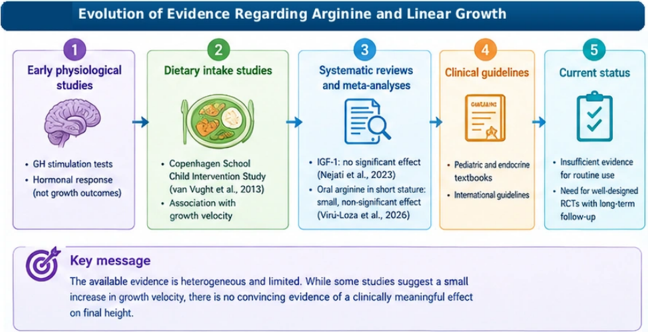
- A 2023 systematic review and meta-analysis (Nejati et al.) found no significant overall effect of acute or chronic arginine supplementation on IGF-1 concentrations.
- A 2026 systematic review and meta-analysis (Virú-Loza et al.) of oral arginine in prepubertal children with idiopathic short stature reported a pooled height-velocity increase corresponding to a re-expressed mean difference of approximately 0.59 cm/year (95% CI: 0.19–1.00) across 6- or 12-month interventions, but the evidence was rated low quality and the effect was not statistically significant when restricted to 12-month interventions.
- In the Copenhagen School Child Intervention Study (van Vught et al.), children aged 7–13 years in the third and fourth quintiles of arginine intake (2.5–2.8 and 2.8–3.2 g/day) had greater growth velocity than the lowest quintile (< 2.2 g/day), with a largest reported difference of approximately 0.33 cm/year; the association lost statistical significance after adjustment for dietary protein intake excluding arginine.
Methods
- Narrative review (not a systematic review) using iterative, targeted searches of PubMed and PubMed Central, supplemented by manual reference-list examination of primary studies, systematic reviews, and meta-analyses, plus pediatric/endocrine textbooks and international guidelines.
- A supplementary targeted search was conducted on October 30, 2026, covering literature from database inception through that date, using keywords including "arginine," "L-arginine supplementation," "linear growth," "height velocity," "growth hormone," "IGF-1," and "growth plate."
- Priority was given to clinical studies evaluating oral arginine supplementation and anthropometric growth outcomes; no formal systematic-review protocol, predefined screening process, or quantitative meta-analysis was undertaken.
Limitations
- Stated by the paper: it is a narrative rather than systematic review, with no formal protocol, predefined systematic screening, or quantitative meta-analysis; the author also notes that adequately powered RCTs with standardized growth outcomes and sufficiently long follow-up are still needed.
- Stated by the paper: the 2026 meta-analytic evidence was of low quality, the effect magnitude was limited, and durability and clinical importance of the observed effect remain uncertain; evidence demonstrating sustained change in growth trajectory or improvement in adult height is lacking.
- Evident from the text: the review relies on a small number of key sources (notably the 2023 and 2026 meta-analyses and one observational cohort), and the van Vught observational findings cannot establish that supplementation increases height in children with short stature and were confounded by overall protein intake.
Model-written summary. Check it against the paper before relying on it.
Integrity signals
Registry
Cites
Statistics
Figures
Verification
Claims the paper makes
0 Valid · 0 Not valid · 25 Not checked · 25 Own results and interpretations
A conclusion the paper draws from its own results — it cites no other source for it, so there is none to check. The quote shows it is in the paper.
In the paper
“The same principle applies to arginine: its ability to transiently increase GH does not establish persistent stimulation of the growth plate.”
- Also stated in: § 5. Conclusions · plain
“However, a transient increase in GH does not establish sustained activation of the GH-IGF-1 axis, persistent stimulation of the growth plate, increased growth velocity, or increased adult height.”
§ Arginine and Linear Growth in Children and Adolescents: Scientific Evidence or Marketing Claim? > 3.1. Biological Relationship Between Arginine and Growth Hormone
plain- Asserted: passes — The authors put it forward as true.
- Checkable: passes — It can be checked against evidence.
- Load-bearing: passes — The paper’s conclusions depend on it.
- Based: passes — The paper gives a reason why it holds.
- Also stated in: § 5. Conclusions · plain
A conclusion the paper draws from its own results — it cites no other source for it, so there is none to check. The quote shows it is in the paper.
In the paper
“Such observations cannot establish causality.”
§ Arginine and Linear Growth in Children and Adolescents: Scientific Evidence or Marketing Claim? > 3.5. Factors That May Contribute to Perceived Benefit
plain- Asserted: passes — The authors put it forward as true.
- Checkable: passes — It can be checked against evidence.
- Load-bearing: passes — The paper’s conclusions depend on it.
- Based: passes — The paper gives a reason why it holds.
None of the sources cited for this claim have been checked yet.
In the paper
“A specific and established direct molecular target of arginine within the growth plate that could explain a sustained pharmacological increase in linear growth has not been established (3,5,12).”
§ Arginine and Linear Growth in Children and Adolescents: Scientific Evidence or Marketing Claim? > J Compr Ped. 2026; 17(4): e175161
What the sources say
- Not checked yetcites [3] Álvares TS, Meirelles CM, Bhambhani YN, Paschoalin VM, Gomes PS. L- Arginine as a potential ergogenic aid in healthy subjects. Sports Med. 2011;41(3):233-248. [PubMed ID: 21395365]. https://doi.org/10.2165/11538590-000000000-00000. source
- Not checked yetcites [5] Grimberg A, DiVall SA, Polychronakos C, Allen DB, Cohen LE, Quintos JB, et al. Guidelines for growth hormone and insulin-like growth factor-I treatment in children and adolescents: Growth hormone deficiency, idiopathic short stature, and primary insulin-like growth factor-I deficiency. Horm Res Paediatr. 2016;86(6):361-397. [PubMed ID: 27884013]. https://doi.org/10.1159/000452150. source
- Not checked yetcites [12] Nejati M, Dehghan P, Safari S, Jamilian P, Zarezadeh M. The influence of arginine supplementation on IGF-1: A systematic review and meta- analysis. Clin Nutr ESPEN. 2023;55:51-57. [PubMed ID: 37202084]. https://doi.org/10.1016/j.clnesp.2023.02.024. source
plain- Asserted: passes — The authors put it forward as true.
- Checkable: passes — It can be checked against evidence.
- Load-bearing: passes — The paper’s conclusions depend on it.
- Based: passes — The paper gives a reason why it holds.
A conclusion the paper draws from its own results — it cites no other source for it, so there is none to check. The quote shows it is in the paper.
In the paper
“The central finding of this narrative review is that the biological capacity of arginine to increase GH secretion should not be interpreted as evidence that oral arginine is an established height-promoting intervention.”
§ Arginine and Linear Growth in Children and Adolescents: Scientific Evidence or Marketing Claim? > 4. Discussion
plain- Asserted: passes — The authors put it forward as true.
- Checkable: passes — It can be checked against evidence.
- Load-bearing: passes — The paper’s conclusions depend on it.
- Based: passes — The paper gives a reason why it holds.
- Rests on 2 assumptions not shown here.
In the paper
“In Laron syndrome, impaired GH receptor signaling results in markedly reduced IGF-1 activity and severe postnatal growth impairment, despite the presence of circulating GH (1).”
- Also stated in: § 4. Discussion · plain
“Children with impaired GH receptor signaling can have circulating GH but markedly impaired IGF-1 activity and severe growth failure (1).”
§ Arginine and Linear Growth in Children and Adolescents: Scientific Evidence or Marketing Claim? > 3.1. Biological Relationship Between Arginine and Growth Hormone
What the sources say
- Not checked yetcites [1] Melmed S, Auchus RJ, Goldfine AB, Koenig RJ, Rosen CJ, editors. Williams Textbook of Endocrinology. 15th ed. Philadelphia: Elsevier; 2024.
plainstates a cause- Asserted: passes — The authors put it forward as true.
- Checkable: passes — It can be checked against evidence.
- Load-bearing: passes — The paper’s conclusions depend on it.
- Based: passes — The paper gives a reason why it holds.
- Also stated in: § 4. Discussion · plain
27 more claims
Create a free account to see all 50 claims and to verify the 49 references still open.
- Probably not a substantial claim. 5
- It may state two separate claims as one. 13
Citations
Cites
Grimberg, A., DiVall, S. A., Polychronakos, C., Allen, D. B., Cohen, L. E., Quintos, J. B., Rossi, W. C., Feudtner, C., Murad, M. H., & on behalf of the Drug and Therapeutics Committee and Ethics Committee of the Pediatric Endocrine Society (2016) · Hormone Research in Paediatrics · doi:10.1159/000452150 · Cited by 821
Cohen, P., Rogol, A. D., Deal, C. L., Saenger, P., Reiter, E. O., Ross, J. L., Chernausek, S. D., Savage, M. O., Wit, J. M., & participants, O. B. O. T. 2. I. C. W. (2008) · The Journal of Clinical Endocrinology & Metabolism · doi:10.1210/jc.2008-0509 · Cited by 737
Horton, W. A., Hall, J. G., & Hecht, J. T. (2007) · The Lancet · doi:10.1016/s0140-6736(07)61090-3 · Cited by 582
Short and tall stature: a new paradigm emerges
Baron, J., Sävendahl, L., De Luca, F., Dauber, A., Phillip, M., Wit, J. M., & Nilsson, O. (2015) · Nature Reviews Endocrinology · doi:10.1038/nrendo.2015.165 · Cited by 314
Hokken-Koelega, A. C. S., van der Steen, M., Boguszewski, M. C. S., Cianfarani, S., Dahlgren, J., Horikawa, R., Mericq, V., Rapaport, R., Alherbish, A., Braslavsky, D., et al. (2023) · Endocrine Reviews · doi:10.1210/endrev/bnad002 · Cited by 261
Savarirayan, R., Tofts, L., Irving, M., Wilcox, W., Bacino, C. A., Hoover-Fong, J., Ullot Font, R., Harmatz, P., Rutsch, F., Bober, M. B., et al. (2020) · The Lancet · doi:10.1016/s0140-6736(20)31541-5 · Cited by 204
L-Arginine as a Potential Ergogenic Aid in Healthy Subjects
Álvares, T. S., Meirelles, C. M., Bhambhani, Y. N., Paschoalin, V. M. F., & Gomes, P. S. C. (2011) · Sports Medicine · doi:10.2165/11538590-000000000-00000 · Cited by 138
Safety and Effectiveness of Arginine in Adults
McNeal, C. J., Meininger, C. J., Reddy, D., Wilborn, C., & Wu, G. (2016) · Journal of Nutrition · doi:10.3945/jn.116.234740 · Cited by 103
Wit, J. M., Kamp, G. A., Oostdijk, W., & on behalf of the Dutch Working Group on Triage and Diagnosis of Growth Disorders in Children (2019) · Hormone Research in Paediatrics · doi:10.1159/000499915 · Cited by 63
Dietary arginine and linear growth: the Copenhagen School Child Intervention Study
van Vught, A. J. A. H., Dagnelie, P. C., Arts, I. C. W., Froberg, K., Andersen, L. B., El-Naaman, B., Bugge, A., Nielsen, B. M., & Heitman, B. L. (2013) · British Journal of Nutrition · doi:10.1017/s0007114512002942 · Cited by 25
Research works printed but not linked: 2
- Melmed S, Auchus RJ, Goldfine AB, Koenig RJ, Rosen CJ, editors. Williams Textbook of Endocrinology. 15th ed. Philadelphia: Elsevier; 2024.
- Kliegman RM, St Geme JW, Blum NJ, Shah SS, Tasker RC, Wilson KM, editors. Nelson Textbook of Pediatrics. 22nd ed. Philadelphia: Elsevier; 2024.
Metadata
- Authors
- Elyasi, B.
- Affiliations
- Independent Pediatrician, Mashhad, Iran
- Corresponding author
- Elyasi, Babak
- ORCID
- Elyasi, Babak
- Venue
- Journal of Comprehensive Pediatrics
- Publisher
- Brieflands
- Published
- 2026-11-14
- Volume
- 17
- Issue
- 4
- ISSN
- 2251-8150 (ISSN-L)
- 2251-8177
- OpenAlex
- W7236236225
- Cited by
- 0
- References
- 13
- FWCI
- 0.00
- Type
- journal article
- Language
- en
- Open access
- diamond
- doi.org
- Licence
- cc-by
- creativecommons.org/licenses/by/4.0/ (am)
- creativecommons.org/licenses/by/4.0/ (vor)
- creativecommons.org/licenses/by/4.0/ (tdm)
- Locations
- Journal of Comprehensive Pediatrics (publishedVersion, cc-by)
- Topics
- Health Sciences › Medicine › Endocrinology, Diabetes and Metabolism › Growth Hormone and Insulin-like Growth Factors
- Health Sciences › Medicine › Pediatrics, Perinatology and Child Health › Human Health and Disease
- Health Sciences › Medicine › Reproductive Medicine › Hypothalamic control of reproductive hormones
- Keywords
- arginine supplementation, linear growth, children and adolescents, growth hormone secretion, insulin-like growth factor I, growth plate, idiopathic short stature, height velocity, somatostatin, dietary supplements, adult height
About these checks
Registry, retraction, Cites and statistics results are computed, not judged, with one exception: a printed reference that no index lists is read once by a model before it counts as a citation error. Claims are extracted by a model and kept only when their quote appears verbatim in the text; each cited source is then checked, with a model’s help, for whether it says what the claim relies on. Those verdicts can be wrong — read the claim’s quote and the cited source before relying on one.
A language model drew the claims from the paper on 2026-11-28, under version 3 of the claim definition (model deepseek-v4.1-flash, prompt extract-v3).
A second model labelled each claim on 2026-11-28 (model jev-1.13-20260917, definition revision gold-guideline-v0.2).
Statistics and arithmetic are recomputed, not judged.
Confidence bands are shown only for fields calibrated on our annotated test set. None is calibrated yet, so no band is shown.
What counts as a claim ›How we measure confidence ›How we check this ›
Are you an author, or do you see a problem with this page? Request a review
Data sources
Bibliographic data: Semantic Scholar, OpenAlex, Crossref.
Contains information from the Semantic Scholar Academic Graph Datasets, made available under the ODC Attribution License (ODC-BY 1.0).
Semantic Scholar’s data is described in: Kinney, R., et al. (2023). The Semantic Scholar Open Data Platform. arXiv:2301.10140.
