

Influence of Mascarene High and Indian Ocean dipole on East African extreme weather events
Open accessThe DOI matches its Crossref record; 40 of the 40 references it cites were found in a registry or an index.
Abstract
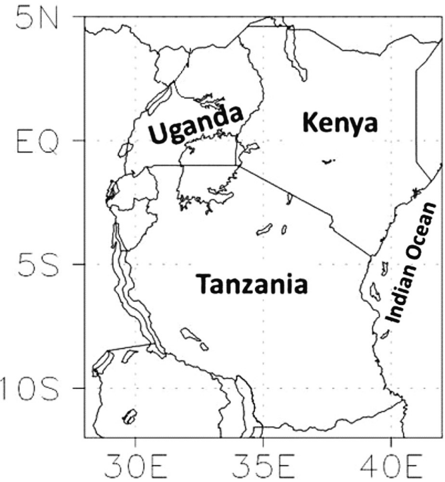
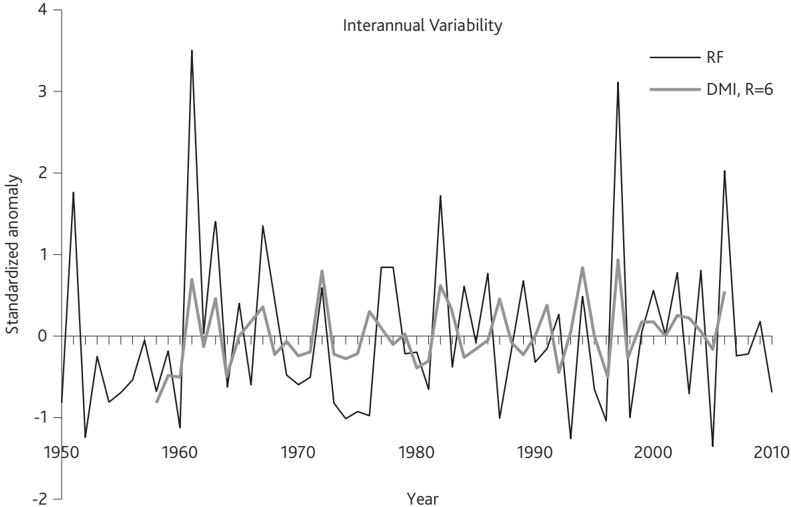
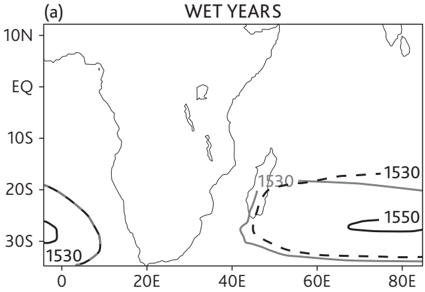
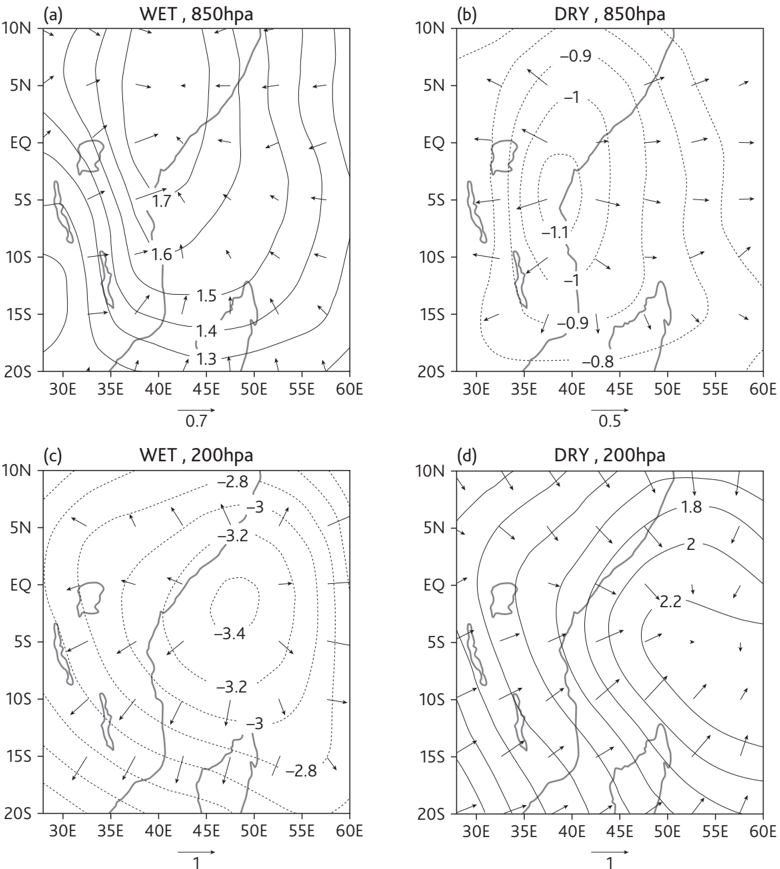
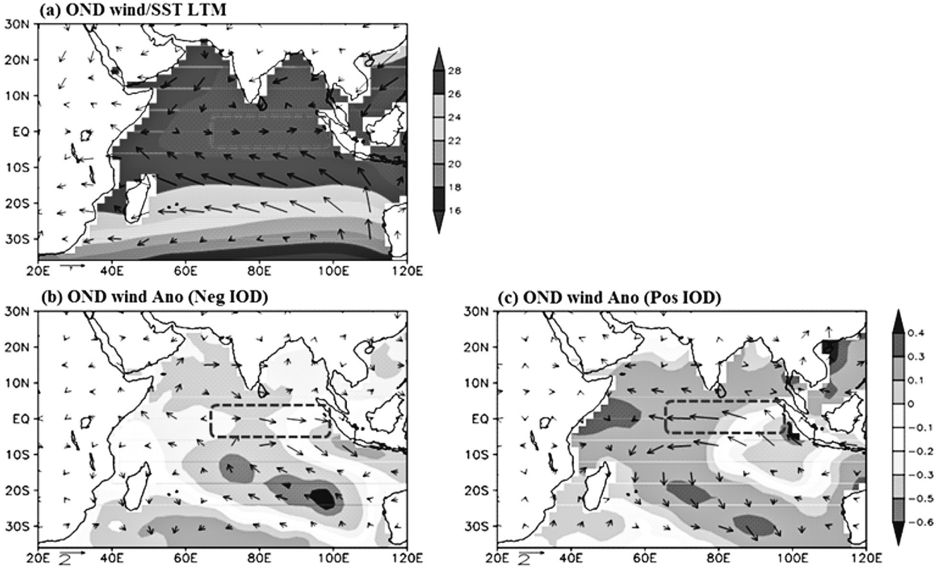
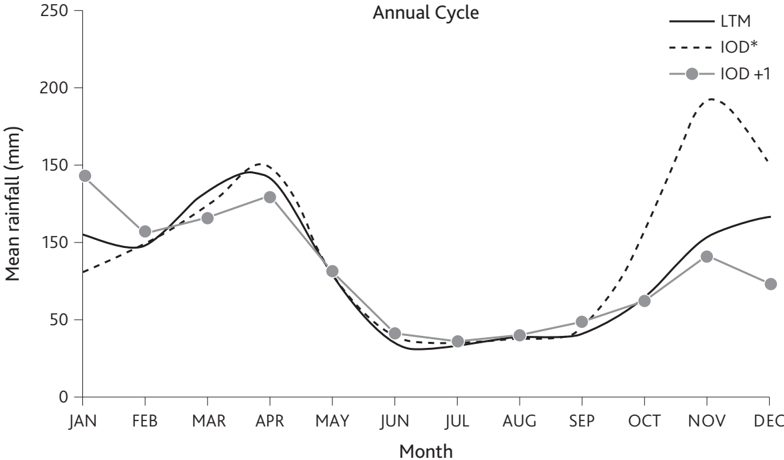
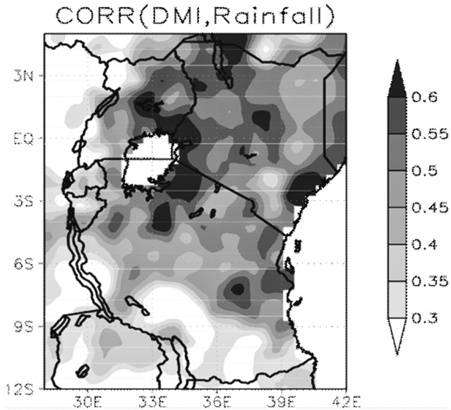
Extreme weather and climate events such as floods and droughts are common in East Africa, causing huge socio-economic losses. This study links the east African October-December (OND) rainfall, Indian Ocean Dipole (IOD) and Mascarene High (MH).Correlation analysis is applied to quantify the relationship between the index of IOD (Dipole Mode Index (DMI)) and OND rainfall. Results show that there exists a significant correlation between OND rainfall and DMI, with a correlation coefficient of 0.6. During dry years, MH is observed to intensify and align itself in the southeast-northwest orientation, stretching up to the continent, which in turn inhibits the influx of moisture from Indian Ocean into East Africa. During wet years, MH weakens, shifts to the east and aligns itself in the zonal orientation. Moisture from Indian Ocean is freely transported into east Africa during wet years. Analysis of the drought and flood years with respect to the different variables including wind, velocity potential and divergence/ convergence revealed that the drought (flood) years were characterized by divergence (convergence) in the lower troposphere and convergence (divergence) at the upper level, implying sinking (rising) motion, especially over the western Indian Ocean and the study area. Convergence at low level gives rise to vertical stretching, whereas divergence results in vertical shrinking, which suppresses convection due to subsidence. Positive IOD (Negative IOD) event results into flood (drought) in the region. The evolution of these phenomena can thus be keenly observed for utilization in the update of seasonal forecasts.
Overview
The claims and statistics of this paper haven’t been checked yet.
Free: it reads the open-access text and checks the first 5 claims that cite a source we can check. Create a free account to check every claim.
Integrity signals
Registry
Cites
Statistics
Figures
Verification
Claims the paper makes
The claims and statistics of this paper haven’t been checked yet.
Free: it reads the open-access text and checks the first 5 claims that cite a source we can check. Create a free account to check every claim.
Claims other papers make about this one
Each is checked against this paper’s own text: does it say what the citing paper says it does?
The source backs part of the claim, not all of it — or backs it for a different population, condition or comparison.
In the citing paper
“Additionally, the location and intensity of the Mascarene High [73], low-level jet streams, pressure cells over the Sahara and Saudi Arabia, and local topography, also contribute to rainfall variation in East Africa [60, 74] and hence to the rainfall oscillations in the GMSE.”
From Trends and cycles in rainfall, temperature, NDVI, IOD and SOI in the Mara-Serengeti: Insights for biodiversity conservation (2024) · cites this paper as [73]
Experimental — accuracy not yet measured
Self-check
Percentages, sums and reported differences re-computed from the paper’s own numbers.
The self-check needs the paper’s full text.
Citations
Cites
The NCEP/NCAR 40-Year Reanalysis Project
Kalnay, E., Kanamitsu, M., Kistler, R., Collins, W., Deaven, D., Gandin, L., Iredell, M., Saha, S., White, G., Woollen, J., et al. (1996) · Bulletin of the American Meteorological Society · doi:10.1175/1520-0477(1996)077<0437:tnyrp>2.0.co;2 · Cited by 28,360
A dipole mode in the tropical Indian Ocean
Saji, N. H., Goswami, B. N., Vinayachandran, P. N., & Yamagata, T. (1999) · Nature · doi:10.1038/43854 · Cited by 5,510 · cited 1×
“The Dipole Mode Index (DMI) is an index used to quantify Indian Ocean Dipole (IOD) is used in this study, it has by been used by a number of studies (e.g. Behera et al., 2005; Muhati et al., 2007; Saji et al., 1999).”
MethodGlobal and Regional Scale Precipitation Patterns Associated with the El Niño/Southern Oscillation
Ropelewski, C. F., & Halpert, M. S. (1987) · Monthly Weather Review · doi:10.1175/1520-0493(1987)115<1606:garspp>2.0.co;2 · Cited by 3,674
Improvements to NOAA’s Historical Merged Land–Ocean Surface Temperature Analysis (1880–2006)
Smith, T. M., Reynolds, R. W., Peterson, T. C., & Lawrimore, J. (2008) · Journal of Climate · doi:10.1175/2007jcli2100.1 · Cited by 2,923 · cited 2×
“The SST data (1950 - 2010) used is the Extended Reconstructed Sea Surface Temperature (ERSST) version3b from the National Oceanic and Atmospheric Administration/National Climatic Data Center (Smith et al., 2008), available in their website at http:// iridl.”
MethodStatistical Methods in the Atmospheric Sciences
Briggs, W. (. (2007) · Journal of the American Statistical Association · doi:10.1198/jasa.2007.s163 · Cited by 1,531 · cited 1×
“Simple Correlation analysis reveals simple relationship between pairs of variables (Wilks, 2006).”
BackgroundSchneider, U., Becker, A., Finger, P., Meyer-Christoffer, A., Ziese, M., & Rudolf, B. (2014) · Theoretical and Applied Climatology · doi:10.1007/s00704-013-0860-x · Cited by 1,385 · cited 1×
“It is calculated from the global station data (Schneider et al., 2013).”
An Extension of the Tahiti–Darwin Southern Oscillation Index
Ropelewski, C. F., & Jones, P. D. (1987) · Monthly Weather Review · doi:10.1175/1520-0493(1987)115<2161:aeotts>2.0.co;2 · Cited by 891
The nature of rainfall variability over Africa on time scales of decades to millenia
Nicholson, S. (2000) · Global and Planetary Change · doi:10.1016/s0921-8181(00)00040-0 · Cited by 662
Black, E. C. L., Slingo, J., & Sperber, K. R. (2002) · Monthly Weather Review · doi:10.1175/1520-0493(2003)131<2112:soteto>2.0.co;2 · Cited by 493
Black, E., Slingo, J., & Sperber, K. R. (2003) · Monthly Weather Review · doi:10.1175/1520-0493(2003)131<0074:aosotr>2.0.co;2 · Cited by 485 · cited 1×
“The intensity of the ITCZ has a significant effect on the rainfall received in a given locality; it thus plays ITCZ plays a crucial part in the rainfall variability over East Africa (Black et al., 2003).”
Background
Research works printed but not linked: 4
- Ogwang, B.A., Guirong, T., Haishan, C. 2012. Diagno- sis of September -November Drought and the As- sociated Circulation Anomalies Over Uganda. Pa- kistan Journal of Meteorology 9,11-24
- Okoola, R.E. 1996. Space-Time Characteristics of ITCZ over Equatorial East Africa during anoma- lous rainfall years. PhD. Thesis, University of Nai- robi, Kenya
- Okoola, R.E. 1999. A diagnostic study of the East Af- rican monsoon circulation during the northern hemisphere spring season. International Journal of Climatology 19, 143-169
- Yang, W, Seager R, Cane M.A., Lyon B. 2015. The Annu- al Cycle of East African Precipitation. Journal of Cli- mate 28, 2385-2404. DOI: 10.1175/JCLI-D-14-00484. · doi:10.1175/jcli-d-14-00484
Cited by
Effects of climate change on the occurrence and distribution of livestock diseases
Bett, B., Kiunga, P., Gachohi, J., Sindato, C., Mbotha, D., Robinson, T., Lindahl, J., & Grace, D. (2017) · Preventive Veterinary Medicine · doi:10.1016/j.prevetmed.2016.11.019 · Cited by 217
Temporal and spatial variability of temperature and precipitation over East Africa from 1951 to 2010
Ongoma, V., & Chen, H. (2017) · Meteorology and Atmospheric Physics · doi:10.1007/s00703-016-0462-0 · Cited by 203
“The two datasets have successfully been used by a number of recent studies over EA, including Yang et al. (2014) and Ogwang et al. (2015).”
MethodOngoma, V., Chen, H., & Omony, G. W. (2016) · Theoretical and Applied Climatology · doi:10.1007/s00704-016-1973-9 · Cited by 131
“Other systems include the highpressure systems (Manatsa et al. 2014; Ogwang et al. 2015), Quasi-Biennial Oscillation (QBO) (Indeje and Semazzi 2000), and jet streams (Kinuthia 1992; Nicholson 2016a).”
BackgroundMethodNgoma, H., Wen, W., Ojara, M., & Ayugi, B. O. (2021) · Meteorology and Atmospheric Physics · doi:10.1007/s00703-021-00784-3 · Cited by 109
Ayugi, B. O., Tan, G., Gnitou, G. T., Ojara, M., & Ongoma, V. (2019) · Atmospheric Research · doi:10.1016/j.atmosres.2019.104705 · Cited by 110
Ayugi, B. O., Shilenje, Z. W., Babaousmail, H., Sian, K. T. C. L. K., Mumo, R., Dike, V. N., Iyakaremye, V., Chehbouni, A., & Ongoma, V. (2022) · Natural Hazards · doi:10.1007/s11069-022-05341-8 · Cited by 101
Decadal and multidecadal natural variability of African rainfall
Lüdecke, H.-J., Müller-Plath, G., Wallace, M. G., & Lüning, S. (2021) · Journal of Hydrology Regional Studies · doi:10.1016/j.ejrh.2021.100795 · Cited by 102
Climatology of the Mascarene High and Its Influence on Weather and Climate over Southern Africa
Xulu, N. G., Chikoore, H., Bopape, M.-J. M., & Nethengwe, N. S. (2020) · Climate · doi:10.3390/cli8070086 · Cited by 71
Evaluation of spatiotemporal variability of rainfall over Kenya from 1979 to 2017
Mumo, L., Yu, J., & Ayugi, B. O. (2019) · Journal of Atmospheric and Solar-Terrestrial Physics · doi:10.1016/j.jastp.2019.105097 · Cited by 59
Circulations Associated with Variations in Boreal Spring Rainfall over Kenya
Ayugi, B. O., Tan, G., Ongoma, V., & Mafuru, K. B. (2018) · Earth Systems and Environment · doi:10.1007/s41748-018-0074-6 · Cited by 52
Assessment of drought events, their trend and teleconnection factors over Burundi, East Africa
Nkunzimana, A., Bi, S., Guojie, W., Alriah, M. A. A., Sarfo, I., Zhi-hui, X., Vuguziga, F., & Ayugi, B. O. (2021) · Theoretical and Applied Climatology · doi:10.1007/s00704-021-03680-3 · Cited by 52
Kerandi, N. M., Laux, P., Arnault, J., & Kunstmann, H. G. (2016) · Theoretical and Applied Climatology · doi:10.1007/s00704-016-1890-y · Cited by 45
“(°C) related to a failure of influx of moisture from the Indian Ocean and a weakening of theMascarene High (Ogwang et al. 2015).”
BackgroundNkunzimana, A., Bi, S., Alriah, M. A. A., Zhi, T., & Kur, N. A. D. (2020) · Earth and Space Science · doi:10.1029/2019ea000834 · Cited by 46
Ngarukiyimana, J. P., Fu, Y., Yang, Y., Ogwang, B. A., Ongoma, V., & Ntwali, D. (2017) · International Journal of Climatology · doi:10.1002/joc.5169 · Cited by 43
The effect of Indian Ocean on Ethiopian seasonal rainfall
Dubache, G., Ogwang, B. A., Ongoma, V., & Islam, A. R. M. T. (2019) · Meteorology and Atmospheric Physics · doi:10.1007/s00703-019-00667-8 · Cited by 40
Groundwater hydrodynamics of an Eastern Africa coastal aquifer, including La Niña 2016–17 drought
Ferrer, N., Folch, A., Lane, M., Olago, D. O., Odida, J., & Custódio, E. (2019) · The Science of The Total Environment · doi:10.1016/j.scitotenv.2019.01.198 · Cited by 41
Juma, B., Olang, L., Hassan, M. A., Chasia, S., Bukachi, V., Shiundu, P. M., & Mulligan, J. (2020) · Physics and Chemistry of the Earth Parts A/B/C · doi:10.1016/j.pce.2020.102929 · Cited by 36
Kebacho, L. L. (2021) · Meteorology and Atmospheric Physics · doi:10.1007/s00703-021-00846-6 · Cited by 33
Sensitivity of Rainfall Extremes to Unprecedented Indian Ocean Dipole Events
MacLeod, D. A., Kolstad, E. W., Michaelides, K., & Singer, M. B. (2024) · Geophysical Research Letters · doi:10.1029/2023gl105258 · Cited by 33
“…is the Indian Ocean Dipole (IOD), which has a strong and extensively studied teleconnection to the region's short rains season, generally occurring from October to December (hereafter OND) (Black et al., 2003; Kolstad & MacLeod, 2022; MacLeod et al., 2021; Ogwang et al., 2015; Owiti et al., 2008).”
BackgroundVariability of temperature properties over Kenya based on observed and reanalyzed datasets
Ongoma, V., Chen, H., Gao, C., & Sagero, P. O. (2017) · Theoretical and Applied Climatology · doi:10.1007/s00704-017-2246-y · Cited by 32
“On the contrary, low temperatures are observed in JJA (Southern Hemisphere winter season), attributed to the inflow of cold air from the Southern hemisphere (SH) pumped in by the Mascarene High (Ogwang et al. 2015).”
BackgroundIndian Ocean Dipole affects eastern tropical Atlantic salinity through Congo River Basin hydrology
Jarugula, S., & McPhaden, M. J. (2023) · Communications Earth & Environment · doi:10.1038/s43247-023-01027-6 · Cited by 31
Wanzala, M. A., Ficchì, A., Cloke, H., Stephens, E., Badjana, H. M., & Lavers, D. A. (2022) · Journal of Hydrology Regional Studies · doi:10.1016/j.ejrh.2022.101105 · Cited by 38
Trends and zonal variability of extreme rainfall events over East Africa during 1960–2017
Ojara, M., Yunsheng, L., Babaousmail, H., & Wasswa, P. (2021) · Natural Hazards · doi:10.1007/s11069-021-04824-4 · Cited by 29
“While we acknowledge previous attempts aimed at generating information on 98 extreme rainfall events over EA (e.g Hague 2010; Ogwang et al. 2015b; Ongoma and Chen 2018; Kilavi 99 et al. 2018; Nimusiima et al. 2019; Nkunzimana et al. 2019), in-depth and regular comprehensive analysis 100 of rainfall…”
MethodProjected changes in rainfall over Uganda based on CMIP6 models
Ngoma, H., Ayugi, B. O., Onyutha, C., Babaousmail, H., Sian, K. T. C. L. K., Iyakaremye, V., Mumo, R., & Ongoma, V. (2022) · Theoretical and Applied Climatology · doi:10.1007/s00704-022-04106-4 · Cited by 25
Vizy, E. K., & Cook, K. H. (2020) · Climate Dynamics · doi:10.1007/s00382-020-05244-z · Cited by 21
Alriah, M. A. A., Bi, S., Nkunzimana, A., Elameen, A. M., Sarfo, I., & Ayugi, B. O. (2022) · International Journal of Climatology · doi:10.1002/joc.7845 · Cited by 22
Strengthening of the Indian Ocean Dipole With Increasing Seasonal Cycle in the Mid‐Holocene
Iwakiri, T., & Watanabe, M. (2019) · Geophysical Research Letters · doi:10.1029/2019gl083088 · Cited by 22
Bond events and monsoon variability during Holocene—Evidence from marine and continental archives
Banerji, U. S., & Padmalal, D. (2021) · Elsevier eBooks · doi:10.1016/b978-0-323-90085-0.00016-4 · Cited by 23
Dyer, E. L. E., Hirons, L. C., & Taye, M. T. (2022) · Climate Dynamics · doi:10.1007/s00382-022-06287-0 · Cited by 20
Ngoma, H., Wen, W., Ayugi, B. O., Karim, R., & Makula, E. K. (2021) · Geographica Pannonica · doi:10.5937/gp25-29932 · Cited by 16
“…westerlies from Congo basin, monsoons, anticyclones; the Mascarene High, Arabian High, Azores High and the St Helena High, sea surface temperature (SST) anomalies, El-Nino Southern Oscillation (ENSO) and Indian Ocean Dipole (Saji et al., 1999; Indeje et al., 2000; Ogwang et al., 2012; 2015).”
BackgroundResultInfluentialOgutu, J. O., Bartzke, G. S., Mukhopadhyay, S., Dublin, H. T., Senteu, J. S., Gikungu, D., Obara, I., & Piepho, H.-P. (2024) · PLOS Climate · doi:10.1371/journal.pclm.0000388 · Cited by 12
Azhar, S. S. A., Chenoli, S. N., Samah, A. A., Kim, S., & Murukesh, N. (2022) · Climate Dynamics · doi:10.1007/s00382-022-06466-z · Cited by 12
Applicability of Combined Drought Index in drought analysis over North Eastern Kenya
Shilenje, Z. W., Ongoma, V., & Njagi, M. (2019) · Natural Hazards · doi:10.1007/s11069-019-03745-7 · Cited by 11
Unravelling atmospheric factors associated with long rain precipitation variability in East Africa
Berihu, T., Chen, W., & Wang, L. (2025) · Climate Dynamics · doi:10.1007/s00382-025-07603-0 · Cited by 10
Zhou, X., Chen, L., Umuhoza, J., Cheng, Y., Wang, L., & Wang, R. (2021) · Atmospheric and Oceanic Science Letters · doi:10.1016/j.aosl.2021.100099 · Cited by 11
Bagambilana, F. R., & Rugumamu, W. (2019) · African Journal of Environmental Science and Technology · doi:10.5897/ajest2018.2586 · Cited by 9
The Impact of Cumulus Parameterization on Rainfall Simulations over East Africa
Otieno, G., Mutemi, J. N., Opijah, F. J., Ogallo, L. A., & Omondi, H. (2018) · Atmospheric and Climate Sciences · doi:10.4236/acs.2018.83024 · Cited by 9
Kebacho, L. L., Ongoma, V., & Chen, H. (2024) · Climate Dynamics · doi:10.1007/s00382-024-07136-y · Cited by 8
“…been extensively connected with two significant tropical climate drivers, namely IOD (Black et al. 2003; Behera et al. 2005; Manatsa et al. 2012; Ogwang et al. 2015; Shaaban and Roundy 2017; Liu et al. 2020; Wainwright et al. 2020; Palmer et al. 2023) and the ENSO (Indeje et al. 2000; Reason et…”
Regionalization of precipitation in Mauritius: a statistical approach
Raja, N. B., & Aydın, O. (2019) · Meteorological Applications · doi:10.1002/met.1798 · Cited by 6
“The region is also affected by other phenomena such as the subtropical Indian Ocean dipole and the Mascarene high (Ogwang et al., 2015), which have not been intensively investigated for this area.”
BackgroundDrought across East Africa under climate variability
Onyutha, C., Ayugi, B. O., Tabari, H., Ngoma, H., & Ongoma, V. (2022) · Elsevier eBooks · doi:10.1016/b978-0-323-88456-3.00002-2 · Cited by 6
Debie, E. (2025) · Theoretical and Applied Climatology · doi:10.1007/s00704-025-05713-7 · Cited by 4
King’uza, P. H., Zhou, B., & Limbu, P. T. S. (2025) · International Journal of Climatology · doi:10.1002/joc.70038 · Cited by 3
“Studying the influence of SST on EWDs during the MAM rainy season is crucial, as SST anomalies, particularly in the TIO, play a key role in modulating the moisture influx and atmospheric circulation patterns that drive extreme rainfall events in the region (MacLeod et al. 2024; Ogwang et al. 2015).”
Ntigwaza, C. Y., & Wang, W. (2024) · Journal of Geoscience and Environment Protection · doi:10.4236/gep.2024.123007 · Cited by 2
“SAM influences OND rainfall by modulating the sea level pressure meridional dipole, impacting Mascarene high and leading to drought or weak flood events (Mbigi & Xiao, 2023; Peng et al., 2020; Xing & Ogou, 2015).”
BackgroundExamine the Role of Indo-Pacific Sea Surface Temperatures in Recent Meteorological Drought in Sudan
Mohammed, A. H. A., Zhang, X., & Alriah, M. A. A. (2024) · Atmosphere · doi:10.3390/atmos15101194 · Cited by 2
Assenga, G. T., Chabaga, C., Ndabagenga, D. M., & Mwageni, D. G. (2025) · Atmospheric and Climate Sciences · doi:10.4236/acs.2025.151006 · Cited by 2
Hydroclimate dipole pattern in the eastern South African monsoon domain on various timescales.
Li, H., Lei, S., Sha, L., Zhang, Q., Zhang, H., Zhao, J., Wang, K., & Cheng, H. (2025) · Global and Planetary Change · doi:10.1016/j.gloplacha.2025.104963 · Cited by 2
Frank, L. O., & Sarthi, P. P. (2024) · Journal of Atmospheric Science Research · doi:10.30564/jasr.v7i3.6190 · Cited by 2
“The weaker Mascarene High is linked to wetter conditions that are shifted to the East [73] .”
BackgroundBethel, B. J., & Dusabe, K. (2021) · SOLA · doi:10.2151/sola.2021-028 · Cited by 1
“In regional-scale studies such as those provided by Ogwang et al. (2015), Nkurunzizia et al. (2019), and Liu et al. (2020), where a significant correlation between DMI and OND rainfall was identified, the results of this study are also inconsistent.”
Assessment of a groundwater system under global change scenarios: the case of Kwale (Kenya)
Ferrer, N. (2019) · UPCommons institutional repository (Universitat Politècnica de Catalunya) · doi:10.5821/dissertation-2117-327406 · Cited by 2
The possible linkage of ENSO and IOD to JJAS rainfall variability over EthiopiaPreprint
Wassie, H. J., & Guirong, T. (2026) · Research Square · doi:10.21203/rs.3.rs-8493289/v1 · Cited by 1
Keijzer, T. (2020) · Utrecht University Repository (Utrecht University) · Cited by 5
Warming of the northern tropical Atlantic intensifies aridity in southeastern Africa
Ngassa, T., Zhou, A., & Yuan, C. (2025) · Atmospheric and Oceanic Science Letters · doi:10.1016/j.aosl.2025.100719 · Cited by 1
Siti Syairah Atiqah, A. (2023) · University of Malaya Students Repository
Ntigwaza, C. Y., & Wen, W. (2026) · Meteorology and Atmospheric Physics · doi:10.1007/s00703-026-01130-1
“SAM influences OND rainfall by trigger - ing the Mascarene High causing drought events when the Mascarene High eastern ridge migrates westwards, whereas its eastward migration is associated with weak flood events (Manatsa et al. 2014 ; Peng et al. 2020 ; Xing and Ogou 2015).”
From climate experience to public policy support: Insights from 15 African countries
Kambiet, P. L. K., Ongoma, V., Molua, E. L., Achli, S., Martínez-Cruz, A. L., Chfadi, T., Ayoubi, H. E., & Chehbouni, A. (2026) · Current Research in Environmental Sustainability · doi:10.1016/j.crsust.2026.100367
Mechanisms Driving Drought–Flood Abrupt Alternation in East Africa during Boreal Spring
Geremew, T., 余锦华, Ullah, I., Abera, M., & Teshome, A. (2026) · 气象学报:英文版 · doi:10.1007/s13351-026-5265-8
“…mechanism explains both the timing and polarity of DTF and FTD events and is consistent with previous studies emphasizing the sensitivity of East African rainfall to zonal wind anomalies and Indo–Pacific SST gradients (Ogwang et al., 2015; Nicholson, 2017; Finney et al., 2020; Vizy and Cook, 2020).”
Metadata
- Authors
- Xing, L., & Ogou, K.
- Venue
- Geographica Pannonica
- Published
- 2015
- Volume
- 19
- Issue
- 2
- Pages
- 64-72
- ISSN
- 0354-8724 (ISSN-L)
- 1820-7138
- OpenAlex
- W2753749806
- Cited by
- 57
- References
- 40
- Citations by year
- 2026: 4 · 2025: 6 · 2024: 7 · 2023: 1 · 2022: 8 · 2021: 9 · 2020: 5 · 2019: 8 · 2018: 3 · 2017: 2 · 2016: 4
- FWCI
- 2.46
- Type
- journal article
- Language
- en
- Open access
- diamond
- doi.org
- Licence
- cc-by
- Locations
- Geographica Pannonica (publishedVersion, cc-by)
- Funders
- China Scholarship Council
- Nanjing University of Information Science and Technology
- Nanjing University
- National Oceanic and Atmospheric Administration
- Topics
- Physical Sciences › Environmental Science › Global and Planetary Change › Climate variability and models
- Physical Sciences › Environmental Science › Global and Planetary Change › Hydrology and Drought Analysis
- Physical Sciences › Earth and Planetary Sciences › Atmospheric Science › Meteorological Phenomena and Simulations
- Keywords
- Mascarene High, Indian Ocean Dipole, East African rainfall, extreme weather events, drought, floods, Dipole Mode Index, moisture transport, atmospheric circulation, convergence and divergence, vertical motion, seasonal forecasting
About these checks
Registry, retraction, Cites and statistics results are computed, not judged, with one exception: a printed reference that no index lists is read once by a model before it counts as a citation error. Claims are extracted by a model and kept only when their quote appears verbatim in the text; each cited source is then checked, with a model’s help, for whether it says what the claim relies on. Those verdicts can be wrong — read the claim’s quote and the cited source before relying on one.
Statistics and arithmetic are recomputed, not judged.
Confidence bands are shown only for fields calibrated on our annotated test set. None is calibrated yet, so no band is shown.
What counts as a claim ›How we measure confidence ›How we check this ›
Are you an author, or do you see a problem with this page? Request a review
Data sources
Bibliographic data: Semantic Scholar, OpenAlex, Crossref.
Contains information from the Semantic Scholar Academic Graph Datasets, made available under the ODC Attribution License (ODC-BY 1.0).
Semantic Scholar’s data is described in: Kinney, R., et al. (2023). The Semantic Scholar Open Data Platform. arXiv:2301.10140.
