

The DOI matches its Crossref record; 77 of the 77 references it cites were found in a registry or an index.
AI-DRIVEN BUSINESS INTELLIGENCE FRAMEWORK FOR PREDICTIVE DECISION-MAKING AND STRATEGIC RESOURCE OPTIMIZATION
Open accessAbstract
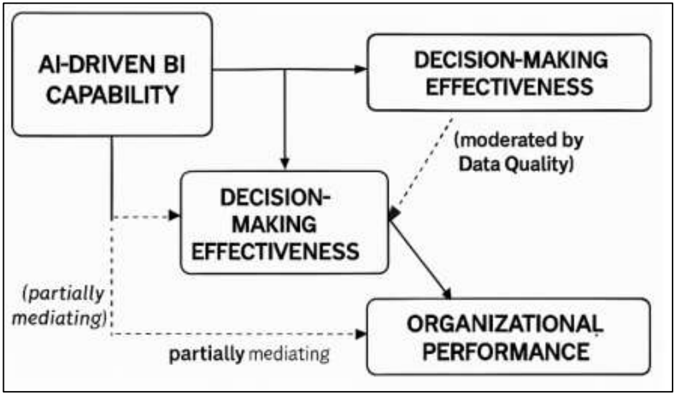
This study investigates the role of Artificial Intelligence driven Business Intelligence (AI-BI) in enhancing predictive decision-making and optimizing strategic resource management across organizations. Using a quantitative research design, data were collected through a structured survey employing five-point Likert-scale measures to examine four key constructs: AI-BI Capability, Decision-Making Effectiveness, Strategic Resource Optimization, and Organizational Performance. The analysis, conducted through Structural Equation Modeling (SEM), revealed that AI-BI Capability significantly influences both Decision-Making Effectiveness (β = 0.71, p < 0.001) and Strategic Resource Optimization (β = 0.67, p < 0.001), while Decision-Making Effectiveness, in turn, has a strong positive impact on Organizational Performance (β = 0.63, p < 0.001). Moreover, Decision-Making Effectiveness was found to partially mediate the relationship between AI-BI Capability and Organizational Performance, suggesting that the cognitive enhancement derived from AI analytics plays a crucial role in translating technological capacity into strategic outcomes. Moderation analysis further revealed that Data Quality and Data Governance significantly strengthen these relationships, highlighting the necessity of reliable, well-managed data environments. The model exhibited high predictive power, with R² values ranging from 0.64 to 0.72 and excellent model fit indices (CFI = 0.951, TLI = 0.945, RMSEA = 0.047). The findings underscore that AI-BI is not merely an analytical tool but a strategic capability that integrates machine learning, automation, and predictive intelligence to drive performance excellence. By linking cognitive decision-making mechanisms with operational intelligence, the study contributes to the theoretical discourse on the Resource-Based View (RBV) and Dynamic Capabilities Theory, positioning AI-BI as a transformative asset that fosters organizational agility, efficiency, and sustained competitive advantage in data-intensive environments.
Overview
The claims and statistics of this paper haven’t been checked yet.
Free: it reads the open-access text and checks the first 5 claims that cite a source we can check. Create a free account to check every claim.
Integrity signals
Registry
Cites
Statistics
Figures

Verification
Claims the paper makes
The claims and statistics of this paper haven’t been checked yet.
Free: it reads the open-access text and checks the first 5 claims that cite a source we can check. Create a free account to check every claim.
Self-check
Percentages, sums and reported differences re-computed from the paper’s own numbers.
The self-check needs the paper’s full text.
Citations
Cites
The publisher hasn’t deposited this paper’s reference list.
Research works printed but not linked: 1
- [78]78. Žigienė, G., Rybakovas, E., Vaitkienė, R., & Gaidelys, V. (2022). Setting the Grounds for the Transition from Business Analytics to Artificial Intelligence in Solving Supply Chain Risk. Sustainability, 14(19), 11827-11827. https://doi.org/10.3390/
Cited by
Data Quality in the Age of AI: A Review of Governance, Ethics, and the FAIR Principles
Guillen-Aguinaga, M., Aguinaga-Ontoso, E., Guillen-Aguinaga, L., Guillen-Grima, F., & Aguinaga-Ontoso, I. (2025) · Data · doi:10.3390/data10120201 · Cited by 37
“The emergence of artificial intelligence and machine learning as dominant paradigms for data-driven decision-making has fundamentally altered the landscape of data quality [94,220,221].”
El-Bakkouri, Y., Aitouhanni, I., Derici, S., & Azegagh, J. (2026) · IGI Global eBooks · doi:10.4018/979-8-3373-6746-0.ch006
Nguyen, P. N., Hoang, C., & Tam, D. (2026) · SSRN Electronic Journal · doi:10.2139/ssrn.7022104
Leong, L.-Y., Hew, T.-S., Hew, J.-J., Tan, G. W.-H., Aw, E. C., & Ooi, K. (2026) · Asia Pacific Journal of Marketing and Logistics · doi:10.1108/apjml-12-2025-2546
"Deep Learning-Based "Xingji Zhilian" Intelligent Decision-Making Model for Government Governance"
Liu, Y. (2026) · International Conference on Machine Intelligence and Digital Applications (MIDA) · doi:10.1145/3801438.3806942
Lytras, M. D. (2026) · Emerald Group Publishing Limited eBooks · doi:10.1108/978-1-83662-878-120261012
Metadata
- Authors
- Abraham & Sons Leather LLC, B. A., & Dhanekula, A.
- Corresponding author
- Dhanekula, Aditya
- Venue
- International Journal of Business and Economics Insights
- Published
- 2025-09-01
- Volume
- 05
- Issue
- 03
- Pages
- 1238-1270
- OpenAlex
- W4415767055
- Cited by
- 6
- References
- 0
- Citations by year
- 2026: 5 · 2025: 1
- FWCI
- 8.14
- Type
- journal article
- Language
- en
- Open access
- gold
- doi.org
- Licence
- cc-by
- Topics
- Social Sciences › Business, Management and Accounting › Management Information Systems › Big Data and Business Intelligence
- Social Sciences › Decision Sciences › Management Science and Operations Research › Impact of AI and Big Data on Business and Society
- Social Sciences › Business, Management and Accounting › Strategy and Management › Competitive and Knowledge Intelligence
- Keywords
- predictive decision-making, decision-making effectiveness, organizational performance, data quality, data governance, resource-based view, dynamic capabilities, organizational agility, competitive advantage
About these checks
Registry, retraction, Cites and statistics results are computed, not judged, with one exception: a printed reference that no index lists is read once by a model before it counts as a citation error. Claims are extracted by a model and kept only when their quote appears verbatim in the text; each cited source is then checked, with a model’s help, for whether it says what the claim relies on. Those verdicts can be wrong — read the claim’s quote and the cited source before relying on one.
Statistics and arithmetic are recomputed, not judged.
Confidence bands are shown only for fields calibrated on our annotated test set. None is calibrated yet, so no band is shown.
What counts as a claim ›How we measure confidence ›How we check this ›
Are you an author, or do you see a problem with this page? Request a review
Data sources
Bibliographic data: Semantic Scholar, OpenAlex, Crossref.
Contains information from the Semantic Scholar Academic Graph Datasets, made available under the ODC Attribution License (ODC-BY 1.0).
Semantic Scholar’s data is described in: Kinney, R., et al. (2023). The Semantic Scholar Open Data Platform. arXiv:2301.10140.
