

A Methodology for Consolidating Decades-Old Enterprise Software Portfolios into a Unified Web Platform: Discovery, Data Model Unification, Architecture, and Migration Approach
Open accessThe DOI matches its Crossref record, with a small difference in title or year; 5 of the 5 references it cites were found in a registry or an index; none of the 20 sources its claims cite is checked for support yet.
Abstract
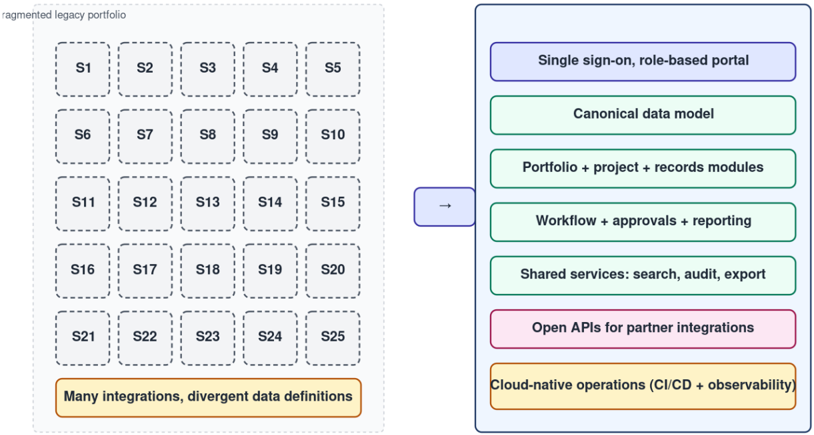
Large enterprises accumulate operational software over decades, ending with portfolios that overlap in capability, contradict in data definitions, and impose substantial cognitive load on users who must traverse them. This paper presents a methodology for consolidating such portfolios into a single unified web-based platform, synthesizing patterns observed across enterprise consolidation programs and validated through a reference deployment that retired more than forty legacy systems serving portfolio, project, and asset management workflows. The methodology comprises three components: a discovery framework that produces a system catalog, a capability map, and a data inventory; a data-model unification approach that resolves cross-system contradictions through user-authored canonical definitions; and a migration discipline that combines phased cutover, coexistence, and reconciliation. The reference deployment under study used containerized microservices distributed across two public clouds, an API-first surface, and a medallion data platform to support continued evolution after consolidation. We report observed values from the reference deployment that show a reduction from forty-three to one production system, a 71 percent decrease in monthly license and support cost, a defect density reduced from 4.8 to 1.2 defects per thousand lines of code, mean time to recovery improved from 6.4 to 1.8 hours, and a 58 percent reduction in user training hours. The findings inform research and practice on portfolio rationalization in long-lived enterprise environments.
Overview
CoChat Summary
TL;DR
This paper presents a three-part methodology—discovery, data-model unification, and phased migration—for consolidating large legacy enterprise software portfolios into one unified web platform. It validates the approach through a single reference deployment that retired more than forty legacy systems and reports large reductions in system count, cost, defects, recovery time, and training hours.
Key findings
- The reference deployment moved from 43 distinct production systems to 1, reported as a 98% reduction in Table 1 and a 97.7% reduction in the conclusion.
- Monthly license and support cost fell from $410,000 to $120,000, a 71% reduction; defect density fell from 4.8 to 1.2 defects per KLOC, a 75% reduction; mean time to recovery fell from 6.4 to 1.8 hours, a 72% reduction.
- User training hours per role fell from 38.5 to 16.2, a 58% reduction.
- Integration points went from 186 directed edges pre-consolidation to 0 external and 122 internal service-to-service edges post-consolidation, reported as a 100% reduction in external integration points.
Methods
- The methodology was developed through retrospective synthesis of patterns observed across enterprise consolidation programs and operationalized in a single primary reference deployment; two other consolidation programs were used only for qualitative triangulation.
- The reference deployment retired more than forty legacy enterprise systems supporting portfolio, project, and asset management workflows for approximately twelve thousand active users; pre-consolidation it comprised 43 production systems, and post-consolidation it was a unified web platform implemented as 47 cooperating microservices across two public clouds.
- Six evaluation criteria were measured: number of production systems, integration points, monthly license and support cost, defect density, mean time to recovery, and user training hours; pre- and post-consolidation measurements used matched six-month windows, with post-consolidation measurement beginning ninety days after the final legacy system was retired.
Limitations
- The paper states that the reference deployment is a single organization with a particular regulatory context, user population, and legacy footprint composition; programs with substantially different legacy compositions, such as mainframe-heavy portfolios, may observe different magnitudes.
- The paper states that although the protocol controls for seasonality within the six-month windows, slow-moving exogenous factors such as vendor pricing changes or hiring-driven user-composition changes are not controlled; reported reductions are treated as accurate to within five percentage points.
- The paper states that the methodology presupposes the organization can sustain a multi-year program, grant the user community decision rights over data definitions, and fund a discovery phase ahead of construction; it does not address settings that cannot meet these preconditions. The text also makes evident that quantitative values are representative measurements from production deployments in which the author has direct engineering experience, with no per-deployment breakdowns and no released production telemetry.
Model-written summary. Check it against the paper before relying on it.
Integrity signals
Registry
Cites
Statistics
Figures
Verification
Claims the paper makes
0 Valid · 2 Not valid · 10 Not checked · 86 Own results and interpretations
A result the paper reports from its own data — it cites no other source for it, so there is none to check. The quote shows it is in the paper.
In the paper
“mean time to recovery improved from 6.4 to 1.8 hours”
plainstates a causeSingle case- Asserted: passes — The authors put it forward as true.
- Checkable: passes — It can be checked against evidence.
- Load-bearing: unclear — It is unclear whether the paper’s conclusions depend on it.
- Based: passes — The paper gives a reason why it holds.
A result the paper states — it cites no source for it, so there is none to check. The quote shows it is in the paper.
In the paper
“a 58 percent reduction in user training hours”
plainstates a causeSingle case- Asserted: passes — The authors put it forward as true.
- Checkable: passes — It can be checked against evidence.
- Load-bearing: unclear — It is unclear whether the paper’s conclusions depend on it.
- Based: passes — The paper gives a reason why it holds.
A result the paper reports from its own data — it cites no other source for it, so there is none to check. The quote shows it is in the paper.
In the paper
“a 71 percent decrease in monthly license and support cost”
- Also stated in: § 1. Introduction · plain
“a 71 percent reduction in monthly license and support cost”
plainstates a causeSingle case- Asserted: passes — The authors put it forward as true.
- Checkable: passes — It can be checked against evidence.
- Load-bearing: passes — The paper’s conclusions depend on it.
- Based: passes — The paper gives a reason why it holds.
- Also stated in: § 1. Introduction · plain
A result the paper reports from its own data — it cites no other source for it, so there is none to check. The quote shows it is in the paper.
In the paper
“validated through a reference deployment that retired more than forty legacy systems serving portfolio, project, and asset management workflows.”
- Also stated in: § 3. Methodology · plain
“The reference deployment retired more than forty legacy enterprise systems supporting portfolio, project, and asset management workflows for an organization of approximately twelve thousand active users.”
- Also stated in: § 1. Introduction · plain
“more than forty legacy systems were retired and replaced by one unified web platform.”
plainstates a causeSingle case- Asserted: passes — The authors put it forward as true.
- Checkable: passes — It can be checked against evidence.
- Load-bearing: passes — The paper’s conclusions depend on it.
- Based: passes — The paper gives a reason why it holds.
- Also stated in: § 3. Methodology · plain
A result the paper states — it cites no source for it, so there is none to check. The quote shows it is in the paper.
In the paper
“Reference data including code tables, organizational hierarchies, and geographic structures was consolidated into a single authoritative source.”
plain- Asserted: passes — The authors put it forward as true.
- Checkable: passes — It can be checked against evidence.
- Load-bearing: passes — The paper’s conclusions depend on it.
- Based: passes — The paper gives a reason why it holds.
30 more claims
Create a free account to see all 98 claims and every source verdict.
- It may state two separate claims as one. 42
- Probably not a substantial claim. 39
- The quote only partly states this claim. 1
Self-check
Percentages, sums and reported differences re-computed from the paper’s own numbers.
Each contradiction between two passages listed here was confirmed by an independent check.
Rated major: it would touch a result — a value a result rests on, reported and recomputed p-values on opposite sides of the significance level, two passages that conflict with no sign which is right, or a cited work retracted before this paper was published.
In the paper
§ 3.1. Deployments and Configurations Studied
“quantitative measurements are reported exclusively from the reference deployment to maintain a single coherent measurement context.”
§ 3.4. Data Provenance and Reporting
“values are summarized as means or medians across the cohort, with the cohort size and measurement window stated alongside each result.”
Rated minor: it would not touch a result — a value no result rests on, a p-value that stays on the same side of the significance level, or a conflict that is clerical, resolved elsewhere in the paper, or outside its own findings.
In the paper
§ 8. Results and Discussion
“The data show that the consolidation produced reductions of comparable magnitude across five of six metrics, clustered between 57.9 percent and 75.0 percent. The exception is system count, which falls by 97.7 percent”
§ 8. Results and Discussion
“| Integration points (directed edges) | 186 | 0external, 122 internal service-to-service | -100% |”
Citations
Cites
The publisher hasn’t deposited this paper’s reference list.
Research works printed but not linked: 21
- [2][2] Hopkins, B. and Jenkins, K. Eating the IT Elephant: Moving from Greenfield Development to Brownfield. IBM Press, 2008. https://scholar.google.com/scholar?q=Hopkins, B. and Jenkins, K. Eating the IT Elephant: Moving from Greenfield Development to Brownfield. IBM Press, 2008. -
- [3][3] Newman, S. Building Microservices, Second Edition. O'Reilly Media, 2021. https://scholar.google.com/scholar?q=Newman, S. Building Microservices, Second Edition. O'Reilly Media, 2021. -
- [4][4] Newman, S. Monolith to Microservices: Evolutionary Patterns to Transform Your Monolith. O'Reilly Media, 2019. https://scholar.google.com/scholar?q=Newman, S. Monolith to Microservices: Evolutionary Patterns to Transform Your Monolith. O'Reilly Media, 2019. -
- [5][5] Richardson, C. Microservices Patterns. Manning Publications, 2018. https://scholar.google.com/scholar?q=Richardson, C. Microservices Patterns. Manning Publications, 2018. -
- [6][6] Evans, E. Domain-Driven Design: Tackling Complexity in the Heart of Software. Addison-Wesley, 2003. https://scholar.google.com/scholar?q=Evans, E. Domain-Driven Design: Tackling Complexity in the Heart of Software. Addison-Wesley, 2003. -
- [7][7] Vernon, V. Implementing Domain-Driven Design. Addison-Wesley, 2013. https://scholar.google.com/scholar?q=Vernon, V. Implementing Domain-Driven Design. Addison-Wesley, 2013. -
- [8][8] Fowler, M. Patterns of Enterprise Application Architecture. Addison-Wesley, 2002. https://scholar.google.com/scholar?q=Fowler, M. Patterns of Enterprise Application Architecture. Addison-Wesley, 2002. -
- [9][9] U.S. Government Accountability Office. Federal Agencies Need to Address Aging Legacy Systems. GAO-16-468, 2016. https://scholar.google.com/scholar?q=U.S. Government Accountability Office. Federal Agencies Need to Address Aging Legacy Systems. GAO-16468, 2016. -
- [10][10] National Association of State Chief Information Officers. State CIO Top 10 Priorities, annual report, 2023. https://scholar.google.com/scholar?q=National Association of State Chief Information Officers. State CIO Top 10 Priorities, annual report, 2023. -
- [13][13] Kim, G., Humble, J., Debois, P., and Willis, J. The DevOps Handbook, Second Edition. IT Revolution Press, 2021. https://scholar.google.com/scholar?q=Kim, G., Humble, J., Debois, P., and Willis, J. The DevOps Handbook, Second Edition. IT Revolution Press, 2021. -
- [14][14] Amazon Web Services. AWS Well-Architected Framework. https://scholar.google.com/scholar?q=Amazon Web Services. AWS Well-Architected Framework. | https://aws.amazon.com/architecture/well-architected/ -
- [15][15] Google Cloud. Google Cloud Architecture Framework. https://scholar.google.com/scholar?q=Google Cloud. Google Cloud Architecture Framework. | https://cloud.google.com/architecture/framework -
- [16][16] Cloud Native Computing Foundation. Kubernetes documentation. https://scholar.google.com/scholar?q=Cloud Native Computing Foundation. Kubernetes documentation. | https://kubernetes.io/docs/ -
- [19][19] Stonebraker, M., Bruckner, D., Ilyas, I. F., et al. Data curation at scale: the Data Tamer system. Proceedings of the Conference on Innovative Data Systems Research (CIDR), 2013. https://scholar.google.com/scholar?q=Stonebraker, M., Bruckner, D., Ilyas, I. F., et al. Data curation at scale: the Data Tamer system. Proceedings of the Conference on Innovative Data Systems Research (CIDR), 2013. -
- [20][20] Bass, L., Weber, I., and Zhu, L. DevOps: A Software Architect's Perspective. Addison-Wesley Professional, 2015. https://scholar.google.com/scholar?q=Bass, L., Weber, I., and Zhu, L. DevOps: A Software Architect's Perspective. Addison-Wesley Professional, 2015. -
- [21][21] Burns, B., Beda, J., and Hightower, K. Kubernetes Up and Running, Third Edition. O'Reilly Media, 2022. https://scholar.google.com/scholar?q=Burns, B., Beda, J., and Hightower, K. Kubernetes Up and Running, Third Edition. O'Reilly Media, 2022. -
- [22][22] Fowler, M. and Lewis, J. Microservices: a definition of this new architectural term. martinfowler.com, 2014. https://scholar.google.com/scholar?q=Fowler, M. and Lewis, J. Microservices: a definition of this new architectural term. martinfowler.com, 2014. | https://martinfowler.com/articles/microservices.html -
- [23][23] Humble, J. and Farley, D. Continuous Delivery: Reliable Software Releases through Build, Test, and Deployment Automation. Addison-Wesley Professional, 2010. https://scholar.google.com/scholar?q=Humble, J. and Farley, D. Continuous Delivery: Reliable Software Releases through Build, Test, and Deployment Automation. Addison-Wesley Professional, 2010. -
- [24][24] Inmon, W. H. Building the Data Warehouse, Fourth Edition. Wiley, 2005. https://scholar.google.com/scholar?q=Inmon, W. H. Building the Data Warehouse, Fourth Edition. Wiley, 2005. -
- [25][25] Hohpe, G. and Woolf, B. Enterprise Integration Patterns: Designing, Building, and Deploying Messaging Solutions. Addison-Wesley Professional, 2003. https://scholar.google.com/scholar?q=Hohpe, G. and Woolf, B. Enterprise Integration Patterns: Designing, Building, and Deploying Messaging Solutions. Addison-Wesley Professional, 2003. -
- [26][26] World Wide Web Consortium. Web Content Accessibility Guidelines 2.2. W3C Recommendation, October 2023. https://scholar.google.com/scholar?q=World Wide Web Consortium. Web Content Accessibility Guidelines 2.2. W3C Recommendation, October 2023. | https://www.w3.org/TR/WCAG22/
Metadata
- Authors
- Brahmandam, L. M. K.
- Corresponding author
- Brahmandam, Laxmi Madhu Kumar
- Venue
- American International Journal of Computer Science and Technology
- Publisher
- ScienceTech Xplore
- Published
- 2025
- Volume
- 7
- Pages
- 112-121
- ISSN
- 3117-5481 (ISSN-L)
- OpenAlex
- W7163378705
- Semantic Scholar
- 399317f19c47d362ad617efe4cebd838da1e402b
- Cited by
- 0
- References
- 0
- FWCI
- 0.00
- Type
- journal article
- Language
- en
- Open access
- bronze
- doi.org
- Locations
- American International Journal of Computer Science and Technology (publishedVersion)
- Topics
- Physical Sciences › Computer Science › Information Systems › Software Engineering Research
- Social Sciences › Business, Management and Accounting › Management Information Systems › Information Technology Governance and Strategy
- Social Sciences › Business, Management and Accounting › Management Information Systems › ERP Systems Implementation and Impact
- Keywords
- capability mapping, data inventory, software migration, microservices, containerization, cloud deployment, defect density, mean time to recovery
About these checks
Registry, retraction, Cites and statistics results are computed, not judged, with one exception: a printed reference that no index lists is read once by a model before it counts as a citation error. Claims are extracted by a model and kept only when their quote appears verbatim in the text; each cited source is then checked, with a model’s help, for whether it says what the claim relies on. Those verdicts can be wrong — read the claim’s quote and the cited source before relying on one.
A language model drew the claims from the paper on 2026-10-10, under version 3 of the claim definition (model deepseek-v4.1-flash, prompt extract-v3).
A second model labelled each claim on 2026-10-10 (model jev-1.13-20260917, definition revision gold-guideline-v0.2).
Statistics and arithmetic are recomputed, not judged.
Confidence bands are shown only for fields calibrated on our annotated test set. None is calibrated yet, so no band is shown.
What counts as a claim ›How we measure confidence ›How we check this ›
Are you an author, or do you see a problem with this page? Request a review
How to cite
Cite CoChat for the checks on this page, and the paper for its own findings.
- This page
- CoChat. (2026). Citation check: A Methodology for Consolidating Decades-Old Enterprise Software Portfolios into a Unified Web Platform: Discovery, Data Model Unification, Architecture, and Migration Approach. https://app.cochat.ai/papers/10.63282/3117-5481/aijcst-v7i2p109
- The paper
- Brahmandam, L. M. K. (2025). A Methodology for Consolidating Decades-Old Enterprise Software Portfolios into a Unified Web Platform: Discovery, Data Model Unification, Architecture, and Migration Approach. American International Journal of Computer Science and Technology. https://doi.org/10.63282/3117-5481/aijcst-v7i2p109
Data sources
Bibliographic data: Semantic Scholar, OpenAlex, Crossref.
Contains information from the Semantic Scholar Academic Graph Datasets, made available under the ODC Attribution License (ODC-BY 1.0).
Semantic Scholar’s data is described in: Kinney, R., et al. (2023). The Semantic Scholar Open Data Platform. arXiv:2301.10140.
