

A Validation Study of a Noninvasive Lactate Threshold Device
Open accessThe DOI matches its Crossref record; 16 of the 16 references it cites were found in a registry or an index; none of the 10 sources its claims cite is checked for support yet.
Abstract
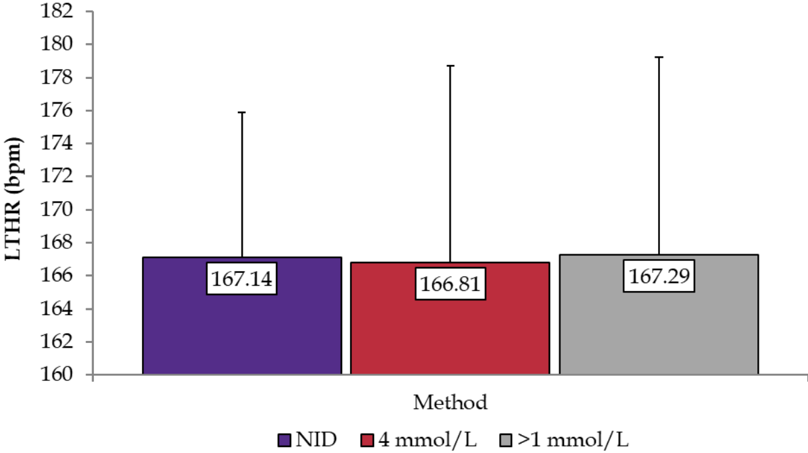
The lactate threshold is considered a key marker of endurance exercise performance and identification of this threshold is important in writing an exercise training program. Unfortunately, assessment of the lactate threshold has traditionally required venous or capillary blood samples and a specialized meter to assess blood lactate concentrations. Recently, a consumer grade, non-invasive device was developed to determine muscle oxygenation and estimate the lactate threshold. PURPOSE: The aim of this study was to assess the validity of a noninvasive lactate threshold device (NID) to determine lactate threshold heart rate (LTHR). METHODS: ) completed a personalized graded exercise test on a treadmill. All participants wore the NID and blood lactate samples were taken at the end of 3-minute stages. LTHR was then calculated using two traditional methods (4 mmol/L and >1 mmol/L increase) and compared against the same heart rate values calculated by the NID. RESULTS: No significant differences (p = .87) were found in LTHR between the NID and the traditional lactate methods (NID: 167 ± 9 bpm, 4 mmol/L: 167 ± 12 bpm, >1 mmol/L: 167 ± 12 bpm). CONCLUSIONS: This study provides preliminary support for the validity of the NID for estimation of LTHR.
Overview
CoChat Summary
TL;DR
This study assessed a consumer-grade noninvasive device (BSX Insight) using near-infrared spectroscopy to estimate lactate threshold heart rate during treadmill graded exercise. In 21 recreational athletes, LTHR from the NID did not differ significantly from traditional blood lactate methods, providing preliminary support for validity.
Key findings
- No significant difference in LTHR among the NID, 4 mmol/L, and >1 mmol/L methods: NID 167 ± 9 bpm, 4 mmol/L 167 ± 12 bpm, >1 mmol/L 167 ± 12 bpm; repeated measures ANOVA F(1.41, 28.17) = .074, p = .87.
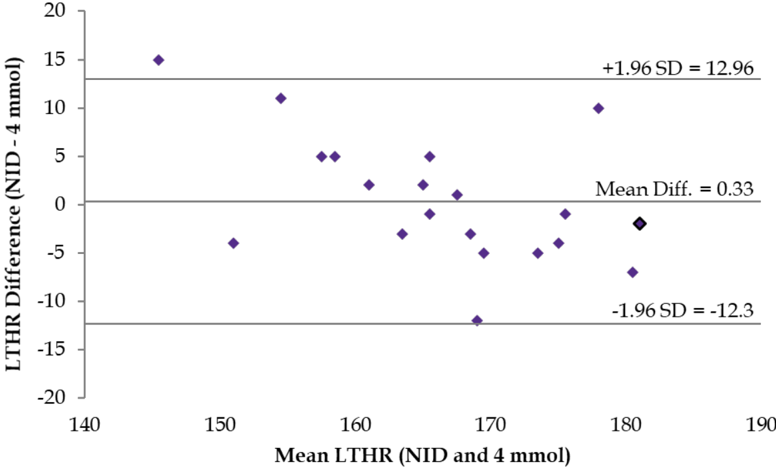
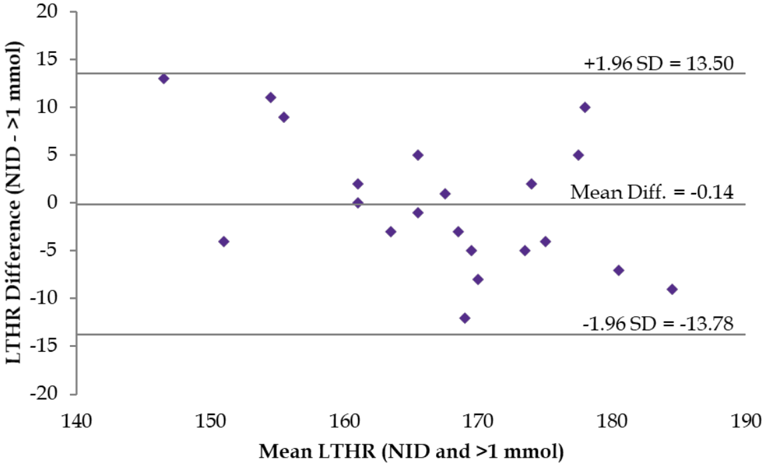
- LTHR correlations were r = .849 (p < .001) for NID vs 4 mmol/L and r = .816 (p < .001) for NID vs >1 mmol/L. Bland-Altman 95% limits of agreement were within ±12 bpm; at higher LTHR (>170 bpm), the NID underestimated LTHR by approximately 5–10 bpm in 6 of 7 subjects for the 4 mmol/L comparison.
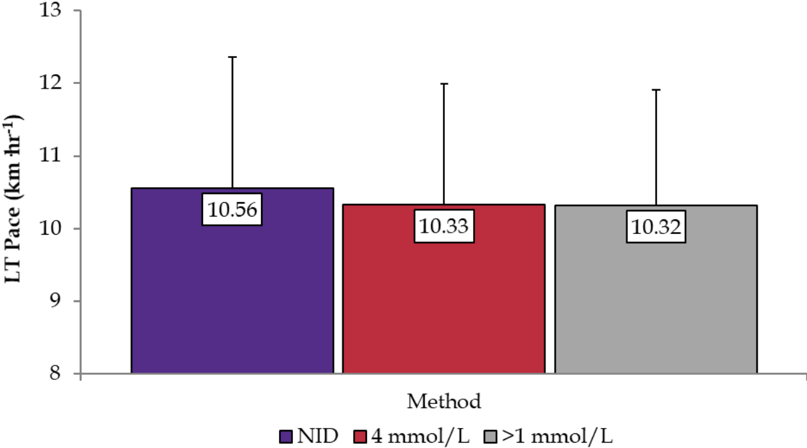
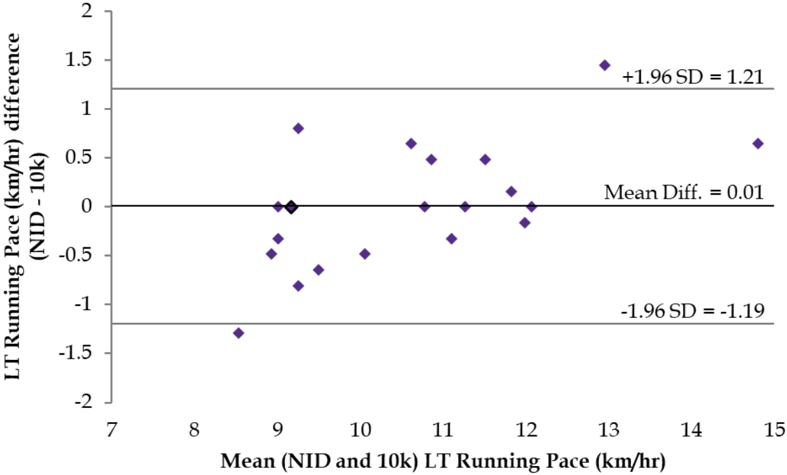
- LT running pace did not differ significantly between methods (F(1.26, 25.16) = 2.19, p = .15). NID LT pace correlated with 4 mmol/L (r = .924), >1 mmol/L (r = .922), and estimated 10k pace (r = .952), all p < .001; average difference between NID LT pace and estimated 10k pace was 0.01 km/hr, with 95% limits of agreement −1.19 to 1.21 km/hr.
Methods
- Twenty-one recreational athletes (14 females, 39 ± 7 years, 29.1 ± 5.2% fat, VO2max 37.8 ± 6.0 ml·kg−1·min−1; 7 males, 42 ± 9 years, 16.8 ± 2.2% fat, VO2max 45.9 ± 6.4 ml·kg−1·min−1) completed a personalized graded exercise test on a treadmill to volitional fatigue.
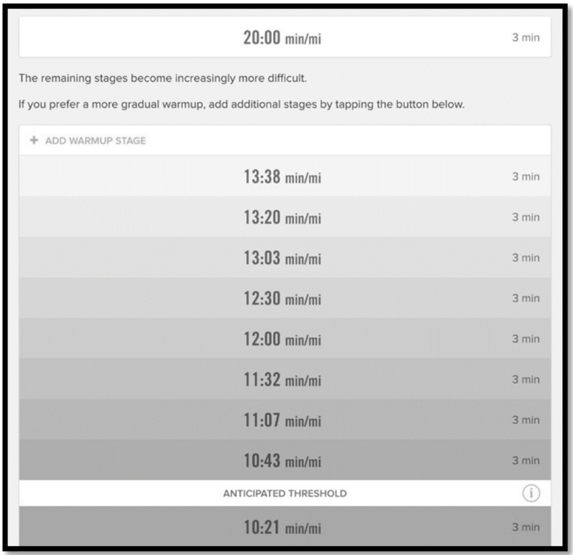
- Participants wore the NID on the left calf and had finger-prick blood lactate samples taken at the end of each 3-minute stage. LTHR was calculated by the NID and by two traditional methods: 4 mmol/L and >1 mmol/L increase from subsequent stages.
- Validity was examined using repeated measures ANOVA, Pearson correlations, and Bland-Altman plots in IBM SPSS Statistics 25.
Limitations
- Stated: the relatively small sample (n = 21) limited generalizability and did not allow testing of gender differences; reliability was not examined because participants were tested with the same device only one time.
- Stated: future work should compare LTHR from the NID’s prescribed 3-minute protocol with longer-stage traditional LT tests, test whether under- or over-estimating 10K pace affects the device’s LT prediction, and validate the device during other exercise modes such as biking or swimming.
- Evident: the sample was recreational triathletes rather than elite athletes, and the authors note this may limit generalizability to elite triathletes; the NID’s LT pace was highly correlated with the user-input estimated 10K pace, which the authors state needs further testing if the proprietary algorithm uses that input.
Model-written summary. Check it against the paper before relying on it.
Integrity signals
Registry
Cites
Statistics
Figures
Verification
Claims the paper makes
0 Valid · 1 Not valid · 8 Not checked · 26 Own results and interpretations
A result the paper reports from its own data — it cites no other source for it, so there is none to check. The quote shows it is in the paper.
In the paper
“| 4mmol/L | .924 | < .001 |”
§ A Validation Study of a Noninvasive Lactate Threshold Device > RESULTS
plainstates an association- Asserted: passes — The authors put it forward as true.
- Checkable: passes — It can be checked against evidence.
- Load-bearing: passes — The paper’s conclusions depend on it.
- Based: passes — The paper gives a reason why it holds.
A result the paper reports from its own data — it cites no other source for it, so there is none to check. The quote shows it is in the paper.
In the paper
“Repeated measures ANOVA showed no significant differences in LT pace between the NID and the traditional methods, F(1.26, 25.16) = 2.19, p = .15.”
§ A Validation Study of a Noninvasive Lactate Threshold Device > RESULTS
plainn = 21- Asserted: passes — The authors put it forward as true.
- Checkable: passes — It can be checked against evidence.
- Load-bearing: passes — The paper’s conclusions depend on it.
- Based: passes — The paper gives a reason why it holds.
A result the paper reports from its own data — it cites no other source for it, so there is none to check. The quote shows it is in the paper.
In the paper
“| >1mmol/L increase | .816 | < .001 |”
§ A Validation Study of a Noninvasive Lactate Threshold Device > RESULTS
plainstates an association- Asserted: passes — The authors put it forward as true.
- Checkable: passes — It can be checked against evidence.
- Load-bearing: passes — The paper’s conclusions depend on it.
- Based: passes — The paper gives a reason why it holds.
A result the paper reports from its own data — it cites no other source for it, so there is none to check. The quote shows it is in the paper.
In the paper
“| Estimated 10k Pace | .952 | < .001 |”
- Also stated in: § DISCUSSION · hedged
“Our findings also indicate a strong relationship (r = .95) between the LT pace determined by the NID and the estimated current 10k pace input by the user.”
§ A Validation Study of a Noninvasive Lactate Threshold Device > RESULTS
plainstates an association- Asserted: passes — The authors put it forward as true.
- Checkable: passes — It can be checked against evidence.
- Load-bearing: passes — The paper’s conclusions depend on it.
- Based: passes — The paper gives a reason why it holds.
- Also stated in: § DISCUSSION · hedged
A result the paper reports from its own data — it cites no other source for it, so there is none to check. The quote shows it is in the paper.
In the paper
“| 4mmol/L | .849 | < .001 |”
§ A Validation Study of a Noninvasive Lactate Threshold Device > RESULTS
plainstates an association- Asserted: passes — The authors put it forward as true.
- Checkable: passes — It can be checked against evidence.
- Load-bearing: passes — The paper’s conclusions depend on it.
- Based: passes — The paper gives a reason why it holds.
13 more claims
Create a free account to see all 35 claims and to verify the 2 references still open.
- It may state two separate claims as one. 10
- Probably not a substantial claim. 9
- The quote only partly states this claim. 1
Claims other papers make about this one
Each is checked against this paper’s own text: does it say what the citing paper says it does?
The source backs part of the claim, not all of it — or backs it for a different population, condition or comparison.
In the citing paper
“Some of the articles included in this review demonstrate mean bias between MOT2 and LT2 or VT2 ranging from 0.01 and 0.4 km·h−125,44,45,49, between 3.9 and 15.4 W39,41, 0.05 W·kg−117 and 10.7% of the power output26.”
From Reliability of threshold determination using portable muscle oxygenation monitors during exercise testing: a systematic review and meta-analysis (2023) · cites this paper as [49]
Experimental — accuracy not yet measuredThe cited source says what the claim attributes to it.
In the citing paper
“The second threshold was determined using the blood lactate concentration and muscle oxygenation in different sports such as cycling16,17,46–48, running44,45,49 and rowing26.”
From Reliability of threshold determination using portable muscle oxygenation monitors during exercise testing: a systematic review and meta-analysis (2023) · cites this paper as [49]
The cited source says what the claim attributes to it.
In the citing paper
“The articles included in this systematic review use different methods for determining thresholds: BSX Insight (20%, N = 3)45,47,49, double linear regression (46%, N = 7)16,26,39,41–44, visual method17,25,40, Dmax or modified Dmax46 and applications of devices Humon Beta48.”
From Reliability of threshold determination using portable muscle oxygenation monitors during exercise testing: a systematic review and meta-analysis (2023) · cites this paper as [49]
Statistics recomputed
Every reported test result, recomputed from its test statistic and degrees of freedom. A result shows as not adding up only once an independent check has confirmed it.
- Consistentχ²(2) = 10.35reported p = .006 · recomputed p = .006
“χ2 (2) = 10.35, p = .006”
- ConsistentF(1.41, 28.17) = 0.074reported p = .87 · recomputed p = .867
“F(1.41, 28.17) = .074, p = .87”
- Consistentχ²(2) = 16.92reported p < .001 · recomputed p < .001
“χ2 (2) = 16.92, p < .001”
- ConsistentF(1.26, 25.16) = 2.19reported p = .15 · recomputed p = .151
“F(1.26, 25.16) = 2.19, p = .15”
Self-check
Percentages, sums and reported differences re-computed from the paper’s own numbers.
Self-check results appear here once an independent check has confirmed them.
Citations
Cites
Measurement in Medicine: The Analysis of Method Comparison Studies
Altman, D. G., & Bland, J. M. (1983) · The Statistician · doi:10.2307/2987937 · Cited by 4,300
Physiological Testing of the High-Performance Athlete
MacDougall, J. D., Wenger, H. A., & Green, H. J. (1993) · Medicine & Science in Sports & Exercise · doi:10.1249/00005768-199302000-00027 · Cited by 443
Evaluation of three portable blood lactate analysers: Lactate Pro, Lactate Scout and Lactate Plus
Tanner, R. K., Fuller, K. L., & Ross, M. L. R. (2010) · European Journal of Applied Physiology · doi:10.1007/s00421-010-1379-9 · Cited by 274
The relationship between plasma lactate parameters, Wpeak and 1-h cycling performance in women
BISHOP, D., JENKINS, D. G., & MACKINNON, L. T. (1998) · Medicine& Science in Sports & Exercise · doi:10.1097/00005768-199808000-00014 · Cited by 263
Billat, L. V. (1996) · Sports Medicine · doi:10.2165/00007256-199622030-00003 · Cited by 249
Blood lactate accumulation and muscle deoxygenation during incremental exercise
Grassi, B., Quaresima, V., Marconi, C., Ferrari, M., & Cerretelli, P. (1999) · Journal of Applied Physiology · doi:10.1152/jappl.1999.87.1.348 · Cited by 248 · cited 7×
“The wearable device utilizes near-infrared spectroscopy (NIRS) to measure the oxygen saturation levels in the calf muscle during a graded exercise test (GXT), and applies a proprietary algorithm to determine the point of LT (3, 8).”
BackgroundMethodResultInfluentialBelardinelli, R., Barstow, T. J., Porszasz, J., & Wasserman, K. (1995) · European Journal of Applied Physiology and Occupational Physiology · doi:10.1007/bf00634377 · Cited by 213 · cited 3×
“The wearable device utilizes near-infrared spectroscopy (NIRS) to measure the oxygen saturation levels in the calf muscle during a graded exercise test (GXT), and applies a proprietary algorithm to determine the point of LT (3, 8).”
MethodAccuracy, reliability, linearity of Accutrend and Lactate Pro versus EBIO plus analyzer
Baldari, C., Bonavolontà, V., Emerenziani, G. P., Gallotta, M. C., Silva, A. J., & Guidetti, L. (2009) · European Journal of Applied Physiology · doi:10.1007/s00421-009-1107-5 · Cited by 171
Van Hooff, M. L. M., Geurts, S. A. E., Kompier, M. A. J., & Taris, T. W. (2007) · Journal of Occupational Health · doi:10.1539/joh.49.224 · Cited by 164
A method-comparison study regarding the validity and reliability of the Lactate Plus analyzer
Hart, S., Drevets, K., Alford, M., Salacinski, A. J., & Hunt, B. E. (2013) · BMJ Open · doi:10.1136/bmjopen-2012-001899 · Cited by 142
Cited by
Sendra-Pérez, C., Sanchez-Jimenez, J. L., Marzano-Felisatti, J. M., Encarnación-Martínez, A., Salvador-Palmer, R., & Priego-Quesada, J. I. (2023) · Scientific Reports · doi:10.1038/s41598-023-39651-z · Cited by 52
Omics and the molecular exercise physiology
Gomes, C., de Almeida, J. A., Franco, O. L., & Petriz, B. A. (2019) · Advances in clinical chemistry · doi:10.1016/bs.acc.2019.11.003 · Cited by 34
Determination of Second Lactate Threshold Using Near-infrared Spectroscopy in Elite Cyclists
Salas-Montoro, J.-A., Mateo-March, M., Sánchez-Muñoz, C., & Zabala, M. (2022) · International Journal of Sports Medicine · doi:10.1055/a-1738-0252 · Cited by 27
“There are several options to reference or estimate the MLSS, such as LT, anaerobic threshold, individual anaerobic threshold (IAT), onset of blood La accumulation (OBLA) or second La threshold (LT2) [1,6].”
Background(2021) · International Journal of Exercise Science · doi:10.70252/hbra1900 · Cited by 19
“However, it is important to investigate the validity and reliability of the NIRS threshold detection method as multiple analysis methods have been proposed (proprietary algorithms, visual inspection, segmented regression analysis) and to determine if the NIRS threshold assessments could be used in populations outside…”
MethodGandía-Soriano, A., Salas-Montoro, J.-A., Javaloyes, A., Lorente-Casaus, C., Zabala, M., Priego‐Quesada, J. I., & Mateo‐March, M. (2022) · International Journal of Sports Medicine · doi:10.1055/a-1828-8499 · Cited by 18
Sendra-Pérez, C., Encarnación-Martínez, A., Oficial-Casado, F., Salvador-Palmer, R., & Priego-Quesada, J. I. (2023) · Physiological Measurement · doi:10.1088/1361-6579/ad1457 · Cited by 9
Rębiś, K., Klusiewicz, A., Długołęcka, B., Różański, P., Kowieski, K., & Kowalski, T. (2024) · Journal of Clinical Medicine · doi:10.3390/jcm13175340 · Cited by 7
“In the available literature regarding the determination of AT values based on measurements of SmO 2 , studies have been conducted mostly among trained individuals [31–34] or in groups of recreationally trained individuals [19].”
BackgroundMethodNon-invasive biomedical analysis: recent advances, challenges, and future perspectives
Cirovic, S. (2024) · doi:10.24834/isbn.9789178774562 · Cited by 12
LACTATE: A BIOLOGICAL MARKER OF PHYSICAL ACTIVITY IN COLOMBIAN WEIGHTLIFTING ATHLETES
Ríos, D. C. Z., Matta, A. J., Mina-Paz, Y., & Padilla, I. C. R. (2021) · Revista Brasileira de Medicina do Esporte · doi:10.1590/1517-8692202127012019_0047 · Cited by 3
Syaifudin, A., Pamungkas, Y., Ridhoi, A., Wibowo, S., Herawati, L., Handrito, R. P., Adi, S., & Hashim, U. (2026) · Human Movement · doi:10.5114/hm/217211
Metadata
- Authors
- McMorries, R. M., Joubert, D. P., Jones, E. J., & Faries, M. D.
- Affiliations
- Stephen F. Austin State University (US)
- Texas A&M University (US)
- Venue
- International Journal of Exercise Science
- Published
- 2019
- Volume
- 12
- Issue
- 2
- Pages
- 221-232
- ISSN
- 1939-795X (ISSN-L)
- PMC
- PMC6355126
- OpenAlex
- W2951291865
- Semantic Scholar
- 9fae7f7f452445658caaec58f7b4d367fde4b5c2
- Cited by
- 14
- References
- 15
- Citations by year
- 2026: 1 · 2025: 1 · 2024: 2 · 2023: 3 · 2022: 4 · 2021: 2 · 2019: 1
- FWCI
- 0.81
- Type
- journal article
- Language
- en
- Open access
- diamond
- doi.org
- Licence
- cc-by-nd
- Locations
- International journal of exercise science (publishedVersion, cc-by-nd)
- Europe PMC (PubMed Central) (publishedVersion)
- PubMed (publishedVersion)
- PubMed Central (publishedVersion)
- Index of Texas Archaeology Open Access Grey Literature from the Lone Star State (submittedVersion)
- TopSCHOLAR (Western Kentucky University) (submittedVersion)
- Topics
- Health Sciences › Medicine › Physiology (medical) › Cardiovascular and exercise physiology
- Health Sciences › Medicine › Orthopedics and Sports Medicine › Sports Performance and Training
- Health Sciences › Nursing › Nutrition and Dietetics › Muscle metabolism and nutrition
- Keywords
- lactate threshold, blood lactate, muscle oxygenation, endurance exercise performance, incremental exercise test, device validation
About these checks
Registry, retraction, Cites and statistics results are computed, not judged, with one exception: a printed reference that no index lists is read once by a model before it counts as a citation error. Claims are extracted by a model and kept only when their quote appears verbatim in the text; each cited source is then checked, with a model’s help, for whether it says what the claim relies on. Those verdicts can be wrong — read the claim’s quote and the cited source before relying on one.
A language model drew the claims from the paper on 2026-10-13, under version 3 of the claim definition (model deepseek-v4.1-flash, prompt extract-v3).
A second model labelled each claim on 2026-10-13 (model jev-1.13-20260917, definition revision gold-guideline-v0.2).
Statistics and arithmetic are recomputed, not judged.
Confidence bands are shown only for fields calibrated on our annotated test set. None is calibrated yet, so no band is shown.
What counts as a claim ›How we measure confidence ›How we check this ›
Are you an author, or do you see a problem with this page? Request a review
Data sources
Bibliographic data: Semantic Scholar, OpenAlex, Crossref.
Contains information from the Semantic Scholar Academic Graph Datasets, made available under the ODC Attribution License (ODC-BY 1.0).
Semantic Scholar’s data is described in: Kinney, R., et al. (2023). The Semantic Scholar Open Data Platform. arXiv:2301.10140.
