

Abraham’s Battle with the Mesopotamian Kings and His Encounter with Melchizedek
Open accessThe DOI matches its Crossref record; 29 of the 29 references it cites were found in a registry or an index; none of the 50 sources its claims cite is checked for support yet.
Abstract
The events described in Genesis 14 have been of great interest to biblical scholars and theologians over the centuries, especially seeking to understand the nature of the meeting of Abraham and Melchizedek and the significance of the priest-king of Salem offering bread and wine to the Patriarch. While theological readings typically dominate the literature on this mysterious meeting, the intent of this study is to examine this encounter in its military setting side-by-side with other Old Testament texts and ancient Near Eastern parallels. The latter will include focusing on Gen 14:13–18 alongside the Tale of Sinuhe, Tanaach Tablet 6, Papyrus Anastasi I, and other sources. It will be suggested that Melchizedek’s actions are consistent with one seeking to appease a military victor.
Overview
CoChat Summary
TL;DR
James K. Hoffmeier reads Genesis 14:13–18 in its military setting and argues that Melchizedek’s bread and wine are best understood as a peace offering/provision to the victorious Abraham, not as a eucharistic or purely theological act. He supports this by comparing the episode with Old Testament and ancient Near Eastern military-diplomatic texts.
Key findings
- Melchizedek’s presentation of bread and wine to Abraham is interpreted as appeasement/provision for a military victor and his small army; Abraham’s tithe acknowledges El-Elyon’s blessing of victory.
- Genesis 14 is treated as preserving an early tradition with historical verisimilitude: the Mesopotamian king names correspond to second-millennium names (e.g., Tidal/Tudkhalia; Arioch/Arriwuk at Mari and Nuzi, 18th–15th centuries BC), and the four-king coalition pattern fits the second millennium.
- Abraham’s 318 ḥănīkîm are understood as loyal retainers/militia, not hired mercenaries; with Amorite allies Mamre, Aner, and Eschol, Hamblin’s estimate is a force of 1000–1200 men.
- The two meetings with Bera and Melchizedek may be telescoped into one scene for literary contrast, which would remove the need to view the Melchizedek pericope as a later intrusion.
Methods
- Exegetical and comparative study of Gen 14:13–18, read alongside OT texts (Gen 33; 1 Sam 25; 2 Sam 16) and ancient Near Eastern sources (Tale of Sinuhe, Taanach Tablet 6, Papyrus Anastasi I, Ramesseum Dapur relief, Khnumhotep III Dahshur inscription).
- Philological analysis of ḥănīkîm in Gen 14:14 and Taanach letter no. 6’s ḫa-na-ku-u-ka, reviewing Egyptian vs. Semitic derivation.
- Historical-geographical and source-critical discussion; the author assumes Genesis 14 preserves an early tradition, following Kitchen, Sarna, Speiser, and Rainey.
Limitations
- Stated: the precise significance of Melchizedek’s gesture is uncertain (Wenham); none of the Mesopotamian kings has been specifically identified; it is unclear what role Khnumhotep III played; evidence is lacking that Melchizedek and Abraham were treaty partners; the telescoping of the two meetings is the author’s proposal.
- Evident: the dating and historicity of Genesis 14 are contested (e.g., Gunkel, Van Seters, Gzella vs. Rainey, Kitchen), and the etymology of ḥnk remains debated.
- Evident: the argument is analogical, drawing on disparate military-diplomatic texts and scenes; no exact ancient parallel to Melchizedek’s bread-and-wine action is presented.
Model-written summary. Check it against the paper before relying on it.
Integrity signals
Registry
Cites
Statistics
Figures
Verification
Claims the paper makes
0 Valid · 1 Not valid · 41 Not checked · 34 Own results and interpretations
In the paper
“Abraham's tithe is likely an acknowledgment that El-Elyon had indeed blessed him with victory in battle from is enemies as Melchidezek's blessing makes clear (Genesis 19-20).”
§ Abraham's Battle with the Mesopotamian Kings and His Encounter with Melchizedek 1 > יש אִ חּור בָ
What the sources say
- Not matchedcites Genesis 19-20
This doesn’t read as a citation we can look up.
hedgedstates a possible cause- Asserted: passes — The authors put it forward as true.
- Checkable: passes — It can be checked against evidence.
- Load-bearing: passes — The paper’s conclusions depend on it.
- Based: unclear — It is unclear why the paper says it holds.
- Rests on an assumption not shown here.
- Not matched
In the paper
“His identification as both a king ( ְך לֶ מֶ ) and a priest ( ן ֹּהֵ כ ) is unexpected.”
§ Abraham's Battle with the Mesopotamian Kings and His Encounter with Melchizedek 1 > Introduction
What the sources say
- Not matchedcites Gen 14:18
This doesn’t read as a citation we can look up.
plain- Asserted: passes — The authors put it forward as true.
- Checkable: passes — It can be checked against evidence.
- Load-bearing: passes — The paper’s conclusions depend on it.
- Based: passes — The paper gives a reason why it holds.
- Not matched
A conclusion the paper draws from its own results — it cites no other source for it, so there is none to check. The quote shows it is in the paper.
In the paper
“meaning that Abraham's rallying his force of 318 יְך נִ חָ fits the sort of military action that would have transpired in ancient Near East.”
§ Abraham's Battle with the Mesopotamian Kings and His Encounter with Melchizedek 1 > The military background
hedgedstates an association- Asserted: passes — The authors put it forward as true.
- Checkable: passes — It can be checked against evidence.
- Load-bearing: unclear — It is unclear whether the paper’s conclusions depend on it.
- Based: passes — The paper gives a reason why it holds.
None of the sources cited for this claim could be matched to a paper, so there is nothing to check it against.
In the paper
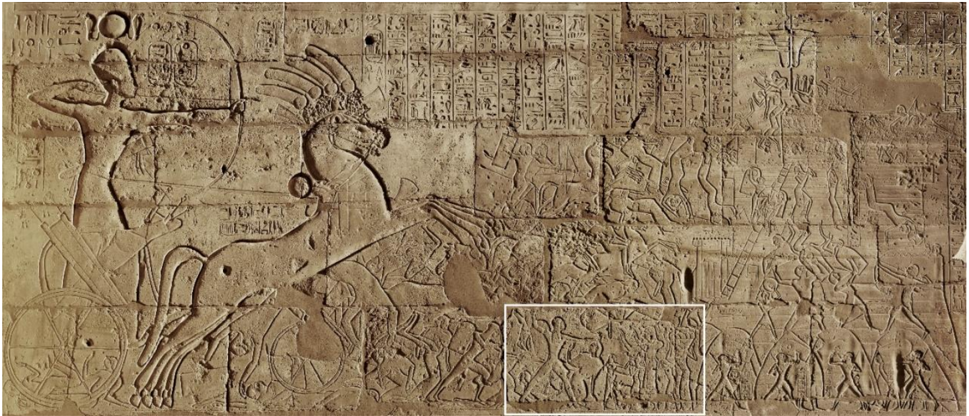
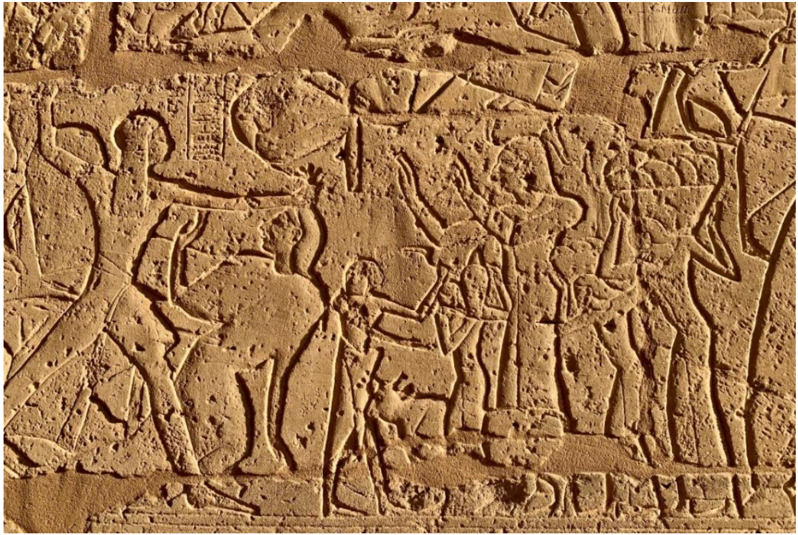
“As with Abigail's peace offering and the food rations in Papyrus Anastasi I, the Dapur scene depicts wine, bread and meat (an ox) for the offering to Ramesses II and his princes.”
§ Abraham's Battle with the Mesopotamian Kings and His Encounter with Melchizedek 1 > יש אִ חּור בָ
What the sources say
- Not matchedcites Kitchen (1996:83)
An author–year citation the paper’s reference list doesn’t settle. We don’t search these by name.
- Not matchedcites Schultz (2016: 287)
An author–year citation the paper’s reference list doesn’t settle. We don’t search these by name.
plainstates an association- Asserted: passes — The authors put it forward as true.
- Checkable: passes — It can be checked against evidence.
- Load-bearing: passes — The paper’s conclusions depend on it.
- Based: passes — The paper gives a reason why it holds.
- Not matched
In the paper
“Donald Wiseman has shown that Abraham was recognized as a man of status, worthy of respect when he negotiated the purchase of property to bury Sarah in Genesis 23.”
§ Abraham's Battle with the Mesopotamian Kings and His Encounter with Melchizedek 1 > The military background
What the sources say
- Not matchedcites Wiseman 1980: 147-48
An author–year citation the paper’s reference list doesn’t settle. We don’t search these by name.
boostedSingle case- Asserted: passes — The authors put it forward as true.
- Checkable: passes — It can be checked against evidence.
- Load-bearing: unclear — It is unclear whether the paper’s conclusions depend on it.
- Based: passes — The paper gives a reason why it holds.
- Not matched
28 more claims
Create a free account to see all 76 claims and to verify the 13 references still open.
- Probably not a substantial claim. 29
- It may state two separate claims as one. 22
- The quote only partly states this claim. 1
Self-check
Percentages, sums and reported differences re-computed from the paper’s own numbers.
Each contradiction between two passages listed here was confirmed by an independent check.
Rated minor: it would not touch a result — a value no result rests on, a p-value that stays on the same side of the significance level, or a conflict that is clerical, resolved elsewhere in the paper, or outside its own findings.
In the paper
§ Abraham's Battle with the Mesopotamian Kings and His Encounter with Melchizedek 1 > יש אִ חּור בָ
“Abraham's tithe is likely an acknowledgment that El-Elyon had indeed blessed him with victory in battle from is enemies as Melchidezek's blessing makes clear (Genesis 19-20).”
§ Abraham's Battle with the Mesopotamian Kings and His Encounter with Melchizedek 1 > Introduction
“They too comment on the two leadership offices mentioned about Melchizedek in Gen 14:18 and Ps 110:4.”
Citations
Cites
Semitic Words in Egyptian Texts of the New Kingdom and Third Intermediate Period
Hoch, J. E. (1994) · doi:10.1515/9781400863884 · Cited by 314 · cited 1×
“In his major compendium on Semitic loanwords into Egyptian, James Hoch (1994) does not include the word ḥnk, indicating that he did not consider it a Semitic loanword into Egyptian.”
A Critical and Exegetical Commentary on Genesis
Skinner, J. (1910) · Medical Entomology and Zoology · Cited by 313
II Samuel: A New Translation with Introduction, Notes and Commentary
McCarter, P. K. (1984) · Doubleday, a division of Random House, Inc. eBooks · doi:10.5040/9780300261202 · Cited by 267
I Samuel: A New Translation with Introduction, Notes and Commentary
McCarter, Jr. (1980) · Yale University Press eBooks · doi:10.5040/9780300261196 · Cited by 230
The Book of Genesis: Chapters 1–17
Hamilton, V. P. (1990) · Wm. B. Eerdmans Publishing Co. eBooks · doi:10.5040/bci-0092 · Cited by 211
Vawter, B. (1977) · Medical Entomology and Zoology · Cited by 181
The Historical Inscription of Khnumhotep at Dahshur: Preliminary Report
Allen, J. P. (2008) · Bulletin of the American Schools of Oriental Research · doi:10.1086/basor25609300 · Cited by 127
Ancient Orient and Old Testament
Kitchen, K. A. (1966) · Cited by 99
The Historicity of the Patriarchal Narratives: The Quest for the Historical Abraham
Thompson, T. L. (1974) · doi:10.1515/9783110841442 · Cited by 93
Egyptian proper names and loanwords in North-West Semitic
Muchiki, Y. (1999) · SBL Press eBooks · Cited by 90
Research works printed but not linked: 8
- Aharoni, Yohanan. 1979. The Land of the Bible: A Historical Geography. Philadelphia: Westminster Press.
- Chavalas, Mark. 2023. "The Travels of the 'Kings of the East': A Geographic Analysis of Gen 14". In Lexham Geograhhic Commentary on the Pentateuch, edited by Barry J. Beitzel, 206-220. Bellingham: Lexham Press.
- Gunkel, Hermann. 1910. Genesis Translated and Interpreted, trans M.E. Biddle of 3 rd ed. 1997. Macon, GA: Mercer University Press.
- ---. 1996. Ramesside Inscriptions: Translated and Annotated II. Oxford: Blackwell ---. 2003. On the Reliability of the Old Testament. Grand Rapids: Eerdmans.
- Lichtheim, Miriam. 1975. Ancient Egyptian Literature I. Berkely: University of California Press.
- Spalinger, Anthony. 1978. "A Canaanite Ritual Found in Egyptian Reliefs". Journal of the Society for the Study of Egyptian Antiquities VIII (2), 47-60.
- Van Seters, John. 1975. Abraham in History and Tradition. New Haven, CT: Yale University Press.
- Wente, Edward. 1990. Letters from Ancient Egypt. Atlanta: Scholars Press.
Metadata
- Authors
- Hoffmeier, J. K.
- Affiliations
- Trinity International University (US)
- Corresponding author
- Hoffmeier, James K.
- Venue
- HIPHIL Novum
- Published
- 2024-12-11
- Volume
- 9
- Issue
- 2
- Pages
- 22-36
- ISSN
- 1603-6565 (ISSN-L)
- OpenAlex
- W4405253033
- Semantic Scholar
- a41cd9768b3abca46cd1e73c72bea4de376b5f5b
- Cited by
- 0
- References
- 28
- FWCI
- 0.00
- Type
- journal article
- Language
- en
- Open access
- hybrid
- doi.org
- Licence
- Locations
- HIPHIL Novum (publishedVersion, cc-by-sa)
- Topics
- Social Sciences › Arts and Humanities › Religious studies › Biblical Studies and Interpretation
- Social Sciences › Arts and Humanities › Archeology (arts and humanities) › Ancient Near East History
- Social Sciences › Arts and Humanities › Archeology (arts and humanities) › Ancient Egypt and Archaeology
- Keywords
- Abraham, Melchizedek, Genesis 14, appeasement, military victory, Old Testament narrative
About these checks
Registry, retraction, Cites and statistics results are computed, not judged, with one exception: a printed reference that no index lists is read once by a model before it counts as a citation error. Claims are extracted by a model and kept only when their quote appears verbatim in the text; each cited source is then checked, with a model’s help, for whether it says what the claim relies on. Those verdicts can be wrong — read the claim’s quote and the cited source before relying on one.
A language model drew the claims from the paper on 2026-11-27, under version 3 of the claim definition (model deepseek-v4.1-flash, prompt extract-v3).
A second model labelled each claim on 2026-11-27 (model jev-1.13-20260917, definition revision gold-guideline-v0.2).
Statistics and arithmetic are recomputed, not judged.
Confidence bands are shown only for fields calibrated on our annotated test set. None is calibrated yet, so no band is shown.
What counts as a claim ›How we measure confidence ›How we check this ›
Are you an author, or do you see a problem with this page? Request a review
Data sources
Bibliographic data: Semantic Scholar, OpenAlex, Crossref.
Contains information from the Semantic Scholar Academic Graph Datasets, made available under the ODC Attribution License (ODC-BY 1.0).
Semantic Scholar’s data is described in: Kinney, R., et al. (2023). The Semantic Scholar Open Data Platform. arXiv:2301.10140.
