

The DOI matches its Crossref record; 24 of the 24 references it cites were found in a registry or an index.
Assessing available information on the burden of sepsis: global estimates of incidence, prevalence and mortality
Open accessAbstract
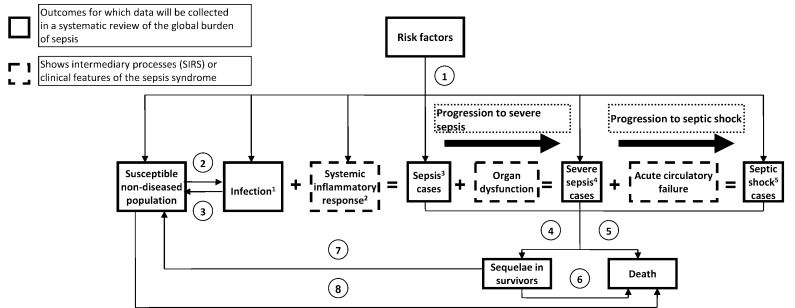
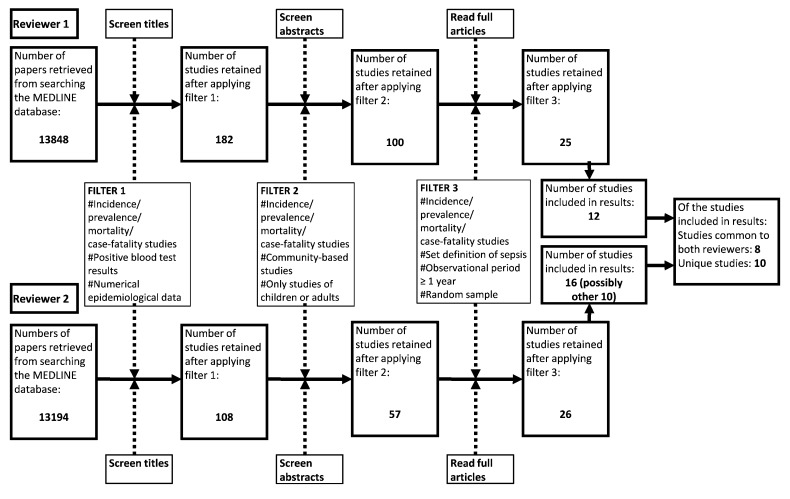
Assessing available information on the burden of sepsis: global estimates of incidence, prevalence and mortalityObjective Sepsis is a complex and hard-to-define condition with many different interactions with other disorders.Presently, there are no estimates of the burden of sepsis and septicaemia at the global level and it was not included in the initial Global Burden of Disease study.Non-maternal sepsis has only recently received attention as a substantial global public health problem.The aim of this study was to assess available data on the burden of non-maternal sepsis, severe sepsis and septic shock in the community and to identify key gaps in information needed to estimate the global burden of sepsis.Methods Literature review of English language-based studies reporting on the incidence, prevalence, mortality or case-fatality of sepsis, severe sepsis and septic shock.The available literature was searched using the MEDLINE database of citations and abstracts of biomedical research articles published between 1980 and 2008.Findings 8 studies reported incidence of sepsis, severe sepsis or septic shock at the national level (4 from the USA and 1 from Brazil, the UK, Norway and Australia).No studies on the incidence, prevalence, mortality or case-fatality from sepsis in developing countries were found.The population sepsis incidence ranged from 22 to 240/100 000 (most plausible estimates ranged from 149 to 240/100 000); of severe sepsis from 13 to 300/100 000 (most of the estimates were between 56 and 91/100 000); and of septic shock 11/100 000.Case-fatality rate depends on the setting and severity of disease.It can reach up to 30% for sepsis, 50% for severe sepsis and 80% for septic shock.While the data were compiled using strict inclusion and exclusion criteria, a degree of uncertainty still exists regarding the reported estimates. ConclusionThe few national-level reports available allow only a very crude estimation of the incidence of sepsis in developed countries while there is apparent lack of data from developing countries.A clear and universal definition of sepsis as well as the development of a sound epidemiological framework to begin addressing the magnitude of this problem is urgently needed through research in developing countries.
Overview
The claims and statistics of this paper haven’t been checked yet.
Run the check — free, no account needed. It reads the open-access text and checks the sources it cites.
Integrity signals
Registry
Cites
Statistics
Figures
Verification
Claims the paper makes
The claims and statistics of this paper haven’t been checked yet.
Run the check — free, no account needed. It reads the open-access text and checks the sources it cites.
Claims other papers make about this one
Each is checked against this paper’s own text: does it say what the citing paper says it does?
In the citing paper
“However, even hospital-born babies in developing countries have a three times greater to 20 times greater risk of neonatal infections because of poor infection-control practices.56, 57, 58, 59”
From Global burden of childhood pneumonia and diarrhoea (2013) · cites this paper as [58]
Self-check
Percentages, sums and reported differences re-computed from the paper’s own numbers.
The self-check needs the paper’s full text.
Citations
Cites
Bone, R. C., BALK, R. A., Cerra, F. B., Dellinger, R. P., Fein, A. M., Knaus, W. A., Schein, R. M. H., & Sibbald, W. J. (1992) · CHEST Journal · doi:10.1378/chest.101.6.1644 · Cited by 13,317
Angus, D. C., Linde-Zwirble, W. T., Lidicker, J., Clermont, G., Carcillo, J., & Pinsky, M. R. (2001) · Critical Care Medicine · doi:10.1097/00003246-200107000-00002 · Cited by 8,503
Murray, C. J. L., & López, A. D. (1997) · The Lancet · doi:10.1016/s0140-6736(96)07492-2 · Cited by 7,007
The epidemiology of sepsis in the United States from 1979 through 2000
Martin, G. S., Mannino, D. M., Eaton, S., & Moss, M. (2003) · New England Journal of Medicine · doi:10.1056/nejmoa022139 · Cited by 5,841
Evidence-based health policy—lessons from the Global Burden of Disease Study
Murray, C. J. L., & Lopez, A. D. (1996) · Science · doi:10.1126/science.274.5288.740 · Cited by 2,178
The Epidemiology of Severe Sepsis in Children in the United States
Watson, R. S., Carcillo, J. A., Linde‐Zwirble, W. T., Clermont, G., Lidicker, J. R., & Angus, D. C. (2003) · American Journal of Respiratory and Critical Care Medicine · doi:10.1164/rccm.200207-682oc · Cited by 880
Epidemiology of sepsis in Germany: results from a national prospective multicenter study
Engel, C., Brunkhorst, F. M., Bone, H.-G., Brunkhorst, R. R., Gerlach, H., Grond, S., Gründling, M., Huhle, G., Jaschinski, U., John, S., et al. (2007) · Intensive Care Medicine · doi:10.1007/s00134-006-0517-7 · Cited by 609
Sepsis: definition, epidemiology, and diagnosis
Lever, A. M. L., & Mackenzie, I. M. J. (2007) · BMJ · doi:10.1136/bmj.39346.495880.ae · Cited by 521
Adult-population incidence of severe sepsis in Australian and New Zealand intensive care units
Finfer, S. R., Bellomo, R., Lipman, J., French, C., DOBB, G. J., & Myburgh, J. (2004) · Intensive Care Medicine · doi:10.1007/s00134-004-2157-0 · Cited by 435
Brazilian Sepsis Epidemiological Study (BASES study)
Silva, E., Pedro, M. D. A., Sogayar, A. M. C. B., Mohovic, T., Silva, C. L. O., Janiszewski, M., Cal, R. G. R., de Sousa, É. F., Abe, T. P., de Andrade, J., et al. (2004) · Critical Care · doi:10.1186/cc2892 · Cited by 413
Harrison, D. A., Welch, C. A., & EDDLESTON, J. M. (2006) · Critical Care · doi:10.1186/cc4854 · Cited by 289
Karlsson, S., Varpula, M., Ruokonen, E., Pettilä, V., Parviainen, I., Ala-Kokko, T. I., Kolho, E., & Rintala, E. M. (2007) · Intensive Care Medicine · doi:10.1007/s00134-006-0504-z · Cited by 249
The SEPSIS Study Group, Salvo, I., de Cian, W., Musicco, M., Langer, M., Piadena, R., Wolfler, A., Montani, C., & Magni, E. (1995) · Intensive Care Medicine · doi:10.1007/bf01740762 · Cited by 247
Scaling up access to antiretroviral treatment in southern Africa: who will do the job?
Kober, K., & Damme, W. V. (2004) · The Lancet · doi:10.1016/s0140-6736(04)16597-5 · Cited by 244
Gender-Based Differences in Outcome in Patients With Sepsis
Eachempati, S. R. (1999) · Archives of Surgery · doi:10.1001/archsurg.134.12.1342 · Cited by 232
Epidemiology of Sepsis: Race, Sex, and Chronic Alcohol Abuse
Moss, M. (2005) · Clinical Infectious Diseases · doi:10.1086/432003 · Cited by 157
Epidemiology of sepsis in Norway in 1999
Flaatten, H. K. (2004) · Critical Care · doi:10.1186/cc2867 · Cited by 102
Empirical Bayes methods for stabilizing incidence rates before mapping.
Devine, O., Louis, T. A., & Halloran, M. (1994) · Epidemiology · doi:10.1097/00001648-199411000-00010 · Cited by 87
Hoa, N. T. T., Diep, T. S., Wain, J. R., Parry, C. M., Hien, T. T., Smith, M. D., Walsh, A. L., & White, N. J. (1998) · Transactions of the Royal Society of Tropical Medicine and Hygiene · doi:10.1016/s0035-9203(98)90891-4 · Cited by 74
Braun, L., Riedel, A. A., & Cooper, L. M. (2004) · Journal of Managed Care Pharmacy · doi:10.18553/jmcp.2004.10.6.521 · Cited by 73
A literature review of the epidemiology of sepsis in Latin America
Jaimes, F. A. (2005) · Revista Panamericana de Salud Pública · doi:10.1590/s1020-49892005000800003 · Cited by 44
Septicaemia in a teaching hospital in Kuwait — I: Incidence and aetiology
Elhag, K. M., Mustafa, A., & Sethi, S. K. (1985) · Journal of Infection · doi:10.1016/s0163-4453(85)80004-9 · Cited by 23
Épidémiologie des états septiques graves
Brun‐Buisson, C. (2006) · La Presse Médicale · doi:10.1016/s0755-4982(06)74627-9 · Cited by 15
Incidencia estimada y análisis de la sepsis en un área de Valencia
Monterde, R. B., Diego, J. A., Monleón, S. F., Bracho, L. S.-V., Escrivá, A. A., & Reig, P. R. (2007) · Anales de Pediatría · doi:10.1157/13107391 · Cited by 8
Cited by
Sorted by citations
Global burden of childhood pneumonia and diarrhoea
Walker, C. L. F., Rudan, I., Liu, L., Nair, H., Theodoratou, E., Bhutta, Z. A., O'Brien, K. L., Campbell, H., & Black, R. E. (2013) · The Lancet · doi:10.1016/s0140-6736(13)60222-6 · Cited by 2,356
Goal-Directed Resuscitation for Patients with Early Septic Shock
The ARISE Investigators and the ANZICS Clinical Trials Group (2014) · New England Journal of Medicine · doi:10.1056/nejmoa1404380 · Cited by 2,049
Cecconi, M., Backer, D. D., Antonelli, M. M., Beale, R. J., Bakker, J., Hofer, C. K., Jaeschke, R., Mebazaa, A., Pinsky, M. R., Teboul, J., et al. (2014) · Intensive Care Medicine · doi:10.1007/s00134-014-3525-z · Cited by 1,833
Hotchkiss, R. S., Moldawer, L. L., Opal, S. M., Reinhart, K., Turnbull, I. R., & Vincent, J. (2016) · Nature Reviews Disease Primers · doi:10.1038/nrdp.2016.45 · Cited by 1,780
Trial of early, goal-directed resuscitation for septic shock.
Mouncey, P. R., Osborn, T. M., Power, G. S., Harrison, D. A., Sadique, M. Z., Grieve, R. D., Jahan, R., Harvey, S. E., Bell, D., Bion, J. F., et al. (2015) · New England Journal of Medicine · doi:10.1056/nejmoa1500896 · Cited by 1,604
Metadata
- Authors
- Jawad, I., Lukšić, I., & Rafnsson, S. B.
- Affiliations
- University of Edinburgh (GB)
- Venue
- Journal of Global Health
- Publisher
- International Global Health Society
- Published
- 2012-06
- Volume
- 2
- Issue
- 1
- Pages
- 010404-010404
- ISSN
- 2047-2978 (ISSN-L)
- 2047-2986
- PMC
- PMC3484761
- OpenAlex
- W4237666362
- Cited by
- 389
- References
- 24
- Citations by year
- 2026: 2 · 2025: 16 · 2024: 29 · 2023: 26 · 2022: 24 · 2021: 31 · 2020: 53 · 2019: 34 · 2018: 37 · 2017: 32 · 2016: 44 · 2015: 28 · 2014: 24 · 2013: 9
- FWCI
- 14.55
- Type
- journal article
- Language
- en
- Open access
- gold
- doi.org
- Licence
- cc-by
- Locations
- Journal of Global Health (publishedVersion, cc-by)
- PubMed Central (publishedVersion, cc-by)
- PubMed (publishedVersion)
- DOAJ (DOAJ: Directory of Open Access Journals) (submittedVersion, cc-by-sa)
- UCL Discovery (University College London) (submittedVersion)
- Topics
- Health Sciences › Medicine › Critical Care and Intensive Care Medicine › Sepsis Diagnosis and Treatment
- Health Sciences › Medicine › Pediatrics, Perinatology and Child Health › Neonatal and Maternal Infections
- Life Sciences › Immunology and Microbiology › Microbiology › Bacterial Infections and Vaccines
- Keywords
- sepsis, severe sepsis, septic shock, global burden of disease, incidence, prevalence, mortality, case fatality rate, data gaps, developing countries, sepsis epidemiology, sepsis definitions
About these checks
Registry, retraction, Cites and statistics results are computed, not judged, with one exception: a printed reference that no index lists is read once by a model before it counts as a citation error. Claims are extracted by a model and kept only when their quote appears verbatim in the text; each cited source is then checked, with a model’s help, for whether it says what the claim relies on. Those verdicts can be wrong — read the claim’s quote and the cited source before relying on one.
Statistics and arithmetic are recomputed, not judged.
Confidence bands are shown only for fields calibrated on our annotated test set. None is calibrated yet, so no band is shown.
What counts as a claim ›How we measure confidence ›How we check this ›
Are you an author, or do you see a problem with this page? Request a review
