

The DOI matches its Crossref record; 121 of the 121 references it cites were found in a registry or an index.
A systematic review of interventions to reduce HIV‐related stigma and discrimination from 2002 to 2013: how far have we come?
Open accessAbstract
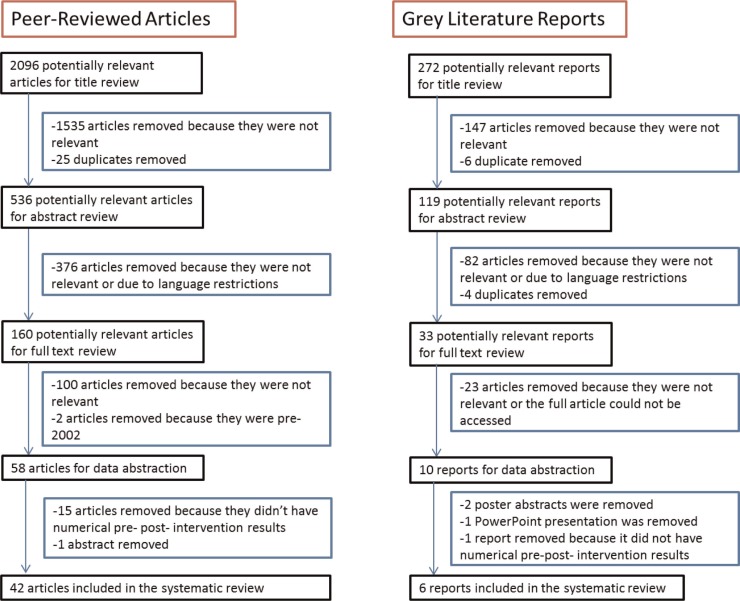
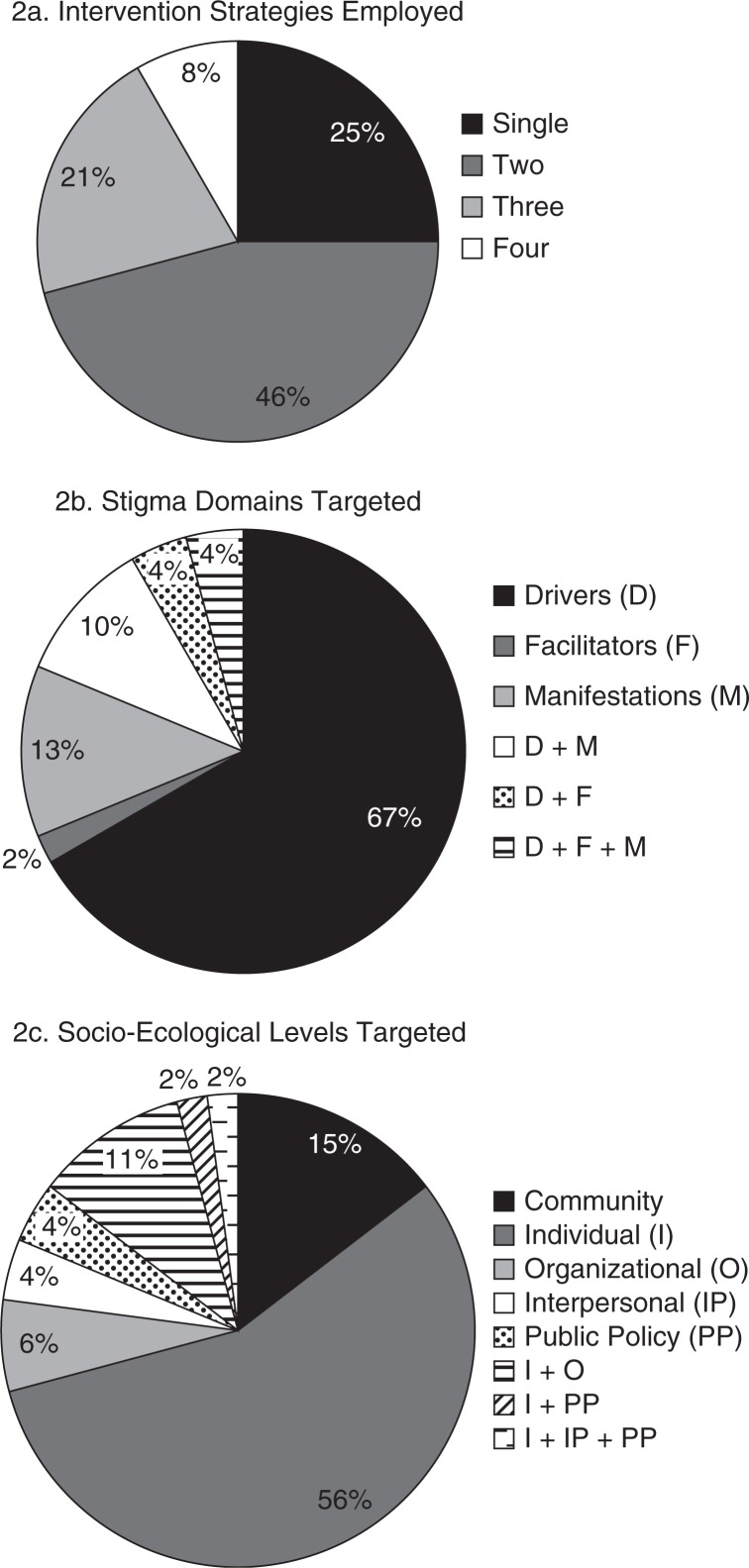
Introduction: HIV‐related stigma and discrimination continue to hamper efforts to prevent new infections and engage people in HIV treatment, care and support programmes. The identification of effective interventions to reduce stigma and discrimination that can be integrated into national responses is crucial to the success of the global AIDS response. Methods: We conducted a systematic review of studies and reports that assessed the effectiveness of interventions to reduce HIV stigma and discrimination between 1 January 2002 and 1 March 2013. Databases searched for peer‐reviewed articles included PubMed, Scopus, EBSCO Host –CINAHL Plus, Psycinfo, Ovid, Sociofile and Popline. Reports were obtained from the www.HIVAIDSClearinghouse.eu, USAID Development Experience Clearinghouse, UNESCO HIV and AIDS Education Clearinghouse, Google, WHO and UNAIDS. Ancestry searches for articles included in the systematic review were also conducted. Studies of any design that sought to reduce stigma as a primary or secondary objective and included pre‐ and post‐intervention measures of stigma were included. Results: Of 2368 peer‐reviewed articles and reports identified, 48 were included in our review representing 14 different target populations in 28 countries. The majority of interventions utilized two or more strategies to reduce stigma and discrimination, and ten included structural or biomedical components. However, most interventions targeted a single socio‐ecological level and a single domain of stigma. Outcome measures lacked uniformity and validity, making both interpretation and comparison of study results difficult. While the majority of studies were effective at reducing the aspects of stigma they measured, none assessed the influence of stigma or discrimination reduction on HIV‐related health outcomes. Conclusions: Our review revealed considerable progress in the stigma‐reduction field. However, critical challenges and gaps remain which are impeding the identification of effective stigma‐reduction strategies that can be implemented by national governments on a larger scale. The development, validation, and consistent use of globally relevant scales of stigma and discrimination are a critical next step for advancing the field of research in this area. Studies comparing the effectiveness of different stigma‐reduction strategies and studies assessing the influence of stigma reduction on key behavioural and biomedical outcomes are also needed to maximize biomedical prevention efforts.
Overview
The claims and statistics of this paper haven’t been checked yet.
Run the check — free, no account needed. It reads the open-access text and checks the sources it cites.
Integrity signals
Registry
Cites
Statistics
Figures
Verification
Claims the paper makes
The claims and statistics of this paper haven’t been checked yet.
Run the check — free, no account needed. It reads the open-access text and checks the sources it cites.
Claims other papers make about this one
Each is checked against this paper’s own text: does it say what the citing paper says it does?
In the citing paper
“Research on infectious disease stigma has focused on those infected or most vulnerable to infection (e.g., anticipated HIV stigma among gay and bisexual men) [55].”
From Psychiatric symptoms, risk, and protective factors among university students in quarantine during the COVID-19 pandemic in China (2021) · cites this paper as [55]
Self-check
Percentages, sums and reported differences re-computed from the paper’s own numbers.
The self-check needs the paper’s full text.
Citations
Cites
Stigma: Notes on the Management of Spoiled Identity
(1969) · Postgraduate Medical Journal · doi:10.1136/pgmj.45.527.642 · Cited by 14,255
Link, B. G., & Phelan, J. C. (2001) · Annual Review of Sociology · doi:10.1146/annurev.soc.27.1.363 · Cited by 8,848
An ecological perspective on health promotion programs
McLeroy, K. R., Bibeau, D., Steckler, A., & Glanz, K. (1988) · Health Education Quarterly · doi:10.1177/109019818801500401 · Cited by 8,502
Downs, S. H., & Black, N. (1998) · Journal of Epidemiology and Community Health · doi:10.1136/jech.52.6.377 · Cited by 8,252
Preexposure chemoprophylaxis for HIV prevention in men who have sex with men.
Grant, R. M., Lama, J. R., Anderson, P. L., McMahan, V., Liu, A. Y., Vargas, L., Goicochea, P., Casapía, M., Guanira-Carranza, J. V., Ramirez-Cardich, M. E., et al. (2010) · New England Journal of Medicine · doi:10.1056/nejmoa1011205 · Cited by 5,096
HIV and AIDS-related stigma and discrimination: a conceptual framework and implications for action
Parker, R. G., & Aggleton, P. (2003) · Social Science & Medicine · doi:10.1016/s0277-9536(02)00304-0 · Cited by 2,754
Abdool Karim, Q., Abdool Karim, S. S., Frohlich, J. A., Grobler, A. C., Baxter, C., Mansoor, L. E., Kharsany, A. B. M., Sibeko, S., Mlisana, K. P., Omar, Z., et al. (2010) · Science · doi:10.1126/science.1193748 · Cited by 2,435
The Paradox of Self-Stigma and Mental Illness
Corrigan, P. W., & Watson, A. C. (2002) · Clinical Psychology Science and Practice · doi:10.1093/clipsy.9.1.35 · Cited by 2,058
Measuring stigma in people with HIV: Psychometric assessment of the HIV stigma scale
Berger, B. E., Ferrans, C. E., & Lashley, F. R. (2001) · Research in Nursing & Health · doi:10.1002/nur.10011 · Cited by 1,601
Stigma in the HIV/AIDS epidemic: a review of the literature and recommendations for the way forward
Mahajan, A. P., Sayles, J. N., Patel, V. A., Remien, R. H., Sawires, S. R., Ortiz, D. J., Szekeres, G., & Coates, T. J. (2008) · AIDS · doi:10.1097/01.aids.0000327438.13291.62 · Cited by 1,404
Research works printed but not linked: 13
- PEPFAR, 2012, PEPFAR blueprint: creating an AIDS‐Free generation
- StanglA GoV ZelayaC BradyL NybladeL Stackpool‐MooreL et al.Enabling the scale‐up of efforts to reduce HIV stigma and discrimination: a new framework to inform program implementation and measurement.XVIII International AIDS Conference July 18–23. Vienna;2010.
- Hong KT, 2004, Because this is the disease of the century: understanding HIV and AIDS‐related stigma and discrimination, 1
- UNAIDS, 2005, HIV‐related stigma, discrimination and human rights violations
- UNAIDS, IPPF, 2004, A brief report of the IPPF and UNAIDS Joint Consultative Meeting on PLWA rights index
- UNAIDS, 2006, Courting rights: case studies in litigation the human rights of people living with HIV
- Adam BD, hivstigma, 26, 795
- Nyblade L, 2008, Communities confront HIV stigma in Viet Nam: participatory interventions reduce HIV‐related stigma in two provinces, 1
- Lakshmi MG, 2013, Impact of psycho‐education on stigma in people living with HIV/AIDS, Int J Soc Sci Tomorrow, 2, 1
- Apinundecha C, 2007, A community participation intervention to reduce HIV/AIDS stigma, Nakhon Ratchasima province, northeast Thailand, 19, 1157
- UNAIDS, 2007, Reducing stigma and discrimination: a critical part of National AIDS Programmes
- UNAIDS, 2010, Making the law work for the HIV response: country snapshot. The International Planned Parenthood Federation, the Global Network of People living with HIV, the International Lesbian, Gay, Bisexual, Trans and Intersex Association, the International Harm Reduction Association, and the Joint United Nations Programme on HIV/AIDS
- UNAIDS, 2012, Global report: UNAIDS report on the Global AIDS epidemic
Cited by
Sorted by citations
Stangl, A. L., Earnshaw, V. A., Logie, C. H., van Brakel, W., C. Simbayi, L., Barré, I., & Dovidio, J. F. (2019) · BMC Medicine · doi:10.1186/s12916-019-1271-3 · Cited by 1,603
Self-citationRueda, S., Mitra, S., Chen, S., Gogolishvili, D., Globerman, J., Chambers, L. A., Wilson, M. S., Logie, C. H., Shi, Q., Morassaei, S., et al. (2016) · BMJ Open · doi:10.1136/bmjopen-2016-011453 · Cited by 1,010
Stigma in health facilities: Why it matters and how we can change it
Nyblade, L., Stockton, M. A., Giger, K., Bond, V., Ekstrand, M. L., Lean, R. M., Mitchell, E. M. H., Nelson, L. R. E., Sapag, J. C., Siraprapasiri, T., et al. (2019) · BMC Medicine · doi:10.1186/s12916-019-1256-2 · Cited by 881
Framing Mechanisms Linking HIV-Related Stigma, Adherence to Treatment, and Health Outcomes
Turan, B., Hatcher, A. M., Weiser, S. D., Johnson, M. O., Rice, W. S., & Turan, J. M. (2017) · American Journal of Public Health · doi:10.2105/ajph.2017.303744 · Cited by 522
Stigma reduction interventions in people living with HIV to improve health-related quality of life
Zeluf, G., Reinius, M., Eriksson, L. E., Svedhem, V., Esfahani, F. M., Deuba, K., Rao, D., Lyatuu, G., Giovenco, D., & Ekström, A. M. (2019) · The Lancet HIV · doi:10.1016/s2352-3018(19)30343-1 · Cited by 312
Metadata
- Authors
- Stangl, A. L., Lloyd, J. K., Brady, L. M., Holland, C. E., & Baral, S.
- Affiliations
- International Center for Research on Women (US)
- Johns Hopkins University (US)
- Corresponding author
- Stangl, Anne L
- Venue
- Journal of the International AIDS Society
- Publisher
- Wiley
- Published
- 2013-11
- Volume
- 16
- Issue
- 3S2
- Pages
- 18734-18734
- ISSN
- 1758-2652 (ISSN-L)
- PMC
- PMC3833106
- OpenAlex
- W2038136417
- Cited by
- 698
- References
- 121
- Citations by year
- 2026: 28 · 2025: 36 · 2024: 48 · 2023: 42 · 2022: 68 · 2021: 78 · 2020: 68 · 2019: 69 · 2018: 56 · 2017: 65 · 2016: 55 · 2015: 57 · 2014: 24 · 2013: 3
- FWCI
- 5.98
- Type
- journal article
- Language
- en
- Open access
- gold
- doi.org
- Licence
- Locations
- Journal of the International AIDS Society (publishedVersion, cc-by)
- Europe PMC (PubMed Central) (publishedVersion, cc-by)
- PubMed Central (publishedVersion, cc-by)
- PubMed (publishedVersion)
- Funders
- Department for International Development
- Topics
- Health Sciences › Medicine › Infectious Diseases › HIV/AIDS Research and Interventions
- Health Sciences › Medicine › Epidemiology › HIV, Drug Use, Sexual Risk
- Social Sciences › Economics, Econometrics and Finance › Economics and Econometrics › HIV/AIDS Impact and Responses
- Keywords
- HIV stigma, HIV discrimination, stigma reduction interventions, HIV prevention, HIV treatment engagement, stigma measurement scale, biomedical HIV prevention
- MeSH terms
- Discrimination, Psychological, Humans, HIV Infections, Social Stigma
About these checks
Registry, retraction, Cites and statistics results are computed, not judged, with one exception: a printed reference that no index lists is read once by a model before it counts as a citation error. Claims are extracted by a model and kept only when their quote appears verbatim in the text; each cited source is then checked, with a model’s help, for whether it says what the claim relies on. Those verdicts can be wrong — read the claim’s quote and the cited source before relying on one.
Statistics and arithmetic are recomputed, not judged.
Confidence bands are shown only for fields calibrated on our annotated test set. None is calibrated yet, so no band is shown.
What counts as a claim ›How we measure confidence ›How we check this ›
Are you an author, or do you see a problem with this page? Request a review
