Cited by 14Magnesium in Health and DiseaseCalcium signaling and nucleotide metabolismIon Channels and Receptors

The DOI matches its Crossref record; 3 of the 3 references it cites were found in a registry or an index.

Structural insights into regulation of CNNM-TRPM7 divalent cation uptake by the small GTPase ARL15

Open access

Published version of a preprint

Abstract

Cystathionine-β-synthase (CBS)-pair domain divalent metal cation transport mediators (CNNMs) are an evolutionarily conserved family of magnesium transporters. They promote efflux of Mg 2+ ions on their own and influx of divalent cations when expressed with the transient receptor potential ion channel subfamily M member 7 (TRPM7). Recently, ADP-ribosylation factor-like GTPase 15 (ARL15) has been identified as CNNM-binding partner and an inhibitor of divalent cation influx by TRPM7. Here, we characterize ARL15 as a GTP and CNNM-binding protein and demonstrate that ARL15 also inhibits CNNM2 Mg 2+ efflux. The crystal structure of a complex between ARL15 and CNNM2 CBS-pair domain reveals the molecular basis for binding and allowed the identification of mutations that specifically block binding. A binding deficient ARL15 mutant, R95A, failed to inhibit CNNM and TRPM7 transport of Mg 2+ and Zn 2+ ions. Structural analysis and binding experiments with phosphatase of regenerating liver 2 (PRL2 or PTP4A2) showed that ARL15 and PRLs compete for binding CNNM to coordinate regulation of ion transport by CNNM and TRPM7.

Overview

The claims and statistics of this paper haven’t been checked yet.

Run the check — free, no account needed. It reads the open-access text and checks the sources it cites.

A few free checks a day · papers already verified open instantly · results are public

Integrity signals

Registry

Crossref · 10.7554/elife.86129

Cites

3 of 3 references verified0 citation errors · 0 not checkable

Statistics

Figures

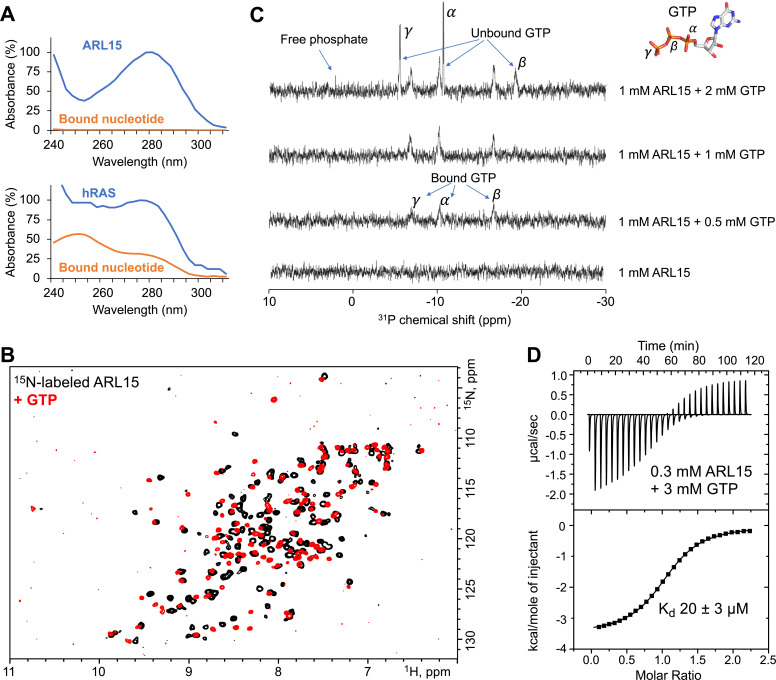
Figure 1. ADP-ribosylation factor-like GTPase 15 (ARL15) (32–197) purifies without nucleotide bound and has weak affinity for GTP. (A) UV spectra of recombinant ARL15 and the GTPase hRAS. Spectra were recorded before (blue) and after heat treatment (orange) to precipitate the protein component. Unlike hRAS, ARL15 has no nucleotide bound. (B) 1H-15N correlation NMR spectra of 100 µM ARL15 unliganded (black) and with 500 µM GTP (red). (C) Phosphorus (31P) NMR spectra of recombinant ARL15 titrated with GTP. Prior to addition of GTP, no signals are visible. GTP binds until ARL15 is saturated whereupon signals for both bound and free GTP are observed. (D) Isothermal titration calorimetry shows ARL15 binds GTP with mid-micromolar affinity.
Figure 1. ADP-ribosylation factor-like GTPase 15 (ARL15) (32–197) purifies without nucleotide bound and has weak affinity for GTP. (A) UV spectra of recombinant ARL15 and the GTPase hRAS. Spectra were recorded before (blue) and after heat treatment (orange) to precipitate the protein component. Unlike hRAS, ARL15 has no nucleotide bound. (B) 1H-15N correlation NMR spectra of 100 µM ARL15 unliganded (black) and with 500 µM GTP (red). (C) Phosphorus (31P) NMR spectra of recombinant ARL15 titrated with GTP. Prior to addition of GTP, no signals are visible. GTP binds until ARL15 is saturated whereupon signals for both bound and free GTP are observed. (D) Isothermal titration calorimetry shows ARL15 binds GTP with mid-micromolar affinity.CC BY · PubMed Central
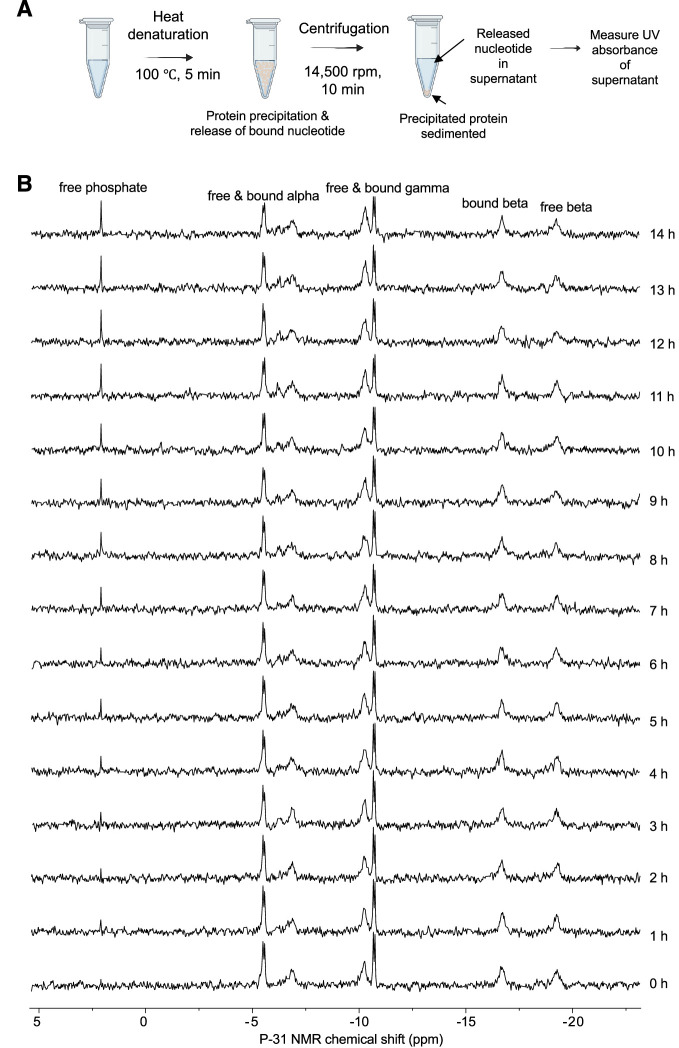
Figure 1—figure supplement 1. ADP-ribosylation factor-like GTPase 15 (ARL15) has low intrinsic GTPase activity. (A) Procedure to detect bound nucleotide. Figure prepared with BioRender. (B) Measurement of intrinsic GTPase activity. 31P NMR spectra of 1 mM ARL15 with 2 mM GTP collected overnight at 25°C show an accumulation of free phosphate and a small (~25%) decrease in free GTP. The loss corresponds to a turnover rate of 0.000005 s–1. Notably, there is no evidence of formation of GDP, which would appear as a decrease in the β signal relative to the α and γ signals.
Figure 1—figure supplement 1. ADP-ribosylation factor-like GTPase 15 (ARL15) has low intrinsic GTPase activity. (A) Procedure to detect bound nucleotide. Figure prepared with BioRender. (B) Measurement of intrinsic GTPase activity. 31P NMR spectra of 1 mM ARL15 with 2 mM GTP collected overnight at 25°C show an accumulation of free phosphate and a small (~25%) decrease in free GTP. The loss corresponds to a turnover rate of 0.000005 s–1. Notably, there is no evidence of formation of GDP, which would appear as a decrease in the β signal relative to the α and γ signals.CC BY · PubMed Central
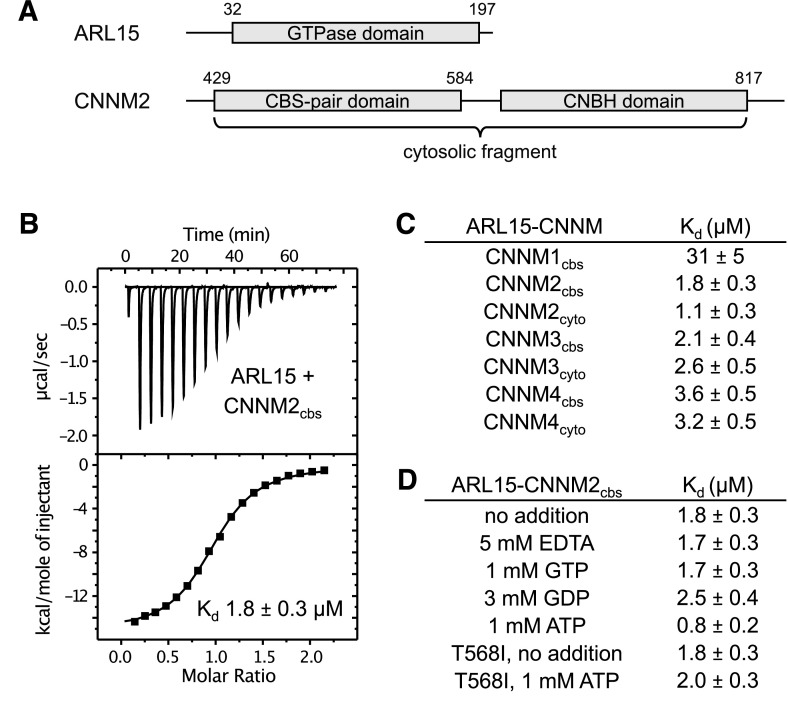
Figure 2. ADP-ribosylation factor-like GTPase 15 (ARL15) binds cystathionine-β-synthase-pair domain divalent metal cation transport mediator (CNNM) cystathionine-β-synthase (CBS)-pair domains. (A) Domains of ARL15 and CNNM2 proteins used in binding experiments. The four CNNM protein have the same domain organization. (B) Isothermal titration calorimetry experiment between the ARL15 GTPase domain and CNNM2 CBS-pair domain. (C) Binding affinities (Kd) between ARL15 GTPase domain and CBS-pair and cytosolic fragments of CNNM proteins measured by isothermal titration calorimetry (ITC). (D) Effect of nucleotides on the affinity of the ARL15-CNNM2 interaction measured by ITC. The CNNM2 T568I mutant, which is unable to bind ATP, bound ARL15 with the same affinity as the wild-type CNNM2 CBS-pair domain but did not show increased affinity upon addition of ATP.
Figure 2. ADP-ribosylation factor-like GTPase 15 (ARL15) binds cystathionine-β-synthase-pair domain divalent metal cation transport mediator (CNNM) cystathionine-β-synthase (CBS)-pair domains. (A) Domains of ARL15 and CNNM2 proteins used in binding experiments. The four CNNM protein have the same domain organization. (B) Isothermal titration calorimetry experiment between the ARL15 GTPase domain and CNNM2 CBS-pair domain. (C) Binding affinities (Kd) between ARL15 GTPase domain and CBS-pair and cytosolic fragments of CNNM proteins measured by isothermal titration calorimetry (ITC). (D) Effect of nucleotides on the affinity of the ARL15-CNNM2 interaction measured by ITC. The CNNM2 T568I mutant, which is unable to bind ATP, bound ARL15 with the same affinity as the wild-type CNNM2 CBS-pair domain but did not show increased affinity upon addition of ATP.CC BY · PubMed Central
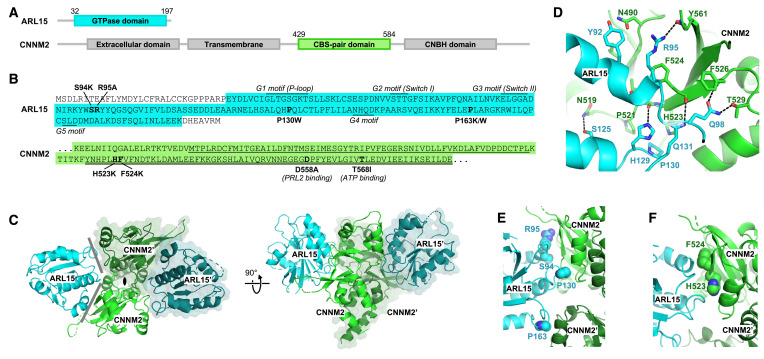
Figure 3. Crystal structure of ADP-ribosylation factor-like GTPase 15 (ARL15) bound to the cystathionine-β-synthase (CBS)-pair domain of CBS-pair domain divalent metal cation transport mediator 2 (CNNM2). (A) Domain organization of the proteins. (B) Sequences of the fragments crystallized and residues mutated. The typical GTPase motifs are indicated for ARL15. Within the CNNM2 CBS-pair domain, the CBS1 and CBS2 motifs are singly and doubly underlined. (C) Crystal structure of two ARL15 molecules bound to a CBS-pair domain dimer. There are two distinct interfaces (gray lines) between the ARL15 and CBS-pair monomers. (D) Detail of intermolecular contacts between ARL15 and the CNNM2 CBS-pair domain. (E) Interfacial ARL15 residues tested by mutagenesis. (F) Interfacial CNNM2 residues tested by mutagenesis.
Figure 3. Crystal structure of ADP-ribosylation factor-like GTPase 15 (ARL15) bound to the cystathionine-β-synthase (CBS)-pair domain of CBS-pair domain divalent metal cation transport mediator 2 (CNNM2). (A) Domain organization of the proteins. (B) Sequences of the fragments crystallized and residues mutated. The typical GTPase motifs are indicated for ARL15. Within the CNNM2 CBS-pair domain, the CBS1 and CBS2 motifs are singly and doubly underlined. (C) Crystal structure of two ARL15 molecules bound to a CBS-pair domain dimer. There are two distinct interfaces (gray lines) between the ARL15 and CBS-pair monomers. (D) Detail of intermolecular contacts between ARL15 and the CNNM2 CBS-pair domain. (E) Interfacial ARL15 residues tested by mutagenesis. (F) Interfacial CNNM2 residues tested by mutagenesis.CC BY · PubMed Central
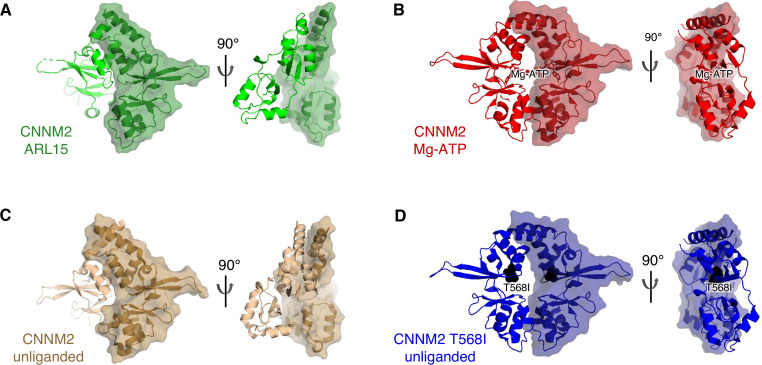
Figure 3—figure supplement 1. Structural comparison of the cystathionine-β-synthase-pair domain divalent metal cation transport mediator 2 (CNNM2) cystathionine-β-synthase (CBS)-pair domain dimerization when (A) bound to ADP-ribosylation factor-like GTPase 15 (ARL15) (green), (B) bound to Mg-ATP (red, PDB code 4P1O), (C) no ligand bound (brown, 4IYS), and (D) T568I mutant (blue, 4IY4).
Figure 3—figure supplement 1. Structural comparison of the cystathionine-β-synthase-pair domain divalent metal cation transport mediator 2 (CNNM2) cystathionine-β-synthase (CBS)-pair domain dimerization when (A) bound to ADP-ribosylation factor-like GTPase 15 (ARL15) (green), (B) bound to Mg-ATP (red, PDB code 4P1O), (C) no ligand bound (brown, 4IYS), and (D) T568I mutant (blue, 4IY4).CC BY · PubMed Central
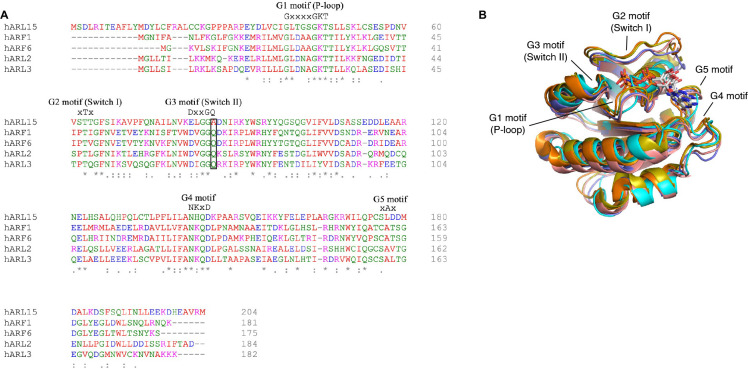
Figure 3—figure supplement 2. Comparison of ADP-ribosylation factor-like GTPase 15 (ARL15) to related small GTPases. (A) Sequence alignment of human ARL15 and other ARL/ARF GTPases. The glutamine residue in the G3 motif that is alanine in ARL15 is boxed. (B) Structural comparison of ARL15 (cyan) to small GTPases: ARL2 (pink, PDB code 4GOK), ARL3 (orange, 3BH6), ARF1 (olive, 1O3Y), ARF6 (violet, 4KAX).
Figure 3—figure supplement 2. Comparison of ADP-ribosylation factor-like GTPase 15 (ARL15) to related small GTPases. (A) Sequence alignment of human ARL15 and other ARL/ARF GTPases. The glutamine residue in the G3 motif that is alanine in ARL15 is boxed. (B) Structural comparison of ARL15 (cyan) to small GTPases: ARL2 (pink, PDB code 4GOK), ARL3 (orange, 3BH6), ARF1 (olive, 1O3Y), ARF6 (violet, 4KAX).CC BY · PubMed Central
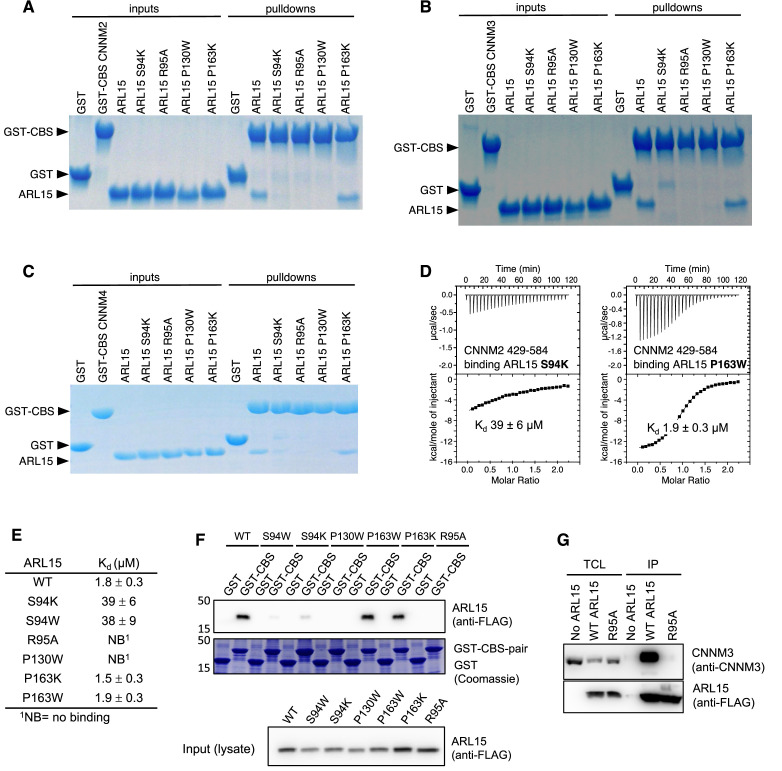
Figure 4. Mutagenesis of ADP-ribosylation factor-like GTPase 15 (ARL15) confirms the cystathionine-β-synthase-pair domain divalent metal cation transport mediator (CNNM)-binding site. Pulldowns of recombinant WT and mutant ARL15 GTPase domains (residues 32–197) by (A) GST-CNNM2 cystathionine-β-synthase (CBS)-pair domain (residues 429–584), (B) GST-CNNM3 CBS-pair domain (residues 299–452), (C) GST-CNNM4 CBS-pair domain (residues 356–511). (D) Isothermal titration of mutants of ARL15 GTPase domain and CNNM2 CBS-pair domain. (E) CNNM2 binding affinities (Kd) of ARL15 GTPase mutants measured by isothermal titration calorimetry (ITC). (F) Pulldown of wild-type ARL15 (WT) and the indicated mutants expressed in HEK-293T cells by GST-fused CNNM2 CBS-pair domain. (G) Co-immunoprecipitation of FLAG-tagged ARL15 with native CNNM3 shows that the ARL15 R95A mutation fully blocks binding. No ARL15, untransfected; WT, wild-type.
Figure 4. Mutagenesis of ADP-ribosylation factor-like GTPase 15 (ARL15) confirms the cystathionine-β-synthase-pair domain divalent metal cation transport mediator (CNNM)-binding site. Pulldowns of recombinant WT and mutant ARL15 GTPase domains (residues 32–197) by (A) GST-CNNM2 cystathionine-β-synthase (CBS)-pair domain (residues 429–584), (B) GST-CNNM3 CBS-pair domain (residues 299–452), (C) GST-CNNM4 CBS-pair domain (residues 356–511). (D) Isothermal titration of mutants of ARL15 GTPase domain and CNNM2 CBS-pair domain. (E) CNNM2 binding affinities (Kd) of ARL15 GTPase mutants measured by isothermal titration calorimetry (ITC). (F) Pulldown of wild-type ARL15 (WT) and the indicated mutants expressed in HEK-293T cells by GST-fused CNNM2 CBS-pair domain. (G) Co-immunoprecipitation of FLAG-tagged ARL15 with native CNNM3 shows that the ARL15 R95A mutation fully blocks binding. No ARL15, untransfected; WT, wild-type.CC BY · PubMed Central
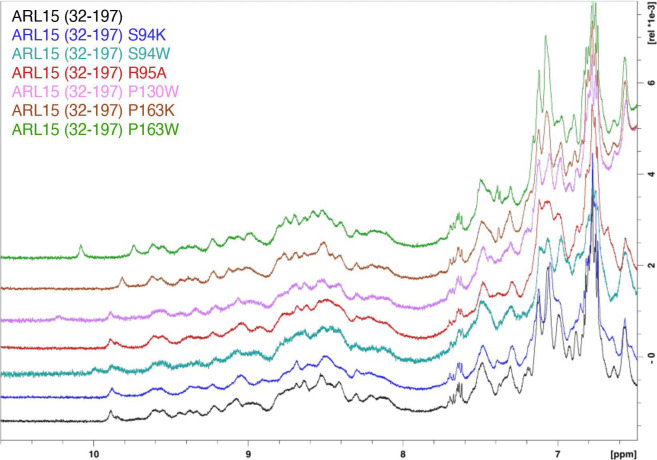
Figure 4—figure supplement 1. ADP-ribosylation factor-like GTPase 15 (ARL15) mutants are properly folded. Downfield 1H NMR spectra of ARL15 GTPase domain (residues 32–197) and mutants (S94K, S94W, R95A, P130W, P163K, P163W).
Figure 4—figure supplement 1. ADP-ribosylation factor-like GTPase 15 (ARL15) mutants are properly folded. Downfield 1H NMR spectra of ARL15 GTPase domain (residues 32–197) and mutants (S94K, S94W, R95A, P130W, P163K, P163W).CC BY · PubMed Central
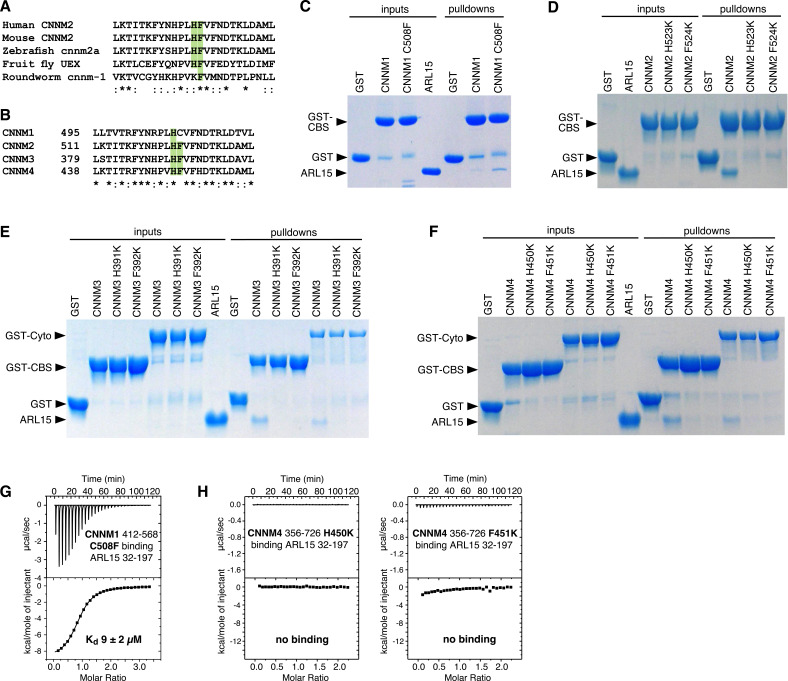
Figure 5. Mutagenesis of cystathionine-β-synthase-pair domain divalent metal cation transport mediator (CNNM) confirms conservation of ADP-ribosylation factor-like GTPase 15 (ARL15)-binding site. (A) Conservation of key ARL15-binding residues (green) in different species. (B) Conservation of ARL15-binding residues in human CNNMs. (C–F) Pulldown of recombinant GTPase domain (residues 32–197) by GST fusions with (C) CNNM1 (residues 412–568), (D) CNNM2 (residues 429–584), (E) CNNM3 (residues 299–452 and residues 299–658), (F) CNNM4 (residues 356–511 and residues 356–726). (G) Isothermal titration calorimetry (ITC) thermogram of ARL15 GTPase domain and CNNM1 cystathionine-β-synthase (CBS)-pair domain with C508F mutation shows a threefold improvement in affinity. (H) Thermograms of CNNM4 cytosolic fragment H450K and F451K mutants show no ARL15 binding.
Figure 5. Mutagenesis of cystathionine-β-synthase-pair domain divalent metal cation transport mediator (CNNM) confirms conservation of ADP-ribosylation factor-like GTPase 15 (ARL15)-binding site. (A) Conservation of key ARL15-binding residues (green) in different species. (B) Conservation of ARL15-binding residues in human CNNMs. (C–F) Pulldown of recombinant GTPase domain (residues 32–197) by GST fusions with (C) CNNM1 (residues 412–568), (D) CNNM2 (residues 429–584), (E) CNNM3 (residues 299–452 and residues 299–658), (F) CNNM4 (residues 356–511 and residues 356–726). (G) Isothermal titration calorimetry (ITC) thermogram of ARL15 GTPase domain and CNNM1 cystathionine-β-synthase (CBS)-pair domain with C508F mutation shows a threefold improvement in affinity. (H) Thermograms of CNNM4 cytosolic fragment H450K and F451K mutants show no ARL15 binding.CC BY · PubMed Central
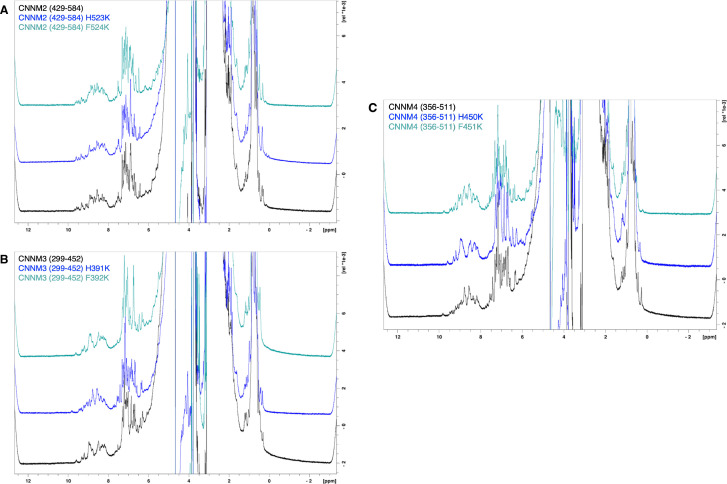
Figure 5—figure supplement 1. Cystathionine-β-synthase-pair domain divalent metal cation transport mediator 2 (CNNM2) cystathionine-β-synthase (CBS)-pair domain mutants are properly folded. 1H NMR spectra of (A) CNNM2 WT, H523K, and F524K mutants, (B) CNNM3 WT, H391K, and F392K mutants, and (C) CNNM4 WT, H450K, and F451K mutants.
Figure 5—figure supplement 1. Cystathionine-β-synthase-pair domain divalent metal cation transport mediator 2 (CNNM2) cystathionine-β-synthase (CBS)-pair domain mutants are properly folded. 1H NMR spectra of (A) CNNM2 WT, H523K, and F524K mutants, (B) CNNM3 WT, H391K, and F392K mutants, and (C) CNNM4 WT, H450K, and F451K mutants.CC BY · PubMed Central
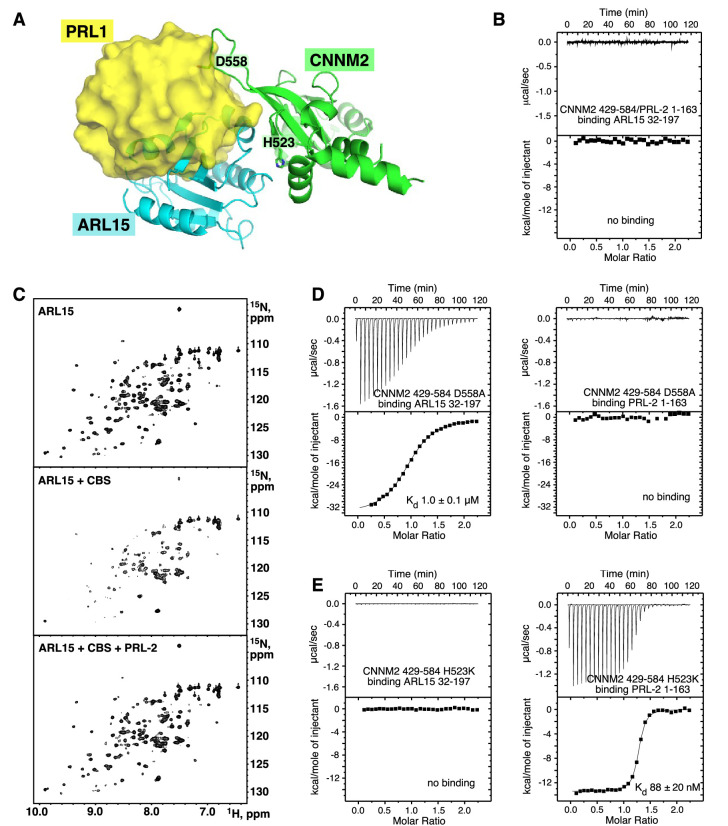
Figure 6. ADP-ribosylation factor-like GTPase 15 (ARL15) and phosphatases of regenerating liver (PRLs) have overlapping but distinct binding sites. (A) Overlay of the structures of the cystathionine-β-synthase-pair domain divalent metal cation transport mediator 2 (CNNM2) complexes with ARL15 (cyan) and PRL1 (yellow, PDB code 6WUS) shows that simultaneous binding is not possible. (B) Isothermal titration calorimetry (ITC) thermogram shows no binding of ARL15 to the preformed complex of CNNM2 and PRL2. (C) 1H-15N correlation NMR spectra of 100 µM 15N-labeled ARL15 alone (top), in the presence of 100 µM CNNM2 cystathionine-β-synthase (CBS)-pair domain (middle), and after addition of 150 µM PRL2 (bottom). The ARL15 NMR signals are attenuated upon binding CNNM2 but reappear when ARL15 is displaced by PRL2. (D) ITC thermograms demonstrating that the CNNM2 D558A mutation specifically disrupts PRL2 binding. (E) ITC thermograms demonstrating that the CNNM2 H523K mutation specifically disrupts ARL15 binding.
Figure 6. ADP-ribosylation factor-like GTPase 15 (ARL15) and phosphatases of regenerating liver (PRLs) have overlapping but distinct binding sites. (A) Overlay of the structures of the cystathionine-β-synthase-pair domain divalent metal cation transport mediator 2 (CNNM2) complexes with ARL15 (cyan) and PRL1 (yellow, PDB code 6WUS) shows that simultaneous binding is not possible. (B) Isothermal titration calorimetry (ITC) thermogram shows no binding of ARL15 to the preformed complex of CNNM2 and PRL2. (C) 1H-15N correlation NMR spectra of 100 µM 15N-labeled ARL15 alone (top), in the presence of 100 µM CNNM2 cystathionine-β-synthase (CBS)-pair domain (middle), and after addition of 150 µM PRL2 (bottom). The ARL15 NMR signals are attenuated upon binding CNNM2 but reappear when ARL15 is displaced by PRL2. (D) ITC thermograms demonstrating that the CNNM2 D558A mutation specifically disrupts PRL2 binding. (E) ITC thermograms demonstrating that the CNNM2 H523K mutation specifically disrupts ARL15 binding.CC BY · PubMed Central
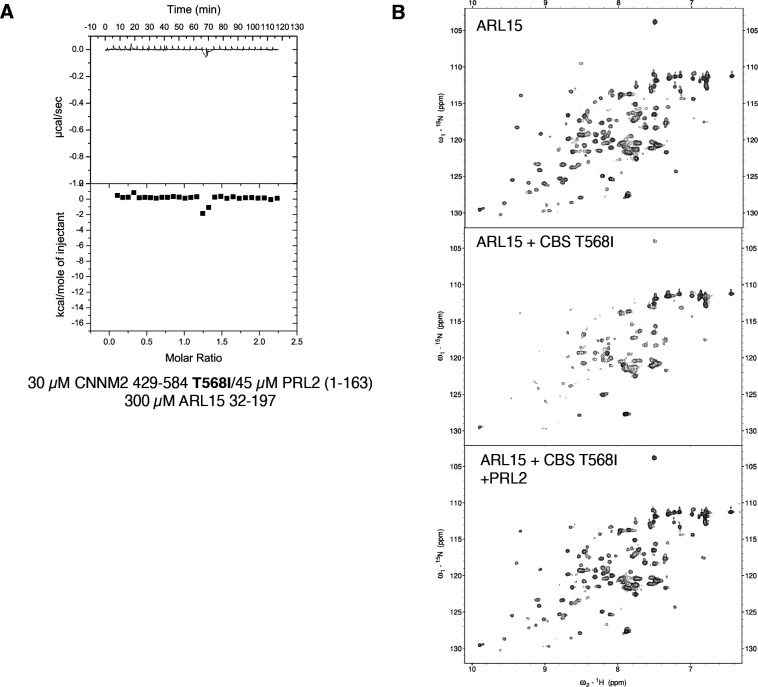
Figure 6—figure supplement 1. Competition between ADP-ribosylation factor-like GTPase 15 (ARL15) and phosphatase of regenerating liver 2 (PRL2) binding to cystathionine-β-synthase-pair domain divalent metal cation transport mediator 2 (CNNM2) is not affected by the CNNM2 T568I mutation. (A) Isothermal titration calorimetry (ITC) thermogram shows no binding of ARL15 to the preformed complex of CNNM2 T568I and PRL2. (B) 1H-15N correlation NMR spectra of 100 µM 15N-labeled ARL15 alone (top), in the presence of 100 µM CNNM2 cystathionine-β-synthase (CBS)-pair domain mutant T568I (middle), and after addition of 150 µM PRL2 (bottom). The ARL15 NMR signals are attenuated upon binding the CNNM2 T568I mutant but reappear when ARL15 is displaced by PRL2.
Figure 6—figure supplement 1. Competition between ADP-ribosylation factor-like GTPase 15 (ARL15) and phosphatase of regenerating liver 2 (PRL2) binding to cystathionine-β-synthase-pair domain divalent metal cation transport mediator 2 (CNNM2) is not affected by the CNNM2 T568I mutation. (A) Isothermal titration calorimetry (ITC) thermogram shows no binding of ARL15 to the preformed complex of CNNM2 T568I and PRL2. (B) 1H-15N correlation NMR spectra of 100 µM 15N-labeled ARL15 alone (top), in the presence of 100 µM CNNM2 cystathionine-β-synthase (CBS)-pair domain mutant T568I (middle), and after addition of 150 µM PRL2 (bottom). The ARL15 NMR signals are attenuated upon binding the CNNM2 T568I mutant but reappear when ARL15 is displaced by PRL2.CC BY · PubMed Central
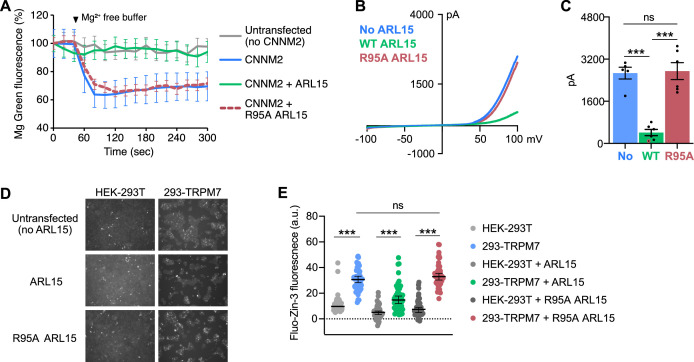
Figure 7. Disruption of the cystathionine-β-synthase-pair domain divalent metal cation transport mediator (CNNM)-binding site blocks ADP-ribosylation factor-like GTPase 15 (ARL15) regulation of CNNM and transient receptor potential ion channel subfamily M member 7 (TRPM7) divalent cation transport. (A) CNNM2 Mg2+ efflux is inhibited by ARL15 but not the R95A mutant. HEK-293T cells transfected with the indicated constructs were loaded with a magnesium sensitive dye and fluorescence monitored following Mg2+ depletion. The mean relative fluorescence intensities of 10 cells are shown. (B) Representative TRPM7 whole-cell currents from 293-TRPM7 cells from untransfected controls (no ARL15), wild-type, and R95A mutant ARL15 transfectants. (C) Average current density of the different groups from (B). (D) Zinc influx assay using the FluoZin-3 Zn2+ indicator was used to monitor TRPM7 function in untransfected cells or transfected with wild-type or mutant ARL15. Images shown are taken at a time point 5–10 min after application of 30 μM ZnCl2 to stimulate Zn2+ influx. (E) Cell counts of fluorescence intensity from (D). A total of 50 cells per condition were randomly selected for quantification. *** indicates a p-value of less than 0.0001.
Figure 7. Disruption of the cystathionine-β-synthase-pair domain divalent metal cation transport mediator (CNNM)-binding site blocks ADP-ribosylation factor-like GTPase 15 (ARL15) regulation of CNNM and transient receptor potential ion channel subfamily M member 7 (TRPM7) divalent cation transport. (A) CNNM2 Mg2+ efflux is inhibited by ARL15 but not the R95A mutant. HEK-293T cells transfected with the indicated constructs were loaded with a magnesium sensitive dye and fluorescence monitored following Mg2+ depletion. The mean relative fluorescence intensities of 10 cells are shown. (B) Representative TRPM7 whole-cell currents from 293-TRPM7 cells from untransfected controls (no ARL15), wild-type, and R95A mutant ARL15 transfectants. (C) Average current density of the different groups from (B). (D) Zinc influx assay using the FluoZin-3 Zn2+ indicator was used to monitor TRPM7 function in untransfected cells or transfected with wild-type or mutant ARL15. Images shown are taken at a time point 5–10 min after application of 30 μM ZnCl2 to stimulate Zn2+ influx. (E) Cell counts of fluorescence intensity from (D). A total of 50 cells per condition were randomly selected for quantification. *** indicates a p-value of less than 0.0001.CC BY · PubMed Central
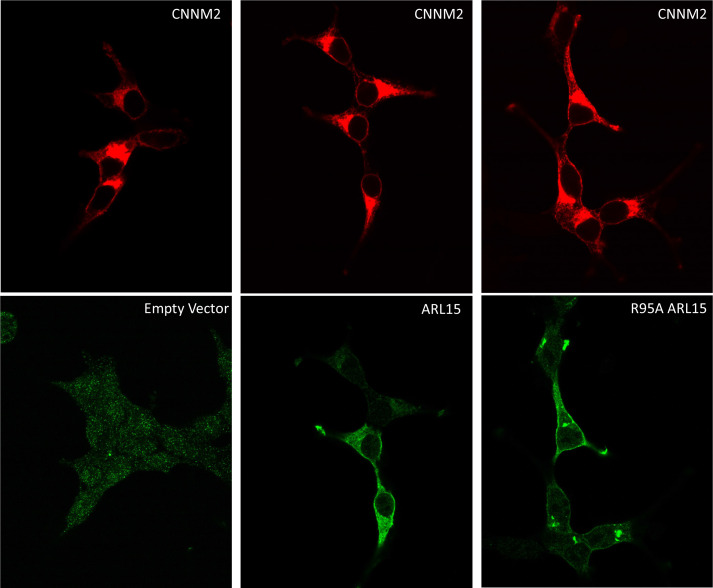
Figure 7—figure supplement 1. Localization of HEK239T cells transfected with mCNNM2-mCherry and FLAG-ADP-ribosylation factor-like GTPase 15 (ARL15). Confocal microscopy shows that CNNM2 localizes to the plasma membrane and an intracellular compartment, possibly the Golgi apparatus. This localization is not affected by ARL15 expression. Both wild-type ARL15 and the R95A mutant localize to the plasma membrane as well as internal structures.
Figure 7—figure supplement 1. Localization of HEK239T cells transfected with mCNNM2-mCherry and FLAG-ADP-ribosylation factor-like GTPase 15 (ARL15). Confocal microscopy shows that CNNM2 localizes to the plasma membrane and an intracellular compartment, possibly the Golgi apparatus. This localization is not affected by ARL15 expression. Both wild-type ARL15 and the R95A mutant localize to the plasma membrane as well as internal structures.CC BY · PubMed Central
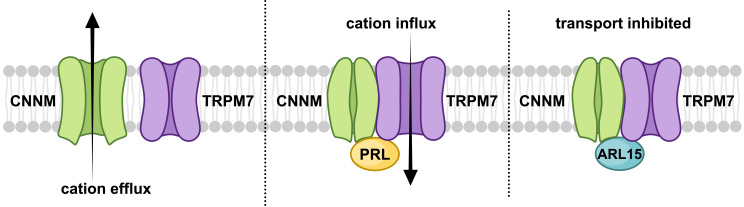
Figure 8. Model of regulation of cystathionine-β-synthase-pair domain divalent metal cation transport mediator (CNNM)-transient receptor potential ion channel subfamily M member 7 (TRPM7) complex by ADP-ribosylation factor-like GTPase 15 (ARL15) and phosphatases of regenerating liver (PRLs). CNNM on their own mediate cation efflux. PRL binding to CNNM inhibits cation efflux via CNNMs and activates TRPM7 influx. ARL15 binding to CNNM inhibits both TRPM7 and CNNM transport activity.
Figure 8. Model of regulation of cystathionine-β-synthase-pair domain divalent metal cation transport mediator (CNNM)-transient receptor potential ion channel subfamily M member 7 (TRPM7) complex by ADP-ribosylation factor-like GTPase 15 (ARL15) and phosphatases of regenerating liver (PRLs). CNNM on their own mediate cation efflux. PRL binding to CNNM inhibits cation efflux via CNNMs and activates TRPM7 influx. ARL15 binding to CNNM inhibits both TRPM7 and CNNM transport activity.CC BY · PubMed Central
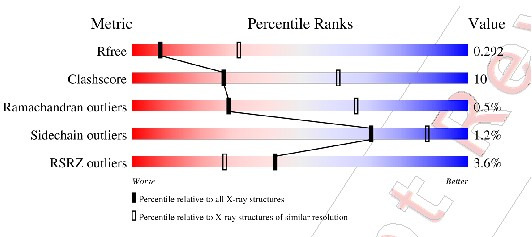
Author response image 1.
Author response image 1. CC BY · PubMed Central
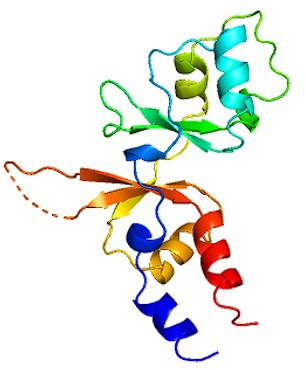
Author response image 2. CNNM2 CBS-pair domain color-coded, blue-to-red from the N- to C-terminus. The CBS1 (blue to green) and CBS2 motifs (yellow-green to red) fold together to form a single protein domain.
Author response image 2. CNNM2 CBS-pair domain color-coded, blue-to-red from the N- to C-terminus. The CBS1 (blue to green) and CBS2 motifs (yellow-green to red) fold together to form a single protein domain.CC BY · PubMed Central

Verification

Claims the paper makes

The claims and statistics of this paper haven’t been checked yet.

Run the check — free, no account needed. It reads the open-access text and checks the sources it cites.

A few free checks a day · papers already verified open instantly · results are public

Self-check

Percentages, sums and reported differences re-computed from the paper’s own numbers.

The self-check needs the paper’s full text.

Citations

Cites

Show all 3 references

Research works printed but not linked: 60

  1. Adams, 2010, PHENIX: a comprehensive python-based system for macromolecular structure solution, Acta Crystallographica. Section D, Biological Crystallography, 66, 213, 10.1107/S0907444909052925 · DOI · Paper page
  2. Bai, 2021, CNNM proteins selectively bind to the TRPM7 channel to stimulate divalent cation entry into cells, PLOS Biology, 19, 10.1371/journal.pbio.3001496 · DOI
  3. Bateman, 1997, The structure of a domain common to archaebacteria and the homocystinuria disease protein, Trends in Biochemical Sciences, 22, 12, 10.1016/s0968-0004(96)30046-7 · DOI
  4. Baykov, 2011, The CBS domain: a protein module with an emerging prominent role in regulation, ACS Chemical Biology, 6, 1156, 10.1021/cb200231c · DOI
  5. Burd, 2004, Arf-like GTPases: not so Arf-like after all, Trends in Cell Biology, 14, 687, 10.1016/j.tcb.2004.10.004 · DOI
  6. Cates, 1996, Prenylation of oncogenic human PTP(CAAX) protein tyrosine phosphatases, Cancer Letters, 110, 49, 10.1016/s0304-3835(96)04459-x · DOI
  7. Chen, 2018, The cyclic nucleotide-binding homology domain of the integral membrane protein CNNM mediates dimerization and is required for Mg2+ efflux activity, The Journal of Biological Chemistry, 293, 19998, 10.1074/jbc.RA118.005672 · DOI
  8. Chen, 2020, Mg(2+)-ATP sensing in CNNM, a putative magnesium transporter, Structure, 28, 324, 10.1016/j.str.2019.11.016 · DOI
  9. Chen, 2021, Crystal structure of an archaeal CorB magnesium transporter, Nature Communications, 12, 10.1038/s41467-021-24282-7 · DOI
  10. Chen, 2023, New insights into the structure and function of CNNM proteins, The FEBS Journal, 24, 10.1111/febs.16872 · DOI
  11. Clark, 2006, TRPM7, a novel regulator of actomyosin contractility and cell adhesion, The EMBO Journal, 25, 290, 10.1038/sj.emboj.7600931 · DOI
  12. Corral-Rodríguez, 2014, Nucleotide binding triggers a conformational change of the CBS module of the magnesium transporter CNNM2 from a twisted towards a flat structure, The Biochemical Journal, 464, 23, 10.1042/BJ20140409 · DOI
  13. de Baaij, 2012, Membrane topology and intracellular processing of cyclin M2 (CNNM2), The Journal of Biological Chemistry, 287, 13644, 10.1074/jbc.M112.342204 · DOI
  14. Delaglio, 1995, NMRPipe: a multidimensional spectral processing system based on UNIX pipes, Journal of Biomolecular NMR, 6, 277, 10.1007/BF00197809 · DOI
  15. Duan, 2019, Cryo-EM structure of TRPC5 at 2.8-Å resolution reveals unique and conserved structural elements essential for channel function, Science Advances, 5, 10.1126/sciadv.aaw7935 · DOI
  16. Emsley, 2004, Coot: model-building tools for molecular graphics, Acta Crystallographica. Section D, Biological Crystallography, 60, 2126, 10.1107/S0907444904019158 · DOI · Paper page
  17. Ereño-Orbea, 2013, CBS domains: ligand binding sites and conformational variability, Archives of Biochemistry and Biophysics, 540, 70, 10.1016/j.abb.2013.10.008 · DOI
  18. Fakih, 2023, Burst kinetics and CNNM binding are evolutionarily conserved properties of phosphatases of regenerating liver, The Journal of Biological Chemistry, 299, 10.1016/j.jbc.2023.103055 · DOI
  19. Ford, 2009, Characterization of a Ras mutant with identical GDP- and GTP-bound structures, Biochemistry, 48, 11449, 10.1021/bi901479b · DOI
  20. Funato, 2014, Membrane protein CNNM4-dependent Mg2+ efflux suppresses tumor progression, The Journal of Clinical Investigation, 124, 5398, 10.1172/JCI76614 · DOI
  21. Funato, 2019, Molecular function and biological importance of CNNM family Mg2+ transporters, Journal of Biochemistry, 165, 219, 10.1093/jb/mvy095 · DOI
  22. Gehring, 2022, The double lives of phosphatases of regenerating liver: A structural view of their catalytic and noncatalytic activities, The Journal of Biological Chemistry, 298, 10.1016/j.jbc.2021.101471 · DOI
  23. Giménez-Mascarell, 2017, Structural basis of the oncogenic interaction of phosphatase PRL-1 with the magnesium transporter CNNM2, The Journal of Biological Chemistry, 292, 786, 10.1074/jbc.M116.759944 · DOI
  24. Giménez-Mascarell, 2019, Current structural knowledge on the CNNM family of magnesium transport mediators, International Journal of Molecular Sciences, 20, 10.3390/ijms20051135 · DOI
  25. Gorski, 2017, 1000 Genomes-based meta-analysis identifies 10 novel loci for kidney function, Scientific Reports, 7, 10.1038/srep45040 · DOI
  26. Gulerez, 2016, Phosphocysteine in the PRL-CNNM pathway mediates magnesium homeostasis, EMBO Reports, 17, 1890, 10.15252/embr.201643393 · DOI
  27. Hanzal-Bayer, 2005, Properties of the interaction of Arf-like protein 2 with PDEdelta, Journal of Molecular Biology, 350, 1074, 10.1016/j.jmb.2005.05.036 · DOI
  28. Hardy, 2015, The protein tyrosine phosphatase PRL-2 interacts with the magnesium transporter CNNM3 to promote oncogenesis, Oncogene, 34, 986, 10.1038/onc.2014.33 · DOI
  29. Hardy, 2023, PRL-1/2 phosphatases control TRPM7 magnesium-dependent function to regulate cellular bioenergetics, PNAS, 120, 10.1073/pnas.2221083120 · DOI
  30. Hirata, 2014, Mg2+-Dependent interactions of ATP with the Cystathionine-Β-synthase (CBS) domains of a magnesium transporter, The Journal of Biological Chemistry, 289, 14731, 10.1074/jbc.M114.551176 · DOI
  31. Huang, 2021, Structural basis for the Mg(2+) recognition and regulation of the Corc Mg(2+) transporter, Science Advances, 7, 10.1126/sciadv.abe6140 · DOI
  32. Ivanova, 2017, Biochemical characterization of purified mammalian ARL13B protein indicates that it is an atypical GTPase and ARL3 guanine nucleotide exchange factor (GEF), The Journal of Biological Chemistry, 292, 11091, 10.1074/jbc.M117.784025 · DOI
  33. Kollewe, 2021, The molecular appearance of native TRPM7 channel complexes identified by high-resolution proteomics, eLife, 10, 10.7554/eLife.68544 · DOI
  34. Kozlov, 2020, PRL3 pseudophosphatase activity is necessary and sufficient to promote metastatic growth, The Journal of Biological Chemistry, 295, 11682, 10.1074/jbc.RA120.014464 · DOI
  35. Krapivinsky, 2014, The TRPM7 chanzyme is cleaved to release a chromatin-modifying kinase, Cell, 157, 1061, 10.1016/j.cell.2014.03.046 · DOI
  36. Li, 2007, Molecular determinants of Mg2+ and Ca2+ permeability and pH sensitivity in TRPM6 and TRPM7, The Journal of Biological Chemistry, 282, 25817, 10.1074/jbc.M608972200 · DOI
  37. Linari, 1999, The delta subunit of rod specific cyclic GMP phosphodiesterase, PDE delta, interacts with the Arf-like protein Arl3 in a GTP specific manner, FEBS Letters, 458, 55, 10.1016/s0014-5793(99)01117-5 · DOI
  38. McCoy, 2007, Phaser crystallographic software, Journal of Applied Crystallography, 40, 658, 10.1107/S0021889807021206 · DOI · Paper page
  39. Ménétrey, 2007, Structural basis for ARF1-mediated recruitment of ARHGAP21 to Golgi membranes, The EMBO Journal, 26, 1953, 10.1038/sj.emboj.7601634 · DOI
  40. Mittermeier, 2019, TRPM7 is the central gatekeeper of intestinal mineral absorption essential for postnatal survival, PNAS, 116, 4706, 10.1073/pnas.1810633116 · DOI
  41. Monteilh-Zoller, 2003, TRPM7 provides an ion channel mechanism for cellular entry of trace metal ions, The Journal of General Physiology, 121, 49, 10.1085/jgp.20028740 · DOI
  42. Nadezhdin, 2023, Structural mechanisms of TRPM7 activation and inhibition, Nature Communications, 14, 10.1038/s41467-023-38362-3 · DOI
  43. Nadler, 2001, LTRPC7 is a Mg.ATP-regulated divalent cation channel required for cell viability, Nature, 411, 590, 10.1038/35079092 · DOI
  44. Neal, 1988, Kinetic analysis of the hydrolysis of GTP by p21N-ras. The basal GTPase mechanism, The Journal of Biological Chemistry, 263, 19718, 10.1016/S0021-9258(19)77694-7 · DOI
  45. Negi, 2013, A genome-wide association study reveals ARL15, a novel non-HLA susceptibility gene for rheumatoid arthritis in North Indians, Arthritis and Rheumatism, 65, 3026, 10.1002/art.38110 · DOI
  46. Otwinowski, 1997, Processing of X-ray diffraction data collected in oscillation mode, Methods in Enzymology, 276, 307, 10.1016/S0076-6879(97)76066-X · DOI · Paper page
  47. Richards, 2009, A genome-wide association study reveals variants in ARL15 that influence adiponectin levels, PLOS Genetics, 5, 10.1371/journal.pgen.1000768 · DOI
  48. Rocha, 2017, The metabolic syndrome- associated small G protein ARL15 plays a role in adipocyte differentiation and adiponectin secretion, Scientific Reports, 7, 10.1038/s41598-017-17746-8 · DOI
  49. Shi, 2022, Arl15 upregulates the TGFβ family signaling by promoting the assembly of the Smad-complex, eLife, 11, 10.7554/eLife.76146 · DOI
  50. Sprang, 1997, G protein mechanisms: insights from structural analysis, Annual Review of Biochemistry, 66, 639, 10.1146/annurev.biochem.66.1.639 · DOI
  51. Sztul, 2019, ARF GTPases and their GEFs and GAPs: concepts and challenges, Molecular Biology of the Cell, 30, 1249, 10.1091/mbc.E18-12-0820 · DOI
  52. Visser, 2013, TRPM7 triggers Ca2+ sparks and invadosome formation in neuroblastoma cells, Cell Calcium, 54, 404, 10.1016/j.ceca.2013.09.003 · DOI
  53. Wang, 2002, The tyrosine phosphatase PRL-1 localizes to the endoplasmic reticulum and the mitotic spindle and is required for normal mitosis, The Journal of Biological Chemistry, 277, 46659, 10.1074/jbc.M206407200 · DOI
  54. Wang, 2003, Molecular cloning and characterization of a novel gene family of four ancient conserved domain proteins (ACDP), Gene, 306, 37, 10.1016/s0378-1119(02)01210-6 · DOI
  55. Winn, 2003, Macromolecular TLS refinement in REFMAC at moderate resolutions, Methods in Enzymology, 374, 300, 10.1016/S0076-6879(03)74014-2 · DOI
  56. Wu, 2021, Palmitoylated small GTPase ARL15 is translocated within Golgi network during adipogenesis, Biology Open, 10, 10.1242/bio.058420 · DOI
  57. Yamazaki, 2013, Basolateral Mg2+ extrusion via CNNM4 mediates transcellular Mg2+ transport across epithelia: a mouse model, PLOS Genetics, 9, 10.1371/journal.pgen.1003983 · DOI
  58. Zeng, 2000, Prenylation-dependent association of protein-tyrosine phosphatases PRL-1, -2, and -3 with the plasma membrane and the early endosome, The Journal of Biological Chemistry, 275, 21444, 10.1074/jbc.M000453200 · DOI
  59. Zhang, 2017, PRL3 phosphatase active site is required for binding the putative magnesium transporter CNNM3, Scientific Reports, 7, 10.1038/s41598-017-00147-2 · DOI
  60. Zolotarov, 2021, ARL15 modulates magnesium homeostasis through N-glycosylation of CNNMs, Cellular and Molecular Life Sciences, 78, 5427, 10.1007/s00018-021-03832-8 · DOI

Metadata

Authors
Mahbub, L., Kozlov, G., Zong, P., Lee, E. L., Tetteh, S., Nethramangalath, T., Knorn, C., Jiang, J., Shahsavan, A., Yue, L., Runnels, L., & Gehring, K.
Affiliations
  • McGill University (CA)
  • UConn Health (US)
  • Rutgers, The State University of New Jersey (US)
Corresponding author
Gehring, Kalle
Venue
eLife
Published
2023-07-14
Volume
12
ISSN
2050-084X (ISSN-L)
OpenAlex
W4384339426
Cited by
14
References
3
Citations by year
2026: 3 · 2025: 8 · 2023: 3
FWCI
2.45
Type
journal article
Language
en
Open access
Locations
  • eLife (publishedVersion, cc-by)
  • bioRxiv (Cold Spring Harbor Laboratory) (acceptedVersion, cc-by)
  • PubMed Central (publishedVersion, cc-by)
  • PubMed (publishedVersion)
  • OSTI OAI (U.S. Department of Energy Office of Scientific and Technical Information) (submittedVersion)
  • PubMed Central (submittedVersion, cc-by)
  • DOAJ (DOAJ: Directory of Open Access Journals) (submittedVersion, cc-by-sa)
Funders
  • Natural Sciences and Engineering Research Council of Canada (RGPIN-2020-07195)
  • National Institutes of Health (R01HL147350)
Topics
  • Health Sciences › Nursing › Nutrition and Dietetics › Magnesium in Health and Disease
  • Life Sciences › Biochemistry, Genetics and Molecular Biology › Physiology › Calcium signaling and nucleotide metabolism
  • Life Sciences › Neuroscience › Sensory Systems › Ion Channels and Receptors
Keywords
CNNM2, TRPM7, ARL15, divalent cation transport, magnesium efflux, zinc transport, GTPase, PRL-2, ion transport regulation

About these checks

Registry, retraction, Cites and statistics results are computed, not judged, with one exception: a printed reference that no index lists is read once by a model before it counts as a citation error. Claims are extracted by a model and kept only when their quote appears verbatim in the text; each cited source is then checked, with a model’s help, for whether it says what the claim relies on. Those verdicts can be wrong — read the claim’s quote and the cited source before relying on one.

Statistics and arithmetic are recomputed, not judged.

Confidence bands are shown only for fields calibrated on our annotated test set. None is calibrated yet, so no band is shown.

What counts as a claim ›How we measure confidence ›How we check this ›

Are you an author, or do you see a problem with this page? Request a review

How to cite

Cite CoChat for the checks on this page, and the paper for its own findings.

This page
CoChat. (2026). Citation check: Structural insights into regulation of CNNM-TRPM7 divalent cation uptake by the small GTPase ARL15. https://app.cochat.ai/papers/10.7554/elife.86129
The paper
Mahbub, L., Kozlov, G., Zong, P., Lee, E. L., Tetteh, S., Nethramangalath, T., Knorn, C., Jiang, J., Shahsavan, A., Yue, L., Runnels, L., & Gehring, K. (2023). Structural insights into regulation of CNNM-TRPM7 divalent cation uptake by the small GTPase ARL15. eLife. https://doi.org/10.7554/elife.86129