

The DOI matches its Crossref record; 6 of the 6 references it cites were found in a registry or an index.
The affective profiles, psychological well-being, and harmony: environmental mastery and self-acceptance predict the sense of a harmonious life
Open accessAbstract
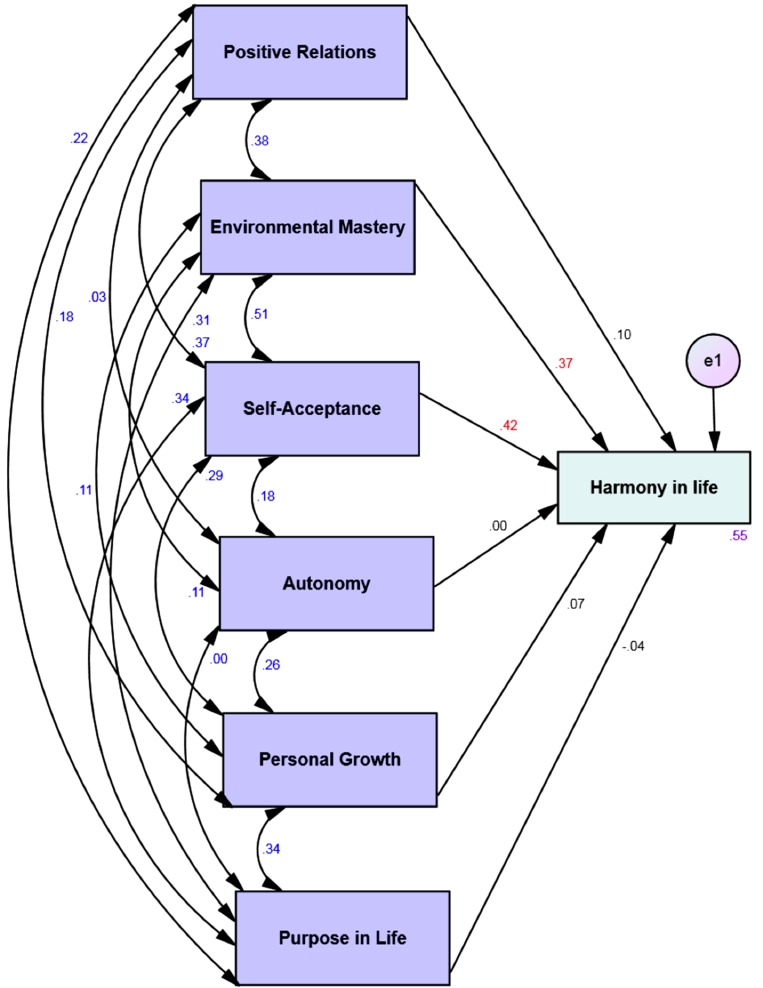
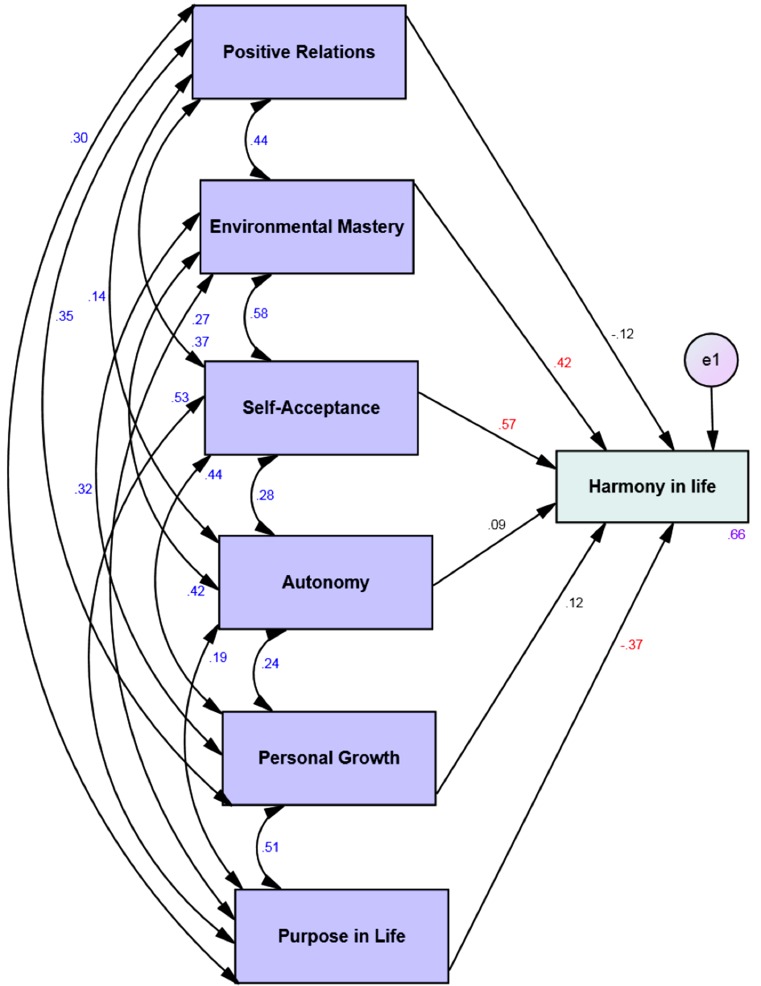
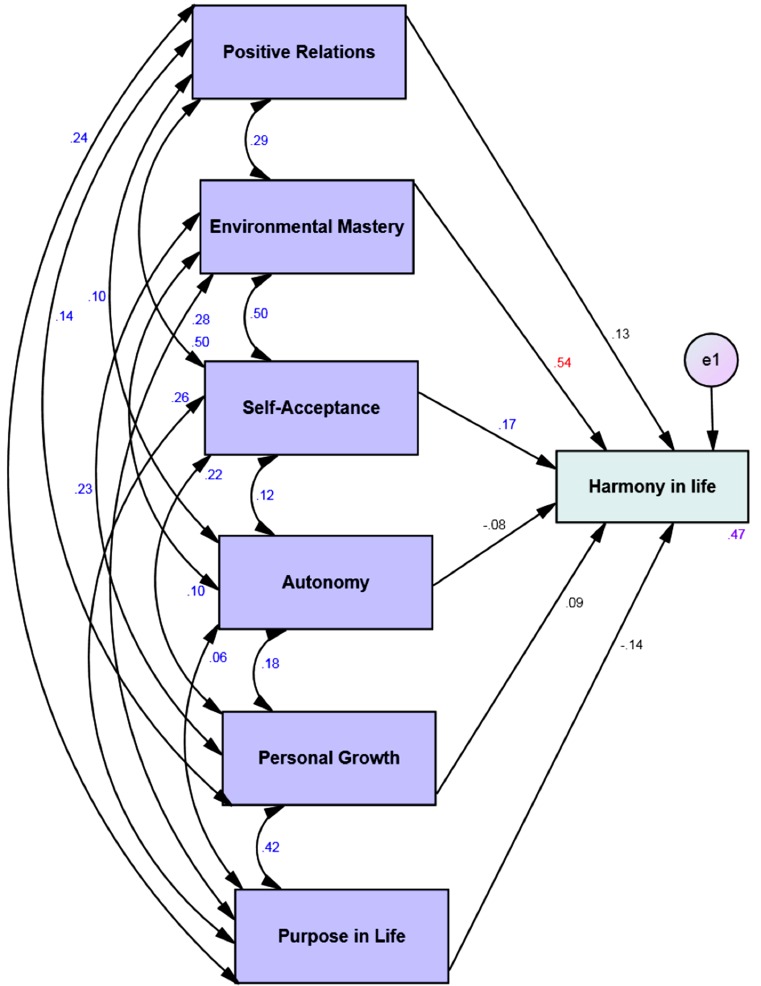
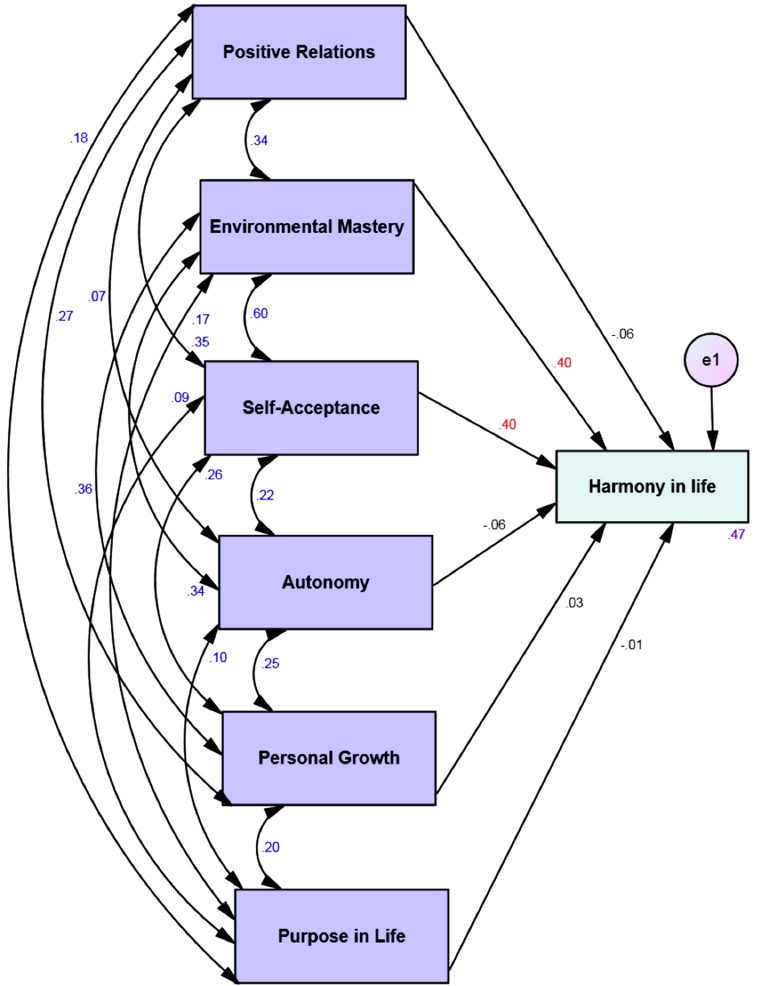
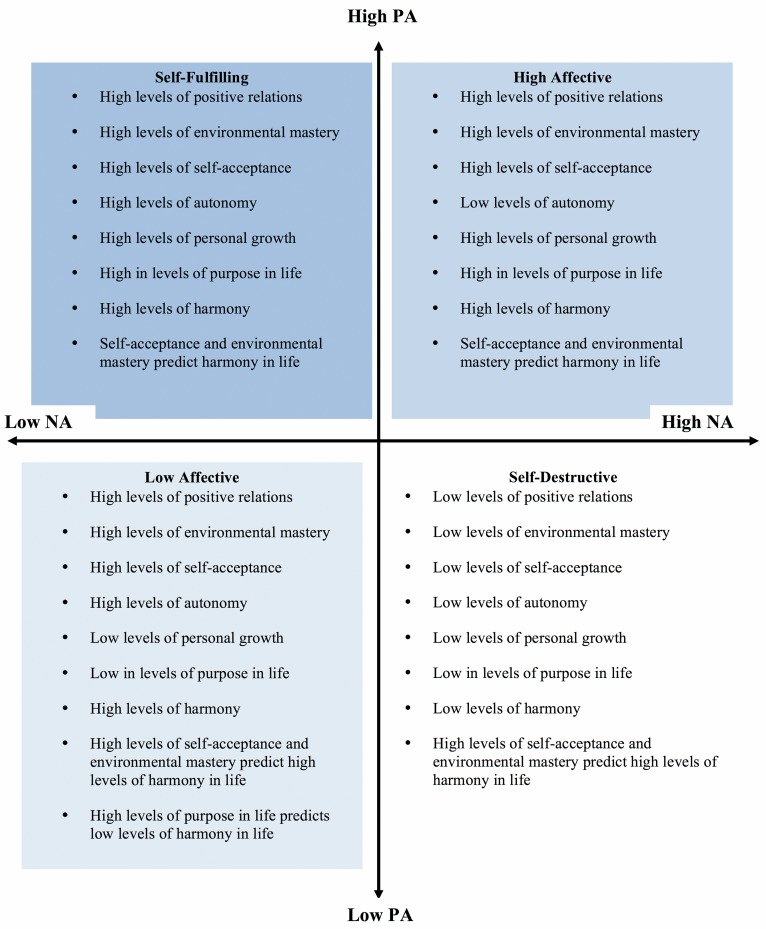
Background. An important outcome from the debate on whether wellness equals happiness, is the need of research focusing on how psychological well-being might influence humans' ability to adapt to the changing environment and live in harmony. To get a detailed picture of the influence of positive and negative affect, the current study employed the affective profiles model in which individuals are categorised into groups based on either high positive and low negative affect (self-fulfilling); high positive and high negative affect (high affective); low positive and low negative affect (low affective); and high negative and low positive affect (self-destructive). The aims were to (1) investigate differences between affective profiles in psychological well-being and harmony and (2) how psychological well-being and its dimensions relate to harmony within the four affective profiles. Method. 500 participants (mean age = 34.14 years, SD. = ±12.75 years; 187 males and 313 females) were recruited online and required to answer three self-report measures: The Positive Affect and Negative Affect Schedule; The Scales of Psychological Well-Being (short version) and The Harmony in Life Scale. We conducted a Multivariate Analysis of Variance where the affective profiles and gender were the independent factors and psychological well-being composite score, its six dimensions as well as the harmony in life score were the dependent factors. In addition, we conducted four multi-group (i.e., the four affective profiles) moderation analyses with the psychological well-being dimensions as predictors and harmony in life as the dependent variables. Results. Individuals categorised as self-fulfilling, as compared to the other profiles, tended to score higher on the psychological well-being dimensions: positive relations, environmental mastery, self-acceptance, autonomy, personal growth, and purpose in life. In addition, 47% to 66% of the variance of the harmony in life was explained by the dimensions of psychological well-being within the four affective profiles. Specifically, harmony in life was significantly predicted by environmental mastery and self-acceptance across all affective profiles. However, for the low affective group high purpose in life predicted low levels of harmony in life. Conclusions. The results demonstrated that affective profiles systematically relate to psychological well-being and harmony in life. Notably, individuals categorised as self-fulfilling tended to report higher levels of both psychological well-being and harmony in life when compared with the other profiles. Meanwhile individuals in the self-destructive group reported the lowest levels of psychological well-being and harmony when compared with the three other profiles. It is proposed that self-acceptance and environmental acceptance might enable individuals to go from self-destructive to a self-fulfilling state that also involves harmony in life.
Overview
The claims and statistics of this paper haven’t been checked yet.
Run the check — free, no account needed. It reads the open-access text and checks the sources it cites.
Integrity signals
Registry
Cites
Statistics
Figures
Verification
Claims the paper makes
The claims and statistics of this paper haven’t been checked yet.
Run the check — free, no account needed. It reads the open-access text and checks the sources it cites.
Claims other papers make about this one
Each is checked against this paper’s own text: does it say what the citing paper says it does?
The source backs part of the claim, not all of it — or backs it for a different population, condition or comparison.
In the citing paper
“There is evidence that acceptance is linked with a better quality of life (Garcia, Al Nima, Kjell, 2014).”
From The four horsemen of fear: An integrated model of understanding fear experiences during the COVID-19 pandemic (2020) · cites this paper as Garcia, Al Nima, Kjell, 2014
Experimental — accuracy not yet measured
Self-check
Percentages, sums and reported differences re-computed from the paper’s own numbers.
The self-check needs the paper’s full text.
Citations
Cites
Happiness is everything, or is it? Explorations on the meaning of psychological well-being.
Ryff, C. D. (1989) · Journal of Personality and Social Psychology · doi:10.1037/0022-3514.57.6.1069 · Cited by 14,847
The structure of psychological well-being revisited.
Ryff, C. D., & Keyes, C. L. M. (1995) · Journal of Personality and Social Psychology · doi:10.1037//0022-3514.69.4.719 · Cited by 10,285
Higgins, E. T. (1997) · American Psychologist · doi:10.1037/0003-066x.52.12.1280 · Cited by 6,775
The Contours of Positive Human Health
Ryff, C. D., & Singer, B. (1998) · Psychological Inquiry · doi:10.1207/s15327965pli0901_1 · Cited by 2,658
Reconsidering happiness: The costs of distinguishing between hedonics and eudaimonia
Kashdan, T. B., Biswas-Diener, R., & King, L. A. (2008) · The Journal of Positive Psychology · doi:10.1080/17439760802303044 · Cited by 1,027
Huppert, F. A., & Whittington, J. E. (2003) · British Journal of Health Psychology · doi:10.1348/135910703762879246 · Cited by 536
Research works printed but not linked: 62
- Adrianson, 2013, Cultural influences upon health, affect, self-esteem and impulsiveness: An Indonesian-Swedish comparison, International Journal of Research Studies in Psychology, 10.5861/ijrsp.2013.228 · DOI
- Archer, 2008, Affective personality as cognitive-emotional presymptom profiles regulatory for self-reported health predispositions, Neurotoxicity Research, 14, 21, 10.1007/BF03033573 · DOI
- Archer, 2007, Influence of affective personality on cog- nitive-mediated emotional processing: Need for empowerment, European Journal of Psychiatry, 21, 21, 10.4321/S0213-61632007000400002 · DOI
- Archer, 2013, The inductive agency of stress: From perinatal to adolescent induction, 10.1007/978-1-4614-5605-6_1 · DOI
- Archer, 2013, Epigenetic modulation of mood disorders, Journal of Genetic Syndromes & Gene Therapy, 4, 120, 10.4172/2157-7412.1000120 · DOI
- Bergman, 2003, Studying individual development in an interindividual context: A person-oriented approach, 10.4324/9781410606822 · DOI
- Biswas-Diener, 2009, Two traditions of happiness research, not two distinct types of happiness, Journal of Positive Psychology, 4, 208, 10.1080/17439760902844400 · DOI
- Bood, 2004, Affective personality in relation to general personality, self-reported stress, coping and optimism, Individual Differences Research, 2, 26
- Buhrmester, 2011, Amazon’s Mechanical Turk: a new source of inexpensive, yet high-quality, data?, Perspectives on Psychological Science, 6, 3, 10.1177/1745691610393980 · DOI · Paper page
- Clarke, 2001, Measuring psychological well-being in the Canadian study of health and aging, International Psychogeriatrics, 13, 79, 10.1017/S1041610202008013 · DOI
- Cloninger, 2004, Feeling good: the science of well-being, 10.1093/oso/9780195051377.001.0001 · DOI
- Cloninger, 2006, Fostering spirituality and well-being in clinical practice, Psychiatric Annals, 36, 1, 10.3928/00485713-20060301-07 · DOI
- Cloninger, 2013, What makes people healthy, happy, and fulfilled in the face of current world challenges?, Mens Sana Monographs, 1, 16, 10.4103/0973-1229.109288 · DOI
- Cloninger, 2011, Personality and the perception of health and happiness, Journal of Affective Disorders, 128, 24, 10.1016/j.jad.2010.06.012 · DOI
- Christopher, 1999, Situating psychological well-being: Exploring the cultural roots of its theory and research, Journal of Counseling and Development, 77, 141, 10.1002/j.1556-6676.1999.tb02434.x · DOI
- Delle Fave, 2009, The contribution of diversity to happiness research, The Journal of Positive Psychology, 4, 205, 10.1080/17439760902844319 · DOI
- Diener, 1984, Subjective well-being, Psychological Bulletin, 95, 542, 10.1037/0033-2909.95.3.542 · DOI · Paper page
- Diener, 1985, The satisfaction with life scale, Journal of Personality Assessment, 49, 71, 10.1207/s15327752jpa4901˙13 · DOI
- Adolescents’ happiness: The role of the affective temperament model on memory and apprehension of events, subjective well-being, and psychological well-being. Ph.D. Thesis, University of Gothenburg, Gothenburg
- Garcia, 2012, The affective temperaments: differences between adolescents in the big five model and Cloninger’s psychobiological model of personality, Journal of Happiness Studies, 13, 999, 10.1007/s10902-011-9303-5 · DOI
- Garcia, 2013, La vie en Rose: high levels of well-being and events inside and outside autobiographical memory, Journal of Happiness Studies, 10.1007/s10902-013-9443-x · DOI
- Garcia, 2013, Self-directedness and cooperativeness, psychosocial dysfunction and suffering in ESSENCE, The Scientific World Journal, 10.1155/2013/416981 · DOI
- Garcia, 2012, Adolescent life satisfaction and well-being, Journal of Alternative Medicine Research, 4, 271
- Garcia, 2013, The happy personality: a tale of two philosophies, 41
- Garcia, 2012, Temperament, character, and adolescents’ depressive symptoms: focusing on affect, Depression Research and Treatment, 10.1155/2012/925372 · DOI
- Garcia, 2013, International note: temperament and character’s relationship to subjective well-being in salvadorian adolescents and young adults, Journal of Adolescence, 36, 1115, 10.1016/j.adolescence.2013.08.018 · DOI
- Garcia, 2013, Temperament and character in the child and adolescent twin study in sweden (CATSS): Comparison to the general population, and genetic structure analysis, PLoS ONE, 8, e70475, 10.1371/journal.pone.0070475 · DOI · Paper page
- Garcia, 2013, The affective temperaments and well-being: Swedish and Iranian adolescents’ life satisfaction and psychological well-being, Journal of Happiness Studies, 14, 689, 10.1007/s10902-012-9349-z · DOI
- Garcia, 2009a, Adolescents’ affective temperaments: life satisfaction, interpretation and memory of events, The Journal of Positive Psychology, 4, 155, 10.1080/17439760802399349 · DOI
- Garcia, 2009b, Adolescents’ psychological well-being and memory for life events: influences on life satisfaction with respect to temperamental dispositions, Journal of Happiness Studies, 10, 387, 10.1007/s10902-008-9096-3 · DOI
- Garcia, 2013, Quantifying the semantic representations in adolescents’ memories of positive and negative life events, Journal of Happiness Studies, 14, 1309
- Garcia, 2010, On lions and adolescents: affective temperaments and the influence of negative stimuli on memory, Journal of Happiness Studies, 11, 477, 10.1007/s10902-009-9153-6 · DOI
- Horton, 2011, The online laboratory: conducting experiments in a real labor market, Experimental Economics, 14, 399, 10.1007/s10683-011-9273-9 · DOI
- Jimmefors, Locomotion (empowering) and assessment (disempowering) self-reglatory dimensions as a function of affective profiles in high school students, International Journal of School and Cognitive Psychology
- Johansson, 2013, Personality change after interner-delivered cognitive behavior therapy for depression, PeerJ, 1, e39, 10.7717/peerj.39 · DOI
- Kjell, 2011, Sustainable well-being: a potential synergy between sustainability and well-being research, Review of General Psychology, 15, 255, 10.1037/a0024603 · DOI
- Kjell, 2013, Iranian and swedish adolescents: differences in personality traits and well-being, PeerJ, 1, e197, 10.7717/peerj.197 · DOI
- Kjell, The harmony in life scale complements the satisfaction with life scale: expanding the conceptualization and measurement of the cognitive component of subjective well-being, Journal of Happiness Studies
- Karlsson, 2007, Relationship between personality characteristics and affect: gender and affective personality, Individual Differences Research, 5, 44
- Kunst, 2011, Affective personality type, post-traumatic stress disorder symptom severity and post-traumatic growth in victims of violence, Stress and Health, 27, 42, 10.1002/smi.1318 · DOI
- Lavrakas, 2008, Encyclopedia of Survey Research Methods, 10.4135/9781412963947 · DOI · Paper page
- Lindahl, 2013, Depressive expression and anti-depressive protection in adolescence: stress, positive affect, motivation and self-efficacy, Psychology, 4, 495, 10.4236/psych.2013.46070 · DOI
- MacDonald, 2013, The affective personality, sleep, and autobiographical memories, The Journal of Positive Psychology: Dedicated to furthering research and promoting good practice, 8, 305, 10.1080/17439760.2013.800904 · DOI
- Nima, 2012, Adolescents’ happiness-increasing strategies, temperament, and character: mediation models on subjective well-being, Health, 4, 802, 10.4236/health.2012.410124 · DOI
- Nima, 2013, The happiness-increasing strategies scales in a sample of Swedish adolescents, International Journal of Happiness and Development, 1, 196, 10.1504/IJHD.2013.055647 · DOI
- Nima, 2013, Anxiety, affect, self-esteem, and stress: mediation and moderation effects on depression, PLOS ONE, 10.1371/journal.pone.0073265 · DOI
- Norlander, 2002, Performance during stress: affective personality age, and regularity of physical exercise, Social Behavior and Personality, 30, 495, 10.2224/sbp.2002.30.5.495 · DOI
- Norlander, 2005, The affective personality: its relation to quality of sleep, well-being and stress, Social Behavior and Personality, 33, 709, 10.2224/sbp.2005.33.7.709 · DOI
- Palomo, 2008, Focusing on symtoms rather than diagnoses in brain dysfunction: Conscious and nonconscious expression in impulsiveness and decision making, Neurotoxicity Research, 14, 1, 10.1007/BF03033572 · DOI
- Palomo, 2007, Treatment consideration and manifest complexity in comorbid neuropsychiatric disorders, Neurotoxicity Research, 12, 43, 10.1007/BF03033900 · DOI
- Paolacci, 2010, Running experiments on Amazon Mechanical Turk, Judgment and Decision Making, 5, 411, 10.1017/S1930297500002205 · DOI · Paper page
- Russell, 1999, Core affect, prototypical emotional episodes, and other things called emotion: dissecting the elephant, Journal of Personality and Social Psychology, 76, 805, 10.1037/0022-3514.76.5.805 · DOI
- Ryan, 2009, Wellness as healthy functioning or wellness as happiness: The importance of eudaimonic thinking, The Journal of Positive Psychology: Dedicated to Furthering Research and Promoting Good Practice, 4, 202, 10.1080/17439760902844285 · DOI
- Ryff, 1995, Psychological well-being in adult life, Current Directions in Psychological Science, 4, 99, 10.1111/1467-8721.ep10772395 · DOI
- Schütz, 2013, Character profiles and adolescents’ self-reported affect, Personality and Individual Differences, 54, 841, 10.1016/j.paid.2012.12.020 · DOI
- Schütz, 2014, Affective state, stress, and type a-personality as a function of gender and affective profiles, International Journal of Research Studies in Psychology, 3, 51, 10.5861/ijrsp.2013.450 · DOI
- Schütz, 2013, The affective profiles in the USA: happiness, depression, life satisfaction, and happiness- increasing strategies, PeerJ, 1, e156, 10.7717/peerj.156 · DOI
- Shapiro, 2013, Using mechanical turk to study clinical populations, Clinical Psychological Science, 1, 213, 10.1177/2167702612469015 · DOI · Paper page
- Straume, 2012, Happiness, inspiration and the fully functioning person: Separating hedonic and eudaimonic well-being in the workplace, The Journal of Positive Psychology: Dedicated to Furthering Research and Promoting Good Practice, 7, 387, 10.1080/17439760.2012.711348 · DOI
- Waterman, 2008, Reconsidering happiness: a eudaimonist’s perspective, The Journal of Positive Psychology: Dedicated to Furthering Research and Promoting Good Practice, 3, 234, 10.1080/17439760802303002 · DOI · Paper page
- Watson, 1988, Development and validation of brief measures of positive and negative affect: The PANAS scale, Journal of Personality and Social Psychology, 54, 1063, 10.1037/0022-3514.54.6.1063 · DOI · Paper page
- Yik, 1999, Structure of self reported current affect: integration and beyond, Journal of Personality and Social Psychology, 77, 600, 10.1037/0022-3514.77.3.600 · DOI
Cited by
Sorted by citations
Schimmenti, A., Billieux, J., & Starcevic, V. (2020) · PubMed Central · doi:10.36131/cn20200202 · Cited by 313
Metadata
- Authors
- Garcia, D., Al Nima, A., & Kjell, O. N. E.
- Affiliations
- University of Gothenburg (SE)
- Network for Empowerment and Well-Being, University of Gothenburg, Gothenburg, Sweden
- Lund University (SE)
- Corresponding author
- Garcia, Danilo
- Venue
- PeerJ
- Publisher
- PeerJ
- Published
- 2014-02-13
- Volume
- 2
- Pages
- e259
- ISSN
- 2167-8359 (ISSN-L)
- PMC
- PMC3933359
- OpenAlex
- W2023985296
- Cited by
- 130
- References
- 6
- Citations by year
- 2026: 9 · 2025: 5 · 2024: 10 · 2023: 19 · 2022: 17 · 2021: 14 · 2020: 9 · 2019: 5 · 2018: 5 · 2017: 13 · 2016: 8 · 2015: 11 · 2014: 5
- FWCI
- 18.30
- Type
- journal article
- Language
- en
- Open access
- gold
- doi.org
- Licence
- cc-by
- Locations
- PeerJ (publishedVersion, cc-by)
- Europe PMC (PubMed Central) (publishedVersion, cc-by)
- PubMed Central (publishedVersion, cc-by)
- PubMed (publishedVersion)
- DOAJ (DOAJ: Directory of Open Access Journals) (submittedVersion, cc-by-sa)
- Lund University Publications (Lund University) (submittedVersion, other-oa)
- Topics
- Social Sciences › Psychology › Social Psychology › Psychological Well-being and Life Satisfaction
- Social Sciences › Psychology › Applied Psychology › Optimism, Hope, and Well-being
- Health Sciences › Health Professions › General Health Professions › Health, psychology, and well-being
- Keywords
- affective profiles, psychological well-being, harmony in life, environmental mastery, self-acceptance, positive affect, negative affect, meaning of life, PANAS, gender differences, life satisfaction, autonomy, personal growth, positive relationships, moderation analysis, meaning in life
About these checks
Registry, retraction, Cites and statistics results are computed, not judged, with one exception: a printed reference that no index lists is read once by a model before it counts as a citation error. Claims are extracted by a model and kept only when their quote appears verbatim in the text; each cited source is then checked, with a model’s help, for whether it says what the claim relies on. Those verdicts can be wrong — read the claim’s quote and the cited source before relying on one.
Statistics and arithmetic are recomputed, not judged.
Confidence bands are shown only for fields calibrated on our annotated test set. None is calibrated yet, so no band is shown.
What counts as a claim ›How we measure confidence ›How we check this ›
Are you an author, or do you see a problem with this page? Request a review
How to cite
Cite CoChat for the checks on this page, and the paper for its own findings.
- This page
- CoChat. (2026). Citation check: The affective profiles, psychological well-being, and harmony: environmental mastery and self-acceptance predict the sense of a harmonious life. https://app.cochat.ai/papers/10.7717/peerj.259
- The paper
- Garcia, D., Al Nima, A., & Kjell, O. N. E. (2014). The affective profiles, psychological well-being, and harmony: environmental mastery and self-acceptance predict the sense of a harmonious life. PeerJ. https://doi.org/10.7717/peerj.259
