

Hospital Readmissions Among Patients Experiencing Homelessness: An Electronic Health Record Data Study
Open accessThe DOI matches its Crossref record; 15 of the 15 references it cites were found in a registry or an index; none of the 9 sources its claims cite is checked for support yet.
Abstract
BACKGROUND: Population-level tracking of hospital use patterns with integrated care organizations in patients experiencing homelessness has been difficult. A California law implemented in 2019 (Senate Bill 1152) aimed to ensure safety for this population after discharge from the hospital by requiring additional documentation for patients experiencing homelessness, which provides an opportunity to evaluate hospital use by this population. METHODS: In a large integrated health system in California, patients experiencing homelessness were identified through documentation change requirements associated with this law and compared with a matched group from the general population. RESULTS: Patients experiencing homelessness had increased rates of hospital readmission after discharge compared to the general population matched on demographics and medical comorbidity in 2019 and 2020. Any address change in the prior year for patients was associated with increased odds of emergency department readmission. Patients experiencing homelessness, both enrolled in an integrated delivery system and not, were successfully identified as having higher readmission rates compared with their housed counterparts. CONCLUSION: Documentation of housing status following Senate Bill 1152 has enabled improved study of hospital use among those with housing instability. Understanding patterns of hospital use in this vulnerable group will help practitioners identify timely points of intervention for further social and health care support.
Overview
CoChat Summary
TL;DR
In a large California integrated health system after Senate Bill 1152, patients experiencing homelessness identified through electronic health record documentation had higher 30-day hospital readmission rates than a propensity-matched general population. Emergency department readmissions largely drove the difference, and prior-year address changes were associated with increased odds of ED readmission.
Key findings
- Patients experiencing homelessness had higher any 30-day readmission (30.47% vs 23.79%, p < 0.0001) and 30-day ED readmission (29.54% vs 22.31%, p < 0.0001); 30-day inpatient readmission was 10.97% vs 9.89% (p = 0.0563).
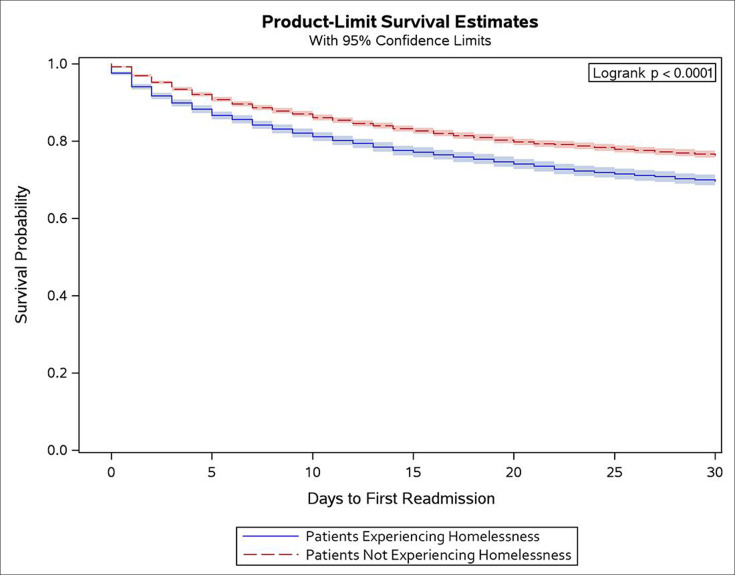
- Homelessness was associated with higher odds of any 30-day readmission (OR = 1.47; 95% CI = 1.33–1.63), ED readmission (OR = 1.49; 95% CI = 1.35–1.66), and inpatient readmission (OR = 1.32; 95% CI = 1.14–1.54), as well as increased length of index hospitalization (IRR = 1.14; 95% CI = 1.05–1.23) and shorter time to first inpatient readmission (HR = 1.32; 95% CI = 1.18–1.48).
- Any address change in the prior year was associated with increased odds of 30-day ED readmission [1 change: OR = 1.31; 95% CI = 1.14–1.51; ≥2 changes: OR = 2.02; 95% CI = 1.63–2.50] but not inpatient admissions; address changes were also associated with shorter time to any readmission [1 change: HR = 1.26; 95% CI = 1.14–1.39; ≥2 changes: HR = 1.87; 95% CI = 1.63–2.15].
- The study found no difference in primary or secondary outcomes during the COVID-19 lockdown shelter-in-place period compared with the year before the pandemic.
Methods
- Retrospective cohort study of adults aged ≥18 years hospitalized in Kaiser Permanente Northern California between January 1, 2019, and December 1, 2020; 12,909 patients were included, with 4,303 patients experiencing homelessness and 8,606 controls matched 1:2 by propensity score on Elixhauser comorbidities and demographics. Patients who died during their first hospitalization in the study period were excluded.
- Homelessness was identified by SB 1152–specific documentation, a homelessness diagnosis code, or homelessness documented in the address section of the EHR. Primary outcome was 30-day readmission to the hospital or ED; secondary outcomes included length of index hospitalization and time to any readmission. Covariates included address changes in the prior year, months of enrollment in Kaiser Permanente Northern California, and whether the index hospitalization occurred during the COVID-19 lockdown.
- Analyses used χ2 and Wilcoxon–Mann–Whitney tests, logistic regression for readmission, negative binomial regression for length of index hospitalization, and Cox proportional hazards models for time to first readmission; sensitivity analyses were performed for index hospitalizations during the COVID-19 shelter-in-place period from March 1, 2020, to December 1, 2020.
Limitations
- Stated: the study is not designed to prove causality or identify specific effects of SB 1152 on hospital use patterns; SB 1152 documentation may have introduced misclassification of homelessness status, and patients experiencing homelessness were likely under-identified, meaning some controls may have been experiencing homelessness. The authors expect this misclassification would bias results toward the null.
- Stated: findings are within an integrated, capitated health care system and may be less generalizable to other populations, though inclusion of patients without Kaiser Permanente insurance and controlling for insurance status suggests the findings could be more generalizable. The study was not empowered to examine hospital-level differences due to low numbers of patients experiencing homelessness at a few hospitals, and it is limited in parsing out causes of readmissions based on admission diagnosis.
- Evident from the design: this is a retrospective observational cohort using EHR documentation and address fields, so unmeasured confounding and documentation-based exposure misclassification remain possible beyond the limitations the authors explicitly describe.
Model-written summary. Check it against the paper before relying on it.
Integrity signals
Registry
Cites
Statistics
Figures
Verification
Claims the paper makes
0 Valid · 0 Not valid · 6 Not checked · 22 Own results and interpretations
A result the paper reports from its own data — it cites no other source for it, so there is none to check. The quote shows it is in the paper.
In the paper
“Any address change in the prior year compared with no address changes within the year prior to their index admission was associated with significantly increased odds for ED readmissions within 30 days [2+ address changes (OR = 2.02; 95% CI = 1.63-2.50); 1 address change (OR = 1.31; 95% CI = 1.14-1.5)]”
§ Hospital Readmissions Among Patients Experiencing Homelessness: An Electronic Health Record Data Study > Results
plainstates an association- Asserted: passes — The authors put it forward as true.
- Checkable: passes — It can be checked against evidence.
- Load-bearing: passes — The paper’s conclusions depend on it.
- Based: passes — The paper gives a reason why it holds.
- Rests on an assumption not shown here.
A result the paper reports from its own data — it cites no other source for it, so there is none to check. The quote shows it is in the paper.
In the paper
“but they did have a shorter time to any readmission compared to patients with no address changes [1 address change vs none (HR = 1.26; 95% CI = 1.14-1.39); ≥ 2 address changes vs none (HR = 1.87; 95% CI = 1.63-2.15)].”
§ Hospital Readmissions Among Patients Experiencing Homelessness: An Electronic Health Record Data Study > Results
plainstates an association- Asserted: passes — The authors put it forward as true.
- Checkable: passes — It can be checked against evidence.
- Load-bearing: passes — The paper’s conclusions depend on it.
- Based: passes — The paper gives a reason why it holds.
- Rests on an assumption not shown here.
A result the paper reports from its own data — it cites no other source for it, so there is none to check. The quote shows it is in the paper.
In the paper
“Patients experiencing homelessness were also more likely to have shorter times to their first inpatient readmissions compared to the patients who were readmitted from the control group (Hazard Ratio [HR] = 1.32; 95% CI = 1.18-1.48; Figure 1).”
§ Hospital Readmissions Among Patients Experiencing Homelessness: An Electronic Health Record Data Study > Results
plainstates an association- Asserted: passes — The authors put it forward as true.
- Checkable: passes — It can be checked against evidence.
- Load-bearing: passes — The paper’s conclusions depend on it.
- Based: passes — The paper gives a reason why it holds.
A result the paper reports from its own data — it cites no other source for it, so there is none to check. The quote shows it is in the paper.
In the paper
“In addition, patients experiencing homelessness were more likely to have higher lengths of stay for their index hospitalization (incidence rate ratio [IRR] = 1.14; 95% CI = 1.05-1.23; Table 3).”
§ Hospital Readmissions Among Patients Experiencing Homelessness: An Electronic Health Record Data Study > Results
plainstates an associationn = 4,303- Asserted: passes — The authors put it forward as true.
- Checkable: passes — It can be checked against evidence.
- Load-bearing: unclear — It is unclear whether the paper’s conclusions depend on it.
- Based: passes — The paper gives a reason why it holds.
A result the paper reports from its own data — it cites no other source for it, so there is none to check. The quote shows it is in the paper.
In the paper
“but was not associated with any changes to inpatient admissions”
§ Hospital Readmissions Among Patients Experiencing Homelessness: An Electronic Health Record Data Study > Results
plain- Asserted: passes — The authors put it forward as true.
- Checkable: passes — It can be checked against evidence.
- Load-bearing: unclear — It is unclear whether the paper’s conclusions depend on it.
- Based: passes — The paper gives a reason why it holds.
- Rests on an assumption not shown here.
14 more claims
Create a free account to see all 28 claims and to verify the 9 references still open.
- The quote only partly states this claim. 1
- Probably not a substantial claim. 7
- It may state two separate claims as one. 3
Self-check
Percentages, sums and reported differences re-computed from the paper’s own numbers.
Each contradiction between two passages listed here was confirmed by an independent check.
Rated major: it would touch a result — a value a result rests on, reported and recomputed p-values on opposite sides of the significance level, two passages that conflict with no sign which is right, or a cited work retracted before this paper was published.
In the paper
§ Hospital Readmissions Among Patients Experiencing Homelessness: An Electronic Health Record Data Study > Results
“There was no difference in primary or secondary outcomes during the COVID-19 lockdown shelter-in-place period compared with the year before the start of the pandemic.”
§ Hospital Readmissions Among Patients Experiencing Homelessness: An Electronic Health Record Data Study > Results
“| Hospitalization during COVID-19 lockdown vs prior | 0.89 | 0.80–0.99 | 0.88 | 0.79–0.98 | 0.97 | 0.83–1.12 | 0.94 | 0.89–1.00 |”
Rated minor: it would not touch a result — a value no result rests on, a p-value that stays on the same side of the significance level, or a conflict that is clerical, resolved elsewhere in the paper, or outside its own findings.
In the paper
§ Hospital Readmissions Among Patients Experiencing Homelessness: An Electronic Health Record Data Study > Discussion
“When controlling for length of enrollment in Kaiser Permanente insurance compared with not being Kaiser Permanente members, the authors see an increased chance of hospital use within their cohort for nonmembers, despite the data not capturing their use outside of Kaiser Permanente Northern California (Table 3).”
§ Hospital Readmissions Among Patients Experiencing Homelessness: An Electronic Health Record Data Study > Results
“| Full enrollment in Kaiser Permanente Northern California for the year vs none | 1.28 | 1.12–1.46 | 1.21 | 1.06–1.39 | 1.6 | 1.33–1.97 | 0.98 | 0.90–1.07 |”
Citations
Cites
Comorbidity measures for use with administrative data.
Elixhauser, A., Steiner, C., Harris, D. R., & Coffey, R. M. (1998) · Medical Care · doi:10.1097/00005650-199801000-00004 · Cited by 9,921
Fazel, S., Geddes, J. R., & Kushel, M. (2014) · The Lancet · doi:10.1016/s0140-6736(14)61132-6 · Cited by 1,568
Aldridge, R. W., Story, A., Hwang, S. W., Nordentoft, M., Luchenski, S. A., Hartwell, G., Tweed, E. J., Lewer, D., Vittal Katikireddi, S., & Hayward, A. C. (2018) · The Lancet · doi:10.1016/s0140-6736(17)31869-x · Cited by 905
Homeless persons' experiences of health‐ and social care: A systematic integrative review
Omerov, P., Craftman, Å. G., Mattsson, E., & Klarare, A. (2020) · Health & Social Care in the Community · doi:10.1111/hsc.12857 · Cited by 391
Association of Homelessness with Hospital Readmissions—an Analysis of Three Large States
Khatana, S. A. M., Wadhera, R. K., Choi, E. H., Groeneveld, P. W., Culhane, D. P., Kushel, M., Kazi, D. S., Yeh, R. W., & Shen, C. (2020) · Journal of General Internal Medicine · doi:10.1007/s11606-020-05946-4 · Cited by 69
Koh, K. A., Racine, M., Gaeta, J. M., Goldie, J., Martin, D. P., Bock, B., Takach, M., O’Connell, J. J., & Song, Z. (2020) · Health Affairs · doi:10.1377/hlthaff.2019.00687 · Cited by 52
Health assessments and screening tools for adults experiencing homelessness: a systematic review
Gordon, S. J., Grimmer, K. A., Bradley, A., Direen, T., Baker, N., Marin, T. S., Kelly, M. T., Gardner, S. P., Steffens, M., Burgess, T. A., et al. (2019) · BMC Public Health · doi:10.1186/s12889-019-7234-y · Cited by 43
Miyawaki, A., Hasegawa, K., Figueroa, J. F., & Tsugawa, Y. (2020) · Journal of General Internal Medicine · doi:10.1007/s11606-020-06029-0 · Cited by 37
Identifying homeless medicaid enrollees using enrollment addresses
Vickery, K. D., Shippee, N. D., Bodurtha, P., Guzman‐Corrales, L. M., Reamer, E., Soderlund, D., Abel, S., Robertshaw, D., & Gelberg, L. (2018) · Health Services Research · doi:10.1111/1475-6773.12738 · Cited by 30
When Crises Converge: Hospital Visits Before And After Shelter Use Among Homeless New Yorkers
Treglia, D., Johns, E. L., Schretzman, M., Berman, J. E., Culhane, D. P., Lee, D. C., & Doran, K. M. (2019) · Health Affairs · doi:10.1377/hlthaff.2018.05308 · Cited by 26
Factors associated with hospital readmission among patients experiencing homelessness
Subedi, K., Acharya, B., & Ghimire, S. (2022) · American Journal of Preventive Medicine · doi:10.1016/j.amepre.2022.02.004 · Cited by 24
Thirty-Day Hospital Readmission Among Homeless Individuals With Medicaid in Massachusetts
Racine, M. W., Munson, D., Gaeta, J. M., & Baggett, T. P. (2019) · Medical Care · doi:10.1097/mlr.0000000000001234 · Cited by 22
Potter, A. J., Wilking, J. R., Nevarez, H., Salinas, S. R., & Eisa, R. F. H. (2020) · Population Health Management · doi:10.1089/pop.2019.0217 · Cited by 9
Taira, B. R., Kim, H. L., Tlatelpa, K., Gutierrez-Palominos, L., Aleman, A. I., Steinberg, L., Tchakalian, G., Yadav, K., & Tucker‐Seeley, R. D. (2022) · Milbank Quarterly · doi:10.1111/1468-0009.12563 · Cited by 9
Rodríguez, L. A., Thomas, T., Finertie, H., Wiley, D. M., Dyer, W. T., Sanchez, P. E., Yassin, M., Banerjee, S., Adams, A. S., & Schmittdiel, J. A. (2023) · The Permanente Journal · doi:10.7812/tpp/22.096 · Cited by 6
Self-citation
Research works printed but not linked: 2
- [7]Moulin A, Lopez-Gusman E. How a bill becomes a law, or how a truly terrible bill becomes less awful. West J Emerg Med. 2019; 20(4): 549– 551. 10.5811/westjem.2019.5.43666 31316692 PMC6625691 · doi:10.5811/westjem.2019.5.43666
- [13]Eakin M, Singleterry V, Wang E, Brown I, Saynina O, Walker R. Effects of California’s new patient homelessness screening and discharge care law in an emergency department. Cureus. 2023; 15(2): e35534. 10.7759/cureus.35534 37007375 PMC10054841 · doi:10.7759/cureus.35534
Cited by
Still being checked.
Metadata
- Authors
- Banerjee, S., Yassin, M., Dyer, W. T., Thomas, T. W., Rodriguez, L. A., & Schmittdiel, J.
- Affiliations
- Kaiser Permanente (US)
- Kaiser Permanente Northern California Division of Research, Oakland, CA, USA
- Corresponding author
- Banerjee, Somalee
- Venue
- The Permanente Journal
- Publisher
- The Permanente Federation
- Published
- 2024-03-15
- Volume
- 28
- Issue
- 1
- Pages
- 55-61
- ISSN
- 1552-5767 (ISSN-L)
- 1552-5775
- PMC
- PMC10940252
- OpenAlex
- W4389883994
- Semantic Scholar
- 074f2463dd43bce5df9eda8a0a5556bcde46aee5
- Cited by
- 5
- References
- 15
- Citations by year
- 2026: 2 · 2025: 3
- FWCI
- 1.10
- Type
- journal article
- Language
- en
- Open access
- hybrid
- doi.org
- Licence
- cc-by-nc-nd
- Locations
- The Permanente Journal (publishedVersion, cc-by-nc-nd)
- PubMed Central (publishedVersion, cc-by-nc-nd)
- PubMed (publishedVersion)
- Funders
- Kaiser Permanente
- National Institute of Diabetes and Digestive and Kidney Diseases (T32DK116684, P30DK092924)
- Topics
- Social Sciences › Sociology and Political Science › Homelessness and Social Issues
- Health Sciences › Medicine › Emergency Medicine › Emergency and Acute Care Studies
- Health Sciences › Nursing › Leadership and Management › Hospital Admissions and Outcomes
- Keywords
- homelessness, hospital readmission, emergency department readmission, housing instability, address change, vulnerable populations
- MeSH terms
- Ill-Housed Persons, Housing, Humans, Patient Discharge, Patient Readmission, Electronic Health Records
About these checks
Registry, retraction, Cites and statistics results are computed, not judged, with one exception: a printed reference that no index lists is read once by a model before it counts as a citation error. Claims are extracted by a model and kept only when their quote appears verbatim in the text; each cited source is then checked, with a model’s help, for whether it says what the claim relies on. Those verdicts can be wrong — read the claim’s quote and the cited source before relying on one.
A language model drew the claims from the paper on 2026-11-25, under version 3 of the claim definition (model deepseek-v4.1-flash, prompt extract-v3).
A second model labelled each claim on 2026-11-25 (model jev-1.13-20260917, definition revision gold-guideline-v0.2).
Statistics and arithmetic are recomputed, not judged.
Confidence bands are shown only for fields calibrated on our annotated test set. None is calibrated yet, so no band is shown.
What counts as a claim ›How we measure confidence ›How we check this ›
Are you an author, or do you see a problem with this page? Request a review
Data sources
Bibliographic data: Semantic Scholar, OpenAlex, Crossref.
Contains information from the Semantic Scholar Academic Graph Datasets, made available under the ODC Attribution License (ODC-BY 1.0).
Semantic Scholar’s data is described in: Kinney, R., et al. (2023). The Semantic Scholar Open Data Platform. arXiv:2301.10140.
