

Quantifying bile acid malabsorption helps predict response and tailor sequestrant therapy
Open accessThe DOI matches its Crossref record; 36 of the 37 references it cites were found in a registry or an index.
Abstract
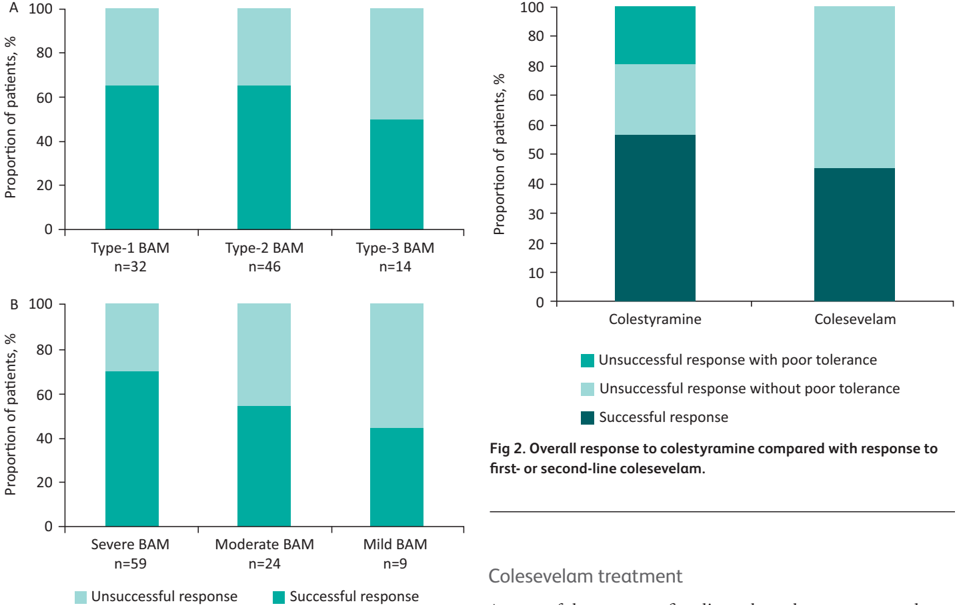
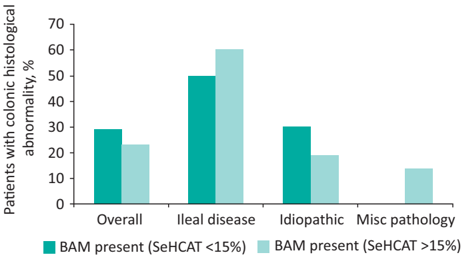
Although recognised as a cause of chronic diarrhoea for over forty years, diagnostic tests and treatments for bile acid malabsorption (BAM) remain controversial. Recent National Institute for Health and Care Excellence (NICE) guidelines highlighted the lack of evidence in the field, and called for further research. This retrospective study explores the BAM subtype and severity, the use and response to bile acid sequestrants (BAS) and the prevalence of abnormal colonic histology. 264 selenium-75-labelled homocholic acid conjugated taurine (SeHCAT)-tested patient records were reviewed and the severity and subtype of BAM, presence of colonic histopathology and response to BAS were recorded. 53% of patients tested had BAM, with type-2 BAM in 45% of patients with presumed irritable bowel syndrome. Colonic histological abnormalities were similar overall between patients with (29%) or without (23%) BAM (p = 0.46) and between BAM subtypes, with no significant presence of inflammatory changes. 63% of patients with BAM had a successful BAS response which showed a trend to decreased response with reduced severity. Colestyramine was unsuccessful in 44% (38/87) and 45% of these (17/38) were related to medication intolerance, despite a positive SeHCAT. 47% (7/15) of colestyramine failures had a successful colesevelam response. No patient reported colesevelam intolerance. Quantifying severity of BAM appears to be useful in predicting BAS response. Colesevelam was better tolerated than colestyramine and showed some efficacy in colestyramine failures. Colestyramine failure should not be used to exclude BAM. Colonic histology is of no relevance.
Overview
The claims and statistics of this paper haven’t been checked yet.
Free: it reads the open-access text and checks the first 5 claims that cite a source we can check. Create a free account to check every claim.
Integrity signals
Registry
Cites
Statistics
Figures

Verification
Claims the paper makes
The claims and statistics of this paper haven’t been checked yet.
Free: it reads the open-access text and checks the first 5 claims that cite a source we can check. Create a free account to check every claim.
Self-check
Percentages, sums and reported differences re-computed from the paper’s own numbers.
The self-check needs the paper’s full text.
Citations
Cites
WEDLAKE, L., A’HERN, R., RUSSELL, D., THOMAS, K., WALTERS, J. R. F., & ANDREYEV, H. J. N. (2009) · Alimentary Pharmacology & Therapeutics · doi:10.1111/j.1365-2036.2009.04081.x · Cited by 435
A New Mechanism for Bile Acid Diarrhea: Defective Feedback Inhibition of Bile Acid Biosynthesis
Walters, J. R. F., Tasleem, A. M., Omer, O. S., Brydon, W. G., Dew, T., & le Roux, C. W. (2009) · Clinical Gastroenterology and Hepatology · doi:10.1016/j.cgh.2009.04.024 · Cited by 318
The Syndrome of Ileal Disease and the Broken Enterohepatic Circulation: Cholerheic Enteropathy
Hofmann, A. F. (1967) · Gastroenterology · doi:10.1016/s0016-5085(67)80140-9 · Cited by 306
CHADWICK, V. S., Gaginella, T. S., Carlson, G. L., Debongnie, J. C., Phillips, S. F., & Hofmann, A. F. (1979) · PubMed · Cited by 271
Fernández-Bañares, F., Esteve, M., Salas, A., Forné, M., Espinós, J. C., Martín-Comín, J., & Viver, J. M. (2001) · Digestive Diseases and Sciences · doi:10.1023/a:1011927302076 · Cited by 169
Merrick, M. V., Eastwood, M. A., & Ford, M. J. (1985) · BMJ · doi:10.1136/bmj.290.6469.665 · Cited by 152
Williams, A. J., Merrick, M. V., & Eastwood, M. A. (1991) · Gut · doi:10.1136/gut.32.9.1004 · Cited by 144
Systematic review: the management of chronic diarrhoea due to bile acid malabsorption
Wilcox, C., Turner, J., & Green, J. (2014) · Alimentary Pharmacology & Therapeutics · doi:10.1111/apt.12684 · Cited by 137
Fromm, H., & Malavolti, M. (1986) · Clinics in Gastroenterology · doi:10.1016/s0300-5089(21)00739-2 · Cited by 127
Methods for Diagnosis of Bile Acid Malabsorption in Clinical Practice
Vijayvargiya, P., Camilleri, M., Shin, A., & Saenger, A. (2013) · Clinical Gastroenterology and Hepatology · doi:10.1016/j.cgh.2013.04.029 · Cited by 126
Research works printed but not linked: 1
- Aldridge, 2001, Colesevelam hydrochloride: a novel bile acid-binding resin, Ann Pharmacother, 35, 898, 10.1345/aph.10263 · doi:10.1345/aph.10263 · Paper page
Cited by
Ford, A. C., Sperber, A. D., Corsetti, M., & Camilleri, M. (2020) · The Lancet · doi:10.1016/s0140-6736(20)31548-8 · Cited by 818
British Society of Gastroenterology guidelines on the management of irritable bowel syndrome
Vasant, D. H., Paine, P. A., Black, C. J., Houghton, L. A., Everitt, H. A., Corsetti, M., Agrawal, A., Aziz, I., Farmer, A. D., Eugenicos, M. P., et al. (2021) · Gut · doi:10.1136/gutjnl-2021-324598 · Cited by 592
“132 Symptoms of BAD can mimic IBS-D, with between one- in-three and one- in-four patients with suspected IBS-D having an abnormal SeHCAT retention, 133 134 and response rates to a bile acid sequestrant are higher at reten-tions of 10% or 5%.”
Self-citationArasaradnam, R. P., Brown, S., Forbes, A., Fox, M. R., Hungin, P., Kelman, L., Major, G., O’Connor, M., Sanders, D. S., Sinha, R., et al. (2018) · Gut · doi:10.1136/gutjnl-2017-315909 · Cited by 332
Savarino, E., Zingone, F., Barberio, B., Marasco, G., Akyuz, F., Akpinar, H., Barboi, O., Bodini, G., Bor, S., Chiarioni, G., et al. (2022) · United European Gastroenterology Journal · doi:10.1002/ueg2.12259 · Cited by 146
“Colesevelam may be more acceptable in those who fail colestyramine.(170,175) Long‐term use of sequestrants is affected by their poor tolerability.”
BackgroundNew treatments and therapeutic targets for IBS and other functional bowel disorders
Simrén, M., & Tack, J. F. (2018) · Nature Reviews Gastroenterology & Hepatology · doi:10.1038/s41575-018-0034-5 · Cited by 161
Metadata
- Authors
- Orekoya, O., McLaughlin, J., Leitao, E., Johns, W., Lal, S., & Paine, P.
- Affiliations
- Bolton NHS Foundation Trust (GB)
- Salford Royal NHS Foundation Trust (GB)
- Venue
- Clinical Medicine
- Publisher
- Elsevier BV
- Published
- 2015-06
- Volume
- 15
- Issue
- 3
- Pages
- 252-257
- ISSN
- 1470-2118 (ISSN-L)
- PMC
- PMC4953109
- OpenAlex
- W2616787139
- Cited by
- 74
- References
- 37
- Citations by year
- 2026: 4 · 2025: 6 · 2024: 7 · 2023: 4 · 2022: 9 · 2021: 7 · 2020: 6 · 2019: 9 · 2018: 10 · 2017: 2 · 2016: 6 · 2015: 4
- FWCI
- 7.64
- Type
- journal article
- Language
- en
- Open access
- gold
- doi.org
- Licence
- cc-by-nc-nd
- www.elsevier.com/tdm/userlicense/1.0/ (tdm)
- www.elsevier.com/legal/tdmrep-license (tdm)
- creativecommons.org/licenses/by-nc-nd/4.0/ (vor, 3225 d)
- Locations
- Clinical Medicine (publishedVersion, cc-by-nc-nd)
- Europe PMC (PubMed Central) (publishedVersion)
- PubMed Central (publishedVersion)
- PubMed (publishedVersion)
- Research Explorer (The University of Manchester) (submittedVersion)
- Topics
- Health Sciences › Medicine › Gastroenterology › Gastrointestinal motility and disorders
- Health Sciences › Medicine › Gastroenterology › Digestive system and related health
- Life Sciences › Biochemistry, Genetics and Molecular Biology › Molecular Biology › Gut microbiota and health
- Keywords
- bile acid malabsorption, bile acid sequestrants, SeHCAT test, irritable bowel syndrome, chronic diarrhea, cholestyramine, colesevelam, treatment response prediction, colonic histology, drug intolerance
- MeSH terms
- Colesevelam Hydrochloride, Adolescent, Adult, Aged, Aged, 80 and over, Allylamine, Anticholesteremic Agents, Bile Acids and Salts, Cholestyramine Resin, Colon, Diarrhea, Female, Humans, Male, Middle Aged, Retrospective Studies, Taurocholic Acid, Steatorrhea, Young Adult
About these checks
Registry, retraction, Cites and statistics results are computed, not judged, with one exception: a printed reference that no index lists is read once by a model before it counts as a citation error. Claims are extracted by a model and kept only when their quote appears verbatim in the text; each cited source is then checked, with a model’s help, for whether it says what the claim relies on. Those verdicts can be wrong — read the claim’s quote and the cited source before relying on one.
Statistics and arithmetic are recomputed, not judged.
Confidence bands are shown only for fields calibrated on our annotated test set. None is calibrated yet, so no band is shown.
What counts as a claim ›How we measure confidence ›How we check this ›
Are you an author, or do you see a problem with this page? Request a review
How to cite
Cite CoChat for the checks on this page, and the paper for its own findings.
- This page
- CoChat. (2026). Citation check: Quantifying bile acid malabsorption helps predict response and tailor sequestrant therapy. https://app.cochat.ai/papers/10.7861/clinmedicine.15-3-252
- The paper
- Orekoya, O., McLaughlin, J., Leitao, E., Johns, W., Lal, S., & Paine, P. (2015). Quantifying bile acid malabsorption helps predict response and tailor sequestrant therapy. Clinical Medicine. https://doi.org/10.7861/clinmedicine.15-3-252
Data sources
Bibliographic data: Semantic Scholar, OpenAlex, Crossref.
Contains information from the Semantic Scholar Academic Graph Datasets, made available under the ODC Attribution License (ODC-BY 1.0).
Semantic Scholar’s data is described in: Kinney, R., et al. (2023). The Semantic Scholar Open Data Platform. arXiv:2301.10140.
