

The DOI matches its Crossref record; 8 of the 8 references it cites were found in a registry or an index.
Trends in ransomware attacks on US hospitals, clinics, and other health care delivery organizations, 2016-2021.
Open accessAbstract
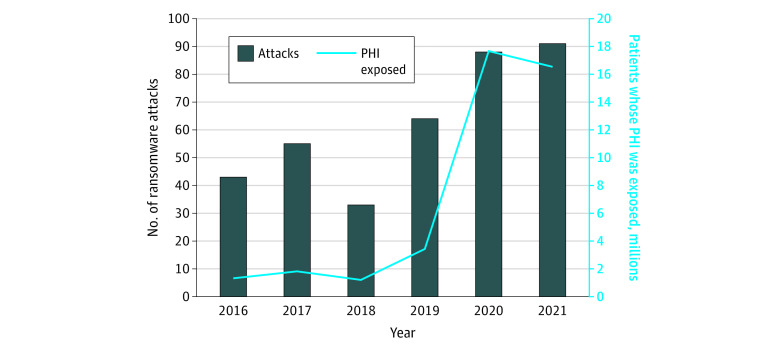
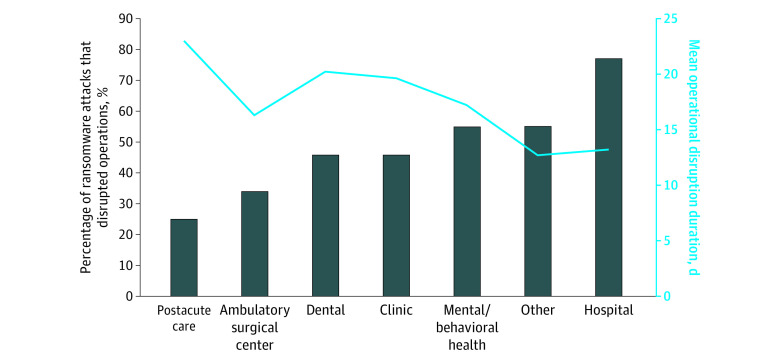
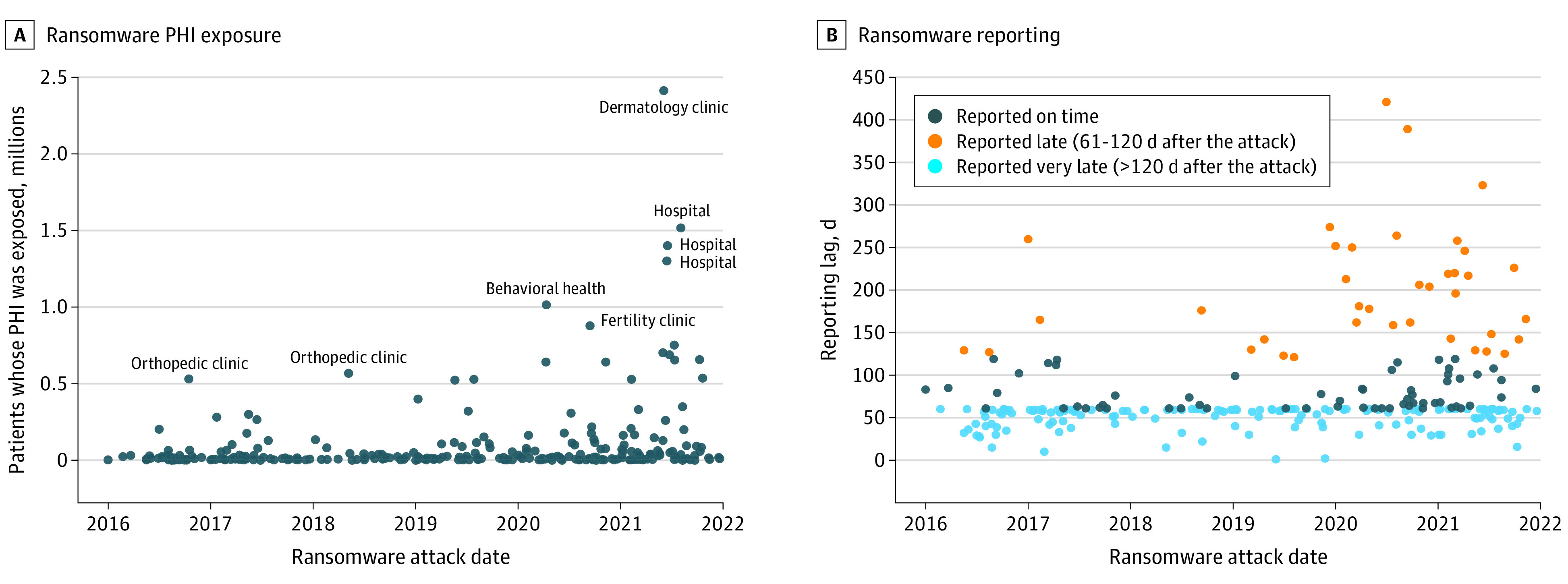
Importance: Anecdotal evidence suggests that health care delivery organizations face a growing threat from ransomware attacks that are designed to disrupt care delivery and may consequently threaten patient outcomes. Objective: To quantify the frequency and characteristics of ransomware attacks on health care delivery organizations. Design, Setting, and Participants: This cohort study used data from the Tracking Healthcare Ransomware Events and Traits database to examine the number and characteristics of ransomware attacks on health care delivery organizations from 2016 to 2021. Logistic and negative binomial regression quantified changes over time in the characteristics of ransomware attacks that affected health care delivery organizations. Main Outcomes and Measures: Date of ransomware attack, public reporting of ransomware attacks, personal health information (PHI) exposure, status of encrypted/stolen data following the attack, type of health care delivery organization affected, and operational disruption during the ransomware attack. Results: From January 2016 to December 2021, 374 ransomware attacks on US health care delivery organizations exposed the PHI of nearly 42 million patients. From 2016 to 2021, the annual number of ransomware attacks more than doubled from 43 to 91. Almost half (166 [44.4%]) of ransomware attacks disrupted the delivery of health care, with common disruptions including electronic system downtime (156 [41.7%]), cancellations of scheduled care (38 [10.2%]), and ambulance diversion (16 [4.3%]). From 2016 to 2021, ransomware attacks on health care delivery organizations increasingly affected large organizations with multiple facilities (annual marginal effect [ME], 0.08; 95% CI, 0.05-0.10; P < .001), exposed the PHI of more patients (ME, 66 385.8; 95% CI, 3400.5-129 371.2; P = .04), were less likely to be restored from data backups (ME, -0.04; 95% CI, -0.06 to -0.01; P = .002), were more likely to exceed mandatory reporting timelines (ME, 0.06; 95% CI, 0.03-0.08; P < .001), and increasingly were associated with delays or cancellations of scheduled care (ME, 0.02; 95% CI, 0-0.05; P = .02). Conclusions and Relevance: This cohort study of ransomware attacks documented growth in their frequency and sophistication. Ransomware attacks disrupt care delivery and jeopardize information integrity. Current monitoring/reporting efforts provide limited information and could be expanded to potentially yield a more complete view of how this growing form of cybercrime affects the delivery of health care.
Overview
The claims and statistics of this paper haven’t been checked yet.
Run the check — free, no account needed. It reads the open-access text and checks the sources it cites.
Integrity signals
Registry
Cites
Statistics
Figures
Verification
Claims the paper makes
The claims and statistics of this paper haven’t been checked yet.
Run the check — free, no account needed. It reads the open-access text and checks the sources it cites.
Claims other papers make about this one
Each is checked against this paper’s own text: does it say what the citing paper says it does?
The source backs part of the claim, not all of it — or backs it for a different population, condition or comparison.
In the citing paper
“Ransomware cyberattacks on healthcare delivery organizations (HDOs) are increasing in frequency and sophistication (1).”
From Ransomware Cyberattack Associated With Cardiac Arrest Incidence and Outcomes at Untargeted, Adjacent Hospitals (2024) · cites this paper as [1]
Experimental — accuracy not yet measured
Self-check
Percentages, sums and reported differences re-computed from the paper’s own numbers.
The self-check needs the paper’s full text.
Citations
Cites
Assessment of Employee Susceptibility to Phishing Attacks at US Health Care Institutions
Gordon, W. J., Wright, A. T., Aiyagari, R. M., Corbo, L., Glynn, R. J., Kadakia, J., Kufahl, J., Mazzone, C., Noga, J., Parkulo, M. A., et al. (2019) · JAMA Network Open · doi:10.1001/jamanetworkopen.2019.0393 · Cited by 81
Temporal trends and characteristics of reportable health data breaches, 2010-2017
McCoy, T. H., & Perlis, R. H. (2018) · JAMA · doi:10.1001/jama.2018.9222 · Cited by 62
Health Information Technology for Economic and Clinical Health Act
(2011) · NASN School Nurse · doi:10.1177/1942602x10390377 · Cited by 52
Hospital risk of data breaches
Bai, G., Jiang, J. (., & Flasher, R. (2017) · JAMA Internal Medicine · doi:10.1001/jamainternmed.2017.0336 · Cited by 51
Data breach locations, types, and associated characteristics among US hospitals.
Gabriel, M. H., Noblin, A. M., Rutherford, A. E., Walden, A., & Cortelyou-Ward, K. H. (2018) · PubMed · Cited by 45
Types of Information Compromised in Breaches of Protected Health Information
Jiang, J. (., & Bai, G. (2020) · Annals of Internal Medicine · doi:10.7326/m19-1759 · Cited by 21
Your Money or Your Patient's Life? Ransomware and Electronic Health Records
Cohen, I. G., Hoffman, S., & Adashi, E. Y. (2017) · Annals of Internal Medicine · doi:10.7326/m17-1312 · Cited by 14
Beyond Security Patches—Fundamental Incentive Problems in Health Care Cybersecurity
Kanter, G. P., Kufahl, J., & Cohen, I. G. (2021) · JAMA Health Forum · doi:10.1001/jamahealthforum.2021.2969 · Cited by 4
Cited by
Sorted by citations
Ethical hacking for IoT: Security issues, challenges, solutions and recommendations
Yaacoub, J.-P. A., Noura, H., Salman, O., & Chehab, A. (2023) · Internet of Things and Cyber-Physical Systems · doi:10.1016/j.iotcps.2023.04.002 · Cited by 141
Ransomware attack associated with disruptions at adjacent emergency departments in the US.
Dameff, C., Tully, J., Chan, T. C., Castillo, E. M., Savage, S., Maysent, P., Hemmen, T. M., Clay, B. J., & Longhurst, C. A. (2023) · JAMA Network Open · doi:10.1001/jamanetworkopen.2023.12270 · Cited by 60
Clinicians’ Perspectives on Healthcare Cybersecurity and Cyber Threats
Alanazi, A. T. (2023) · Cureus · doi:10.7759/cureus.47026 · Cited by 55
“Furthermore, hospitals have experienced a 300% surge in attacks over the past three years [8].”
BackgroundRansomware Reloaded: Re-examining Its Trend, Research and Mitigation in the Era of Data Exfiltration
McIntosh, T. R., Sušnjak, T., Liu, T., Xu, D., Watters, P., Liu, D., Hao, Y., Ng, A., & Halgamuge, M. N. (2024) · ACM Computing Surveys · doi:10.1145/3691340 · Cited by 55
Emerging Digital Technologies in Healthcare with a Spotlight on Cybersecurity: A Narrative Review
Arafa, A., Sheerah, H. A., & Alsalamah, S. (2023) · Information · doi:10.3390/info14120640 · Cited by 57
“Ransomware can lead to significant disruptions in healthcare services, compromise patient care, and result in financial losses [77,78].”
Background
Metadata
- Authors
- Neprash, H. T., McGlave, C. C., Cross, D. A., Virnig, B. A., Puskarich, M. A., Huling, J. D., Rozenshtein, A. Z., & Nikpay, S. S.
- Affiliations
- University of Minnesota (US)
- University of Florida Health (US)
- Corresponding author
- Neprash, Hannah T.
- ORCID
- Venue
- JAMA Health Forum
- Publisher
- American Medical Association (AMA)
- Published
- 2022-12-29
- Volume
- 3
- Issue
- 12
- Pages
- e224873
- ISSN
- 2689-0186 (ISSN-L)
- PMC
- PMC9856685
- OpenAlex
- W4313325293
- Cited by
- 154
- References
- 8
- Citations by year
- 2026: 49 · 2025: 43 · 2024: 43 · 2023: 19
- FWCI
- 25.94
- Type
- journal article
- Language
- en
- Open access
- gold
- doi.org
- Licence
- cc-by
- Locations
- JAMA Health Forum (publishedVersion, cc-by)
- PubMed Central (publishedVersion, cc-by)
- PubMed (publishedVersion)
- Topics
- Health Sciences › Health Professions › Health Information Management › Thoreau and American Literature
- Physical Sciences › Computer Science › Information Systems › Information and Cyber Security
- Physical Sciences › Computer Science › Software › Advanced Malware Detection Techniques
- Keywords
- ransomware, health care delivery organization, hospitals, clinics, operational disruption, mandatory reporting, ransom negotiation, ransom payments, ambulance diversion, patient safety
- MeSH terms
- Delivery of Health Care, Health Facilities, Hospitals, Humans, Organizations, Cohort Studies
About these checks
Registry, retraction, Cites and statistics results are computed, not judged, with one exception: a printed reference that no index lists is read once by a model before it counts as a citation error. Claims are extracted by a model and kept only when their quote appears verbatim in the text; each cited source is then checked, with a model’s help, for whether it says what the claim relies on. Those verdicts can be wrong — read the claim’s quote and the cited source before relying on one.
Statistics and arithmetic are recomputed, not judged.
Confidence bands are shown only for fields calibrated on our annotated test set. None is calibrated yet, so no band is shown.
What counts as a claim ›How we measure confidence ›How we check this ›
Are you an author, or do you see a problem with this page? Request a review
