

The DOI matches its Crossref record; 28 of the 35 references it cites were found in a registry or an index.
Safety of GLP-1 Receptor Agonists and Other Second-Line Antidiabetics in Early Pregnancy
Open accessAbstract
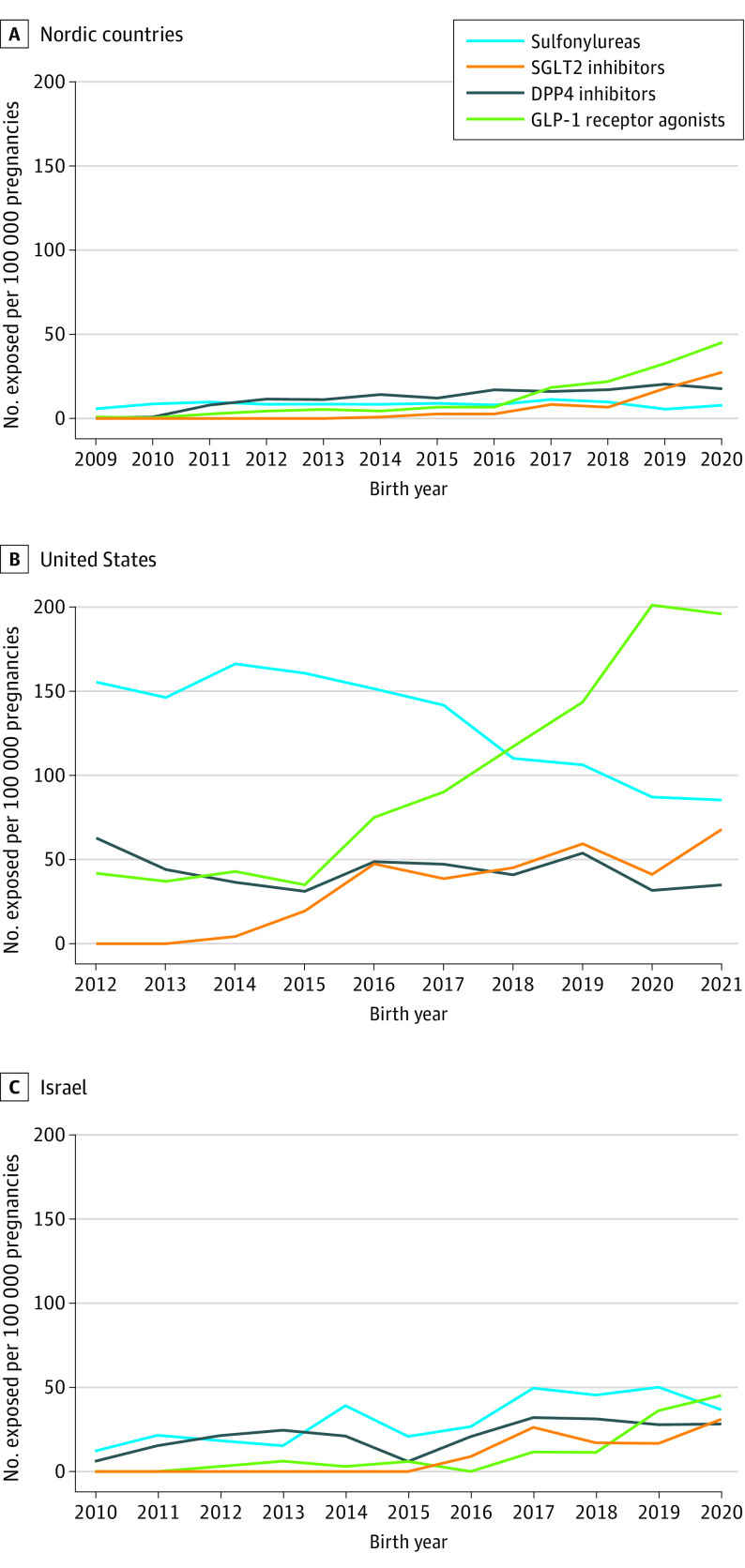
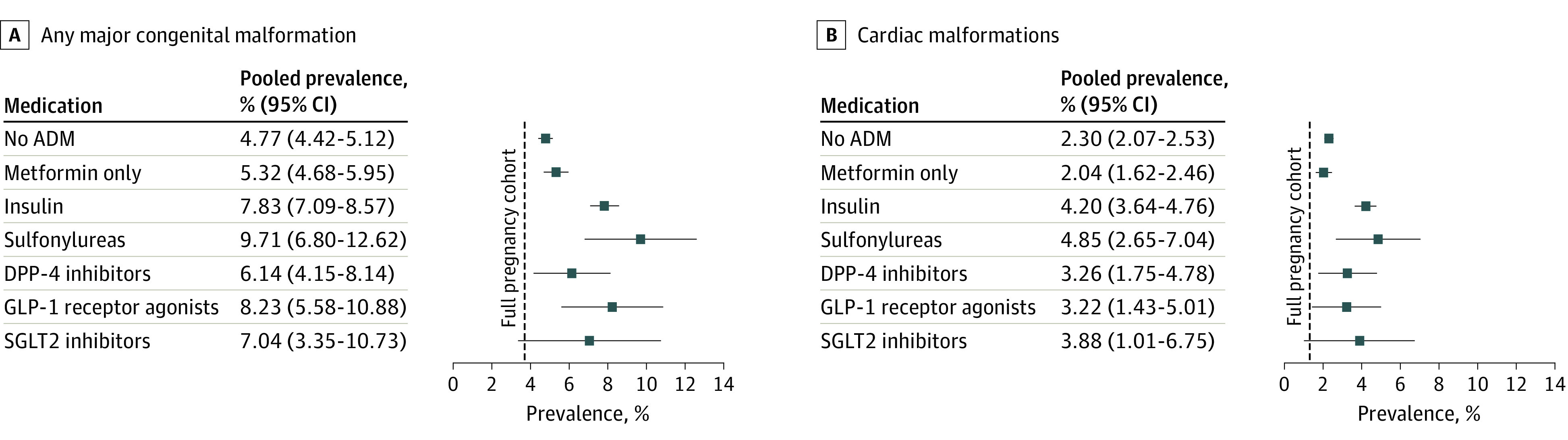
Importance: Increasing use of second-line noninsulin antidiabetic medication (ADM) in pregnant individuals with type 2 diabetes (T2D) may result in fetal exposure, but their teratogenic risk is unknown. Objective: To evaluate periconceptional use of second-line noninsulin ADMs and whether it is associated with increased risk of major congenital malformations (MCMs) in the infant. Design, Setting, and Participants: This observational population-based cohort study used data from 4 Nordic countries (2009-2020), the US MarketScan Database (2012-2021), and the Israeli Maccabi Health Services database (2009-2020). Pregnant women with T2D were identified and their live-born infants were followed until up to 1 year after birth. Exposure: Periconceptional exposure was defined as 1 or more prescription fill of sulfonylureas, dipeptidyl peptidase 4 (DPP-4) inhibitors, glucagon-like peptide 1 (GLP-1) receptor agonists, and sodium-glucose cotransporter 2 (SGLT2) inhibitors, or insulin (active comparator) from 90 days before pregnancy to end of first trimester. Main Outcomes and Measures: Relative risks (RRs) and 95% CIs for MCMs were estimated using log-binomial regression models, adjusting for key confounders in each cohort and meta-analyzed. Results: Periconceptional exposure to second-line noninsulin ADMs differed between countries (32, 295, and 73 per 100 000 pregnancies in the Nordics, US, and Israel, respectively), and increased over the study period, especially in the US. The standardized prevalence of MCMs was 3.7% in all infants (n = 3 514 865), 5.3% in the infants born to women with T2D (n = 51 826), and among infants exposed to sulfonylureas was 9.7% (n = 1362); DPP-4 inhibitors, 6.1% (n = 687); GLP-1 receptor agonists, 8.3% (n = 938); SGLT2 inhibitors, 7.0% (n = 335); and insulin, 7.8% (n = 5078). Compared with insulin, adjusted RRs for MCMs were 1.18 (95% CI, 0.94-1.48), 0.83 (95% CI, 0.64-1.06), 0.95 (95% CI, 0.72-1.26), and 0.98 (95% CI, 0.65-1.46) for infants exposed to sulfonylureas, DPP-4 inhibitors, GLP-1 receptor agonists, and SGLT2 inhibitors, respectively. Conclusions and Relevance: Use of second-line noninsulin ADMs is rapidly increasing for treatment of T2D and other indications, resulting in an increasing number of exposed pregnancies. Although some estimates were imprecise, results did not indicate a large increased risk of MCMs above the risk conferred by maternal T2D requiring second-line treatment. Although reassuring, confirmation from other studies is needed, and continuous monitoring will provide more precise estimates as data accumulate.
Overview
The claims and statistics of this paper haven’t been checked yet.
Run the check — free, no account needed. It reads the open-access text and checks the sources it cites.
Integrity signals
Registry
Cites
Statistics
Figures
Verification
Claims the paper makes
The claims and statistics of this paper haven’t been checked yet.
Run the check — free, no account needed. It reads the open-access text and checks the sources it cites.
Claims other papers make about this one
Each is checked against this paper’s own text: does it say what the citing paper says it does?
The cited source says what the claim attributes to it.
In the citing paper
“These findings align with a recently published multinational population-based cohort study.”
The cited source says what the claim attributes to it.
In the citing paper
“Compared with insulin, there was no increased risk of major congenital malformations (adjusted relative risk 0.95, 95% CI, 0.72 to 1.26) for infants exposed to GLP1-RA.”
The cited source says what the claim attributes to it.
In the citing paper
“In a multinational population-based cohort study involving 51,826 pregnant women diagnosed with type 2 diabetes and their infants, the standardised prevalence of major congenital malformations was 8.3% among infants with periconceptional exposure to GLP1-RA (n=938).12”
Self-check
Percentages, sums and reported differences re-computed from the paper’s own numbers.
The self-check needs the paper’s full text.
Citations
Cites
IDF Diabetes Atlas: Global estimates of diabetes prevalence for 2017 and projections for 2045
Cho, N. H., Shaw, J. E., Karuranga, S., Huang, Y., da Rocha Fernandes, J. D., Ohlrogge, A. W., & Malanda, B. (2018) · Diabetes Research and Clinical Practice · doi:10.1016/j.diabres.2018.02.023 · Cited by 7,283
Disparities in Rates of Unintended Pregnancy In the United States, 1994 and 2001
Finer, L. B., & Henshaw, S. K. (2006) · Perspectives on Sexual and Reproductive Health · doi:10.1363/3809006 · Cited by 1,557
Bearak, J., Popinchalk, A., Ganatra, B., Moller, A., Tunçalp, Ö., Beavin, C., Kwok, L., & Alkema, L. (2020) · The Lancet Global Health · doi:10.1016/s2214-109x(20)30315-6 · Cited by 1,341
9. Pharmacologic Approaches to Glycemic Treatment: Standards of Medical Care in Diabetes—2021
American Diabetes Association (2021) · Diabetes Care · doi:10.2337/dc21-s009 · Cited by 972
The Prevalence of Congenital Anomalies in Europe
Dolk, H. M., Loane, M. A., & Garne, E. (2010) · Advances in experimental medicine and biology · doi:10.1007/978-90-481-9485-8_20 · Cited by 718
Disparities in rates of unintended pregnancy in the United States, 1994 and 2001.
Finer, L. B., & Henshaw, S. K. (2006) · PubMed · doi:10.1363/psrh.38.090.06 · Cited by 585
Update on overall prevalence of major birth defects - Atlanta, Georgia, 1978-2005
(2008) · PsycEXTRA Dataset · doi:10.1037/e403792008-002 · Cited by 408
Deputy, N. P., Kim, S. Y., Conrey, E. J., & Bullard, K. M. (2018) · MMWR Morbidity and Mortality Weekly Report · doi:10.15585/mmwr.mm6743a2 · Cited by 354
Progress and challenges in anti-obesity pharmacotherapy
Bessesen, D. H., & Van Gaal, L. F. (2018) · The Lancet Diabetes & Endocrinology · doi:10.1016/s2213-8587(17)30236-x · Cited by 347
Ornoy, A., Reece, E. A., Pavlínková, G., Kappen, C., & Miller, R. K. (2015) · Birth Defects Research Part C Embryo Today Reviews · doi:10.1002/bdrc.21090 · Cited by 337
Research works printed but not linked: 1
- Kitzmiller, 2018, Diabetes in America. Bethesda (MD) no conflicts of interest
Cited by
Sorted by citations
Efficacy and Safety of GLP-1 Medicines for Type 2 Diabetes and Obesity
Drucker, D. J. (2024) · Diabetes Care · doi:10.2337/dci24-0003 · Cited by 383
Targeting the incretin system in obesity and type 2 diabetes mellitus
Ansari, S., Khoo, B. C. E., & Tan, T. (2024) · Nature Reviews Endocrinology · doi:10.1038/s41574-024-00979-9 · Cited by 110
“Moreover, observational data suggest that GLP1RA use in the preconceptional context is not associated with more congenital malformations relative to insulin treatment, although such observational data should be interpreted carefully because of the potential for bias 153 .”
Glucagon-like peptide-1 receptor agonist use in pregnancy: a review
Drummond, R. F., Seif, K. E., & Reece, E. A. (2024) · American Journal of Obstetrics and Gynecology · doi:10.1016/j.ajog.2024.08.024 · Cited by 102
GLP-1 and Its Analogs: Does Sex Matter?
Börchers, S., & Skibicka, K. P. (2024) · Endocrinology · doi:10.1210/endocr/bqae165 · Cited by 96
Gestational Weight Gain and Pregnancy Outcomes After GLP-1 Receptor Agonist Discontinuation
Maya, J., Pant, D. B., Fu, Y., James, K. E., Camero, C. B., Hsu, S. C., Soria‐Contreras, D. C., Shook, L. L., Mow, C., Hivert, M., et al. (2025) · JAMA · doi:10.1001/jama.2025.20951 · Cited by 75
Metadata
- Authors
- Cesta, C. E., Rotem, R., Bateman, B. T., Chodick, G., Cohen, J. M., Furu, K., Gissler, M., Huybrechts, K. F., Kjerpeseth, L. J., Leinonen, M. K., Pazzagli, L., Zoega, H., Seely, E. W., Patorno, E., & Hernández-Díaz, S.
- Affiliations
- Karolinska Institutet (SE)
- Harvard University (US)
- Stanford Medicine (US)
- Maccabi Healthcare Services (IL)
- Norwegian Institute of Public Health (NO)
- University of Turku (FI)
- Brigham and Women's Hospital (US)
- Finnish Institute for Health and Welfare (FI)
- School of Population Health, Faculty of Medicine & Health, UNSW Sydney, Sydney, New South Wales, Australia
- Department of Epidemiology, Harvard T.H. Chan School of Public Health, Boston, Massachusetts
- Corresponding author
- Cesta, Carolyn E.
- ORCID
- Venue
- JAMA Internal Medicine
- Publisher
- American Medical Association (AMA)
- Published
- 2024-02-01
- Volume
- 184
- Issue
- 2
- Pages
- 144
- ISSN
- 2168-6106 (ISSN-L)
- PMC
- PMC10714281
- OpenAlex
- W4389553854
- Cited by
- 200
- References
- 35
- Citations by year
- 2026: 90 · 2025: 79 · 2024: 31
- FWCI
- 51.20
- Type
- journal article
- Language
- en
- Open access
- hybrid
- doi.org
- Licence
- cc-by
- Locations
- JAMA Internal Medicine (publishedVersion, cc-by)
- PubMed Central (publishedVersion, cc-by)
- PubMed (publishedVersion)
- Opin vísindi (Opin vísindi) (submittedVersion, cc-by-nc-sa)
- Opin vísindi (Opin vísindi) (submittedVersion, other-oa)
- STM:n Hallinnonalan avoin julkaisuarkisto (Julkari) (submittedVersion)
- Funders
- European Commission (844728)
- Eunice Kennedy Shriver National Institute of Child Health and Human Development (R01HD097778)
- Topics
- Health Sciences › Medicine › Public Health, Environmental and Occupational Health › Pregnancy and Medication Impact
- Health Sciences › Medicine › Obstetrics and Gynecology › Gestational Diabetes Research and Management
- Health Sciences › Medicine › Pediatrics, Perinatology and Child Health › Pharmacological Effects and Toxicity Studies
- Keywords
- GLP-1 receptor agonists, type 2 diabetes in pregnancy, major congenital malformations, teratogenicity, sulfonylureas, DPP-4 inhibitors, SGLT2 inhibitors, insulin, prenatal exposure, pregnancy safety, liveborn infants, first trimester
- MeSH terms
- Glucagon-Like Peptide-1 Receptor, Sodium-Glucose Transporter 2 Inhibitors, Glucagon-Like Peptide-1 Receptor Agonists, Diabetes Mellitus, Type 2, Female, Humans, Hypoglycemic Agents, Insulin, Pregnancy, Sulfonylurea Compounds, Cohort Studies, Dipeptidyl-Peptidase IV Inhibitors
About these checks
Registry, retraction, Cites and statistics results are computed, not judged, with one exception: a printed reference that no index lists is read once by a model before it counts as a citation error. Claims are extracted by a model and kept only when their quote appears verbatim in the text; each cited source is then checked, with a model’s help, for whether it says what the claim relies on. Those verdicts can be wrong — read the claim’s quote and the cited source before relying on one.
Statistics and arithmetic are recomputed, not judged.
Confidence bands are shown only for fields calibrated on our annotated test set. None is calibrated yet, so no band is shown.
What counts as a claim ›How we measure confidence ›How we check this ›
Are you an author, or do you see a problem with this page? Request a review
