

The DOI matches its Crossref record; 34 of the 34 references it cites were found in a registry or an index.
Projected Lifetime Cancer Risks From Current Computed Tomography Imaging
Open accessAbstract
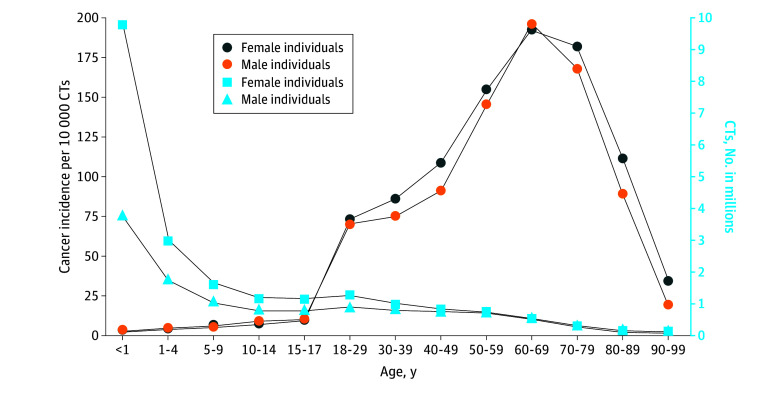
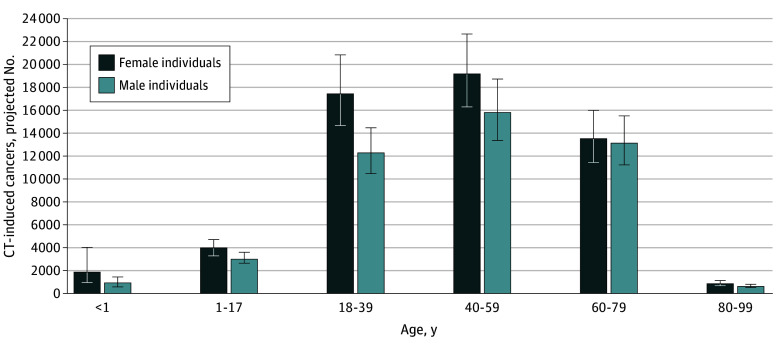
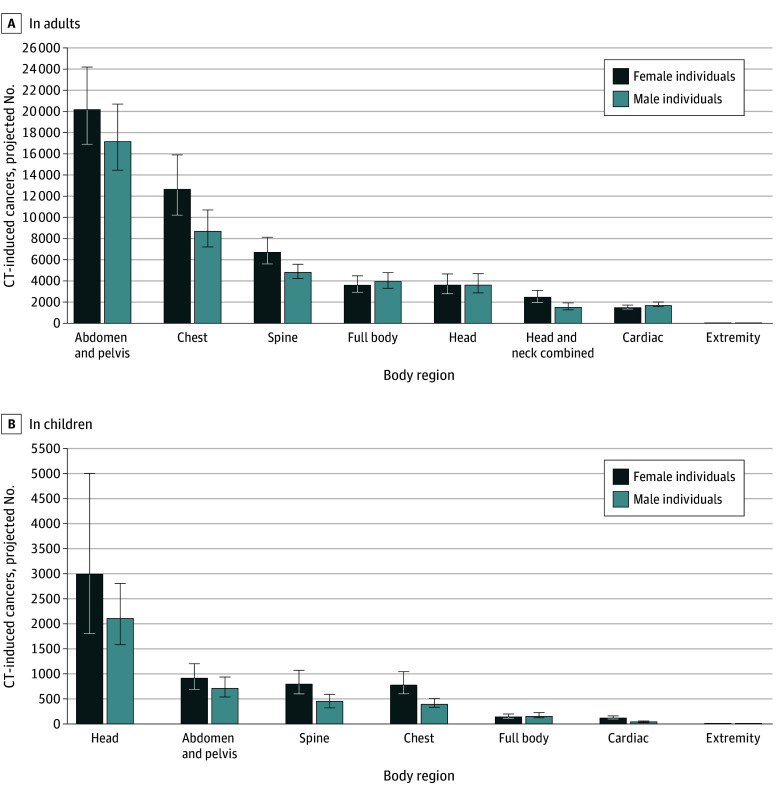
Importance: Approximately 93 million computed tomography (CT) examinations are performed on 62 million patients annually in the United States, and ionizing radiation from CT is a known carcinogen. Objective: To project the number of future lifetime cancers in the US population associated with CT imaging in 2023. Design, Setting, and Participants: This risk model used a multicenter sample of CT examinations prospectively assembled between January 2018 and December 2020 from the University of California San Francisco International CT Dose Registry. Data analysis was conducted from October 2023 to October 2024. Main Outcomes and Measures: Distributions of CT examinations and associated organ-specific radiation doses were estimated by patient age, sex, and CT category and scaled to the US population based on the number of examinations in 2023, quantified by the IMV national survey. Lifetime radiation-induced cancer incidence and 90% uncertainty limits (UL) were estimated by age, sex, and CT category using National Cancer Institute software based on the National Research Council’s Biological Effects of Ionizing Radiation VII models and projected to the US population using scaled examination counts. Results: An estimated 61 510 000 patients underwent 93 000 000 CT examinations in 2023, including 2 570 000 (4.2%) children, 58 940 000 (95.8%) adults, 32 600 000 (53.0%) female patients, and 28 910 000 (47.0%) male patients. Approximately 103 000 (90% UL, 96 400-109 500) radiation-induced cancers were projected to result from these examinations. Estimated radiation-induced cancer risks were higher in children and adolescents, yet higher CT utilization in adults accounted for most (93 000; 90% UL, 86 900-99 600 [91%]) radiation-induced cancers. The most common cancers were lung cancer (22 400 cases; 90% UL, 20 200-25 000 cases), colon cancer (8700 cases; 90% UL, 7800-9700 cases), leukemia (7900 cases; 90% UL, 6700-9500 cases), and bladder cancer (7100 cases, 90% UL, 6000-8500 cases) overall, while in female patients, breast was second most common (5700 cases; 90% UL, 5000-6500 cases). The largest number of cancers was projected to result from abdomen and pelvis CT in adults, reflecting 37 500 of 103 000 cancers (37%) and 30 million of 93 million CT examinations (32%), followed by chest CT (21 500 cancers [21%]; 20 million examinations [21%]). Estimates remained large over a variety of sensitivity analyses, which resulted in a range of 80 000 to 127 000 projected cancers across analyses. Conclusions and Relevance: This study found that at current utilization and radiation dose levels, CT examinations in 2023 were projected to result in approximately 103 000 future cancers over the course of the lifetime of exposed patients. If current practices persist, CT-associated cancer could eventually account for 5% of all new cancer diagnoses annually.
Overview
The claims and statistics of this paper haven’t been checked yet.
Run the check — free, no account needed. It reads the open-access text and checks the sources it cites.
Integrity signals
Registry
Cites
Statistics
Figures
Verification
Claims the paper makes
The claims and statistics of this paper haven’t been checked yet.
Run the check — free, no account needed. It reads the open-access text and checks the sources it cites.
Claims other papers make about this one
Each is checked against this paper’s own text: does it say what the citing paper says it does?
The check wasn’t confident either way, so it gives no verdict — never disputed.
In the citing paper
“Currently, computed tomography accounts for roughly 15% of diagnostic examinations yet contributes up to 75% of the overall radiation exposure in major hospitals.37–39”
From Computed Tomography Diagnostic Reference Levels Worldwide and in Jordan: Implications for Patient Dose Reduction (2026) · cites this paper as [37]
Experimental — accuracy not yet measured
Self-check
Percentages, sums and reported differences re-computed from the paper’s own numbers.
The self-check needs the paper’s full text.
Citations
Cites
Siegel, R. L., Giaquinto, A. N., & Jemal, A. (2024) · CA: A Cancer Journal for Clinicians · doi:10.3322/caac.21820 · Cited by 9,533
Pearce, M. S., Salotti, J. A., Little, M. P., McHugh, K., Lee, C., Kim, K. P., Howe, N. L., Ronckers, C. M., Rajaraman, P., Craft, A. W., et al. (2012) · The Lancet · doi:10.1016/s0140-6736(12)60815-0 · Cited by 3,735
Health Risks from Exposure to Low Levels of Ionizing Radiation:: BEIR VII Phase 2
Earth, D. O. (2006) · CERN Document Server (European Organization for Nuclear Research) · Cited by 2,190
Mathews, J. D., Forsythe, A. V., Brady, Z., Butler, M. W., Goergen, S. K., Byrnes, G. B., Giles, G. G., Wallace, A. B., Anderson, P. R., Guiver, T. A., et al. (2013) · BMJ · doi:10.1136/bmj.f2360 · Cited by 2,029
Projected Cancer Risks From Computed Tomographic Scans Performed in the United States in 2007
de González, A. B. (2009) · Archives of Internal Medicine · doi:10.1001/archinternmed.2009.440 · Cited by 1,880
Best care at lower cost: the path to continuously learning health care in America
Smith, M. A., Saunders, R., Stuckhardt, L., & McGinnis, J. M. (2014) · Choice Reviews Online · doi:10.5860/choice.51-3277 · Cited by 1,358
Trends in Use of Medical Imaging in US Health Care Systems and in Ontario, Canada, 2000-2016
Smith‐Bindman, R., Kwan, M. L., Marlow, E. C., Theis, M. K., Bolch, W. E., Cheng, S. Y., Bowles, E. J. A., Duncan, J. R., Greenlee, R. T., Kushi, L. H., et al. (2019) · JAMA · doi:10.1001/jama.2019.11456 · Cited by 738
Self-citationAddressing Overutilization in Medical Imaging
Hendee, W. R., Becker, G. J., Borgstede, J. P., Bosma, J. L., Casarella, W. J., Erickson, B. A., Maynard, C. D., Thrall, J. H., & Wallner, P. E. (2010) · Radiology · doi:10.1148/radiol.10100063 · Cited by 622
Bosch de Basea, M., Thierry-Chef, I., Harbron, R., Hauptmann, M., Byrnes, G., Bernier, M.-O., Le Cornet, L., Dabin, J., Ferro, G., Istad, T. S., et al. (2023) · Nature Medicine · doi:10.1038/s41591-023-02620-0 · Cited by 349
The UF family of reference hybrid phantoms for computational radiation dosimetry
Lee, C., Lodwick, D. L., Hurtado, J., Pafundi, D., Williams, J. L., & Bolch, W. E. (2009) · Physics in Medicine and Biology · doi:10.1088/0031-9155/55/2/002 · Cited by 345
Self-citation
Cited by
Sorted by citations
Unravelling the rise in thyroid cancer incidence and addressing overdiagnosis
Chen, D., & Haymart, M. R. (2025) · Nature Reviews Endocrinology · doi:10.1038/s41574-025-01168-y · Cited by 46
Early Detection of Lung Cancer: A Review of Innovative Milestones and Techniques
Habbab, F. M., Bédard, E. L. R., Joy, A. A., Alam, Z., Abraham, A., & Roa, W. (2025) · Journal of Clinical Medicine · doi:10.3390/jcm14217812 · Cited by 22
Thyroid cancer in adolescents and young adults: a population-based study in 185 countries worldwide
Li, M., Maso, L. D., Pizzato, M., Rumgay, H., & Vaccarella, S. (2025) · The Lancet Diabetes & Endocrinology · doi:10.1016/s2213-8587(25)00289-x · Cited by 19
Marshall, S. K., Kwandee, P., Songphum, N., & Chuaymuang, J. (2025) · Polymers · doi:10.3390/polym17111491 · Cited by 17
Qordja, F., Valpiana, P., Andriollo, L., Rossi, S. M. P., Salvi, A. G., Bocchino, G., Zepeda, K. E., Benazzo, F., & Indelli, P. F. (2025) · Journal of Experimental Orthopaedics · doi:10.1002/jeo2.70370 · Cited by 17
Metadata
- Authors
- Smith-Bindman, R., Chu, P. W., Azman Firdaus, H., Stewart, C., Malekhedayat, M., Alber, S., Bolch, W. E., Mahendra, M., Berrington de González, A., & Miglioretti, D. L.
- Affiliations
- Department of Epidemiology and Biostatistics, University of California, San Francisco
- University of California, San Francisco (US)
- University of California, Davis (US)
- University of Florida (US)
- Division of Genetics and Epidemiology, The Institute of Cancer Research, London, United Kingdom
- Kaiser Permanente Washington Health Research Institute (US)
- Venue
- JAMA Internal Medicine
- Publisher
- American Medical Association (AMA)
- Published
- 2025-06-01
- Volume
- 185
- Issue
- 6
- Pages
- 710
- ISSN
- 2168-6106 (ISSN-L)
- PMC
- PMC11997853
- OpenAlex
- W4409413635
- Cited by
- 358
- References
- 34
- Citations by year
- 2026: 222 · 2025: 136
- FWCI
- 205.45
- Type
- journal article
- Language
- en
- Open access
- hybrid
- doi.org
- Licence
- cc-by
- Locations
- JAMA Internal Medicine (publishedVersion, cc-by)
- PubMed Central (publishedVersion, cc-by)
- PubMed (publishedVersion)
- Funders
- Kaiser Permanente
- University of California, Davis
- University of California, San Francisco
- National Cancer Institute (R01CA181191)
- Topics
- Health Sciences › Medicine › Radiology, Nuclear Medicine and Imaging › Radiation Dose and Imaging
- Health Sciences › Medicine › Radiology, Nuclear Medicine and Imaging › Effects of Radiation Exposure
- Health Sciences › Medicine › Radiology, Nuclear Medicine and Imaging › Radiology practices and education
- Keywords
- computed tomography, ionizing radiation, radiation-induced cancer, lifetime cancer risk, cancer incidence projections, lung cancer, colon cancer, leukemia, pediatric radiation exposure, CT utilization, risk communication, radiation dose reduction, cancer prevention guidelines
- MeSH terms
- Adolescent, Adult, Aged, Child, Child, Preschool, Female, Humans, Male, Middle Aged, Neoplasms, Radiation-Induced, Prospective Studies, Radiation Dosage, Tomography, X-Ray Computed, United States, Incidence, Risk Assessment, Young Adult
About these checks
Registry, retraction, Cites and statistics results are computed, not judged, with one exception: a printed reference that no index lists is read once by a model before it counts as a citation error. Claims are extracted by a model and kept only when their quote appears verbatim in the text; each cited source is then checked, with a model’s help, for whether it says what the claim relies on. Those verdicts can be wrong — read the claim’s quote and the cited source before relying on one.
Statistics and arithmetic are recomputed, not judged.
Confidence bands are shown only for fields calibrated on our annotated test set. None is calibrated yet, so no band is shown.
What counts as a claim ›How we measure confidence ›How we check this ›
Are you an author, or do you see a problem with this page? Request a review
