

The DOI matches its Crossref record; 66 of the 76 references it cites were found in a registry or an index.
Effectiveness of Cognitive Behavioral Therapy–Based Intervention in Preventing Gaming Disorder and Unspecified Internet Use Disorder in Adolescents: A Cluster Randomized Clinical Trial
Open accessAbstract
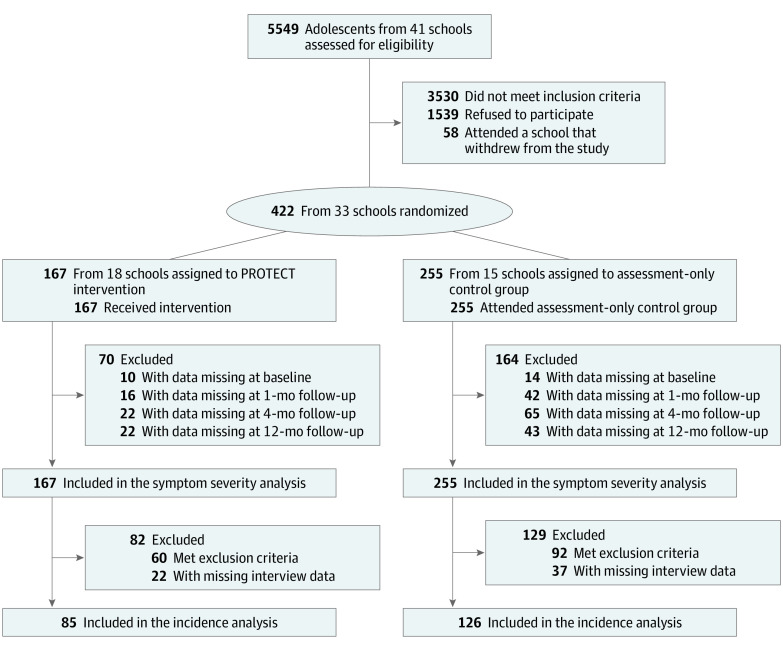
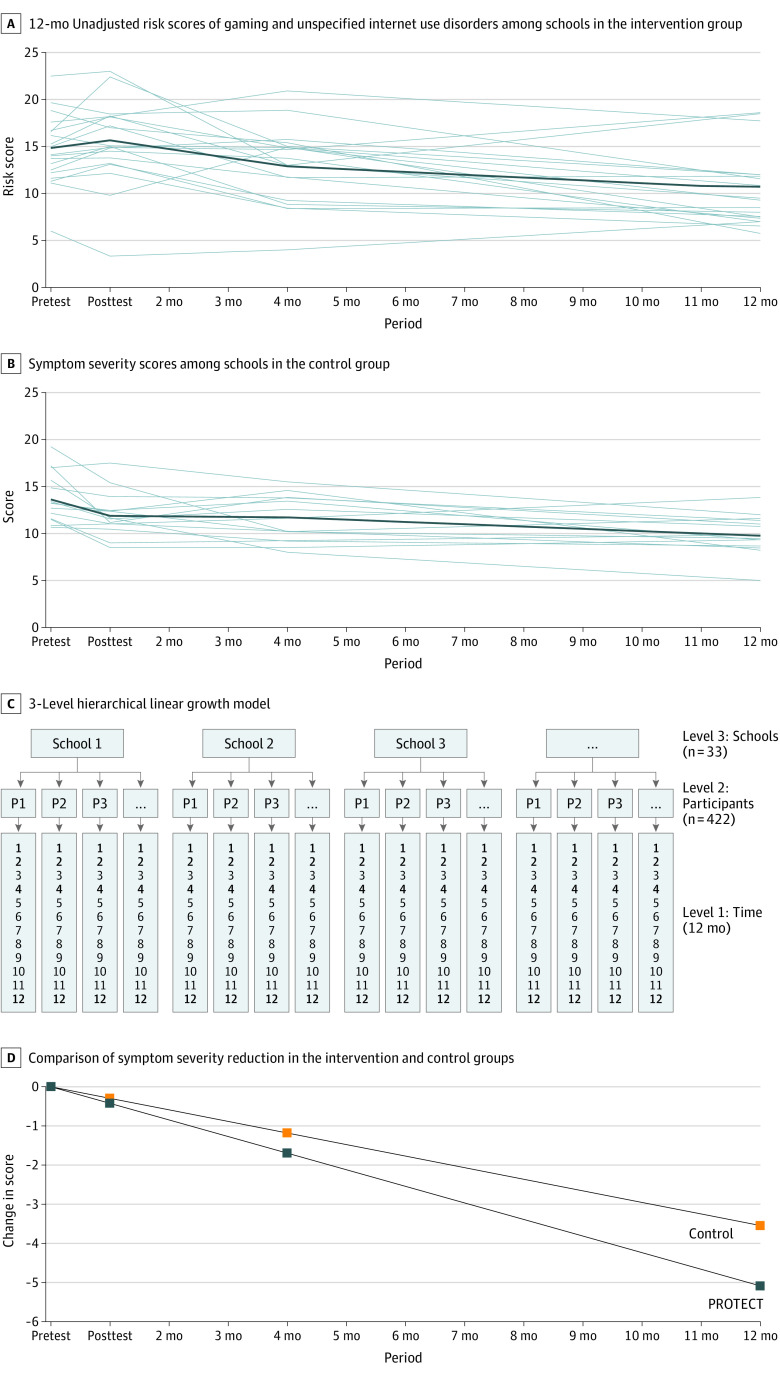
Importance: Behavioral addictions were introduced as novel mental disorders in the International Classification of Diseases, 11th Revision, based on evidence that human behavior itself can become addictive, similar to addiction to substances. However, previous studies on prevention of gaming disorder and unspecified internet use disorder lacked randomization, follow-up measurements, and diagnostic interviews that assessed incidence rates; this trial was intended to fill this gap. Objectives: To investigate whether the PROTECT (Professioneller Umgang mit technischen Medien [Professional Use of Technical Media]) intervention can reduce the symptom severity and prevent full syndrome and subthreshold onset of gaming disorder and unspecified internet use disorder in at-risk adolescents. Design, Setting, and Participants: A multicenter cluster randomized clinical trial conducted recruitment, screening, intervention delivery, and data collection among at-risk adolescents aged 12 to 18 years in 33 high schools in Germany. Inclusion criteria for the study and symptom severity analyses were elevated symptoms of gaming disorder and unspecified internet use disorder. A subsample that met the inclusion criteria for incidence analyses (no full syndrome of gaming disorder or unspecified internet use disorder, depression, or anxiety at baseline) was analyzed for illness onset. Participants were randomized to either the PROTECT intervention group or the assessment-only control group. Participants were assessed at baseline, 1-month follow-up, 4-month follow-up, and 12-month follow-up between October 1, 2015, and September 30, 2018. Based on intent-to-treat principle, data analyses were conducted from February 8, 2019, to May 7, 2021. Interventions: PROTECT, a theory-driven, manualized, cognitive behavioral therapy-based indicated preventive group intervention that is delivered in 4 sessions by trained psychologists. It targets changes in addictive reward processing and pathological cognitive mechanisms. Main Outcomes and Measures: The primary outcome was symptom severity (measured by CSAS [Computerspielabhängigkeitsskala], a modified German video game dependency scale with a score range of 0-56 [higher scores indicating greater pathology]) along with incidence rates (assessed by a structured clinical interview) after 12 months. Secondary outcomes were comorbid psychopathology and problem behaviors. Results: A total of 422 at-risk adolescents (mean [SD] age, 15.11 [2.01] years; 229 female participants [54.3%]) were randomized to either the PROTECT intervention group (n = 167; mean [SD] risk score, 29.05 [6.98]) or the assessment-only control group (n = 255; mean [SD] risk score, 26.21 [5.01]) and were included in the symptom severity analyses. Compared with the control group, the PROTECT group showed a significantly greater reduction in symptom severity of gaming disorder or unspecified internet use disorder (γ11 = -0.128; 95% CI, -0.246 to -0.011; P = .03), reflecting a 39.8% vs 27.7% reduction of symptoms with an effect size of Cohen d = 0.67 (baseline vs 12-month follow-up) for the PROTECT group. Differences in incidence rates did not reach statistical significance. The PROTECT group showed a significantly greater decrease in procrastination (γ11 = -0.458; 95% CI, -0.735 to -0.180; P < .001) over 12 months, but no significant differences were found for other secondary outcomes. Conclusions and Relevance: Results of this trial showed that the PROTECT intervention effectively reduced symptoms of gaming disorder and unspecified internet use disorder over 12 months. The intervention did not change incidence rates of gaming disorder or unspecified internet use disorder. Trial Registration: ClinicalTrials.gov Identifier: NCT02907658.
Overview
The claims and statistics of this paper haven’t been checked yet.
Run the check — free, no account needed. It reads the open-access text and checks the sources it cites.
Integrity signals
Registry
Cites
Statistics
Figures
Verification
Claims the paper makes
The claims and statistics of this paper haven’t been checked yet.
Run the check — free, no account needed. It reads the open-access text and checks the sources it cites.
Claims other papers make about this one
Each is checked against this paper’s own text: does it say what the citing paper says it does?
The source backs part of the claim, not all of it — or backs it for a different population, condition or comparison.
In the citing paper
“Recent research shows positive effects of digital detox programs and cognitive behavior therapy as treatment for problematic SMU; however, more research is still needed (Cañas & Estévez, 2021; Kurnaz & Koçtürk, 2024; Lindenberg, Kindt, & Szász‐Janocha, 2022; Ramadhan et al., 2024).”
From Review: Social media use and adolescent mental health - an umbrella review and power analysis. (2026) · cites this paper as Lindenberg, Kindt, & Szász‐Janocha, 2022
Experimental — accuracy not yet measured
Self-check
Percentages, sums and reported differences re-computed from the paper’s own numbers.
The self-check needs the paper’s full text.
Citations
Cites
Timely mental health care for the 2019 novel coronavirus outbreak is urgently needed
Xiang, Y.-T., Yang, Y., Li, W., Zhang, L., Zhang, Q., Cheung, T., & Ng, C. H. (2020) · The Lancet Psychiatry · doi:10.1016/s2215-0366(20)30046-8 · Cited by 3,598
Brand, M., Wegmann, E., Stark, R., Müller, A., Wölfling, K., Robbins, T. W., & Potenza, M. N. (2019) · Neuroscience & Biobehavioral Reviews · doi:10.1016/j.neubiorev.2019.06.032 · Cited by 2,126
Shigemura, J., Ursano, R. J., Morganstein, J. C., Kurosawa, M., & Benedek, D. M. (2020) · Psychiatry and Clinical Neurosciences · doi:10.1111/pcn.12988 · Cited by 1,959
Luo, M., Guo, L., Yu, M., Jiang, W., & Wang, H. (2020) · Psychiatry Research · doi:10.1016/j.psychres.2020.113190 · Cited by 1,615
Pathological Video Game Use Among Youths: A Two-Year Longitudinal Study
Gentile, D. A., Choo, H., Liau, A., Sim, T., Li, D., Fung, D., & Khoo, A. (2011) · Pediatrics · doi:10.1542/peds.2010-1353 · Cited by 1,314
Pathological Video-Game Use Among Youth Ages 8 to 18
Gentile, D. A. (2009) · Psychological Science · doi:10.1111/j.1467-9280.2009.02340.x · Cited by 1,107
Duan, L., Shao, X., Wang, Y., Huang, Y., Miao, J., Yang, X., & Zhu, G. (2020) · Journal of Affective Disorders · doi:10.1016/j.jad.2020.06.029 · Cited by 991
The compulsive internet use scale (CIUS): some psychometric properties
Meerkerk, G.-J., Van Den Eijnden, R. J. J. M., Vermulst, A. A., & Garretsen, H. F. L. (2009) · CyberPsychology & Behavior · doi:10.1089/cpb.2008.0181 · Cited by 989
The Internet Gaming Disorder Scale.
Lemmens, J. S., Valkenburg, P. M., & Gentile, D. A. (2015) · Psychological Assessment · doi:10.1037/pas0000062 · Cited by 742
Cheng, C., & Li, A. Y.-L. (2014) · Cyberpsychology, Behavior, and Social Networking · doi:10.1089/cyber.2014.0317 · Cited by 727
Research works printed but not linked: 1
- Malik, 2016, Exploring the relationship of personality, loneliness, and online social support with interned addiction and procrastination., Pakistan J Psychol Res, 31, 93
Cited by
Sorted by citations
Fineberg, N. A., Menchón, J. M., Hall, N., Dell’Osso, B. M., Brand, M., Potenza, M. N., Chamberlain, S. R., Cirnigliaro, G., Löchner, C., Billieux, J., et al. (2022) · Comprehensive Psychiatry · doi:10.1016/j.comppsych.2022.152346 · Cited by 276
Digital Addiction Intervention for Children and Adolescents: A Scoping Review
Ding, K., & Li, H. (2023) · International Journal of Environmental Research and Public Health · doi:10.3390/ijerph20064777 · Cited by 154
Prevalence of gaming disorder in East Asia: A comprehensive meta-analysis
Liao, Z., Chen, X., Huang, Q., & Shen, H. (2022) · Journal of Behavioral Addictions · doi:10.1556/2006.2022.00050 · Cited by 72
Burden of gaming disorder among adolescents: A systemic review and meta-analysis
Satapathy, P., Khatib, M. N., Balaraman, A. K., Roopashree, R., Kaur, M., Srivastava, M., Barwal, A., Prasad, G. V. S., Rajput, P., Syed, R., et al. (2024) · Public Health in Practice · doi:10.1016/j.puhip.2024.100565 · Cited by 62
Dong, G., Dai, J., & Potenza, M. N. (2024) · Journal of Behavioral Addictions · doi:10.1556/2006.2023.00071 · Cited by 58
Metadata
- Authors
- Lindenberg, K., Kindt, S., & Szász-Janocha, C.
- Affiliations
- Goethe University Frankfurt (DE)
- Corresponding author
- Lindenberg, Katajun
- ORCID
- Lindenberg, Katajun
- Venue
- JAMA Network Open
- Publisher
- American Medical Association (AMA)
- Published
- 2022-02-18
- Volume
- 5
- Issue
- 2
- Pages
- e2148995
- ISSN
- 2574-3805 (ISSN-L)
- PMC
- PMC8857686
- OpenAlex
- W4213329925
- Cited by
- 157
- References
- 76
- Citations by year
- 2026: 39 · 2025: 50 · 2024: 43 · 2023: 14 · 2022: 10
- FWCI
- 42.09
- Type
- journal article
- Language
- en
- Open access
- gold
- doi.org
- Licence
- cc-by
- Locations
- JAMA Network Open (publishedVersion, cc-by)
- PubMed Central (publishedVersion, cc-by)
- PubMed (publishedVersion)
- Funders
- Bundesministerium für Bildung und Forschung
- Topics
- Social Sciences › Sociology and Political Science › Impact of Technology on Adolescents
- Social Sciences › Psychology › Clinical Psychology › Gambling Behavior and Treatments
- Health Sciences › Medicine › Epidemiology › Substance Abuse Treatment and Outcomes
- Keywords
- gaming disorder, behavioral addiction, adolescents, cognitive behavioral therapy, prevention, at-risk youth, symptom severity, incidence, comorbid psychopathology, problematic internet use, gaming addiction, school-based intervention, ICD-11, anxiety, behavioral problems
- MeSH terms
- Internet Addiction Disorder, Technology Addiction, Adolescent, Child, Female, Humans, Male, Cognitive Behavioral Therapy, Treatment Outcome
About these checks
Registry, retraction, Cites and statistics results are computed, not judged, with one exception: a printed reference that no index lists is read once by a model before it counts as a citation error. Claims are extracted by a model and kept only when their quote appears verbatim in the text; each cited source is then checked, with a model’s help, for whether it says what the claim relies on. Those verdicts can be wrong — read the claim’s quote and the cited source before relying on one.
Statistics and arithmetic are recomputed, not judged.
Confidence bands are shown only for fields calibrated on our annotated test set. None is calibrated yet, so no band is shown.
What counts as a claim ›How we measure confidence ›How we check this ›
Are you an author, or do you see a problem with this page? Request a review
