

The DOI matches its Crossref record; 49 of the 53 references it cites were found in a registry or an index.
Prevalence of Perinatal Depression and Anxiety in Both Parents: A Systematic Review and Meta-analysis
Open accessAbstract
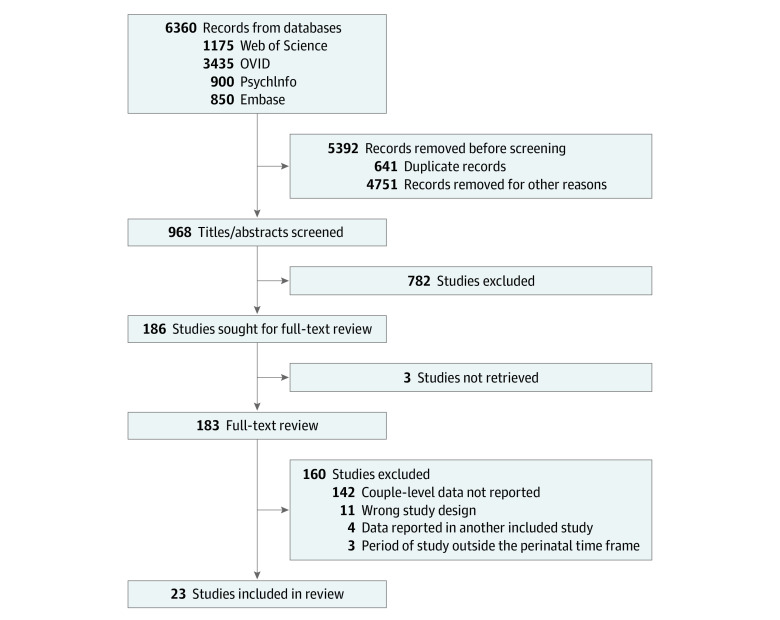
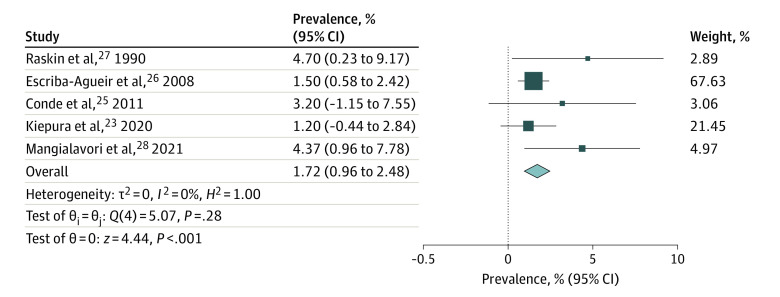
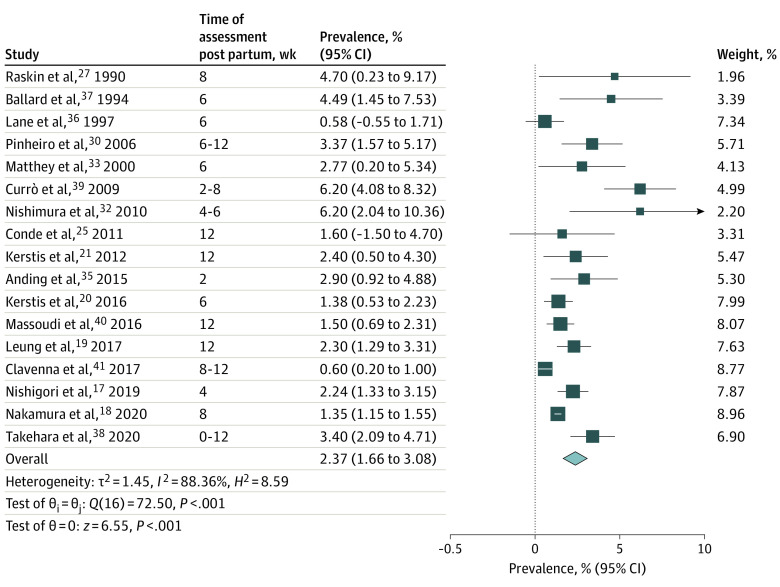
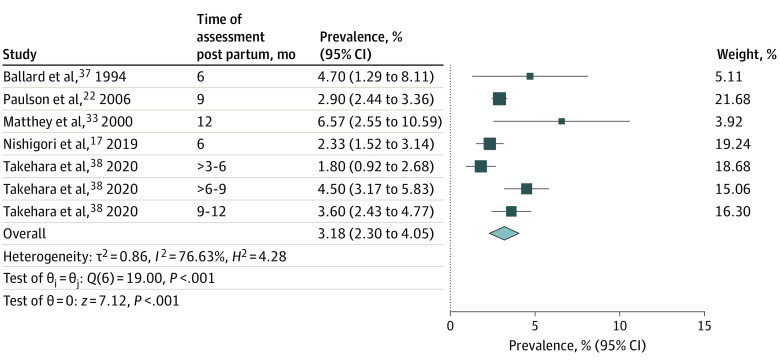
Importance: New and expectant parents experience perinatal mood disorders, with consequences to parenting ability, bonding with the neonate, interpersonal relationships, and health and well-being of parents. Research shows that maternal and paternal perinatal mood disorders are associated, but no recent systematic review has addressed the prevalence of perinatal mood disorders in both mothers and fathers (parental dyad). Objective: To examine the prevalence of perinatal mood disorders in parental dyads and identify factors associated with perinatal mood disorders in parental dyads. Data Sources: Ovid (MEDLINE, Embase, and PsycINFO) and Web of Science were searched from January 1, 1990, to June 8, 2021, for observational studies reporting on the prevalence of perinatal depression or anxiety in a parental dyad. Study Selection: Studies reporting the prevalence of anxiety or depression in both members of a parental dyad were included, with diagnosis according to established criteria (Diagnostic and Statistical Manual of Mental Disorders [Fifth Edition], International Classification of Diseases, 11th Revision) or use of validated screening tools. Data Extraction and Synthesis: Prevalence data were extracted in accordance with Preferred Reporting Items for Systematic Reviews and Meta-Analyses guidelines. Data were analyzed in subgroups: antenatal depression, early postnatal depression (0-12 weeks), late postnatal depression (3-12 months), and perinatal anxiety. Pooled prevalence was calculated using a random-effects meta-analysis model. Quality assessment was performed using Joanna Briggs Institute Appraisal Checklist for Studies Reporting Prevalence Data. Data were analyzed in June 2021. Main Outcomes and Measures: Prevalence of perinatal anxiety and perinatal depression in parental dyads. Results: Twenty-three studies were included, with data from 29 286 couples. The pooled prevalence of antenatal depression in both parents was 1.72% (95% CI, 0.96%-2.48%; P < .001). The prevalence of early postnatal depression (up to 12 weeks post partum) was 2.37% (95% CI, 1.66%-3.08%; P < .001) and the prevalence of late postnatal depression (3-12 months post partum) was 3.18% (95% CI, 2.3-4.05; P < .001). Only 3 studies reported on perinatal anxiety in both parents, precluding a quantitative analysis. Conclusions and Relevance: In up to 3.18% of couples, both parents may concurrently experience perinatal depression. Perinatal health care must consider the mental health needs of parents, both as individuals and as a parental dyad. Further research is needed to examine outcomes in families where both parents experience perinatal mood disorders.
Overview
The claims and statistics of this paper haven’t been checked yet.
Run the check — free, no account needed. It reads the open-access text and checks the sources it cites.
Integrity signals
Registry
Cites
Statistics
Figures
Verification
Claims the paper makes
The claims and statistics of this paper haven’t been checked yet.
Run the check — free, no account needed. It reads the open-access text and checks the sources it cites.
Claims other papers make about this one
Each is checked against this paper’s own text: does it say what the citing paper says it does?
The source backs part of the claim, not all of it — or backs it for a different population, condition or comparison.
In the citing paper
“Parents with babies in the neonatal intensive care unit (NICU) experience high levels of stress, anxiety, and depression.”
From A digital Acceptance and Commitment Therapy and education intervention targeting stress of parents and caregivers with preterm babies in the neonatal intensive care unit: A randomised controlled cluster trial protocol (2024) · cites this paper as [3]
Experimental — accuracy not yet measuredThe source backs part of the claim, not all of it — or backs it for a different population, condition or comparison.
In the citing paper
“Increased psychological distress of NICU parents is associated with a wide range of short- and long-term challenges for parents and infants, including increased risk of mental health disorders [1 -3], impaired parenting, and early childhood behavioural and emotional problems [5].”
From A digital Acceptance and Commitment Therapy and education intervention targeting stress of parents and caregivers with preterm babies in the neonatal intensive care unit: A randomised controlled cluster trial protocol (2024) · cites this paper as [3]
Experimental — accuracy not yet measuredThe cited source says what the claim attributes to it.
In the citing paper
“Postnatal depression affects approximately 13 % of mothers and 9 % of co-parents, with many cases going undetected and untreated, posing significant risks to women, their families, and especially their children [12 -14].”
The check wasn’t confident either way, so it gives no verdict — never disputed.
In the citing paper
“Postnatal depression affects approximately 13 % of mothers and 9 % of co-parents, with many cases going undetected and untreated, posing significant risks to women, their families, and especially their children [12 -14].”
From Systematic home visit planning prior to hospital discharge: a propensity-score matched comparative cohort study of over one million mother-infant dyads with one-year follow-up (2026) · cites this paper as [14]
Experimental — accuracy not yet measured
Self-check
Percentages, sums and reported differences re-computed from the paper’s own numbers.
The self-check needs the paper’s full text.
Citations
Cites
The PRISMA 2020 statement: An updated guideline for reporting systematic reviews
Page, M. J., McKenzie, J. E., Bossuyt, P. M., Boutron, I., Hoffmann, T. C., Mulrow, C. D., Shamseer, L., Tetzlaff, J. M., Akl, E. A., Brennan, S. E., et al. (2021) · BMJ · doi:10.1136/bmj.n71 · Cited by 108,283
Screening for serious mental illness in the general population
Kessler, R. C., Barker, P. R., Colpe, L. J., Epstein, J. F., Gfroerer, J. C., Hiripi, E., Howes, M. J., Normand, S.-L. T., Manderscheid, R. W., Walters, E. E., et al. (2003) · Archives of General Psychiatry · doi:10.1001/archpsyc.60.2.184 · Cited by 5,692
JBI Manual for Evidence Synthesis
(2020) · JBI eBooks · doi:10.46658/jbimes-20-01 · Cited by 4,165
Munn, Z., Moola, S., Riitano, D., & Lisy, K. (2014) · International Journal of Health Policy and Management · doi:10.15171/ijhpm.2014.71 · Cited by 1,479 · cited 1×
“Although the EPDS has been validated in many different settings, the cutoff varies, and this is reflected in the range of cutoffs used (8-13).”
MethodNon-psychotic mental disorders in the perinatal period
Howard, L. M., Molyneaux, E., Dennis, C.-L., Rochat, T., Stein, A., & Milgrom, J. (2014) · The Lancet · doi:10.1016/s0140-6736(14)61276-9 · Cited by 1,328
Gelaye, B., Rondon, M. B., Araya, R., & Williams, M. A. (2016) · The Lancet Psychiatry · doi:10.1016/s2215-0366(16)30284-x · Cited by 1,155
Paulson, J. F., Dauber, S., & Leiferman, J. A. (2006) · Pediatrics · doi:10.1542/peds.2005-2948 · Cited by 706
Advances in Experimental Medicine and Biology
Berry, C. L. (1973) · Journal of Medical Genetics · doi:10.1136/jmg.10.4.401-a · Cited by 668
Paternal and maternal depressed mood during the transition to parenthood
Matthey, S., Barnett, B. E. W., Ungerer, J. A., & Waters, B. G. H. (2000) · Journal of Affective Disorders · doi:10.1016/s0165-0327(99)00159-7 · Cited by 500
The prevalence of antenatal and postnatal co-morbid anxiety and depression: a meta-analysis
Falah‐Hassani, K., Shiri, R., & Dennis, C. (2017) · Psychological Medicine · doi:10.1017/s0033291717000617 · Cited by 384
Research works printed but not linked: 1
- della Vedova, 2019, Prenatal attachment, distress symptoms and psychosocial variables in a sample of Italian first-time parents., Life Span Disabil, 22, 255
Cited by
Sorted by citations
Psychological distress in the neonatal intensive care unit: a meta-review
van Wyk, L., Majiza, A. P., Ely, C. S. E., & Singer, L. T. (2024) · Pediatric Research · doi:10.1038/s41390-024-03599-1 · Cited by 65
Aziz, H. A., Yahya, H. D. B., Ang, W. W., & Lau, Y. (2024) · Journal of Psychiatric Research · doi:10.1016/j.jpsychires.2024.11.070 · Cited by 59
Hu, F., Liu, P., Jia, Y., Ge, M., Shen, L.-T., Xia, X., & Chen, H. (2024) · Psychology Health & Medicine · doi:10.1080/13548506.2024.2424998 · Cited by 46
Ou, L., Shen, Q., Xiao, M., Wang, W., He, T., & Wang, B. (2025) · Psychological Medicine · doi:10.1017/s0033291725000601 · Cited by 36
Pan, T., Zeng, Y., Chai, X., Wen, Z., Tan, X., & Sun, M. (2024) · Depression and Anxiety · doi:10.1155/2024/1882604 · Cited by 34
Metadata
- Authors
- Smythe, K. L., Petersen, I., & Schartau, P.
- Affiliations
- University College London (GB)
- Corresponding author
- Smythe, Kara L.
- Venue
- JAMA Network Open
- Publisher
- American Medical Association (AMA)
- Published
- 2022-06-24
- Volume
- 5
- Issue
- 6
- Pages
- e2218969
- ISSN
- 2574-3805 (ISSN-L)
- PMC
- PMC9233234
- OpenAlex
- W4283397289
- Cited by
- 147
- References
- 53
- Citations by year
- 2026: 41 · 2025: 32 · 2024: 41 · 2023: 29 · 2022: 4
- FWCI
- 5.24
- Type
- journal article
- Language
- en
- Open access
- gold
- doi.org
- Licence
- cc-by
- Locations
- JAMA Network Open (publishedVersion, cc-by)
- PubMed Central (publishedVersion, cc-by)
- PubMed (publishedVersion)
- ORCA Online Research @Cardiff (Cardiff University) (acceptedVersion)
- Topics
- Health Sciences › Medicine › Public Health, Environmental and Occupational Health › Maternal Mental Health During Pregnancy and Postpartum
- Health Sciences › Medicine › Pediatrics, Perinatology and Child Health › Maternal and Neonatal Healthcare
- Health Sciences › Medicine › Pediatrics, Perinatology and Child Health › Infant Health and Development
- Keywords
- perinatal depression, perinatal anxiety, antenatal depression, postpartum depression, prevalence, couples, risk factors
- MeSH terms
- Anxiety, Depression, Female, Humans, Infant, Newborn, Parents, Pregnancy, Prevalence, Depression, Postpartum
About these checks
Registry, retraction, Cites and statistics results are computed, not judged, with one exception: a printed reference that no index lists is read once by a model before it counts as a citation error. Claims are extracted by a model and kept only when their quote appears verbatim in the text; each cited source is then checked, with a model’s help, for whether it says what the claim relies on. Those verdicts can be wrong — read the claim’s quote and the cited source before relying on one.
Statistics and arithmetic are recomputed, not judged.
Confidence bands are shown only for fields calibrated on our annotated test set. None is calibrated yet, so no band is shown.
What counts as a claim ›How we measure confidence ›How we check this ›
Are you an author, or do you see a problem with this page? Request a review
