

Breast Cancer Incidence Among US Women Aged 20 to 49 Years by Race, Stage, and Hormone Receptor Status
Open accessThe DOI matches its Crossref record; 47 of the 55 references it cites were found in a registry or an index; none of the 54 sources its claims cite is checked for support yet.
Abstract
Importance: Breast cancer in young women has a less favorable prognosis compared with older women. Yet, comprehensive data on recent trends and how period and cohort effects may affect these trends among young women are not well-known. Objective: To evaluate breast cancer incidence among young women in the US over a 20-year period by race and ethnicity, hormone receptor status (estrogen receptor [ER] and progesterone receptor [PR]), tumor stage, and age at diagnosis, as well as how period and cohort effects may affect these trends. Design, Setting, and Participants: This cross-sectional study used data from Surveillance, Epidemiology, and End Results 17 registries (2000-2019). Women aged 20 to 49 years with a primary invasive breast cancer were included. Data were analyzed between February and June 2023. Main Outcomes and Measures: Age-standardized incidence rates (ASIR), incidence rate ratios (IRR), and average annual percent changes (AAPC) stratified by race and ethnicity, hormone receptor status, tumor stage, and age at diagnosis. Results: Out of 217 815 eligible women (1485 American Indian or Alaska Native [0.7%], 25 210 Asian or Pacific Islander [11.6%], 27 112 non-Hispanic Black [12.4%], 37 048 Hispanic [17.0%], 126 960 non-Hispanic White [58.3%]), the majority were diagnosed with an ER+/PR+ tumor (134 024 [61.5%]) and were diagnosed with a stage I tumor (81 793 [37.6%]). Overall, invasive breast cancer incidence increased (AAPC, 0.79; 95% CI, 0.42 to 1.15), with increasing trends across almost all racial and ethnic groups. ASIR increased for ER+/PR+ (AAPC, 2.72; 95% CI, 2.34 to 3.12) and ER+/PR− tumors (AAPC, 1.43; 95% CI, 1.00 to 1.87), and decreased for ER−/PR+ (AAPC, −3.25; 95% CI, −4.41 to −2.07) and ER−/PR− tumors (AAPC, −0.55; 95% CI, −1.68 to 0.60). For women aged 20 to 29 and 30 to 39 years, ASIRs were highest among non-Hispanic Black women (age 20-29 years: IRR, 1.53; 95% CI, 1.43 to 1.65; age 30-39 years: IRR, 1.15; 95% CI, 1.12 to 1.18). For women aged 40 to 49 years, ASIR was lower for non-Hispanic Black women (IRR, 0.96; 95% CI, 0.94 to 0.97) compared with non-Hispanic White women. Incidence rates increased for stages I and IV tumors but decreased for stage II and III tumors. Age-period-cohort analysis demonstrated both cohort and period effects on breast cancer incidence ( P < .001). Conclusions and Relevance: In this population-based cross-sectional analysis, an increase in breast cancer incidence rates among young US women and age-related crossover between non-Hispanic White and Black women were observed. Prevention efforts in young women need to adopt a targeted approach to address racial disparities in incidence rates observed at different age phases.
Overview
CoChat Summary
TL;DR
In a SEER-based cross-sectional study of 217,815 US women aged 20-49 diagnosed with primary invasive breast cancer from 2000-2019, breast cancer incidence increased overall, driven mainly by ER-positive tumors, while ER-negative tumors decreased. Non-Hispanic Black women had elevated incidence at ages 20-29 and 30-39, and both period and cohort effects were significant.
Key findings
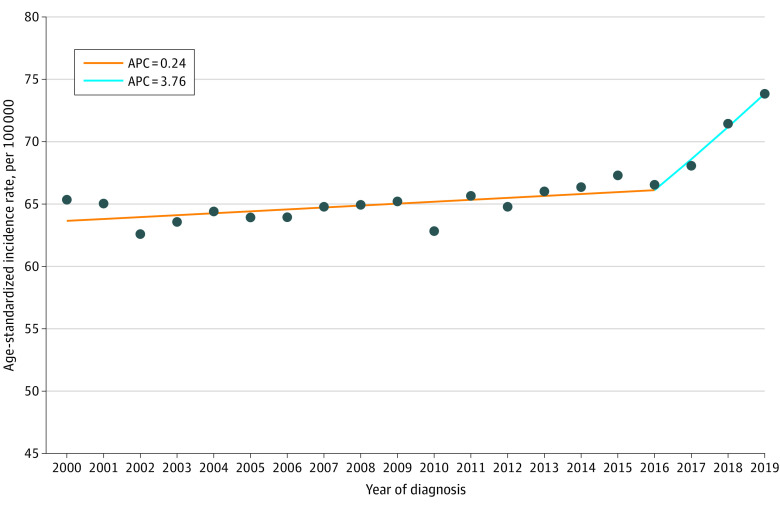
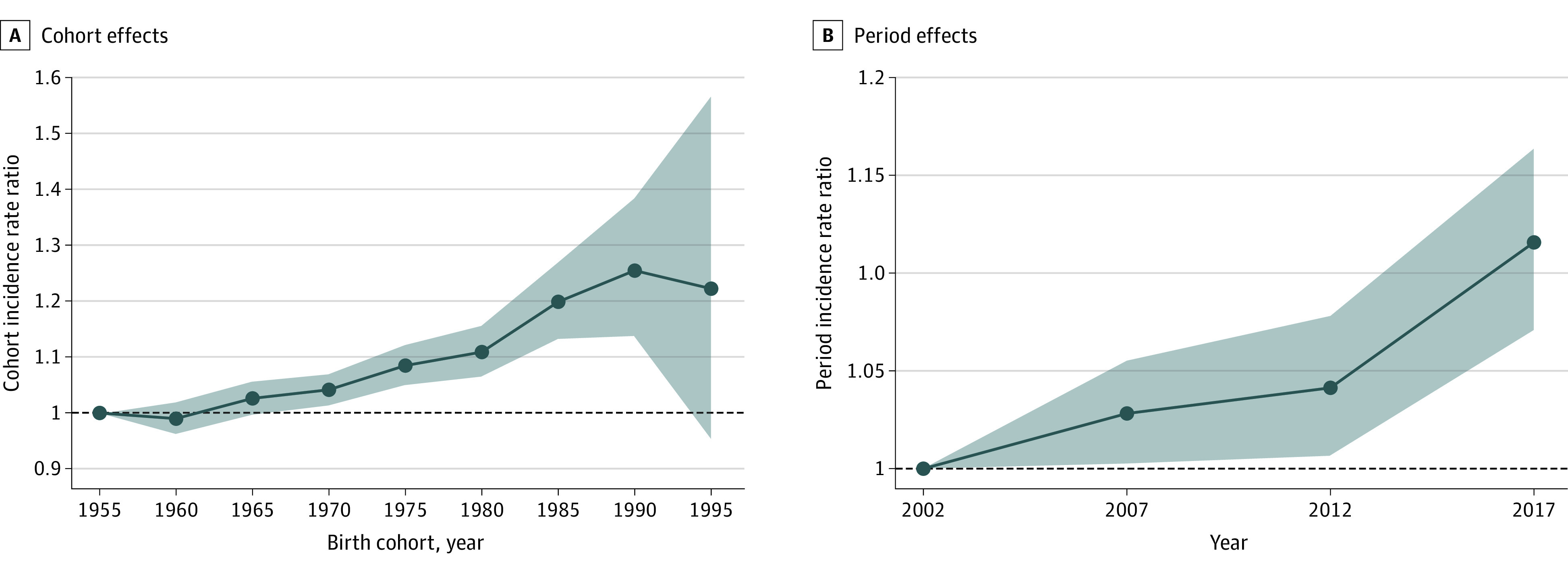
Overall age-standardized breast cancer incidence increased by 0.79% annually (95% CI, 0.42 to 1.15), with a gradual increase from 2000 to 2016 (APC, 0.24; 95% CI, 0.05 to 0.42) and a steeper increase from 2016 onward (APC, 3.76; 95% CI, 1.39 to 6.19). ER+/PR+ incidence increased (AAPC, 2.72; 95% CI, 2.34 to 3.12) and ER+/PR− increased (AAPC, 1.43; 95% CI, 1.00 to 1.87), while ER−/PR+ decreased (AAPC, −3.25; 95% CI, −4.41 to −2.07). Stage I and stage IV incidence increased, whereas stage II and stage III incidence decreased. Among women aged 20-29 and 30-39 years, non-Hispanic Black women had the highest incidence rates (IRR vs non-Hispanic White, 1.53; 95% CI, 1.43 to 1.65 and 1.15; 95% CI, 1.12 to 1.18, respectively); age-period-cohort models showed strong period (P = 4.77 × 10⁻⁹) and cohort (P = 4.83 × 10⁻¹⁴) effects, with the cohort effect approximately twice the period effect.
Methods
Population-based, cross-sectional analysis of the SEER 17 Registries, covering 2000-2019 and nearly 27% of the US population; included women aged 20-49 years with primary invasive breast cancer, yielding a final analytic set of 217,815 women after exclusions. Calculated age-standardized incidence rates per 100,000 using the 2000 US standard population and incidence rate ratios with 95% CIs, stratified by race and ethnicity, hormone receptor status (ER/PR), AJCC stage, and age group. Used Joinpoint regression to estimate average annual percent change and age-period-cohort models to assess period and cohort effects, with sensitivity analyses in SEER 12 and SEER 22.
Limitations
The paper states that excluding missing/unknown ER or PR status could lead to underestimated age-standardized incidence rates; ERBB2 information was available in SEER only from 2010, so more intricate molecular subtypes could not be evaluated over the full 20-year period; and SEER does not provide risk factor data. Evident from the text: the study is observational and cross-sectional, so it cannot establish causality for the trends or associations described. Also evident: some race/HR/age subgroup estimates were based on very small numbers or could not be calculated, and stage was classified using different algorithms across periods (Breast-Adjusted AJCC 6th Stage for 2000-2015, Derived SEER Combined Stage Group for 2016-2017, and Derived Extent of Disease for 2018 onward), which may affect stage-trend comparability.
Model-written summary. Check it against the paper before relying on it.
Integrity signals
Registry
Cites
Statistics
Figures
Verification
Claims the paper makes
0 Valid · 0 Not valid · 31 Not checked · 49 Own results and interpretations
A result the paper reports from its own data — it cites no other source for it, so there is none to check. The quote shows it is in the paper.
In the paper
“However, the incidence rate was highest among non-Hispanic White women aged 40 to 49 years.”
§ Breast Cancer Incidence Among US Women Aged 20 to 49 Years by Race, Stage, and Hormone Receptor Status > Discussion
plainstates an association- Asserted: passes — The authors put it forward as true.
- Checkable: passes — It can be checked against evidence.
- Load-bearing: unclear — It is unclear whether the paper’s conclusions depend on it.
- Based: passes — The paper gives a reason why it holds.
A result the paper reports from its own data — it cites no other source for it, so there is none to check. The quote shows it is in the paper.
In the paper
“Incidence rates for estrogen receptor (ER)-positive, stage I, and stage IV tumors increased, while rates decreased for ER-negative, stage II, and stage III tumors.”
- Also stated in: § Overall Breast Cancer Incidence Rates and Trends · plain
“ASIR increased for ER+/PR+ (AAPC, 2.72; 95% CI, 2.34 to 3.12) and ER+/PR− tumors (AAPC, 1.43; 95% CI, 1.00 to 1.87), and decreased for ER−/PR+ (AAPC, −3.25; 95% CI, −4.41 to −2.07).”
§ Breast Cancer Incidence Among US Women Aged 20 to 49 Years by Race, Stage, and Hormone Receptor Status > Abstract > Findings
plainstates a cause- Asserted: passes — The authors put it forward as true.
- Checkable: passes — It can be checked against evidence.
- Load-bearing: passes — The paper’s conclusions depend on it.
- Based: passes — The paper gives a reason why it holds.
- Also stated in: § Overall Breast Cancer Incidence Rates and Trends · plain
A result the paper reports from its own data — it cites no other source for it, so there is none to check. The quote shows it is in the paper.
In the paper
“Incidence rates by both period and cohort increased for ER+/PR+ and ER+/PR− tumors but decreased for ER−/PR+ and ER−/PR− tumors.”
§ Breast Cancer Incidence Among US Women Aged 20 to 49 Years by Race, Stage, and Hormone Receptor Status > Results > Cohort and Period Effects on Breast Cancer Incidence
plainstates a cause- Asserted: passes — The authors put it forward as true.
- Checkable: passes — It can be checked against evidence.
- Load-bearing: unclear — It is unclear whether the paper’s conclusions depend on it.
- Based: passes — The paper gives a reason why it holds.
A result the paper reports from its own data — it cites no other source for it, so there is none to check. The quote shows it is in the paper.
In the paper
“The age-period-cohort models indicated strong period (P = 4.77 × 10⁻⁹) and cohort (P = 4.83 × 10⁻¹⁴) effects on breast cancer incidence.”
§ Breast Cancer Incidence Among US Women Aged 20 to 49 Years by Race, Stage, and Hormone Receptor Status > Results > Cohort and Period Effects on Breast Cancer Incidence
boostedstates an association- Asserted: passes — The authors put it forward as true.
- Checkable: passes — It can be checked against evidence.
- Load-bearing: passes — The paper’s conclusions depend on it.
- Based: passes — The paper gives a reason why it holds.
A result the paper reports from its own data — it cites no other source for it, so there is none to check. The quote shows it is in the paper.
In the paper
“Incidence rate by birth cohort peaked for the 1990 birth cohort for non-Hispanic White (IRR, 1.34; 95% CI, 1.19 to 1.51) and non-Hispanic American Indian or Alaska Native women (IRR, 1.56; 95% CI, 0.79 to 3.08).”
§ Breast Cancer Incidence Among US Women Aged 20 to 49 Years by Race, Stage, and Hormone Receptor Status > Results > Cohort and Period Effects on Breast Cancer Incidence
plainstates an association- Asserted: passes — The authors put it forward as true.
- Checkable: passes — It can be checked against evidence.
- Load-bearing: unclear — It is unclear whether the paper’s conclusions depend on it.
- Based: passes — The paper gives a reason why it holds.
30 more claims
Create a free account to see all 80 claims and to verify the 54 references still open.
- It may state two separate claims as one. 31
- The quote only partly states this claim. 2
- Probably not a substantial claim. 13
Self-check
Percentages, sums and reported differences re-computed from the paper’s own numbers.
Each contradiction between two passages listed here was confirmed by an independent check.
Rated major: it would touch a result — a value a result rests on, reported and recomputed p-values on opposite sides of the significance level, two passages that conflict with no sign which is right, or a cited work retracted before this paper was published.
In the paper
§ Breast Cancer Incidence Among US Women Aged 20 to 49 Years by Race, Stage, and Hormone Receptor Status > Discussion
“The increase in incidence rates among Hispanic women was greater than among women of other races and ethnicities”
§ Breast Cancer Incidence Among US Women Aged 20 to 49 Years by Race, Stage, and Hormone Receptor Status > Results > Characteristics of the Study Population
“| Hispanic | 37 048 (17.0) | 52.8 | 0.76 (0.75 to 0.77) | 0.80 (0.39 to 1.21) | | Non-Hispanic American Indian or Alaska Native | 1485 (0.7) | 52.6 | 0.75 (0.72 to 0.79) | 1.66 (0.59 to 2.75) |”
Rated minor: it would not touch a result — a value no result rests on, a p-value that stays on the same side of the significance level, or a conflict that is clerical, resolved elsewhere in the paper, or outside its own findings.
In the paper
§ Breast Cancer Incidence Among US Women Aged 20 to 49 Years by Race, Stage, and Hormone Receptor Status > Methods > Study Population
“Age at diagnosis was formatted as 5-year age groups (20-24, 25-29, 20-34, 35-39, 40-44, and 45-49 years).”
§ Breast Cancer Incidence Among US Women Aged 20 to 49 Years by Race, Stage, and Hormone Receptor Status > Methods > Statistical Analysis
“6 five-year age groups (20-24, 25-29, 30-34, 35-39, 40-44, 45-49)”
Rated minor: it would not touch a result — a value no result rests on, a p-value that stays on the same side of the significance level, or a conflict that is clerical, resolved elsewhere in the paper, or outside its own findings.
In the paper
§ Breast Cancer Incidence Among US Women Aged 20 to 49 Years by Race, Stage, and Hormone Receptor Status > Results > Differences in Breast Cancer Incidence Rates by Age Group, Race, and Hormone Receptor Status
“age 40-99 years: IRR, 0.69; 95% CI, 0.68 to 0.71”
§ Breast Cancer Incidence Among US Women Aged 20 to 49 Years by Race, Stage, and Hormone Receptor Status > Results > Differences in Breast Cancer Incidence Rates by Age Group and Race
“Age 40-49 y | Age 40-49 y | Age 40-49 y | Age 40-49 y | Age 40-49 y”
Rated minor: it would not touch a result — a value no result rests on, a p-value that stays on the same side of the significance level, or a conflict that is clerical, resolved elsewhere in the paper, or outside its own findings.
In the paper
§ Breast Cancer Incidence Among US Women Aged 20 to 49 Years by Race, Stage, and Hormone Receptor Status > Results > Differences in Breast Cancer Incidence Rates by Age Group, Race, and Hormone Receptor Status
“| Non-Hispanic Black | 1824 (15.2) | 13.5 | 1.33 (1.26 to 1.40) | 3.06 (0.89 to 5.28) |”
§ Breast Cancer Incidence Among US Women Aged 20 to 49 Years by Race, Stage, and Hormone Receptor Status > Results > Differences in Breast Cancer Incidence Rates by Age Group, Race, and Hormone Receptor Status
“| Non-Hispanic White | 6735 (58.7) | 10.2 | 1 [Reference] | −0.11 (−0.75 to 0.54) |”
Citations
Cites
Siegel, R. L., Miller, K. D., Wagle, N. S., & Jemal, A. (2023) · CA: A Cancer Journal for Clinicians · doi:10.3322/caac.21763 · Cited by 16,303
Permutation tests for joinpoint regression with applications to cancer rates
Kim, H.-J., Fay, M. P., Feuer, E. J., & Midthune, D. N. (2000) · Statistics in Medicine · doi:10.1002/(sici)1097-0258(20000215)19:3<335::aid-sim336>3.0.co;2-z · Cited by 6,318
(2020) · PubMed · Cited by 2,642
Breast Cancer Statistics, 2022
Giaquinto, A. N., Sung, H., Miller, K. D., Kramer, J. L., Newman, L. A., Minihan, A., Jemal, A., & Siegel, R. L. (2022) · CA: A Cancer Journal for Clinicians · doi:10.3322/caac.21754 · Cited by 2,286
Oeffinger, K. C., Fontham, E. T. H., Etzioni, R., Herzig, A., Michaelson, J. S., Shih, Y.-C. T., Walter, L. C., Church, T. R., Flowers, C. R., LaMonte, S. J., et al. (2015) · JAMA · doi:10.1001/jama.2015.12783 · Cited by 1,653
Estimating average annual per cent change in trend analysis
Clegg, L. X., Hankey, B. F., Tiwari, R., Feuer, E. J., & Edwards, B. K. (2009) · Statistics in Medicine · doi:10.1002/sim.3733 · Cited by 1,256
Age at first birth and breast cancer risk.
MacMahon, B., Cole, P. T., Lin, T. M., Lowe, C. R., Mirra, A. P., Ravnihar, B., Salber, E. J., Valaoras, V. G., & Yuasa, S. (1970) · Europe PMC (PubMed Central) · Cited by 1,057
A Web Tool for Age–Period–Cohort Analysis of Cancer Incidence and Mortality Rates
Rosenberg, P. S., Check, D. P., & Anderson, W. F. (2014) · Cancer Epidemiology, Biomarkers & Prevention · doi:10.1158/1055-9965.epi-14-0300 · Cited by 819
Efficient interval estimation for age-adjusted cancer rates
Tiwari, R. C., Clegg, L. X., & Zou, Z. (2006) · Statistical Methods in Medical Research · doi:10.1177/0962280206070621 · Cited by 566
The Healthy Immigrant Effect: Patterns and Evidence from Four Countries
Kennedy, S., Kidd, M. P., McDonald, J. T., & Biddle, N. (2015) · Journal of International Migration and Integration · doi:10.1007/s12134-014-0340-x · Cited by 545
Research works printed but not linked: 1
- Mathews TJ, Hamilton BE. Mean Age of Mothers is on the Rise: United States, 2000-2014. National Vital Statistics System data brief No. 232. 2000. Accessed August 11, 2023. https://pubmed.ncbi.nlm.nih.gov/26828319/
Cited by
Immunotherapy in Breast Cancer
Dvir, K., Giordano, S. B., & Leone, J. P. (2024) · International Journal of Molecular Sciences · doi:10.3390/ijms25147517 · Cited by 202
Chrysin: A Comprehensive Review of Its Pharmacological Properties and Therapeutic Potential
Kurkiewicz, M., Moździerz, A., Rzepecka‐Stojko, A., & Stojko, J. (2025) · Pharmaceuticals · doi:10.3390/ph18081162 · Cited by 53
Why are so many young people getting cancer? What the data say
Ledford, H. K. (2024) · Nature · doi:10.1038/d41586-024-00720-6 · Cited by 46
Yan, W., Liu, M., Jing, W., Kang, L., Zhang, N., Sun, H., He, J., Chen, Z., Liu, J., Liang, W., et al. (2025) · Experimental Hematology and Oncology · doi:10.1186/s40164-025-00634-7 · Cited by 35
Trends in Cancer Incidence and Mortality in US Adolescents and Young Adults, 2016–2021
Zhang, L., Muscat, J. E., Chinchilli, V. M., & Behura, C. G. (2024) · Cancers · doi:10.3390/cancers16183153 · Cited by 26
Hormonal Contraceptive Formulations and Breast Cancer Risk in Adolescents and Premenopausal Women
Hadizadeh, F., Koteci, A., Karlsson, T., Ek, W. E., & Johansson, Å. (2025) · JAMA Oncology · doi:10.1001/jamaoncol.2025.4480 · Cited by 25
Ogunmodede, E. O., Ajala, D. E., ALUKO, J. O., Anokwuru, R., Awotunde, T. A., Olajide, A. O., Dosumu, T. O., Olabisi, O. I., & Ajala, R. G. (2024) · BMC Cancer · doi:10.1186/s12885-024-12949-5 · Cited by 22
Increasing incidence of breast cancer in young women over time
Pujol, P., Remontet, L., Lapôtre-Ledoux, B., Rogel, A., Lafay, L., & Molinié, F. (2025) · The Breast · doi:10.1016/j.breast.2025.104555 · Cited by 21
Depression risk among breast cancer survivors: a nationwide cohort study in South Korea
Choi, H. L., Jeong, S. M., Jeon, K. H., Kim, B., Jung, W., Jeong, A., Han, K., & Shin, D. W. (2024) · Breast Cancer Research · doi:10.1186/s13058-024-01948-w · Cited by 19
Thymoquinone and Metabolic Reprogramming in Breast Cancer: A New Dimension From Proteomic Analysis
Korak, T., Albayrak, M. G. B., Kasap, M., & Akpınar, G. (2025) · Journal of Biochemical and Molecular Toxicology · doi:10.1002/jbt.70124 · Cited by 18
Madar, S., Amor, R. E., Furman-Assaf, S., & Friedman, E. (2025) · Cancers · doi:10.3390/cancers17111867 · Cited by 17
Shapira, M., Sella, T., Safrai, M., Villain, E., Lifshitz, D., Orvieto, R., Gal‐Yam, E. N., & Meirow, D. (2024) · Fertility and Sterility · doi:10.1016/j.fertnstert.2024.10.014 · Cited by 15
Immunotherapy for hormone receptor‒positive HER2-negative breast cancer
Cardoso, F., Hirshfield, K. M., Kraynyak, K. A., Tryfonidis, K., & Bardia, A. (2024) · npj Breast Cancer · doi:10.1038/s41523-024-00704-9 · Cited by 15
Telehealth Approach in Breast Cancer Care: A Systematic Review of Models and Outcomes
Yanny Trisyani, W., Nuraeni, A., Anna, A., Priambodo, A. P., & Sugiharto, F. (2025) · International Journal of Women s Health · doi:10.2147/ijwh.s549643 · Cited by 14
Gong, Y., Qi, J., Huang, S., Zhang, R., Li, J., Zhang, B., Zhang, P. F., Zhang, Q., Liu, X., Wu, X., et al. (2025) · Small Structures · doi:10.1002/sstr.202400463 · Cited by 12
Glutamine: fructose-6-phosphate amidotransferase (GFAT) in the pathology of diseases: a review
Yang, C., Chu, F., Chen, X., Meng, F., Li, Y., Chen, J., Sun, C., Shang, Y., Guo, R., Wang, J. M., et al. (2025) · Cell Death Discovery · doi:10.1038/s41420-025-02898-8 · Cited by 13
The Role of Immunotherapy and Radiation Therapy in the Treatment of Breast Cancer
Panse, D., Hsieh, K., Arons, D., Runnels, J., Wassel, M., Shah, A. H., Patel, R. D., Tiersten, A., Nehlsen, A. D., Marshall, D. C., et al. (2025) · Biomedicines · doi:10.3390/biomedicines13092209 · Cited by 10
Racial Differences in ctDNA Profiles, Targeted Therapy Use, and Outcomes in Metastatic Breast Cancer
Podany, E. L., Foffano, L., Gerratana, L., Medford, A. J., Clifton, K., Tapiavala, S., Velimirovic, M., Lipsyc-Sharf, M. D., Reduzzi, C., Bubie, A., et al. (2025) · JAMA Network Open · doi:10.1001/jamanetworkopen.2024.61899 · Cited by 10
Bernasconi, A., Toss, A., Zattarin, E., Mousavi, S. M., Blum, M., Kuehni, C. E., Katalinic, A., Trallero, J., Rapiti, E., Maso, L. D., et al. (2025) · The Breast · doi:10.1016/j.breast.2025.104472 · Cited by 9
Aromatics from fossil fuels and breast cancer
Hilakivi-Clarke, L. A., Jolejole, T. K. B., da Silva, J. L., Andrade, F. D. O., Dennison, G., & Mueller, S. (2025) · iScience · doi:10.1016/j.isci.2025.112204 · Cited by 9
Bai, L., Hao, X., Xu, W., Huang, H., Guo, M., Zhang, Y., Xiang, D.-X., Yang, G., Wu, J., & Chen, C. (2025) · Materials Today Bio · doi:10.1016/j.mtbio.2025.102075 · Cited by 8
Adherence to Breast Cancer Screening Guidelines Among Age‐Eligible US Women: Findings From NHIS 2021
Chandra, M., Domgue, J. F., Yu, R. K., & Shete, S. S. (2025) · Cancer Medicine · doi:10.1002/cam4.71423 · Cited by 8
Tailoring targeted therapies for younger women with ER-positive early-stage breast cancer
Lobo-Martins, S., Luen, S. J., Piccart, M. J., & Loi, S. (2026) · Nature Reviews Clinical Oncology · doi:10.1038/s41571-026-01120-7 · Cited by 9
Aktaş, A., Greiner, R. S., Flores, M., Boselli, D. M., Stone, T. J., Wang, E. W., Hadžikadić-Gušić, L., Wallander, M. L., Hecksher, A., Bailey-Dorton, C. M., et al. (2024) · Clinical Breast Cancer · doi:10.1016/j.clbc.2024.10.014 · Cited by 8
Outcome of Patients with Pregnancy-Associated Breast Cancer Who Have Subsequent Pregnancies
Doll, A., Lipsyc-Sharf, M. D., Sim, M., Baker, J. L., & Kapoor, N. S. (2024) · Annals of Surgical Oncology · doi:10.1245/s10434-024-15798-5 · Cited by 7
Factors Associated With Not Returning to Work Among Breast Cancer Survivors
Merdawati, L., Lin, H., Pan, C.-H., & Huang, H. (2024) · Workplace Health & Safety · doi:10.1177/21650799241303524 · Cited by 7
Impact of a Breast Cancer Diagnosis on Finances and Marital Status in Young Women
Hamlish, T., Foster, M. L., Strom, S., Jaber, R., & Hughes, M. C. (2025) · BMC Women s Health · doi:10.1186/s12905-025-03607-4 · Cited by 7
Chai, Y., & Shi, Y. (2025) · Journal of Pharmaceutical Analysis · doi:10.1016/j.jpha.2025.101268 · Cited by 7
Trends in breast cancer incidence by estrogen receptor status in the United States , 2004–2020
Jiang, C., Giaquinto, A. N., Jemal, A., & Sung, H. (2024) · International Journal of Cancer · doi:10.1002/ijc.35073 · Cited by 7
Breast Cancer Risk, Screening, and Risk Reduction in Young Females
Gheller, A., Tuttle, R., & Oxenberg, J. C. (2025) · The American Surgeon · doi:10.1177/00031348251331294 · Cited by 6
Weber, E., Carmona-Gonzalez, C. A., Boucher, M., Eisen, A. F., Laing, K. E., Melvin, J. C., Schrader, K. A., Sehdev, S. R., Wong, S. M., & Gelmon, K. A. (2025) · Current Oncology · doi:10.3390/curroncol32060290 · Cited by 6
Female breast cancer trends: A South African perspective
Lima, H. D., Ramos, S., Rajkumar, L., & Cubasch, H. (2025) · South African Journal of Radiology · doi:10.4102/sajr.v29i1.3117 · Cited by 6
Myers, S. P., Olvera, R. G., Lee, S., Shiu, K., Blevins, T. R., Tarver, W. L., Carson, W. E., Paskett, E. D., Obeng‐Gyasi, S., & McAlearney, A. S. (2025) · Supportive Care in Cancer · doi:10.1007/s00520-025-09887-8 · Cited by 6
Parrish, M. E., Traugh, N. C., Seraj, M., & Kuperwasser, C. (2025) · npj Breast Cancer · doi:10.1038/s41523-025-00840-w · Cited by 7
Brewster, H., Amare, T., Belachew, S. A., McCormack, V., Fidler-Benaoudia, M. M., & Garvey, G. (2026) · The Breast · doi:10.1016/j.breast.2026.104742 · Cited by 6
Navigating the Landscape of Cancer From Ancient Times to Modern Challenges: A Narrative Review
Bhawalkar, J., Nagar, A., Rathod, H. K., & Verma, P. (2024) · Cureus · doi:10.7759/cureus.65230 · Cited by 6
Ku, G. D. L. C., Desai, A., Singhal, M., Mallouh, M. P., King, C., Rojas, A. N., Persing, S. M., Homsy, C., Chatterjee, A., & Nardello, S. M. (2024) · Journal of Reconstructive Microsurgery · doi:10.1055/a-2491-3110 · Cited by 6
Pregnancy and breast cancer in young women: current updates and future directions
Zhang, S., Guclu, S. B., Lipsyc-Sharf, M. D., & Kapoor, N. S. (2025) · Therapeutic Advances in Medical Oncology · doi:10.1177/17588359251369973 · Cited by 5
Thomas, A., Rhoads, A., Mayer, E. L., O’Reilly, S., Harbeck, N., Curigliano, G., Zhou, Y., Adam, V. S., Chan, N., Conway, K. M. C., et al. (2025) · npj Breast Cancer · doi:10.1038/s41523-025-00835-7 · Cited by 5
Guarini, C., Santoro, A. N., Melaccio, A., Lanotte, L., Gadaleta‐Caldarola, G., Giuliani, F., Pinto, A., & Fedele, P. (2024) · Expert Opinion on Drug Safety · doi:10.1080/14740338.2024.2419547 · Cited by 5
Estimated human intake of endogenous and exogenous hormones from beef in the United States
Thilakaratne, R., Castorina, R., Solomon, G. M., Mosburg, M. M., Moeller, B. C., Trott, J. F., Falt, T. D., Villegas-Gomez, A., Dodd, K. W., Thomsen, C., et al. (2024) · Journal of Exposure Science & Environmental Epidemiology · doi:10.1038/s41370-024-00727-1 · Cited by 4
Medications to reduce breast cancer risk: a network meta-analysis of randomized controlled trials
Pourali, G., Liu, M., Sherpa, S. S., Hardi, A., Luo, C., & Toriola, A. T. (2025) · Breast Cancer Research · doi:10.1186/s13058-025-02059-w · Cited by 4
Self-citationAssociation of Obesity with Premenopausal Breast Cancer: Analyzing Molecular Subtypes
Mirzaeva, M., Iriskulov, B., Asrorov, A. M., Hudoynazarov, I., Norbekova, M. K., Tadjibayeva, R., & Mirzaev, A. (2025) · Archives of Breast Cancer · doi:10.32768/abc.8063149720-581 · Cited by 4
Yang, L., & Toriola, A. T. (2026) · Breast Cancer Research · doi:10.1186/s13058-026-02222-x · Cited by 4
Self-citationSafety evaluation of tucatinib: Adverse event signal mining and analysis based on the FAERS database
Yang, N., & Cao, J. (2025) · Medicine · doi:10.1097/md.0000000000043778 · Cited by 4
Trends in general surgeon operative practice patterns in a modern cohort
Goldberg, D., Sharpe, J. E., Bakillah, E., Landau, S. I., Syvyk, S., Wirtalla, C. J., & Kelz, R. R. (2024) · The American Journal of Surgery · doi:10.1016/j.amjsurg.2024.116017 · Cited by 4
Cancer statistics for Hispanic/Latino people, 2026
Saka, A., Kratzer, T. B., Giaquinto, A. N., Mazzitelli, N., Pinheiro, P. S., Ortiz, A. P., Tyson, D. M., Jemal, A., & Siegel, R. L. (2026) · CA A Cancer Journal for Clinicians · doi:10.3322/caac.70107 · Cited by 4
McArthur, A. R., Magasi, S. R., Hamlish, T., Winters, C. A., & Hammel, J. M. (2025) · BMC Women s Health · doi:10.1186/s12905-025-03814-z · Cited by 3
Varagur, K., Ribaudo, J. G., Keller, M. R., Fadell, N. R., Martin, C., He, K., Sacks, J. M., Aft, R., Anolik, R. A., & Christensen, J. M. (2025) · Journal of Surgical Oncology · doi:10.1002/jso.70010 · Cited by 3
Dysbiosis of the Evolved Intestinal Microbiome
Smith, D. (2025) · MDPI eBooks · doi:10.3390/books978-3-7258-1523-4 · Cited by 4
Exosomal cannabidiol: A promising candidate for targeted oral delivery against breast cancer
Moholkar, D. N., Kandimalla, R., Jeyabalan, J., Singhal, R. A., Mayer, K., Klinge, C. M., Gupta, R. C., & Aqil, F. (2026) · Cancer Letters · doi:10.1016/j.canlet.2026.218416 · Cited by 3
Tokatlıoğlu, T. Ş., Kavala, A., & Oflaz, F. (2026) · Supportive Care in Cancer · doi:10.1007/s00520-026-10554-9 · Cited by 3
Gut microbiome modulates breast cancer risk in socially isolated mice
Andrade, F. D. O., Staley, C. M., Jin, L., Ozgul-Onal, M., McDermott, M., Kenanoğlu, S., de Oliveira, K. A., Verma, V., & Hilakivi-Clarke, L. A. (2026) · Breast Cancer Research · doi:10.1186/s13058-026-02292-x · Cited by 3
Alatrash, M., & Alkrisat, S. (2024) · Journal of Women s Health · doi:10.1089/jwh.2023.1167 · Cited by 3
Ziegler‐Rodriguez, G., Pinillos-Portella, M., Ku, G. D. L. C., Santillan, S. V., Yataco, J. D., Galarreta-Zegarra, J. A., Valencia, G. G. C., & Cotrina, J. M. (2024) · ecancermedicalscience · doi:10.3332/ecancer.2024.1766 · Cited by 3
Lipsyc-Sharf, M. D., Huang, M., Huang, S.-Y., Suresh, Y., Doll, A., Baker, J. L., & Kapoor, N. S. (2024) · The American Journal of Surgery · doi:10.1016/j.amjsurg.2024.116060 · Cited by 3
Hu, B., Qiu, X., Wang, Y., Wei, X., Feng, J., & Hou, L. (2025) · Neuroepidemiology · doi:10.1159/000545221 · Cited by 3
Litsas, D. C., Paulus, K., Nace, T., Hoadley, A., Zisman‐Ilani, Y., & Siminoff, L. A. (2025) · Supportive Care in Cancer · doi:10.1007/s00520-025-09425-6 · Cited by 4
Mendonca, J., Etzel, M., Eldawy, N., Lent, A., Jimenez, S., Brinzo, P., Kaleem, S., Dean, A. F., Burgoa, S., Follin, T. A., et al. (2025) · Journal of Public Health · doi:10.1007/s10389-025-02514-0 · Cited by 3
Clinical and Pathological Characteristics of Breast Cancer Patients at Soedarso Hospital Pontianak
Aisha, A., Pratiwi, S. E., Trianto, H. F., Suhardiman, E. R., & Fitrianingrum, I. (2025) · Indonesian Journal of Cancer · doi:10.33371/ijoc.v19i2.1163 · Cited by 3
Yang, H., Li, X., Hoogland, A. I., Welniak, T. L., Rodriguez, Y., Carpenter, K. M., Fischer, S. M., Kinney, A. Y., Li, D., Nguyen, O., et al. (2025) · Psycho-Oncology · doi:10.1002/pon.70288 · Cited by 3
Comparative impact of the affordable care act on breast cancer outcomes among women in two US states
Akinyemi, O. A., Fasokun, M., Weldeslase, T. A., Odusanya, E., Akinyemi, I., Geter, K., Akula, M., Michael, M. B., Hughes, K., & Williams, R. (2024) · Frontiers in Oncology · doi:10.3389/fonc.2024.1460714 · Cited by 2
Prevalence, Incidence and Mortality Rates of Cervical Cancer in India: based on Global Burden
Gupta, S. (2025) · Journal of Neonatal Surgery · doi:10.63682/jns.v14i32s.9162 · Cited by 2
Nunes, N., Carvalho, G. D. S., Ramos, B., Pecoraro, J. P., Lerner, L. C. C., Azevedo, D., Ferreira, T., de Moura, L. S., Galvão, C. H., & Monteiro, M. R. (2025) · Cancers · doi:10.3390/cancers17193229 · Cited by 2
Koric, A., Jiang, S., Liu, Y., & Colditz, G. A. (2025) · Cancer · doi:10.1002/cncr.70164 · Cited by 2
Population-Level Trends in Lifestyle Factors and Early-Onset Breast, Colorectal, and Uterine Cancers
Ayoub, N. L., Francoeur, A., Chang, J. J., Tran, N., Tewari, K. S., Kapp, D. S., Bristow, R. E., & Chan, J. K. (2026) · Cancers · doi:10.3390/cancers18010167 · Cited by 2
Management during pregnancy and lactation of patients who are at high risk of breast cancer
Nguyen, C. Q., Gunaratne, S. D., Clune, C. G., Sandhu, N. P., & Klassen, C. L. (2026) · Maturitas · doi:10.1016/j.maturitas.2026.108860 · Cited by 2
Rising Breast Cancer Incidence and Poor Outcomes in Young Women: A Retrospective Study
Den, J., Nelson, N., Vaghjiani, R. G., Tyler, D., & Klimberg, V. S. (2026) · The Breast Journal · doi:10.1155/tbj/5584726 · Cited by 2
Yabrude, A. T. Z., Reis, L. C. S., Anchía, A. J. R., Santos, T. A. E. D., de Albuquerque, C. F. A., & Manna, E. D. F. (2026) · Cancer Epidemiology · doi:10.1016/j.canep.2026.103122 · Cited by 2
Panguluri, G. A., & Findlay, V. J. (2024) · Journal of young women's breast cancer and health. · doi:10.4103/ywbc.ywbc_11_24 · Cited by 2
Trends in the incidence and mutational landscape of advanced uterine cancer
Francoeur, A., Liao, C.-I., Johnson, C. A., Argueta, C., Tian, C., Darcy, K. M., Kapp, D. S., Bristow, R. E., & Chan, J. K. (2024) · International Journal of Gynecological Cancer · doi:10.1016/j.ijgc.2024.100013 · Cited by 2
Female-Specific Cancers—India in the Global Context: An Evaluation Using GLOBOCAN 2022 Estimates
Mohan, R., Prabhu, P. R., Geetha, G. M. N., & Thulaseedharan, J. V. (2025) · Clinical and Experimental Obstetrics & Gynecology · doi:10.31083/ceog26363 · Cited by 2
Lee, M. V., Garrett, H. V., Weilbaecher, K. N., Toriola, A. T., & Bennett, D. L. (2024) · Annals of Internal Medicine · doi:10.7326/annals-24-00720 · Cited by 1
Self-citationImplications of breast density for breast cancer screening
Watkins, E. J., & Jackson, T. (2024) · JAAPA · doi:10.1097/01.jaa.0000000000000127 · Cited by 1
Sarantis, N.-D., Zervoudis, S., Kyritsi, A.-D., Spanopoulos, C., Iatrakis, G. M., Tsikouras, P. N., & Mastorakos, G. P. (2024) · Review of Clinical Pharmacology and Pharmacokinetics - International Edition · doi:10.61873/zeku1257 · Cited by 1
Grechukhina, K., Максимовна, К. Е., Kalugin, M. V., & Zhukova, L. (2024) · Meditsinskiy sovet = Medical Council · doi:10.21518/ms2024-524 · Cited by 1
Weimer, W., & Sleven, M. (2025) · Journal of Hand Therapy · doi:10.1016/j.jht.2025.01.007 · Cited by 1
Breast Cancer Characteristics and Outcomes in Canadian Black Women by Ancestry
Wilkinson, A. N., Lofters, A., Rushton, M. K., Seely, J. M., & Ng, C. (2025) · Current Oncology · doi:10.3390/curroncol32110616 · Cited by 1
A Student-Informed Guide for Success on the OB/GYN Clerkship
Hopkins-Kotb, N., Sylla, H., Krotinger, A., Pelletier, A. J., Bartz, D., & Johnson, N. R. (2025) · Journal of Medical Education and Curricular Development · doi:10.1177/23821205241299584 · Cited by 1
Jones, T., Zhang, A., & Freeman, K. D. (2025) · Medical Research Archives · doi:10.18103/mra.v13i2.6293 · Cited by 1
Could 30 be the New 40 for Breast Cancer Screening
Gruzalski, K. (2025) · Journal of Radiology Nursing · doi:10.1016/j.jradnu.2025.02.002 · Cited by 1
Heeling, E., van de Kamer, J. B., Bruining, A., Pluim, J. M. E., Peeters, M.-J. T. F. D. V., Lok, C. A. R., & van der Ploeg, I. M. C. (2025) · Clinical Breast Cancer · doi:10.1016/j.clbc.2025.05.008 · Cited by 1
Braun, D., Huang, T., Stopfer, J. E., Garber, J. E., & Weiss, A. (2025) · Medical Research Archives · doi:10.18103/mra.v13i7.6814 · Cited by 1
Recent Advancements in Immunotherapy for the Treatment of Metastatic Breast Cancer
Krishna, B. M., Garg, P., Ramisetty, S. K., Nair, M., & Singhal, S. S. (2025) · Cancer treatment and research · doi:10.1007/978-3-031-97242-3_3 · Cited by 1
Histopathological Grading based on BI-RADS Mammography Category 4 and 5 in Breast Cancer
Ramadhan, F. U., Mardiyana, L., Kusumastuti, E. H., & Ghaib, H. (2025) · JUXTA Jurnal Ilmiah Mahasiswa Kedokteran Universitas Airlangga · doi:10.20473/juxta.v16i22025.109-114 · Cited by 1
Wante, M., Reddy, A. S. S., Nirhale, D. S., Jeughale, K., & Kavya, A. (2025) · Annals of African Medicine · doi:10.4103/aam.aam_203_25 · Cited by 1
Translocation of benzo(a)pyrene reactive metabolites across human mammary epithelial cell membranes
Merrick, B. A., Brooks, A. M., Foley, J. F., Mansfield, B. K., & Selkirk, J. K. (2025) · PLoS ONE · doi:10.1371/journal.pone.0337395 · Cited by 1
Impact of Breast Cancer-Related Lymphedema on Cancer Care Costs: Longitudinal and Age-Based Analyses
Raymakers, A. M., King, T. A., Mittendorf, E. A., Dey, T., Jain, M., Paskett, E. D., McAlearney, A. S., Greenup, R. A., Broyles, J. M., & Myers, S. P. (2025) · Annals of Surgical Oncology · doi:10.1245/s10434-025-18875-5 · Cited by 1
Adzrago, D., Fujimoto, K., Wilkerson, J. M., Dyer, T. V., & Williams, F. (2026) · JAMA Network Open · doi:10.1001/jamanetworkopen.2025.57332 · Cited by 1
Yan, P., Bui, T. M., Jimenez, E. R., Kuang, Y., Xu, S., Paweletz, C. P., Haimov, H., Sklartz, M., Cohen, O., McAllister, S. S., et al. (2026) · Proceedings of the National Academy of Sciences · doi:10.1073/pnas.2523254123 · Cited by 1
Self-citationDhahir, N. M., Ahmed, M. M., & Younis, N. M. (2026) · Journal of Education and Health Promotion · doi:10.4103/jehp.jehp_687_25 · Cited by 1
Zulbayar, S., Brooks, J. D., Aminoleslami, A., Kim, S. J., Calderon-Anyosa, R. J. C., Xiang, F., Knight, J. A., Eisen, A. F., & Anderson, G. M. (2026) · JCO Clinical Cancer Informatics · doi:10.1200/cci-25-00173 · Cited by 1
Fadem, S. J., Maniaci, A., Devine, K. A., O’Malley, D. M., Hemler, J. R., Holover, G., Hudson, S. V., & Crabtree, B. F. (2026) · Journal of Cancer Survivorship · doi:10.1007/s11764-026-02001-9 · Cited by 1
Disparities in breast cancer incidence and survival by age, race, and molecular subtype in US women
Wang, L., Wan, Z., Dhillon, V., Wang, X., Zheng, Y., Ezeana, C. F., Niravath, P. A., Puri, A., Sun, K., Chang, J. C., et al. (2026) · npj Breast Cancer · doi:10.1038/s41523-026-00935-y · Cited by 1
Asmussen, J. K., Wilhelm, K. O., Lee, K. Y., Wang, C., Katsonis, P., Li, Y., Donehower, L. A., & Lichtarge, O. (2026) · The American Journal of Human Genetics · doi:10.1016/j.ajhg.2026.03.005 · Cited by 1
Lyu, X., Zhong, Y., Zhou, Y., Sun, Q., Mao, F., Shen, S., Lin, Y., & Huang, X. (2026) · The Oncologist · doi:10.1093/oncolo/oyag244 · Cited by 1
Boyle, M. K., Attiyeh, M. A., Amersi, F. F., Chung, A. P., Lee, J. S., & Giuliano, A. E. (2026) · Annals of Surgical Oncology · doi:10.1245/s10434-026-19993-4 · Cited by 1
Metabolic phenotypes of doxorubicin-induced cardiotoxicity among patients with breast cancer
Singh, A., Jun, S., Wallis, K., Lan, R. S.-L., Todorova, V., Su, L. J., Makhoul, S., & Hsu, P.-C. (2026) · Metabolomics · doi:10.1007/s11306-026-02469-7 · Cited by 1
Podany, E. L., Foffano, L., Gerratana, L., Medford, A. J., Heater, N. K., Nicolò, E., Tapiavala, S., Pontolillo, L., Putur, A., Jaber, D. A., et al. (2026) · Breast Cancer Research and Treatment · doi:10.1007/s10549-026-08068-3 · Cited by 1
Is anastrozole really better than tamoxifen for low-risk breast cancer?
Den, J., Baughn, C., & Klimberg, V. S. (2025) · The American Journal of Surgery · doi:10.1016/j.amjsurg.2025.116734 · Cited by 1
Metadata
- Authors
- Xu, S., Murtagh, S., Han, Y., Wan, F., & Toriola, A. T.
- Affiliations
- Washington University in St. Louis (US)
- University College Dublin (IE)
- Corresponding author
- Toriola, Adetunji T.
- Venue
- JAMA Network Open
- Publisher
- American Medical Association (AMA)
- Published
- 2024-01-26
- Volume
- 7
- Issue
- 1
- Pages
- e2353331
- ISSN
- 2574-3805 (ISSN-L)
- PMC
- PMC10818222
- OpenAlex
- W4391263494
- Semantic Scholar
- 8b0d25f40cdd5fe4970aa5e5771df08ca47ec6ce
- Cited by
- 178
- References
- 55
- Citations by year
- 2026: 72 · 2025: 74 · 2024: 32
- FWCI
- 26.07
- Type
- journal article
- Language
- en
- Open access
- gold
- doi.org
- Licence
- cc-by
- Locations
- JAMA Network Open (publishedVersion, cc-by)
- PubMed Central (publishedVersion, cc-by)
- PubMed (publishedVersion)
- Digital Commons@Becker (Washington University School of Medicine) (submittedVersion, cc-by)
- Funders
- National Institutes of Health
- National Cancer Institute (R01CA246592, R37CA235602, P30CA091842)
- Topics
- Health Sciences › Medicine › Oncology › Global Cancer Incidence and Screening
- Health Sciences › Medicine › Oncology › Cancer Risks and Factors
- Life Sciences › Biochemistry, Genetics and Molecular Biology › Cancer Research › Breast Cancer Treatment Studies
- Keywords
- breast cancer incidence, young women, racial and ethnic disparities, hormone receptor status, estrogen receptor, progesterone receptor, tumor stage, age at diagnosis, period and cohort effects, incidence trends, SEER database, American Indian and Alaska Native women, non-Hispanic Black women, Hispanic women, Asian/Pacific Islander women, non-Hispanic white women
- MeSH terms
- Adult, Breast Neoplasms, Cross-Sectional Studies, Ethnicity, Female, Hormones, Humans, Middle Aged, Incidence, Racial Groups, Young Adult
About these checks
Registry, retraction, Cites and statistics results are computed, not judged, with one exception: a printed reference that no index lists is read once by a model before it counts as a citation error. Claims are extracted by a model and kept only when their quote appears verbatim in the text; each cited source is then checked, with a model’s help, for whether it says what the claim relies on. Those verdicts can be wrong — read the claim’s quote and the cited source before relying on one.
A language model drew the claims from the paper on 2026-11-17, under version 3 of the claim definition (model deepseek-v4.1-flash, prompt extract-v3).
A second model labelled each claim on 2026-11-17 (model jev-1.13-20260917, definition revision gold-guideline-v0.2).
Statistics and arithmetic are recomputed, not judged.
Confidence bands are shown only for fields calibrated on our annotated test set. None is calibrated yet, so no band is shown.
What counts as a claim ›How we measure confidence ›How we check this ›
Are you an author, or do you see a problem with this page? Request a review
Data sources
Bibliographic data: Semantic Scholar, OpenAlex, Crossref.
Contains information from the Semantic Scholar Academic Graph Datasets, made available under the ODC Attribution License (ODC-BY 1.0).
Semantic Scholar’s data is described in: Kinney, R., et al. (2023). The Semantic Scholar Open Data Platform. arXiv:2301.10140.
