

Breast Cancer Incidence Among US Women Aged 20 to 49 Years by Race, Stage, and Hormone Receptor Status
Open accessThe DOI matches its Crossref record; 47 of the 55 references it cites were found in a registry or an index; none of the 54 sources its claims cite is checked for support yet.
Abstract
Importance: Breast cancer in young women has a less favorable prognosis compared with older women. Yet, comprehensive data on recent trends and how period and cohort effects may affect these trends among young women are not well-known. Objective: To evaluate breast cancer incidence among young women in the US over a 20-year period by race and ethnicity, hormone receptor status (estrogen receptor [ER] and progesterone receptor [PR]), tumor stage, and age at diagnosis, as well as how period and cohort effects may affect these trends. Design, Setting, and Participants: This cross-sectional study used data from Surveillance, Epidemiology, and End Results 17 registries (2000-2019). Women aged 20 to 49 years with a primary invasive breast cancer were included. Data were analyzed between February and June 2023. Main Outcomes and Measures: Age-standardized incidence rates (ASIR), incidence rate ratios (IRR), and average annual percent changes (AAPC) stratified by race and ethnicity, hormone receptor status, tumor stage, and age at diagnosis. Results: Out of 217 815 eligible women (1485 American Indian or Alaska Native [0.7%], 25 210 Asian or Pacific Islander [11.6%], 27 112 non-Hispanic Black [12.4%], 37 048 Hispanic [17.0%], 126 960 non-Hispanic White [58.3%]), the majority were diagnosed with an ER+/PR+ tumor (134 024 [61.5%]) and were diagnosed with a stage I tumor (81 793 [37.6%]). Overall, invasive breast cancer incidence increased (AAPC, 0.79; 95% CI, 0.42 to 1.15), with increasing trends across almost all racial and ethnic groups. ASIR increased for ER+/PR+ (AAPC, 2.72; 95% CI, 2.34 to 3.12) and ER+/PR− tumors (AAPC, 1.43; 95% CI, 1.00 to 1.87), and decreased for ER−/PR+ (AAPC, −3.25; 95% CI, −4.41 to −2.07) and ER−/PR− tumors (AAPC, −0.55; 95% CI, −1.68 to 0.60). For women aged 20 to 29 and 30 to 39 years, ASIRs were highest among non-Hispanic Black women (age 20-29 years: IRR, 1.53; 95% CI, 1.43 to 1.65; age 30-39 years: IRR, 1.15; 95% CI, 1.12 to 1.18). For women aged 40 to 49 years, ASIR was lower for non-Hispanic Black women (IRR, 0.96; 95% CI, 0.94 to 0.97) compared with non-Hispanic White women. Incidence rates increased for stages I and IV tumors but decreased for stage II and III tumors. Age-period-cohort analysis demonstrated both cohort and period effects on breast cancer incidence ( P < .001). Conclusions and Relevance: In this population-based cross-sectional analysis, an increase in breast cancer incidence rates among young US women and age-related crossover between non-Hispanic White and Black women were observed. Prevention efforts in young women need to adopt a targeted approach to address racial disparities in incidence rates observed at different age phases.
Overview
CoChat Summary
TL;DR
In a SEER-based cross-sectional study of 217,815 US women aged 20-49 diagnosed with primary invasive breast cancer from 2000-2019, breast cancer incidence increased overall, driven mainly by ER-positive tumors, while ER-negative tumors decreased. Non-Hispanic Black women had elevated incidence at ages 20-29 and 30-39, and both period and cohort effects were significant.
Key findings
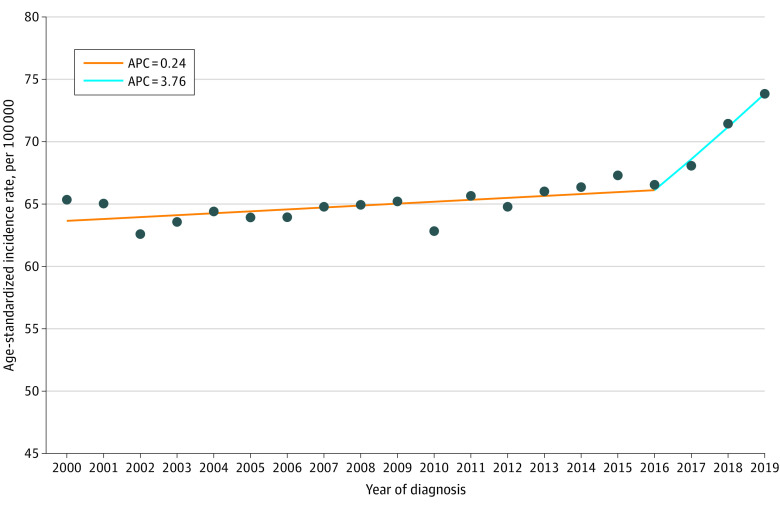
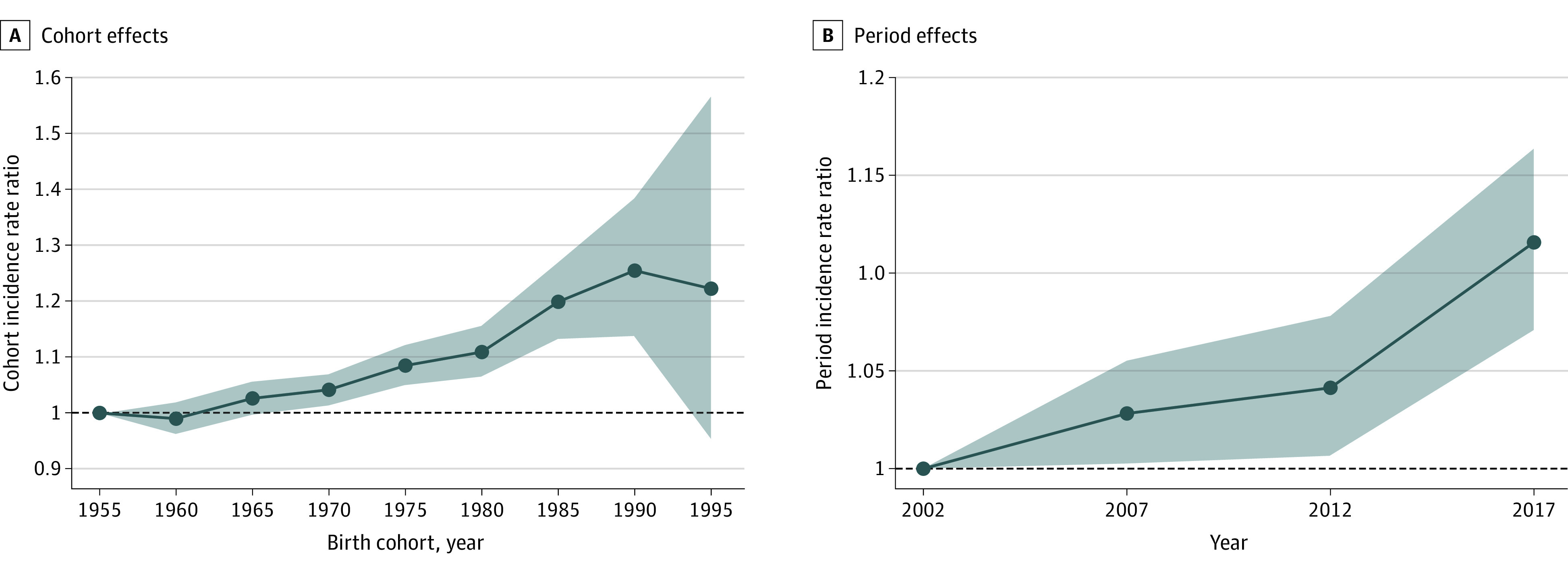
Overall age-standardized breast cancer incidence increased by 0.79% annually (95% CI, 0.42 to 1.15), with a gradual increase from 2000 to 2016 (APC, 0.24; 95% CI, 0.05 to 0.42) and a steeper increase from 2016 onward (APC, 3.76; 95% CI, 1.39 to 6.19). ER+/PR+ incidence increased (AAPC, 2.72; 95% CI, 2.34 to 3.12) and ER+/PR− increased (AAPC, 1.43; 95% CI, 1.00 to 1.87), while ER−/PR+ decreased (AAPC, −3.25; 95% CI, −4.41 to −2.07). Stage I and stage IV incidence increased, whereas stage II and stage III incidence decreased. Among women aged 20-29 and 30-39 years, non-Hispanic Black women had the highest incidence rates (IRR vs non-Hispanic White, 1.53; 95% CI, 1.43 to 1.65 and 1.15; 95% CI, 1.12 to 1.18, respectively); age-period-cohort models showed strong period (P = 4.77 × 10⁻⁹) and cohort (P = 4.83 × 10⁻¹⁴) effects, with the cohort effect approximately twice the period effect.
Methods
Population-based, cross-sectional analysis of the SEER 17 Registries, covering 2000-2019 and nearly 27% of the US population; included women aged 20-49 years with primary invasive breast cancer, yielding a final analytic set of 217,815 women after exclusions. Calculated age-standardized incidence rates per 100,000 using the 2000 US standard population and incidence rate ratios with 95% CIs, stratified by race and ethnicity, hormone receptor status (ER/PR), AJCC stage, and age group. Used Joinpoint regression to estimate average annual percent change and age-period-cohort models to assess period and cohort effects, with sensitivity analyses in SEER 12 and SEER 22.
Limitations
The paper states that excluding missing/unknown ER or PR status could lead to underestimated age-standardized incidence rates; ERBB2 information was available in SEER only from 2010, so more intricate molecular subtypes could not be evaluated over the full 20-year period; and SEER does not provide risk factor data. Evident from the text: the study is observational and cross-sectional, so it cannot establish causality for the trends or associations described. Also evident: some race/HR/age subgroup estimates were based on very small numbers or could not be calculated, and stage was classified using different algorithms across periods (Breast-Adjusted AJCC 6th Stage for 2000-2015, Derived SEER Combined Stage Group for 2016-2017, and Derived Extent of Disease for 2018 onward), which may affect stage-trend comparability.
Model-written summary. Check it against the paper before relying on it.
Integrity signals
Registry
Cites
Statistics
Figures
Verification
Claims the paper makes
0 Valid · 0 Not valid · 31 Not checked · 49 Own results and interpretations
A result the paper reports from its own data — it cites no other source for it, so there is none to check. The quote shows it is in the paper.
In the paper
“However, the incidence rate was highest among non-Hispanic White women aged 40 to 49 years.”
§ Breast Cancer Incidence Among US Women Aged 20 to 49 Years by Race, Stage, and Hormone Receptor Status > Discussion
plainstates an association- Asserted: passes — The authors put it forward as true.
- Checkable: passes — It can be checked against evidence.
- Load-bearing: unclear — It is unclear whether the paper’s conclusions depend on it.
- Based: passes — The paper gives a reason why it holds.
A result the paper reports from its own data — it cites no other source for it, so there is none to check. The quote shows it is in the paper.
In the paper
“Incidence rates for estrogen receptor (ER)-positive, stage I, and stage IV tumors increased, while rates decreased for ER-negative, stage II, and stage III tumors.”
- Also stated in: § Overall Breast Cancer Incidence Rates and Trends · plain
“ASIR increased for ER+/PR+ (AAPC, 2.72; 95% CI, 2.34 to 3.12) and ER+/PR− tumors (AAPC, 1.43; 95% CI, 1.00 to 1.87), and decreased for ER−/PR+ (AAPC, −3.25; 95% CI, −4.41 to −2.07).”
§ Breast Cancer Incidence Among US Women Aged 20 to 49 Years by Race, Stage, and Hormone Receptor Status > Abstract > Findings
plainstates a cause- Asserted: passes — The authors put it forward as true.
- Checkable: passes — It can be checked against evidence.
- Load-bearing: passes — The paper’s conclusions depend on it.
- Based: passes — The paper gives a reason why it holds.
- Also stated in: § Overall Breast Cancer Incidence Rates and Trends · plain
A result the paper reports from its own data — it cites no other source for it, so there is none to check. The quote shows it is in the paper.
In the paper
“Incidence rates by both period and cohort increased for ER+/PR+ and ER+/PR− tumors but decreased for ER−/PR+ and ER−/PR− tumors.”
§ Breast Cancer Incidence Among US Women Aged 20 to 49 Years by Race, Stage, and Hormone Receptor Status > Results > Cohort and Period Effects on Breast Cancer Incidence
plainstates a cause- Asserted: passes — The authors put it forward as true.
- Checkable: passes — It can be checked against evidence.
- Load-bearing: unclear — It is unclear whether the paper’s conclusions depend on it.
- Based: passes — The paper gives a reason why it holds.
A result the paper reports from its own data — it cites no other source for it, so there is none to check. The quote shows it is in the paper.
In the paper
“The age-period-cohort models indicated strong period (P = 4.77 × 10⁻⁹) and cohort (P = 4.83 × 10⁻¹⁴) effects on breast cancer incidence.”
§ Breast Cancer Incidence Among US Women Aged 20 to 49 Years by Race, Stage, and Hormone Receptor Status > Results > Cohort and Period Effects on Breast Cancer Incidence
boostedstates an association- Asserted: passes — The authors put it forward as true.
- Checkable: passes — It can be checked against evidence.
- Load-bearing: passes — The paper’s conclusions depend on it.
- Based: passes — The paper gives a reason why it holds.
A result the paper reports from its own data — it cites no other source for it, so there is none to check. The quote shows it is in the paper.
In the paper
“Incidence rate by birth cohort peaked for the 1990 birth cohort for non-Hispanic White (IRR, 1.34; 95% CI, 1.19 to 1.51) and non-Hispanic American Indian or Alaska Native women (IRR, 1.56; 95% CI, 0.79 to 3.08).”
§ Breast Cancer Incidence Among US Women Aged 20 to 49 Years by Race, Stage, and Hormone Receptor Status > Results > Cohort and Period Effects on Breast Cancer Incidence
plainstates an association- Asserted: passes — The authors put it forward as true.
- Checkable: passes — It can be checked against evidence.
- Load-bearing: unclear — It is unclear whether the paper’s conclusions depend on it.
- Based: passes — The paper gives a reason why it holds.
30 more claims
Create a free account to see all 80 claims and to verify the 54 references still open.
- It may state two separate claims as one. 31
- The quote only partly states this claim. 2
- Probably not a substantial claim. 13
Self-check
Percentages, sums and reported differences re-computed from the paper’s own numbers.
Each contradiction between two passages listed here was confirmed by an independent check.
Rated major: it would touch a result — a value a result rests on, reported and recomputed p-values on opposite sides of the significance level, two passages that conflict with no sign which is right, or a cited work retracted before this paper was published.
In the paper
§ Breast Cancer Incidence Among US Women Aged 20 to 49 Years by Race, Stage, and Hormone Receptor Status > Discussion
“The increase in incidence rates among Hispanic women was greater than among women of other races and ethnicities”
§ Breast Cancer Incidence Among US Women Aged 20 to 49 Years by Race, Stage, and Hormone Receptor Status > Results > Characteristics of the Study Population
“| Hispanic | 37 048 (17.0) | 52.8 | 0.76 (0.75 to 0.77) | 0.80 (0.39 to 1.21) | | Non-Hispanic American Indian or Alaska Native | 1485 (0.7) | 52.6 | 0.75 (0.72 to 0.79) | 1.66 (0.59 to 2.75) |”
Rated minor: it would not touch a result — a value no result rests on, a p-value that stays on the same side of the significance level, or a conflict that is clerical, resolved elsewhere in the paper, or outside its own findings.
In the paper
§ Breast Cancer Incidence Among US Women Aged 20 to 49 Years by Race, Stage, and Hormone Receptor Status > Methods > Study Population
“Age at diagnosis was formatted as 5-year age groups (20-24, 25-29, 20-34, 35-39, 40-44, and 45-49 years).”
§ Breast Cancer Incidence Among US Women Aged 20 to 49 Years by Race, Stage, and Hormone Receptor Status > Methods > Statistical Analysis
“6 five-year age groups (20-24, 25-29, 30-34, 35-39, 40-44, 45-49)”
Rated minor: it would not touch a result — a value no result rests on, a p-value that stays on the same side of the significance level, or a conflict that is clerical, resolved elsewhere in the paper, or outside its own findings.
In the paper
§ Breast Cancer Incidence Among US Women Aged 20 to 49 Years by Race, Stage, and Hormone Receptor Status > Results > Differences in Breast Cancer Incidence Rates by Age Group, Race, and Hormone Receptor Status
“age 40-99 years: IRR, 0.69; 95% CI, 0.68 to 0.71”
§ Breast Cancer Incidence Among US Women Aged 20 to 49 Years by Race, Stage, and Hormone Receptor Status > Results > Differences in Breast Cancer Incidence Rates by Age Group and Race
“Age 40-49 y | Age 40-49 y | Age 40-49 y | Age 40-49 y | Age 40-49 y”
Rated minor: it would not touch a result — a value no result rests on, a p-value that stays on the same side of the significance level, or a conflict that is clerical, resolved elsewhere in the paper, or outside its own findings.
In the paper
§ Breast Cancer Incidence Among US Women Aged 20 to 49 Years by Race, Stage, and Hormone Receptor Status > Results > Differences in Breast Cancer Incidence Rates by Age Group, Race, and Hormone Receptor Status
“| Non-Hispanic Black | 1824 (15.2) | 13.5 | 1.33 (1.26 to 1.40) | 3.06 (0.89 to 5.28) |”
§ Breast Cancer Incidence Among US Women Aged 20 to 49 Years by Race, Stage, and Hormone Receptor Status > Results > Differences in Breast Cancer Incidence Rates by Age Group, Race, and Hormone Receptor Status
“| Non-Hispanic White | 6735 (58.7) | 10.2 | 1 [Reference] | −0.11 (−0.75 to 0.54) |”
Citations
Cites
Siegel, R. L., Miller, K. D., Wagle, N. S., & Jemal, A. (2023) · CA: A Cancer Journal for Clinicians · doi:10.3322/caac.21763 · Cited by 16,303
Permutation tests for joinpoint regression with applications to cancer rates
Kim, H.-J., Fay, M. P., Feuer, E. J., & Midthune, D. N. (2000) · Statistics in Medicine · doi:10.1002/(sici)1097-0258(20000215)19:3<335::aid-sim336>3.0.co;2-z · Cited by 6,318
(2020) · PubMed · Cited by 2,642
Breast Cancer Statistics, 2022
Giaquinto, A. N., Sung, H., Miller, K. D., Kramer, J. L., Newman, L. A., Minihan, A., Jemal, A., & Siegel, R. L. (2022) · CA: A Cancer Journal for Clinicians · doi:10.3322/caac.21754 · Cited by 2,286
Oeffinger, K. C., Fontham, E. T. H., Etzioni, R., Herzig, A., Michaelson, J. S., Shih, Y.-C. T., Walter, L. C., Church, T. R., Flowers, C. R., LaMonte, S. J., et al. (2015) · JAMA · doi:10.1001/jama.2015.12783 · Cited by 1,653
Estimating average annual per cent change in trend analysis
Clegg, L. X., Hankey, B. F., Tiwari, R., Feuer, E. J., & Edwards, B. K. (2009) · Statistics in Medicine · doi:10.1002/sim.3733 · Cited by 1,256
Age at first birth and breast cancer risk.
MacMahon, B., Cole, P. T., Lin, T. M., Lowe, C. R., Mirra, A. P., Ravnihar, B., Salber, E. J., Valaoras, V. G., & Yuasa, S. (1970) · Europe PMC (PubMed Central) · Cited by 1,057
A Web Tool for Age–Period–Cohort Analysis of Cancer Incidence and Mortality Rates
Rosenberg, P. S., Check, D. P., & Anderson, W. F. (2014) · Cancer Epidemiology, Biomarkers & Prevention · doi:10.1158/1055-9965.epi-14-0300 · Cited by 819
Efficient interval estimation for age-adjusted cancer rates
Tiwari, R. C., Clegg, L. X., & Zou, Z. (2006) · Statistical Methods in Medical Research · doi:10.1177/0962280206070621 · Cited by 566
The Healthy Immigrant Effect: Patterns and Evidence from Four Countries
Kennedy, S., Kidd, M. P., McDonald, J. T., & Biddle, N. (2015) · Journal of International Migration and Integration · doi:10.1007/s12134-014-0340-x · Cited by 545
Research works printed but not linked: 1
- Mathews TJ, Hamilton BE. Mean Age of Mothers is on the Rise: United States, 2000-2014. National Vital Statistics System data brief No. 232. 2000. Accessed August 11, 2023. https://pubmed.ncbi.nlm.nih.gov/26828319/
Cited by
Items 101–178 of 178
Q RadFusion: Hybrid Quantum Classical Radiogenomic Framework for Breast Cancer DiagnosisPreprint
Padmaja, C., Sivaneasan Bala Krishnan, S., Ramacharan, S., & Chakrabarti, P. (2025) · Research Square · doi:10.21203/rs.3.rs-7657076/v1 · Cited by 1
Doll, A., & Kapoor, N. S. (2024) · Annals of Surgical Oncology · doi:10.1245/s10434-024-15854-0
Lu, Y., Xu, H., Yang, J., Zhang, Q., Kong, W., Yang, D., Ma, L., Zhang, S., Yan, P., & Yang, K. (2024) · SSRN Electronic Journal · doi:10.2139/ssrn.4962461
A Perspective on Breast Cancer in Young Women: Unique Challenges and Opportunities
Heeling, E., van der Ploeg, I. M. C., & Peeters, M.-J. T. F. D. V. (2024) · Journal of young women's breast cancer and health. · doi:10.4103/ywbc.ywbc_13_24
RELT Is Upregulated in Breast Cancer and Induces Death in Breast Cancer Cells
Batiste, M., Joy, B., Yee, C. K., Cho, L., Christensen, A., Abed, I., Nguyen, K. N., Yanumula, A., Chang, H., Cho, E. D., et al. (2024) · Biomedicines · doi:10.3390/biomedicines12122667
Ovarian Stimulation and the Long-Term Risk of Cancer
Vassard, D., Hunt, S., Pinborg, A. B., & Wang, R. (2024) · Elsevier eBooks · doi:10.1016/b978-0-443-21477-6.00308-4
Impact of IVF Restriction on Patients With Cancer and Surgeons
Glencer, A., & Esserman, L. J. (2024) · JAMA Surgery · doi:10.1001/jamasurg.2024.4741
Stearns, V., Chen, R., Blackford, A. L., Saylor, E., Mull, J., Folmer, A., Jelinek, J., Hodgdon, C., Bacon, J., Engle, J. P., et al. (2025) · Breast Cancer Research and Treatment · doi:10.1007/s10549-024-07591-5
Treatment Patterns and Outcomes of Young Female Early Breast Cancer in Taiwan
Huang, C., & Tseng, L. (2025) · Journal of Breast Cancer · doi:10.4048/jbc.2024.0188
Scherübl, H. (2025) · DMW - Deutsche Medizinische Wochenschrift · doi:10.1055/a-2531-9761
Scherübl, H. (2025) · TumorDiagnostik & Therapie · doi:10.1055/a-2596-8059
Gootzen, T. A., Steenbeek, M. P., van Gelder, M. M. H. J., van Bommel, M. H. D., Timmer-Bonte, A., Kets, C. M., Nitecki-Wilke, R., Swisher, E. M., Norquist, B. M., Lu, K. H., et al. (2025) · American Journal of Obstetrics and Gynecology · doi:10.1016/j.ajog.2025.06.024
Untangling the mystery of rising breast cancer rates
Nelson, B., & Faquin, W. C. (2025) · Cancer Cytopathology · doi:10.1002/cncy.70026
Salahuddin, S. A., Wetzer, E., Wickstrøm, K., Thrun, S., Kampffmeyer, M., & Jenssen, R. (2025) · Lecture notes in computer science · doi:10.1007/978-3-031-95918-9_20
Blum, L. M., & Surkan, K. J. (2025) · Gender & Society · doi:10.1177/08912432251374235
Symonds, L. K., & Davidson, N. E. (2025) · JNCI Journal of the National Cancer Institute · doi:10.1093/jnci/djaf247
Oncogénétique : les cancers héréditaires du sein
Comel, M., & Pujol, P. (2025) · EMC - Gynécologie · doi:10.1016/s0246-1064(25)49894-6
Triple-Negative Breast Cancer on the Rise or…? [Letter]
Lønning, P. E., Nikolaienko, O., & Knappskog, S. (2025) · Breast Cancer Targets and Therapy · doi:10.2147/bctt.s560499
Knowledgeable Language Models as Black-Box Optimizers for Personalized Medicine
Yao, M. S., Bastani, O., Andersson, A., Biancalani, T., BenTaieb, A., & Iriondo, C. (2026) · International Conference on Learning Representations · doi:10.48550/arxiv.2509.20975
Wang, L., Tian, Y., Wang, C., Pan, W., Sun, Z., Wang, K., Zhao, Z., & Zhang, H. (2025) · Research Square · doi:10.21203/rs.3.rs-7469593/v1
Fan, Z., Zhang, M., & Han, S. S. (2025) · bioRxiv (Cold Spring Harbor Laboratory) · doi:10.1101/2025.10.09.681515
Impact of breast MRI on the surgical management of young women with breast cancer
Erguven, T., Akiska, Y. M., Arafat, A., & Brem, R. F. (2025) · Clinical Imaging · doi:10.1016/j.clinimag.2025.110682
Cayetano‐Salazar, L., Ortiz‐Ortiz, J., López, M. J. R., Dorantes, N. R., Catalán, M. A. M., & Arizmendi-Izazaga, A. (2025) · Revista Veritas de Difusão Cientifica. · doi:10.61616/rvdc.v6i3.1061
The Role of Health Policy in Expanding Access to Early Cancer Detection Technologies
Anil Kumar, C., Narayanappa, C. K., M, M. H., R, V. K., Harish, S., & Shilpakala, V. (2025) · Journal of Carcinogenesis · doi:10.64149/j.carcinog.24.2s.1009-1019
Mammo-CLIP Dissect: A Framework for Analysing Mammography Concepts in Vision-Language ModelsPreprint
Salahuddin, S. A., Dorszewski, T., Martiniussen, M. A., Hovda, T., Portaluri, A., Thrun, S., Kampffmeyer, M., Wetzer, E., Wickstrøm, K., & Jenssen, R. (2025) · arXiv (Cornell University) · doi:10.48550/arxiv.2509.21102
Guan, S., Jian, Y., Dong, W., & Dong, L. (2025) · medRxiv · doi:10.64898/2025.12.22.25342768
Best Practices for Diagnostic Evaluation of Unintentional Weight Loss
Rao, G., Ufholz, K. E., Koopman-Gonzalez, S., Menegay, H. J., Song, S., Koepf, B., & Beno, M. F. (2026) · American Journal of Medical Quality · doi:10.1097/jmq.0000000000000281
Wang, Z., Liu, W., Hua, L., Li, X., & Xue, G. (2026) · International Journal of Medical Informatics · doi:10.1016/j.ijmedinf.2026.106300
Bozal, R. G., Baena-Guil, M. P., Ruíz-González, P., Ordoñez‐Mora, L. T., & Márquez, P. G.-O. (2026) · Acta Psychologica · doi:10.1016/j.actpsy.2026.106248
Zubair, M., Mubeen, F., Khan, R., Qaiser, A., Abdullah, N., & Shoaib, U. (2025) · Khyber Journal Of Medical Sciences · doi:10.70520/kjms.v18i4.711
Hwang, Y.-T., & Yeh, H. (2026) · Cancer Treatment and Research Communications · doi:10.1016/j.ctarc.2026.101126
Cancer screening and prevention: Sex and gender evidence in lung, breast, and colorectal cancer
Konda, M., & Verma, R. (2026) · Elsevier eBooks · doi:10.1016/b978-0-443-26712-3.00017-3
Breast Cancer in Young Women: Implications for Pregnancy, Lactation, and Fertility Preservation
Labora, A. N., & Kapoor, N. S. (2026) · Obstetrics and Gynecology · doi:10.1097/aog.0000000000006187
Ho, K. L., Desjardins, M. R., Alcaraz, K. I., & Connor, A. E. (2026) · Cancer Causes & Control · doi:10.1007/s10552-026-02134-3
Shapira, M., Berkovitz, C., Safrai, M., Haas, J., Sella, T., Aizer, A., Meirow, D., & Orvieto, R. (2026) · Journal of Assisted Reproduction and Genetics · doi:10.1007/s10815-026-03812-6
Optimizing breast contour preserving possibilities in breast cancer surgery:Shaping the future
Heeling, E. (2025) · UvA-DARE (University of Amsterdam)
Yang, W., Wang, Q., Yang, Q., Peng, Y., Gao, Y., Yang, H., Lan, W., Zhang, T., Zhang, S., Su, Z., et al. (2026) · Discover Oncology · doi:10.1007/s12672-026-04631-y
Ahdi, D., Elmi, N., & Derakhshan, S. M. (2026) · Research Square · doi:10.21203/rs.3.rs-8937161/v1
Breast Cancer Knowledge and Preventive Practice Among Graduate Students: A Scoping Review
Adhikari, B., Goodman, X. Y., Alam, M. M., Fudolig, M. A., Buccini, G., & DeVille, N. V. (2026) · Cancers · doi:10.3390/cancers18071147
Lønning, P. E., Nikolaienko, O., & Knappskog, S. (2026) · Breast Cancer Research · doi:10.1186/s13058-026-02279-8
Peifer, H. G., Rockefeller, E. S., & Newman, L. (2026) · Current Breast Cancer Reports · doi:10.1007/s12609-026-00646-0
Neighborhood Disadvantage and Breast Cancer among Women Living in the United States
Lawrence, K. G., Woo, J. M. P., O’Brien, K. M., & Sandler, D. P. (2026) · Cancer Epidemiology Biomarkers & Prevention · doi:10.1158/1055-9965.epi-25-1511
¿ESTAMOS LLEGANDO TARDE? UNA REFLEXIÓN SOBRE EL TAMIZAJE DEL CÁNCER DE MAMA EN CHILE
Montecinos-Mundaca, M. J., & García-Alvarado, F. (2026) · Revista Matronería Actual · doi:10.22370/revmat.1.2026.5043
Lee, A. W., Aguilar-Cruz, D., Siddiqui, S., Flair, A. L., Tubman, S., & Wells, N. (2026) · Cancer Epidemiology · doi:10.1016/j.canep.2026.103101
Nelis, M., & Chichura, A. M. (2026) · O&G Open · doi:10.1097/og9.0000000000000172
Nanotechnological Approaches for Targeted Drug Delivery to Combat Breast and Ovarian Cancer
Rani, V., Obadat, A., Boyes, K., & Brown, N. (2026) · Springer eBooks · doi:10.1007/978-3-032-10745-9_20
Distinct epigenetic alterations and accelerated mitotic aging define second primary breast cancers
Bedoya-López, A. F., Orozco, J. I. J., Llinàs‐Arias, P., Ensenyat-Méndez, M., Valdez, B. J., Íñiguez-Muñoz, S., Morote-Llabrés, M., Matsuba, C., Salomon, M. P., Marzese, D. M., et al. (2026) · Scientific Reports · doi:10.1038/s41598-026-54795-4
Redondo‐Sánchez, D., Petrova, D., Bigorra, J., Ameijide, A., Pérez-Esparza, B. M., Palacios-Castaño, M.-I., Farreny, M. M., López, M. D. C., Guevara, M., Carulla, M., et al. (2026) · European Journal of Cancer · doi:10.1016/j.ejca.2026.116883
Fan, D., Wang, Y., Han, J., Liu, H., Zhu, Z., Hu, Z., Tao, H., Li, Y., & Shen, Z. (2026) · Journal of Geriatric Oncology · doi:10.1016/j.jgo.2026.103035
Distal, Intermediate, and Proximal Barriers Associated with Breast Cancer Disparities in Screening
Sierra, M., Farma, M., & Goel, N. (2026) · Current Breast Cancer Reports · doi:10.1007/s12609-026-00658-w
Murphy, C., Poll, A., Eisen, A. F., Cybulski, C., & Narod, S. A. (2026) · Research Square · doi:10.21203/rs.3.rs-9987221/v1
Trends in surgical management and postoperative outcomes in adolescent and young adult breast cancer
Harrison, L. E., Scutari, T., Jerliu, A., Connors, C., & McLoughlin, R. J. (2026) · Surgery · doi:10.1016/j.surg.2026.110467
Jacobs, W., Atwood, T., Gonzalez, R., & Lee, A. W. (2026) · MethodsX · doi:10.1016/j.mex.2026.104057
Davenport, S., & Cooper, L. (2026) · Journal of the American Association of Nurse Practitioners · doi:10.1097/jxx.0000000000001337
Complications Following Abdominal‐Based Microsurgical Breast Reconstruction
Savage, N. E., Catalano, J., Zhou, J., Doherty, Z. B., Sinha, S., & Blake, W. E. (2026) · ANZ Journal of Surgery · doi:10.1111/ans.70882
Dennison, R. A., Valasaki, M., Wright, S., Frost, R., Howell, S. J., Antoniou, A. C., Easton, D. F., Morris, S., Garcia-Closas, M., Woof, V. G., et al. (2026) · British Journal of Cancer · doi:10.1038/s41416-026-03546-3
Gusbi, E., Abuagela, M. O., & Mahanay, F. (2026) · Libyan Journal of Medical Research · doi:10.54361/ljmr.20.2.68
Schedin, P. S., Cete, H. D., Phipps, J. L., Bartlett, A. Q., Ozaki, M. K., & Mayo, S. C. (2026) · Research Square · doi:10.21203/rs.3.rs-9903557/v1
Frigieri, B. M., Barbosa, G. S. B., Novais, A. A., Rezende, C. P., Almeida, F. B. D. R., Simão, V. A., Sogayar, M. C., Chuffa, L. G. D. A., Reiter, R. J., & Zuccari, D. A. P. D. C. (2026) · Journal of Cellular and Molecular Medicine · doi:10.1111/jcmm.71309
Oncogenética: cáncer de mama hereditario
Comel, M., & Pujol, P. (2026) · EMC - Ginecología-Obstetricia · doi:10.1016/s1283-081x(26)51971-4
Bi, Y., Wang, H., Wei, F., Qi, Y., Li, S., Liang, J., Guo, C., Jiang, H., Ren, M., Wang, M., et al. (2026) · Journal of the National Cancer Center · doi:10.1016/j.jncc.2026.07.002
MoghaddamHosseini, V., & Zand, A. (2026) · Cancers · doi:10.3390/cancers18162715
Lumpkins, C. Y., Smith, P., Law, A., Webster, O., Maxwell, W. F., Buabeng, S., Johnson‐Davis, K. L., Wolfsfeld, C., & Kaphingst, K. A. (2026) · Research Square · doi:10.21203/rs.3.rs-10543530/v1
Polyakov, А. А., Velikaya, V. V., Старцева, Ж. А., Александровна, Л. П., Подоплекин, Д. М., & Грибова, О. В. (2026) · Malignant tumours · doi:10.18027/2224-5057-2026-078
Fertility in breast cancer survivorship: a scoping review
Rajput, S., Cathcart-Rake, E. J., Ruddy, K. J., Shenoy, C. C., Connors, C., & Idossa, D. W. (2026) · Journal of Cancer Survivorship · doi:10.1007/s11764-026-02111-4
Metabolic Reprogramming Of Macrophages In Breast Cancer: Mechanisms And Therapeutic Implications
Zhang, J., & Yang, R. (2026) · Cancer Treatment and Research Communications · doi:10.1016/j.ctarc.2026.101376
Impact of Clinicopathologic Factors on Breast Cancer Diagnosed in Pregnancy
Su, M., Patel, D., Syed, S., Ramos, G. M. D., McArthur, H., Patel, I., Manohar, P., & Kanjwal, S. (2026) · Oncology · doi:10.1159/ocl/aebag014
Intratumoral therapeutic dust for chemo-photodynamic combination treatment
Lin, R., Zou, P., Chen, J., Jiang, Z., Chen, K., Tang, B., Long, Z., Han, Q., Fang, Z., Yu, M., et al. (2026) · Science Advances · doi:10.1126/sciadv.aeh5237
Sodiq, T. A., Lawal, A. O., Adigun, M. A. A., & Shuaibu, A. B. (2026) · Nigerian Journal of Pharmaceutical and Applied Science Research
Jones, B. L. (2026) · ScholarWorks (Walden University)
Rossi, S., Cerza, F., Bennett, D., Innos, K., Henau, K., Demuru, E., Botta, L., Hammas, K., Vener, C., Lillini, R., et al. (2026) · ESMO Real World Data and Digital Oncology · doi:10.1016/j.esmorw.2026.100794
Fanaei, S. M., Aisagbonhi, O. A., Hasteh, F., Fadare, O., & Zare, S. (2026) · Human Pathology · doi:10.1016/j.humpath.2026.106283
Treatment Considerations in Adolescent and Young Adult Patients with Breast Cancer
Farley, C. R., & King, T. A. (2026) · Surgical Oncology Clinics of North America · doi:10.1016/j.soc.2026.09.001
Polyakov, А. А., Валерьевна, В. В., Старцева, Ж. А., Александровна, Л. П., Михайлович, П. Д., & Вячеславовна, Г. О. (2026) · Malignant tumours
Ramadhani, A., Kristina, S., Vo, T., & Rosyida, K. A. (2026) · Asian Pacific Journal of Cancer Prevention · doi:10.31557/apjcp.2026.27.10.3525
O'Sullivan, C. C., & Ruddy, K. J. (2026) · Pediatric Adolescent & Young Adult Cancer · doi:10.1002/pay2.70006
Age‐associated differences in the breast cancer immune microenvironment
Humlevik, R. O. C., Chen, Y., Klingen, T. A., Sæle, A. K. M., Svanøe, A. A., Hugaas, U., Kvamme, A. B., Tegnander, A., Winge, I., Aas, T., et al. (2026) · The Journal of Pathology Clinical Research · doi:10.1002/2056-4538.70115
Gao, F., Jiang, Y., Guo, N., & Ma, J. (2026) · International Journal of Women s Health · doi:10.2147/ijwh.s646854
Metadata
- Authors
- Xu, S., Murtagh, S., Han, Y., Wan, F., & Toriola, A. T.
- Affiliations
- Washington University in St. Louis (US)
- University College Dublin (IE)
- Corresponding author
- Toriola, Adetunji T.
- Venue
- JAMA Network Open
- Publisher
- American Medical Association (AMA)
- Published
- 2024-01-26
- Volume
- 7
- Issue
- 1
- Pages
- e2353331
- ISSN
- 2574-3805 (ISSN-L)
- PMC
- PMC10818222
- OpenAlex
- W4391263494
- Semantic Scholar
- 8b0d25f40cdd5fe4970aa5e5771df08ca47ec6ce
- Cited by
- 178
- References
- 55
- Citations by year
- 2026: 72 · 2025: 74 · 2024: 32
- FWCI
- 26.07
- Type
- journal article
- Language
- en
- Open access
- gold
- doi.org
- Licence
- cc-by
- Locations
- JAMA Network Open (publishedVersion, cc-by)
- PubMed Central (publishedVersion, cc-by)
- PubMed (publishedVersion)
- Digital Commons@Becker (Washington University School of Medicine) (submittedVersion, cc-by)
- Funders
- National Institutes of Health
- National Cancer Institute (R01CA246592, R37CA235602, P30CA091842)
- Topics
- Health Sciences › Medicine › Oncology › Global Cancer Incidence and Screening
- Health Sciences › Medicine › Oncology › Cancer Risks and Factors
- Life Sciences › Biochemistry, Genetics and Molecular Biology › Cancer Research › Breast Cancer Treatment Studies
- Keywords
- breast cancer incidence, young women, racial and ethnic disparities, hormone receptor status, estrogen receptor, progesterone receptor, tumor stage, age at diagnosis, period and cohort effects, incidence trends, SEER database, American Indian and Alaska Native women, non-Hispanic Black women, Hispanic women, Asian/Pacific Islander women, non-Hispanic white women
- MeSH terms
- Adult, Breast Neoplasms, Cross-Sectional Studies, Ethnicity, Female, Hormones, Humans, Middle Aged, Incidence, Racial Groups, Young Adult
About these checks
Registry, retraction, Cites and statistics results are computed, not judged, with one exception: a printed reference that no index lists is read once by a model before it counts as a citation error. Claims are extracted by a model and kept only when their quote appears verbatim in the text; each cited source is then checked, with a model’s help, for whether it says what the claim relies on. Those verdicts can be wrong — read the claim’s quote and the cited source before relying on one.
A language model drew the claims from the paper on 2026-11-17, under version 3 of the claim definition (model deepseek-v4.1-flash, prompt extract-v3).
A second model labelled each claim on 2026-11-17 (model jev-1.13-20260917, definition revision gold-guideline-v0.2).
Statistics and arithmetic are recomputed, not judged.
Confidence bands are shown only for fields calibrated on our annotated test set. None is calibrated yet, so no band is shown.
What counts as a claim ›How we measure confidence ›How we check this ›
Are you an author, or do you see a problem with this page? Request a review
Data sources
Bibliographic data: Semantic Scholar, OpenAlex, Crossref.
Contains information from the Semantic Scholar Academic Graph Datasets, made available under the ODC Attribution License (ODC-BY 1.0).
Semantic Scholar’s data is described in: Kinney, R., et al. (2023). The Semantic Scholar Open Data Platform. arXiv:2301.10140.
