

Ultrasound Neuromodulation With Transcranial Pulse Stimulation in Alzheimer Disease: A Randomized Clinical Trial
Open accessThe DOI matches its Crossref record; 30 of the 30 references it cites were found in a registry or an index; none of the 32 sources its claims cite is checked for support yet.
Abstract
Importance: Given the increasing prevalence of dementia and the limited treatment options available, ultrasound neuromodulation could serve as a novel add-on therapy to standard treatments for Alzheimer disease (AD). As ultrasound neuromodulation is still in its early stages, further research is essential to fully explore its potential in treating brain disorders. Objective: To evaluate clinical and functional imaging effects of transcranial pulse stimulation (TPS) in patients with AD. Design, Setting, and Participants: A randomized, double-blind, sham-controlled, crossover clinical trial was conducted at the Medical University of Vienna between January 1, 2017, and July 27, 2022. Sixty patients with clinically diagnosed AD receiving state-of-the-art treatment were randomly allocated to treatment sequence groups verum-sham (first cycle verum, second cycle sham, n = 30) and sham-verum (n = 30). Data analysis was performed from July 28, 2022, to September 5, 2024. Intervention: Each participant received 6 verum and 6 sham TPS sessions (6000 pulses, 0.20 mJ/mm 2, 5 Hz) to frontoparietal brain areas. Main Outcomes and Measures: Neuropsychological tests, including the primary outcome Consortium to Establish a Registry for Alzheimer’s Disease (CERAD) corrected total score (CTS), were performed at baseline and 1 week, 1 month, and 3 months following the stimulations in each cycle. Primary and secondary outcomes, including functional magnetic resonance imaging and Beck Depression Inventory-II, were analyzed by intention-to-treat analysis and, for sensitivity, by per protocol analysis. Results: For the intention-to-treat analysis, 60 patients between ages 51 and 82 years (mean [SD], 70.65 [8.16] years; 30 females; 30 males) were included. The CERAD CTS increased by a mean (SD) of 2.22 (6.87) points in the verum condition from 70.93 (14.27) points at baseline to 73.15 (14.90) 3 months after stimulation, while the mean (SD) score in the sham condition increased by 1.00 (6.82) point vs baseline from 71.68 (13.62] at baseline to 72.68 (14.48) 3 months after stimulation. Primary data analysis of the condition × session interaction was not significant (P = .68; partial η 2 [ηp 2] = 0.01), but its interaction with age was P = .003; ηp 2 = 0.08, followed by post hoc analyses of age subsamples. Although several patients older than 70 years benefited from verum TPS, only the younger subgroup (≤70 years) showed significantly higher CTS increases for verum in all poststimulation sessions (condition × session: P = .005; ηp 2 = 0.16). At 3 months after stimulation, for example, a mean (SD) 3.91 (7.86)-point increase was found for verum TPS in the younger patients, but a mean (SD) CTS decrease of 1.83 (5.80) was observed for sham. Memory-associated brain activation was significantly higher after verum TPS in the precuneus, visual, and frontal areas, while resting state functional connectivity was significantly upregulated in the dorsal attention network. In the per protocol sample, a significant reduction of the Beck Depression Inventory-II scores 3 months following verum TPS was found (verum baseline: 7.27 [5.87]; verum 3 months after stimulation: 5.27 [5.27]; sham baseline: 6.70 [5.65]; sham 3 months after stimulation: 6.22 [4.40]; P = .008; ηp 2 = 0.23). During both verum and sham conditions, the most common observed adverse symptom was depression; no major neuropathologic change was detected in the patients by detailed neuroradiologic assessments. Conclusions and Relevance: In this randomized clinical trial of TPS in patients with AD, a 2-week verum treatment improved cognitive scores in the younger subgroup, ameliorated depressive symptoms, and induced upregulation of functional brain activation and connectivity. These findings suggest TPS may be a safe and promising add-on therapy for patients with AD receiving state-of-the-art treatment. Trial Registration: ClinicalTrials.gov Identifier: NCT03770182
Overview
CoChat Summary
TL;DR
In a randomized, double-blind, sham-controlled crossover trial of 60 patients with Alzheimer disease or mild cognitive impairment on stable state-of-the-art therapy, 2 weeks of transcranial pulse stimulation (TPS) was well tolerated and upregulated memory-related fMRI activation and attention-network connectivity. Cognitive benefit on the primary CERAD CTS was not significant overall but emerged in younger patients and in first-cycle analyses.
Key findings
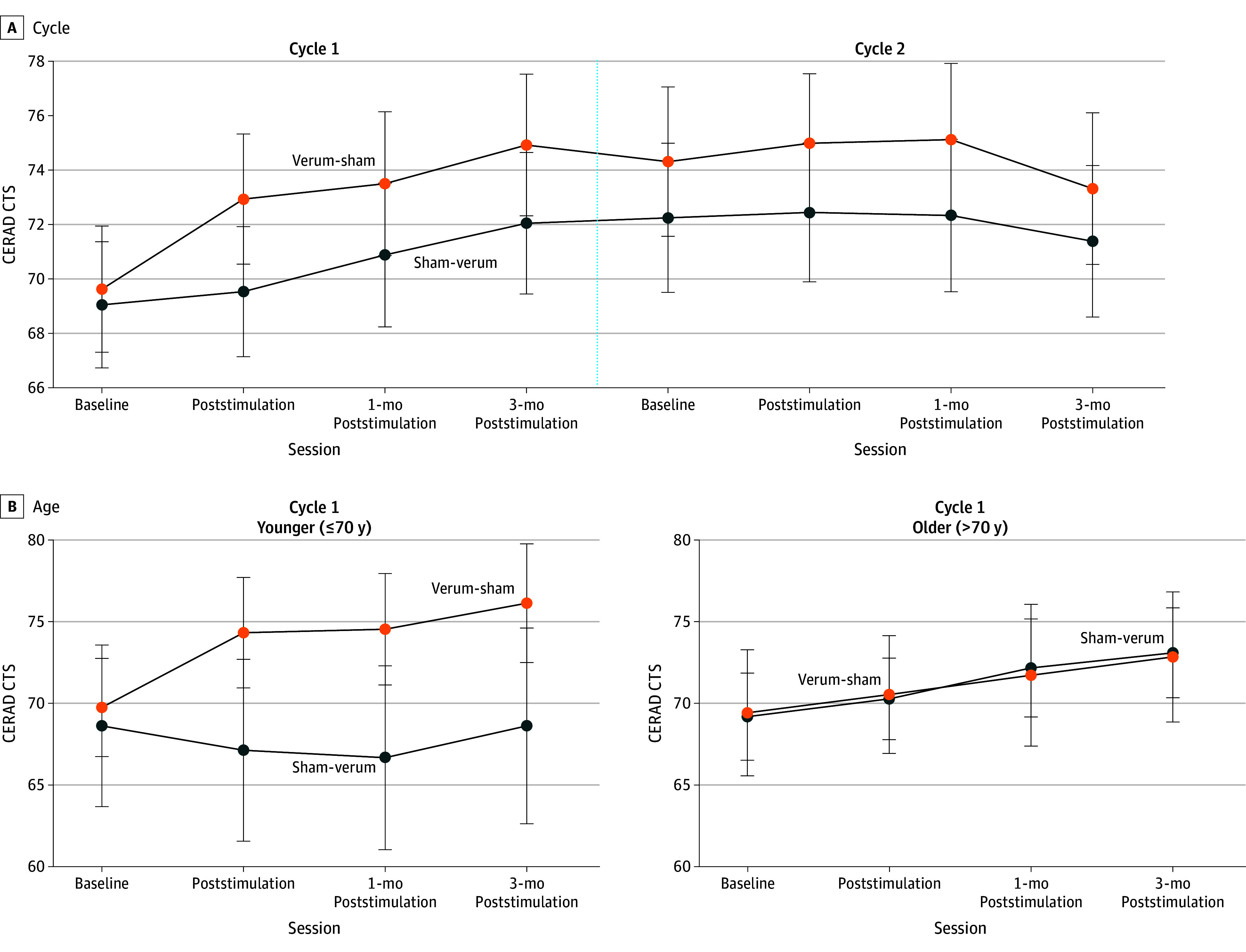
- Primary outcome CERAD CTS increased in verum by 2.22 (6.87) points from 70.93 (14.27) at baseline to 73.15 (14.90) 3 months post stimulation, and in sham by 1.00 (6.82) point from 71.68 (13.62) to 72.68 (14.48); rmANOVA showed a session effect (P = .007; ηp2 = 0.07) but no condition × session interaction (P = .68; ηp2 = 0.01).
- A condition × session × age interaction was found (P = .003; ηp2 = 0.08). In younger patients (mean age 62.69; range 51-70 years), condition × session was significant (P = .005; ηp2 = 0.16), with CERAD CTS increasing 3.91 (7.86) points 3 months post verum vs decreasing 1.83 (5.80) points in sham; older patients (mean age 76.73; range 71-82 years) showed only a session effect (P = .01; ηp2 = 0.11). First-cycle post hoc analysis in younger patients showed session × group interaction P = .03; ηp2 = 0.12, with verum improvements of 6.38 (7.51) in younger and 3.42 (6.91) in older patients.
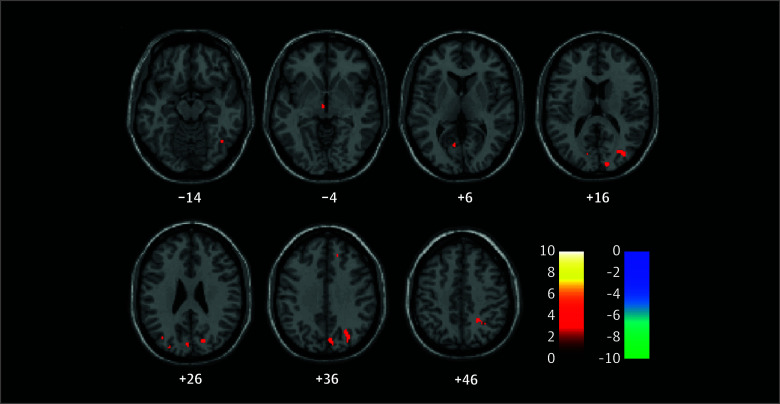
- fMRI memory task showed higher posttreatment activation in verum vs sham in precuneus, visual areas, and superior/inferior frontal gyrus; no area showed higher activation in sham. Resting-state global efficiency showed a condition × session interaction in the dorsal attention network (P = .03), specifically the left frontal part (P < .05).
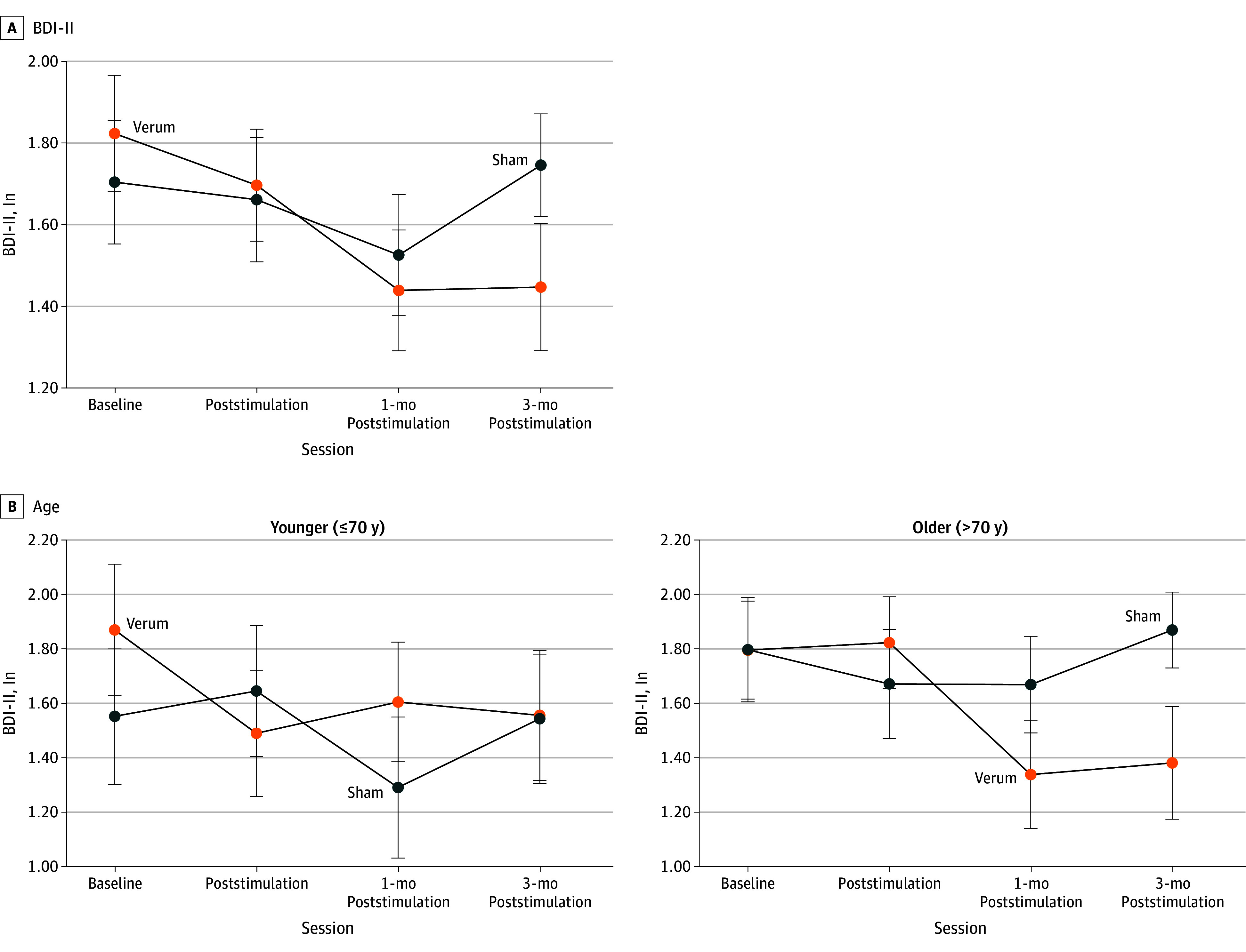
- In the per-protocol sample, BDI-II showed condition × session (P = .04; ηp2 = 0.07) and condition × session × age (P = .008; ηp2 = 0.11) interactions; verum baseline 7.27 (5.87) decreased to 5.27 (5.27) at 3 months vs sham 6.70 (5.65) to 6.22 (4.40), with significant reduction in older patients (P = .02; ηp2 = 0.28). Adverse events: 39 mild-to-moderate events in 24 participants; depression in 7 (12%), including 3 temporally associated with verum; one mild transient ischemic attack after completing the first sham cycle; headaches 7%, pain 7%, dizziness 5%, anxiety 2%, sleep disorder 2%, fatigue 2%; blinding accuracy was by chance.
Methods
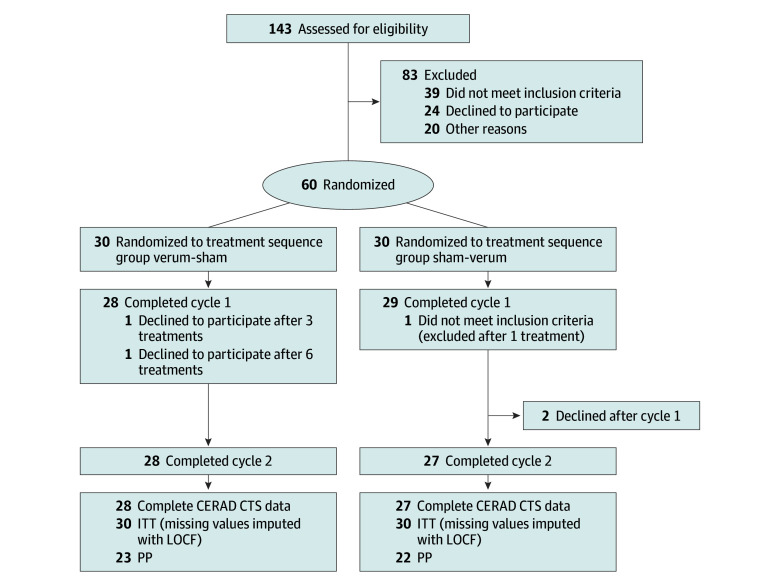
- Randomized, double-blind, sham-controlled crossover trial at the Medical University of Vienna; 60 patients randomized 30 to verum-sham and 30 to sham-verum, with 60 in the intention-to-treat sample and 45 in the per-protocol sample. Participants were clinically stable with mild cognitive impairment or probable AD by NIA-AA or ICD-10 criteria, mean (SD) age 70.65 (8.16) years and mean MMSE 23.77 (3.53).
- TPS used a modified Duolith SD1 (Storz Medical AG), prototype of Neurolith; 6 sessions over 2 weeks per cycle, 6000 pulses per session, 0.20-mJ/mm2 energy flux density, 3-μs pulse duration, 5-Hz repetition frequency, multifrequency band predominantly 0.05-0.45 MHz. Targets were bilateral dorsolateral prefrontal cortex and inferior frontal cortex, bilateral lateral parietal cortex extending to Wernicke area, and precuneus; sham used an identical-looking/sounding cap blocking ultrasound. Assessments occurred at baseline, post stimulation, 1 month, and 3 months; MRI was performed on a 3-T scanner.
- Primary outcome was CERAD corrected total score (CTS); behavioral analysis used rmANOVA with condition and session factors for ITT with last-observation-carried-forward and PP, plus post hoc rmANCOVA with age covariate, age subgroup analyses, and first-cycle parallel-group analysis. fMRI memory task used SPM12 flexible factorial design; resting-state fMRI used CONN toolbox global efficiency within cognitive networks.
Limitations
- Stated: treatment sequence groups differed significantly in age (verum-sham mean 67.83 [8.69] vs sham-verum 73.47 [6.59] years; P = .007); neuropsychological tests were administered 8 times, so practice or attrition effects must be considered; learning curves are typically nonlinear and attenuated in older or more impaired individuals; age bias was addressed only by post hoc analyses, and future studies should prospectively consider age, optimally with biological and brain age measures.
- Evident from the text: a carryover effect was suggested by higher first-cycle score increases and a second-cycle plateau, requiring post hoc first-cycle analysis; the overall primary condition × session interaction was not significant; the significant cognitive benefit was confined to a younger subsample, and the first-cycle younger group was small (n = 26; 19 verum-sham, 7 sham-verum).
Model-written summary. Check it against the paper before relying on it.
Integrity signals
Registry
Cites
Statistics
Figures
Verification
Claims the paper makes
0 Valid · 1 Not valid · 19 Not checked · 82 Own results and interpretations
A result the paper reports from its own data — it cites no other source for it, so there is none to check. The quote shows it is in the paper.
In the paper
“The rmANOVA revealed an effect of time (main effect of session: P = .007; ηp2 = 0.07) (eTable 5 in Supplement 2)”
§ Ultrasound Neuromodulation With Transcranial Pulse Stimulation in Alzheimer Disease > Results > Primary Outcome
plainstates an association- Asserted: passes — The authors put it forward as true.
- Checkable: passes — It can be checked against evidence.
- Load-bearing: unclear — It is unclear whether the paper’s conclusions depend on it.
- Based: passes — The paper gives a reason why it holds.
A result the paper reports from its own data — it cites no other source for it, so there is none to check. The quote shows it is in the paper.
In the paper
“The score appeared to plateau during the second cycle in both conditions, which diluted the overall increase in mean scores.”
§ Ultrasound Neuromodulation With Transcranial Pulse Stimulation in Alzheimer Disease > Discussion
hedged- Asserted: passes — The authors put it forward as true.
- Checkable: passes — It can be checked against evidence.
- Load-bearing: passes — The paper’s conclusions depend on it.
- Based: passes — The paper gives a reason why it holds.
A result the paper reports from its own data — it cites no other source for it, so there is none to check. The quote shows it is in the paper.
In the paper
“Separate ANOVAs for both age groups showed a significant interaction condition × session for both groups (younger: P = .04; ηp2 = 0.19; older: P = .007; ηp2 = 0.17) (eTables 36-38 in Supplement 2) with a nonsignificant improvement post stimulation in the younger participants and a significant reduction of depressive symptoms 3 months post stimulation in the older group (P = .02 with correction; ηp”
§ Ultrasound Neuromodulation With Transcranial Pulse Stimulation in Alzheimer Disease > Results > Secondary Behavioral Outcomes
plainstates an association- Asserted: passes — The authors put it forward as true.
- Checkable: passes — It can be checked against evidence.
- Load-bearing: passes — The paper’s conclusions depend on it.
- Based: passes — The paper gives a reason why it holds.
A result the paper reports from its own data — it cites no other source for it, so there is none to check. The quote shows it is in the paper.
In the paper
“In addition, fMRI data showed no area with a significantly higher memory-related activation or resting state GE in the sham condition, indicating a specific functional upregulation of cognitive areas and networks due to verum TPS.”
§ Ultrasound Neuromodulation With Transcranial Pulse Stimulation in Alzheimer Disease > Discussion
plain- Asserted: passes — The authors put it forward as true.
- Checkable: passes — It can be checked against evidence.
- Load-bearing: passes — The paper’s conclusions depend on it.
- Based: passes — The paper gives a reason why it holds.
A result the paper reports from its own data — it cites no other source for it, so there is none to check. The quote shows it is in the paper.
In the paper
“A sham vs verum GE was found in none of the networks investigated.”
§ Ultrasound Neuromodulation With Transcranial Pulse Stimulation in Alzheimer Disease > Results > fMRI Outcomes
plain- Asserted: passes — The authors put it forward as true.
- Checkable: passes — It can be checked against evidence.
- Load-bearing: unclear — It is unclear whether the paper’s conclusions depend on it.
- Based: passes — The paper gives a reason why it holds.
54 more claims
Create a free account to see all 102 claims and to verify the 32 references still open.
- It may state two separate claims as one. 28
- Probably not a substantial claim. 26
- The quote only partly states this claim. 1
Self-check
Percentages, sums and reported differences re-computed from the paper’s own numbers.
Rated minor: it would not touch a result — a value no result rests on, a p-value that stays on the same side of the significance level, or a conflict that is clerical, resolved elsewhere in the paper, or outside its own findings.
In the paper
“most patients (n = 46) having mild dementia (MMSE, 18-26,), 5 patients showing moderate dementia (MMSE, 10-17), and 11 patients displaying mild or minor cognitive impairment (MMSE, 27-30).”
§ Ultrasound Neuromodulation With Transcranial Pulse Stimulation in Alzheimer Disease > Results > Study Population
Reported 60 · recomputed 62
Citations
Cites
McKhann, G. M., Knopman, D. S., Chertkow, H., Hyman, B. T., Jack, C. R., Kawas, C. H., Klunk, W. E., Koroshetz, W. J., Manly, J. J., Mayeux, R., et al. (2011) · Alzheimer's & Dementia · doi:10.1016/j.jalz.2011.03.005 · Cited by 18,657
Conn : A Functional Connectivity Toolbox for Correlated and Anticorrelated Brain Networks
Whitfield-Gabrieli, S., & Nieto-Castanon, A. (2012) · Brain Connectivity · doi:10.1089/brain.2012.0073 · Cited by 4,885
2023 Alzheimer's disease facts and figures
(2023) · Alzheimer's & Dementia · doi:10.1002/alz.13016 · Cited by 3,212
Revised criteria for diagnosis and staging of Alzheimer's disease: Alzheimer's Association Workgroup
Jack, C. R., Andrews, J. S., Beach, T. G., Buracchio, T., Dunn, B., Graf, A., Hansson, O., Ho, C., Jagust, W., McDade, E., et al. (2024) · Alzheimer's & Dementia · doi:10.1002/alz.13859 · Cited by 2,803
Calamia, M., Markon, K., & Tranel, D. (2012) · The Clinical Neuropsychologist · doi:10.1080/13854046.2012.680913 · Cited by 583
Brain age and other bodily ‘ages’: implications for neuropsychiatry
Cole, J. H., Marioni, R. E., Harris, S. E., & Deary, I. J. (2019) · Molecular Psychiatry · doi:10.1038/s41380-018-0098-1 · Cited by 440
A total score for the CERAD neuropsychological battery
Chandler, M. J., Lacritz, L. H., Hynan, L. S., Barnard, H. D., Allen, G., Deschner, M., Weiner, M. F., & Cullum, C. M. (2005) · Neurology · doi:10.1212/01.wnl.0000167607.63000.38 · Cited by 387
Benoit, R. G., & Schacter, D. L. (2015) · Neuropsychologia · doi:10.1016/j.neuropsychologia.2015.06.034 · Cited by 366
Neuromodulation with single‐element transcranial focused ultrasound in human thalamus
Legon, W., Ai, L., Bansal, P., & Mueller, J. K. (2018) · Human Brain Mapping · doi:10.1002/hbm.23981 · Cited by 334
Beisteiner, R., Matt, E., Fan, C., Baldysiak, H., Schönfeld, M., Philippi Novak, T., Amini, A., Aslan, T., Reinecke, R., Lehrner, J., et al. (2020) · Advanced Science · doi:10.1002/advs.201902583 · Cited by 269
Self-citationUltrasound Neuromodulation as a New Brain Therapy
Beisteiner, R., Hallett, M., & Lozano, A. M. (2023) · Advanced Science · doi:10.1002/advs.202205634 · Cited by 100
Self-citationFillenbaum, G. G., & Mohs, R. C. (2023) · Journal of Alzheimer s Disease · doi:10.3233/jad-230026 · Cited by 95
Expression of Concern: Focused transcranial ultrasound for treatment of neurodegenerative dementia
Nicodemus, N. E., Becerra, S., Kuhn, T. P., Packham, H. R., Duncan, J., Mahdavi, K., Iovine, J., Kesari, S., Pereles, S., Whitney, M., et al. (2019) · Alzheimer's & Dementia: Translational Research & Clinical Interventions · doi:10.1016/j.trci.2019.06.007 · Cited by 88
Jeremic, D., Navarro-López, J. D., & Jiménez-Díaz, L. (2023) · Ageing Research Reviews · doi:10.1016/j.arr.2023.102012 · Cited by 77
Pellow, C., Pichardo, S., & Pike, G. B. (2024) · Brain stimulation · doi:10.1016/j.brs.2024.06.005 · Cited by 74
First evidence of long-term effects of transcranial pulse stimulation (TPS) on the human brain
Matt, E., Kaindl, L., Tenk, S., Egger, A., Kolarova, T., Karahasanović, N., Amini, A., Arslan, A., Sariçiçek, K., Weber, A., et al. (2022) · Journal of Translational Medicine · doi:10.1186/s12967-021-03222-5 · Cited by 65
Self-citationCurrent state of clinical ultrasound neuromodulation
Matt, E., Radjenovic, S., Mitterwallner, M., & Beisteiner, R. (2024) · Frontiers in Neuroscience · doi:10.3389/fnins.2024.1420255 · Cited by 57
Self-citationPopescu, T., Pernet, C., & Beisteiner, R. (2021) · Alzheimer's & Dementia: Translational Research & Clinical Interventions · doi:10.1002/trc2.12121 · Cited by 56
Self-citationCheung, T. C. C., Li, T. M. H., Ho, J. Y. S., Kranz, G. S., Fong, K. N. K., Leung, S. F., Lam, S. C., Yeung, W., Lam, J. Y. T., Fong, T. K. H., et al. (2023) · International Journal of Environmental Research and Public Health · doi:10.3390/ijerph20032333 · Cited by 53
Self-citationShimokawa, H., Shindo, T., Ishiki, A., Tomita, N., Ichijyo, S., Watanabe, T., Nakata, T., Eguchi, K., Kikuchi, Y., Shiroto, T., et al. (2022) · The Tohoku Journal of Experimental Medicine · doi:10.1620/tjem.2022.j078 · Cited by 51
Pagali, S. R., Kumar, R., LeMahieu, A. M., Basso, M. R., Boeve, B. F., Croarkin, P. E., Geske, J. R., Hassett, L. C., Huston, J., Kung, S., et al. (2024) · International Psychogeriatrics · doi:10.1017/s1041610224000085 · Cited by 51
Matt, E., Dörl, G., & Beisteiner, R. (2022) · Alzheimer's & Dementia: Translational Research & Clinical Interventions · doi:10.1002/trc2.12245 · Cited by 43
Self-citationDe Paolis, M. L., Paoletti, I., Zaccone, C., Capone, F., D’Amelio, M., & Krashia, P. (2024) · Translational Neurodegeneration · doi:10.1186/s40035-024-00423-y · Cited by 42
Cont, C., Stute, N., Galli, A., Schulte, C., Logmin, K., Trenado, C., & Wojtecki, L. (2022) · Frontiers in Neurology · doi:10.3389/fneur.2022.948204 · Cited by 40
Dörl, G., Matt, E., & Beisteiner, R. (2022) · Neurology and Therapy · doi:10.1007/s40120-022-00362-8 · Cited by 37
Self-citationTruong, D. Q., Thomas, C., Hampstead, B. M., & Datta, A. (2022) · Neuromodulation: Technology at the Neural Interface · doi:10.1016/j.neurom.2021.12.012 · Cited by 35
Evaluation of clinical benefits of treatments for Alzheimer's disease
Liu, K. Y., Walsh, S., Brayne, C., Merrick, R., Richard, E., & Howard, R. (2023) · The Lancet Healthy Longevity · doi:10.1016/s2666-7568(23)00193-9 · Cited by 31
Evaluating transcranial magnetic stimulation (TMS) induced electric fields in pediatric stroke.
Mantell, K. E., Sutter, E. N., Shirinpour, S., Nemanich, S. T., Lench, D. H., Gillick, B. T., & Opitz, A. (2021) · NeuroImage: Clinical · doi:10.1016/j.nicl.2021.102563 · Cited by 27
Shinzato, G. T., Assone, T., Sandler, P. C., Pacheco-Barrios, K., Fregni, F., Radanovic, M., Forlenza, O. V., & Battistella, L. R. (2024) · Brain Stimulation · doi:10.1016/j.brs.2024.03.007 · Cited by 26
Clinical recommendations for non-invasive ultrasound neuromodulation.
Beisteiner, R., Lozano, A., Di Lazzaro, V., George, M. S., & Hallett, M. (2024) · Brain Stimulation · doi:10.1016/j.brs.2024.07.013 · Cited by 25
Self-citation
Cited by
Wearable Ultrasound Devices for Therapeutic Applications
Chen, S., Ouyang, Q., Miao, X.-B., Zhang, F., Chen, Z., Qian, X., Xie, J., & Yan, Z. G. (2025) · Nano-Micro Letters · doi:10.1007/s40820-025-01890-2 · Cited by 47
Targeting Neural Oscillations for Cognitive Enhancement in Alzheimer’s Disease
Palacino, F., Manganotti, P., & Benussi, A. (2025) · Medicina · doi:10.3390/medicina61030547 · Cited by 25
“…with AD has shown that TPS can improve cognitive scores and ameliorate depressive symptoms by inducing upregulation of functional brain activation and connectivity [252] Table 4 provides a comprehensive overview of studies employing DBS, while Tables 5–8 provide an overview of NIBS in AD treatment.”
Radjenovic, S., Bender, L., Gaal, M., Grigoryeva, D., Mitterwallner, M., Osou, S., Zettl, A., Plischek, N., Lachmair, P., Herzhauser, K., et al. (2025) · Psychological Medicine · doi:10.1017/s0033291725000406 · Cited by 15
Self-citationTranscranial pulse stimulation modulates neuronal activity and functional network dynamics
Karakatsani, M. E., Gezginer, I., Nozdriukhin, D. V., Tiemann, S. J., Yoshihara, H. A. I., Storz, R., Belau, M., Ni, R., Deán‐Ben, X. L., & Razansky, D. (2025) · Brain stimulation · doi:10.1016/j.brs.2025.09.021 · Cited by 12
Fuh, J., Wang, S.-J., Wang, P., Wu, H., Su, W.-S., Lin, H.-M., & Yang, F. (2025) · Ultrasonics · doi:10.1016/j.ultras.2025.107844 · Cited by 11
Metadata
- Authors
- Matt, E., Mitterwallner, M., Radjenovic, S., Grigoryeva, D., Weber, A., Stögmann, E., Domitner, A., Zettl, A., Osou, S., & Beisteiner, R.
- Affiliations
- Medical University of Vienna (AT)
- Corresponding author
- Beisteiner, Roland
- ORCID
- Venue
- JAMA Network Open
- Publisher
- American Medical Association (AMA)
- Published
- 2025-02-26
- Volume
- 8
- Issue
- 2
- Pages
- e2459170
- ISSN
- 2574-3805 (ISSN-L)
- PMC
- PMC11866033
- OpenAlex
- W4407955219
- Cited by
- 53
- References
- 30
- Citations by year
- 2026: 34 · 2025: 18
- FWCI
- 14.60
- Type
- journal article
- Language
- en
- Open access
- gold
- doi.org
- Licence
- cc-by-nc-nd
- Locations
- JAMA Network Open (publishedVersion, cc-by-nc-nd)
- PubMed Central (publishedVersion, cc-by-nc-nd)
- PubMed (publishedVersion)
- Funders
- Medizinische Universität Wien (SO10300020)
- Topics
- Life Sciences › Neuroscience › Neurology › Transcranial Magnetic Stimulation Studies
- Health Sciences › Medicine › Psychiatry and Mental health › Dementia and Cognitive Impairment Research
- Physical Sciences › Engineering › Biomedical Engineering › Ultrasound and Hyperthermia Applications
- Keywords
- ultrasound neuromodulation, transcranial pulse stimulation, Alzheimer's disease, dementia, functional MRI, depression, sham stimulation, neuropsychological outcomes, adjunctive therapy, safety and tolerability, medication adherence, treatment discontinuation
- MeSH terms
- Aged, Aged, 80 and over, Alzheimer Disease, Double-Blind Method, Female, Humans, Male, Middle Aged, Neuropsychological Tests, Ultrasonic Therapy, Treatment Outcome, Cross-Over Studies, Transcranial Direct Current Stimulation
About these checks
Registry, retraction, Cites and statistics results are computed, not judged, with one exception: a printed reference that no index lists is read once by a model before it counts as a citation error. Claims are extracted by a model and kept only when their quote appears verbatim in the text; each cited source is then checked, with a model’s help, for whether it says what the claim relies on. Those verdicts can be wrong — read the claim’s quote and the cited source before relying on one.
A language model drew the claims from the paper on 2026-11-27, under version 3 of the claim definition (model deepseek-v4.1-flash, prompt extract-v3).
A second model labelled each claim on 2026-11-27 (model jev-1.13-20260917, definition revision gold-guideline-v0.2).
Statistics and arithmetic are recomputed, not judged.
Confidence bands are shown only for fields calibrated on our annotated test set. None is calibrated yet, so no band is shown.
What counts as a claim ›How we measure confidence ›How we check this ›
Are you an author, or do you see a problem with this page? Request a review
Data sources
Bibliographic data: Semantic Scholar, OpenAlex, Crossref.
Contains information from the Semantic Scholar Academic Graph Datasets, made available under the ODC Attribution License (ODC-BY 1.0).
Semantic Scholar’s data is described in: Kinney, R., et al. (2023). The Semantic Scholar Open Data Platform. arXiv:2301.10140.
