

Effectiveness of Personalized Hippocampal Network–Targeted Stimulation in Alzheimer Disease: A Randomized Clinical Trial
Open accessThe DOI matches its Crossref record; 53 of the 58 references it cites were found in a registry or an index; none of the 64 sources its claims cite is checked for support yet.
Abstract
Importance: Repetitive transcranial magnetic stimulation (rTMS) has emerged as a safe and promising intervention for Alzheimer disease (AD). Objective: To investigate the effect of a 4-week personalized hippocampal network–targeted rTMS on cognitive and functional performance, as well as functional connectivity in AD. Design, Setting, and Participants: This randomized clinical trial, which was sham-controlled and masked to participants and evaluators, was conducted between May 2020 and April 2022 at a single Korean memory clinic. Eligible participants were between ages 55 and 90 years and had confirmed early AD with evidence of an amyloid biomarker. Participants who met the inclusion criteria were randomly assigned to receive hippocampal network–targeted rTMS or sham stimulation. Participants received 4-week rTMS treatment, with assessment conducted at weeks 4 and 8. Data were analyzed between April 2022 and January 2024. Interventions: Each patient received 20 sessions of personalized rTMS targeting the left parietal area, functionally connected to the hippocampus, based on fMRI connectivity analysis over 4 weeks. The sham group underwent the same procedure, excluding actual magnetic stimulation. A personalized 3-dimensional printed frame to fix the TMS coil to the optimal target site was produced. Main Outcomes and Measures: The primary outcome was the change in the AD Assessment Scale-Cognitive Subscale test (ADAS-Cog) after 8 weeks from baseline. Secondary outcomes included changes in the Clinical Dementia Rating-Sum of Boxes (CDR-SOB) and Seoul-Instrumental Activity Daily Living (S-IADL) scales, as well as resting-state fMRI connectivity between the hippocampus and cortical areas. Results: Among 30 participants (18 in the rTMS group; 12 in the sham group) who completed the 8-week trial, the mean (SD) age was 69.8 (9.1) years; 18 (60%) were female. As the primary outcome, the change in ADAS-Cog at the eighth week was significantly different between the rTMS and sham groups (coefficient [SE], −5.2 [1.6]; P = .002). The change in CDR-SOB (−4.5 [1.4]; P = .007) and S-IADL (1.7 [0.7]; P = .004) were significantly different between the groups favoring rTMS groups. The fMRI connectivity analysis revealed that rTMS increased the functional connectivity between the hippocampus and precuneus, with its changes associated with improvements in ADAS-Cog ( r = −0.57; P = .005). Conclusions and Relevance: This randomized clinical trial demonstrated the positive effects of rTMS on cognitive and functional performance, and the plastic changes in the hippocampal-cortical network. Our results support the consideration of rTMS as a potential treatment for AD. Trial Registration: ClinicalTrials.gov Identifier: NCT04260724
Overview
CoChat Summary
TL;DR
In this single-center randomized clinical trial, 4-week personalized hippocampal network–targeted rTMS improved ADAS-Cog and some functional measures versus sham in patients with amyloid-confirmed MCI due to AD or mild AD dementia. The cognitive improvement correlated with increased hippocampal-precuneus functional connectivity.
Key findings
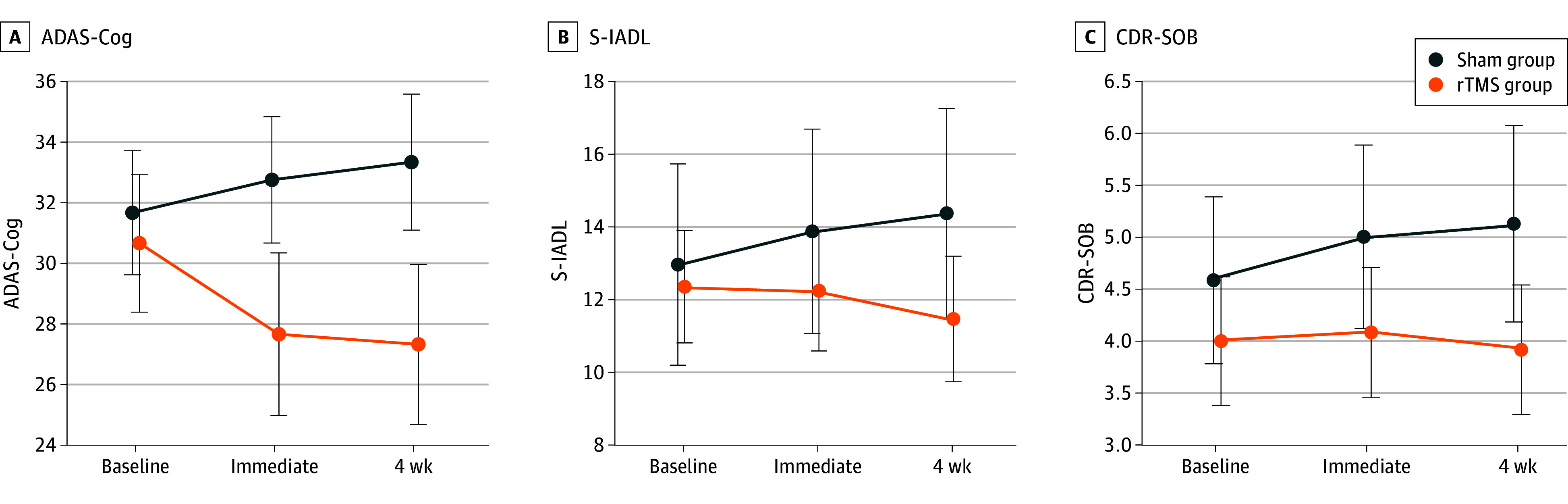
Among 30 completers (18 rTMS, 12 sham), the primary outcome ADAS-Cog-13 group-by-visit interaction favored rTMS at 8 weeks (coefficient −5.2 [SE 1.6]; P = .002) and at 4 weeks (−4.4 [1.6]; P = .007); pairwise ADAS-Cog improved in the rTMS group at V1 (3.24 [0.95]; P = .01) and V2 (3.53 [1.01]; P = .01).
- Domain analysis showed a significant 8-week group-by-visit effect only in memory (−4.5 [1.4]; P = .002); language was significant but reversed (1.7 [0.7]; P = .03), and praxis was not significant. CDR-SOB improved at V2 (−0.78 [0.3]; P = .008); S-IADL at V2 was −2.4 [0.8] in the table (P = .002; the text reports P = .16). No significant differences were found for MMSE, MOCA-K, frontal-executive tests, or CANTAB.
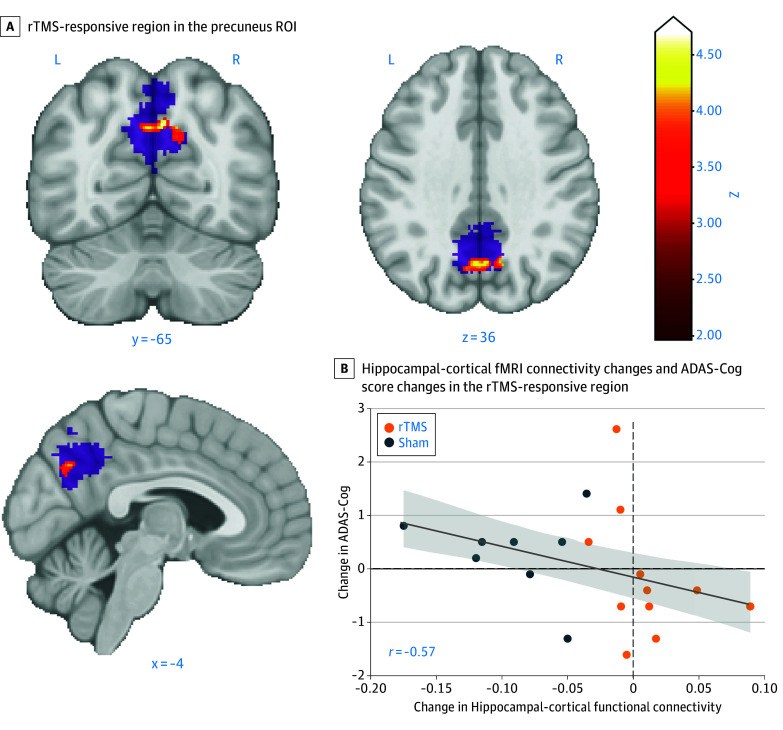
- In the fMRI analysis (20 participants: 12 rTMS, 8 sham), an rTMS-responsive precuneus cluster showed larger hippocampal connectivity change versus sham; change in ADAS-Cog correlated with connectivity change (r = −0.57; P = .005; rTMS-only r = −0.56, P = .03; sham r = −0.07, P = .43).
Methods
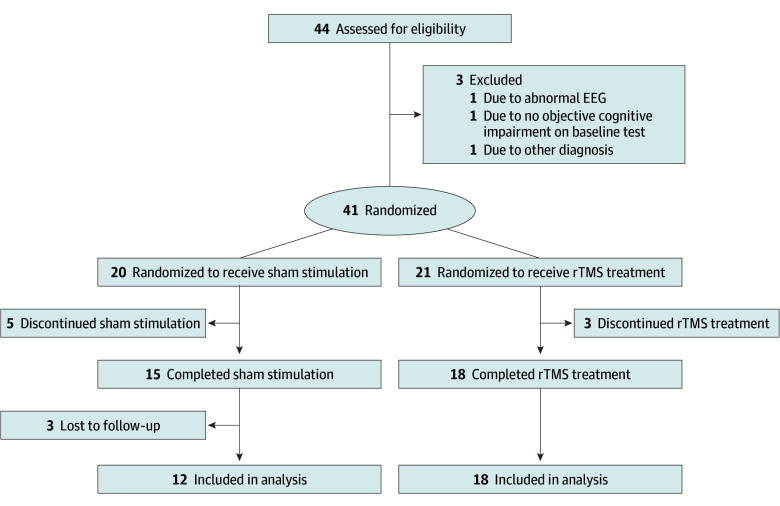
Single-center, randomized, sham-controlled trial (NCT04260724) conducted May 2020–April 2022; 41 participants were randomized 1:1 to active rTMS or sham for 4 weeks, and 30 completed the 8-week trial (18 rTMS, 12 sham). Eligible participants were aged 55–90 years with MCI due to AD or mild AD dementia and amyloid positivity by PET or CSF testing.
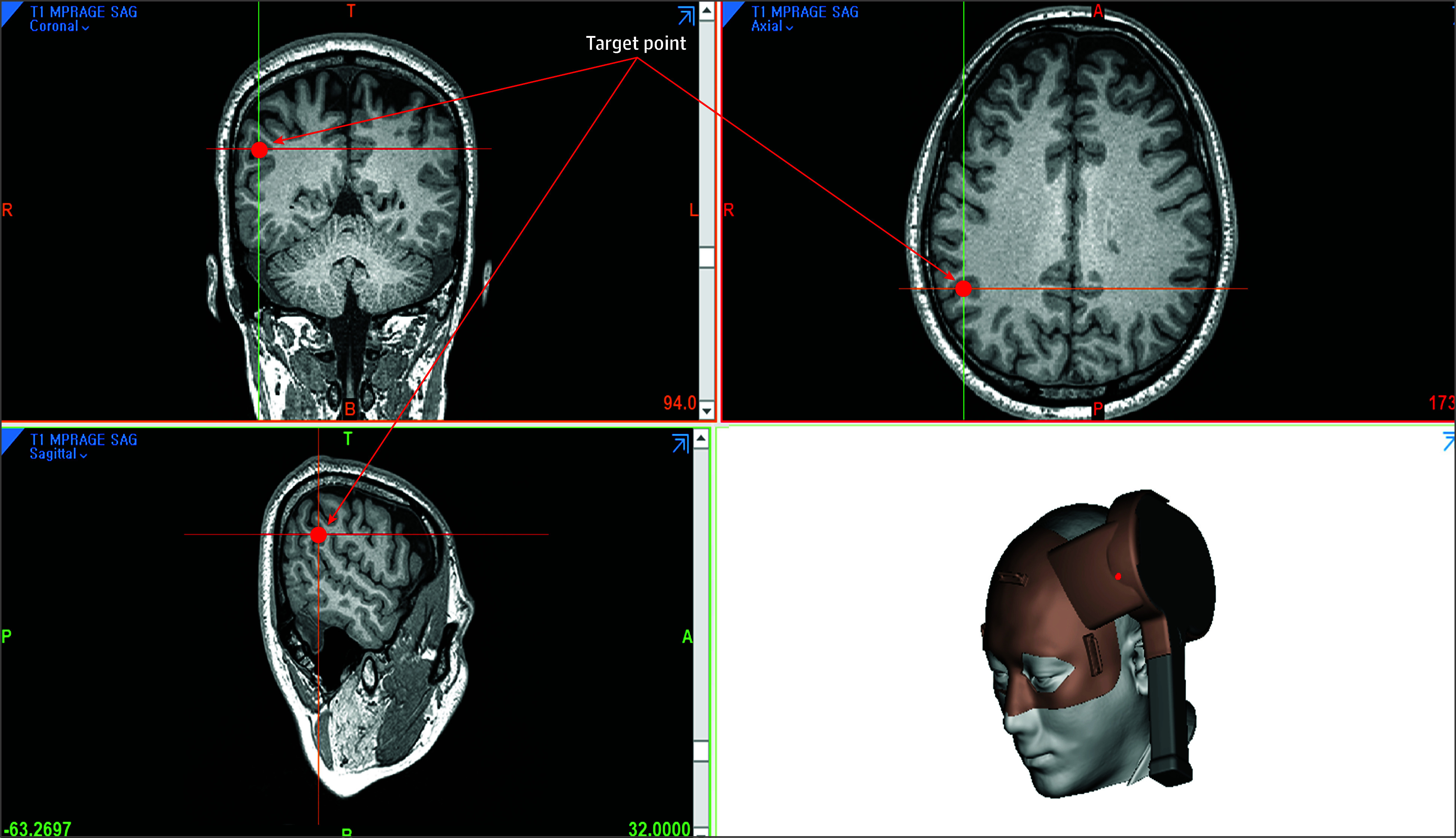
- Active rTMS used 40 trains (20 Hz for 2 seconds at 40 pulses/train), totaling 1600 pulses/day, 5 days/week for 4 weeks; sham played recorded pulse sounds without magnetic stimulation. Targets were individualized from resting-state fMRI connectivity and secured with a personalized 3D-printed coil frame.
- Outcomes were assessed at baseline, 4 weeks, and 8 weeks; the primary outcome was ADAS-Cog-13 change at 8 weeks. Linear mixed models adjusted for age, sex, education, APOE ε4, group, visit, and group-by-visit; fMRI analysis used a precuneus ROI, cluster-level correction, and Spearman correlation between connectivity change and ADAS-Cog change.
Limitations
Stated: small sample size and unequal loss to follow-up led to unbalanced groups; the sham coil only recreated sound without magnetic stimulation, so nonspecific TMS effects such as peripheral nerve or muscle stimulation and bone conduction could not be ruled out; and although participants had amyloid biomarkers, they cannot be considered to have AD without evidence of tau deposition.
- Evident: the neuroimaging sample was smaller (20) after exclusions for protocol differences and incomplete posttreatment fMRI. The paper also reports no significant baseline-to-V2 connectivity increase in the rTMS group (P = .13) and a significant connectivity decline in the sham group (P = .008), and the language-domain result was reversed and possibly ceiling-limited.
Model-written summary. Check it against the paper before relying on it.
Integrity signals
Registry
Cites
Statistics
Figures
Verification
Claims the paper makes
0 Valid · 0 Not valid · 29 Not checked · 42 Own results and interpretations
A result the paper reports from its own data — it cites no other source for it, so there is none to check. The quote shows it is in the paper.
In the paper
“We found that change in ADAS-Cog significantly correlated with corresponding changes in connectivity between the hippocampal seed and the identified rTMS-responsive region (r = −0.57; P = .005 in a 1-sided test with a hypothesis of hippocampal-cortical connectivity).”
§ Effectiveness of Personalized Hippocampal Network–Targeted Stimulation in Alzheimer Disease > Results > Changes in Functional Connectivity
plainstates an association- Asserted: passes — The authors put it forward as true.
- Checkable: passes — It can be checked against evidence.
- Load-bearing: passes — The paper’s conclusions depend on it.
- Based: passes — The paper gives a reason why it holds.
A result the paper reports from its own data — it cites no other source for it, so there is none to check. The quote shows it is in the paper.
In the paper
“The second significant finding was that the improvement in ADAS-Cog scores was significantly correlated with the increased functional connectivity between the hippocampus and the precuneus after rTMS, as determined through resting-state fMRI data analysis.”
§ Effectiveness of Personalized Hippocampal Network–Targeted Stimulation in Alzheimer Disease > Discussion
plainstates an association- Asserted: passes — The authors put it forward as true.
- Checkable: passes — It can be checked against evidence.
- Load-bearing: passes — The paper’s conclusions depend on it.
- Based: passes — The paper gives a reason why it holds.
A result the paper reports from its own data — it cites no other source for it, so there is none to check. The quote shows it is in the paper.
In the paper
“There was no significant difference between the groups both at V1 and V2 in secondary outcomes, including MMSE, MOCA-K, and all components in frontal-executive tests and CANTAB (Table).”
§ Effectiveness of Personalized Hippocampal Network–Targeted Stimulation in Alzheimer Disease > Results > Changes in Cognitive Performance
plain- Asserted: passes — The authors put it forward as true.
- Checkable: passes — It can be checked against evidence.
- Load-bearing: unclear — It is unclear whether the paper’s conclusions depend on it.
- Based: passes — The paper gives a reason why it holds.
A result the paper states — it cites no source for it, so there is none to check. The quote shows it is in the paper.
In the paper
“because the mean language score of our study participants was generally low.”
§ Effectiveness of Personalized Hippocampal Network–Targeted Stimulation in Alzheimer Disease > Discussion
plain- Asserted: passes — The authors put it forward as true.
- Checkable: passes — It can be checked against evidence.
- Load-bearing: passes — The paper’s conclusions depend on it.
- Based: passes — The paper gives a reason why it holds.
A result the paper reports from its own data — it cites no other source for it, so there is none to check. The quote shows it is in the paper.
In the paper
“The group-by-visit interaction effect at V2 from V0 was significant only in the memory domain (−4.5 [1.4]; P = .002).”
§ Effectiveness of Personalized Hippocampal Network–Targeted Stimulation in Alzheimer Disease > Results > Changes in Cognitive Performance
plain- Asserted: passes — The authors put it forward as true.
- Checkable: passes — It can be checked against evidence.
- Load-bearing: passes — The paper’s conclusions depend on it.
- Based: passes — The paper gives a reason why it holds.
33 more claims
Create a free account to see all 71 claims and to verify the 64 references still open.
- It may state two separate claims as one. 22
- Probably not a substantial claim. 18
- The quote only partly states this claim. 1
Claims other papers make about this one
Each is checked against this paper’s own text: does it say what the citing paper says it does?
In the citing paper
“The trial was powered for the ADAS-Cog primary endpoint assuming Cohen’s d ≈ 0.8, α = 0.05 (two-sided), 80% power, and ~ 15% attrition, yielding a target N = 40 [34].”
From Effects of 40-Hz transcranial alternating current stimulation on cognition and neural markers in Alzheimer’s disease: a randomized, sham-controlled trial (2026) · cites this paper as [34]
Self-check
Percentages, sums and reported differences re-computed from the paper’s own numbers.
Each contradiction between two passages listed here was confirmed by an independent check.
Rated major: it would touch a result — a value a result rests on, reported and recomputed p-values on opposite sides of the significance level, two passages that conflict with no sign which is right, or a cited work retracted before this paper was published.
In the paper
§ Effectiveness of Personalized Hippocampal Network–Targeted Stimulation in Alzheimer Disease > Results > Changes in Cognitive Performance
“Also, the rTMS group showed a larger improvement in S-IADL than the sham group at V2 (−2.4 [0.8]; P = .16), while the difference in S-IADL change between the groups was not significant at V1 (P = .002)”
§ Effectiveness of Personalized Hippocampal Network–Targeted Stimulation in Alzheimer Disease > Results > Changes in Cognitive Performance
“| SIADL | 13.0 (9.6) | 13.9 (9.8) | 14.4 (10.0) | 12.4 (6.6) | 12.3 (7.0) | 11.5 (7.4) | −1.1 (0.7) | .16 | −2.4 (0.8) | .002 |”
Rated major: it would touch a result — a value a result rests on, reported and recomputed p-values on opposite sides of the significance level, two passages that conflict with no sign which is right, or a cited work retracted before this paper was published.
In the paper
§ Effectiveness of Personalized Hippocampal Network–Targeted Stimulation in Alzheimer Disease > Discussion
“Interestingly, there were no significant effects on S-IADL and CDR-SOB at V1.”
§ Effectiveness of Personalized Hippocampal Network–Targeted Stimulation in Alzheimer Disease > Results > Changes in Cognitive Performance
“the difference in CDR-SOB change between the groups was also significant at V1 (0.6 [0.3]; P = .046).”
Rated minor: it would not touch a result — a value no result rests on, a p-value that stays on the same side of the significance level, or a conflict that is clerical, resolved elsewhere in the paper, or outside its own findings.
In the paper
§ Effectiveness of Personalized Hippocampal Network–Targeted Stimulation in Alzheimer Disease > Results > Changes in Cognitive Performance
“the difference in CDR-SOB change between the groups was also significant at V1 (0.6 [0.3]; P = .046).”
§ Effectiveness of Personalized Hippocampal Network–Targeted Stimulation in Alzheimer Disease > Results > Changes in Cognitive Performance
“| CDR-SOB | 4.6 (2.8) | 5.0 (3.0) | 5.1 (3.3) | 4.0 (2.6) | 4.1 (2.6) | 3.9 (2.6) | −0.6 (0.3) | .05 | −0.78 (0.3) | .008 |”
Rated minor: it would not touch a result — a value no result rests on, a p-value that stays on the same side of the significance level, or a conflict that is clerical, resolved elsewhere in the paper, or outside its own findings.
In the paper
§ Effectiveness of Personalized Hippocampal Network–Targeted Stimulation in Alzheimer Disease > Discussion
“improvements were evident as soon as 4 weeks after the end of rTMS.”
§ Effectiveness of Personalized Hippocampal Network–Targeted Stimulation in Alzheimer Disease > Results > Changes in Cognitive Performance
“The difference in improvement between the groups was also significant at the fourth week (V1, −4.4 [1.6]; P = .007) (Figure 3 and Table).”
Rated minor: it would not touch a result — a value no result rests on, a p-value that stays on the same side of the significance level, or a conflict that is clerical, resolved elsewhere in the paper, or outside its own findings.
In the paper
§ Effectiveness of Personalized Hippocampal Network–Targeted Stimulation in Alzheimer Disease > Results > Changes in Cognitive Performance
“the praxis domain (−2.097 × 10⁻¹⁵ [0.7]; P = .97)”
§ Effectiveness of Personalized Hippocampal Network–Targeted Stimulation in Alzheimer Disease > Results > Changes in Cognitive Performance
“| Praxis | 1.6 (1.9) | 2.0 (1.6) | 1.4 (1.2) | 1.8 (1.5) | 1.6 (1.9) | 1.7 (2.1) | −0.6 (0.7) | .33 | −2.097 × 10⁻¹⁵ (0.7) | >.99 |”
Citations
Cites
McKhann, G. M., Knopman, D. S., Chertkow, H., Hyman, B. T., Jack, C. R., Kawas, C. H., Klunk, W. E., Koroshetz, W. J., Manly, J. J., Mayeux, R., et al. (2011) · Alzheimer's & Dementia · doi:10.1016/j.jalz.2011.03.005 · Cited by 18,657
AFNI: Software for analysis and visualization of functional magnetic resonance neuroimages
Cox, R. W. (1996) · Computers and Biomedical Research · doi:10.1006/cbmr.1996.0014 · Cited by 10,913
The Clinical Dementia Rating (CDR): Current version and scoring rules
Morris, J. C. (1993) · Neurology · doi:10.1212/wnl.43.11.2412-a · Cited by 9,882
Fischl, B. (2012) · NeuroImage · doi:10.1016/j.neuroimage.2012.01.021 · Cited by 9,526
Lecanemab in early Alzheimer's disease
van Dyck, C. H., Swanson, C. J., Aisen, P., Bateman, R. J., Chen, C., Gee, M., Kanekiyo, M., Li, D., Reyderman, L., Cohen, S., et al. (2023) · New England Journal of Medicine · doi:10.1056/nejmoa2212948 · Cited by 5,678
Large-scale automated synthesis of human functional neuroimaging data.
Yarkoni, T., Poldrack, R. A., Nichols, T. E., Van Essen, D. C., & Wager, T. D. (2011) · Nature Methods · doi:10.1038/nmeth.1635 · Cited by 3,686
Lefaucheur, J.-P., Aleman, A., Baeken, C., Benninger, D. H., Brunelin, J., Di Lazzaro, V., Filipović, S. R., Grefkes, C., Hasan, A., Hummel, F. C., et al. (2020) · Clinical Neurophysiology · doi:10.1016/j.clinph.2019.11.002 · Cited by 2,382
Lefaucheur, J.-P., André-Obadia, N., Antal, A., Ayache, S. S., Baeken, C., Benninger, D. H., Cantello, R. M., Cincotta, M., de Carvalho, M., De Ridder, D., et al. (2014) · Clinical Neurophysiology · doi:10.1016/j.clinph.2014.05.021 · Cited by 2,119
Rossi, S., Antal, A., Bestmann, S., Bikson, M., Brewer, C., Brockmöller, J., Carpenter, L. L., Cincotta, M., Chen, R., Daskalakis, J. D., et al. (2021) · Clinical Neurophysiology · doi:10.1016/j.clinph.2020.10.003 · Cited by 1,573
Parietal lobe contributions to episodic memory retrieval
Wagner, A. D., Shannon, B. J., Kahn, I., & Buckner, R. L. (2005) · Trends in Cognitive Sciences · doi:10.1016/j.tics.2005.07.001 · Cited by 1,571
Research works printed but not linked: 1
- Kang Y, Na D, Hahn S. Seoul Neuropsychological Screening Battery. Incheon: Human Brain Research & Consulting Co; 2003.
Cited by
The emerging field of non-invasive brain stimulation in Alzheimer’s disease
Koch, G., Altomare, D., Benussi, A., Bréchet, L., Casula, E. P., Dodich, A., Pievani, M., Santarnecchi, E., & Frisoni, G. B. (2024) · Brain · doi:10.1093/brain/awae292 · Cited by 90
Non-invasive brain stimulation: current and future applications in neurology
Rektorová, I., Pupíková, M., Fleury, L., Brabenec, L., & Hummel, F. C. (2025) · Nature Reviews Neurology · doi:10.1038/s41582-025-01137-z · Cited by 73
Antonioni, A., Martorana, A., Santarnecchi, E., Hampel, H. J., & Koch, G. (2025) · Alzheimer s & Dementia · doi:10.1002/alz.70337 · Cited by 37
Pini, L., Lista, S., Griffa, A., Allali, G., & Imbimbo, B. P. (2024) · Brain Communications · doi:10.1093/braincomms/fcae460 · Cited by 26
Vaughn, D. A., Marino, B., Engelbertson, A., Dojnov, A., Johnson, L., Stine, M., Vila‐Rodriguez, F., Weiss, N., Nanos, G., & Downar, J. H. (2025) · Transcranial magnetic stimulation . · doi:10.1016/j.transm.2025.100200 · Cited by 14
Wang, L., Hu, W., Wang, H., Song, Z., Lin, H., & Jiang, J. (2024) · Brain stimulation · doi:10.1016/j.brs.2024.11.003 · Cited by 13
Liu, Y., Chen, S., Li, S., Pei, Z., Fan, S., & Guo, Y. (2025) · Journal of Alzheimer s Disease Reports · doi:10.1177/25424823251362444 · Cited by 11
Progress of research and application of non-pharmacologic intervention in Alzheimer's disease
Tang, M., Guo, J.-J., Guo, R.-X., Xu, S., Lou, Q., Hu, Q., Li, W., Yu, J., Yao, Q., & Wang, Q. (2024) · Journal of Alzheimer s Disease · doi:10.1177/13872877241289396 · Cited by 10
Wang, B., Wang, Y., Yang, F., Han, F., Li, K., Sun, K., & Liang, P. (2025) · Journal of NeuroEngineering and Rehabilitation · doi:10.1186/s12984-025-01777-8 · Cited by 9
Zheng, W., Shi, X., Ya, C., Hou, X., Yang, Z., Yao, W., Lv, T., & Bai, F. (2024) · Cerebral Cortex · doi:10.1093/cercor/bhae460 · Cited by 9
Network-targeted transcranial magnetic stimulation (TMS) for mild cognitive impairment (MCI)
Taylor, J. L., Priyanka, B., Hernandez, B., Iv, M., Adamson, M. M., Heath, A. M., Yesavage, J. A., & McNerney, M. W. (2025) · NeuroImage Clinical · doi:10.1016/j.nicl.2025.103819 · Cited by 9
Leng, L., Liao, Z., Lu, P., Sun, Y., Weng, Q., Fan, W., Zhu, H., Wu, W., Liu, P., Liu, X., et al. (2025) · Journal of Alzheimer s Disease · doi:10.1177/13872877251406619 · Cited by 8
VR-based gamma sensory stimulation: a pilot feasibility study
Reis, C., Azizollahi, H., Headley, G., Navarro, S., Hanslmayr, S., Clouter, A., Zanto, T. P., & Certain, R. (2025) · Scientific Reports · doi:10.1038/s41598-025-13725-6 · Cited by 8
Wang, C., Chen, H., Liu, M., Lu, W., Hao, Z., & Wang, B. (2026) · Journal of NeuroEngineering and Rehabilitation · doi:10.1186/s12984-025-01842-2 · Cited by 7
Badillo‐Goicoechea, E., Agres, P. F., Rau, J. M. H., Agustín, A. S., & Voss, J. L. (2026) · eLife · doi:10.7554/elife.108934.3 · Cited by 7
Ferroptosis and aging: Inducing and catalyzing neurodegenerative diseases
Song, Q., Sun, S., Song, Y., Wang, Y., Yin, Y., Zhang, L., & Cui, Q. (2025) · Neural Regeneration Research · doi:10.4103/nrr.nrr-d-25-00710 · Cited by 7
Neuromodulation and cognition in late-life depression
Mirjalili, M., Blumberger, D. M., Brunoni, A. R., Mulsant, B. H., & Rajji, T. K. (2026) · Neuropsychopharmacology · doi:10.1038/s41386-026-02323-3 · Cited by 6
Clinical development and guiding theory of transcranial magnetic stimulation: a literature review
Lin, Z., Cheng, J.-L., Tan, C., Liu, Z., & Han, D. (2025) · Annals of Medicine · doi:10.1080/07853890.2025.2581921 · Cited by 6
Zhang, Y., Xu, K., Wang, Y., Shen, Y., Liu, Z., Zhang, C., Zhou, Y., Lv, P., Bai, Y., & Wang, S. (2025) · BMC Neurology · doi:10.1186/s12883-025-04292-4 · Cited by 5
Leuchter, M. K., Oughli, H. A., Durbin, K. A., Jackson, N. J., Elashoff, D. A., Chang, T. S., Corlier, J., Ngo, D., Matthews, C. D., Wong, D. Y., et al. (2025) · Alzheimer s & Dementia Translational Research & Clinical Interventions · doi:10.1002/trc2.70043 · Cited by 4
Fang, M., Yan, Y., Song, W., Geng, Z., Wang, L., Hu, C., Li, W., Song, B., Chen, M., Dai, Y., et al. (2026) · Alzheimer's Research & Therapy · doi:10.1186/s13195-026-02033-4 · Cited by 4
Diagnosis and Treatment of Alzheimer’s Disease: Current Update
Yim, Y., & Moon, W. (2025) · Journal of the Korean Society of Radiology · doi:10.3348/jksr.2024.0146 · Cited by 4
Neuromodulation in Geriatric Psychiatry: an Update
Franklin, C. E., Behlke, L. M., & Freedberg, A. (2025) · Current Geriatrics Reports · doi:10.1007/s13670-025-00439-w · Cited by 4
Chigareva, O., Astafeva, D., Bikbaeva, K., Berezhnaya, K., Sheifer, M., Gayduk, A., Khairedinova, I., Zakharov, A. V., Sack, A. T., Koutsoumistros, T., et al. (2024) · Research Publications (Maastricht University) · doi:10.24869/psyd.2024.188 · Cited by 4
Wang, Y., Li, W., Dong, T., Xu, R., Ai, Q., Yang, L., Gai, X., & Li, L. (2025) · Frontiers in Human Neuroscience · doi:10.3389/fnhum.2025.1601651 · Cited by 3
Heath, A. M., Mojabi, F. S., Kraybill, E. P., Beard, C., Venkataramanan, V., Cuéllar, V., Piekarski, D. J., & McNerney, M. W. (2025) · Experimental Neurology · doi:10.1016/j.expneurol.2025.115551 · Cited by 2
Kashyap, B., Hanson, L. R., Gustafson, S. K., Barclay, T. R., Howe, C. M., Sherman, S. J., Hungs, M., & Rosenbloom, M. H. (2024) · Frontiers in Neuroscience · doi:10.3389/fnins.2024.1492428 · Cited by 2
Noda, Y. (2025) · Clinical Neurophysiology · doi:10.1016/j.clinph.2025.2111373 · Cited by 1
Zhang, Y., Wang, Y., Xu, K., Zhang, C., Lv, P., Bai, Y., & Wang, S. (2025) · Frontiers in Aging Neuroscience · doi:10.3389/fnagi.2025.1615734 · Cited by 1
Kumar, B. S., Syed, A., Ekta, Raparthi, A., Palaniappan, A., Kakde, S. P., Shreelakshmi, M. N., Biswas, S. K., Ahmed, S. R., Khan, R., et al. (2025) · medRxiv · doi:10.1101/2025.08.31.25334781 · Cited by 1
Eldaly, A. B. M., Agadagba, S. K., Verma, A., Li, K., Lim, L. W., & Chan, L. L.-H. (2025) · Neuroscience · doi:10.1016/j.neuroscience.2025.12.035 · Cited by 1
Wen, J., Li, M., Xu, J., Sun, Y., Chen, X., & Mao, Z. (2026) · Neurological Sciences · doi:10.1007/s10072-026-08852-5 · Cited by 1
Napoleon, T., Akinrinde, D., Femi‐Lawal, V. O., Adebajo, G. O., Yokolo, H., Okei, F. U., Alabi, G. J., Ifeoluwa, O. I., Lawal, S. O., Abati, S. O., et al. (2026) · Health Science Reports · doi:10.1002/hsr2.73104 · Cited by 1
Prospects for treating Alzheimer’s disease
Васильевна, В. Н., Novikov, D. K., Vekhova, K. A., Zhuk, A. M., Klimanovich, D. L., Isaikin, A. I., & Zakharov, V. V. (2025) · S S Korsakov Journal of Neurology and Psychiatry · doi:10.17116/jnevro202512504254 · Cited by 1
Broncel, A., Konopacki, J., David, T. B., Gałecki, P., Ben-Menachem, E., & Krawczyk, M. (2026) · Journal of Alzheimer s Disease · doi:10.1177/13872877261458276 · Cited by 1
Sun, W., Bi, H., Qi, Z., Hu, M., & Wang, W. (2025) · Journal of Alzheimer s Disease Reports · doi:10.1177/25424823251407542 · Cited by 1
Xu, N., Xing, Y., Li, A., Liu, S., Gao, J., Liu, X., Xie, W., Guo, N., Chen, Y., Sun, X., et al. (2026) · Brain stimulation · doi:10.1016/j.brs.2026.103142 · Cited by 1
Paranhos, T., Du, A., Eckbo, R., Wong, B., Camprodon, J. A., Dickerson, B. C., Eldaief, M. C., & Touroutoglou, A. (2026) · International Review of Psychiatry · doi:10.1080/09540261.2026.2682195 · Cited by 1
Liu, Y., Zhu, L., Pei, Z., Zhou, Z., Su, X., Ren, H., Fan, S., Lan, X., Lian, C., Shi, X., et al. (2025) · Journal of Alzheimer s Disease Reports · doi:10.1177/25424823251377988 · Cited by 1
A Network Target for Memory Dysfunction Derived from Brain Lesions and StimulationsPreprint
Howard, C., Madan, S., Garimella, A. H., Schaper, F. L. W. V. J., Kletenik, I., Ng, M., Mosley, P. E., Grafman, J. H., Bakshi, R., Glanz, B., et al. (2026) · medRxiv · doi:10.64898/2026.03.10.26348082 · Cited by 1
Papaliagkas, V. T., Kalinderi, K., Moschou, M., Arnaoutoglou, M., Koutsouraki, E., & Kimiskidis, V. Κ. (2026) · Life · doi:10.3390/life16030397 · Cited by 1
Deng, S., Tian, L., Song, J., Zhou, Y., Gao, Y., & Cao, S. (2026) · Brain Sciences · doi:10.3390/brainsci16080795 · Cited by 1
Velioğlu, H. A., Şekerci, B. S., Hanoğlu, T., & Salar, A. B. (2025) · Anadolu Kliniği Tıp Bilimleri Dergisi · doi:10.21673/anadoluklin.1595288 · Cited by 1
(2024) · JAMA Network Open · doi:10.1001/jamanetworkopen.2024.26187 · Cited by 1
Wang, J., Fu, X., Liu, J., & Yang, Y. (2026) · Frontiers in Aging Neuroscience · doi:10.3389/fnagi.2026.1842455
Valverde, H. P., Clark, B. J., Hogeveen, J., & Clark, V. P. (2026) · Brain Sciences · doi:10.3390/brainsci16050527
Zhang, Y., Liu, S., Xu, K., Shen, Y., Liu, Z., Wang, Y., Bai, Y., & Wang, S. (2025) · Neurological Sciences · doi:10.1007/s10072-025-08531-x
Alzheimer’s Disease: Progress in Biomarkers, Diagnostics and Therapies
Wilson, E. N., Sommer, B., Scheltens, P., & Nikolich, K. (2026) · Springer eBooks · doi:10.1007/978-3-032-31497-0_8
Kwon, S., Lee, S., Siegel, J. S., Chiulli, N., Freedberg, M., Hebscher, M., Hendrikse, J. J., Hermiller, M. S., Ji, G., Tambini, A., et al. (2026) · bioRxiv (Cold Spring Harbor Laboratory) · doi:10.64898/2026.04.10.717784
Functional connectivity in neurodegenerative conditions
Basaia, S., Orlandi, F., Lumaca, L., Filippi, M., & Agosta, F. (2025) · Elsevier eBooks · doi:10.1016/b978-0-443-19099-5.00008-8
Wang, Y., Gu, Z., Zhang, H., Bi, X., Chen, L., & Lu, J. (2026) · Japanese Journal of Radiology · doi:10.1007/s11604-026-02062-x
Li, L., Wang, S. W., Kueh, Y. C., & Kuan, G. (2026) · Cognitive Therapy and Research · doi:10.1007/s10608-026-10760-z
Xu, N., Xing, Y., Li, A., Pan, R., Liu, S., Gao, J., Liu, X., Tao, T., Zhang, P., Xie, W., et al. (2026) · medRxiv · doi:10.64898/2026.02.13.26346250
Johnson, L., Bowman, J., Voss, M., Middleton, V. J., Rodriguez, J., Dojnov, A., Marino, B., Steinfink, D., Donachie, N., Vaughn, D. A., et al. (2026) · Transcranial magnetic stimulation . · doi:10.1016/j.transm.2026.100329
Zhang, Q., Liu, C., & Zhang, Q. (2026) · ALPHA PSYCHIATRY · doi:10.31083/ap51117
Liu, Y., Liu, S., Yan, H., Yang, X., Wu, Y., Liu, C., & Xu, Y. (2026) · Frontiers in Neuroscience · doi:10.3389/fnins.2026.1890235
Zhu, Z., Xu, J., Wu, N., Su, Q., Zhu, S., Jiang, J., Zhang, G., Wang, L., & Lin, H. (2026) · Research Square · doi:10.21203/rs.3.rs-10979108/v1
Prospects for the Treatment of Alzheimer’s Disease
Васильевна, В. Н., Novikov, D. K., Vekhova, K. A., Zhuk, A. M., Klimanovich, D. L., Isaikin, A. I., & Zakharov, V. V. (2025) · Neuroscience and Behavioral Physiology · doi:10.1007/s11055-025-01882-0
A watershed algorithm GUI for personalized fMRI-guided rTMS target
Feng, Z.-J., Wei, Z., Hong, L., Fang, H., Han, Y., Yang, P., Lv, D., & Zang, Y.-F. (2026) · NeuroImage · doi:10.1016/j.neuroimage.2026.121743
VR‐based Gamma Sensory Stimulation: A feasibility study
Reis, C., Azizollahi, H., Headley, G., Navarro, S., Hanslmayr, S., Clouter, A., Zanto, T. P., & Certain, R. (2025) · Alzheimer s & Dementia · doi:10.1002/alz70859_106544
Frank, L. R., Galinsky, V. L., Zhang, H., Hall, J. D., Bondi, M. W., & Chou, Y. (2026) · Frontiers in Human Neuroscience · doi:10.3389/fnhum.2026.1741133
Transcranial Magnetic Stimulation in Older Adults
Basiru, T., Camprodon, J. A., & Kritzer, M. D. (2025) · Advances in neuroethics · doi:10.1007/978-3-031-92401-9_12
Cunningham, U. J., Seal, P. T., Mustapha, K. O. S. O., & Keebler, J. R. (2026) · Proceedings of the Human Factors and Ergonomics Society Annual Meeting · doi:10.1177/10711813261499646
Stronger memories through smarter stimulation
Riddle, J. (2026) · eLife · doi:10.7554/elife.111806
Luo, J., & Chen, Q. (2026) · Journal of Alzheimer s Disease Reports · doi:10.1177/25424823261500993
Wang, D., Jiang, D., Chen, C., Xu, X., Huang, G., Zheng, K., Zhang, G., & Ren, C. (2026) · Frontiers in Neurology · doi:10.3389/fneur.2026.1703554
Liu, F., Zhang, Z., Wei, L., Chen, Y., Zheng, Z., Xu, Y., Cai, H., Li, Z. Y., Tang, Y., Wang, J., et al. (2026) · Transcranial magnetic stimulation . · doi:10.1016/j.transm.2026.100222
Zhou, S., Keller, C. J., Chen, N.-F., Adeli, E., & Lin, F. V. (2025) · Neuroscience & Biobehavioral Reviews · doi:10.1016/j.neubiorev.2025.106528
Yang, J., Wang, J., Chai, W., Zhang, L., Li, A., Lan, G., Jiang, M., Fan, X., 杨洪杰, Li, J., et al. (2026) · Alzheimer s & Dementia · doi:10.1002/alz.71397
Jian, J., Zhuang, Y., Ding, Z., Wang, J., Zhou, Y., Yan, T., Jiang, T., Yang, M., Kuan, G., & Liu, W. (2026) · Brain‐X · doi:10.1002/brx2.70045
Taylor, J. L., Hernandez, B., Lazzeroni, L. C., McNerney, M. W., Heath, A. M., Ashford, J. W., Cheng, J. J., Chao, S. Z., Priyanka, B., Iv, M., et al. (2026) · Brain Disorders · doi:10.1016/j.dscb.2026.100322
Chen, J., Li, J., Ran, L., Li, K., & Xie, Y. (2026) · Journal of Molecular Neuroscience · doi:10.1007/s12031-026-02535-8
Network-targeted TMS modulates task-related striatal activity during motor skill learningPreprint
Park, S., Kim, J., Kwon, Y., & Kim, S. (2026) · bioRxiv (Cold Spring Harbor Laboratory) · doi:10.64898/2026.03.17.712285
Self-citationÇankaya, Ş., Akturk, A., Karakuş, A., Hanoğlu, L., Mardinoğlu, A., & Yuluğ, B. (2025) · Frontiers in Human Neuroscience · doi:10.3389/fnhum.2025.1661790
Cognitive enhancement by brain stimulation techniques
Ebrahimzadeh, E., Rostami, R., & Soltanian-Zadeh, H. (2026) · Frontiers research topics · doi:10.3389/978-2-8325-7832-2
Translational Neuroscience: Foundations for Precision Therapies
Nikolich, K., & Malenka, R. C. (2026) · Springer eBooks · doi:10.1007/978-3-032-31497-0
Abdelsalam, O. K., Mosad, N., Abouelmagd, M. E., Messak, M., Almosilhy, N. A., Harb, A., Hassan, M. A., Shata, A., & Makhlouf, H. A. (2026) · Neuromodulation Technology at the Neural Interface · doi:10.1016/j.neurom.2026.09.008
Kewat, D. P., Kumari, N., Kumar, N., Vaishnav, V. A. D., Pandey, P. P., & Bodakhe, S. H. (2025) · doi:10.70593/978-93-7185-149-7_4
Macedo, J., Almeida, M., Ribeiro, R., Álvarez, M. J. L., & Ribeiro, F. (2026) · Neurobiology of Aging · doi:10.1016/j.neurobiolaging.2026.11.002
Personalized Prediction of Differences in fMRI Connectivity Estimates Across Preprocessing PipelinesPreprint
Maximov, Y., Volkov, A., Chattopadhyay, T., Thompson, P. M., & Gabitov, I. (2026) · bioRxiv (Cold Spring Harbor Laboratory) · doi:10.64898/2026.11.04.763874
Effects of rTMS on EEG Time-Frequency and Network Features of Alzheimer's Disease
Guo, M., Chen, S., Wang, L., Wang, P., Wang, Q., Gao, J., & Xu, G. (2025) · Lecture notes in electrical engineering · doi:10.1007/978-981-96-4067-6_5
Zhao, K., Zhou, R., Chen, P., Wang, D., Li, Y., Bi, S., Wang, D., Wei, Y., Xi, H., Yao, H., et al. (2025) · Research Square · doi:10.21203/rs.3.rs-8184263/v1
Zhang, W., Hu, Q., Ding, M., Qi, J., Wang, X., Chang, X., Li, C., Wang, H., Zhang, L., 高守玹, et al. (2026) · Aging and Disease · doi:10.14336/ad.2026.11026
Huang, A., Jiang, K., Chi, L., Qiao, M., Yang, X., Wu, H., Chen, S., Fan, J., Wang, H., Chen, Y., et al. (2026) · Translational Psychiatry · doi:10.1038/s41398-026-04539-9
Atrofia hipocampal na doença de Alzheimer: mecanismos e implicações
Pires, J. I. G. S., Severo, A. T., Davesac, C. L., Crispim, D. D. S., Pagliarini, E. R., Orça, L. C. D., Ferreira, L. O., Welter, M. W., Cabeda, R., & Alves, G. C. S. (2025) · Revista Eletrônica Acervo Científico · doi:10.25248/reac.e19452.2025
Technologies for comprehensive spa health programs aimed at reducing biological age
Kotenko, K. V., Aa, M., Kikot, A. I., Olifer, Y. S., Illarionov, V. E., Markosyan, T. G., Vasilieva, E. S., Mikhaelis, M. A., & Корчажкина, Н. Б. (2026) · Fizioterapevt (Physiotherapist) · doi:10.33920/med-14-2604-18
Metadata
- Authors
- Jung, Y. H., Jang, H., Park, S., Kim, H. J., Seo, S. W., Kim, G. B., Shon, Y.-M., Kim, S., & Na, D. L.
- Affiliations
- Myongji Hospital (KR)
- Seoul National University (KR)
- Hanyang University (KR)
- Samsung Medical Center (KR)
- Anymedi Inc, Seoul, Korea
- Institute for Basic Science (KR)
- Corresponding author
- Kim, Sungshin
- Na, Duk L.
- ORCID
- Venue
- JAMA Network Open
- Publisher
- American Medical Association (AMA)
- Published
- 2024-05-06
- Volume
- 7
- Issue
- 5
- Pages
- e249220
- ISSN
- 2574-3805 (ISSN-L)
- PMC
- PMC11074813
- OpenAlex
- W4396669663
- Semantic Scholar
- d9b2ebd34e17fb8e137c8140c1db1b85f836528d
- Cited by
- 86
- References
- 58
- Citations by year
- 2026: 43 · 2025: 35 · 2024: 8
- FWCI
- 11.16
- Type
- journal article
- Language
- en
- Open access
- gold
- doi.org
- Licence
- cc-by
- Locations
- JAMA Network Open (publishedVersion, cc-by)
- PubMed Central (publishedVersion, cc-by)
- PubMed (publishedVersion)
- Funders
- Hanyang University
- Korea Health Industry Development Institute
- National Research Foundation of Korea (NRF-2021R1A2C2011648, 2021R1A2C2011648, NRF-2020R1A2C1009778)
- Ministry of Science and ICT, South Korea (HU20C0414, NRF-2020R1A2C1009778)
- Korea Centers for Disease Control and Prevention (2023-ER1003-00)
- Topics
- Life Sciences › Neuroscience › Neurology › Transcranial Magnetic Stimulation Studies
- Health Sciences › Medicine › Psychiatry and Mental health › Dementia and Cognitive Impairment Research
- Life Sciences › Neuroscience › Cellular and Molecular Neuroscience › Alzheimer's disease research and treatments
- Keywords
- Alzheimer's disease, repetitive transcranial magnetic stimulation, personalized stimulation, hippocampal network, functional connectivity, early Alzheimer's disease, amyloid biomarkers, parietal cortex, cognitive function, functional performance, non-pharmacological treatment, ADAS-Cog, CDR-SB, instrumental activities of daily living
- MeSH terms
- Aged, Aged, 80 and over, Alzheimer Disease, Female, Hippocampus, Humans, Magnetic Resonance Imaging, Male, Middle Aged, Treatment Outcome, Transcranial Magnetic Stimulation
About these checks
Registry, retraction, Cites and statistics results are computed, not judged, with one exception: a printed reference that no index lists is read once by a model before it counts as a citation error. Claims are extracted by a model and kept only when their quote appears verbatim in the text; each cited source is then checked, with a model’s help, for whether it says what the claim relies on. Those verdicts can be wrong — read the claim’s quote and the cited source before relying on one.
A language model drew the claims from the paper on 2026-11-27, under version 3 of the claim definition (model deepseek-v4.1-flash, prompt extract-v3).
A second model labelled each claim on 2026-11-27 (model jev-1.13-20260917, definition revision gold-guideline-v0.2).
Statistics and arithmetic are recomputed, not judged.
Confidence bands are shown only for fields calibrated on our annotated test set. None is calibrated yet, so no band is shown.
What counts as a claim ›How we measure confidence ›How we check this ›
Are you an author, or do you see a problem with this page? Request a review
Data sources
Bibliographic data: Semantic Scholar, OpenAlex, Crossref.
Contains information from the Semantic Scholar Academic Graph Datasets, made available under the ODC Attribution License (ODC-BY 1.0).
Semantic Scholar’s data is described in: Kinney, R., et al. (2023). The Semantic Scholar Open Data Platform. arXiv:2301.10140.
