

The DOI matches its Crossref record; 2 of the 2 references it cites were found in a registry or an index.
Ponesimod Compared With Teriflunomide in Patients With Relapsing Multiple Sclerosis in the Active-Comparator Phase 3 OPTIMUM Study: A Randomized Clinical Trial
Open accessAbstract
Importance: To our knowledge, the Oral Ponesimod Versus Teriflunomide In Relapsing Multiple Sclerosis (OPTIMUM) trial is the first phase 3 study comparing 2 oral disease-modifying therapies for relapsing multiple sclerosis (RMS). Objective: To compare the efficacy of ponesimod, a selective sphingosine-1-phosphate receptor 1 (S1P1) modulator with teriflunomide, a pyrimidine synthesis inhibitor, approved for the treatment of patients with RMS. Design, Setting, and Participants: This multicenter, double-blind, active-comparator, superiority randomized clinical trial enrolled patients from April 27, 2015, to May 16, 2019, who were aged 18 to 55 years and had been diagnosed with multiple sclerosis per 2010 McDonald criteria, with a relapsing course from the onset, Expanded Disability Status Scale (EDSS) scores of 0 to 5.5, and recent clinical or magnetic resonance imaging disease activity. Interventions: Patients were randomized (1:1) to 20 mg of ponesimod or 14 mg of teriflunomide once daily and the placebo for 108 weeks, with a 14-day gradual up-titration of ponesimod starting at 2 mg to mitigate first-dose cardiac effects of S1P1 modulators and a follow-up period of 30 days. Main Outcomes and Measures: The primary end point was the annualized relapse rate. The secondary end points were the changes in symptom domain of Fatigue Symptom and Impact Questionnaire-Relapsing Multiple Sclerosis (FSIQ-RMS) at week 108, the number of combined unique active lesions per year on magnetic resonance imaging, and time to 12-week and 24-week confirmed disability accumulation. Safety and tolerability were assessed. Exploratory end points included the percentage change in brain volume and no evidence of disease activity (NEDA-3 and NEDA-4) status. Results: For 1133 patients (567 receiving ponesimod and 566 receiving teriflunomide; median [range], 37.0 [18-55] years; 735 women [64.9%]), the relative rate reduction for ponesimod vs teriflunomide in the annualized relapse rate was 30.5% (0.202 vs 0.290; P < .001); the mean difference in FSIQ-RMS, -3.57 (-0.01 vs 3.56; P < .001); the relative risk reduction in combined unique active lesions per year, 56% (1.405 vs 3.164; P < .001); and the reduction in time to 12-week and 24-week confirmed disability accumulation risk estimates, 17% (10.1% vs 12.4%; P = .29) and 16% (8.1% vs 9.9; P = .37), respectively. Brain volume loss at week 108 was lower by 0.34% (-0.91% vs -1.25%; P < .001); the odds ratio for NEDA-3 achievement was 1.70 (25.0% vs 16.4%; P < .001). Incidence of treatment-emergent adverse events (502 of 565 [88.8%] vs 499 of 566 [88.2%]) and serious treatment-emergent adverse events (49 [8.7%] vs 46 [8.1%]) was similar for both groups. Treatment discontinuations because of adverse events was more common in the ponesimod group (49 of 565 [8.7%] vs 34 of 566 [6.0%]). Conclusions and Relevance: In this study, ponesimod was superior to teriflunomide on annualized relapse rate reduction, fatigue, magnetic resonance imaging activity, brain volume loss, and no evidence of disease activity status, but not confirmed disability accumulation. The safety profile was in line with the previous safety observations with ponesimod and the known profile of other S1P receptor modulators. Trial Registration: ClinicalTrials.gov Identifier: NCT02425644.
Overview
The claims and statistics of this paper haven’t been checked yet.
Run the check — free, no account needed. It reads the open-access text and checks the sources it cites.
Integrity signals
Registry
Cites
Statistics
Figures
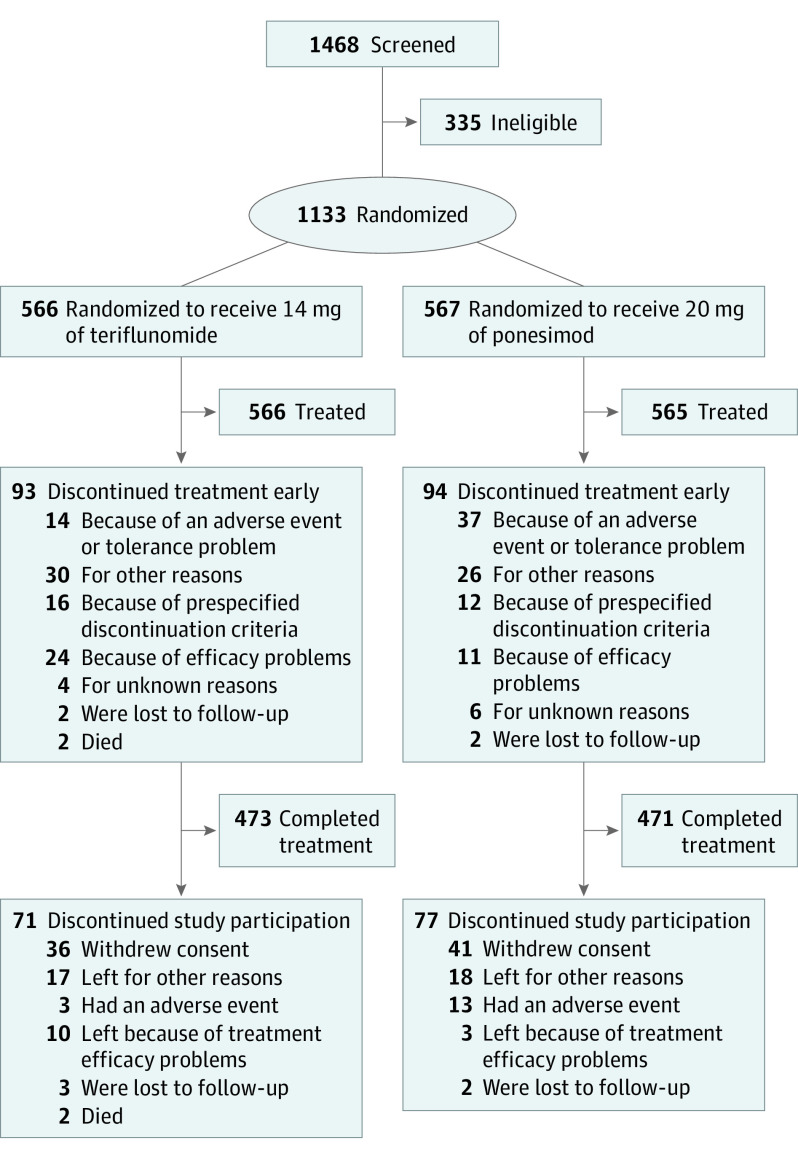
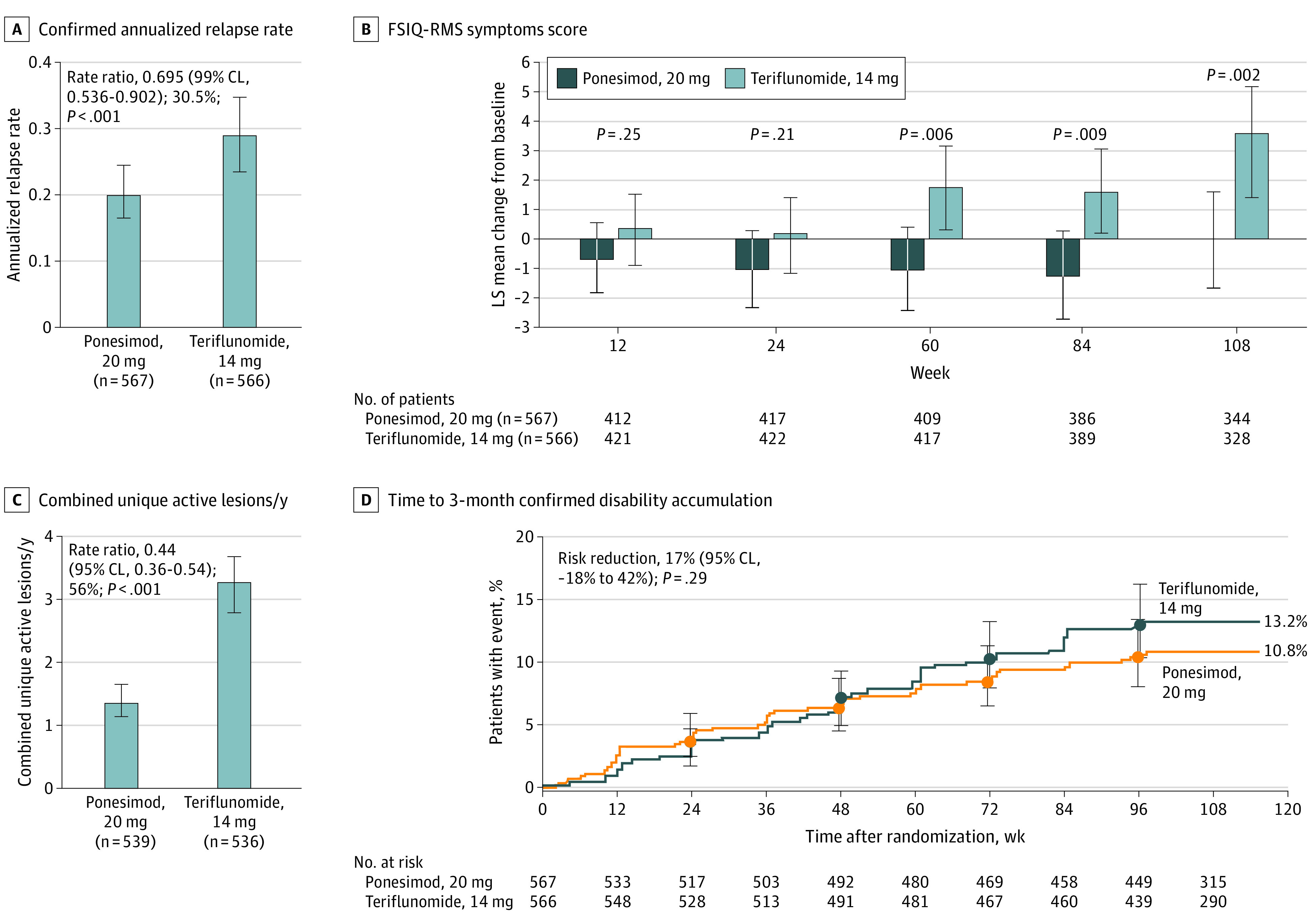
Verification
Claims the paper makes
The claims and statistics of this paper haven’t been checked yet.
Run the check — free, no account needed. It reads the open-access text and checks the sources it cites.
Self-check
Percentages, sums and reported differences re-computed from the paper’s own numbers.
The self-check needs the paper’s full text.
Citations
Cites
Diagnostic criteria for multiple sclerosis: 2010 revisions to the McDonald criteria
Polman, C. H., Reingold, S. C., Banwell, B., Clanet, M., Cohen, J. A., Filippi, M., Fujihara, K., Havrdova, E., Hutchinson, M., Kappos, L., et al. (2011) · Annals of Neurology · doi:10.1002/ana.22366 · Cited by 9,802
Self-citationOcrelizumab versus Interferon Beta-1a in Relapsing Multiple Sclerosis
Hauser, S. L., Bar-Or, A., Comi, G., Giovannoni, G., Hartung, H.-P., Hemmer, B., Lublin, F., Montalban, X., Rammohan, K. W., Selmaj, K., et al. (2017) · New England Journal of Medicine · doi:10.1056/nejmoa1601277 · Cited by 2,021
Self-citation
Research works printed but not linked: 37
- Thompson, 2018, Multiple sclerosis., Lancet, 391, 1622, 10.1016/S0140-6736(18)30481-1 · DOI
- Dobson, 2019, Multiple sclerosis—a review., Eur J Neurol, 26, 27, 10.1111/ene.2019.26.issue-1 · DOI
- Confavreux, 2000, Relapses and progression of disability in multiple sclerosis., N Engl J Med, 343, 1430, 10.1056/NEJM200011163432001 · DOI
- O’Connor, 2011, Randomized trial of oral teriflunomide for relapsing multiple sclerosis., N Engl J Med, 365, 1293, 10.1056/NEJMoa1014656 · DOI
- Confavreux, 2014, Oral teriflunomide for patients with relapsing multiple sclerosis (TOWER): a randomised, double-blind, placebo-controlled, phase 3 trial., Lancet Neurol, 13, 247, 10.1016/S1474-4422(13)70308-9 · DOI
- Kappos, 2010, A placebo-controlled trial of oral fingolimod in relapsing multiple sclerosis., N Engl J Med, 362, 387, 10.1056/NEJMoa0909494 · DOI
- Fox, 2012, Placebo-controlled phase 3 study of oral BG-12 or glatiramer in multiple sclerosis., N Engl J Med, 367, 1087, 10.1056/NEJMoa1206328 · DOI
- Gold, 2012, Placebo-controlled phase 3 study of oral BG-12 for relapsing multiple sclerosis., N Engl J Med, 367, 1098, 10.1056/NEJMoa1114287 · DOI
- Kappos, 2018, Siponimod versus placebo in secondary progressive multiple sclerosis (EXPAND): a double-blind, randomised, phase 3 study., Lancet, 391, 1263, 10.1016/S0140-6736(18)30475-6 · DOI · Paper page
- Hutchinson, 2009, The efficacy of natalizumab in patients with relapsing multiple sclerosis: subgroup analyses of AFFIRM and SENTINEL., J Neurol, 256, 405, 10.1007/s00415-009-0093-1 · DOI
- Ontaneda, 2019, Early highly effective versus escalation treatment approaches in relapsing multiple sclerosis., Lancet Neurol, 18, 973, 10.1016/S1474-4422(19)30151-6 · DOI
- Brown, 2019, Association of initial disease-modifying therapy with later conversion to secondary progressive multiple sclerosis., JAMA, 321, 175, 10.1001/jama.2018.20588 · DOI
- Derfuss, 2020, Advances in oral immunomodulating therapies in relapsing multiple sclerosis., Lancet Neurol, 19, 336, 10.1016/S1474-4422(19)30391-6 · DOI
- D’Ambrosio, 2016, Ponesimod, a selective S1P1 receptor modulator: a potential treatment for multiple sclerosis and other immune-mediated diseases., Ther Adv Chronic Dis, 7, 18, 10.1177/2040622315617354 · DOI
- Piali, 2011, The selective sphingosine 1-phosphate receptor 1 agonist ponesimod protects against lymphocyte-mediated tissue inflammation., J Pharmacol Exp Ther, 337, 547, 10.1124/jpet.110.176487 · DOI
- Chun, 2010, International Union of Basic and Clinical Pharmacology: LXXVIII, lysophospholipid receptor nomenclature., Pharmacol Rev, 62, 579, 10.1124/pr.110.003111 · DOI
- Brossard, 2013, Pharmacokinetics and pharmacodynamics of ponesimod, a selective S1P1 receptor modulator, in the first-in-human study., Br J Clin Pharmacol, 76, 888, 10.1111/bcp.2013.76.issue-6 · DOI
- Krause, 2014, Population pharmacokinetics and pharmacodynamics of ponesimod, a selective S1P1 receptor modulator., J Pharmacokinet Pharmacodyn, 41, 261, 10.1007/s10928-014-9362-4 · DOI
- Olsson, 2014, Oral ponesimod in relapsing-remitting multiple sclerosis: a randomised phase II trial., J Neurol Neurosurg Psychiatry, 85, 1198, 10.1136/jnnp-2013-307282 · DOI
- Hudgens, 2019, Development and validation of the FSIQ-RMS: a new patient-reported questionnaire to assess symptoms and impacts of fatigue in relapsing multiple sclerosis., Value Health, 22, 453, 10.1016/j.jval.2018.11.007 · DOI
- Schwab, 2007, Finding a way out: lymphocyte egress from lymphoid organs., Nat Immunol, 8, 1295, 10.1038/ni1545 · DOI
- Smith, 2001, Normalized accurate measurement of longitudinal brain change., J Comput Assist Tomogr, 25, 466, 10.1097/00004728-200105000-00022 · DOI
- Sormani, 2017, Defining brain volume cutoffs to identify clinically relevant atrophy in RRMS., Mult Scler, 23, 656, 10.1177/1352458516659550 · DOI
- Kappos, 2016, Inclusion of brain volume loss in a revised measure of ‘no evidence of disease activity’ (NEDA-4) in relapsing-remitting multiple sclerosis., Mult Scler, 22, 1297, 10.1177/1352458515616701 · DOI
- Bretz, 2009, A graphical approach to sequentially rejective multiple test procedures., Stat Med, 28, 586, 10.1002/sim.v28:4 · DOI
- Lublin, 2005, Multiple sclerosis trial designs for the 21st century: building on recent lessons., J Neurol, 252, v46, 10.1007/s00415-005-5008-1 · DOI
- Janardhan, 2002, Quality of life in patients with multiple sclerosis: the impact of fatigue and depression., J Neurol Sci, 205, 51, 10.1016/S0022-510X(02)00312-X · DOI · Paper page
- Ayache, 2017, Fatigue in multiple sclerosis—insights into evaluation and management., Neurophysiol Clin, 47, 139, 10.1016/j.neucli.2017.02.004 · DOI
- Chalah, 2015, Fatigue in multiple sclerosis: neural correlates and the role of non-invasive brain stimulation., Front Cell Neurosci, 9, 460, 10.3389/fncel.2015.00460 · DOI
- Sormani, 2014, Treatment effect on brain atrophy correlates with treatment effect on disability in multiple sclerosis., Ann Neurol, 75, 43, 10.1002/ana.24018 · DOI
- Pichler, 2016, Combined analysis of global and compartmental brain volume changes in early multiple sclerosis in clinical practice., Mult Scler, 22, 340, 10.1177/1352458515593405 · DOI
- Radue, 2015, Correlation between brain volume loss and clinical and MRI outcomes in multiple sclerosis., Neurology, 84, 784, 10.1212/WNL.0000000000001281 · DOI
- Radue, 2017, Teriflunomide slows BVL in relapsing MS: a reanalysis of the TEMSO MRI data set using SIENA., Neurol Neuroimmunol Neuroinflamm, 4, 10.1212/NXI.0000000000000390 · DOI
- Cohen, 2019, Safety and efficacy of ozanimod versus interferon beta-1a in relapsing multiple sclerosis (RADIANCE): a multicentre, randomised, 24-month, phase 3 trial., Lancet Neurol, 18, 1021, 10.1016/S1474-4422(19)30238-8 · DOI
- Calabresi, 2014, Safety and efficacy of fingolimod in patients with relapsing-remitting multiple sclerosis (FREEDOMS II): a double-blind, randomised, placebo-controlled, phase 3 trial., Lancet Neurol, 13, 545, 10.1016/S1474-4422(14)70049-3 · DOI
- Hatcher, 2016, Rebound syndrome in patients with multiple sclerosis after cessation of fingolimod treatment., JAMA Neurol, 73, 790, 10.1001/jamaneurol.2016.0826 · DOI
- Freedman, 2020, Long-term efficacy and safety of ponesimod, an oral S1P1 receptor modulator: results from randomized phase ii core and extension studies in relapsing-remitting multiple sclerosis (1752)., Neurology, 94, 1752, 10.1212/WNL.94.15_supplement.1752 · DOI
Cited by
Sorted by citations
Sphingosine 1-phosphate receptor modulators in multiple sclerosis and other conditions
McGinley, M., & Cohen, J. A. (2021) · The Lancet · doi:10.1016/s0140-6736(21)00244-0 · Cited by 320
Updates and Advances in Multiple Sclerosis Neurotherapeutics
Amin, M., & Hersh, C. M. (2022) · Neurodegenerative Disease Management · doi:10.2217/nmt-2021-0058 · Cited by 180
Autoreactive lymphocytes in multiple sclerosis: Pathogenesis and treatment target
Liu, R., Du, S., Zhao, L., Jain, S., Sahay, K., Rizvanov, A. A., Lezhnyova, V., Хайбуллин, Т. И., Martynova, E. V., Khaiboullina, S. F., et al. (2022) · Frontiers in Immunology · doi:10.3389/fimmu.2022.996469 · Cited by 170
Bravo, G. Á., Robles‐Cedeño, R., Casadevall, M. P., & Ramió‐Torrentà, L. (2022) · Cells · doi:10.3390/cells11132058 · Cited by 154
Bălașa, R., Bărcuţean, L., Mosora, O., & Manu, D. R. (2021) · International Journal of Molecular Sciences · doi:10.3390/ijms22168370 · Cited by 169
Metadata
- Authors
- Kappos, L., Fox, R. J., Burcklen, M., Freedman, M. S., Havrdová, E. K., Hennessy, B., Hohlfeld, R., Lublin, F., Montalban, X., Pozzilli, C., Scherz, T., D'Ambrosio, D., Linscheid, P., Vaclavkova, A., Pirozek-Lawniczek, M., Kracker, H., & Sprenger, T.
- Affiliations
- University of Basel (CH)
- Cleveland Clinic (US)
- Actelion (Switzerland) (CH)
- University of Ottawa (CA)
- Charles University (CZ)
- Actelion Pharmaceuticals, Part of Janssen Pharmaceutical Companies, Allschwil, Switzerland
- Munich Cluster for Systems Neurology (DE)
- Icahn School of Medicine at Mount Sinai (US)
- Department of Neurology-Neuroimmunology, Multiple Sclerosis Center of Catalonia, Vall d’Hebron University Hospital, Barcelona, Spain
- Sapienza University of Rome (IT)
- Corresponding author
- Kappos, Ludwig
- ORCID
- Venue
- JAMA Neurology
- Publisher
- American Medical Association (AMA)
- Published
- 2021-05-01
- Volume
- 78
- Issue
- 5
- Pages
- 558
- ISSN
- 2168-6149 (ISSN-L)
- PMC
- PMC8008435
- OpenAlex
- W3149798718
- Cited by
- 228
- References
- 46
- Citations by year
- 2026: 27 · 2025: 34 · 2024: 49 · 2023: 52 · 2022: 53 · 2021: 12
- FWCI
- 27.66
- Type
- journal article
- Language
- en
- Open access
- hybrid
- doi.org
- Licence
- cc-by-nc-nd
- Locations
- JAMA Neurology (publishedVersion, cc-by-nc-nd)
- PubMed Central (publishedVersion, cc-by-nc-nd)
- PubMed (publishedVersion)
- Dipòsit Digital de Documents de la UAB (Universitat Autònoma de Barcelona) (submittedVersion, cc-by-nc-nd)
- Open access LMU (Ludwid Maxmilian's Universitat Munchen) (submittedVersion, cc-by-nc-nd)
- Funders
- Actelion Pharmaceuticals
- Topics
- Health Sciences › Medicine › Clinical Neurology › Multiple Sclerosis Research Studies
- Life Sciences › Biochemistry, Genetics and Molecular Biology › Molecular Biology › Sphingolipid Metabolism and Signaling
- Health Sciences › Medicine › Hematology › Chronic Lymphocytic Leukemia Research
- Keywords
- ponesimod, teriflunomide, relapsing multiple sclerosis, disease-modifying therapy, annualized relapse rate, disability progression, brain volume changes, no evidence of disease activity, fatigue, safety and tolerability
- MeSH terms
- Adolescent, Adult, Crotonates, Female, Humans, Hydroxybutyrates, Immunologic Factors, Magnetic Resonance Imaging, Male, Middle Aged, Neoplasm Recurrence, Local, Nitriles, Thiazoles, Toluidines, Disease Progression, Multiple Sclerosis, Relapsing-Remitting, Young Adult
About these checks
Registry, retraction, Cites and statistics results are computed, not judged, with one exception: a printed reference that no index lists is read once by a model before it counts as a citation error. Claims are extracted by a model and kept only when their quote appears verbatim in the text; each cited source is then checked, with a model’s help, for whether it says what the claim relies on. Those verdicts can be wrong — read the claim’s quote and the cited source before relying on one.
Statistics and arithmetic are recomputed, not judged.
Confidence bands are shown only for fields calibrated on our annotated test set. None is calibrated yet, so no band is shown.
What counts as a claim ›How we measure confidence ›How we check this ›
Are you an author, or do you see a problem with this page? Request a review
