

The DOI matches its Crossref record; 44 of the 44 references it cites were found in a registry or an index.
Individual and Area-Based Socioeconomic Factors Associated With Dementia Incidence in England: Evidence From a 12-Year Follow-up in the English Longitudinal Study of Ageing
Open accessAbstract
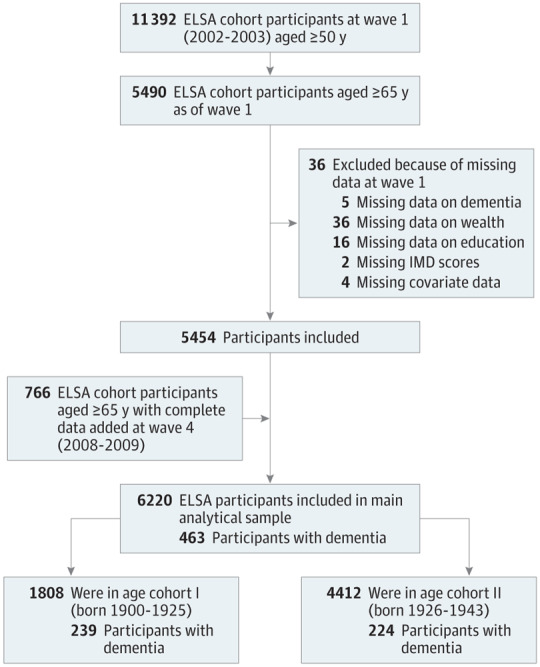
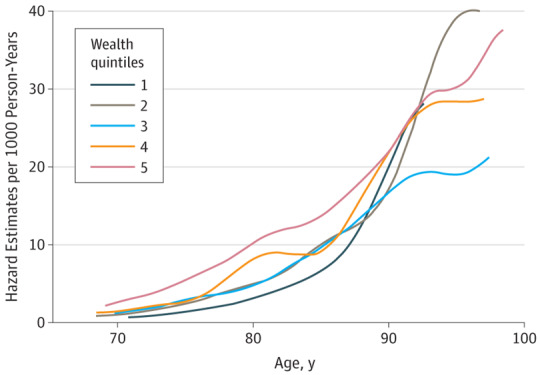
Importance: Lower educational attainment is associated with a higher risk of dementia. However, less clear is the extent to which other socioeconomic markers contribute to dementia risk. Objective: To examine the relationship of education, wealth, and area-based deprivation with the incidence of dementia over the last decade in England and investigate differences between people born in different periods. Design, Setting, and Participants: Data from the English Longitudinal Study of Ageing, a prospective cohort study that is representative of the English population, were used to investigate the associations between markers of socioeconomic status (wealth quintiles and the index of multiple deprivation) and dementia incidence. To investigate outcomes associated with age cohorts, 2 independent groups were derived using a median split (born between 1902-1925 and 1926-1943). Main Outcomes and Measures: Dementia as determined by physician diagnosis and the Informant Questionnaire on Cognitive Decline in the Elderly. Results: A total of 6220 individuals aged 65 years and older enrolled in the study (median [interquartile range] age at baseline, 73.2 [68.1-78.3] years; 3410 [54.8%] female). Of these, 463 individuals (7.4%) had new cases of dementia ascertained in the 12 years between 2002-2003 and 2014-2015. In the cohort born between 1926 and 1943, the hazard of developing dementia was 1.68 times higher (hazard ratio [HR] = 1.68 [95% CI, 1.05-2.86]) for those in the lowest wealth quintile compared with those in the highest quintile, independent of education, index of multiple deprivation, and health indicators. Higher hazards were also observed for those in the second-highest quintile of index of multiple deprivation (HR = 1.62 [95% CI, 1.06-2.46]) compared with those in the lowest (least deprived) quintile. Conclusions and Relevance: In an English nationally representative sample, the incidence of dementia appeared to be socioeconomically patterned primarily by the level of wealth. This association was somewhat stronger for participants born in later years.
Overview
The claims and statistics of this paper haven’t been checked yet.
Run the check — free, no account needed. It reads the open-access text and checks the sources it cites.
Integrity signals
Registry
Cites
Statistics
Figures
Verification
Claims the paper makes
The claims and statistics of this paper haven’t been checked yet.
Run the check — free, no account needed. It reads the open-access text and checks the sources it cites.
Claims other papers make about this one
Each is checked against this paper’s own text: does it say what the citing paper says it does?
In the citing paper
“research shows dementia risk to be associated with lower socio-economic status, independently of education status118,119.”
From Genetic meta-analysis of diagnosed Alzheimer’s disease identifies new risk loci and implicates Aβ, tau, immunity and lipid processing (2019) · cites this paper as [118]
Self-check
Percentages, sums and reported differences re-computed from the paper’s own numbers.
The self-check needs the paper’s full text.
Citations
Cites
A Proportional Hazards Model for the Subdistribution of a Competing Risk
Fine, J. P., & Gray, R. J. (1999) · Journal of the American Statistical Association · doi:10.1080/01621459.1999.10474144 · Cited by 14,290
Dementia prevention, intervention, and care
Livingston, G., Sommerlad, A., Orgeta, V., Costafreda, S. G., Huntley, J., Ames, D., Ballard, C., Banerjee, S., Burns, A., Cohen-Mansfield, J., et al. (2017) · The Lancet · doi:10.1016/s0140-6736(17)31363-6 · Cited by 6,072
Cognitive reserve in ageing and Alzheimer's disease
Stern, Y. (2012) · The Lancet Neurology · doi:10.1016/s1474-4422(12)70191-6 · Cited by 3,557 · cited 3×
“These findings are consistent with the cognitive reserve hypothesis, which acknowledges a rapid cognitive deterioration for people with highereducationonce thepathologicalprocessassociatedwith dementiahasbeen initiated.(7)However, findings fromtheSeoul DementiaManagement Project(15) showed therewere no additiveor syne…”
BackgroundResult(2003) · RePEc: Research Papers in Economics · Cited by 1,844
Cohort profile: The English longitudinal study of ageing
Steptoe, A., Breeze, E., Banks, J., & Nazroo, J. (2013) · International Journal of Epidemiology · doi:10.1093/ije/dys168 · Cited by 1,779
Self-citationLindsay, J. (2002) · American Journal of Epidemiology · doi:10.1093/aje/kwf074 · Cited by 1,261
Higgins (2002) · doi:10.1002/(issn)1097-0258 · Cited by 1,248
Jorm, A. F. (1994) · Psychological Medicine · doi:10.1017/s003329170002691x · Cited by 1,198
Incidence of dementia over three decades in the Framingham heart study
Satizabal, C. L., Beiser, A. S., Chouraki, V., Chêne, G., Dufouil, C., & Seshadri, S. (2016) · New England Journal of Medicine · doi:10.1056/nejmoa1504327 · Cited by 1,051
A Comparison of the Prevalence of Dementia in the United States in 2000 and 2012
Langa, K. M., Larson, E. B., Crimmins, E. M., Faul, J. D., Levine, D. A., Kabeto, M. U., & Weir, D. R. (2017) · JAMA Internal Medicine · doi:10.1001/jamainternmed.2016.6807 · Cited by 910
Research works printed but not linked: 3
- Banks, 2003, Health, Wealth and Lifestyle of the Older Population in England, 71
- Noble, 2004, The English Indices of Deprivation 2004: Summary (revised)—Report to the Office of the Deputy Prime Minister
- Scholes, 2009, Methodology London
Cited by
Sorted by citations
Alzheimer Disease Genetics Consortium (ADGC), Kunkle, B. W., The European Alzheimer’s Disease Initiative (EADI), Cohorts for Heart and Aging Research in Genomic Epidemiology Consortium (CHARGE), Genetic and Environmental Risk in AD/Defining Genetic, P. A. E. R. F. A. D. C. (., Grenier-Boley, B., Sims, R., Bis, J. C., Damotte, V., Naj, A. C., et al. (2019) · Nature Genetics · doi:10.1038/s41588-019-0358-2 · Cited by 2,946
Defining Cognitive Reserve and Implications for Cognitive Aging
Pettigrew, C. A., & Soldan, A. (2019) · Current Neurology and Neuroscience Reports · doi:10.1007/s11910-019-0917-z · Cited by 484
Lower socioeconomic status and the acceleration of aging: An outcome-wide analysis
Steptoe, A., & Zaninotto, P. (2020) · Proceedings of the National Academy of Sciences · doi:10.1073/pnas.1915741117 · Cited by 326
Self-citationFang, J., Zhang, P., Zhou, Y., Chiang, C.-W., Tan, J., Hou, Y., Stauffer, S., Li, L., Pieper, A. A., Cummings, J., et al. (2021) · Nature Aging · doi:10.1038/s43587-021-00138-z · Cited by 206
Majoka, M. A., & Schimming, C. (2021) · Clinical Therapeutics · doi:10.1016/j.clinthera.2021.05.005 · Cited by 191
Metadata
- Authors
- Cadar, D., Lassale, C., Davies, H., Llewellyn, D. J., Batty, G. D., & Steptoe, A.
- Affiliations
- University College London (GB)
- School of Health Sciences, University of Surrey, Guildford, United Kingdom
- University of Exeter (GB)
- Corresponding author
- Cadar, Dorina
- Venue
- JAMA Psychiatry
- Publisher
- American Medical Association (AMA)
- Published
- 2018-07-01
- Volume
- 75
- Issue
- 7
- Pages
- 723
- ISSN
- 2168-622X (ISSN-L)
- PMC
- PMC6145673
- OpenAlex
- W2803752526
- Cited by
- 245
- References
- 44
- Citations by year
- 2026: 29 · 2025: 28 · 2024: 51 · 2023: 39 · 2022: 28 · 2021: 23 · 2020: 26 · 2019: 16 · 2018: 5
- FWCI
- 13.77
- Type
- journal article
- Language
- en
- Open access
- hybrid
- doi.org
- Licence
- cc-by
- Locations
- JAMA Psychiatry (publishedVersion, cc-by)
- Europe PMC (PubMed Central) (publishedVersion, cc-by)
- PubMed Central (publishedVersion, cc-by)
- PubMed (publishedVersion)
- Surrey Research Insight Open Access (The University of Surrey) (submittedVersion)
- UCL Discovery (University College London) (submittedVersion)
- Figshare (submittedVersion)
- Open Research Exeter (University of Exeter) (submittedVersion, cc-by)
- Funders
- National Institute on Aging (R01AG017644)
- Topics
- Health Sciences › Medicine › Psychiatry and Mental health › Dementia and Cognitive Impairment Research
- Social Sciences › Health › Health disparities and outcomes
- Social Sciences › Psychology › Experimental and Cognitive Psychology › Cognitive Abilities and Testing
- Keywords
- dementia incidence, socioeconomic status, educational attainment, wealth, area deprivation, Index of Multiple Deprivation, birth cohort differences, older adults, cognitive decline
- MeSH terms
- Economic Status, Aged, Aged, 80 and over, Dementia, Educational Status, England, Female, Follow-Up Studies, Humans, Longitudinal Studies, Male, Socioeconomic Factors, Cohort Studies, Incidence, Proportional Hazards Models
About these checks
Registry, retraction, Cites and statistics results are computed, not judged, with one exception: a printed reference that no index lists is read once by a model before it counts as a citation error. Claims are extracted by a model and kept only when their quote appears verbatim in the text; each cited source is then checked, with a model’s help, for whether it says what the claim relies on. Those verdicts can be wrong — read the claim’s quote and the cited source before relying on one.
Statistics and arithmetic are recomputed, not judged.
Confidence bands are shown only for fields calibrated on our annotated test set. None is calibrated yet, so no band is shown.
What counts as a claim ›How we measure confidence ›How we check this ›
Are you an author, or do you see a problem with this page? Request a review
