

The DOI matches its Crossref record; 26 of the 26 references it cites were found in a registry or an index.
Stratified Care vs Stepped Care for Depression: A Cluster Randomized Clinical Trial
Open accessAbstract
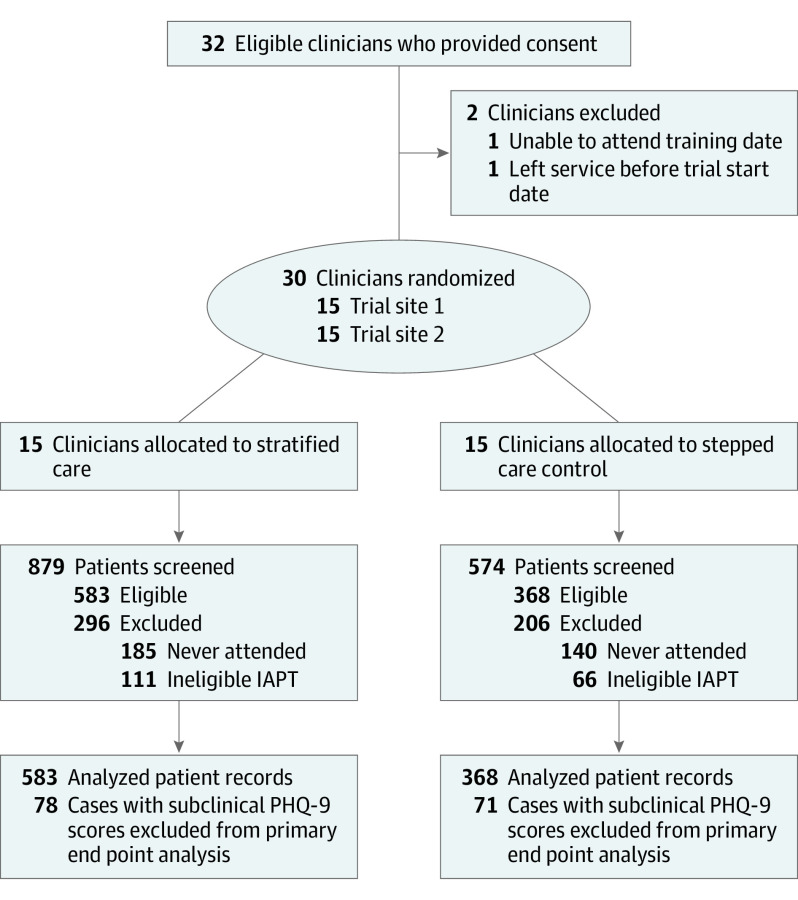
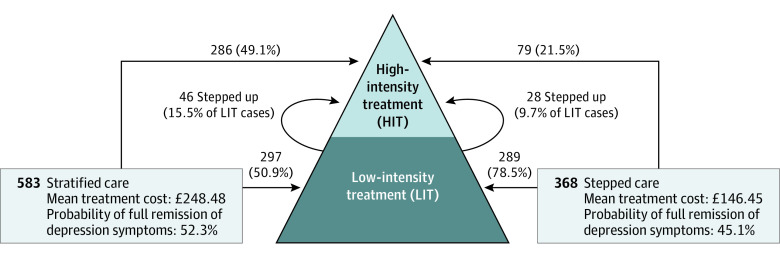
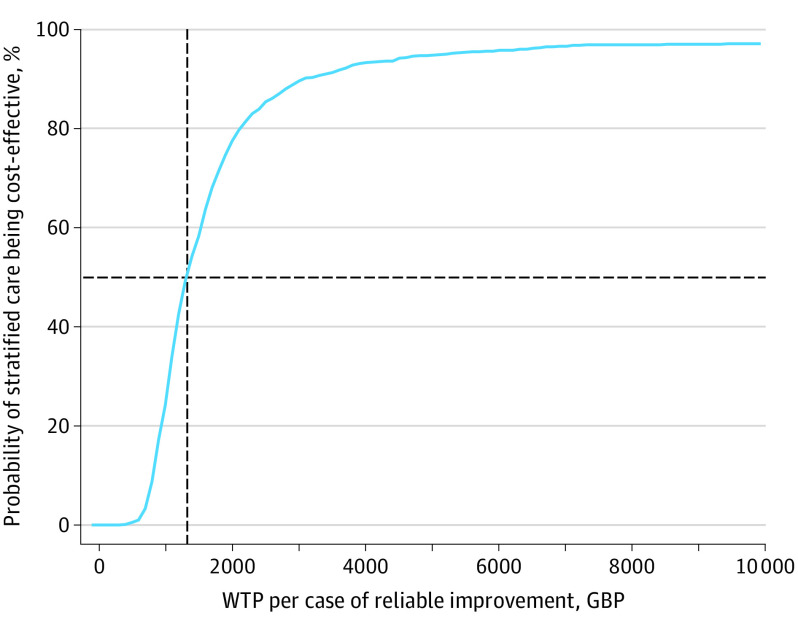
Importance: Depression is a major cause of disability worldwide. Although empirically supported treatments are available, there is scarce evidence on how to effectively personalize psychological treatment selection. Objective: To compare the clinical effectiveness and cost-effectiveness of 2 treatment selection strategies: stepped care and stratified care. Design, Setting, and Participants: This multisite, cluster randomized clinical trial recruited participants from the English National Health Service from July 5, 2018, to February 1, 2019. Thirty clinicians working across 4 psychological therapy services were randomly assigned to provide stratified (n = 15) or stepped (n = 15) care. In stepped care, patients sequentially access low-intensity guided self-help followed by high-intensity psychotherapy. In stratified care, patients are matched with either low- or high-intensity treatments at initial assessment. Data were analyzed from May 18, 2020, to October 13, 2021, using intention-to-treat principles. Interventions: All clinicians used the same interview schedule to conduct initial assessments with patients seeking psychological treatment for common mental disorders, but those in the stratified care group received a personalized treatment recommendation for each patient generated by a machine learning algorithm. Eligible patients received either stratified or stepped care (ie, treatment as usual). Main Outcomes and Measures: The preregistered outcome was posttreatment reliable and clinically significant improvement (RCSI) of depression symptoms (measured using the 9-item Patient Health Questionnaire). The RCSI outcome was compared between groups using logistic regression adjusted for baseline severity. Cost-effectiveness analyses compared incremental costs and health outcomes of the 2 treatment pathways. Results: A total of 951 patients were included (618 women among 950 with data available [65.1%]; mean [SD] age, 38.27 [14.53] years). The proportion of cases of RCSI was significantly higher in the stratified care arm compared with the stepped care arm (264 of 505 [52.3%] vs 134 of 297 [45.1%]; odds ratio, 1.40 [95% CI, 1.04-1.87]; P = .03). Stratified care was associated with a higher mean additional cost per patient (£104.5 [95% CI, £67.5-£141.6] [$139.83 (95% CI, $90.32-$189.48)]; P < .001) because more patients accessed high-intensity treatments (332 of 583 [56.9%] vs 107 of 368 [29.1%]; χ2 = 70.51; P < .001), but this additional cost resulted in an approximately 7% increase in the probability of RCSI. Conclusions and Relevance: In this cluster randomized clinical trial of adults with common mental disorders, stratified care was efficacious and cost-effective for the treatment of depression symptoms compared with stepped care. Stratified care can improve depression treatment outcomes at a modest additional cost. Trial Registration: isrctn.org Identifier: ISRCTN11106183.
Overview
The claims and statistics of this paper haven’t been checked yet.
Run the check — free, no account needed. It reads the open-access text and checks the sources it cites.
Integrity signals
Registry
Cites
Statistics
Figures
Verification
Claims the paper makes
The claims and statistics of this paper haven’t been checked yet.
Run the check — free, no account needed. It reads the open-access text and checks the sources it cites.
Claims other papers make about this one
Each is checked against this paper’s own text: does it say what the citing paper says it does?
The cited source doesn’t support the claim as written.
In the citing paper
“A two-arm waitlist-controlled RCT showed that increased pre–post global trait mindfulness mediated the effect of MBSR on lower posttreatment distress and avoidance in cancer patients [12].”
From Treatment condition as a moderator and change in trait mindfulness as a mediator of a brief mindfulness ecological momentary intervention for generalized anxiety disorder (2024) · cites this paper as [12]
Checked by a reasoning model — may be wrong.
Experimental — accuracy not yet measured
Self-check
Percentages, sums and reported differences re-computed from the paper’s own numbers.
The self-check needs the paper’s full text.
Citations
Cites
The PHQ-9: Validity of a brief depression severity measure
Kroenke, K., Spitzer, R. L., & Williams, J. B. W. (2001) · Journal of General Internal Medicine · doi:10.1046/j.1525-1497.2001.016009606.x · Cited by 44,910
A Brief Measure for Assessing Generalized Anxiety Disorder: The GAD-7
Spitzer, R. L., Kroenke, K., Williams, J. B. W., & Löwe, B. (2006) · Archives of Internal Medicine · doi:10.1001/archinte.166.10.1092 · Cited by 31,765
Jacobson, N. S., & Truax, P. (1991) · Journal of Consulting and Clinical Psychology · doi:10.1037/0022-006x.59.1.12 · Cited by 7,770
The Work and Social Adjustment Scale: a simple measure of impairment in functioning
Mundt, J. C., Marks, I. M., Shear, M. K., & Greist, J. M. (2002) · British Journal of Psychiatry · doi:10.1192/bjp.180.5.461 · Cited by 2,515
Bower, P., & Gilbody, S. (2005) · British Journal of Psychiatry · doi:10.1192/bjp.186.1.11 · Cited by 1,084
Shared decision making: really putting patients at the centre of healthcare
Stiggelbout, A. M., Weijden, T. V. D., Wit, M. P. T. D., Frosch, D., Legare, F., Montori, V. M., Trevena, L., & Elwyn, G. (2012) · BMJ · doi:10.1136/bmj.e256 · Cited by 1,014
The National Collaborating Centre for Mental Health
Kendall, T., & Pilling, S. (2004) · UCL Discovery (University College London) · Cited by 840
Clark, D. M. (2011) · International Review of Psychiatry · doi:10.3109/09540261.2011.606803 · Cited by 699
Prognosis research strategy (PROGRESS) 4: Stratified medicine research
Hingorani, A. D., van der Windt, D., Riley, R. D., Abrams, K. R., Moons, K. G. M., Steyerberg, E. W., Schroter, S., Sauerbrei, W., Altman, D. G., Hemingway, H., et al. (2013) · BMJ · doi:10.1136/bmj.e5793 · Cited by 534
Moran, P., Leese, M., Lee, T., Walters, P., Thornicroft, G., & MANN, A. H. (2003) · The British Journal of Psychiatry · doi:10.1192/bjp.183.3.228 · Cited by 449
Research works printed but not linked: 1
- Richards, 2011, Reach Out: National Programme Educator Materials to Support the Delivery of Training for Psychological Wellbeing Practitioners Delivering Low Intensity Interventions.
Cited by
Sorted by citations
Lam, R. W. M., Kennedy, S. H., Adams, G. C., Bahji, A., Beaulieu, S., Bhat, V., Blier, P., Blumberger, D. M., Brietzke, E. M., Chakrabarty, T., et al. (2024) · The Canadian Journal of Psychiatry · doi:10.1177/07067437241245384 · Cited by 435
Stade, E. C., Stirman, S. W., Ungar, L. H., Boland, C. L., Schwartz, H. A., Yaden, D. B., Sedoc, J., DeRubeis, R. J., Willer, R., & Eichstaedt, J. C. (2024) · npj Mental Health Research · doi:10.1038/s44184-024-00056-z · Cited by 391
Self-citationTreatment of Posttraumatic Stress Disorder: A State-of-the-art Review
Burback, L., Brémault‐Phillips, S., Nijdam, M. J., McFARLANE, A. C., & Vermetten, E. H. G. J. M. (2023) · Current Neuropharmacology · doi:10.2174/1570159x21666230428091433 · Cited by 251
González, P. C., He, A., Lam, E. K. M., Ng, I. M. C., Li, M. W., Hou, R., Chan, J. N.-M., Sahni, Y., Viñas‐Guasch, N., Miller, T., et al. (2025) · Psychological Medicine · doi:10.1017/s0033291724003295 · Cited by 255
Efficacy of Personalized Psychological Interventions: A Systematic Review and Meta-Analysis
Nye, A., Delgadillo, J., & Barkham, M. (2023) · Journal of Consulting and Clinical Psychology · doi:10.1037/ccp0000820 · Cited by 142
Self-citation
Metadata
- Authors
- Delgadillo, J., Ali, S., Fleck, K., Agnew, C., Southgate, A., Parkhouse, L., Cohen, Z. D., DeRubeis, R. J., & Barkham, M.
- Affiliations
- Humber Teaching NHS Foundation Trust (GB)
- Western University (CA)
- Lancashire Care NHS Foundation Trust (GB)
- University of California, Los Angeles (US)
- University of Pennsylvania (US)
- University of Sheffield (GB)
- Corresponding author
- Delgadillo, Jaime
- Venue
- JAMA Psychiatry
- Publisher
- American Medical Association (AMA)
- Published
- 2022-02-01
- Volume
- 79
- Issue
- 2
- Pages
- 101
- ISSN
- 2168-622X (ISSN-L)
- PMC
- PMC8655665
- OpenAlex
- W4200371774
- Cited by
- 194
- References
- 26
- Citations by year
- 2026: 45 · 2025: 48 · 2024: 43 · 2023: 37 · 2022: 20
- FWCI
- 22.30
- Type
- journal article
- Language
- en
- Open access
- hybrid
- doi.org
- Licence
- cc-by
- Locations
- JAMA Psychiatry (publishedVersion, cc-by)
- PubMed Central (publishedVersion, cc-by)
- PubMed (publishedVersion)
- White Rose Research Online (University of Leeds, The University of Sheffield, University of York) (acceptedVersion)
- Scholarship@Western (Western University) (submittedVersion)
- Research Portal (King's College London) (submittedVersion, cc-by)
- Funders
- National Institute for Health and Care Research (28/05/18)
- Topics
- Social Sciences › Psychology › Applied Psychology › Digital Mental Health Interventions
- Health Sciences › Medicine › Psychiatry and Mental health › Mental Health Treatment and Access
- Social Sciences › Psychology › Experimental and Cognitive Psychology › Anxiety, Depression, Psychometrics, Treatment, Cognitive Processes
- Keywords
- depression, stratified care, stepped care, treatment selection, personalized treatment recommendations, machine learning algorithms, guided self-help, psychotherapy, common mental disorders, cost-effectiveness, clinical effectiveness, National Health Service
- MeSH terms
- Distance Counseling, Adult, Depression, Female, Humans, Male, Middle Aged, Psychotherapy, Surveys and Questionnaires, Self Care, Treatment Outcome, Young Adult, Eye Movement Desensitization Reprocessing
About these checks
Registry, retraction, Cites and statistics results are computed, not judged, with one exception: a printed reference that no index lists is read once by a model before it counts as a citation error. Claims are extracted by a model and kept only when their quote appears verbatim in the text; each cited source is then checked, with a model’s help, for whether it says what the claim relies on. Those verdicts can be wrong — read the claim’s quote and the cited source before relying on one.
Statistics and arithmetic are recomputed, not judged.
Confidence bands are shown only for fields calibrated on our annotated test set. None is calibrated yet, so no band is shown.
What counts as a claim ›How we measure confidence ›How we check this ›
Are you an author, or do you see a problem with this page? Request a review
