

The DOI matches its Crossref record; 36 of the 36 references it cites were found in a registry or an index.
Representation and Outcomes of Individuals With Schizophrenia Seen in Everyday Practice Who Are Ineligible for Randomized Clinical Trials
Open accessAbstract
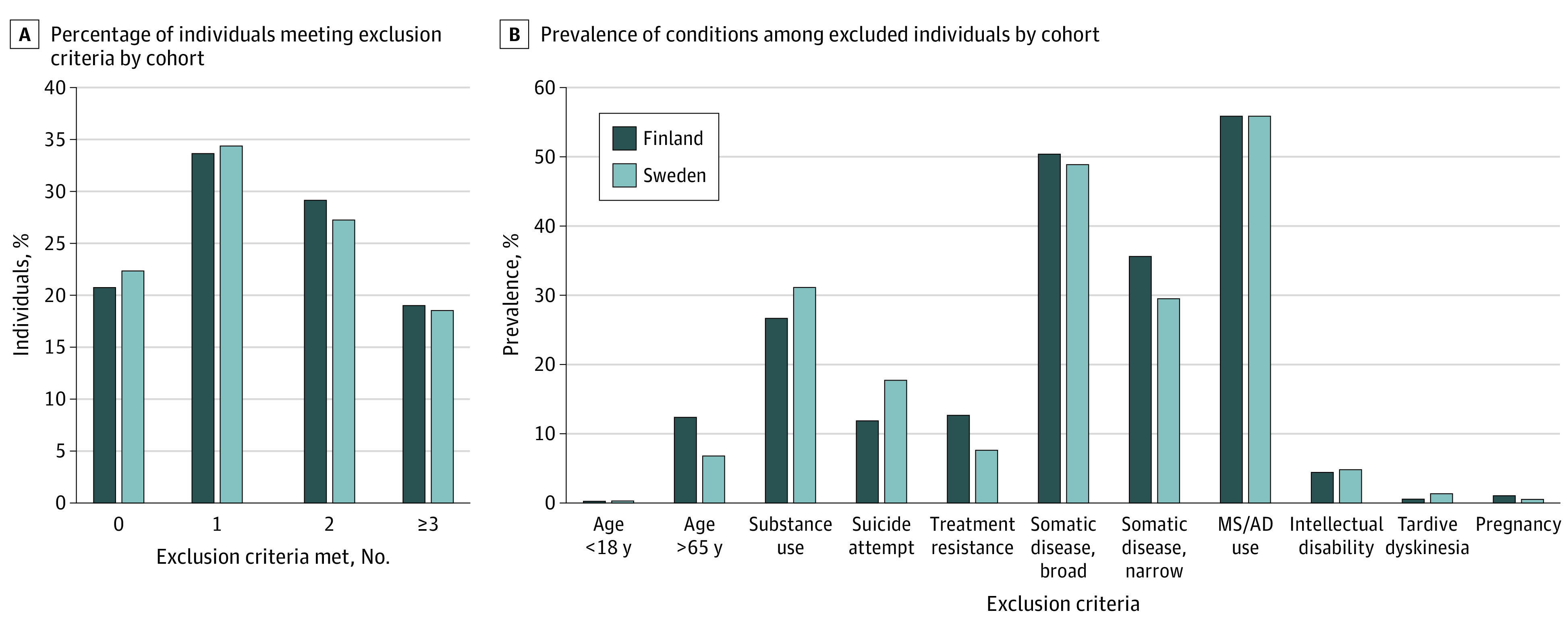
IMPORTANCE: Most evidence about efficacy and safety of antipsychotics in schizophrenia spectrum disorders relies on randomized clinical trials (RCTs). However, owing to their strict eligibility criteria, RCTs represent only a part of the real-world population (ie, unselected patients seen in everyday clinical practice), which may result in an efficacy-effectiveness gap. OBJECTIVE: To quantify the proportion of real-world individuals with schizophrenia spectrum disorders who would be ineligible for participation in RCTs, and to explore whether clinical outcomes differ between eligible and ineligible individuals. DESIGN, SETTING, AND PARTICIPANTS: This study applied eligibility criteria typically used in RCTs for relapse prevention in schizophrenia spectrum disorders to real-world populations. Individuals with diagnoses of schizophrenia spectrum disorders recorded in national patient registries in Finland and Sweden were identified. Individuals who had used antipsychotics continuously for 12 weeks in outpatient care were selected. Individuals were followed up for up to 1 year while they were receiving maintenance treatment with any second-generation antipsychotic (excluding clozapine). Follow-up was censored at treatment discontinuation, initiation of add-on antipsychotics, death, and end of database linkage. MAIN OUTCOMES AND MEASURES: Proportions of RCT-ineligible individuals with schizophrenia spectrum disorders owing to any and specific RCT exclusion criteria. The risk of hospitalization due to psychosis within 1-year follow-up in ineligible vs eligible persons were compared using hazard ratios (HR) and corresponding 95% CIs. RESULTS: The mean (SD) age in the Finnish cohort (n = 17 801) was 47.5 (13.8) years and 8972 (50.4%) were women; the mean (SD) age in the Swedish cohort (n = 7458) was 44.8 (12.5) years and 3344 (44.8%) were women. A total of 20 060 individuals (79%) with schizophrenia spectrum disorders would be ineligible for RCTs (Finnish cohort: 14 221 of 17 801 [79.9%]; Swedish cohort: 5839 of 7458 [78.3%]). Most frequent reasons for ineligibility were serious somatic comorbidities and concomitant antidepressant/mood stabilizer use. Risks of hospitalization due to psychosis was higher among ineligible than eligible individuals (Finnish cohort: 18.4% vs 17.2%; HR, 1.14 [95% CI, 1.04-1.24]; Swedish cohort: 20.1% vs 14.8%; HR, 1.47 [95% CI, 1.28-1.92]). The largest risks of hospitalization due to psychosis were observed in individuals ineligible owing to treatment resistance, tardive dyskinesia, and history of suicide attempts. Finally, with more ineligibility criteria met, larger risks of hospitalization due to psychosis were observed in both countries. CONCLUSIONS AND RELEVANCE: RCTs may represent only about a fifth of real-world individuals with schizophrenia spectrum disorders. Underrepresented (ineligible) patients with schizophrenia spectrum disorders have moderately higher risks of admission due to psychosis while receiving maintenance treatment than RCT-eligible patients. These findings set the stage for future studies targeting real-world populations currently not represented by RCTs.
Overview
The claims and statistics of this paper haven’t been checked yet.
Run the check — free, no account needed. It reads the open-access text and checks the sources it cites.
Integrity signals
Registry
Cites
Statistics
Figures
Verification
Claims the paper makes
The claims and statistics of this paper haven’t been checked yet.
Run the check — free, no account needed. It reads the open-access text and checks the sources it cites.
Claims other papers make about this one
Each is checked against this paper’s own text: does it say what the citing paper says it does?
The source backs part of the claim, not all of it — or backs it for a different population, condition or comparison.
In the citing paper
“Research of RCTs on medications for schizophrenia highlights the significant disparity between the broader patient population and those who qualify for trials, primarily due to exclusion criteria that eliminate many individuals with comorbid conditions and more severe manifestations of the disorder: 79% of individuals with schizophrenia spectrum disorders would be deemed ineligible for RCTs.15”
From Evaluating ADHD medication trial representativeness: a Swedish population-based study comparing hypothetically trial-eligible and trial-ineligible individuals (2025) · cites this paper as [15]
Experimental — accuracy not yet measuredIn the citing paper
“a study found only about 20% of people who have schizophrenia spectrum disorders would be eligible for inclusion in a typical randomised clinical trial.”
From Developing clinical prediction models: a step-by-step guide (2024) · cites this paper as [46]
In the citing paper
“Patients who are ineligible had a higher risk of hospital admission with psychosis than those who are eligible.46”
From Developing clinical prediction models: a step-by-step guide (2024) · cites this paper as [46]
Self-check
Percentages, sums and reported differences re-computed from the paper’s own numbers.
The self-check needs the paper’s full text.
Citations
Cites
Benchimol, E. I., Smeeth, L., Guttmann, A., Harron, K., Moher, D., Petersen, I., Sørensen, H. T., von Elm, E., Langan, S. M., & RECORD Working Committee (2015) · PLOS Medicine · doi:10.1371/journal.pmed.1001885 · Cited by 5,749
Rush, A. J., Trivedi, M. H., Wisniewski, S. R., Nierenberg, A. A., Stewart, J. W., Warden, D., Niederehe, G., Thase, M. E., Lavori, P. W., Lebowitz, B. D., et al. (2006) · American Journal of Psychiatry · doi:10.1176/ajp.2006.163.11.1905 · Cited by 5,643
Kennedy-Martin, T., Curtis, S., Faries, D., Robinson, S., & Johnston, J. (2015) · Trials · doi:10.1186/s13063-015-1023-4 · Cited by 878
Tiihonen, J., Mittendorfer-Rutz, E., Majak, M., Mehtälä, J., Hoti, F., Jedenius, E., Enkusson, D., Leval, A., Sermon, J., Tanskanen, A., et al. (2017) · JAMA Psychiatry · doi:10.1001/jamapsychiatry.2017.1322 · Cited by 670
Self-citationStroup, T., Mcevoy, J., Swartz, M., Byerly, M., Glick, I., Cañive, J., McGee, M., Simpson, G., Stevens, M., & Lieberman, J. (2003) · Schizophrenia bulletin · doi:10.1093/oxfordjournals.schbul.a006986 · Cited by 647
(2020) · Clinical Epidemiology · doi:10.2147/clep · Cited by 468
Isohanni, M. K., M�kikyr�, T., Moring, J., R�sanen, P., Hakko, H. H., Partanen, U., Koiranen, M., & Jones, P. B. (1997) · Social Psychiatry and Psychiatric Epidemiology · doi:10.1007/bf00789044 · Cited by 275
From prescription drug purchases to drug use periods – a second generation method (PRE2DUP)
Tanskanen, A. J., Taipale, H. T., Koponen, M., Tolppanen, A., Hartikainen, S. A., Ahonen, R. S., & Tiihonen, J. (2015) · BMC Medical Informatics and Decision Making · doi:10.1186/s12911-015-0140-z · Cited by 200
Self-citationMaintenance treatment with antipsychotic drugs for schizophrenia
Ceraso, A., Lin, J., Schneider‐Thoma, J., Siafis, S., Tardy, M., Komossa, K., Heres, S., Kissling, W., Davis, J. M., & Leucht, S. (2020) · Cochrane Database of Systematic Reviews · doi:10.1002/14651858.cd008016.pub3 · Cited by 184
Self-citationTaipale, H., Mehtälä, J., Tanskanen, A., & Tiihonen, J. (2018) · Schizophrenia Bulletin · doi:10.1093/schbul/sbx176 · Cited by 153
Self-citationKrause, M., Zhu, Y., Huhn, M., Schneider‐Thoma, J., Bighelli, I., Chaimani, A., & Leucht, S. (2018) · European Neuropsychopharmacology · doi:10.1016/j.euroneuro.2018.03.008 · Cited by 145
Self-citationAlphs, L. D., Benson, C. J., Cheshire-Kinney, K., Lindenmayer, J., Mao, L., Rodriguez, S. C., & Starr, H. L. (2015) · The Journal of Clinical Psychiatry · doi:10.4088/jcp.14m09584 · Cited by 137
Haro, J. M., Suarez, D. L., Novick, D., Brown, J., Usall, J., & Naber, D. (2006) · European Neuropsychopharmacology · doi:10.1016/j.euroneuro.2006.09.005 · Cited by 126
Haro, J. M., Edgell, E. T., Jones, P. B., Alonso, J., Gavart, S., Gregor, K. J., Wright, P., Knapp, M. R. J., & on behalf of the SOHO Study Group (2003) · Acta Psychiatrica Scandinavica · doi:10.1034/j.1600-0447.2003.00064.x · Cited by 115
Selection Bias in Clinical Trials With Antipsychotics
Hofer, A., Hummer, M., Huber, R., Kurz, M., Walch, T., & Fleischhacker, W. W. (2000) · Journal of Clinical Psychopharmacology · doi:10.1097/00004714-200012000-00019 · Cited by 112
Treatment Recommendations for Tardive Dyskinesia
Ricciardi, L., Pringsheim, T. M., Barnes, T. R. E., Martino, D., Gardner, D. M., Remington, G. J., Addington, D. E., Morgante, F., Poole, N. A., Carson, A. J., et al. (2019) · The Canadian Journal of Psychiatry · doi:10.1177/0706743719828968 · Cited by 104
Generating comparative evidence on new drugs and devices after approval
Cipriani, A., Ioannidis, J. P. A., Rothwell, P. M., Glasziou, P., Li, T., Hernandez, A. F., Tomlinson, A., Simes, R. J., & Naci, H. (2020) · The Lancet · doi:10.1016/s0140-6736(19)33177-0 · Cited by 89
Self-citationKrause, M., Huhn, M., Schneider-Thoma, J., Bighelli, I., Gutsmiedl, K., & Leucht, S. (2019) · European Neuropsychopharmacology · doi:10.1016/j.euroneuro.2018.11.1105 · Cited by 86
Self-citationPhillips, C. M., Parmar, A., Guo, H., Schwartz, D., Isaranuwatchai, W., Beca, J. M., Dai, W. F., Arias, J., Gavura, S., & Chan, K. (2020) · Cancer · doi:10.1002/cncr.32697 · Cited by 85
der Welle, C. M. C., Peters, B. J. M., Schramel, F. M. N. H., Klungel, O. H., Groen, H. J. M., & van de Garde, E. M. W. (2018) · European Respiratory Journal · doi:10.1183/13993003.01100-2018 · Cited by 64
Riedel, M. J., Strassnig, M., M�ller, N., Zwack, P., & M�ller, H.-J. (2004) · European Archives of Psychiatry and Clinical Neuroscience · doi:10.1007/s00406-004-0547-5 · Cited by 60
The Gap Between Couple Therapy Research Efficacy and Practice Effectiveness
Halford, W. K., Pepping, C. A., & Petch, J. F. (2015) · Journal of Marital and Family Therapy · doi:10.1111/jmft.12120 · Cited by 59
Correll, C. U., Kishimoto, T., & Kane, J. M. (2011) · Dialogues in Clinical Neuroscience · doi:10.31887/dcns.2011.13.2/ccorrell · Cited by 49
Antipsychotic drugs for elderly patients with schizophrenia: A systematic review and meta-analysis
Krause, M., Huhn, M., Schneider‐Thoma, J., Rothe, P., Smith, R. C., & Leucht, S. (2018) · European Neuropsychopharmacology · doi:10.1016/j.euroneuro.2018.09.007 · Cited by 43
Self-citationThe Representativeness of Participants With Severe Mental Illness in a Psychosocial Clinical Trial
Lally, J., Watkins, R. E., Nash, S., Shetty, H., Gardner-Sood, P., Smith, S. M., Murray, R. M., & Gaughran, F. (2018) · Frontiers in Psychiatry · doi:10.3389/fpsyt.2018.00654 · Cited by 36
Antipsychotic use among persons with schizophrenia in Sweden and Finland, trends and differences
Taipale, H. T., Puranen, A., Mittendorfer‐Rutz, E., Tiihonen, J., Tanskanen, A. J., Červenka, S., & Lähteenvuo, M. (2020) · Nordic Journal of Psychiatry · doi:10.1080/08039488.2020.1854853 · Cited by 31
Self-citationAnkarfeldt, M. Z., Adalsteinsson, E., Groenwold, R. H. H., Ali, M. S., & Klungel, O. H. (2017) · Clinical Epidemiology · doi:10.2147/clep.s121991 · Cited by 29
Registry-based studies: What they can tell us, and what they cannot
Taipale, H. T., & Tiihonen, J. (2021) · European Neuropsychopharmacology · doi:10.1016/j.euroneuro.2021.03.005 · Cited by 22
Self-citationKline, E. R., Hendel, V., Friedman‐Yakoobian, M. S., Mesholam‐Gately, R. I., Findeisen, A., Zimmet, S. V., Wojcik, J., Petryshen, T. L., Woo, T.-U. W., Goldstein, J. M., et al. (2018) · Social Psychiatry and Psychiatric Epidemiology · doi:10.1007/s00127-018-1631-x · Cited by 18
Randomized Controlled Trials for Schizophrenia: Study Designs Targeted to Distinct Goals
Stroup, T. S., & Geddes, J. R. (2007) · Schizophrenia Bulletin · doi:10.1093/schbul/sbm156 · Cited by 14
Bridging the efficacy-effectiveness gap in HIV programs: lessons from economics
Bor, J., & Thirumurthy, H. (2019) · Journal of Acquired Immune Deficiency Syndromes · doi:10.1097/qai.0000000000002201 · Cited by 12
Schneider, C., Breilmann, J., Reuter, B., Becker, T. M., & Kösters, M. (2021) · Acta Psychiatrica Scandinavica · doi:10.1111/acps.13293 · Cited by 12
Observational, Pragmatic, and Clinical Trials in Bipolar Disorder
Vieta, E. (2008) · The Journal of Clinical Psychiatry · doi:10.4088/jcp.0908e27 · Cited by 8
Self-citationEarly intervention in psychiatry: scotomas, representativeness, and the lens of clinical populations
Shah, J. L., & Peters, M. I. (2019) · Social Psychiatry and Psychiatric Epidemiology · doi:10.1007/s00127-019-01686-x · Cited by 7
How do participants in clinical trials compare with other patients with schizophrenia?
Freudenthal, R., Marston, L., Stansfeld, J. L., Priebe, S., & Moncrieff, J. (2021) · Contemporary Clinical Trials Communications · doi:10.1016/j.conctc.2021.100803 · Cited by 7
Patients in Clinical Trials on COPD Triple Therapy Compared to Real World Populations
Buhl, R., Criée, C.-P., Kardos, P., Berschneider, K., Obermoser, V., Vogelmeier, C. F., & Worth, H. (2019) · doi:10.1164/ajrccm-conference.2019.199.1_meetingabstracts.a1117 · Cited by 4 · cited 2×
“(2) The selection criteria used for our analysis are typical for a specific, relatively common type of RCTs (ie, relapse prevention of schizophrenia with antipsychotics) and specific real-world samples (Finland and Sweden).”
BackgroundMethod
Research works printed but not linked: 1
- Luykx, 2020, What is the Impact of Randomized Controlled Trials Inclusion and Exclusion Criteria on Outcomes in People using Antipsychotics in the Real World? A Systematic Analysis in National Registries
Cited by
Sorted by citations
Correll, C. U., Solmi, M., Croatto, G., Schneider, L. K., Rohani-Montez, S. C., Fairley, L., Smith, N., Bitter, I., Gorwood, P. A. P. M., Taipale, H. T., et al. (2022) · World Psychiatry · doi:10.1002/wps.20994 · Cited by 758
Self-citationDeveloping clinical prediction models: a step-by-step guide
Efthimiou, O., Seo, M., Chalkou, K., Debray, T., Egger, M., & Salanti, G. (2024) · BMJ · doi:10.1136/bmj-2023-078276 · Cited by 544
“46 Therefore, a prediction model based on trial data might underestimate the real world risk of hospital admissions.”
Self-citationAntipsychotic-Induced Weight Gain: Dose-Response Meta-Analysis of Randomized Controlled Trials
Wu, H., Siafis, S., Hamza, T., Schneider‐Thoma, J., Davis, J. M., Salanti, G., & Leucht, S. (2022) · Schizophrenia Bulletin · doi:10.1093/schbul/sbac001 · Cited by 131
Self-citationLeucht, S., Priller, J., & Davis, J. M. (2024) · American Journal of Psychiatry · doi:10.1176/appi.ajp.20240738 · Cited by 117
Self-citationCorrell, C. U., Solmi, M., Cortese, S., D, M. F. M., Højlund, M., KRAEMER, H. C., McIntyre, R. S., Pine, D. S., Schneider, L. S. S., & Kane, J. M. (2023) · World Psychiatry · doi:10.1002/wps.21056 · Cited by 115
Metadata
- Authors
- Taipale, H., Schneider-Thoma, J., Pinzón-Espinosa, J., Radua, J., Efthimiou, O., Vinkers, C. H., Mittendorfer-Rutz, E., Cardoner, N., Pintor, L., Tanskanen, A., Tomlinson, A., Fusar-Poli, P., Cipriani, A., Vieta, E., Leucht, S., Tiihonen, J., & Luykx, J. J.
- Affiliations
- University of Eastern Finland (FI)
- Department of Psychiatry and Psychotherapy, School of Medicine, Technical University of Munich, Munich, Germany
- Universidad de Panamá (PA)
- Divisions of Insurance Medicine, Department of Clinical Neuroscience, Karolinska Institutet, Stockholm, Sweden
- University of Bern (CH)
- Amsterdam Neuroscience (NL)
- Department of Mental Health, Parc Tauli University Hospital, Sabadell, Barcelona, Spain
- Institut d’Investigacions Biomèdiques August Pi i Sunyer (IDIBAPS), CIBERSAM, Barcelona, Spain
- Oxford Health NHS Foundation Trust (GB)
- Early Psychosis: Interventions and Clinical-detection (EPIC) Lab, Department of Psychosis Studies, Institute of Psychiatry, Psychology, and Neuroscience, King’s College London, London, United Kingdom
- Hospital Clínic de Barcelona (ES)
- Technical University of Munich (DE)
- Utrecht University (NL)
- Corresponding author
- Luykx, Jurjen J.
- ORCID
- Venue
- JAMA Psychiatry
- Publisher
- American Medical Association (AMA)
- Published
- 2022-03-01
- Volume
- 79
- Issue
- 3
- Pages
- 210
- ISSN
- 2168-622X (ISSN-L)
- PMC
- PMC8792792
- OpenAlex
- W4210419267
- Cited by
- 129
- References
- 36
- Citations by year
- 2026: 30 · 2025: 28 · 2024: 33 · 2023: 26 · 2022: 12
- FWCI
- 16.14
- Type
- journal article
- Language
- en
- Open access
- hybrid
- doi.org
- Licence
- cc-by
- Locations
- JAMA Psychiatry (publishedVersion, cc-by)
- PubMed Central (publishedVersion, cc-by)
- PubMed (publishedVersion)
- Research Portal (King's College London) (publishedVersion, other-oa)
- Pure Amsterdam UMC (publishedVersion, cc-by)
- Bern Open Repository and Information System (University of Bern) (submittedVersion)
- Research Publications (Maastricht University) (submittedVersion, cc-by)
- Dipòsit Digital de Documents de la UAB (Universitat Autònoma de Barcelona) (submittedVersion, cc-by)
- Utrecht University Repository (Utrecht University) (submittedVersion, other-oa)
- mediaTUM – the media and publications repository of the Technical University Munich (Technical University Munich) (submittedVersion)
- mediaTUM – the media and publications repository of the Technical University Munich (Technical University Munich) (submittedVersion, other-oa)
- Amsterdam UMC (VU Amsterdam) - Institutional Repository (submittedVersion, other-oa)
- Research Publications (Maastricht University) (submittedVersion, other-oa)
- Data Archiving and Networked Services (DANS) (submittedVersion, other-oa)
- Data Archiving and Networked Services (DANS) (submittedVersion)
- Greater South Information System
- Funders
- National Science Foundation
- Eli Lilly and Company
- Pfizer
- GlaxoSmithKline
- Sanofi
- Ministerio de Ciencia, Innovación y Universidades
- National Institute for Health and Care Research (AI_AWARD02183, RP-2017-08-ST2-006, BRC‐1215‐20005, NIHR Research Professorship (grant RP-2017-08-ST2-)
- European Commission (CPII19/00009)
- Schweizerischer Nationalfonds zur Förderung der Wissenschaftlichen Forschung (20005, 180083)
- Academy of Finland (320107, 315969)
- Fondazione Cariplo
- Sigrid Juséliuksen Säätiö
- Angelini Pharma
- Otsuka Pharmaceutical
- Casen Recordati
- H. Lundbeck A/S
- Neuraxpharm
- Instituto de Salud Carlos III ((CPII19/00009), PI19/00394)
- European Regional Development Fund (CPII19/00009)
- Janssen Pharmaceuticals
- Cilag
- Topics
- Health Sciences › Medicine › Psychiatry and Mental health › Schizophrenia research and treatment
- Health Sciences › Medicine › Psychiatry and Mental health › Mental Health Treatment and Access
- Social Sciences › Psychology › Clinical Psychology › Psychiatric care and mental health services
- Keywords
- schizophrenia spectrum disorders, antipsychotic drugs, relapse prevention, long-term antipsychotic treatment, atypical antipsychotics, efficacy-effectiveness gap, somatic comorbidity, real-world outcomes, patient registry, Finland, Sweden
- MeSH terms
- Adult, Clozapine, Female, Humans, Male, Middle Aged, Psychotic Disorders, Schizophrenia, Antipsychotic Agents, Randomized Controlled Trials as Topic
About these checks
Registry, retraction, Cites and statistics results are computed, not judged, with one exception: a printed reference that no index lists is read once by a model before it counts as a citation error. Claims are extracted by a model and kept only when their quote appears verbatim in the text; each cited source is then checked, with a model’s help, for whether it says what the claim relies on. Those verdicts can be wrong — read the claim’s quote and the cited source before relying on one.
Statistics and arithmetic are recomputed, not judged.
Confidence bands are shown only for fields calibrated on our annotated test set. None is calibrated yet, so no band is shown.
What counts as a claim ›How we measure confidence ›How we check this ›
Are you an author, or do you see a problem with this page? Request a review
