

The DOI matches its Crossref record; 256 of the 256 references it cites were found in a registry or an index.
Metabolic reprogramming: a bridge between aging and tumorigenesis
Open accessAbstract
Aging is the most robust risk factor for cancer development, with more than 60% of cancers occurring in those aged 60 and above. However, how aging and tumorigenesis are intertwined is poorly understood and a matter of significant debate. Metabolic changes are hallmarks of both aging and tumorigenesis. The deleterious consequences of aging include dysfunctional cellular processes, the build-up of metabolic byproducts and waste molecules in circulation and within tissues, and stiffer connective tissues that impede blood flow and oxygenation. Collectively, these age-driven changes lead to metabolic reprogramming in different cell types of a given tissue that significantly affects their cellular functions. Here, we put forward the idea that metabolic changes that happen during aging help create a favorable environment for tumorigenesis. We review parallels in metabolic changes that happen during aging and how these changes function both as adaptive mechanisms that enable the development of malignant phenotypes in a cell-autonomous manner and as mechanisms that suppress immune surveillance, collectively creating the perfect environment for cancers to thrive. Hence, antiaging therapeutic strategies that target the metabolic reprogramming that occurs as we age might provide new opportunities to prevent cancer initiation and/or improve responses to standard-of-care anticancer therapies.
Overview
The claims and statistics of this paper haven’t been checked yet.
Run the check — free, no account needed. It reads the open-access text and checks the sources it cites.
Integrity signals
Registry
Cites
Statistics
Figures
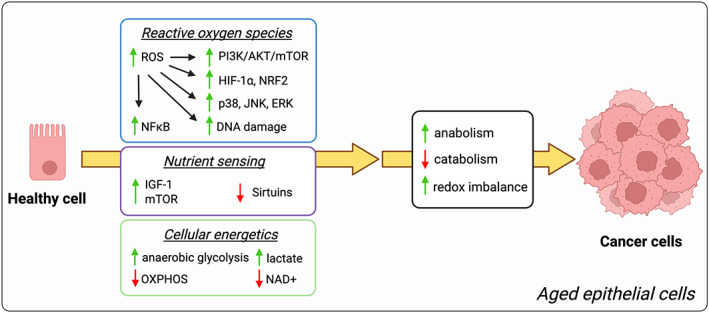
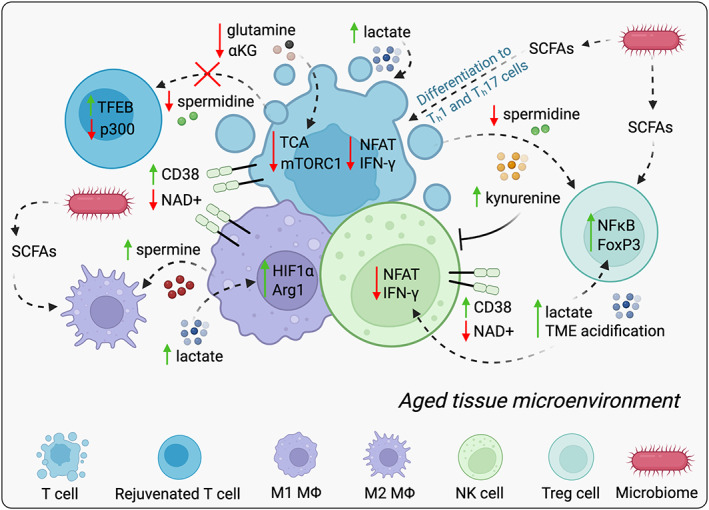
Verification
Claims the paper makes
The claims and statistics of this paper haven’t been checked yet.
Run the check — free, no account needed. It reads the open-access text and checks the sources it cites.
Claims other papers make about this one
Each is checked against this paper’s own text: does it say what the citing paper says it does?
In the citing paper
“Both hallmarks exhibit clear commonalities, but there are also some differences or even antagonisms between aging-associated deregulated nutrient sensing and cancer-associated deregulation of cellular energy metabolism.[204][205][206]”
From Meta-hallmarks of aging and cancer (2023) · cites this paper as [206]
Self-check
Percentages, sums and reported differences re-computed from the paper’s own numbers.
The self-check needs the paper’s full text.
Citations
Cites
1 retracted
Concomitant suppression of three target genes can explain the impact of a microRNA on metastasisPreprint
Valastyan, S., Benaich, N., Chang, A., Reinhardt, F., & Weinberg, R. A. (2009) · Genes & Development · doi:10.1101/gad.1832709 · Cited by 104
RetractedHallmarks of Cancer: The Next Generation
Hanahan, D., & Weinberg, R. A. (2011) · Cell · doi:10.1016/j.cell.2011.02.013 · Cited by 66,590
Understanding the Warburg Effect: The Metabolic Requirements of Cell Proliferation
Vander Heiden, M. G., Cantley, L. C., & Thompson, C. B. (2009) · Science · doi:10.1126/science.1160809 · Cited by 16,197
López-Otín, C., Blasco, M. A., Partridge, L., Serrano, M., & Kroemer, G. (2013) · Cell · doi:10.1016/j.cell.2013.05.039 · Cited by 14,982
Mutation and cancer: statistical study of retinoblastoma
Knudson, A. G. (1971) · Proceedings of the National Academy of Sciences · doi:10.1073/pnas.68.4.820 · Cited by 7,612
ROS function in redox signaling and oxidative stress
Schieber, M., & Chandel, N. S. (2014) · Current Biology · doi:10.1016/j.cub.2014.03.034 · Cited by 6,931
Nowell, P. C. (1976) · Science · doi:10.1126/science.959840 · Cited by 6,471
The emerging hallmarks of cancer metabolism
Pavlova, N. N., & Thompson, C. B. (2016) · Cell Metabolism · doi:10.1016/j.cmet.2015.12.006 · Cited by 5,926
Gut microbiome modulates response to anti-PD-1 immunotherapy in melanoma patients
Gopalakrishnan, V., Spencer, C. N., Nezi, L., Reuben, A., Andrews, M. C., Karpinets, T. V., Prieto, P. A., Vicente, D., Hoffman, K., Wei, S. C., et al. (2018) · Science · doi:10.1126/science.aan4236 · Cited by 4,812
Metabolic regulation of gene expression by histone lactylation
Zhang, D., Tang, Z., Huang, H., Zhou, G., Cui, C., Weng, Y., Liu, W., Kim, S., Lee, S., Perez-Neut, M., et al. (2019) · Nature · doi:10.1038/s41586-019-1678-1 · Cited by 4,371
Cited by
Sorted by citations
Meta-hallmarks of aging and cancer
López-Otín, C., Pietrocola, F., Roiz-Valle, D., Galluzzi, L., & Kroemer, G. (2023) · Cell Metabolism · doi:10.1016/j.cmet.2022.11.001 · Cited by 529
Metabolic interplays between the tumour and the host shape the tumour macroenvironment
Altea‐Manzano, P., Decker-Farrell, A. R., Janowitz, T., & Erez, A. (2025) · Nature reviews. Cancer · doi:10.1038/s41568-024-00786-4 · Cited by 138
Mitochondrial dysfunction and aging: multidimensional mechanisms and therapeutic strategies
Wei, P., Zhang, X., Yan, C., Sun, S., Chen, Z., & Lin, F. (2025) · Biogerontology · doi:10.1007/s10522-025-10273-4 · Cited by 68
Host-directed therapy for tuberculosis
Tian, N., Chu, H., Li, Q., Sun, H., Zhang, J., Chu, N., & Sun, Z. (2025) · European journal of medical research · doi:10.1186/s40001-025-02443-4 · Cited by 43
Stangis, M. M., Chen, Z., Min, J., Glass, S. E., Jackson, J. O., Radyk, M. D., Hoi, X. P., Brennen, W. N., Yu, M., Dinh, H. Q., et al. (2024) · Cancer Discovery · doi:10.1158/2159-8290.cd-23-1550 · Cited by 37
Havas, A. P., Yin, S., & Adams, P. D. (2022) · Molecular Oncology · doi:10.1002/1878-0261.13302 · Cited by 32
Natural Compounds for Preventing Age-Related Diseases and Cancers
Ki, M., Youn, S., Kim, D. H., & Pack, S. P. (2024) · International Journal of Molecular Sciences · doi:10.3390/ijms25147530 · Cited by 30
Shi, X., Jiang, A., Qiu, Z., Lin, A., Liu, Z., Zhu, L., Mou, W., Cheng, Q., Zhang, J., Miao, K., et al. (2024) · Frontiers of Medicine · doi:10.1007/s11684-024-1094-2 · Cited by 24
Zhang, M., Cui, J., Chen, H., Wang, Y., Kuai, X., Sun, S., Tang, Q., Zong, F., Chen, Q., Wu, J., et al. (2023) · Cancers · doi:10.3390/cancers15092427 · Cited by 18
Age- and diet-instructed metabolic rewiring of the tumor–immune microenvironment
Plata-Gómez, A. B., & Ho, P. (2025) · The Journal of Experimental Medicine · doi:10.1084/jem.20241102 · Cited by 17
Ding, F., Yu, Y., Zhao, J., Wei, S., Zhang, Y., Han, J. H., Li, Z., Jiang, H., Ryu, D., Cho, M., et al. (2025) · Frontiers in Cell and Developmental Biology · doi:10.3389/fcell.2025.1593096 · Cited by 18
The tumor microenvironment: adding pieces to the puzzle
Aguilar‐Cázares, D., Perez-Medina, M., Benito-Lopez, J. J., Galicia-Velasco, M., Meneses-Flores, M., Camarena, Á., & López-González, J. S. (2026) · Frontiers in Immunology · doi:10.3389/fimmu.2025.1731338 · Cited by 13
Finding regulatory modules of chemical reaction systems
Yamauchi, Y., Hishida, A., Okada, T., & Mochizuki, A. (2024) · Physical Review Research · doi:10.1103/physrevresearch.6.023150 · Cited by 10
Wang, Z., Fang, X., Yu, Z., Huo, X., Liu, H., Du, Y., & Shi, B. (2025) · Journal of Animal Science and Biotechnology/Journal of animal science and biotechnology · doi:10.1186/s40104-025-01262-1 · Cited by 13
Alexa‐Stratulat, T., Tanasa, M. P., Cianga, V. A., & Antoniu, S. A. (2022) · Expert Review of Anticancer Therapy · doi:10.1080/14737140.2022.2139242 · Cited by 11
Cancer progression through the lens of age-induced metabolic reprogramming
Lazure, F., & Gomes, A. P. (2025) · Nature reviews. Cancer · doi:10.1038/s41568-025-00845-4 · Cited by 11
Self-citationMetabolic Reprogramming Induced by Aging Modifies the Tumor Microenvironment
Chen, X., Wang, Z., Zhu, B., Deng, M., Qiu, J., Feng, Y., Ding, N., & Huang, C. (2024) · Cells · doi:10.3390/cells13201721 · Cited by 7
Tan, X., Na, J., Tian, X., Zhu, R., Su, Y., Chen, Y., & Zhong, L. (2026) · Journal of Translational Medicine · doi:10.1186/s12967-026-07837-4 · Cited by 5
Yue, Z., Ke, S., Shi, L., Hu, R., Wang, Z., Peng, Q., Zou, H., Xiao, J., Jiang, Y., Wu, F., et al. (2025) · Meat Science · doi:10.1016/j.meatsci.2025.109945 · Cited by 5
Defining aging-associated factors that increase susceptibility to prostate cancer
Zhang, S., Lee, E., Bopardikar, S., & Goldstein, A. S. (2025) · Endocrine Related Cancer · doi:10.1530/erc-25-0026 · Cited by 5
Cancer and aging: complex associations and therapeutic targets
Liang, J., Zang, S., Zhe, W. A. N. G., & Zhang, R. (2026) · Molecular Biomedicine · doi:10.1186/s43556-026-00423-6 · Cited by 4
The aging lung reawakens dormant tumor cells
Drápela, S., & Gomes, A. P. (2023) · Nature Cancer · doi:10.1038/s43018-023-00537-8 · Cited by 4
Self-citationHK1 and HK2 Beyond Glycolysis: Mitochondrial Interactions and Dual Roles in Metabolism and Cell Fate
Pesce, N. A., Seminara, G., Giarrusso, G., & Tomasello, M. F. (2025) · Advanced Biology · doi:10.1002/adbi.202500472 · Cited by 3
Downregulation of Aging-Associated Gene SUCLG1 Marks the Aggressiveness of Liver Disease
Tsoneva, D. K., Napoli, A., Teneva, M., Mazza, T., & Vinciguerra, M. (2025) · Cancers · doi:10.3390/cancers17030339 · Cited by 3
Sun, Y. (2025) · American Journal of Translational Research · doi:10.62347/ztgp5030 · Cited by 2
A Multi-PTM omics atlas uncovers novel aging regulators in colorectal cancer
Zhang, Y., Zhang, W., Li, T., Hao, E., Du, J., Feng, M., Zhu, F., & Dai, Y. (2025) · BMC Cancer · doi:10.1186/s12885-025-15274-7 · Cited by 3
Li, C., Hu, C., Liu, X., & Li, M. (2026) · European journal of medical research · doi:10.1186/s40001-025-03793-9 · Cited by 2
Decoding the tumor-aging axis: from bench to clinical
Wang, Y., Lv, G., Gao, X., Zheng, J. H., Huang, J., & Wang, Z. (2026) · Frontiers in Immunology · doi:10.3389/fimmu.2026.1823423 · Cited by 2
Editorial: Rising stars in red blood cell physiology: 2022
D’Alessandro, A. (2022) · Frontiers in Physiology · doi:10.3389/fphys.2022.1020144 · Cited by 2
Fast food consumption has a great impact on the aging process — A review
Awlqadr, F. H., Altemimi, A. B., Qadir, S. A., Alkanan, Z. T., Faraj, A. M., ALKaisy, Q. H., & Abedelmaksoud, T. G. (2025) · Theory and practice of meat processing · doi:10.21323/2414-438x-2025-10-1-11-31 · Cited by 2
Liu, D., Xia, Y., Wang, H., Sun, K., Wang, S., Yu, Y., & Dai, X. (2025) · Frontiers in Cell and Developmental Biology · doi:10.3389/fcell.2025.1719273 · Cited by 1
Zhang, Y., Yang, T., Zheng, S., Wang, L., Bai, L., Liu, T., Li, X., Shan, W., Song, M., Ning, S., et al. (2025) · Medicine · doi:10.1097/md.0000000000046616 · Cited by 1
Wang, Q., Sun, X., Han, X., Zhang, X., Wang, W., Wang, H., Ren, H., & Gu, L. (2026) · MedComm – Oncology · doi:10.1002/mog2.70054 · Cited by 1
Cao, X., Deng, M., Hui, H., Hu, Y., Li, B., & Dong, L. (2026) · Current Treatment Options in Oncology · doi:10.1007/s11864-026-01398-w · Cited by 1
Sun, Y., Shen, Y., Yan, Y., Xi, J., Luo, W., Liu, C., & Tang, J. (2023) · Research Square · doi:10.21203/rs.3.rs-3043774/v1
miR ‐134‐3p Deficiency‐Induced Methionine Metabolism Promotes Fibrosis via SLC25A33 in OSF
Yao, M., Shao, M., Li, Q., Yang, T., Zheng, Z., Zhang, X., Huang, J., Sun, Y., He, J., Jiang, L., et al. (2025) · Journal of Oral Pathology and Medicine · doi:10.1111/jop.70003
Mitokondriyal Disfonksiyonun Yaşlanmadaki Rolü
Kömüroğlü, A. U. (2025) · Özgür Yayınları eBooks · doi:10.58830/ozgur.pub1069.c4207
Zhao, Y., Ni, W., Yao, S., Yu, S., Wang, C., Jin, C., Wang, X., Feng, J., Cui, Y., Yu, X., et al. (2026) · Journal of Ethnopharmacology · doi:10.1016/j.jep.2026.121376
Fang, W., Wang, Y., Yang, Z., Zheng, H., Wu, Y., Chen, R., Wang, R., Tang, H., Tang, M., & Ye, X. (2026) · Frontiers in Immunology · doi:10.3389/fimmu.2026.1785073
Amina, B., Nasir, Z., Butt, R. N., Chanan-Khan, A. A., & Chaudhary, S. U. (2026) · Biology · doi:10.3390/biology15161443
Metadata
- Authors
- Drapela, S., Ilter, D., & Gomes, A. P.
- Affiliations
- Department of Molecular Oncology H. Lee Moffit Cancer Center & Research Institute Tampa FL USA
- Moffitt Cancer Center (US)
- Corresponding author
- Gomes, Ana P.
- Venue
- Molecular Oncology
- Publisher
- Wiley
- Published
- 2022-06-19
- Volume
- 16
- Issue
- 18
- Pages
- 3295-3318
- ISSN
- 1574-7891 (ISSN-L)
- 1878-0261
- PMC
- PMC9490145
- OpenAlex
- W4281620894
- Cited by
- 41
- References
- 256
- Citations by year
- 2026: 11 · 2025: 18 · 2024: 5 · 2023: 4 · 2022: 3
- FWCI
- 0.91
- Type
- journal article
- Language
- en
- Open access
- gold
- doi.org
- Licence
- Locations
- Molecular Oncology (publishedVersion, cc-by)
- PubMed Central (publishedVersion, cc-by)
- PubMed (publishedVersion)
- DOAJ (DOAJ: Directory of Open Access Journals) (submittedVersion, cc-by-sa)
- Funders
- American Lung Association
- Florida Breast Cancer Foundation
- National Cancer Institute (R00CA218686)
- NIH Office of the Director (DP2 AG0776980)
- Topics
- Life Sciences › Biochemistry, Genetics and Molecular Biology › Cancer Research › Cancer, Hypoxia, and Metabolism
- Life Sciences › Biochemistry, Genetics and Molecular Biology › Molecular Biology › Metabolism, Diabetes, and Cancer
- Life Sciences › Biochemistry, Genetics and Molecular Biology › Aging › Genetics, Aging, and Longevity in Model Organisms
- Keywords
- metabolic reprogramming, aging, carcinogenesis, cellular senescence, immune surveillance, cancer prevention, tumor microenvironment, metabolic waste accumulation
- MeSH terms
- Cell Transformation, Neoplastic, Humans, Neoplasms
About these checks
Registry, retraction, Cites and statistics results are computed, not judged, with one exception: a printed reference that no index lists is read once by a model before it counts as a citation error. Claims are extracted by a model and kept only when their quote appears verbatim in the text; each cited source is then checked, with a model’s help, for whether it says what the claim relies on. Those verdicts can be wrong — read the claim’s quote and the cited source before relying on one.
Statistics and arithmetic are recomputed, not judged.
Confidence bands are shown only for fields calibrated on our annotated test set. None is calibrated yet, so no band is shown.
What counts as a claim ›How we measure confidence ›How we check this ›
Are you an author, or do you see a problem with this page? Request a review
