

The DOI matches its Crossref record; 215 of the 218 references it cites were found in a registry or an index.
Recent Progress in Electronic Skin
Open accessAbstract
The skin is the largest organ of the human body and can sense pressure, temperature, and other complex environmental stimuli or conditions. The mimicry of human skin's sensory ability via electronics is a topic of innovative research that could find broad applications in robotics, artificial intelligence, and human–machine interfaces, all of which promote the development of electronic skin (e‐skin). To imitate tactile sensing via e‐skins, flexible and stretchable pressure sensor arrays are constructed based on different transduction mechanisms and structural designs. These arrays can map pressure with high resolution and rapid response beyond that of human perception. Multi‐modal force sensing, temperature, and humidity detection, as well as self‐healing abilities are also exploited for multi‐functional e‐skins. Other recent progress in this field includes the integration with high‐density flexible circuits for signal processing, the combination with wireless technology for convenient sensing and energy/data transfer, and the development of self‐powered e‐skins. Future opportunities lie in the fabrication of highly intelligent e‐skins that can sense and respond to variations in the external environment. The rapidly increasing innovations in this area will be important to the scientific community and to the future of human life.
Overview
The claims and statistics of this paper haven’t been checked yet.
Run the check — free, no account needed. It reads the open-access text and checks the sources it cites.
Integrity signals
Registry
Cites
Statistics
Figures






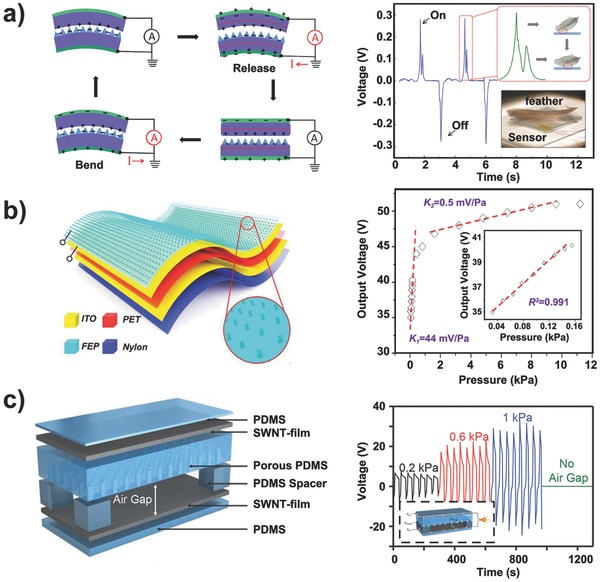
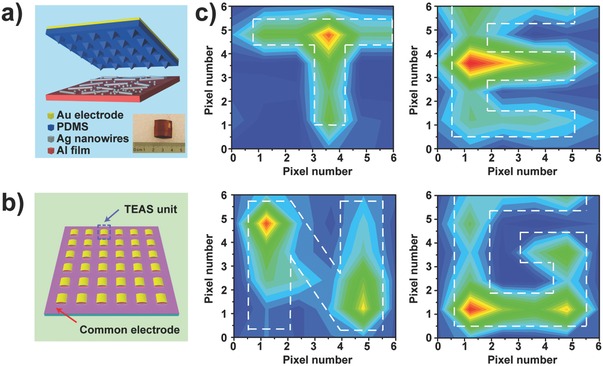

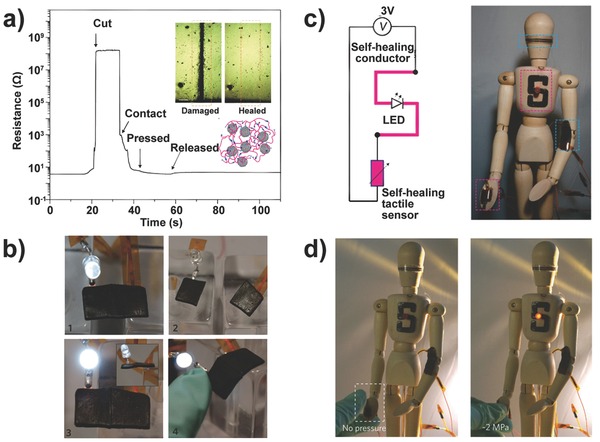


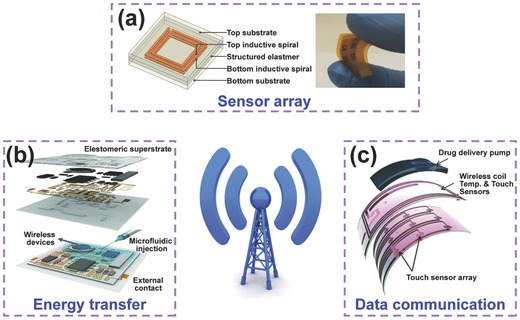
Verification
Claims the paper makes
The claims and statistics of this paper haven’t been checked yet.
Run the check — free, no account needed. It reads the open-access text and checks the sources it cites.
Claims other papers make about this one
Each is checked against this paper’s own text: does it say what the citing paper says it does?
The source backs part of the claim, not all of it — or backs it for a different population, condition or comparison.
In the citing paper
“Flexible and wearable vapor sensors can fit directly on human skin or clothing, and endure human movement without mechanical damage, which greatly broaden their application”
From Functionalized Hydrogel-Based Wearable Gas and Humidity Sensors. (2023) · cites this paper as [39]
Experimental — accuracy not yet measured
Self-check
Percentages, sums and reported differences re-computed from the paper’s own numbers.
The self-check needs the paper’s full text.
Citations
Cites
Piezoelectric Nanogenerators Based on Zinc Oxide Nanowire Arrays
Wang, Z. L., & Song, J. (2006) · Science · doi:10.1126/science.1124005 · Cited by 7,922
Self-citationFlexible triboelectric generator
Fan, F.-R., Tian, Z.-Q., & Lin Wang, Z. (2012) · Nano Energy · doi:10.1016/j.nanoen.2012.01.004 · Cited by 6,705
Self-citationMaterials and Mechanics for Stretchable Electronics
Rogers, J. A., Someya, T., & Huang, Y. (2010) · Science · doi:10.1126/science.1182383 · Cited by 5,042
Kim, D.-H., Lu, N., Ma, R., Kim, Y.-S., Kim, R.-H., Wang, S., Wu, J., Won, S. M., Tao, H., Islam, A., et al. (2011) · Science · doi:10.1126/science.1206157 · Cited by 4,836
Autonomic healing of polymer composites
White, S. R., Sottos, N. R., Geubelle, P. H., Moore, J. S., Kessler, M. R., Sriram, S. R., Brown, E. N., & Viswanathan, S. (2001) · Nature · doi:10.1038/35057232 · Cited by 4,575
Highly sensitive flexible pressure sensors with microstructured rubber dielectric layers
Mannsfeld, S. C. B., Tee, B. C.-K., Stoltenberg, R. M., Chen, C. V. H.-H., Barman, S., Muir, B. V. O., Sokolov, A. N., Reese, C., & Bao, Z. (2010) · Nature Materials · doi:10.1038/nmat2834 · Cited by 3,291
A stretchable carbon nanotube strain sensor for human-motion detection
Yamada, T., Hayamizu, Y., Yamamoto, Y., Yomogida, Y., Izadi-Najafabadi, A., Futaba, D. N., & Hata, K. (2011) · Nature Nanotechnology · doi:10.1038/nnano.2011.36 · Cited by 3,247
Skin-like pressure and strain sensors based on transparent elastic films of carbon nanotubes
Lipomi, D. J., Vosgueritchian, M., Tee, B. C.-K., Hellstrom, S. L., Lee, J. A., Fox, C. H., & Bao, Z. (2011) · Nature Nanotechnology · doi:10.1038/nnano.2011.184 · Cited by 3,188
A Thermally Re-mendable Cross-Linked Polymeric Material
Chen, X., Dam, M. A., Ono, K., Mal, A., Shen, H., Nutt, S. R., Sheran, K., & Wudl, F. (2002) · Science · doi:10.1126/science.1065879 · Cited by 2,645
An ultra-lightweight design for imperceptible plastic electronics
Kaltenbrunner, M., Sekitani, T., Reeder, J., Yokota, T., Kuribara, K., Tokuhara, T., Drack, M., Schwödiauer, R., Graz, I., Bauer-Gogonea, S., et al. (2013) · Nature · doi:10.1038/nature12314 · Cited by 2,485
Research works printed but not linked: 2
- Clippinger F. W., 1974, Bull. Prosthetics Res., 247
- Jiang F. K., 1997, Proc. IEEE Tenth Annu. Int. Workshop on Micro. Electro. Mech. Syst, 465
Cited by
Trung, T. Q., & Lee, N. (2016) · Advanced Materials · doi:10.1002/adma.201504244 · Cited by 2,160
Advanced Carbon for Flexible and Wearable Electronics
Wang, C., Xia, K., Wang, H., Liang, X., Yin, Z., & Zhang, Y. (2019) · Advanced Materials · doi:10.1002/adma.201801072 · Cited by 1,300
PEDOT:PSS for Flexible and Stretchable Electronics: Modifications, Strategies, and Applications
Fan, X., Nie, W., Tsai, H., Wang, N., Huang, H., Cheng, Y., Wen, R., Ma, L., Yan, F., & Xia, Y. (2019) · Advanced Science · doi:10.1002/advs.201900813 · Cited by 1,028
Lei, Z., Wang, Q., Sun, S., Zhu, W., & Wu, P. (2017) · Advanced Materials · doi:10.1002/adma.201700321 · Cited by 1,015
Peng, X., Dong, K., Ye, C., Jiang, Y., Zhai, S., Cheng, R., Liu, D., Gao, X., Wang, J., & Wang, Z. L. (2020) · Science Advances · doi:10.1126/sciadv.aba9624 · Cited by 885
Self-citation
Metadata
- Authors
- Wang, X., Dong, L., Zhang, H., Yu, R., Pan, C., & Wang, Z. L.
- Affiliations
- Chinese Academy of Sciences (CN)
- Georgia Institute of Technology (US)
- Corresponding author
- Pan, Caofeng
- Venue
- Advanced Science
- Publisher
- Wiley
- Published
- 2015-07-14
- Volume
- 2
- Issue
- 10
- Pages
- 1500169-1500169
- ISSN
- 2198-3844 (ISSN-L)
- PMC
- PMC5115318
- OpenAlex
- W1772021317
- Cited by
- 976
- References
- 218
- Citations by year
- 2026: 34 · 2025: 64 · 2024: 83 · 2023: 107 · 2022: 103 · 2021: 124 · 2020: 130 · 2019: 131 · 2018: 97 · 2017: 73 · 2016: 26 · 2015: 4
- FWCI
- 33.12
- Type
- journal article
- Language
- en
- Open access
- gold
- doi.org
- Licence
- Locations
- Advanced Science (publishedVersion, cc-by)
- Europe PMC (PubMed Central) (publishedVersion, cc-by)
- PubMed Central (publishedVersion, cc-by)
- PubMed (publishedVersion)
- Funders
- Chinese Academy of Sciences
- National Natural Science Foundation of China (51272238, 21321062, 51432005, 61405040)
- Topics
- Physical Sciences › Engineering › Biomedical Engineering › Advanced Sensor and Energy Harvesting Materials
- Physical Sciences › Engineering › Electrical and Electronic Engineering › Nanomaterials and Printing Technologies
- Life Sciences › Neuroscience › Cognitive Neuroscience › Tactile and Sensory Interactions
- Keywords
- electronic skin, tactile sensing, pressure sensors, self-healing materials, multimodal sensing, temperature and humidity monitoring, flexible circuits, wireless sensing, human-machine interaction, robotics
About these checks
Registry, retraction, Cites and statistics results are computed, not judged, with one exception: a printed reference that no index lists is read once by a model before it counts as a citation error. Claims are extracted by a model and kept only when their quote appears verbatim in the text; each cited source is then checked, with a model’s help, for whether it says what the claim relies on. Those verdicts can be wrong — read the claim’s quote and the cited source before relying on one.
Statistics and arithmetic are recomputed, not judged.
Confidence bands are shown only for fields calibrated on our annotated test set. None is calibrated yet, so no band is shown.
What counts as a claim ›How we measure confidence ›How we check this ›
Are you an author, or do you see a problem with this page? Request a review
How to cite
Cite CoChat for the checks on this page, and the paper for its own findings.
- This page
- CoChat. (2026). Citation check: Recent Progress in Electronic Skin. https://app.cochat.ai/papers/10.1002/advs.201500169
- The paper
- Wang, X., Dong, L., Zhang, H., Yu, R., Pan, C., & Wang, Z. L. (2015). Recent Progress in Electronic Skin. Advanced Science. https://doi.org/10.1002/advs.201500169
Data sources
Bibliographic data: Semantic Scholar, OpenAlex, Crossref.
Contains information from the Semantic Scholar Academic Graph Datasets, made available under the ODC Attribution License (ODC-BY 1.0).
Semantic Scholar’s data is described in: Kinney, R., et al. (2023). The Semantic Scholar Open Data Platform. arXiv:2301.10140.
